Palavras chave:
Diversidade de plantas Fitossociologia Savana tropical úmida Degradação.
Histórico:
Recebido 30/09/2015 Aceito 08/12/2015
Keywords:
Plant diversity Phytosociology Tropical wet savannah Degradation
1 Universidade Estadual de Montes Claros - Montes Claros, Minas Gerais, Brasil 2 Universidade Federal de Lavras -Lavras, Minas Gerais, Brasil
3 Universidade Federal de Minas Gerais, Montes Claros, Minas Gerais, Brasil Correspondência:
DOI:
10.1590/01047760201622012086
Marly Antonielle Ávila1, Saimo Reblleth Souza1, Maria das Dores Magalhães Veloso1, Rubens Manoel Santos2, Luiz Arnaldo Fernandes3, Yule Roberta Ferreira Nunes1
STRUCTURE OF NATURAL REGENERATION IN RELATION TO SOIL PROPERTIES AND DISTURBANCE IN TWO SWAMP FORESTS
ABSTRACT: Veredas(palm swamps) is a type of vegetation associated with watercourses, characterized by the presence of Mauritia flexuosa palm trees. These systems are not well understood and suffer from high anthropogenic pressure. The aims of this study were to describe the natural regeneration of two swamp forests in vereda systems with different anthropogenic impacts and investigate if the variation in these plant communities are associated to edaphic conditions. The study was performed in preserved and impacted sites located in the Environmental Protection Area of the Pandeiros River in northern Minas Gerais. At each site, one hundred 25 m2 plots were established for surveying regenerating shrubs and trees (≥1 cm diameter at the base of the stem and < 3 cm diameter at breast height). Vegetation structure was evaluated by phytosociological parameters, similarity index, and size distribution of individuals. Regenerating strata was correlated with chemical and physical soil analyses. The vegetation at the preserved site was characterized by a higher number of individuals and a lower diversity but contained
species that were typical of flooded areas. The results also showed differences in soil nutrient availability between sites that influenced the distribution of species at the two
study sites.
ESTRUTURA DA REGENERAÇÃO NATURAL EM RELAÇÃO ÀS PROPRIEDADES DO SOLO E DISTÚRBIO EM DUAS FLORESTAS HIGRÓFILAS
RESUMO: As veredas são um tipo de vegetação associada aos cursos d’água, caracterizada pela presença da palmeira arbórea Mauritia flexuosa. Estes sistemas não são bem compreendidos e sofrem grande pressão antrópica. Os objetivos deste estudo
foram descrever a regeneração natural de duas florestas higrófilas em sistemas de veredas
com diferentes impactos antropogênicos e investigar se a variação nesta comunidade de
plantas está associada as condições edáficas. O estudo foi realizado em sítios preservado
e impactado localizado na área de Proteção Ambiental do rio Pandeiros, norte de Minas
Gerais. Em cada sítio, 100 parcelas de 25 m2 foram estabelecidas para o levantamento dos arbustos e árvores regenerantes (≥1 cm de diâmetro na base do caule e < 3 cm de diâmetro na altura do peito). A estrutura da vegetação foi avaliada pelos parâmetros
DISTURBANCE IN TWO SWAMP FORESTS
INTRODUCTION
Vereda or palm swamps ecosystems in Brazil, which belong to the Cerrado (Brazilian savanna) biome, are not well understood. However, this ecosystem presents great importance because it plays a role in the
hydrologic balance of water bodies (RAMOS et al., 2006).
In addition, veredas have a relevant socioeconomic role as a source of livelihoods for surrounding communities
(BAHIA et al., 2009). Mauritia flexuosa L.f., a palm tree commonly known as buriti, is characteristic of the vereda
ecosystem. It occurs in flooded areas on peat soils and grows
with other existing shrub and tree vegetation
(FERRAZ-VICENTINI; SALGADO-LABOURIAU, 1996). In some
cases, the geomorphological evolution of these ecosystems provide the formation of swamps forests (hygrophilous
forests) near the water course (CARVALHO, 1991).
The species occurring in palm swamps vary with soil characteristics and the degree of water saturation
(BOAVENTURA, 2007). Variation in the substrate,
especially in soil humidity, fertility, and topography,
influences the distribution of tree species (PINTO et al., 2005), and particular species may dominate in areas of environmental extremes (BOTREL et al., 2002). Soil fertility is directly influenced by nutrient concentrations
and by the soil’s resilience to disturbance (VARGAS;
HUNGRIA, 1997) because some types of degradation
modify biotic and abiotic conditions within a vereda
ecosystem (MEIRELES et al., 2004).
Indiscriminate soil use in veredas causes siltation in water bodies and the drying up of water sources
(BOAVENTURA, 2007). Anthropogenic pressures
include not only agricultural and livestock grazing activities, in particular, but also the construction of small dams, embankments, drains and roads; peat and clay extraction; urban development; and excessive
burning (ARAÚJO et al., 2002). These activities cause
suppression of native vegetation and soil compaction, and consequently decrease the system’s capacity for
infiltration and retention of rainfall (MEIRELES et al., 2004),
and compromise the functional equilibrium of veredas.
Knowledge about the floristic and structural
characteristics of regenerating vegetation can contribute to understanding community dynamics and help predict the direction of ecological succession, thereby improving the management practices and restoration. There are few studies on vereda vegetation (ARAÚJO
et al., 2002; GUIMARÃES et al., 2002; MEIRELES et al., 2004; OLIVEIRA et al., 2009), specially about the swamp forests in veredas (BAHIA et al., 2009) and no studies
about natural regeneration
The aim of this study was to characterize the
floristic structure of regenerating tree communities in
two swamp forests with different environmental impacts histories. The following questions drove this study: (i) is there variation in the composition and structure of naturally regenerating plant communities between the two study sites?; and (ii) does edaphic variation between the
sites determine the floristic and structural characteristics
of naturally regenerating vegetation? It is believed that anthropogenic disturbances cause changes in soil, thereby degrading the ecosystem and negatively affecting its capacity for natural regeneration in a given environment.
MATERIALS AND METHODS
Study sites
The study was performed in two swamp forests located in the Pandeiros River Environmental Protection Area (Fig. 1) in northern Minas Gerais, Brazil. The Pandeiros River EPA includes the entire hydrographic
basin of this river (393,060 ha) and is an important left
bank tributary of the São Francisco River (NUNES et
al. 2009). The region is at the transition between the
Cerrado and Caatinga (scrub dry forest) biomes and contains a variety of phytophysiognomies: riparian forest, dry forest, cerrado sensu stricto, and vereda (NUNES et
al., 2009). The climate is tropical wet and dry (Köppen’s Aw), with well-defined dry winters and rainy summers,
and the average annual precipitation and temperature is
920 mm and 26.8o C, respectively (MENINO et al. 2012).
The study areas were located in the mid to upper
reaches of the Pandeiros River. The first site, known as Água Doce (15°13’18.7” S and 44°55’21.2” W), was
located in the municipality of Bonito de Minas. The
second site, Buriti Grosso (15°26’26.6”S and 45°3’55”W),
was located in the municipality of Januária. During the
1970s, government programs supported using drainage
and irrigation techniques in veredas areas (NUNES et
al., 2009), which was the case in Buriti Grosso. At the end of 1980s, these programs were interrupted, leaving abandoned areas (BOAVENTURA, 2007). Currently, the Buriti Grosso site still has artificial drainage channels and
impacted by human activities (impacted site), while the Água Doce site was considered to be relatively well preserved (preserved site).
Sampling of regenerating vegetation
For the sampling of regenerating shrubs
and trees, 100 plots of 5 × 5 m (25 m2) size were established at each site along the water body with 15 m distance between plots. All shrub and tree individuals with ≥1 cm DBS (diameter at the base of the stem) and < 3 cm DBH (diameter at the breast
height, measured at 1.30 m above the soil level) were
recorded. Regenerating M. fl exuosa individuals were counted, and their total height was measured. For the other species, DBS and total height were measured, using a caliper and a wooden ruler, respectively.
For each inventoried plant, a botanical material
sample was collected for species identifi cation. A
specimen of each species was deposited at the Montes Claros Herbarium (MCMG) of the Universidade Estadual
de Montes Claros. Identifi cation of the collected plant
material was performed with the help of specialists and by consulting specialized literature. The Angiosperm Phylogeny Group III (ANGIOSPERM PHYLOGENY
GROUP III - APG III, 2009) classifi cation for families of fl owering plant species was used.
Soil characterization
Soil type classifi cation was performed in situ by a
specialist and soil sample of 0-20 cm depth was collected
in each plot. The soil analyses were performed at the Soil Analysis Laboratory of the Instituto de Ciências Agrárias of Universidade Federal de Minas Gerais (UFMG), according to Empresa Brasileira de Pesquisa Agropecuária - EMBRAPA (2006). The following parameters were determined: soil pH in water; potassium (K; mg.kg-1), phosphorus (P-Mehlich-1; mg.kg-1), calcium (Ca; cmolc. dm-3), magnesium (Mg; cmolc.dm-3), and aluminum (Al; cmolc.dm-3) concentration; potential soil acidity (H+Al; cmolc.dm-3), sum of bases (SB; cmolc.dm-3), base saturation (V; %), organic matter (OM; dag.kg-1), aluminum saturation (m; %), effective cation exchange capacity (t; cmolc.dm-3), and total cation exchange capaciy (T; cmolc.dm-3); and coarse (dag.kg-1) and fi ne sand (dag.kg-1), silt (dag.kg-1) and clay (dag.kg-1) content.
Data analysis
The following phytosociology parameters were calculated: density, dominance and frequency, absolute and relative, importance value (IV)
(MUELLER-DOMBOIS; ELLENBERG, 1974), and Shannon diversity
(H’) and Pielou evenness (J’) indexes (BROWER; ZAR,
1984). Floristic similarity between sites was determined
by comparing an abundance matrix of the existing
DISTURBANCE IN TWO SWAMP FORESTS
species using the Jaccard index (MUELLER-DOMBOIS;
ELLENBERG, 1974). Diameter and height classes were grouped according to Botrel et al. (2002), with
diameter values being grouped by increasing intervals to compensate for decreases in density of the higher diameter classes. The chi-square test for contingency tables (ZAR,
1996) was applied to compare the frequency distribution
of individuals into the size classes between sites.
To compare soil variables, an Analysis of Variance (ANOVA) was performed using the GLM (General Linear
Models) procedure (NELDER; WEDDERBURN, 1972).
Correlations between edaphic and vegetation parameters were detected using a Canonical Correspondence
Analysis (CCA) (MCCUNE; GRACE, 2002). Soil data
were prior logarithm transformed to minimize the effects of the distribution of values. The species matrix contained the abundance values in each plot, and the environmental matrix contained the results of the soil
analysis. Only 193 plots were used in the analysis. Seven
plots were excluded because no regenerating plants were found. Species represented by a single individual were considered rare and were not included in the analysis. A Monte Carlo permutation test was performed
(MCCUNE; GRACE, 2002) to determine the significance of the model, with correlation values from 0.0 to 0.39 being considered weak, values from 0.40 to 0.69 being considered moderate, and values from 0.7 to 1.0 being considered strong (CALLEGARI-JACQUES, 2003).
RESULTS
Structure of the regenerating vegetation
A total of 2264 individuals and 72 species from 37
families (Table 1 and 2) were recorded at the two study sites, with H’ of 2.64 and J’ of 0.62. Fabaceae was the family with the highest number of species (11), followed by Melastomataceae (seven).
At preserved site 1404 individuals belonging to 46 species and 28 families were found. The three most
representative families, in terms of number of individuals,
were Annonaceae (533 individuals), Myrtaceae (514), and Clusiaceae (83). Fabaceae was the family with
the highest number of species (seven), followed by Meliaceae, Myrtaceae, and Rubiaceae (three species each), and Clusiaceae, Melastomataceae, Myrsinaceae, Piperaceae, Styracaceae, and Burseraceae (two species
each). The remaining families accounted for 39.13% of
the total number of species. The most abundant species were Xylopia emarginata (533 individuals), Calyptranthes
brasiliensis (514), Calophyllum brasiliense (83), and Blepharocalyx salicifolius (54), which together comprised 84.33% of the total number of species sampled. Some
of these same species also had high importance values
and together accounted for 75% of the total IV, including X. emarginata (34%) and C. brasiliensis (29%), both
with high density and dominance; and C. brasiliense
(7%) and B. salicifolius (5%), due to their high density and frequency, respectively. Eighteen families were represented by only one species. Individuals of M. flexuosa were found distributed throughout the palm
swamp, totaling 82 individuals between 10 cm and 1.4 m height, with 69.51% belonging to the > 10-50 cm
height class.
At the impacted site 860 regenerating individuals from 29 species and 18 families were recorded. The
three best represented families were Melastomataceae
(527 individuals), Malpighiaceae (86), and Lamiaceae (54). Melastomataceae had the highest number of species (five species), followed by Fabaceae (four), Myrtaceae
(three), and Anacardiaceae and Onagraceae (two each).
The remaining families accounted for 44.83% of the
total number of species. The most abundant species were Trembleya sp. (281 individuals) and Miconia sp.1
(193) (both belonging to the family Melastomataceae), Byrsonima pachyphylla (86), and Aegiphila lhotskyana (54).
These species had the highest IV values and accounted
for 71.4% of the total abundance and 66.33% of the
total IV. Miconia sp.1 and Trembleya sp. had high density and dominance; and B. pachyphylla and A. lhotskyana had high density and frequency, respectively. Thirteen of the families sampled at impacted site were represented by a single species, and seven species were represented by a single individual. No M. flexuosa regenerating individuals were recorded at this site.
Floristic and structural variation between sites
The two study sites had distinctly flora (Table 1
and 2). Only three species (Miconia sp.1, Vernonanthura
phosphorica and Tapirira guianensis) were common to both sites, which resulted in a low similarity index for
the two sites (0.04). The diversity and evenness indexes
were lower for preserved site (H’=1.83 and J’=0.48) than for impacted site (H’=2.23 and J’=0.66). Similarly,
preserved site had a higher density (5616 ind.ha-1) and
basal area (66.89cm2.ha-1) than impacted site (3440 ind. ha-1 and 38.01cm2.ha-1, respectively).
The greatest individual’s height (7.5 m) and largest diameter (0.64 cm) were found at preserved site.
TABLE 1 Regenerating species observed at the preserved site (Água Doce vereda, Environmental Protection Area of the Pandeiros River, northern Minas Gerais) in alphabetical order by family and species with their respective structure parameters. NI=number of sampled individuals; BA=basal area (cm2.ha-1); AD=absolute density (ind.ha-1); RD=relative density (%); ADo =absolute dominance (m2.ha-1); RDo=relative dominance (%); AF= absolute frequency (%); RF=relative frequency (%); IV=importance value (%); and V=voucher number (Montes Claros Herbarium).
Family Species NI BA AD RD ADo RDo AF RF IV V
ANACARDIACEAE Tapirira guianensis Aubl. 21 1.75 84 1.5 6.99 2.61 18 5.01 9.12 487 ANNONACEAE Xylopia emarginata Mart. 533 28.39 2132 37.96 113.56 42.44 79 22.01 102.41 488 ARALIACEAE Dendropanax cuneatus (DC.) Decne. e Planch. 3 0.17 12 0.21 0.69 0.26 3 0.84 1.31 489 ASTERACEAE Vernonanthura phosphorica (Vell.) H.Rob. 1 0.01 4 0.07 0.03 0.01 1 0.28 0.36 486 BIGNONIACEAE Handroanthus chrysotrichus (Mart. ex A.DC.) Mattos 1 0.07 4 0.07 0.28 0.11 1 0.28 0.46 490
BURSERACEAE Protium spruceanum (Benth.) Engl. 3 0.15 12 0.21 0.61 0.23 3 0.84 1.28 449
Protium brasiliense (Spreng.) Engl. 2 0.22 8 0.14 0.89 0.33 1 0.28 0.75 482 CHRYSOBALANACEAE Hieronyma alchorneoides Allemão 1 0.1 4 0.07 0.41 0.15 1 0.28 0.5 474
CLUSIACEAE Calophyllum brasiliense Cambess. 83 5.18 332 5.91 20.73 7.75 25 6.96 20.62 460
Garcinia brasiliensis Mart. 6 0.58 24 0.43 2.31 0.86 5 1.39 2.68 483
EBENACEAE Diospyros sericea A.DC. 1 0.02 4 0.07 0.06 0.02 1 0.28 0.37 478
ELAEOCARPACEAE Sloanea stipitata Spruce ex Benth. 3 0.09 12 0.21 0.38 0.14 1 0.28 0.63 448 ERYTHROXYLACEAE Erythroxylum citrifolium A.St.-Hil. 3 0.06 12 0.21 0.23 0.08 3 0.84 1.13 451
EUPHORBIACEAE Croton urucurana Baill. 1 0.02 4 0.07 0.07 0.03 1 0.28 0.38 492
FABACEAE
Bauhinia acuruana Moric. 6 0.21 24 0.43 0.85 0.32 4 1.11 1.86 475
Bauhinia cheilantha (Bong.) Steud. 14 0.52 56 1 2.09 0.78 7 1.95 3.73 470
Bauhinia rufa (Bong.) Steud. 2 0.08 8 0.14 0.3 0.11 2 0.56 0.81 469
Inga laurina (Sw.) Willd. 6 0.24 24 0.43 0.95 0.35 5 1.39 2.17 493
Inga vera Willd. 2 0.06 8 0.14 0.23 0.09 2 0.56 0.79 464
Machaerium hirtum (Vell.) Stellfeld 5 0.28 20 0.36 1.1 0.41 3 0.84 1.6 463
Zollernia cowanii Mansano 10 0.57 40 0.71 2.29 0.86 9 2.51 4.08 485
LAURACEAE Nectandra membranacea (Sw.) Griseb. 3 0.19 12 0.21 0.75 0.28 3 0.84 1.33 459
MELASTOMATACEAE Miconia sp.1 14 0.42 56 1 1.67 0.62 12 3.34 4.96 480
Miconia sp.2 12 0.47 48 0.85 1.87 0.7 8 2.23 3.78 481
MELIACEAE
Guarea guidonia (L.) Sleumer 3 0.08 12 0.21 0.32 0.12 3 0.84 1.17 468
Guarea kunthiana A. Juss. 1 0.17 4 0.07 0.69 0.26 1 0.28 0.61 455
Guarea macrophylla Vahl 1 0.02 4 0.07 0.07 0.03 1 0.28 0.38 479
MORACEAE Ficus obtusiuscula (Miq.) Miq. 2 0.4 8 0.14 1.61 0.6 2 0.56 1.3 473
MYRTACEAE
Calyptranthes brasiliensis Spreng. 514 21.14 2056 36.61 84.58 31.61 67 18.66 86.88 477
Blepharocalyx salicifolius (Kunth) O. Berg 54 1.55 216 3.85 6.2 2.32 32 8.91 15.08 461
Myrcia splendens (Sw.) DC. 2 0.07 8 0.14 0.27 0.1 2 0.56 0.8 467
OLEACEAE Chionanthus crassifolius (Mart.) P.S. Green 10 0.17 40 0.71 0.69 0.26 5 1.39 2.36 462 PHYLLANTHACEAE Hirtella gracilipes (Hook. f.) Prance 11 0.64 44 0.78 2.57 0.96 9 2.51 4.25 465
PIPERACEAE Piper gaudichaudianum Kunth 2 0.06 8 0.14 0.24 0.09 2 0.56 0.79 471
Piper arboreum Aubl. 3 0.03 12 0.21 0.11 0.04 1 0.28 0.54 476
POLYGONACEAE Coccoloba declinata (Vell.) Mart. 26 1.13 104 1.85 4.54 1.7 15 4.18 7.73 466
PRIMULACEAE Myrsine umbellata Mart. 5 0.16 20 0.36 0.65 0.24 4 1.11 1.71 452
Cybianthus cuneifolius Mart. 2 0.05 8 0.14 0.22 0.08 1 0.28 0.5 484
PROTEACEAE Euplassa inaequalis (Pohl) Engl. 2 0.16 8 0.14 0.63 0.24 2 0.56 0.93 491
RUBIACEAE
Ladenbergia cujabensis Klotzsch 3 0.16 12 0.21 0.64 0.24 3 0.84 1.29 458
Posoqueria latifolia (Rudge) Roem. e Schult. 2 0.19 8 0.14 0.77 0.29 2 0.56 0.99 447
Posoqueria sp. 1 0.09 4 0.07 0.34 0.13 1 0.28 0.48 457
SAPOTACEAE Pouteria torta (Mart.) Radlk. 20 0.58 80 1.42 2.32 0.87 4 1.11 3.41 453 SIPARUNACEAE Siparuna reginae (Tul.) A.DC. 1 0.06 4 0.07 0.25 0.09 1 0.28 0.44 454
STYRACACEAE Styrax camporum Pohl 2 0.12 8 0.14 0.46 0.17 2 0.56 0.87 456
Styrax latifolius Pohl 1 0.01 4 0.07 0.05 0.02 1 0.28 0.37 472
the largest diameter was 0.78 m. Average height and diameter were greater at preserved site (2.17 m and 0.22 cm, respectively) than at impacted site (1.51 m and 0.21
cm, respectively). Differences in the size of regenerating individual’s distribution were not independent between the sites (Table 3). For the diameter classes, the frequency
of individuals ≥ 1.0 to 1.5 cm and > 4.5 cm was lower
than expected for the preserved site, and was higher than expected for the impacted site. The opposite was
observed for the class >1.5-2.5 cm, while in preserved
site the frequency of individuals was higher and in the impacted site was lower than expected. The frequency
of individuals >2.5-4.5 cm interval did not differ between
the sites. However, the preserved site community
showed higher abundances of individuals across all diameter classes (Figure 2A).
Among height classes, significant differences in the
observed and expected distribution frequencies of individuals between sites were found (Table 3). The frequency of
individuals ≥ 0.2-1.0 m was lower than expected for the
preserved site and higher than expected for the impacted
site. The reverse was observed for the classes > 2.0-3.0 m, >3.0-4.0 m, >4.0-5.0 m, and >5.0 m, that showed higher
frequency of individuals in the preserved site and lower frequency of individuals in the impacted site than expected.
The height class >1.0 to 2.0 m had the largest number of
DISTURBANCE IN TWO SWAMP FORESTS
TABLE 2 Regenerating species observed at the impacted site (Buriti Grosso vereda, Environmental Protection Area of the Pandeiros River, northern Minas Gerais), in alphabetical order by family and species with their respective structure parameters. NI=number of sampled individuals; BA=basal area (cm2.ha-1); AD=absolute density (ind.ha-1); RD=relative density (%); ADo=absolute dominance (m2.ha-1); RDo=relative dominance (%); AF=absolute frequency (%); RF=relative frequency (%); IV=importance value (%); and V=voucher number (Montes Claros Herbarium).
Family Species NI BA AD RD DAo RDo AF RF IV V
ANACARDIACEAE Astronium fraxinifolium Schott ex Spreng. 1 0.01 4 0.12 0.03 0.02 1 0.28 0.42 1142
Tapirira guianensis Aubl. 8 0.22 32 0.93 0.86 0.57 6 1.69 3.18 1163
ANNONACEAE Xylopia aromatica (Lam.) Mart. 1 0.03 4 0.12 0.14 0.09 1 0.28 0.49 1169 ASTERACEAE Vernonanthura phosphorica (Vell.) H. Rob. 10 0.14 40 1.16 0.56 0.37 8 2.25 3.78 1167 CLUSIACEAE Kielmeyera rubriflora Cambess. 1 0.13 4 0.12 0.5 0.33 1 0.28 0.73 1150 ERYTHROXYLACEAE Erythroxylum suberosum A.St.-Hil. 1 0.1 4 0.12 0.41 0.27 1 0.28 0.67 1149
FABACEAE
Copaifera coriacea Mart. 24 0.94 96 2.79 3.77 2.48 17 4.78 10.05 1146
Dimorphandra gardneriana Tul. 1 0.03 4 0.12 0.13 0.08 1 0.28 0.48 1148
Plathymenia reticulata Benth. 1 0.03 4 0.12 0.13 0.08 1 0.28 0.48 1158
Senna macranthera (Collad.) H.S. Irwin e Barneby 14 0.7 56 1.63 2.79 1.84 8 2.25 5.71 1161 LAMIACEAE Aegiphila lhotskyana Cham. 54 3.69 216 6.28 14.78 9.72 33 9.27 25.27 1141 MALPIGHIACEAE Byrsonima pachyphylla A. Juss. 86 3.76 344 10 15.04 9.89 32 8.99 28.88 1143
MELASTOMATACEAE
Miconia albicans (Sw.) Triana 37 1.65 148 4.3 6.6 4.34 20 5.62 14.26 1153
Miconia sp.1 193 10.94 772 22.44 43.75 28.78 70 19.66 70.89 1154
Tibouchina sellowiana (Cham.) Cogn. 5 0.17 20 0.58 0.66 0.44 5 1.4 2.42 1164
Tibouchina sp. 11 0.41 44 1.28 1.62 1.07 8 2.25 4.59 1165
Trembleya sp. 281 6.91 1124 32.67 27.64 18.18 66 18.54 69.4 1166
MYRTACEAE
Myrcia guianensis (Aubl.) DC. 5 0.2 20 0.58 0.82 0.54 4 1.12 2.24 1155
Psidium firmum O. Berg 10 0.85 40 1.16 3.39 2.23 6 1.69 5.08 1159
Psidium guajava L. 5 0.15 20 0.58 0.61 0.4 4 1.12 2.11 1160
OCHNACEAE Ouratea hexasperma (A.St.-Hil.) Baill. 12 0.87 48 1.4 3.47 2.28 9 2.53 6.21 1156
ONAGRACEAE Ludwigia elegans (Cambess. ex A. St.-Hil.) H. Hara 8 0.42 32 0.93 1.69 1.11 7 1.97 4.01 1151
Ludwigia speciosa (Brenan) Hoch 32 0.82 128 3.72 3.28 2.16 16 4.49 10.38 1152
PIPERACEAE Piper aduncum L. 2 0.06 8 0.23 0.23 0.15 2 0.56 0.95 1157
SALICACEAE Casearia sylvestris Sw. 19 1.35 76 2.21 5.39 3.54 9 2.53 8.28 1144 SAPINDACEAE Diatenopteryxs orbifolia Radlk. 1 0.02 4 0.12 0.07 0.05 1 0.28 0.44 1147 SOLANACEAE Solanum lycocarpum A. St.-Hil. 2 0.09 8 0.23 0.37 0.24 2 0.56 1.04 1162 URTICACEAE Cecropia pachystachya Trécul 33 3.18 132 3.84 12.74 8.38 16 4.49 16.71 1145
VOCHYSIACEAE Vochysia tucanorum Mart. 2 0.15 8 0.23 0.59 0.39 1 0.28 0.9 1168
TABLE 3 Contingency tables of frequency distribution of observed and expected (in parenthesis) individuals of regenerating species sampled in two swamp forests (preserved and impacted) in Pandeiros River EPA (Minas Gerais, Brazil) among diameter and height classes. The results of the chi-square (c2) test and the probability (P) are provided for each table and for rows and columns separately.
Classes Sites
Diameter (cm) Preserved Impacted c2 P ≥1.0-1.5 398 (475.6) 369 (291.4) 33.37 <0.001 >1.5-2.5 593 (539.5) 277 (330.5) 13.95 <0.001 >2.5-4.5 369 (336.7) 174 (206.3) 8.14 <0.05 >4.5 44 (52.1) 40 (31.9) 3.31 >0.05
2 22.33 36.45
P <0.001 <0.001 <0.001
Height (m) Preserved Impacted c2 P
≥0.2-1.0 253 (339.8) 295 (208.2) 58.42 <0.001 >1.0-2.0 609 (653.6) 445 (400.4) 8.02 >0.05 >2.0-3.0 321 (258.6) 96 (158.4) 39.64 <0.001 >3.0-4.0 132 (93.6) 19 (57.4) 41.37 <0.001 >4.0-5.0 59 (38.4) 3 (23.6) 28.92 <0.001 >5.0 30 (19.8) 2 (12.2) 13.68 <0.05
c2 72.19 117.85
P <0.001 <0.001 <0.001
c
Correlations between environmental conditions and vegetation
The results of the soil analysis indicated
significant variation in all parameters measured especially for soil pH (Table 4). Soil pH was lower and aluminum
concentrations were higher at impacted site compared to the preserved site soils, which had an average pH of
6.7 and almost no detectable Al. In addition, K, P, Ca,
and Mg concentrations and organic matter were higher at preserved than at impacted site. The soil at both sites
was dystrophic Mesic Histosol with flat relief and a sandy
texture. A Haplic Gleisol was also present at preserved
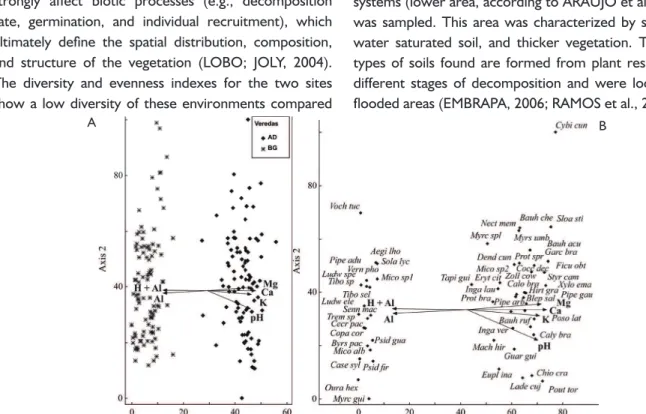
site. The CCA resulted in eigenvalue of 0.922 (Axis 1) and 0.124 (Axis 2). The first axis was a long gradient and
the second was a short gradient. The axes explained
9.0% (Axis 1) and 1.2% (Axis 2) of the total variance in the edaphic variables (10.29%) for the 56 species from the 193 sampling plots. The species-environment correlations were strong for Axis 1 (0.977) and moderate (0.526) for Axis 2. The Monte Carlo permutation test indicated that there was a significant correlation between
species composition and the edaphic variables for Axis 1 (p = 0.001). The edaphic variables most strongly
correlated with the first axis were, in decreasing order,
Ca, pH, Al, Mg, H + Al, and K (Table 5).
The ordination of the plots along the first axis
shows a clear separation of edaphic characteristics between the two sites, with soils with a lower pH (Al and H + Al) at impacted site and a higher pH (Mg, Ca, pH,
the soil chemical characteristics determined for the two sites (Table 5). The ordination of the species along the
fi rst axis (Figure 3B) indicated that fl oristic composition
also differed between the sites. At the impacted site,
Ouratea hexasperma and Psidium guajava were strongly correlated with H+Al, and Solanum lycocarpum was strongly correlated with Al. At the preserved site,
Pouteria torta and Ladenbergia cujabensis were strongly correlated with K, and Cybianthus cuneifolius was more correlated with Mg.
DISCUSSION
Veredas are surrounded by cerrado vegetation
(BOAVENTURA, 2007) and a large number of species
from the Fabaceae family, typically found in cerrado
(MANTOVANI; MARTINS, 1993), occur this ecosystem (ARAÚJO et al., 2002). Menino et al. (2012) studied a
regenerating stratum of the Pandeiros River riparian forest, located in the same region of this study, and found the family Fabaceae to be the most species rich. Species belonging to the family Melastomataceae are also commonly found in forest and cerrado areas, and these species are considered to be one of the largest groups of
species in Brazil (SOUZA; LORENZI, 2005). However,
the number of families represented by a single species
was high, both at preserved (18) and at impacted (13) sites. According to Araújo et al. (2002), a large number
of families with a single species are restricted to wetter
FIGURE 2 Distribution of diameter (A) and height (B) classes of regenerating individuals at the two study sites (preserved and impacted site) in the Pandeiros River EPA (Minas Gerais, Brazil)
TABLE 4 Analysis of Variance with General Linear Models procedure of edaphic variables at the two swamps forests (preserved and impacted sites), in the Pandeiros River EPA (Minas Gerais, Brazil). All
variables were signifi cant at p < 0.01.
Edaphic variable Preserved Impacted F
pH 6.77 ± 0.04 4.93 ± 0.04 295.40
P 15.92 ± 1.16 10.74 ± 1.16 114.20
K+ 143.44 ± 7.66 19.14 ± 7.70 56.02
Ca++ 14.2 ± 0.29 0.57 ± 0.29 286.13
Mg++ 1.82 ± 0.07 0.28 ± 0.07 147.92
Al 0.01 ± 0.11 1.92 ± 0.11 54.28
Potential soil acidity (H + Al) 1.38 ± 0.33 11.50 ± 0.34 133.46
Sum of bases (SB) 16.28 ± 0.34 0.90 ± 0.35 269.76
Effective cation exchange capacity (t) 16.29 ± 0.35 2.82 ± 0.35 210.84
Aluminum saturation (m) 0.03 ± 1.51 62.08 ± 1.52 326.84
Cation retention capacity (T) 17.67 ± 0.43 12.40 ± 0.43 37.79
Base saturation (V) 91.49 ± 1.40 9.59 ± 1.41 534.14
Organic matter 14.86 ± 0.32 11.32 ± 0.32 34.87
Coarse sand 3.80 ± 1.14 1.63 ± 1.14 56.72
Fine sand 81.68 ± 1.24 79.70 ± 1.25 64.80
Silt 8.54 ± 0.45 10.66 ± 0.45 10.10
Clay 5.98 ± 0.33 6.87 ± 0.33 86.41 environments, which may be due to their potentially higher sensitivity to anthropogenic disturbance.
The differences observed in fl oristic composition between the study sites may have refl ected differences in the level of environmental degradation. Of the 46 species
observed at the preserved site, the two best-represented species, Xylopia emarginata and Calyptranthes brasiliensis,
are associated with fl ooded environments or water
saturated soils. These species occur in large numbers in a given location but have restricted distributions and
prefer hydromorphic soils (DURIGAN et al., 2004).
The most abundant species at the impacted site were typical of the surrounding vegetation. These species may have spread into the interior of the swamp forest following site disturbance, like vegetation opening and decreased drainage and organic matter. The presence of Byrsonima pachyphylla, with the second highest IV, and Aegiphila lhotskyana, with the third
highest IV, refl ected these environmental changes. These species typically occur in fi elds and cerrado sensu stricto (SILVA-JUNIOR, 2005; SOUZA; LORENZI, 2005).
DISTURBANCE IN TWO SWAMP FORESTS
and A. lhotskyana) are commonly found in the cerrado
phytophysiognomy (MENDONÇA et al., 2008) and not
in hydromorphic environments. Furthermore, Trembleya sp. and Miconia sp.1 belong to a family that is important in poorly preserved environments suffering from human impacts, suggesting that these species are common in
open conditions (GUIMARÃES et al., 2002).
The predominance of a small number of species in the regenerating communities at the study sites
refl ects the selective nature of water saturation in these environments. Specifi c abiotic characteristics resulting
from the duration and frequency of soil water saturation strongly affect biotic processes (e.g., decomposition rate, germination, and individual recruitment), which
ultimately defi ne the spatial distribution, composition, and structure of the vegetation (LOBO; JOLY, 2004).
The diversity and evenness indexes for the two sites show a low diversity of these environments compared
to the results of other studies on natural regeneration
(SANTIAGO et al., 2005; MENINO et al., 2012).
Although it was more disturbed, the impacted site had a higher diversity index than the preserved site. However, the species observed at impacted site are not typical of wet forests environments.
The size distribution of individuals showed the
typical “inverted-J”, except for the fi rst class, both in
diameter, for the preserved site, and height, for the preserved and impacted site. This pattern indicates the existence of a stock of young plants that will replace the
senile ones (LOPES et al., 2002). Besides, the minimum
inclusion criteria may have excluded many individuals
within the fi rst class (LOPES et al., 2002). The greater
plant sizes observed at the preserved site may have been due to the lower degree of human impacts at this site.
The origin and deposition processes of sediments, the stability of the water table, and anthropogenic
impacts are factors that can infl uence the physical and
chemical attributes of veredas soils (RAMOS et al.,
2006). The type of soils found at the studied sites may be related to relief, as observed by Ramos et al. (2006),
who reported a gradual change from a Mesic Histosol to a Haplic Gleisol. In this study, the sites were located in
fl atter zones, , because only the lowest area of vereda’s systems (lower area, according to ARAÚJO et al., 2002)
was sampled. This area was characterized by swampy, water saturated soil, and thicker vegetation. The two types of soils found are formed from plant residues in different stages of decomposition and were located in
fl ooded areas (EMBRAPA, 2006; RAMOS et al., 2006). TABLE 5 Correlations of two fi rst CCA ordination axes (intraset
correlations) and matrix of weighted correlations for the edaphic variables from 193 plots. Correlations
in * had signifi cance values > 0.5 according to the
Monte Carlo test.
Edaphic
variable
Intraset correlations Edaphic variable
Axis1 Axis2 Ca pH Al Mg H+Al
Ca 0.909* -0.027
-pH 0.879* -0.119 0.821*
-Al -0.839* -0.099 -0.731* -0.823*
-Mg 0.835* 0.080 0.844* 0.737* -0.692*
-H+Al -0.805* -0.139 -0.702* -0.766* 0.842* -0.657*
-K 0.691* -0.136 0.826* 0.668* -0.576* 0.651* -0.567*
FIGURE 3 CCA ordination diagram of sampling plots (A) and species (B) based on a distribution of 156 individuals from 193 plots at the preserved (AD) and impacted (BG) sites (Pandeiros River EPA, Minas Gerais, Brazil).
The more acidic soil found at the impacted site may be related to the observed establishment of species from surrounding areas (cerrado), which are better adapted to soils with a low pH. Ouratea hexasperma, which was an important component of the impacted site, is frequent in areas with low water availability that
had been burned (FONSECA; SILVA-JÚNIOR, 2004). Psidium guajava, a species that typically occupies slight to strongly acidic soils, can be frequently found in open
areas such as cerrado or in disturbed areas (ORWA et al., 2009). Solanum lycocarpum, a woody species typical of the cerrado, occurs frequently in open areas and
is considered opportunistic (LORENZI, 1998). The
presence of these three species, which were correlated with low soil pH at the impacted site, suggest that the area is being overtaken by the surrounding vegetation (typical cerrado vegetation), leading to a loss of the typical characteristics of the veredas hydromorphic formation.
The study sites showed differences in vegetation composition that resulted from differences in soil characteristics, such as soil pH and macronutrient concentrations, as well as the impacts of anthropogenic activities on the sites. The availability of Mg, Ca, and K, which are required in large amounts by plants, are
higher at a pH of 6-6.5 (LARCHER, 2000). This may be
one of the factors determining the vegetation structure at the preserved site. The soil pH at the preserved site was very close to this value, and Mg, Ca, and K concentrations were higher than those of the impacted site. Organic matter content contributes to the solid soil phase in swamp areas by increasing soil aeration
(RAMOS et al., 2006). Soil water saturation can limit the
establishment of some species and favor species that are better adapted to wetter conditions (MUNHOZ et al.,
2008). This pattern was observed in the preserved site,
where poorly drained soils were associated with higher species richness compared to the more well-drained soils at the impacted site.
CONCLUSION
The regenerating flora in the preserved site
consists of typical species of wetland environments and in the impacted site was related to the surrounding vegetation (cerrado). This result is probably associated to anthropogenic impacts to the impacted site, which led to colonization by species from surrounding areas. The soils at the two study sites showed differences in pH and nutrient availability, possibly due to the different degrees of anthropogenic impact.
ACKNOWLEDGMENTS
The authors thank the Laboratório de Ecologia Vegetal and IEF for logistical support; CAPES, CNPq, FAPEMIG and Promotoria de Defesa do Rio São
Francisco (NIEA/NM) for financial support.
REFERENCES
ANGIOSPERM PHYLOGENY GROUP III. An update of the
Angiosperm Phylogeny Group classification for orders and families of flowering plants: APG III. Botanical Journal of Linnean Society, London, v. 161, p. 105-121, 2009.
ARAÚJO, G. M.; ARANTES, A. A.; BARBOSA, A. A. A.;
AMARAL, A. F. Composição florística de veredas no município de Uberlândia, MG. Revista Brasileira de Botânica, São Paulo, v. 25, p. 475-493, 2002.
BAHIA, T. O.; LUZ, G. R.; BRAGA, L. L.; MENINO, G. C.
O.; NUNES, Y. R. F.; VELOSO, M. D. M.; NEVES, W. V.; SANTOS, R. M. Florística e fitossociologia de veredas
em diferentes estágios de conservação na APA do Rio
Pandeiros, norte de Minas Gerais. MG. Biota, Belo
Horizonte, v. 2, p. 14-21, 2009.
BOAVENTURA, R. S. Veredas: berço das águas. Belo
Horizonte: Ecodinâmica, 2007.
BOTREL, R. T.; OLIVEIRA-FILHO, A. T.; RODRIGUES, A. L.;
CURI, N. Influência do solo e topografia sobre as variações da comunidade florística e estrutura da comunidade
arbóreo-arbustiva de uma Floresta Estacional Semidecidual
em Ingaí, MG. Revista Brasileira Botânica, São Paulo, v.
25, p. 195-213, 2002.
BROWER, J. E.; ZAR, J. H. Field and laboratory methods for general ecology. Dubuque: W. C. Brown, 1984.
CALLEGARI-JACQUES, S. M. Bioestatística: princípios e
aplicações. Porto Alegre: Artmed, 2003.
CARVALHO, P. G. S. As veredas e sua importância no domínio
dos cerrados. Informe Agropecuário, Belo Horizonte, v.
168, p. 47-54, 1991.
DURIGAN, G.; RODRIGUES, R. R.; SCHIAVINI, I. A heterogeneidade ambiental definindo a metodologia de amostragem da floresta ciliar. In: RODRIGUES,
R. R.; LEITÃO-FILHO, H. F. (Ed.). Matas ciliares:
conservação e restauração. São Paulo: EDUSP, 2004. p. 159-167.
EMPRESA BRASILEIRA DE PESQUISA AGROPECUÁRIA.
Sistema brasileiro de classificação de solos. Rio de
Janeiro, 2006.
FERRAZ-VICENTINI, K. R.; SALGADO-LABOURIAU, M. L. Palynological analysis of a palm swamp in central Brazil.
Journal of South American Earth Sciences, Oxford, v.
DISTURBANCE IN TWO SWAMP FORESTS
FONSECA, M. S.; SILVA-JÚNIOR, M. C. Fitossociologia e
similaridade florística entre trechos de Cerrado sentido restrito em interflúvio e em vale no Jardim Botânico de Brasília,
DF. Acta Botanica Brasilica, São Paulo, v. 18, p. 19-29, 2004.
GUIMARÃES, A. J. M.; ARAÚJO, G. M.; CORRÊA, G. F. Estrutura fitossociológica em área natural e antropizada de
uma vereda em Uberlândia, MG. Acta Botanica Brasilica,
São Paulo, v. 16, p. 317-329, 2002.
LARCHER, W. Ecofisiologia vegetal. São Carlos: Rima, 2000.
LOBO, P. C.; JOLY, C. A. Aspectos ecofisiológicos da vegetação
de mata ciliar do sudeste do Brasil. In: RODRIGUES, R. R.;
LEITÃO-FILHO, H. F. (Ed.). Matas ciliares: conservação e
restauração. São Paulo: EDUSP, 2004. p. 143-157.
LOPES, W. P.; SILVA, A. F.; SOUZA, A. L.; MEIRA-NETO, J. A. Estrutura fitossociológica de um trecho de vegetação arbórea
no Parque Estadual do Rio Doce, Minas Gerais, Brasil. Acta Botanica Brasilica, São Paulo, v. 16, p. 443-456, 2002.
LORENZI, H. Árvores brasileiras: manual de identificação e
cultivo de plantas arbóreas nativas do Brasil. Nova Odessa:
Plantarum, 1998.
MANTOVANI, W.; MARTINS, F. R. Florística do cerrado
na reserva biológica de Moji Guaçu, SP.Acta Botanica Brasilica, São Paulo, v. 7, p. 33-60, 1993.
MCCUNE, B.; GRACE, J. B. Analysis of ecological
communities. Oregon: Gleneden Beach, 2002.
MEIRELES, M. L.; GUIMARÃES, A. J. M.; OLIVEIRA, R. C.;
ARAUJO, G. M.; RIBEIRO, J. F. Impactos sobre o estrato
herbáceo de áreas úmidas do Cerrado. In: AGUIAR, L.
M. S.; CAMARGO, A. J. A. (Ed.). Cerrado: ecologia e caracterização. Planaltina: EMBRAPA Cerrados; EMBRAPA
Informação Tecnológica, 2004. p. 41-68.
MENDONÇA, R. C.; FELFILI, J. M.; WALTER, B. M. T.;
SILVA-JÚNIOR, M. C.; REZENDE, A. V.; FILGUEIRAS, T. S.;
NOGUEIRA, P. E.; FAGG, C. W. Flora vascular do bioma
Cerrado. In: SANO, S. M.; ALMEIDA, S. P.; RIBEIRO, J. F. (Ed.). Cerrado: ecologia e flora. Brasília: EMBRAPA
Informação Tecnológica, 2008. p. 421-1279.
MENINO, G. C. O.; NUNES, Y. R. F.; SANTOS, R. M.;
FERNANDES, G. W.; FERNANDES, L. A. Environmental
heterogeneity and natural regeneration in riparian vegetation of the Brazilian Semi-Arid region. Edinburgh Journal of Botany, Edinburg, v. 69, p. 29-51, 2012.
MUELLER-DOMBOIS, D.; ELLENBERG, H. Aims and
methods of vegetation ecology. New York: J. Wiley, 1974.
MUNHOZ, C. B. R.; FELFILI, J. B.; RODRIGUES, C. Species-environment relationship in the herb-subshrub layer of a moist Savanna site, Federal District, Brazil. Brazilian Journal of Biology, São Carlos, v. 68, p. 25-35, 2008.
NELDER, J. A.; WEDDERBURN, W. M. Generalized linear
models. Journal of the Royal Statistical Society: Series A, London, v. 135, p. 370-384, 1972.
NUNES, Y. R. F.; AZEVEDO, I. F. P.; NEVES, W. V.; VELOSO, M. D. M.; SOUZA, R. A.; FERNANDES, G. W. Pandeiros:
o pantanal mineiro. MG. Biota, Belo Horizonte, v. 2, p.
4-17, 2009.
OLIVEIRA, G. C.; ARAÚJO, G. M.; BARBOSA, A. A. A.
Florística e zonação de espécies vegetais em veredas no
triângulo mineiro, Brasil. Rodriguésia, Rio de Janeiro, v.
60, p. 1077-1085, 2009.
ORWA, C.; MUTUA, A.; KINDT, R.; JAMNADASS, R.;
SIMON, A. Agroforestree database: a tree reference
and selection guide. v. 4. Available from: <http://www. worldagroforestry.org/af/treedb>. Accessed on: 19 Sept. 2009.
PINTO, J. R. R.; OLIVEIRA-FILHO, A. T.; HAY, J. D. V.
Influence of soil and topography on the composition
of a tree community in a central Brazilian valley forest.
Edinburgh Journal of Botany, Edinburgh, v. 62, p.
69-90, 2005.
RAMOS, M. V. V.; CURI, N.; MOTTA, P. E. F.; VITORINO, A. C. T.; FERREIRA, M. M.; SILVA, M. L. N. Veredas do triângulo: mineiro: solos, água e uso. Ciência e Agrotecnologia,
Lavras, v. 30, p. 283-293, 2006.
SANTIAGO, J.; SILVA-JUNIOR, M. C.; LIMA, L. C. Fitossociologia da regeneração arbórea na mata de galeria do Pitoco (IBGE-DF), seis anos após fogo acidental.
Scientia Forestalis, Piracicaba, v. 67, p. 64-77, 2005.
SILVA-JUNIOR, M. C. 100 árvores do cerrado: guia de
campo. Brasília: Rede de Sementes do Cerrado, 2005.
SOUZA, V. C.; LORENZI, H. Botânica sistemática: guia
ilustrado para identificação das famílias de Angiospermas da flora brasileira, baseado em APG II. Nova Odessa: Instituto Plantarum, 2005.
VARGAS, M. A. T.; HUNGRIA, M. Biologia dos solos dos
cerrados. Planaltina: EMBRAPA, 1997.
ZAR, J. H. Biostatistical analysis. New Jersey: