Rev Odontol UNESP. 2016 July-Aug; 45(4): 214-218 © 2016 - ISSN 1807-2577
ORIGINAL ARTICLE
Doi: http://dx.doi.org/10.1590/1807-2577.11015
Antimicrobial potential of
Casearia sylvestris
against oral bacteria
Potencial antimicrobiano da Casearia sylvestris frente a bactérias orais
Amanda Henriques CAVALHEIRO
a*, Ana Paula Terossi GODOI
b, Tatiane Cruz de CARVALHO
a,
Alma Blasida CATIRSE
b, Niege Araçari Jacometti Cardoso FURTADO
aaFaculdade de Ciências Farmacêuticas de Ribeirão Preto, USP – Universidade de São Paulo, Ribeirão Preto, SP, Brazil
bFaculdade de Odontologia de Ribeirão Preto, USP – Universidade de São Paulo, Ribeirão Preto, SP, Brazil
Resumo
Objetivo: O objetivo deste estudo foi obter extratos por diferentes métodos de extração de Casearia sylvestris, incluindo a obtenção de óleo essencial, a fim de comparar suas atividades antimicrobianas em relação aos enxaguatórios bucais convencionais com clorexidina contra bactérias orais. Material e método: Para esta avaliação, extratos das folhas foram obtidos por diferentes métodos de extração (infusão, decocção, maceração e percolação) utilizando diferentes sistemas de solventes: 100% de água, 100%, de etanol, metanol 100%, água: etanol 3: 7; água: etanol 7: 3; água: metanol 7: 3 e água: metanol 3: 7. O óleo essencial, que corresponde a uma fração volátil, foi obtido por hidrodestilação usando o aparelho de Clevenger modificado. O método de microdiluição em caldo foi usado para determinar os valores de concentração inibitória mínima (MIC) e a concentração bactericida mínima (MBC) para os seguintes microrganismos: Streptococcus mutans ATCC 25175, ATCC 49456 S. mitis, S. sanguinis ATCC 10556, S. salivarius
ATCC 25975, Lactobacillus casei ATCC 11578 e Enterococcus faecalis ATCC4082. Gluconato de clorexidina foi usada como um controle positivo. Resultado: Todos os extratos avaliados no protocolo utilizado apresentaram valores de MIC superior a 400 ug/mL e alguns mostraram atividade bactericida. A atividade antimicrobiana do óleo essencial foi maior do que a atividade dos extratos, e a melhor concentração inibitória mínima e valores de concentração bactericida mínima foram obtidos contra L. casei (MIC de 0,023 ug/mL e MBC de 0,046 ug/mL) e S. mutans (MIC de 25 ug/mL e MBC de 50 ug /mL), respectivamente. Conclusão: O óleo essencial de Casearia sylvestris tem atividade antimicrobiana significativa contra microrganismos orais.
Descritores: Pesquisa de laboratório; cáries dentárias; microrganismos; fitoterapia.
Abstract
Aim: The aim of this study was to obtain Casearia sylvestris leave extracts by different extractive methods, including the obtention of essential oil, in order to compare their antimicrobial activities to conventional mouthwash chlorhexidine against oral bacteria. Material and method: For this evaluation, extracts from the leaves were obtained by different methods of extraction (infusion, decoction, maceration and percolation) using different solvent systems: water 100%, ethanol 100%, methanol 100%, water: ethanol 3:7; water: ethanol 7:3; water: methanol 7:3 and water: methanol 3:7. The essential oil, which corresponds to a volatile fraction, was obtained by hydrodistillation using Clevenger modified apparatus. The microdilution broth method was used to determine the values of minimum inhibitory concentration (MIC) and minimum bactericidal concentration (MBC) for the following microorganisms: Streptococcus mutans ATCC 25175, S. mitis ATCC 49456, S. sanguinis ATCC 10556, S. salivarius ATCC 25975, Lactobacillus casei ATCC 11578 and Enterococcus faecalis ATCC4082. Chlorhexidine gluconate was used as a positive control. Result: All extracts evaluated in the used protocol displayed MIC values higher than 400 µg/mL and few showed bactericidal activity. The antimicrobial activity of essential oil was higher than the activity of the extracts, and the best minimum inhibitory concentration and minimum bactericidal concentration values were obtained against L. casei (MIC of 0.023 µg/mL and MBC of 0.046 µg/mL) and S. mutans (MIC of 25 µg/mL and MBC of 50 µg/mL), respectively. Conclusion: The essential oil of Casearia sylvestris has significant antimicrobial activity against oral microorganisms.
INTRODUCTION
Dental plaque has been considered the main etiologic agent in the initiation of dental caries and periodontal disease, the most common form of which is gingivitis1. Periodontal diseases
are bacterial infections that afect the supporting structure of the teeth2. Among these, dental caries is a localized and transmissible
infectious process that ends in the destruction of hard dental tissue2.
Normally, periodontal diseases are related to anaerobes such as
Treponema denticola and Porphyromonas gingivalis3. Dental decay
is bioilm dependent; one of the fundamental imbalances that cause the onset of cariogenic bioilm is a rich and frequent diet of fermentable carbohydrates, mainly sucrose4.
Many bacteria are involved in dental caries, mainly Streptococcus mutans2, which is capable of fermenting carbohydrates resulting
in acid production and leading to the demineralization of the tooth. he tooth surface provides the necessary conditions for the adherence and establishment of bacteria, such as Streptococcus sanguis, Streptococcus mitis, Streptococcus gordonii, Streptococcus mutans and Actinomyces species, which can be considered early colonizers of the enamel surface5. Once the bacteria are established
on the surface, plaque forms if the surface isn’t adequately cleaned. Besides this, E. faecalis is also found in the mouth and may cause other diseases6.
he use of mouthrinses containing anti-plaque or those known to have antimicrobial contents2 should complement toothbrushing
as a potential prophylactic method of reducing plaque-mediated disease2. One of the chemical agents widely used against oral bacteria
is chlorhexidine. It has higher solubility in water and dissociates to release a cationic component.
Chlorhexidine is the only compound that has substantivity, i.e., its active residence time in the buccal cavity is approximately 12 hours, which can be explained by its chemical structure. he interactions of charges in the ilm and with the bacteria exert a bactericidal action immediately ater the initial rinse, combined with a prolonged bacteriostatic activity7. However, when used for
an extended period, chlorhexidine causes undesirable side efects, such as stains on teeth and restorations, changes in taste, epithelial desquamation and a burning sensation on the tongue8.
Casearia sylvestris is considered a promising source of compounds that have an antimicrobial activity9. here are already patents to
use these Brazilian plant species in a composition of drugs that promotes the healing of herpetic lip lesions, which represents a major breakthrough for herbal medicine10. Besides this, some
phytotherapics are available in the public health system for medical treatments according to the law of 200611. Maytenus ilicifolia, Mikania glomerata, Cynara scolymus and more than 9 plant species are approved until now12. However, only a few studies have compared
the antimicrobial activity of chlorhexidine with diferent extracts and essential oil from Casearia sylvestris. he aim of this study was to obtain Casearia sylvestris leaf extracts by diferent extractive methods, including the obtention of essential oil, in order to compare their antimicrobial activities with the conventional mouthwash chlorhexidine against Streptococcus mutans, S. mitis, S. sanguinis, S. salivarius, Lactobacillus casei and Enterococcus faecalis.
MATERIAL AND METHOD
Phytochemical Procedures
Plant material
Dried leaves of Casearia sylvestris collected in August 2011 were acquired from Shop Herbs Natural Products Company (CNPJ 08.898.383/0001-79). he leaves were crushed and packed in a glass jar, were properly identiied and were covered to avoid contact with air and moisture.
Extracts preparation
Extracts were prepared using the following extractive processes: I. Infusion
he volume of 30 mL of distilled water was heated to boiling and immediately placed in a glass beaker, which contained one gram of the powdered leaves of Casearia sylvestris. his mixture was allowed to stand for 15 minutes and then iltered. he iltrate was transferred to lyophilization lasks and was then frozen and lyophilized.
II. Decoction
One gram of the powdered leaves of Casearia sylvestris was placed for heating in 30 mL of distilled water. Ater the start of boiling, we counted 15 minutes. he mixture was then iltered, and the iltrate was frozen and lyophilized in the same way as previously mentioned.
III. Maceration a) Static
One gram of the powdered leaves of Casearia sylvestris was placed with their respective solvent (water 100%, ethanol 100%, methanol 100%, water: ethanol 3:7; water: ethanol 7:3) into a beaker and allowed to stand for 24 hours. Ater this period, the suspension was iltered, the iltrate was frozen and a further 30 mL of the same solvent was added to the plant residue. his methodology was repeated three times consecutively over 3 days.
b) Exhaustive
he studied variables in this procedure were the same as in the previous method. However, the plant drug (one gram of powdered leaves of Casearia sylvestris) and the solvent were continuously stirred for 2 hours followed by iltration and solvent exchange three consecutive times, totaling an experiment that lasted 6 consecutive hours. Ater obtaining these statements, they were pooled, frozen and lyophilized.
IV. Percolation
he percolator was illed with one gram of powdered leaves of
Essential oil obtention
Fraction of volatile compounds of plant leaves was obtained by hydrodistillation using Clevenger apparatus, following the parameters of the Brazilian Pharmacopoeia edition13. he oil obtained was
packed in a properly sealed jar and was maintained in a freezer.
Evaluation of Antimicrobial Activity
Bacteria
he following bacteria acquired from the American Type Culture Collection (ATCC) were used: Streptococcus mutans ATCC 25175,
Streptococcus mitis ATCC 49456, Streptococcus sanguis ATCC 10556, Streptococcus salivarius ATCC 25975 and Enterococcus faecalis ATCC 4082.
Antimicrobial activity assay
he minimum inhibitory concentration (MIC) values of the extracts and essential oil from Casearia sylvestris leaves were determined in triplicate using the broth microdilution method, according to CLSI (Clinical and Laboratory Standards Institute). he samples were dissolved in DMSO (dimethyl sulfoxide) at 1 mg/mL and were diluted in tryptone soya broth to achieve concentrations in the range 500-20 μg/mL. he inal concentration of DMSO was 5% (v/v), and this solution was used as a negative control.
he inoculum was adjusted for each organism ater 24h growing in blood agar to yield a cell concentration of 5 × 10⁵ colony-forming
units (CFU/mL) using the 0.5 MacFarland scale. One inoculated well was included to control the adequacy of the broth to support the growth of the organisms, and one non-inoculated well, free of antimicrobial agent, was also used to ensure the sterility of the medium. Chlorhexidine was used as a positive control. he microplates (96-well) were incubated at 37 °C for 24h. Ater that, 30 μL of resazurin (0.02%) in aqueous solution was added to indicate the viability of the microorganisms14. he MIC was determined
as the lowest concentration of the extract capable of inhibiting microorganism growth. For the determination of either bacteriostatic or bactericidal activities, the entire volume of each well of all the incubated microplates was sub-cultured on blood agar at 37 °C for 24 h. he absence of viable cell growth indicated a bactericidal efect. he minimum bactericidal concentration was deined as the lowest concentration that enabled no growth on blood agar.
Analysis of essential oil by gas chromatography
coupled to mass spectrometry
he essential oil sample obtained from the hydrodistillation process was submitted for analysis by gas chromatography coupled with mass spectrometry. Analyses were performed on Shimadzu model GC / MS QP-2010 equipped with a source of electrons by ionization (EI) and quadrupole-type analyzer. he chromatographic conditions used were as follows: ZB-5MS column (0.25mm × 0.25um 30mx)-Phenomenex, injector temperature of 230 °C and hydrogen in a mobile phase (gas low rate: 1 mL. min–1). he column temperature
was kept initially at 60 °C for 1 minute, was increased to 240 °C ater 10 minutes and was then kept at this temperature for 60 minutes. Ater elution, the low divider was used to drive the samples into the ionization source with a ratio of 1:40. he source temperature
was set at 250 °C and the energy of the electron beam was 70 eV. he analyzer was checked for separating ions of m / z 40 to 400.
RESULT
he yield of each extract was evaluated and the largest was obtained by percolation process using, as the solvent, a mixture of water/methanol (3:7). he smallest was obtained by percolation using water.
The amount of essential oil obtained in the process of hydrodistillation of the dried leaves, which was collected in August 2011, was 0.85 mL/100 g of dry leaves.
All extracts displayed MIC values higher than 400 μg/mL and few showed bactericidal activity. In terms of their activity against
S. mutans, the three solvent types—ethanol:water (7:3) in exhaustive maceration, 100% ethanol in percolation and water:methanol (7:3) in percolation—displayed values of 400 μg/mL for MBC. In terms of its activity against S. mitis, ethanol 100% in percolation also showed MBC values of 400 μg/mL. All the other extracts had MBC levels greater than 400 μg/mL.
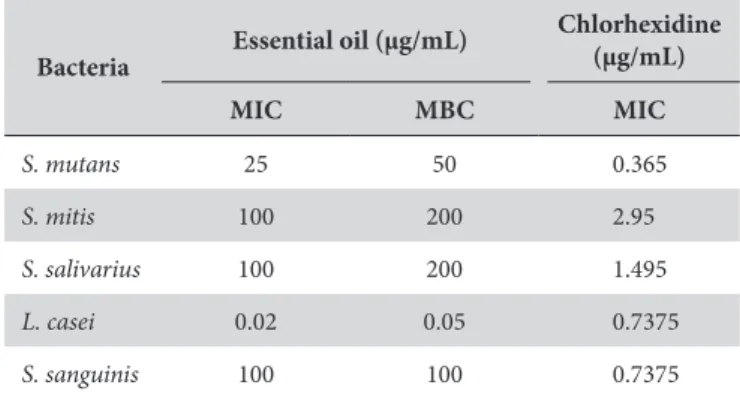
All the values of MIC and MBC for the essential oil are presented in Table 1.
Due to the good activity displayed by the essential oil, a sample was analyzed using gas chromatography coupled with mass spectrometry in order to identify the constituents. he mass spectra gave the molecular weight and the fragmentation proile of each component. herefore, by comparing the data obtained from the Wiley library, it was possible to identify the major constituents: β-caryophyllene, germacrene D, bicyclogermacrene, δ-cadidene, caryophyllene oxide, α-spathulenol and α-elemol. Figure 1 shows the chromatogram and the chemical names of the identiied major constituents.
DISCUSSION
Mouth rinses have been used in dentistry as an adjuvant in oral hygiene. Among these, the most used rinse is chlorhexidine, which can be considered a gold standard anticariogenic, although regular use of this rinse is oten associated with many negative side efects. herefore, in order to ind another antiplaque agent that can
Table 1. Values of minimum inhibitory concentration (MIC) and minimum bactericidal concentration (MBC) of Casearia sylvestris
essential oil in µg/mL
Bacteria Essential oil (µg/mL)
Chlorhexidine (µg/mL)
MIC MBC MIC
S. mutans 25 50 0.365
S. mitis 100 200 2.95
S. salivarius 100 200 1.495
L. casei 0.02 0.05 0.7375
be used on a daily basis without the side efects of chlorhexidine, our research group has decided to investigate the antimicrobial potential of a shrub described in the Brazilian pharmacopoeia.
Studies with C. sylvestris reported in the literature were carried out with methanol, aqueous, and ethanol extracts. It was shown to have anti-hiperlipidemic, antinoceptive, wound healing and anti-inlammatory activities15-17. In this work, diferent solvents
(water, ethanol and methanol in diferent proportions) were used in diferent extraction procedures to obtain diferent types of extracts in order to further analyze the antimicrobial potential. It was also decided to evaluate the essential oil extracted from the leaves through the Clevenger apparatus, because the anti-inlammatory activity of this oil has been described in the literature18,19. he MIC values of
the obtained extracts were not promising, showing values above 400 µg/mL. Values below 100µg/mL for extracts and fractions can be considered promising20.
he essential oil displayed minimum inhibitory concentration values and minimum bactericidal concentration values, which is promising in terms of the development of formulations that demonstrate antimicrobial activity. he essential oil did not show activity in the evaluated concentrations against E. faecalis, which is an enteric facultative gram-positive bacterium that can grow independently in the root canal without the assistance of other bacteria and is also resistant to other agents such as calcium hydroxide21 and sodium hipochlorite22.
Although chlorhexidine displayed lower values of minimum inhibitory concentration for all assayed microorganisms than those of essential oil, the obtained results seem to be satisfactory as the methanol extract of Hydrastis canadensis L. showed a minimum inhibitory concentration of 250 µg/mL against Streptococcus mutans
and has been introduced into the formulation of a number of mouth rinses and toothpastes on the U.S. market23.
Essential oils are volatile odoriferous oils constituted by a complex mixture of compounds and produced as the secondary
metabolites of some plants. Generally, components at a larger percentage determine the biological properties of the oil.
he essential oil composition depends on the stage of a plant’s development and the presence of micronutrients, soil quality, temperature and seasonality. his work was carried out with
C. sylvestris collected in August 2011 and which provided essential oil with a good antimicrobial activity.
Our results were qualitatively similar to others in the literature. hey identiied about 25 constituents, the most predominant of which was the presence of germacrene D, bicyclogermacrene, δ-cadinene, spathulenol, caryophyllene oxide and β-caryophyllene at diferent levels24.
Most of the compounds identiied belong to the group of sesquiterpenes, such as bicyclogermacrene, germacrenes D, caryophyllene oxide and β-caryophyllene, which are deined in the literature as possessing anti-inlammatory, anti-swelling, antitumor, antihistaminic, bactericide and repellant properties16,25.
CONCLUSION
It can be concluded that the essential oil of Casearia sylvestris
presents signiicant antimicrobial activity against oral bacteria. he results achieved in this work highlighted the antimicrobial potential of Casearia sylvestris essential oil, which could be introduced into the formulation of a number of mouth rinses, toothpastes or other types of phytotherapy for use in dental clinics.
ACKNOWLEDGEMENTS
Grant #2011/23866-8 #2011/07328-6 and #2012/08185-7, São Paulo Research Foundation (FAPESP). We would like to thank João Gabriel Curtolo Poiani for his help with some of the experiments.
Figure 1.Casearia sylvestris essential oil cromatogram 1: β-caryophyllene (RT=24.933); 2: germacrene D (RT=27.457); 3: bicyclogermacrene (RT=28.103); 4: δ-cadidene (RT=28.720); 5: caryophyllene oxide (RT=31.492); 6: α-spathulenol (RT=31.411); and 7: α-elemol (RT=50.054).
REFERENCES
2. Prasanth M. Antimicrobial efficacy of different toothpastes and mouthrinses: an in vitro study. Dent Res J (Isfahan). 2011;8(2):85-94. PMid:22013468.
3. Loesche WJ. Role of Streptococcus mutans in human dental decay. Microbiol Rev. 1986 Dec;50(4):353-80. PMid:3540569. 4. Baron S, editor. Medical microbiology. 4th ed. Galveston: University of Texas Medical Branch at Galveston; 1996.
5. Kreth J, Merritt J, Qi F. Bacterial and host interactions of oral streptococci. DNA Cell Biol. 2009 Aug;28(8):397-403. http://dx.doi.org/10.1089/ dna.2009.0868. PMid:19435424.
6. Wang QQ, Zhang CF, Chu CH, Zhu XF. Prevalence of Enterococcus faecalis in saliva and filled root canals of teeth associated with apical periodontitis. Int J Oral Sci. 2012 Mar;4(1):19-23. http://dx.doi.org/10.1038/ijos.2012.17. PMid:22422085.
7. Zanatta FB, Rösing CK. Chlorexidine: actions’s mechanisms and recent evidences of it’s efficacy over supragingival biofilm context. Scientifica. 2007;1(2):35-43.
8. Charles CH, Mostler KM, Bartels LL, Mankodi SM. Comparative antiplaque and antigingivitis effectiveness of a chlorhexidine and an essential oil mouthrinse: 6-month clinical trial. J Clin Periodontol. 2004 Oct;31(10):878-84. http://dx.doi.org/10.1111/j.1600-051X.2004.00578.x. PMid:15367192.
9. Tavares WLF, Apolônio ACM, Gomes RT, Teixeira KIR, Brandão MGL, Santos VR. Assessment of the antimicrobial activity of Casearia sylvestris extract against oral pathogenic microorganisms. Rev Ciênc Farm Básica Apl. 2008;29(3):257-60.
10. Cury VGC, Groppo FC, Souza RA, inventors; Universidade Estadual de Campinas – UNICAMP (BR/SP), assignee. Brazil PI0602094-1. 2006 May 25.
11. Brasil. Decreto Presidencial nº 5813, de 22 de junho de 2006. Política Nacional de Práticas Integrativas e Complementares no SUS. Diário Oficial da União. Brasília, 23 junho 2006.
12. Brasil. Ministério da Saúde. Fitoterápicos disponíveis no SUS. Brasília; 2012 [cited 2015 May 25]. Available from: http://www.brasil.gov.br
13. Brasil. Agência Nacional de Vigilância Sanitária. Brazilian Pharmacopeia IV, parte II, 1o - 5o fascículo, 1996-2004. Brasília; 2004.
14. Palomino JC, Martin A, Camacho M, Guerra H, Swings J, Portaels F. Resazurin microtiter assay plate: simple and inexpensive method for detection of drug resistance in Mycobacterium tuberculosis. Antimicrob Agents Chemother. 2002 Aug;46(8):2720-2. http://dx.doi.org/10.1128/ AAC.46.8.2720-2722.2002. PMid:12121966.
15. Beutler JA, McCall KL, Herbert K, Herald DL, Pettit GR, Johnson T, et al. Novel cytotoxic diterpenes from Casearia arborea. J Nat Prod. 2000 May;63(5):657-61. http://dx.doi.org/10.1021/np990553r. PMid:10843580.
16. Schoenfelder T, Pich CT, Geremias R, Avila S, Daminelli EN, Pedrosa RC, et al. Antihyperlipidemic effect of Casearia sylvestris methanolic extract. Fitoterapia. 2008 Sep;79(6):465-7. http://dx.doi.org/10.1016/j.fitote.2008.03.008. PMid:18538508.
17. Mattos ES, Frederico MJ, Colle TD, Pieri DV, Peters RR, Piovezan AP. Evaluation of antinociceptive activity of Casearia sylvestris and possible mechanism of action. J Ethnopharmacol. 2007 May;112(1):1-6. http://dx.doi.org/10.1016/j.jep.2007.01.034. PMid:17399925.
18. Ferreira PMP, Costa-Lotufo LV, Moraes MO, Barros FWA, Martins AMA, Cavalheiro AJ, et al. Folk uses and pharmacological properties of
Casearia sylvestris: a medicinal review. An Acad Bras Cienc. 2011 Dec;83(4):1373-84. http://dx.doi.org/10.1590/S0001-37652011005000040. PMid:22159347.
19. Esteves I, Souza IR, Rodrigues M, Cardoso LG, Santos LS, Sertie JA, et al. Gastric antiulcer and anti-inflammatory activities of the essential oil from Casearia sylvestris Sw. J Ethnopharmacol. 2005 Oct;101(1-3):191-6. http://dx.doi.org/10.1016/j.jep.2005.04.020. PMid:15994044. 20. Ríos JL, Récio MC. Medicinal plants and antimicrobial activity. J Ethnopharmacol. 2005 Aug;100(1-2):80-4. http://dx.doi.org/10.1016/j.
jep.2005.04.025. PMid:15964727.
21. Adl A, Shojaee NS, Motamedifar M. A Comparison between the antimicrobial effects of triple antibiotic paste and calcium hydroxide against
Enterococcus faecalis. Iran Endod J. 2012;7(3):149-55. PMid:23056135.
22. Laplace JM, Thuault M, Hartke A, Boutibonnes P, Auffray Y. Sodium hypochlorite stress in Enterococcus faecalis: influence of antecedent growth conditions and induced proteins. Curr Microbiol. 1997 May;34(5):284-9. http://dx.doi.org/10.1007/s002849900183. PMid:9099628.
23. Hwang BY, Roberts SK, Chadwick LR, Wu CD, Kinghorn AD. Antimicrobial constituents from goldenseal (the Rhizomes of Hydrastis canadensis) against selected oral pathogens. Planta Med. 2003 Jul;69(7):623-7. http://dx.doi.org/10.1055/s-2003-41115. PMid:12898417. 24. Salvador MJ, Carvalho JE, Wisniewski-Jr A, Kassuya CAL, Santos EP, Riva D, et al. Chemical composition and cytotoxic activity of the essential
oil from the leaves of Casearia lasiophylla. Rev Bras Farmacogn. 2011 Oct;21(5):864-8. http://dx.doi.org/10.1590/S0102-695X2011005000073. 25. Martin S, Padilla E, Ocete MA, Galvez J, Jiménez J, Zarzuelo A. Anti-inflammatory activity of the essential oil of Bupleurum fruticescens.
Planta Med. 1993 Dec;59(6):533-6. http://dx.doi.org/10.1055/s-2006-959755. PMid:8302953.
CONFLICTS OF INTERESTS
he authors declare no conlicts of interest.
*CORRESPONDING AUTHOR
Amanda Henriques Cavalheiro, Faculdade de Ciências Farmacêuticas de Ribeirão Preto, USP – Universidade de São Paulo, Rua Roque Nacarato, 856, apto. 2, Jd. Antártica, 14051-000 Ribeirão Preto - SP, Brazil, e-mail: [email protected]