Interventions to reduce household food
insecurity: a synthesis of current concepts
and approaches for Latin America
Intervenções para reduzir a insegurança alimentar:
uma síntese dos atuais conceitos e abordagens
para a América Latina
Donald Diego ROSE1
A B S T R A C T
Food insecurity has been documented in countries throughout the range of national incomes. M ost Latin American countries, including Brazil, fall in the middle of this range. Although responses to problems of food insecurit y need t o be developed f or specif ic cont ext s, valuable lessons f or successf ul int ervent ions can be learned from both low - and high-income countries. This article begins by describing a continuum of country-level food security contexts. The basic elements of food security, including food availability, access, and utilization, are review ed as are more recent developments in the field, including livelihood analysis, vulnerability, and risk management strategies. A selection of public sector food security interventions is described that focus on improving agricultural production, increasing employment and household income, developing human capital, and distributing food. Recent international experiences and insights are used to develop themes for orientation of these types of food security interventions in Latin America. These include: the importance of planning relief efforts to be synergistic w ith long-run development; the tailoring of interventions to the needs of specific contexts; and the related expansion of information systems to support these activities. The article also describes the need to improve f ood securit y w it hout leading t o over-consum pt ion, a problem of increasing concern in Lat in A m erica an d elsew h ere. Fin ally, d evelo p m en t o f lo cal cap acit y t h ro u g h co m m u n it y-b ased part icipat ory act ions is suggest ed as a m eans f or im proving program out comes as w ell as promot ing human rights.
Indexing terms: Food security. Income. Nutrition Programmes and Policies. Vulnerability.
R E S U M O
A insegurança alimentar tem sido documentada em países de toda a gama de rendas nacionais, desde os países de mais baixa até os de mais alta renda. A maioria dos países latino-americanos, incluindo o Brasil, está
1Tulane University, School of Public Health & Tropical Medicine, Department of Community Health Sciences. 1440 Canal
no meio deste espectro. Embora as ações direcionadas aos problemas de insegurança alimentar precisem ser desenvolvidas de acordo com contextos específicos, lições valiosas para o êxito das intervenções podem ser aprendidas das experiências dos países de baixa e de alta renda. Este artigo descreve a segurança alimentar nos diferentes contextos nacionais. Os elementos básicos de segurança alimentar, incluindo a disponibilidade de alimentos, o acesso e a utilização são revisados, assim como os desenvolvimentos mais recentes na área, incluindo análises de subsist ência, vulnerabilidade e est rat égias de gest ão de risco. É apresent ada um a seleção das intervenções do sector público de segurança alimentar, que se destinam a melhorar a produção agrícola, a aumentar o nível de emprego e da renda familiar, ao desenvolvimento do capital humano e à distribuição de alimentos. Experiências internacionais recentes são utilizadas com o intuito de desenvolver t emas para orient ação desses t ipos de int ervenções de segurança aliment ar na América Lat ina. Dent re as quais, se inclui: a importância de que os projetos de auxílio estejam em sinergia com o desenvolvimento em longo prazo, a adapt ação das int ervenções às necessidades dos cont ext os específ icos e a expansão dos sistemas de informação para apoiar estas atividades. O artigo também descreve a necessidade de melhorar a segurança alimentar sem levar a um excesso de consumo, um problema cada vez mais preocupante, tanto na América Latina como em outros lugares. Finalmente, o desenvolvimento das capacidades locais a partir de ações comunit árias part icipat ivas é sugerido, como um meio para melhorar os result ados dos programas assim como assegurar os direitos humanos.
Termos de indexação: Segurança alim ent ar e nut ricional. Renda. Program as e polít icas de nut rição e
aliment ação. Vulnerabilidade.
I N T R O D U C T I O N
Like povert y, f ood insecurit y has been documented in countries throughout the range of national incomes. This is striking, in part, because dietary energy supplies are so much more plentiful in the richest countries. Aggregate data from the UN Food and Agriculture Organization show that food supplies provided 3,770 calories per person per day in the United States (US), about 2.3 times the comparable figure for Burundi in the period f rom 2001 t o 20031. The exist ence of f ood
insecurity in the U.S. and other countries w ith per capita energy supplies w ell over biological needs is due, in part , t o an unequal dist ribut ion of resources. In shock-prone countries of Sub-Saharan Africa, like Burundi, it is food availability, as w ell as access to food, that can be problematic.
Food securit y int ervent ions need t o be t ailo red t o sp ecif ic co n t ext s an d p ro b lem s. How ever valuable insight s can be gained by st udying t he experiences of t he f ood securit y response in countries throughout the range of national incomes. Latin American countries, for the most part being in the middle of this range, can benefit from experiences of countries at both ends of it.
This article provides a review of current approaches underlying improvements in household
food insecurity. It draw s on experiences and insights t hroughout t he w orld w it h ref erences f rom searches in academic databases, such as EconLit and Agricola, w ebsites of international and other agencies, such as the World Bank and the Food and Agricult ure Organizat ion (FAO) and t he author’s ow n experience. Selection for inclusion w as based on relevance to the themes developed here. The article begins w ith a brief discussion of the range of food security contexts that are found across t he income spect rum. The subsequent section outlines recent advances in the response to food insecurity. A typology illustrative of the breadt h of public-sect or int ervent ions is t hen described. A final section outlines four key themes that may be useful for policymakers and program administrators w orking in Latin America.
A continuum of contexts
Table 1 displays income, food supply, and nutrition indicators of selected countries in Latin
America and elsew here. The table is meant to provide an illustration of the range of food security
contexts found across the w orld, rather than a comprehensive statistical picture. The countries are
countries by their status on this indicator2. M ost
Latin American countries are in the low er middle or upper middle income categories.
M any African countries are found in the
low income category, w here available supplies of
food energy are often less than 2,200 calories per
capita per day. FAO’s undernourishment indicator,
w hich combines this food supply information w ith other distributional and requirement data, provides an estimate of the percent of the population that does not meet their energy needs1. The low -income
African countries in Table 1 have rates above 30% , w hereas most Latin countries have rates below 25% . The percent of the population living on $1
per day or less, a measure of extreme poverty
developed by the World Bank, provides additional
information on the problem of food access1. Data
from the World Health Organization (WHO) on the percentage of children under 5 that are low
w eight-for-age3 give insights into the magnitude
of food access and utilization problems in these count ries, since ant hropomet ric out comes are influenced by diet as w ell as illness.
A number of generalizations can be made from these data. For most Latin American countries, food insecurity is less a problem of availability and more a question of access and utilization. For many African countries food availability, conditioned by
Table 1. A continuum of food security contexts: Income, food supply, and nutritional indicators of selected countries in Latin America
and elsew here.
Burundi Et hiopia M alaw i M ozambique Haiti Kenya India Nicaragua Bolivia Honduras Egypt China Colombia Guatemala Peru Jamaica Brazil Argent ina Costa Rica South Africa Venezuela Chile M exico Spain Canada Japan USA Low Low Low Low Low Low Low Low er middle Low er middle Low er middle Low er middle Low er middle Low er middle Low er middle Low er middle Low er middle Low er middle Upper middle Upper middle Upper middle Upper middle Upper middle Upper middle High High High High 100 160 160 310 450 540 730 950 01,010 01,120 01,260 01,740 02,290 02,400 02,650 03,390 03,550 04,470 04,700 04,770 04,820 05,870 07,310 25,250 32,590 38,950 43,560 1,640 1,860 2,140 2,070 2,090 2,150 2,440 2,290 2,220 2,360 3,350 2,940 2,580 2,210 2,570 2,680 3,060 2,980 2,850 2,940 2,350 2,860 3,180 3,410 3,590 2,770 3,770 67 46 34 45 47 31 20 27 23 22 3 12 14 23 12 10 8 <2.5 4 <2.5 18 4 5 <2.5 <2.5 <2.5 <2.5 Count ry World Bank classification of economy Gross National Income per
capita (US$)
54.6 23 41.7 37.9 22.8 34.7 45.1 14.4 20.7 03.1 08.2 16 18.1 <2 08.2 03.3 <2 10.7 14.3 <2 09.9 Dietary energy
supply per capita (kilo-calories)
Percent under-nourished
Percent living on less than
$1/day 38.9 34.6 18.4 21.2 13.9 16.5 44.4 07.8 05.9 08.6 05.4 06.1 05.1 17.7 05.2 03.1 03.7 02.3 09.6 04.8 00.8 03.4 01.1 00.3 02.1 03.9 07.8 06.3 00.6 18.0 15.1 33.0 03.4 16.6 12.2 19.9 13.1 30.1 25.0 28.1 13.5 13.9 03.3 33.2 Percent of children under-w eight-for-age Percent of adult females obese
Notes: Data from World Bank, FAO, WHO1-3. Gross national income per capita is from 2005. Energy availability and the FAO undernourishment
difficult climates and fragile economies, is still a serious concern as are issues of access and ut ilizat ion. At t he ot her end of t he spect rum, high-income countries have problems of over-consumption, and obesity affects a sizable portion of their populations.
Recent advances underlying food
security interventions
The most commonly-used definition of food security - “ w hen all people, at all times, have physical and economic access to sufficient, safe and nutritious foods to meet their dietary needs and food preferences for an active and healthy life” - comes from the 1996 World Food Summit4.
At the time, many researchers, policymakers, and program managers distinguished food availability, food access, and food utilization as the three key components of food security.
Brow n & Gentilini5 have traced the history
of the food security field w ith respect to these com ponent s. In t he 1970s, t he Soviet grain shortfall, spikes in oil prices, and the 1974 World Food Conference prompted much of the early w ork on food security to focus on national and international food supplies at an aggregate level. Access became the key theme for the 1980s, prompted by the w ork of Nobel-prize w inning economist Amartya Sen and later reinforced by a key World Bank study6,7. Sen linked severe food
insecurity, or famines, to poverty, and the inability of households to command sufficient resources for acquiring food. By the 1990s, the focus included a concern w it h diet qualit y and t he links of household food insecurity to nutritional outcomes influenced by care, sanitation and health services.
Since the 1980s, w hen the focus of food insecurity shifted to the household level, it has been clear that food insecurity can be either chronic or transitory7. Households suffering long-term
inadequate access to food, most commonly linked to poverty, can be considered chronically food insecure. This is distinguished from transitory food insecurity w hich often occurs in conjunction w ith
agricultural cycles, for example w hen households suffer from a “ hungry” season. Transitory food insecurity can also be caused by an unpredicted shock, such as a drought or political conflict. The dichot om y bet w een t he t w o f orm s of f ood insecurity is not alw ays clear-cut. An inability to mitigate the effects of a shock or of annual cycles of food insecurity can precipitate long-term chronic food insecurity. Alternatively, some intervention st rat egies seek t o reduce t he cyclical low s in agriculture or other income sources to reduce chronic household poverty or food insecurity5,8.
A better understanding of this dynamic nature of food insecurity has been a hallmark of food security planning and programming over the last 10-15 years. Planners and programmers have f ocused on t hree aspect s of household f ood security that have become central to the field. These include an emphasis on livelihoods, a better understanding of vulnerability, and the orientation of strategies to assist households manage the different types of risks that they face.
Livelihood analysis
The repeat ed nat ure of w eat her-based em ergencies in Af rica has f ocused t he f ood security community on understanding the specific nature of a household’s subsistence so that relief efforts can be timely and more effective in the short-run as w ell as supportive of a household’s long-term sustainability. Although the importance of household livelihoods to economic w ell-being and food security outcomes has been present in the literature at least since the late 1980s9,10, the
incorporation of the concept into food security planning and intervention gained prominence in the late 1990s and particularly in the early 2000s. The Famine and Early Warning System (FEWS) livelihood f ram ew ork11, Save t he Children’s
Household Economy Approach12, and the World
Fo o d Pro g r am ’s Em er g en cy Fo o d Secu r it y Assessment Framew ork13 all incorporate livelihood
A t i t s m o st b asic, a livelih o o d is a household’s means of support or subsistence. A more comprehensive articulation of livelihood is “ a household’s capabilities, assets and activities required to secure basic needs - food, shelter, healt h, educat ion, and income”13. M ost poor
households in developing count ries support themselves w ith a portfolio of economic activities, such as: production of staple food crops, production of cash crops, small livestock, fruit trees, farm or non-farm employment, fishing or hunting, artisanal sales, etc. Understanding the percentage contribution of each of these activities to a household’s income or food consumption in a non-crisis economy provides insights on the types of interventions that are needed, and their required magnitude w hen particular shocks occur.
A household’s assets w hether they be in t he f orm of physical capit al (e.g., land, f arm m ach in ery), f in an cial cap it al (e.g ., savin g s account), or human capital (e.g., education and healt h of household members) are of cent ral im p o rt an ce t o t h e livelih o o d ap p ro ach . A household’s ability to generate income is based on these assets. Thus, a key concern for those responding to problems of food insecurity is to facilitate the maintenance of a household’s assets after a food security shock as w ell as the continued buildup of those assets w hen times improve. The stronger the position of a household w ith respect to its assets, the better it w ill be able to face a difficult situation in the future14,15.
For much of Latin America, food insecurity is a problem of access rooted in poverty. Thus, a better understanding of a household’s economic situation and responses directed at specific needs are likely to have a positive impact on food security. In fact, livelihoods are so central to food insecurity outcom es an d o verall h o u seh o ld w ell-b ein g t hat t he term “ livelihood security” has gained prominence. This implies adequate stocks and flow s of food and cash to meet basic needs; secure ow nership of, or access to, resources and income-earning activities to offset risk and ease shocks; and maintenance or enhancement of resource productivity on a long-term basis10.
Household vulnerability
Vulnerability, for those concerned w ith food security, is the probability of an acute decline in food access or consumption due to hazards in the physical or social environment. Typical hazards include w eather disturbances, such as drought, or m an-m ade dist urbances, such as civil w ar or extreme price fluctuations. The recent literature on this relates a household’s vulnerability to tw o specific functions: (1) exposure to a hazard (or, shock); and (2) a household’s ability to cope w ith it (or, susceptibility to a livelihood threat)16,17.
Nutritionists w ill recognize these concepts by considering the situation of small children. Diarrheal illness caused by exposure to unsanitary food is much w orse for a child w hose reserves are already compromised. Vulnerability is related to both the situation (living in unsanitary conditions) w hich creat es t he risk as w ell as t he current n u t rit io n al st at u s o f t h e ch ild . A d d ressin g vulnerabilit y of sm all children, t hen, calls f or reducing risks by improving the sanitary conditions of the household as w ell as reducing the effects of a risky event (e.g. int est inal inf ect ion) by building up the reserves, or nutritional status, of the child.
The analogy to household food insecurity and vulnerability is straightforw ard. The physical, political, economic, and social environments in w hich a household lives condition the riskiness of a particular event. Parts of Sub-Saharan Africa are m ore prone t o shocks because of clim act ic conditions. In addition, a drought w ill have very different consequences for a household that lives
in a remote area w ith w eak food markets than a
similar household living close to w ell-functioning markets. The drought-related food production
shortfalls in Southern Africa w ere much larger in
1991-92 than in 2001-2, yet the consequences
w ere more severe in the latter event, in part, because changes in government marketing policies
left food prices more volatile15. Just as a household’s
larger environment condit ions it s exposure, a
diversity of its livelihood - conditions how w ell it w ill respond to a particular hazard.
Risk management strategies
The int erplay bet w een livelihoods and vulnerability has led food security programmers to focus on three aspects of how households deal w ith risk and to develop intervention strategies based on these. Specifically, attention has been paid to strengthening a household’s or community’s ability: (1) to prevent a shock, or negative event, from occurring; (2) to mitigate, or lessen, the effects of a shock that might occur; and (3) to cope w ith a problem once it has happened8,18,19.
Prevention strategies seek to reduce the likelihood of an adverse event from occurring8,18.
M any of these strategies can be thought of as long-term development approaches. Improvements in rural infrastructure, such as roads, irrigation systems, storage facilities, and markets can reduce the possibility that a year w ith low rainfall can turn into an acute shortfall in food availability. While many prevention strategies are broad-based p u b lic ef f o rt s, t h ere are m an y sm all-scale community and household measures. Efforts to increase household incomes or to develop more secure income sources w ould allow households to purchase foods in the event that unfavorable w eather affected their ow n household production. Ult im at ely, im proving t he asset -base of poor households, including long-range investment in the health and education of children (i.e., human capital), can assist households to grow their w ay out of poverty and food insecurity.
M itigation strategies seek to minimize the potential impact of a hazardous event that may occur. Strategies that develop diverse sources of income for a household can allow it to respond bet t er t o part icular shocks19. The plant ing of
drought-resistant crops (e.g., cassava or manioc) can reduce the shortfall that a household might experience in year of low rainfall. Employment in non-agricultural activities can have a similar effect. Although there is some overlap betw een mitigation
an d p r even t io n st r at eg ies, b o t h t yp es o f approaches are know n as ‘ex ante,’ in that they are implemented before a shock takes place.
Coping strategies are ‘ex post’ measures in that they seek to reduce the impact of a negative event once it has happened18. Strategies in this
realm - usually referred to as relief, emergency response, or safety net approaches - can include direct assistance to increase a household’s access to food, either through supplemental foods or income transfers. Not only does this assistance have a direct impact on a household’s w ell-being, it helps to preserve its assets and thus it’s potential for long-term food security. For example, selling off livestock or eating next year’s seed to meet immediate food needs both jeopardize the future earning pow er of the household. Pulling children out of school to help w ith household labor needs reduces human capital and can have a similar effect.
An illustrative typology of food security
interventions
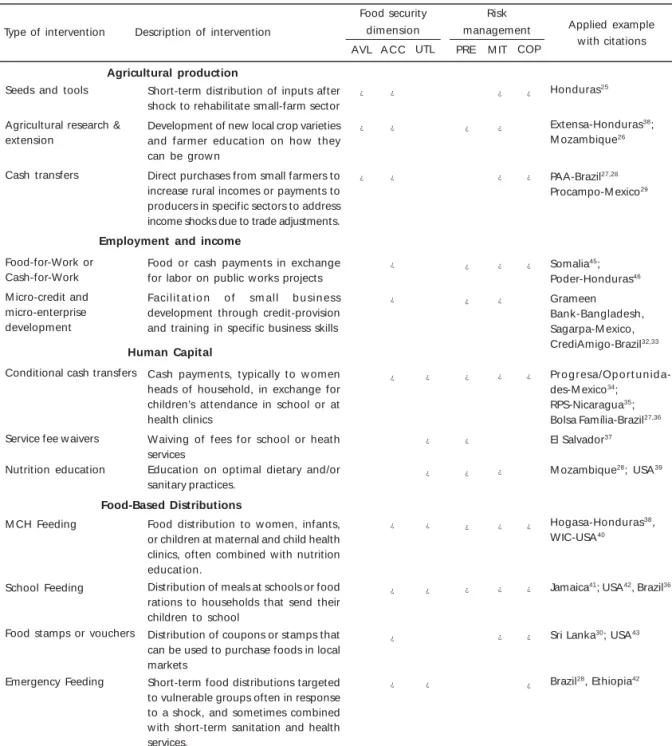
This section presents a brief description of various food security interventions w hich have been used around the w orld. There are many w ays to categorize food security interventions and most int ervent ions cut across m ult iple cat egories. How ever, for purposes of this discussion, it is useful t o organize int ervent ions int o f our groups: programs t o increase agricult ural product ion; employment and income distribution programs; interventions to increase human capital; and food-based distribution programs. Table 2 summarizes selected interventions from these groups.
Left out of this discussion are interventions at b o t h t h e m acro an d m icro en d s o f t h e spectrum. M acro-economic policy interventions (e.g., trade policies, price stabilization efforts, etc.) can affect food security outcomes by increasing overall income grow th, or by affecting food prices w ithin a country20. Interventions addressing the
preventing crises that lead to food insecurity19,21.
M icro n u t rien t in t erven t io n s, su ch as f o o d fortification and nutrient supplementations can have important affects on improving micronutrient outcomes, w hich can in turn, affect food utilization by reducing illness22. These are all essential issues
for food security outcomes, but beyond the scope of this paper.
Agricultural production
Gains in agricult ural product ion, long associated w ith making more food available for a population, continue to be an important means for accomplishing the M illennium Development Goal of reducing poverty and hunger, especially w hen directed at small producers. Although this
Table 2. A typology illustrative of selected food security interventions.
Seeds and tools
Agricultural research & extension
Cash transfers
Food-for-Work or Cash-for-Work M icro-credit and micro-enterprise development
Conditional cash transfers
Service fee w aivers
Nutrition education
M CH Feeding
School Feeding
Food stamps or vouchers
Emergency Feeding
Short-term distribution of inputs after shock to rehabilitate small-farm sector Development of new local crop varieties and f arm er educat ion on how t hey can be grow n
Direct purchases from small farmers to increase rural incomes or payments to producers in specific sectors to address income shocks due to trade adjustments.
Food or cash payments in exchange for labor on public w orks projects Facilit at io n o f sm all b u sin ess development through credit-provision and training in specific business skills
Cash payment s, t ypically t o w omen heads of household, in exchange for children’s attendance in school or at health clinics
W aiving of f ees f or school or heat h services
Education on optimal dietary and/or sanitary practices.
Food distribution to w omen, infants, or children at maternal and child health clinics, often combined w ith nutrition educat ion.
Distribution of meals at schools or food rations to households that send their children to school
Distribution of coupons or stamps that can be used to purchase foods in local markets
Short-term food distributions targeted to vulnerable groups often in response to a shock, and sometimes combined w ith short-term sanitation and health services.
Honduras25
Extensa-Honduras38;
M ozambique26
PAA-Brazil27,28
Procampo-M exico29
Somalia45;
Poder-Honduras46
Grameen Bank-Bangladesh, Sagarpa-M exico, CrediAmigo-Brazil32,33
Pro g resa/Op o rt u n id a-des-M exico34;
RPS-Nicaragua35;
Bolsa Família-Brazil27,36
El Salvador37
M ozambique28; USA39
Hogasa-Honduras38,
WIC-USA40
Jamaica41; USA42, Brazil36
Sri Lanka30; USA43
Brazil28, Ethiopia42
Type of intervention Description of intervention
AVL A CC UTL Food security
dimension
PRE M IT COP Risk management Applied example w ith citations
Not es: Food securit y dim ension ref ers t o w het her t he int ervent ion im pact s availabilit y (AVL), access (ACC), or ut ilizat ion (UTL). Risk management refers to w hether the intervention addresses prevention (PRE), mitigation (M IT), or coping (COP) w ith risks. See text for details.
Agricultural production
Employment and income
Human Capital
is likely to be a strategy of more importance in Af rica and Asia, w here rural populat ions are relatively larger and w here land is less unequally distributed than in some parts of Latin America, agriculture plays a key role in rural economies, and economic grow th and poverty reduction are not likely to be achieved w ithout improvements in agricultural production23.
There are various interventions that have been used to increase agricultural production. Perhaps one of the most common interventions to be used in situations after a climactic shock is the distribution of seeds and tools to low -income farmers in an affected area24. Depending on the
timing of the shock, and the quickness of the distribution, this intervention has the potential to mitigate some of the consequences of a w eather shock by allow ing farm households w ho have lost t heir crops t o ret urn t o gainf ul product ion. Obviously this w ill only w ork in situations w here households have access to their land, w hich given some shocks (eg, hurricane-induced mudslides in Cent ral America) may also require t emporary housing to be useful25. Agricultural research and
extension can play an important role in increasing the development and adoption of new crops w ith improved yields. This strategy w as at the root of the green revolution of the 1970s. Recent approaches have focused on developing crops for small-holders and improving nutritional characteristics. A program
in M ozambique that integrated improved varieties
of orange flesh sw eet potatoes w ith extension and
nutrition education demonstrated increased yields as w ell as improved vitamin A status of children26.
Direct purchases of food crops can increase the
incomes of small farmers and provide foods for
subsequent use in government nutrition programs, as it has in Brazil’s Food Acquisit ion Program
(PAA)27,28. Direct payments to farmers in sectors
af f ect ed by liberalized t rade agreem ent s can cushion the income shock that might otherw ise
have occurred f rom com pet it ion f rom m ore
efficient producers. M exico’s Procampo program
w as developed to do this in response to the NAFTA trade agreements29.
Employment and income generation
Because of the central role that livelihoods play in f ood securit y out com es, program s t o increase or t o develop alt ernat ive sources of income, w hether through employment or small business development, are important in this area.
Food-for-w ork or cash-for-w ork are tw o such types of interventions that are often used in areas of acute or chronic food insecurity. In areas suffering dramatic shortfalls in food availability and w here market systems are not w orking, distribution of food in return for labor on public w orks (e.g. roads, schools) can be useful for assisting households cope w it h immediat e f ood def icit s as w ell as developing community infrastructure that may cushion against future shocks5,30. Cash-for-w ork is
likely a better alternative w here food markets are f unct ioning and f ood price inf lat ion is not of concern24,31. M uch has been w ritten about the
success of micro-credit programs in f ost ering
livelihood diversif icat ion and income grow t h.
Nobel-prize w inning Yosuf Grameen pioneered the Grameen Bank w hich has assist ed millions of
micro-enterprises in Bangladesh through small
loans to purchase needed equipment (e.g. sew ing machine), livestock, or other physical assets32,33.
The programs are often integrated w ith social and educational components to assist in start-up of new businesses. Analogous program s are in operation in many countries including M exico (SAGARPA) and Brazil (CrediAmigo)33.
Human capital development
Programs that develop the skills, education, and health of individuals, so-called human capital
development, allow them to seek better employment
opportunities and to fulfill their earning potential. This objective underlies a series of programs know n as conditional cash transfers in Latin America. M exico’s Progresa/Oportunidades34, Nicaragua’s
Red de Prot eccion Social35, and Brazil’s Bolsa
Fam ília36 all provide direct paym ent s t o low
their children in schools and health clinics. The payments have been show n to increase access to food in the short-run and have the potential to reduce long-term poverty and food insecurity.
Service fee w aivers are also used to encourage attendance of children at schools or health clinics b y elim in at in g cu st o m ar y p aym en t s t h at households w ould have to make at these facilities, an intervention that has been attempted recently in El Salvad o r37. Nu t rit io n ed u cat io n , o f t en
integrated w ith other interventions, such as food distributions, can improve the know ledge and practices of meal preparers w ith regard to infant feeding, food selection, and sanitation practices38
and may be useful for promoting healthy food choices in environments where excess consumption is of concern39.
Food-based assistance
Nutritionists are most likely to be familiar w ith food-based distributions that are targeted to those in need and can assist households cope w ith immediate shocks to a household’s food security as w ell as mit igat e against long-t erm af f ect s. Pregnant w omen, infants, and children are often targeted to receive supplemental food through
m at ernal and child healt h clinics since t heir increased nut rit ional needs make t hem more vulnerable to shocks w ith nutritional insults having lo n g -t erm co n seq u en ces30. Th ere are m an y
exam ples of t hese program s t hroughout t he developing w orld. Int erest ingly, t his t ype of
intervention has been adopted in high income
countries - for example the Special Supplemental
Nut rit ion Program f or W om en, Inf ant s, and Children (WIC) in the U.S. - as a form of social
protection, and has been show n to improve birth out comes and reduce hospit al cost s due t o a reduction in ‘low -birth w eight babies40. School
feeding programs deliver supplemental food to
children in the form of meals or to their households in t h e f o rm o f t ak e-h o m e rat io n s3 6. Th ese
programs have been show n to increase attendance
and improve learning or dietary outcomes in various
countries30,41,42. Food stamps or voucher programs
are useful for ameliorating problems of short-run food insecurity. The administrative burden of these types of programs is sizable, but they have the advantage of offering participants more flexibility than direct food distributions as w ell as support to f o o d m arket in g syst em s43. Em erg en cy f o o d
programs are used in Brazil and other places to deliver f ood basket s t o vulnerable groups28.
Emergency feeding has been used in Ethiopia, as it is t hroughout t he w orld, t o deliver f ood t o populations affected by immediate crises due to natural disaster or conflict44.
Key themes for interventions in Latin
America
This section describes four themes that are u sef u l f o r t h e o rien t at io n o f f o o d secu rit y int ervent ions in Lat in America. These include:
connect ing relief t o development ; developing
interventions to meet problems in specific contexts;
addressing over-consumption at the same time as food insecurity; and enhancing community-based
participatory actions.
Connect relief to development
Although most Latin American countries are in much better overall economic conditions
and suffer from far few er food security hazards
than many shock-prone, low -income countries in
Sub-Saharan Africa, the region is not w ithout serious clim at ologic, polit ical, and econom ic
shocks. Hurricanes and flooding in Honduras and
Guat emala, drought in t he Brazilian Amazon
region, polit ical st rif e in Hait i, and economic shocks in M exico, Argentina, and various Central
America countries have all affected the livelihoods,
and thus food security status, of the region’s poorest
households. Furt herm ore, long-t erm clim at ic changes are making extreme w eather events more
likely. Thus, a key insight f or f ood securit y
body of international experience in dealing w ith risky environments, particularly in Africa45,46.
Sin ce t h e 1 9 9 0 s, t h e d evelo p m en t community has realized the importance of linking relief and development activities. Responses to emergencies, obviously, must assist in meeting the immediate short-term needs of those affected. But under certain conditions, some responses (e.g. international food aid) can sabotage longer-term d evelo p m en t b y w eak en in g lo cal m ark et s, reducing f arm er incent ives, and/or creat ing dependencies among the poor. If responses to emergencies can be developed in a w ay t hat im p ro ves t h e f u n ct io n in g o f lo cal m arket s, diversifies household livelihoods, and increases household incomes and assets, then relief efforts can be supportive of longer-term development. For exam ple, a w ell-orient ed f ood-f or-w ork program could improve local infrastructure (e.g., roads, marketplaces, schools) w hile at the same t im e provide f ood support t o t hose in need. Households w ith expanded livelihoods living in communities w ith better infrastructure w ould be able to better w ithstand future shocks, improving the success of, or even reducing the need for, subsequent relief efforts15.
These insights grow out of a framew ork, know n as the “ relief to development” continuum, in w hich intervention activities could be classified as either relief, rehabilitation, or development19.
Or, using the livelihood framew ork, activities on this continuum ranged from livelihood provisioning (e.g., supplementary and therapeutic feeding) to livelihood protection (for instance distribution of seeds and tools) to livelihood promotion (e.g., small enterprise development).
This f ramew ork has been crit iqued f or assumptions that shocks are based on discrete, short-term events or that intervention activities necessarily proceed in a linear fashion19. How ever,
political crises or conflicts, as opposed to w eather events, can drag on for long periods of time. And, in some places, components of relief, rehabilitation, and development are all in operation simultaneously. In an area w ith repeated w eather or economic
disturbances, today’s setting after a problem has occurred is also a setting before the next problem arrives. A recent policy document developed for t he US Agency f or Int ernat ional Development (USAID) recognizes the non-linearity of responses to problems by suggesting a framew ork for relief and developm ent t hat explicit ly considers t he post-shock and pre-shock periods as appropriate t im es f or bot h relief and developm ent -st yle interventions21. FAO’s “ tw in-track approach” also
acknow ledges that efforts to improve long-term food security w ill need to happen at the same time as interventions to address immediate food requirements47.
A key aspect of programming, then, is to recognize the elements of vulnerability that many households f ace and t o develop responses t o improve their livelihood situation so that they are better able to confront the next emergency. As Webb and Rogers state, “ emergency responses should seek as soon as possible to define, not exit strategies, but asset st rat egies”48. In t his light,
so-called “ safety net” interventions - used to keep individuals and households from falling below a deprivation threshold - are not just relief efforts, but essent ial t o development programming21.
Large-scale, st able, government -f unded social prot ect ion program s, like M exico’s Progresa/
Oport unidades34, Brazil’s Bolsa Fam ília27,36, or
Nicaragua’s Red de Proteccion Social35 build asset
levels of participants and enable them to cushion against future shocks.
Develop interventions to meet problems
in specific contexts
In a detailed analysis of seven case studies in the Great Lakes region of East and Central Africa on em ergencies and hum anit arian response, Levine and Chastre found that, “ many, if not most, food security interventions failed to address the needs of people affected by crises”24. They found
dealt w ith symptoms and not causes. In some sit uat ions, f ood w as given out w here it w as abundant , or seeds w ere given t o people w ho did not need t hem24. Im plem ent ing t he w rong
response is not only w ast ef ul of precious aid resources, but it can cause negative outcomes, such as w eakened f ood market s, or reduced p ro d u ct io n in cen t ives. Recen t an alysis an d d iscu ssio n s su p p o r t ed b y t h e Over seas Develo p m en t In st it u t e h ave called f o r improvements in food security responses employed in emergency situations24,31,49. Strengthening of
needs assessments and increasing the flexibility an d ran g e o f in t erven t io n o p t io n s are k ey elements.
As w ith emergencies, efforts to reduce chronic food insecurity should be tailored to the problems at hand. This raises the importance of needs assessments and problem diagnoses; food insecurity information systems should be central t o t his endeavor. There have been subst ant ial developments in this over the last decade. The experience-based household food security indicator that w as originally developed in the U.S. has been adapted in a number of countries50. This indicator
w as developed to monitor national or sub-national prevalence of household food insecurity over time. Although useful for this purpose, it does not provide
insights into the causal mechanisms underlying a
problem, so it is of limit ed value in planning interventions in specific contexts. How ever, there
have been other impressive developments in food
insecurity information systems that allow for the monitoring of household livelihoods, vulnerability
to particular shocks, and potential outcomes. For exam p le, t h e W o r ld Fo o d Pr o g r am h as a
Vulnerabilit y Assessment and M apping (VAM )
system w it h household surveys in a num ber of
Sub-Saharan Countries51. The Famine and Early
Warning System Netw ork, is a netw ork of food security information systems based on baseline
analyses of household livelihoods11. Save t he
Children’s Household Economy Approach relies on
livelihood assessments for different w ealth groups in different agro-ecologic zones in a country12. The
richness of the household information in all these systems allow s for a diagnosis not only of w hich households are likely to be affected by a shock, but also w hich aspects of their livelihoods are to be at risk, to w hat extent w ill they be affected, and the types of magnitudes of solutions that w ill be needed.
Pay attention to over-consumption w hile
addressing food insecurity
A n alo g o u s t o t h e im p o r t an ce o f co n sid er in g lo n g - t er m d evelo p m en t w h ile int ervening on short -t erm solut ions t o f ood d ep rivat io n , it m ay b e p ru d en t t o d evelo p strategies to confront food insecurity that do not lead to over-consumption and the problems of overw eight. This may be of particular concern for m iddle incom e count ries, like m any in Lat in A m erica, t h at are alread y sh o w in g o b esit y prevalence rat es of serious concern (Table 1). Insights from high-income countries w ith high rates of obesity and overw eight may be of value in this area.
In t he U.S., t here has been subst ant ial w ork of late on approaches that seek to change t he physical or social environm ent in w hich individuals live. Environmental approaches to the obesit y problem have garnered f avor, in part because t he problem is so w idespread t hat individual solut ions are not likely t o be cost -ef f ect ive, and in part because changes in t he environment (as opposed to genetic structure) are a logical explanation for the dramatic increase in the problem. Environmental determinants of food consumption and physical activity and interventions to address them have been suggested for children in schools, adults at w ork sites, and for low -income communities to improve access to healthier foods or opportunities for physical activity52. The U.S.
for the Food Stamp Nutrition Education Program has been dramatically increased54. USDA, based
on expert consultation, has developed historic changes in the food package it offers to low-income w omen and children, in part, to address the obesity problem55.
One challenge for program and policy w ork in this area is the tension betw een private and public concerns. Since health outcomes related to obesity are costly and often paid by government, it is in the public’s interest to develop environmental int ervent ions w hich reduce exposure of t he
p o p u lat io n , eit h er t h r o u g h ad ver t isin g o r
availability, to unhealthy foods. This argument is
particularly persuasive w ith respect to children, since life long food habits are developed early and
obesity rates have skyrocketed in this group. This
approach runs against t he int erest s of m any
producers in the food industry w ho do not w ant to see restraints on their marketing activities. The
political and legal battles that have ensued from
this tension have been w ell documented in the U.S. context56,57. It w ould not be surprising to see
sim ilar b at t les t ak e h o ld in m id d le-in co m e
countries.
Enhance community-based participatory
actions
An important aspect of efforts to reduce
food insecurity is not just w hat specific intervention components are employed, but also how they are
d evelo p ed an d im p lem en t ed . Part icip at o ry
approaches to development and poverty reduction
rely on community involvement in assessment, program design, and evaluation. Although this
t ype of approach is not new , several recent
developments should raise the motivation for its
adoption. First, research has demonstrated the potential of participatory approaches to increase
program ef f ect iveness. Com m unit y m em bers
understand local conditions better than outside
p ro g ram d evelo p ers an d can t h u s d evelo p interventions that are more likely to succeed in
their areas, in part because programs can be better targeted, more realistically designed, and produce
outcomes closer to the concerns of community
residents. For example, analysis of the experience
o f a p u b lic w o rk s p ro ject in So u t h A f rica, dem onst rat ed t hat com m unit y part icipat ion
low ered the cost of creating employment and
transferring funds to poor individuals58.
Second, part icipat ory-based program s
have t he pot ent ial t o develop local capacit ies
beyond t he specif ic object ives of a part icular
program. In contrast to top-down approaches which
t end t o st if le local init iat ive, t he empow ering nature of w orking together to assess and develop
so lu t io n s t o a p ro b lem m ay b e u sef u l f o r
confronting other challenges that communities
face. There has been increasing recognition of the importance of a rights-based approach in reducing
food insecurity and the need for active participation
of all stakeholders in policy development. Thus, asser t in g o n e’s r ig h t s req u ires a f o r m o f
em pow erm ent , w hich m ay be f acilit at ed by
participatory initiatives. FAO has taken a key role
on this rights-based approach by coordinating the
developm ent of guidelines on t he right t o f ood in the context of national food security59, and by
id en t if yin g w ays f o r t h is t o b e p ract ically
implemented at the national level60.
Finally, detailed methodologies now exist
for involving community groups in the assessment
and design of interventions. For example, w ork in Tanzania support ed by t he Int ernat ional Fund f or Agricult ural Developm ent and t he Belgian Survival Fund has led to development of a manual f or a “ bot t om-up-approach” t o f ood securit y interventions61. The manual provides step-by-step
procedures on how to involve community members
in assessment, program design, implementation, and evaluation. The ready availability of this type
of methodology, evidence of improved program
effectiveness of participatory approaches, and their
R E F E R E N C E S
1. Food and Agriculture Organization. The state of f ood insecurit y in t he w orld. Eradicat ing w orld hunger: taking stock ten years after the World Food Summit. Rome: FAO; 2006.
2. The World Bank. Data dow nloaded from w orld development indicators quick query. [cited 2007 M ay 2 5 ]. A vailab le f r o m : < h t t p ://d d p - ext . w orldbank.org/ext /DDPQQ/member.do?method= get M embers&userid=1&queryId=135>.
3. W o rld Healt h Org an izat io n . W HO st at ist ical information system: core health indicators. [cited 2007 M ay 30]. Available from: <http://w w w.w ho. int/w hosis /database/core/core_select.cfm>.
4. Fo o d an d A g r icu lt u r e Or g an izat io n . Ro m e declaration on w orld food security. World Food Summit. Rome: FAO;1996.
5. Brow n L, Gentilini U. The role of food-based safety net s in helping vulnerable households manage f ood insecurit y: research paper nº 2006/111. Washington (DC): UNU-WIDER; 2006.
6. Sen A . Po ver t y an d f am in es. A n essay o n entitlement and deprivation. Oxford: Clarendon Press; 1981.
7. Reutlinger S, van Holst Pellekaan J. Poverty and hunger: issues and opt ions f or f ood securit y in developing countries. WB Policy Study nº 9275. Washington (DC): The World Bank; 1986.
8. The World Bank. World development report 2000/ 2001. Attacking poverty. Oxford: Oxford University Press; 2001.
9. Chambers R. Vulnerability, coping, and policy. IDS Bulletin. 1989; 20(2):1-7.
10. M axw ell S, Frankenberger T. Household f ood security: concepts, indicators, measurement. A technical review. Rome: Unicef; 1992.
11. US Agency for International Development - Femine and Early Warning System. FEWS NET’S approach to livelihoods-based food security analysis. [cited 2007 Jun 3]. Available from: <http://w w w.few s.net/ livelihoods/FNLBroch_en.pdf>.
12. Seam an J, Clarke P, Bo u d reau T, Ho lt J. Th e household economy approach: a resource manual for practitioners. London: Save the Children; 2000.
13. World Food Programme. Emergency food security assessment handbook. Rome: WFP; 2005.
14. Barrett C. Food aid as part of a coherent strategy to advance food security objectives. ESA Working Paper nº 06-09. Rome: FAO; 2006.
15. Devereux S. Policy opt ions f or increasing t he contribution of social protection to food security. Sussex: Institute of Development Studies; 2003.
16. Webb P, Harinarayan A. A measure of uncertainty: The nature of vulnerability and its relationship to malnutrition. Disasters. 1999; 23(4):292-305.
17. Devereu x S. Livelih o o d in secu rit y an d so cial p r o t ect io n : a r e- em er g in g issu e in r u r al development. Dev Policy Rev. 2001; 19(4):507-19.
18. Lovendal CR, Know les M . Tomorrow ’s hunger: a f ram ew ork f or analyzing vulnerabilit y t o f ood insecurit y. ESA w orking paper nº 05-07. Rome: FAO; 2005.
19. CA RE. M an ag in g risk, im p ro vin g livelih o o d s: Program guidelines f or condit ions of chronic vulnerability. 2nd ed. Nairobi: CARE; 2003.
20. Von Braun J, Bouis H, Kumar S, Pandya-Lorch R. Im proving f ood securit y of t he poor: concept , policy, and programs. Washington (DC): Interna-tional Food Policy Research Institute; 1992.
21. Haddad L, Frankenberger R. Integrating relief and developm ent t o accelerat e reduct ions in f ood insecurity in shock-prone areas. Occasional paper nº 2. Washington (DC): US Agency for Interna-tional Development; 2003.
22. Allen L. Interventions for micronutrient deficiency control in developing countries: past present and future. J Nutr. 2003; 133:3875S-8S.
23. World Bank. Int ernat ional Food Policy Research Institute. Agriculture and achieving the M illennium Develo p m en t Go als. Rep o r t n º 3 2 7 2 9 - GLB. Washington (DC): World Bank; 2006.
24. Levine S, Chastre C, et al. M issing the point: an analysis of food security interventions in the Great Lakes: Humanitarian Practice Netw ork paper nº 47. London: Overseas Development Institute; 2004.
25. CARE. The af t ermat h of Hurricane M it ch: how CARE is responding. Relief Web Dec; 1999 [cited 2 0 0 7 Ju n 6 ]. A vailab le f ro m : < h t t p ://w w w . r el i ef w eb . i n t / r w / r w b . n sf / 0 / d aa4 0 ac7 0 6 6 f 83c085256810007a991e?OpenDocument&Click=>.
26. Low J, Arimond M , Osman N, Cunguara B, Zano F, Tschirley D. A food-based approach introducing orange-fleshed sw eet potatoes increased vitamin A intake and serum retinol concentrations in young children in rural M ozambique. J Nutr. 2007; 137: 1320-7.
27. Paes-Sousa R, Vaitsman J. Síntese das pesquisas d e avaliação d e p ro g ram as so ciais d o M DS. Cadernos de Estudos: Desenvolvimento Social em Debate, Número 5. Brasília: M inistério do Desenvol-vimento Social e Combate à Fome; 2007.
29. Baf f es J, Gort er H. Experience w it h decoupling agricult ural support . In: Aksoy M A, Beghin JC, editors. Global agricultural trade and developing count ries. W ashingt on (DC): The W orld Bank; 2005.
30. Rogers BL, Coates J. Food-based safety nets and r elat ed p r o g r am s. Fo o d p o licy an d ap p lied nutrition program discussion paper nº 12. Boston: Tufts University; 2002.
31. Harvey P. Cash and vouchers in em ergencies. Humanit arian Pract ice Group discussion paper. London: Overseas Development Institute; 2005.
32. Kamaluddin S. Lender w ith a mission: Bangladesh’s Grameen Bank targets poorest of poor. Far East Econ Ver. 1993; 156:38-40.
33. Consultative Group to Assist the Poor. Scaling up poverty reduction: case studies in microfinance. Washington (DC): The World Bank; 2004.
34. Skouf ias E. PROGRESA and it s im pact s on t he w elfare of rural households in M exico. Research report 139. Washington (DC): International Food Policy Research Institute; 2005.
35. M alu ccio J, Flo res R. Im p act evalu at io n o f a conditional cash transfer program: the Nicaraguan Red de Proteccion Social. Washington (DC): IFPRI; 2004.
36. FAO. Fome zero: lições principais [Documento de trabalho]. Santiago: Escritório regional da FAO para America Latina e o Caribe; 2006.
37. World Bank. Shocks and social protection: lessons from the Central American coffee crisis. Volume I: Synthesis of findings and implications for policy. Washington (DC): World Bank; 2005.
38. Jennings J, Peri A. Activities to promote mother and child w ell-being in CA RE’s PL480 Tit le II i n t eg r at ed p r o g r am s: a cl o ser l o o k at t h e Honduras & M ozam bique program s. A t lant a: CARE; 2002.
3 9 . Food and Nutrition Service. Nutrition education in FNS: a coordinat ed approach f or promot ing h ealt h y b eh avio r s. A Rep o r t t o Co n g r ess. Washington (DC): U.S. Department of Agriculture; 2002.
40. U.S. General Accounting Office. Early intervention: federal investments like WIC can produce savings. GAO/HRD-92-18. Washington (DC): GAO; 1992.
41. Chandler A-M K, Walker SP, Connolly K, Grantham-M cGregor SGrantham-M . School breakfast improves verbal f luency in undernourished Jamaican children. J Nutr. 1995; 125:894-900.
42. Bhattacharya J, Currie J, Haider SJ. Evaluating the impact of school nutrition programs. Final report.
Publicat ion # E-FAN-04-008. Washingt on (DC): USDA; 2004 [cited 2007 Jun 7]. Available from: < h t t p : / / w w w . e r s. u sd a . g o v / Pu b l i c a t i o n s/ EFAN04008/>.
43. Fraker T. The ef f ect s of f ood st am ps on f ood co n su m p t io n : a r eview o f t h e lit er at u r e, ” Washington (DC): M athematica Policy Research; 1990.
44. World Food Programme. Where w e w ork - Ethiopia. [cited 2007 Jun 5]. Available from: <http://w w w. w f p . o r g / c o u n t r y _ b r i e f / i n d e x c o u n t r y. a sp ? country=231>.
45. M attinen H, Ogden K. Cash-based interventions: lessons from Southern Somalia. Disasters. 2006; 30(3):297-315.
46. Schnell C. St rengt hening local governance t o enhance the impact and sustainability of food & livelihood security interventions: case studies from CARE Honduras and Peru Title II programs. Atlanta: CARE; 2002.
47. Food and Agriculture Organization. Anti-Hunger Program m e. A t w in-t rack approach t o hunger reduction: priorities for national and international action. Rome: FAO; 2003.
48. Webb P, Rogers B. Addressing the “ In” in food insecurity. Occasional paper nº 1. Washingt on (DC): US Agency f or Int ernational Development; 2003.
49. Overseas Developm ent Inst it ut e. ‘ Get t ing t he point ’: improving f ood securit y int ervent ions in emergencies. Notes from a meeting hosted by ODI, June, 2005 [cited 2007 M ay 25]. Available from: <ht t p://w w w.odi.org.uk/HPG/meet ings/Get t ing_ the_Point.pdf>.
50. M elgar-Quinonez HR, Hacket t M . A medida da segurança alimentar: a experiência mundial. Rev Nutr. 2008; 21(Supl). [no prelo].
51. World Food Programme. VAM Standard Analytic Framew ork: Role and Objectives of VAM Activities t o Support W FP Food-Orient ed Int ervent ions. Rome: World Food Programme; 2002.
52. Bo o t h SL, Sallis JF, Rit en b au g h C, et al. Environm ent al and societ al f act ors af f ect f ood choice and physical activity: Rationale, influences, and leverage points. Nutr Review s. 2001; 59(3 Pt 2):S21-S39; discussion S57-65.
54. Food and Nutrition Service. Nutrition program facts: Food stamp nutrition education. US Department of Agriculture, 2006 [cited 2007 Jun 6]. Available f rom : < ht t p://w w w .f ns.usda.gov/f sp/nut rit ion_ education/FSNE-Factsheet-2006.pdf>.
55. Commit t ee t o Review t he W IC Food Packages. Institute of M edicine. WIC food packages: time for a change. Washington (DC): National Academy Press; 2005.
56. Nestle, M . Food Politics: how the food industry influences nutrition and health. Berkeley: University of California Press; 2002.
57. Brow nell KD, Horgen KB. Food fight: the inside story of the food industry, America’s obesity crisis, an d w h at w e can d o ab o u t it . Ch icag o (IL): Contemporary Books; 2004.
58. Ho d d in o t t J, A d at o M , Besley T, Had d ad L. Participation and poverty reduction: issues, theory, an d n ew evid en ce f ro m So u t h A f rica. FCND
d iscu ssio n p ap er n º 9 8 . W ash in g t o n (DC): International Food Policy Research Institute; 2001.
59. Food and Agricult ure Organizat ion. Volunt ary guidelines to support the progressive realization of the right to adequate food in the context of national food security. Rome: FAO; 2005.
60. Food and Agriculture Organization. The right to food in practice: implementation at the national level. Rome: FAO; 2006.
61. Beerlandt H, Huysman S. Analysis of target groups. M anual for bottom-up-approach in food security interventions. International Fund for Agricultural Development; 1999 [cited 2007 M ay 15]. Available f ro m : < h t t p ://w w w .if ad .o rg /g en d er/t o o ls/h f s/ bsfpub/manual_toc.htm>.
Received on: 12/6/2007