Case Report
Major Article
http://dx.doi.org/10.1590/0037-8682-0021-2014INTRODUCTION
Address to: Dra Alexsandra Maria da Silva Lima. Depto Medicina Tropical/ UFPE. Av. Prof. Morais Rego s/n, 50732-970 Recife, PE, Brasil.
Phone: 55 81 2126-8526; Fax: 55 81 2126-8528 e-mail: [email protected] Received 31 January 2014
Accepted 11 April 2014
Investigation of class 1 integrons in
Klebsiella pneumoniae
clinical and microbiota isolates belonging to different
phylogenetic groups in Recife, State of Pernambuco
Alexsandra Maria Silva Lima
[1],[2],[3],
Maíra Espíndola Silva de Melo
[1],
Luiz Carlos Alves
[2],[3],
Fábio André Brayner
[2],[3]and
Ana Catarina Souza Lopes
[1][1]. Departamento de Medicina Tropical, Universidade Federal de Pernambuco, Recife, PE. [2]. Laboratório de Imunopatologia Keizo Asami, Universidade Federal de Pernambuco, Recife, PE. [3]. Centro de Pesquisas Aggeu Magalhães, Universidade Federal de Pernambuco, Recife, PE.
ABSTRACT
Introduction: The high prevalence of Klebsiella pneumoniae infections is related to the ability of K. pneumoniae to acquire and disseminate exogenous genes associated with mobile elements, such as R plasmids, transposons and integrons.This study investigated the presence of class 1 integrons in clinical and microbiota isolates of K. pneumoniae belonging to different
phylogenetic groups and correlated these results with the antimicrobial resistance profi les of the studied isolates. Methods:
Of the 51 isolates of K. pneumoniae selected for this study, 29 were from multidrug-resistant clinical isolates, and 22 were from
children’s microbiota. The susceptibility profi le was determined using the disk diffusion method, and class 1 integrons were
detected through polymerase chain reaction (PCR). Results: The results showed that none of the 22 microbiota isolates carried class 1 integrons. Among the 29 clinical isolates, 19 (65.5%) contained class 1 integrons, and resistance to sulfamethoxazole/
trimethoprim was identifi ed in 18 of these isolates (94.7%). Among the K. pneumoniae isolates with class 1 integrons, 47% belonged to the KpI phylogenetic group, and one isolate (14.3%) carrying these genetic elements belonged to the KpIII group.
Conclusions: The wide variety of detected class 1 integrons supports the presence of high rates of antimicrobial resistance, genetic variability, and rapid dissemination of beta-lactamase genes among K. pneumoniae clinical isolates in recent years in
hospitals in Recife-PE, Brazil. The fi ndings of this study indicate that the surveillance of K. pneumoniae integrons in clinical isolates could be useful for monitoring the spread of antibiotic resistance genes in the hospital environment.
Keywords: Class 1 integron. Klebsiella pneumonia. Phylogenetic groups.
Klebsiella pneumoniae is a bacillus that is commonly associated with serious nosocomial infections, such as septicemia, pneumonia, urinary tract infections, and meningitis1-3. This
species is classifi ed into three phylogenetic groups, KpI, KpII,
and KpIII, based on nucleotide variations in the constitutively expressed genes gyrA, parC, and rpoB4,5. Mobile genetic
elements, such as integrons, contribute to the evolution and dissemination of multidrug resistance genes (blaCTX-M, blaIMP, andblaGES) in K. pneumoniae through horizontal or vertical transfer6-9. The mobile class 1 integrons are predominantly
found in clinical isolates and are associated with transposon Tn21. Class 1 integrons are composed of two conserved regions, a 3´ conserved segment (3´ CS) and a 5´ conserved segment (5´ CS), as well as an internal variable region containing gene
cassettes that encode antimicrobial resistance determinants.The 3´ CS segment contains the qacE Δ 1 and sul 1 genes, which confer resistance to ethidium bromide and quaternary ammonium compounds and to sulfonamide, respectively10-12. These genetic
elements can be found in different species of Gram-negative bacteria13-17 from hospital environments. Based on the amino
acid sequence of the IntI protein, fi ve classes of mobile integrons
have been described18. Classes 1, 2, and 3 are the most commonly
detected19. Class 1 integrons are the most widespread and have
been frequently found in extended-spectrum β-lactamase (ESBL)-producing clinical isolates of Enterobacteriaceae, including K. pneumoniae6,13,16,20,21. Class 2 integrons occur less frequently in
ESBL-producing Escherichia coliand K. pneumoniae, and class 3 integrons are rarely found in ESBL-producing K. pneumoniae21,22.
Class 1 and class 2 integrons have also been found in Escherichia coli from fecal samples from healthy individuals in Spain, indicating that individuals from the community may serve as reservoirs for these genetic elements 23. Nevertheless,
no published study has correlated the presence of these genetic elements with K. pneumoniae phylogenetic groups or with microbiota isolates. Thus, the present study evaluated the presence of class 1 integrons in clinical and microbiota isolates of K. pneumoniae from different phylogenetic groups in Recife, Brazil, and it correlated their presence with the antimicrobial
Lima AMS et al - Class 1 integrons in Klebsiella pneumoniae
RESULTS
DISCUSSION METHODS
Bacterial isolates
A total of 51 K. pneumoniae isolates already typed for phylogenetic groups24 wereanalyzed for the presence of class 1
integrons. Twenty-nine of these isolates werefrom hospitalized patients from the City of Recife, Pernambuco, Brazil, and 22 werefrom normal oropharyngeal and fecal microbiota from healthy 3- to 4-year-old children attending a day care center called Lar Fabiano de Cristo in the Várzea district of Recife, Brazil (Table 1). All the cultures were stored in 20% glycerol at -70°C and were grown at 37ºC for18h in brain-heart infusion broth (BHI) or Luria-Bertani broth (LB).
Antibiotic susceptibility analysis
Antibiotic susceptibility was tested on Mueller-Hinton agar
using the disk diffusion method Clinical and Laboratory Standards Institute (CLSI)25. The following antibiotics were tested:
amoxicillin-clavulanate (AMC), amoxicillin (AMO), amikacin
(AMI), ampicillin (AMP), aztreonam (ATM), ceftazidime (CAZ), cefotaxime (CTX), cefepime (CPM ), ciprofloxacin (CIP), chloramphenicol (CLO), streptomycin (EST), gentamicin (GEN),
imipenem (IPM), kanamycin (KAN), nalidixic acid (NAL),
sulfamethoprim (TSP), and tetracycline (TET).
Genomic DNA extraction
Genomic deoxyribonucleic acid (DNA) was extracted from direct colony suspensions in 200µl of distilled water. The suspensions were heated at 100°C for 10min and centrifuged (5min/10,000xg), and 100µl of the recovered supernatant was stored at -20ºC until use.
Detection of class 1 integrons through PCR
Amplifi cation reactions were prepared in a total volume of 25μl containing 1ng of genomic DNA, 2 units of Taq DNA
polymerase (Promega), 200μM of each deoxyribonucleotide
triphosphate (dNTP) (Promega), 1.5mM MgCl2, 1μM of each primer (3'CS (AAGCAGACTTGACCTGAT) and 5'CS (GGCATCCAAGCAGCAAG), and 1X reaction buffer26.
The cycling conditions were one cycle of 5 min at 95 °C; 30 cycles of 1 min at 95°C, 1min at 65°C, and 1min at 72°C; and
one cycle of 10min at 72°C. The amplifi cation products were
visualized in 1% agarose gels in Tris-borate buffer (TBE) buffer.
Class 1 integrons
Among the 51 K. pneumoniae clinical and microbiota
isolates analyzed in this work, 19 (37.2%) carried class 1
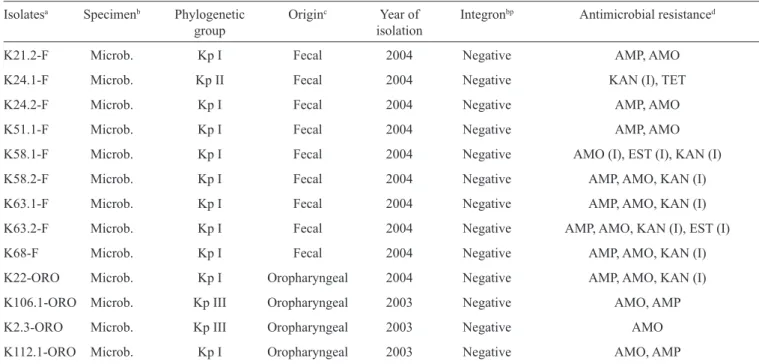
integrons. Nineteen (65.5%) of the 29 clinical isolates carried class 1 integrons, as indicated by amplicons ranging from 750 to >2,080bp. None of the 22 microbiota isolates carried these genetic elements (Table 1). Three clinical isolates (K5A, K10P, and K14P) contained two integrons each, with amplicon
sizes ranging from 750 to >2,080bp. The examination of the relationship between the phylogenetic groups and the presence of class 1 integrons revealed that 16 (80%) of the clinical isolates carrying class 1 integrons belonged to the KpI phylogenetic group. Clinical isolates from 1998 and 1999 exhibited lower integron frequencies compared with those from 2007 and 2008 (Table 1).
Antimicrobial resistance
The identifi ed K. pneumoniae isolates with class 1 integrons exhibited the following high levels of resistance to antibiotics: AMP 100% (n=19); AMO 57.9% (n=11); AMC 42.1% (n=8); CTX 94.7% (n=18); CAZ 73.7% (n=14); CPM 47.4% (n=9); and IPM and meropenem 36.8% (n=7). In addition, resistance to sulfamethoxazole associated with trimethoprim was observed in 94.7% (n=18) of these isolates, and resistance to monobactam aztreonam (ATM) was observed in 73.7% (n=14) of these isolates. The K. pneumoniae isolates were more susceptible to
aminoglycosides, fl uoroquinolones, and CLO than to penicillin, cephalosporin, sulfa, or monobactams. Eighteen (94.7%) of the K. pneumoniae isolates carrying class 1 integrons exhibited simultaneous sulfamethoxazole/trimethoprim resistance. K10-R was the only isolate with one class 1 integron and no resistance to sulfamethoxazole/trimethoprim. Conversely, the K12-A and K20-P isolates did not contain class 1 integrons but displayed resistance to sulfamethoxazole/trimethoprim (Table 1).
This study investigated the presence of class 1 integrons in clinical and microbiota isolates of K. pneumoniae from different phylogenetic groups and correlated these results with
the antimicrobial resistance profi les of the studied isolates.
Few studies have evaluated the presence of class 1 integrons in K. pneumoniae isolates from the Brazilian northeast27. Chagas
et al.20 showed that all K. pneumoniae ESBL-producing isolates
from Rio de Janeiro and São Paulo, Brazil carried class 1 integrons. Ahangarzadeh Rezaee et al.13 found that integrons
were widely prevalent in clinical isolates of K. pneumoniae from northwestern Iran and were associated with multidrug resistance.
In the present study, class 1 integrons were identifi ed in clinical
isolates only; these results are similar to those reported by Dalsgaard et al.11 and confi rm that integrons are predominantly
found in clinical isolates.
Because no integrons were identified in the studied K. pneumoniae microbiota isolates from healthy individuals, we suggest that they are not reservoirs for class 1 integrons. Thus, K. pneumoniae clinical isolates are the main reservoirs for these genetic elements and disseminate them to other bacterial species through horizontal or vertical transfer in the hospital environment. Most of the clinical isolates carried one integron; however, the K5A, K10P, and K14P isolates each contained two integrons. This result is consistent with reports by Penteado et al.28 and Lopes et al.27, who observed additional integrons
TABLE 1 - Specimens, origins, phylogenetic groups, presence of class 1 integrons, and antimicrobial resistance profi les of Klebsiella pneumoniae
isolates from Recife, Brazil.
Isolatesa Specimenb Phylogenetic Originc Year of Integronbp Antimicrobial resistanced group isolation
K1A Hosp. Kp I Catheter 2007 1,800 AMO, AMP, NAL, AMC, ATM, CAZ, CTX, CLO (I), SZT
K2A Hosp. Kp I Urine 2007 1,600 to >2,080 AMO, AMP, NAL, AMC, ATM, CAZ, CTX, TET, SZT
K3A Hosp. Kp III Wound 2007 > 2,080 AMO, AMP, NAL (I), AMC, CTX (I), TET, SZT
K4A Hosp. Kp III Trach. aspirate 2007 Negative AMO, AMP, NAL, CTX (I), TET
K5A Hosp. Kp I Urine 2007 1,300 to 2,080 AMO, AMP, AMC, ATM, CAZ, CTX, TET, CLO, SZT
K7A Hosp. Kp I Trach. aspirate 2007 1,800 AMO, AMP, NAL, AMC, ATM, CAZ, CTX, TET, SZT
K8A Hosp. Kp I Blood 2007 1,500 AMO, AMP, NAL (I), TET, SZT
K9A Hosp. Kp I Trach. Aspirate 2007 2,000 AMO, AMP, AMC, ATM, CAZ, CTX, CLO, SZT
K10A Hosp. Kp I Urine 2007 2,080 AMO, AMP, NAL, AMC, ATM, CAZ, CTX, TET, CLO, SZT
K12A Hosp. Kp I Urine 2007 Negative AMO, AMP, SZT
K1P Hosp. Kp I Urine 2008 1,800 AMP, ATM, CPM, CTX, CAZ, IPM, SZT
K4P Hosp. Kp II Sputum 2008 Negative AMP
K5P Hosp. Kp I Blood 2008 1,800 AMP, ATM, CPM, CTX, CAZ, IPM, SZT
K8P Hosp. Kp I Urine 2008 1,800 AMI, AMP, ATM, CPM, CTX, CAZ, GEN, IPM, SZT
K10P Hosp. Kp I Trach. aspirate 2008 1,600 to 750 AMP, ATM, CPM, CTX, CAZ, CIP, IPM, SZT
K12P Hosp. Kp I Urine 2008 1,800 AMP, ATM, CPM, CTX, CAZ, CIP, GEN, IPM, SZT
K13P Hosp. Kp I Trach. aspirate 2008 1,600 AMP, ATM, CPM, CTX, CAZ, CIP, GEN, IPM, SZT
K14P Hosp. Kp I Blood 2008 1,800 to >2,080 AMP, ATM, CPM, CTX, CAZ, CIP, GEN, SZT
K15P Hosp. Kp I Urine 2008 1,500 AMP, ATM, CPM, CTX, CAZ, CIP, IPM, SZT
K20P Hosp. Kp I Urine 2008 Negative AMP, ATM, CPM, CTX, CAZ, CIP, GEN, IPM, SZT
K10-R Hosp. Kp II Trach. aspirate 1998 1,300 AMP, AMO, CLO (I), TET (I), EST (I), CTX (I)
K15-R Hosp. Kp I Blood 1998 Negative AMI (I), AMP, AMO, AMC, CLO, CTX, GEN, KAN(I), TET(I)
K16-R Hosp. Kp I Urine 1998 > 2,000 AMP, AMO, AMC(I), CLO, CPM, GEN, KAN, EST, ATM, CTX, SZT
K18-R Hosp. Kp II Urine 1998 Negative AMP, AMO, TET (I)
K20-R Hosp. Kp II Urine 1998 Negative AMP, AMO, TET (I), CTX (I)
K7-C Hosp. Kp II Urine 1999 Negative AMP, AMO, CTX(I)
K10-C Hosp. Kp I Urine 1999 Negative AMP, AMO, AMC (I), CLO, TET (I), NAL, ATM, CAZ (I), CTX (I)
K12-C Hosp. Kp II Urine 1999 750 AMP, AMO, CLO, TET, CTX (I), SZT
K17-C Hosp. Kp III Urine 1999 Negative AMP, AMO, CLO (I)
K3.1-F Microb. Kp III Fecal 2004 Negative KAN (I)
K3.2-F Microb. Kp II Fecal 2004 Negative AMP, AMO, KAN (I)
K6.3-F Microb. Kp I Fecal 2004 Negative AMP, AMO, EST (I)
K7.1-F Microb. Kp I Fecal 2004 Negative AMP, AMO
K7.2-F Microb. Kp I Fecal 2004 Negative AMP, AMO, KAN (I), EST (I)
K10.1-F Microb. Kp II Fecal 2004 Negative AMP, AMO
K10.2-F Microb. Kp I Fecal 2004 Negative AMP, AMO, TET
K13.3-F Microb. Kp II Fecal 2004 Negative AMP, AMO, KAN (I), EST (I)
K21.1-F Microb. Kp III Fecal 2004 Negative AMO (I), EST (I), KAN (I)
TABLE 1 - Continuation.
Isolatesa Specimenb Phylogenetic Originc Year of Integronbp Antimicrobial resistanced
group isolation
K21.2-F Microb. Kp I Fecal 2004 Negative AMP, AMO
K24.1-F Microb. Kp II Fecal 2004 Negative KAN (I), TET
K24.2-F Microb. Kp I Fecal 2004 Negative AMP, AMO
K51.1-F Microb. Kp I Fecal 2004 Negative AMP, AMO
K58.1-F Microb. Kp I Fecal 2004 Negative AMO (I), EST (I), KAN (I)
K58.2-F Microb. Kp I Fecal 2004 Negative AMP, AMO, KAN (I)
K63.1-F Microb. Kp I Fecal 2004 Negative AMP, AMO, KAN (I)
K63.2-F Microb. Kp I Fecal 2004 Negative AMP, AMO, KAN (I), EST (I)
K68-F Microb. Kp I Fecal 2004 Negative AMP, AMO, KAN (I)
K22-ORO Microb. Kp I Oropharyngeal 2004 Negative AMP, AMO, KAN (I)
K106.1-ORO Microb. Kp III Oropharyngeal 2003 Negative AMO, AMP
K2.3-ORO Microb. Kp III Oropharyngeal 2003 Negative AMO
K112.1-ORO Microb. Kp I Oropharyngeal 2003 Negative AMO, AMP
Kp: Klebsiella pneumonia; bp: base pairs; IPM: imipenem; KAN: kanamycin; AMO: amoxicillin; AMP: ampicillin; NAL: nalidixic acid;
AMC: amoxicillin-clavulanate; ATM: aztreonam; CAZ: ceftazidime; CTX: cefotaxime; CLO: chloramphenicol; SZT: trimethoprim/
sulfamethoxazole; TET: tetracycline; EST: streptomycin; I: intermediate susceptibility. KAN: kanamycin. aIsolates: K: K. pneumoniae;
A: public hospital; R: public hospital; C: public hospital; P: private hospital; F: fecal; ORO: oropharyngeal. bSpecimen:Hosp: hospital;
Microb: microbiota. cOrigin: Trach: tracheal. dResistance profi le.
which encodes sulfonamide resistance. The K10-R isolate carried a class 1 integron but did not exhibit sulfamethoxazole/
trimethoprim resistance. The most likely reason for this result
is that this isolate does not express the sul1 gene. Our study
confi rmed a correlation between sulfamethoxazole/trimethoprim
resistance and the presence of class 1 integrons: 94.7% of the analyzed isolates carried class 1 integrons and exhibited sulfamethoxazole/trimethoprim resistance29,30. The K12-A and
K20-P isolates did not carry class 1 integrons but displayed sulfamethoxazole/trimethoprim resistance. The sul1 gene encodes resistance to sulfonamides only, and we evaluated the associated sulfamethoxazole/trimethoprim. The most common mechanism of trimethoprim resistance involves variants of the dihydrofolate reductase (DFR), and the absence of class 1 integrons in these two isolates suggests that they may express the dfrA gene and that this gene could be located in other genetic elements, such as plasmids, transposons and chromosomes,
which could explain our fi ndings31-34. We observed that isolates
belonging to the KpI phylogenetic group had the highest frequency of class 1 integrons; some class 1 integrons were observed in isolates from the KpII group, but very few were observed in isolates from the KpIII group. This high frequency of class 1 integrons is one of the factors explaining why isolates from the KpI group presented the highest level of resistance, followed by isolates from the KpII group and isolates from the KpIII group4. We also observed that the frequency and diversity
of class 1 integrons in the K. pneumoniae clinical isolates in Recife increased between 1998 and 1999 and between 2007
and 2008. This result is consistent with the observed rapid dissemination of beta-lactamase genes along with resistance to extended-spectrum cephalosporins and carbapenems among K. pneumoniae clinical isolates in Recife in recent years35. In this
study, the diversity of class 1 integrons in K. pneumoniae isolates from Recife, Brazil favors the dissemination of resistance among K. pneumoniae and other species in the hospital environment. Moreover, this study also indicates that the surveillance of K. pneumoniae integrons in clinical isolates could be useful for monitoring the spread of antibiotic resistance genes in the hospital environment.
FINANCIAL SUPPORT
Fundação de Amparo à Ciência e Tecnologia do Estado
de Pernambuco (FACEPE) for fi nancial support.
REFERENCES
The authors declare that there is no confl ict of interest.
CONFLICT OF INTEREST
1. Minarini LA, Gales AC, Palazzo IC, Darini Al. Prevalence of community-occurring extended spectrum beta-lactamase-producing
2. Pan YJ, Fang HC, Yang HC, Lin TL, Hsieh PF, Tsai FC, et al. Capsular Polysaccharide Synthesis Regions in Klebsiella pneumoniae Serotype K57 and a New Capsular Serotype. J Clin Microbiol 2008; 46:2231-2240.
3. Tu YC, Lu MC, Chiang MK, Huang SP, Peng HL, Chang HY, et al. Genetic requirements for Klebsiella pneumoniae induced liver abscess in oral infection model. Infec Immu 2009; 77:2657-2671.
4. Brisse S, Van Himbergen T, Kusters K, Verhoef J. Development of a rapid identifi cation method for Klebsiella pneumoniae phylogenetic groups and analysis of 420 clinical isolates. Clin Microbiol Infec 2004; 10:942-945.
5. Fevre C, Passet V, Weil FX, Grimont PAD, Brisse S. Variants of the
Klebsiella pneumoniae OKP chromosomal beta-lactamase are divided into two main groups, OKP-A and OKP-B. Antimicrob Agents Chemother 2005; 49:5149-5152.
6. Chen L, Chavda KD, Fraimow HS, Mediavilla JR, Melano RG, Jacobs MR, et al. Complete nucleotide sequences of blaKPC-4- and blaKPC-5-harboring IncN and IncX plasmids from Klebsiella pneumoniae strains isolated in New Jersey. Antimicrob Agents Chemother 2013; 57:269-276.
7. Hussain A, Ewers C, Nandanwar N, Guenther S, Jadhav S, Wieler LH, et al. Multiresistant uropathogenic Escherichia coli from a region in India where urinary tract infections are endemic: Genotypic and phenotypic characteristics of sequence type 131 isolates of the CTXM-15 extended-spectrum-β-lactamase-producing lineage. Antimicrob Agents Chemother 2012; 56:6358-6365.
8. Martínez T, Vazquez GJ, Aquino EE, Goering RV, Robledo IE. Two novel class I integron arrays containing IMP-18 metallo-β-lactamase gene in
Pseudomonas aeruginosa clinical isolates from Puerto Rico. Antimicrob Agents Chemother2012; 56:2119-2121.
9. Bebrone C, Bogaerts P, Delbrück H, Bennink S, Kupper MB, Rezende de Castro R, et al. GES-18, a new carbapenem-hydrolyzing GES-type β-Lactamase from Pseudomonas aeruginosa that contains Ile80 and Ser170 Residues. Antimicrob Agents Chemother 2013; 57:396-401.
10. Levesque C, Piche L, Larose C, Roy PH. PCR mapping of ntegrons reveals several novel combinations of resistence genes. Antimicrob Agents Chemother1995; 39:185-191.
11. Dalsgaard A, Forslund A, Petersen A, Brown DJ, Dias F, Monteiro S, et al. Class 1 Integron-Borne, Multiple-Antibiotic Resistance Encoded by a 150-Kilobase Conjugative Plasmid in Epidemic Vibrio cholerae O1 Strains Isolated in Guinea-Bissau. J Clin Microbiol 2000; 38:3774-3779.
12. Martínez N, Mendonza MC, Rodriguez I, Soto S, Bances M, Rodicio R. Detailed structure of integrons and transposons carried by large conjugative plasmids responsible for multidrug resistance in diverse genomic types of Salmonella enterica serovar Brandenburg. J Antimicrob Chemother 2007; 60:1227-1234.
13. Ahangarzadeh Rezaee M, Langarizadeh N, Aghazadeh M. First report of class 1 and class 2 integrons in multidrug-resistant Klebsiella pneumoniae
isolates from northwest Iran. Jpn J Infect Dis 2012; 65:256-259.
14. Carneiro C, Araújo C, Gonçalves A, Vinué L, Somalo S, Ruiz E, et al. Detection of CTX-M-14 and TEM-52 extended-spectrum beta-lactamases in fecal Escherichia coli isolates of captive ostrich in Portugal. Foodborne Pathog Dis 2010; 7:991-994
15. Ingold AJ, Castro M, Nabón A, Borthagaray G, Márquez C. VIM-2 metallo-ß-lactamase gen detection in a class 1 integron associated to bla(CTX-M-2) in a Pseudomonas aeruginosa clinical isolate in Uruguay: fi rst communication. Rev Argent Microbiol 2011; 43:198-202.
16. Ibrahim N, Wajidi MF, Yusof MY, Tay ST. The integron prevalence of extended-spectrum beta-lactamase producing enterobacterial isolates in a Malaysian teaching hospital. Trop Biomed 2011; 28:668-671.
17. Taherikalani M, Maleki A, Sadeghifard N, Mohammadzadeh D, Soroush S, Asadollahi P, et al. Dissemination of class 1, 2 and 3 integrons among different multidrug resistant isolates of Acinetobacter baumannii in Tehran hospitals, Iran. Pol J Microbiol 2011; 60:169-174.
18. Cambray G, Guerout AM, Mazel D. Integrons. Annu Rev Genet 2010; 44:141-166.
19. Stalder T, Barraud O, Casellas M, Dagot C, Ploy MC. Integron Involvement in Environmental Spread of Antibiotic Resistance. Frontiers Microbiol 2012; 3:119.
20. Chagas TP, Alves RM, Vallim DC, Seki LM, Campos LC, Asensi MD. Diversity of genotypes in CTX-M-producing Klebsiella pneumoniae
isolated in different hospitals in Brazil. Braz J Infect Dis 2011; 15:420-425.
21. Mobarak-Qamsari M, Ashayeri-Panah M, Eftekhar F, Feizabadi MM. Integron mediated multidrug resistance in extended spectrum beta-lactamase producing clinical isolates of Klebsiella pneumoniae. Braz J Microbiol 2014; 44:849-854.
22. Bhattacharjee A, Sen MR, Prakash P, Gaur A, Anupurba S, Nath G. Observation on integron carriage among clinical isolates of Klebsiella pneumoniae producing extended spectrum β-lactamases. Ind J Med
Microbiol 2010; 28:207-210.
23. Vinué L, Sáenz Y, Somalo S, Escudero E, Moreno MA, Ruiz-Larrea F, et al.Prevalence and diversity of integrons and associated resistance genes in faecal Escherichia coli isolates of healthy humans in Spain. J Antimicrob Chemother 2008; 62:934-937.
24. Melo MES, Cabral AB, Maciel MAV, Silveira VM, Lopes ACS. Phylogenetic Groups among Klebsiella pneumoniae isolates from Brazil: Relationship with antimicrobial resistance and origin. Current Microbiology 2011; 62:1596-1601.
25. Clinical and Laboratory Standards Institute (CLSI). Performance standards for antimicrobial susceptibility testing. 23th informational supplement. CLSI M100-S23. Wayne, PA: CLSI; 2013.
26. Bissonnette L, Roy PH. Characterization of In0 of Pseudomonas aeruginosa plasmid pVS1, an ancestor of integrons of multiresistance plasmids and transposons of gram-negative bacteria. J bacteriol 1992; 174:1248-1257.
27. Lopes ACS, Veras DL, Lima AMS, Melo RCA, Ayala J. blaCTX-M-2; and
blaCTX-M-28 extended-spectrum β-lactamase genes and class 1 integrons
in clinical isolates of Klebsiella pneumoniae from Brazil. Mem Inst Oswaldo Cruz 2010; 105:163-167.
28. Penteado AP, Castanheira M, Pignatari ACC, Guimarães T, Mamizuka EM, Gales AC. Dissemination of blaIMP-1- carrying integron In86 among Klebsiella pneumoniae isolates harboring a new trimethoprim resistance gene dfr23. Diagn Microbiol Infect Dis 2009; 63:87-91.
29. Agersø Y, Peirano G, Aarestrup FM. dfrA25, a novel trimethoprim resistance gene from Salmonella agona isolated from a human urine sample in Brazil. J Antimicrob Chemother 2006; 58:1044-1047. 30. Beutlich J, Rodriguez I, Schroeter A, Kasbohrer A, Helmuth R, Guerra B.
A predominant multidrug-resistant Salmonella enteric seroval saintpaul clonal line in German Turkey and related food products. Appl Environ Microbiol 2010; 76:3657-3667.
31. Grape M, Sundström L, Kronvall G. Two new dfr genes in trimethoprim-resistant integron-negative Escherichia coli isolates.Antimicrob Agents Chemother 2007; 51:1863-1864.
32. Wei Q, Xiaofei Jiang X, Yang Z, Chen N, Chen X, Li G, Lu Y. dfrA27, a new integron-associated trimethoprim resistance gene from Escherichia coli.
J Antimicrob Chemother 2009; 63:405-419.
33. Perez-Roth E, Kwong SM, Alcoba-Florez J, Firth N, Alvarez SM. Complete Nucleotide Sequence and Comparative Analysis of pPR9, a 41.7-Kilobase Conjugative Staphylococcal Multiresistance Plasmid Conferring High-Level Mupirocin Resistance. Antimicrob Agents Chemother 2010; 54:2252-2257.
34. Toro M, Rojo-Bezares B, Vinue´ L, Undabeitia E, Torres C, Yolanda S.
In vivo selection of aac(6′)-Ib-cr and mutations in the gyrA gene in
a clinical qnrS1-positive Salmonella enterica serovar Typhimurium
DT104B strain recovered after fl uoroquinolone treatment. J Antimicrob Chemother 2010; 65: 1945-1949.
35. Cabral AB, Melo RCA, Maciel MAV, Lopes ACS. Multidrug resistance genes, including blaKPC and blaCTX-M-2, among Klebsiella pneumoniae