RESUMO
O objeivo deste estudo metodológico foi realizar adaptação transcultural e validar para uso no Brasil um quesionário de co
-nhecimento dos fatores de risco cardiovas
-cular (Q-FARCS), mudança do esilo de vida e adesão em uma amostra de pacientes com doença arterial coronariana. O quesionário é dividido em três escores: conhecimento geral dos fatores de risco; conhecimento especíico e mudanças no esilo de vida. A adaptação transcultural incluiu tradução, síntese, retrotradução, análise por comitê de especialistas e pré-teste. Validade de face e conteúdo, idedignidade e validade de constructo foram mensuradas. Na amos
-tra total (n=240) o Alpha de Cronbach foi de 0,75. Na análise das propriedades psico
-métricas, a validade de face e de conteúdo mostraram-se adequadas; a de constructo indicou sete componentes. Pode-se concluir que a versão adaptada para o Brasil do Q-FARCS apresentou adequada idedignidade e validade para avaliar o conhecimento dos fatores de risco cardiovascular.
DESCRITORES Doença das coronárias Fatores de risco Educação em saúde Quesionários Estudos de validação
Validity and reliability of a questionnaire on
knowledge of cardiovascular risk factors for
use in Brazil
*A
rtigo
o
riginAl
ABSTRACT
Using a sample of paients with coronary artery disease, this methodological study aimed to conduct a cross-cultural adapta
-ion and valida-ion of a ques-ionnaire on knowledge of cardiovascular risk factors (Q-FARCS), lifestyle changes, and treatment adherence for use in Brazil. The quesion
-naire has three scales: general knowledge of risk factors (RFs); speciic knowledge of these RFs; and lifestyle changes achieved. Cross-cultural adaptaion included trans
-laion, synthesis, back-trans-laion, expert commitee review, and pretesing. Face and content validity, reliability, and con
-struct validity were measured. Cronbach’s alpha for the total sample (n = 240) was 0.75. Assessment of psychometric proper
-ies revealed adequate face and content validity, and the construct revealed seven components. It was concluded that the Brazilian version of Q-FARCS had adequate reliability and validity for the assessment of knowledge of cardiovascular RFs.
DESCRIPTORS Coronary disease Risk factors Health educaion Quesionnaires Validaion studies
RESUMEN
El objeivo de este estudio metodológico fue realizar la adaptación transcultural y validar para su uso en el Brasil, un cuesio
-nario de conocimiento de los factores de riesgo cardiovascular (Q-FARCS), el cambio del esilo de vida y adhesión al tratamiento en una muestra de pacientes con enfer
-medad arterial coronaria. El cuesionario está dividido en tres scores: conocimiento general de los factores de riesgo; conoci
-miento especíico y cambios en el esilo de vida. La adaptación transcultural incluyó traducción, síntesis, retro-traducción, aná
-lisis por comité de especialistas y pre-test. Validez de apariencia y contenido, conia
-bilidad y validez de constructo fueron me
-didas. En la muestra total (n=240) el Alfa de Cronbach fue de 0,75. En el análisis de las propiedades psicométricas, la validez de apariencia y de contenido se mostraron adecuadas; la validez de constructo indicó siete componentes. Se concluye que la ver
-sión adaptada para el Brasil del Q-FARCS presentó adecuada coniabilidad y validez para evaluar el conocimiento de los facto
-res de riesgo cardiovascular.
DESCRIPTORES Enfermedad coronaria Factores de riesgo Educación en salud Cuesionarios Estudios de validación
Marco Aurélio Lumertz Safi1, Luis Joeci Jacques de Macedo Junior2, Melina Maria Trojahn3, Carisi Anne Polanczyk4, Eneida Rejane Rabelo-Silva5
VALIDADE E FIDEDIGNIDADE DE UM QUESTIONÁRIO DE CONHECIMENTO DE FATORES DE RISCO CARDIOVASCULAR PARA USO NO BRASIL
VALIDEZ Y CONFIABILIDAD DEL CUESTIONARIO DE CONOCIMIENTO DE FACTORES DE RIESGO CARDIOVASCULAR PARA SU USO EN EL BRASIL
* Taken from the dissertation “Validity and reliability of a questionnaire on knowledge of cardiovascular risk factors in patients with coronary artery disease“, Federal University of Rio Grande do Sul, 2010. 1 Nurse.PhD student Program in Cardiology and Cardiovascular Sciences, Federal University
of Rio Grande do Sul, Brazil. [email protected] 2 Nurse for the School of Nursing of Federal University of Rio Grande do Sul. Porto Alegre, RS,
Brazil. [email protected] 3 Nursing School, Federal University of Rio Grande do Sul, Brazil. [email protected] 4 Cardiovascular Division,
INTRODUCTION
Studies have found associaions between various risk factors (RFs) and acute myocardial infarcion(1-2). Knowled
-ge of paient’s individual RFs can play a useful role in clini -cal decision-making regarding the intensity of prevenive intervenions and in guiding individualized management and control of these factors(3-4). The pursuit of lifestyle
changes (LCs) using health educaion strategies is a neces -sary step in reducing cardiovascular events(5-6).
A posiive correlaion has been found between knowled -ge of RFs and adherence to LCs(5,7-8). European invesigators
developed a quesionnaire and administered it to paients with ischemic heart disease, and paients received guidance on LCs and pharmacotherapy. These studies reported that many paients do not receive adequate guidance on LCs and adherence to drug treatment ater a cardiac event. There -fore, this knowledge is not suicient to lead to changes in behavior concerning reducion in blood glucose levels, blood pressure levels, and smoking, or to afect adherence to drug treatment(7). The same group of invesigators
published a follow-up study showing that pa -ients’ speciic knowledge of their own condi -ion correlated posiively with the domains of adherence to drug treatment and LCs, stress, weight, physical acivity, diet, and smoking compared with general knowledge of RFs for coronary artery disease (CAD)(8).
There is evidence about cardiovascular RFs and health educaion-based prevenion and control strategies(9-10). However, there is
no gold-standard instrument for the deini -ion of paients’ knowledge of the presence of these factors and their importance in CAD pathogenesis. Furthermore, it is important to stress the need for the assessment of pa -ient adherence to guidance on LCs in order to minimize or prevent cardiovascular events.
We believe the quesionnaire published by European invesigators in 2004(7), which correlates knowledge of
RFs, LC, and adherence to drug treatment, could be used in Brazilian populaions ater validaion. Therefore, the present study sought to validate the Brazilian Portuguese version of an instrument on knowledge of cardiovascular RFs, LCs, and treatment adherence and to test its psycho -metric properies on a sample of CAD paients seen at an outpaient cardiology clinic.
METHOD
Study design and instrument
This was a methodological study(11) designed to adapt
and validate the instrument General and speciic knowled
-ge of risk factors for coronary heart disease, lifestyle chan
-ges, and treatment with prophylacic drugs(7) for Brazilian
populaions. The study was conducted at the specialized outpaient Ischemic Heart Disease clinic of a university hospital in the state of Rio Grande do Sul. Data were col -lected between March 2008 and December 2009.
The instrument validated in this study consisted of 28 items designed to assess general knowledge of car -diovascular RFs (obesity, cholesterol and glucose levels, physical acivity, stress, smoking, dietary habits, here -dity, and blood pressure) in direct relaion to CAD pro -gression (Score 1); speciic knowledge of these RFs, ex -cept heredity, in direct relaion to the paient’s own CAD (Score 2); and LCs ater the event. LCs were deined ater scoring changes made toward weight loss, cholesterol and glucose reducion, increased frequency of physical exercise, reducion in stress levels and smoking habits, dietary changes, and decreased blood pressure levels (Score 3). Adherence to pharmacotherapy was measured using scores concerning drugs used in the management of dyslipidemia, diabetes, and hypertension. A scale of 0–9 was used, with higher scores indicaing greater per
-ceived importance of RFs for CAD. Lower scores indicated that paients perceived factors as being less important.
Cross-cultural adaptaion and validaion Cross-cultural adaptation and vali -dation were conducted after obtaining permission from the authors of the ori -ginal instrument. The process comprised translation, synthesis of translations, ba -ck-translation, expert committee review, pretesting, and analysis of psychometric properties(12-13).
The instrument was translated by two professionals with complete mastery of the source and target languages. The translators then discussed their Portuguese versions of the instrument and developed a consensus translaion. Using this preliminary version of the instrument, both translators met the lead invesigator and developed a syn -thesis drat of the instrument. This syn-thesis version was forwarded to two others translators who back-translated it into the source language of the original instrument. The back-translaion stage enabled ideniicaion of potenial errors in interpretaion and laws in cross-cultural adap -taion that might compromise or alter the meaning of quesionnaire items(12). A commitee of experts (bilingual
health care providers and professionals familiar with this methodology) then checked the instrument for semanic, idiomaic, experimental, and conceptual equivalence(12-14)
and deined a version to be used in pretesing. The pretes -ing stage, conducted on a sample of 40 paients, assessed the extent to which respondents understood the quesio -nnaire items(12).
Ater pretesing, the psychometric properies of the inal adapted version were assessed for determining Knowledge of patient’s
individual risk factors can play a useful role in clinical decision-making regarding the intensity of preventive interventions and in guiding individualized
management and control of these
whether the characterisics of the original instrument we -re -retained. To assess the item homogeneity of the ins -trument, reliability was measured with Cronbach’s alpha. Cronbach’s alpha values ranged from 0 to 1 according to the correlaions between the items. Values above 0.70 are considered acceptable(15).
The validity of the instrument was established by the measurement of face and content validity. Face validity measured the understanding and acceptance of quesio -nnaire items by invesigators and respondents, whereas content validity, evaluated by the expert commitee, re -lected the relevance of each quesionnaire item. Cons -truct validity was assessed using exploratory factor analy -sis with principal component analy-sis (PCA).
Ater cross-cultural adaptaion and validaion, the re -suling quesionnaire was given the Portuguese itle Ques
-ionário de Fatores de Risco Cardiovascular (Q-FARCS, Car -diovascular Risk Factors Quesionnaire).
Study populaion, data collecion, and ethical aspects The instrument was administered to patients with a diagnosis of CAD, of both genders, all above 18 years, and selected by convenience sampling. The lead inves -tigator and two other previously trained examiners ad -ministered the final version of the instrument to this target population. On average, administration of the questionnaire took 20 min. Patients with neurological sequelae, which might lead to a compromise of the un -derstanding of the questionnaire items, were excluded from the sample.
When items were not applicable to a given parici -pant, the corresponding answers were recorded as mis -sing data. Sociodemographic and clinical data were col -lected from paient charts. All paients provided writen informed consent prior to paricipaion in the study. This project was approved by the relevant insituional review board (judgment no. 06/570).
Data analysis
Staisical analyses were performed using Staisical Package for the Social Sciences 18.0 sotware. Coninuous variables were expressed as mean ± standard deviaion or median (interquarile range) as appropriate according to the distribuion of data. Cronbach’s alpha was used to assess internal consistency. Bartlet’s test and the Kai -ser–Meyer–Olkin (KMO) criterion were used to determine whether PCA was applicable. A rotated component matrix (Varimax rotaion) was computed to determine which fac -tors were formed.
The sample size was set at 240 paients. According to the literature, the number of observaions must be at least ive imes the number of variables for analysis(16). In
this study, the quesionnaire on which PCA was perfor -med consisted of 23 items.
RESULTS
Translaion and cross-cultural adaptaion
There was no need to modify any terms or expressions for cross-cultural adaptaion. The expert commitee only ideniied a need for the inclusion of an addiional item concerning paients’ knowledge of the cardiovascular RFs associated with CAD: Do you know the risk factors that le
-ad to the progression of coronary artery disease? The inal instrument consisted of 29 items. This quesion (item 1) was used only to idenify RFs that the paients were most familiar with; it was not included in analyses.
The experts’ commitee (bilingual professionals of the health care area and experts on methodology) conferred semanic, idiomaic, funcional, and conceptual equiva -lence to the tool, even as face and content validity. Quesionnaire administraion
The quesionnaire was administered to a sample of 240 paients. Mean age was 65 ± 10 years; 135 (56%) pa -ients were male and 50% had 5 years of formal educaion or less. Regarding comorbidiies, hypertension and dysli -pidemia were present in 100% and 96% of the paients, respecively. Other characterisics are shown in Table 1. Table 1 – Demographic and clinical proile of patients with coronary he
-art disease - Porto Alegre, RS, Brazil, 2009.
Characteristics n=240
Age (years) * 65 ± 10
Gender (male)† 135 (56)
Years of formal education‡ 5 (4–8)
Comorbidities and risk factors†
Hypertension 240 (100)
Dyslipidemia 230 (96)
Acute myocardial infarction 135 (56)
Smoking (former) 122 (51)
Diabetes mellitus 118 (49)
Percutaneous coronary intervention 117 (48)
Coronary artery bypass surgery 84 (35)
Family history 39 (16)
Smoking (current) 31 (13)
Obesity 30 (12)
Stroke 17 (7)
* Variable expressed as mean ± standard deviation; † Categorical data expressed as n (%); ‡ Variable expressed as median (interquartile range)
Table 2 shows the internal consistency of the quesio -nnaire for the sample of 240 paients. Ater analysis of all items, 69 valid instruments remained, with Cronbach’s al -pha of 0.75. The 171 remaining instruments had missing data for at least one of the items designed to assess adhe -rence to drug treatment (items 27, 28, and 29: Do you take prescribed lipid-lowering drugs?; Do you take prescri
-bed anidiabeic medicaion; and Do you take prescribed blood pressure-lowering drugs?), respecively, or for item 24 (Have you changed your smoking habits ater your co
When internal consistency was evaluated after ex -clusion of the three items concerning adherence to drug treatment (items 27, 28, and 29), 153 instruments were analyzed, with Cronbach’s alpha of 0.81. Analysis was also performed after exclusion of the three adhe -rence-related items (items 27, 28, and 29) as well as item 24. In this case, all 240 instruments were valid and Cronbach’s alpha was 0.78.
After stratification by score, the results of internal consistency analysis were as follows: Score 1 (nine ite -ms regarding general knowledge of cardiovascular RFs, items 2–10) had Cronbach’s alpha of 0.71, with all 240 instruments included in the analysis; Score 2 (eight ite -ms regarding specific knowledge of cardiovascular RFs, items 11–18) had Cronbach’s alpha of 0.62, with all 240 instruments included in the analysis. However, isolated analysis of Cronbach’s alpha for item 16 (alpha = 0.69) influenced the reduced overall alpha for Score 2. The -refore, we excluded this item (“Do you think smoking habits influence or have influenced your coronary he -art disease?”) and repeated the analysis. In this case, Cronbach’s alpha for Score 2 was 0.70. Score 3 (eight items regarding LCs, items 19–26) had an alpha of 0.73, with 153 instruments included in the analysis. Howe -ver, after exclusion of item 24 from the analysis becau -se of missing data in 87 instruments, Cronbach’s alpha for this score increased to 0.77.
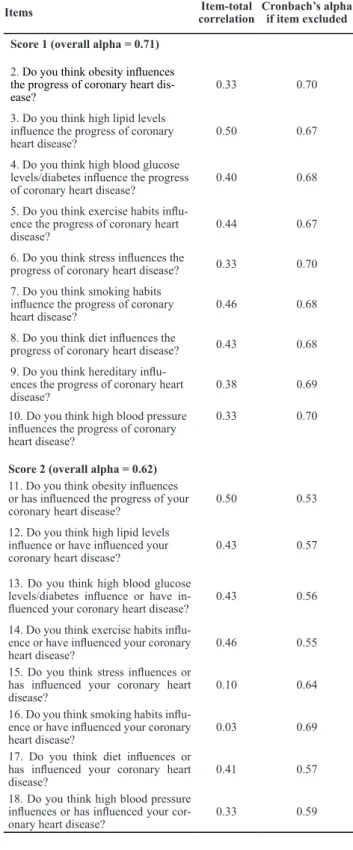
Tables 3 and 4 show overall Cronbach’s alpha va -lues, item–total correlation coefficients (correlation be -tween each item in the domain and its total score), and alpha values when each item was excluded.
Cronbach’s alpha for the items designed to assess general knowledge of cardiovascular RFs (Score 1: ite -ms 2 to 10) was 0.71. With exclusion of each item in -dividually, Cronbach’s alpha ranged from 0.67 to 0.70. The lowest internal consistency was observed for the items that assess specific knowledge of cardiovascular
RFs (Score 2: items 11–18), with Cronbach’s alpha of 0.62. When each of these items was excluded individu -ally, Cronbach’s alpha ranged from 0.53 to 0.69. These values are shown in Table 3.
Table 3 – Overall Cronbach’s alpha for Scores 1 and 2, item-total
correlation coeficients, and Cronbach’s alpha when each item ex
-cluded - Porto Alegre, RS, Brazil, 2009
Items Item-total
correlation
Cronbach’s alpha if item excluded
Score 1 (overall alpha = 0.71)
2. Do you think obesity inluences
the progress of coronary heart dis
-ease? 0.33 0.70
3. Do you think high lipid levels inluence the progress of coronary
heart disease? 0.50 0.67
4. Do you think high blood glucose levels/diabetes inluence the progress
of coronary heart disease? 0.40 0.68
5. Do you think exercise habits inlu
-ence the progress of coronary heart
disease? 0.44 0.67
6. Do you think stress inluences the
progress of coronary heart disease? 0.33 0.70
7. Do you think smoking habits inluence the progress of coronary
heart disease? 0.46 0.68
8. Do you think diet inluences the
progress of coronary heart disease? 0.43 0.68
9. Do you think hereditary inlu
-ences the progress of coronary heart
disease? 0.38 0.69
10. Do you think high blood pressure inluences the progress of coronary heart disease?
Score 2 (overall alpha = 0.62)
0.33 0.70
11. Do you think obesity inluences or has inluenced the progress of your
coronary heart disease? 0.50 0.53
12. Do you think high lipid levels inluence or have inluenced your
coronary heart disease? 0.43 0.57
13. Do you think high blood glucose levels/diabetes inluence or have in
-luenced your coronary heart disease? 0.43 0.56
14. Do you think exercise habits inlu
-ence or have inlu-enced your coronary
heart disease? 0.46 0.55
15. Do you think stress inluences or has inluenced your coronary heart
disease? 0.10 0.64
16. Do you think smoking habits inlu
-ence or have inlu-enced your coronary
heart disease? 0.03 0.69
17. Do you think diet inluences or has inluenced your coronary heart
disease? 0.41 0.57
18. Do you think high blood pressure inluences or has inluenced your cor
-onary heart disease? 0.33 0.59
Table 2 – Internal consistency values and overall scores of the total sample - Porto Alegre, RS, Brazil, 2009
Patients (n=240) Items Valid Instruments
Cronbach’s alpha
Overall internal consistency
240 28 69 0.75
240 25* 153 0.81
240 24† 240 0.78
Score-speciic internal
consistency
Score 1 (9 items) 09 240 0.71
Score 2 (8 items) 08 240 0.62
Score 2 (7 items) 07‡ 240 0.70
Score 3 (8 items) 08 153 0.73
Score 3 (7 items) 07§ 240 0.77
Table 4 shows that Cronbach’s alpha for the LC items (Score 3: items 19–26) was 0.73. When each of these ite -ms was excluded individually, Cronbach’s alpha ranged from 0.66 to 0.75. For the three items that assessed adhe -rence to drug treatment (items 27, 28, and 29), Cronbach’s alpha was 0.20.
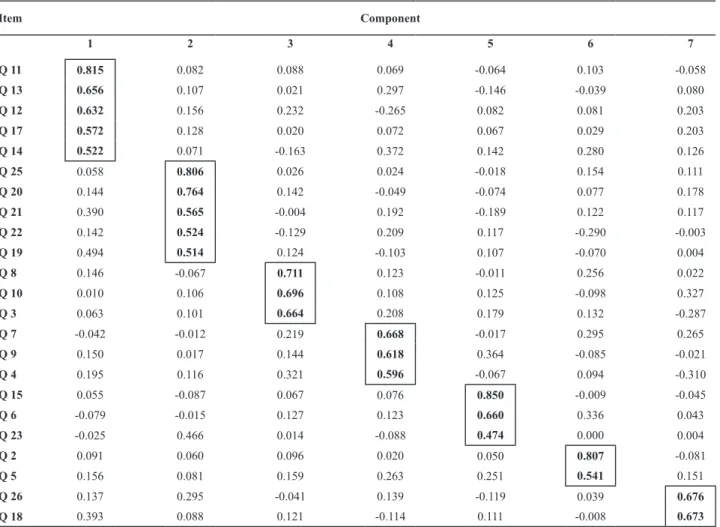
items were assessed. After exploratory PCA, the KMO value was 0.776 and Bartlett’s test was statistically sig -nificant (p < 0.001). We found that 59.6% of the variabi -lity in the 23 analyzed items was explained by variation in the seven artificial components generated by PCA. Component 1 comprised items 11–14 and 17; compo -nent 2 items 19–22 and 25; compo-nent 3 items 8, 10, and 3; component 4 items 7, 9, and 4; component 5 items 15, 6, and 23; component 6 items 2 and 5; and component 7 items 26 and 18 (Table 5).
DISCUSSION
This was the irst Brazilian study to conduct a cross-cul -tural adaptaion and validaion of a quesionnaire about knowledge of cardiovascular RFs, LCs, and adherence to drug treatment in CAD paients. The validaion process was conducted on the basis of systemaic methodological properies in the pursuit of equivalence between the ori -ginal instrument and the adapted version(12). Results sho
-wed that the adapted instrument was validated for use in Brazilian CAD paients.
With regard to reliability, the adapted version of the quesionnaire had Cronbach’s alpha of 0.75. In the origi -nal study, Cronbach’s alpha was 0.73, which shows the similarity of the results obtained and demonstrates item homogeneity(7).
A study published in 2010 validated an instrument in a sample of paients who were taking part in a cardiac reha -bilitaion program. The instrument items measured several domains, but only seven were related to knowledge of car -diovascular RFs. In that study, Cronbach’s alpha was 0.64(17).
Following the same research track as their prior study, the same group of invesigators constructed and validated an instrument to assess knowledge of CAD paients for paient educaion purposes. Of the 19 items, only seven were asso -ciated with knowledge of cardiovascular RFs. In this study, Cronbach’s alpha and the intraclass correlaion coeicient were 0.68 and 0.78, respecively(18). In our study, Cronbach’s
alpha for the items that assessed adherence to drug treat -ment was 0.20. Some studies that used eight- (19) or
seven-item(20) measures of adherence obtained Cronbach’s alpha
values of 0.54 and 0.60, respecively, which suggests that other instruments also failed to exhibit internal consistency for adherence-related items.
On exploratory PCA, the variability of the 23 analyzed ite -ms led to the formaion of seven ariicial components. We can suggest a new grouping and distribuion of items in this validated instrument for use in future studies, as follows. Ite -ms were grouped coherently, enabling an assessment that is more speciically directed at knowledge of RFs. Compo -nent 1 consisted of ive items regarding general knowledge of RFs, such as obesity, blood glucose and lipid levels, diet, and physical exercise. Component 2 consisted of ive items regarding lifestyle changes ater a cardiovascular event, such Construct validity
Items 24, 27, 28, and 29 of the questionnaire we -re excluded from PCA due to missing data. After initial analysis with the Varimax method, item 16 was found to constitute an isolated component and was thus re -moved from subsequent analyses. Items 15 and 23 of the questionnaire showed weak item–total correla -tion (<0.30). However, after analysis with the Varimax method these items formed component 5, comprising three items that have shown the a relationship betwe -en stress and cardiovascular disease. Therefore, 23
Table 4 – Overall Cronbach’s alpha for Score 3, item-total cor
-relation coeficients, and Cronbach’s alpha when each item was excluded - Porto Alegre, RS, Brazil, 2009
Items Item-total
correlation
Cronbach’s alpha if item excluded
Score 3 (overall alpha = 0.73)
19. Have you lost weight with lifestyle changes after your coro
-nary heart disease and/or after your coronary heart operation?
0.49 0.69
20. Have you reduced your lipid levels with lifestyle changes after your coronary heart disease and/or your coronary heart operation?
0.61 0.67
21. Have you reduced your blood glucose levels/diabetes with life
-style changes after your coronary heart disease and/or your heart operation?
0.56 0.67
22. Have you increased your ex
-ercise habits after your coronary heart disease and/or your coronary heart operation?
0.30 0.73
23. Have you reduced your stress level with lifestyle changes after your coronary heart disease and/or your coronary heart operation?
0.20 0.75
24. Have you changed your smok
-ing habits after your coronary heart disease and/or your heart operation?
0.36 0.71
25. Have you made any dietary changes after your coronary heart disease and/or your heart opera
-tion?
0.66 0.66
26. Have you reduced your blood pressure level with lifestyle changes after your coronary heart disease and/or your coronary heart operation?
as changes in dietary habits, lipid and glucose levels, enga -gement in physical acivity, and weight. Components 3 and 4, which comprised three items each, grouped paients’ speciic knowledge of cardiovascular disease. Component 5 comprised three items regarding the relaionship between stress and cardiovascular disease. Component 6 consisted of two items regarding general knowledge of RFs such as obesi -ty and physical exercise. Lastly, component 7 comprised two items regarding the relaionship between blood pressure and cardiovascular disease.
Cardiovascular RFs and strategies for their prevenion and control through health educaion have been well es -tablished and are evidence-based. However, prior to the implementaion of any approach meant to reduce or elimi -nate these factors, it is important to determine the extent of paients’ knowledge of these factors, as well as their po -tenial for adherence to the guidance that will be provided. Study’s limitaions
The shortage of validaion studies of instruments that addressed all of cardiovascular risk factors, thus with analyzes of reliability and validity have limited the discussion of this study.
CONCLUSION
The results show that this quesionnaire was suc -cessfully adapted and validated for use in Brazilian CAD paients. This instrument can support the individualized management of CAD paients and thus contribute to a comprehensive health educaion process.
Further studies are required for a beter understan -ding of the relaionship between knowledge of cardiovas -cular FRs, LCs, and their contribuions to reducion in car -diovascular events in clinical pracice. Future studies using other measures of adherence are warranted.
This paper provides the scieniic community with an instrument that covers aspects of paients’ knowledge of cardiovascular RFs and can serve as a basis for the assess -ment of the efeciveness of intervenions used in clinical pracice. This instrument proved to be a valid indicator for the measurement of these issues. The adapted and validated Brazilian version of this instrument, known as Q-FARCS, consists of several components that are subdi -vided into scores for the quaniicaion of paients’ know -ledge of cardiovascular RFs.
Table 5 –Variability in the 23 items analyzed using a rotated component matrix (Varimax rotation) - Porto Alegre, RS,
Brazil, 2009
Item Component
1 2 3 4 5 6 7
Q 11 0.815 0.082 0.088 0.069 -0.064 0.103 -0.058
Q 13 0.656 0.107 0.021 0.297 -0.146 -0.039 0.080
Q 12 0.632 0.156 0.232 -0.265 0.082 0.081 0.203
Q 17 0.572 0.128 0.020 0.072 0.067 0.029 0.203
Q 14 0.522 0.071 -0.163 0.372 0.142 0.280 0.126
Q 25 0.058 0.806 0.026 0.024 -0.018 0.154 0.111
Q 20 0.144 0.764 0.142 -0.049 -0.074 0.077 0.178
Q 21 0.390 0.565 -0.004 0.192 -0.189 0.122 0.117
Q 22 0.142 0.524 -0.129 0.209 0.117 -0.290 -0.003
Q 19 0.494 0.514 0.124 -0.103 0.107 -0.070 0.004
Q 8 0.146 -0.067 0.711 0.123 -0.011 0.256 0.022
Q 10 0.010 0.106 0.696 0.108 0.125 -0.098 0.327
Q 3 0.063 0.101 0.664 0.208 0.179 0.132 -0.287
Q 7 -0.042 -0.012 0.219 0.668 -0.017 0.295 0.265
Q 9 0.150 0.017 0.144 0.618 0.364 -0.085 -0.021
Q 4 0.195 0.116 0.321 0.596 -0.067 0.094 -0.310
Q 15 0.055 -0.087 0.067 0.076 0.850 -0.009 -0.045
Q 6 -0.079 -0.015 0.127 0.123 0.660 0.336 0.043
Q 23 -0.025 0.466 0.014 -0.088 0.474 0.000 0.004
Q 2 0.091 0.060 0.096 0.020 0.050 0.807 -0.081
Q 5 0.156 0.081 0.159 0.263 0.251 0.541 0.151
Q 26 0.137 0.295 -0.041 0.139 -0.119 0.039 0.676
REFERENCES
1. Piegas LS, Avezum A, Pereira JC, Neto JM, Hoepfner C, Farran JA, et al. Risk factors for myocardial infarcion in Brazil. Am Heart J. 2003;146(2):331-8.
2. Gus I, Fischmann A, Medina C. Prevalence of risk factors for coronary artery disease in the Brazilian State of Rio Grande do Sul. Arq Bras Cardiol. 2002;78(5):478-90.
3. World Health Organizaion. Integrated management of car
-diovascular risk: report of a WHO Meeing [Internet]. Geneva: WHO; 2002 [cited 2012 Mar 22]. Available from: htp://whqli
-bdoc.who.int/publicaions/9241562242.pdf
4. Yusuf S, Hawken S, Ounpuu S, Dans T, Avezum A, Lanas F, et al.; INTERHEART Study Invesigators. Efect of potenially mo
-diiable risk factors associated with myocardial infarcion in 52 countries (the INTERHEART study): case-control study. Lan
-cet. 2004;364(9438):937-52.
5. Maruthur NM, Wang NY, Appel LJ. Lifestyle intervenions re
-duce coronary heart disease risk: results from the PREMIER trial. Circulaion. 2009;119(15):2026-31.
6. Rabelo E, Alii G, Domingues F, Assis MCS, Sai MA, Linhares JC, et al. Enfermagem em cardiologia baseada em evidência. Rev HCPA. 2007;27(2):43-8.
7. Alm-Roijer C, Stagmo M, Udén G, Erhardt L. Beter knowled
-ge improves adherence to lifestyle chan-ges and medicaion in paients with coronary heart disease. Eur J Cardiovasc Nurs. 2004;3(4):321-30.
8. Alm-Roijer C, Fridlund B, Stagmo M, Erhardt L. Knowing your risk factors for coronary heart disease improves adherence to advice on lifestyle changes and medicaion. J Cardiovasc Nurs. 2006;21(5):E24-31.
9. Allen JK, Dennison CR. Randomized trials of nursing interven
-ions for secondary prevenion in paients with coronary ar
-tery disease and heart failure: systemaic review. J Cardiovasc Nurs. 2010;25(3):207-20.
10. Silva AL. Nursing in the era of globalisaion: challenges for the 21st century. Rev Laino Am Enferm. 2008;16(4):787-90.
11. Wood G, Haber J. Pesquisa em enfermagem: métodos, ava
-liação, críica e uilização. Rio de Janeiro: Guanabara Koo
-gan; 2001.
12. Beaton DE, Bombardier C, Guillemin F, Ferraz MB. Guideli
-nes for the process of cross-cultural adaptaion of self-re
-port measures. Spine (Phila Pa 1976). 2000;25(24):3186-91.
13. Surgeons Avansi PoA, Meneghin P. Translaion and adapta
-ion of the In-Hospital Utstein style into the Portuguese lan
-guage. Rev Esc Enferm USP. 2008;42(3):504-11.
14. Beaton D, Bombardier C, Guillemim F, Ferraz M. Recommen
-daions for the cross- cultural adaptaion of the health status measures [Internet]. Rosemont: American Academy of Orto
-paedic Surgeons/Insitute for Work & Health; 2002 [cited 2012 Mar 24]. Available from: htp://med.umn.edu/ortho/prod/ groups/med/@pub/@med/@ortho/documents/asset/med_ asset_360072.pdf
15. Streiner DL. Staring at the beginning: an introducion to coeicient alpha and internal consistency. J Pers Assess. 2003;80(1):99-103.
16. Sapnas KG, Zeller RA. Minimizing sample size when using exploratory factor analysis for measurement. J Nurs Meas. 2002;10(2):135-54.
17. Ghisi GL, Leite CM, Durieux A, Schenkel Ide C, Assumpção MS, Barros MM, et al. Validaion into portuguese of the Maugerl CaRdiac preveniOn-Quesionnaire (MICRO-Q). Arq Bras Cardiol. 2010;94(3):372-8, 94-400.
18. Ghisi GL, Durieux A, Manfroi WC, Herdy AH, Carvalho TD, An
-drade A, et al. Construcion and validaion of the CADE-Q for paient educaion in cardiac rehabilitaion programs. Arq Bras Cardiol. 2010;94(6):813-22.
19. Korb-Savoldelli V, Gillaizeau F, Pouchot J, Lenain E, Postel-Vi
-nay N, Plouin PF, et al. Validaion of a French Version of the 8-Item Morisky Medicaion Adherence Scale in Hypertensive Adults. J Clin Hypertens (Greenwich). 2012;14(7):429-34.
20. Silva Carvalho AR, Dantas RA, Pelegrino FM, Corbi IS. Adapta
-ion and valida-ion of an oral anicoagula-ion measurement of treatment adherence instrument. Rev Laino Am Enferm. 2010;18(3):301-8.
Acknowledgements
We would like to thank Carin Alm-Roijer and the other authors of the original instrument for authorizing our adaptaion and validaion of this quesionnaire for use in Brazil.