RESUMO
O objetivo do estudo foi elaborar títu-los de Diagnósticos e Resultados de En-fermagem (DE/RE) por meio da relação entre os termos do Processo do Sistema Circulatório do eixo Foco e termos de outros eixos da CIPE® e integrá-los em uma ontologia. Foram construídos títulos relacionando 17 termos do eixo Foco, os quais foram avaliados por enfermeiros especialistas de cinco cidades brasileiras. Incluíram-se na ontologia os títulos cuja concordância de uso foi acima de 0,80. Foram elaborados 89 títulos de DE/RE sustentados pela literatura e 19 não sus-tentados; 37 foram avaliados como pas-síveis de utilização na prática assistencial e incluídos na ontologia. A construção de títulos de DE/RE com base na CIPE® e utilizando uma representação formal de conhecimento é um trabalho que exige aprofundamento de conceitos utilizados pela enfermagem e adequação às revi-sões da classificação. Os títulos elabora-dos facilitarão a composição de diagnós-ticos mais coerentes com a prática.
DESCRITORES Diagnósico de enfermagem Classiicação
Sistema cardiovascular Vocabulário controlado Processos de enfermagem
Nursing diagnoses and outcomes related
to the circulatory-system terms (INCP
®)
represented in an ontology
*O
riginal
a
rticle
ABSTRACT
The aim of the present study was to de-velop titles of Nursing Diagnoses and Outcomes (ND/NO) through the rela-tionship between the terms of the Focus axis, limited to the Circulatory System Process, and the terms of other ICNP® axes and to integrate these terms into an ontology. Titles were developed linking 17 terms of the focus axis, which were evaluated by expert nurses in five Brazil-ian cities. Titles whose use concordance was above 0.80 were included in the ontology. In total, 89 titles for ND/NO were supported in the literature, and 19 were not supported; 37 were assessed as eligible for use in healthcare practice and were included in the ontology. The construction of ND/NO titles based on the ICNP® and using a formal representa-tion of knowledge is a task that requires deepening concepts used for nursing and adequate classification revisions. The elaborated titles will facilitate the composition of diagnostics that are more consistent with practice.
DESCRIPTORS Nursing diagnosis Classiicaion Cardiovascular system Vocabulary controlled Nursing process
RESUMEN
El objeivo del estudio fue elaborar ítulos de diagnósicos y resultados de enfermería (DE/ RE), uilizando la relación entre los términos del Proceso del sistema circulatorio del eje central, y términos de otras líneas de la CIPE® e integrarlas en una ontología. Fueron cons-truidos ítulos haciendo el enlace de 17 tér -minos del eje central, los cuales fueron eva-luados por enfermeras especialistas de cinco ciudades brasileñas. Se incluyeron en la onto-logía los ítulos cuya concordancia de uso fue superior a 0,80. Fueron elaborados 89 ítulos de DE/RE sostenidos por la literatura y 19 sin apoyo sostenido, 37 fueron evaluados como posibles ítems para su uilización en la prác -ica asistencial e incluidos en la ontología. La construcción de los ítulos de DE/RE sobre la base de la CIPE® y uilizando una represen -tación formal del conocimiento es una tarea que requiere una mayor profundización de los conceptos uilizados por la enfermería y adecuación a las diversas revisiones de la cla-siicación. Los ítulos elaborados facilitarán la composición de diagnósicos más coherentes con la prácica.
DESCRIPTORES Diagnósico de enfermería Clasiicación
Sistema cardiovascular Vocabulario controlado Procesos de enfermería Marcia Regina Cubas1, Arianny Macedo Brondani2, Andreia Malucelli3
DIAGNÓSTICOS E RESULTADOS DE ENFERMAGEM RELACIONADOS AOS TERMOS
DO SISTEMA CIRCULATÓRIO - CIPE® REPRESENTADOS EM UMA ONTOLOGIA
DIAGNÓSTICOS Y RESULTADOS DE ENFERMERÍA RELACIONADOS A LOS TÉRMINOS
DEL SISTEMA CIRCULATORIO - CIPE® REPRESENTADOS EN UNA ONTOLOGIA
* Extract from the dissertation “Relacionamento entre termos da CIPE® para compor diagnósticos de enfermagem relacionados ao foco processo do sistema circulatório [Relationship between the terms of ICNP® to compose nursing diagnostics related to the focal process of the circulatory system],” Pontiical Catholic University of Paraná (Pontifícia Universidade Católica do Paraná – PUCPR), 2010. 1 PhD in Nursing. Professor of the Graduate Program in Health
Technology, Pontiical Catholic University of Paraná (Pontifícia Universidade Católica do Paraná – PUCPR). Curitiba, PR, [email protected] 2Nurse.
Master in Health Technology. Nurse of Hospital Vita Curitiba. Curitiba, PR, Brazil [email protected] 3PhD in Electrical and Computer Engineering.
INTRODUCTION
O The Nursing Process (NP) is an instrument that al-lows for organizing thoughts for planning and
decision-making, as well as providing resources for the registraion and evaluaion of the care provided. In Brazil, the Federal Nursing Council presented the NP in ive phases through
Resoluion no. 358/2009: data collecion, nursing diagnos
-ics, planning, implementaion, and evaluaion of care(1).
For nursing care based on NP to be visible in
infor-maion systems, it is necessary for the knowledge to be
represented through a standardized language. The
mech-anisms of knowledge representaion in the ield of com
-puter science facilitate the implementaion of comput
-able structures; the ield of informaion science en-ables the elaboraion of languages that allow the retrieval and organizaion of informaional content; and in the ield of terminology, it is possible to systemaize concepts and
consistent deiniions(2).
Currently, several classiicaion systems are compaible with computer systems that
describe nursing care, including the
Inter-naional Classiicaion for Nursing Pracice
(ICNP®)(3). Because this system is a muli
-axial classiicaion of terms represented in
a seven-axis model (i.e., Focus, Judgment,
Means, Time, Locaion, Client, and Acion),
it allows for combining the terms belonging
to the axes and for composing itles called Nursing Diagnoses (ND), Intervenions, and
Outcomes.
The ICNP® deines ND as a consequence of nurses’ acions related to human needs,
organized to produce results(4). Understood as a nominal category, ND is an expression
that represents the health situaions in
-luenced by nursing acions(5). In developing the ND, the
nurse performs acions and prescribes treatment to ob
-tain an expected Nursing Outcome (NO). When the
Nurs-ing Intervenion (NI) ends, the NO is obtained, deined by
ICNP® as a diagnosis changed over ime(4).
The nominal composiion of the ND or NO follows a ge
-neric guide of associaion and restricion: it must include a
term from the Focus axis and one or more terms from the Judgment axis; the terms from other axes, except for the
Acion axis, used in the composiion of Intervenions are
used if a greater speciicity is required in the declaraion(4).
Due to the many combinaions of terms between the ICNP® axes, inconsistencies may occur in elaboraing the
ND or NO(6). Thus, the use of this classiicaion does not ensure that the nurse correctly names the ND or NO. This
problem is recognized by the Internaional Council of Nurs
-es (ICN), which included a knowledge repr-esentaion fea
-ture ater ICNP® version 1.0—more speciically, ontology.
Ontology is deined as a formal, explicit speciicaion of a shared conceptualizaion(7). It is a manifestaion of the understanding of a domain (in this case, nursing) that is common and shared between the members of a com-munity that represent this domain (in this case, nurses)(8).
An ontology is used to improve communicaion between
people, between people and machines, and between ma-chines, and it enables interoperability between computer systems through unifying languages. Ontologies can be maintained and reused(8).
The ICN clariies that the ICNP® ontology can deine and combine the relaionships between terms, which is a
form of support necessary to avoid ambiguiies and incon
-sistencies in the elaboraion of ND, NO, and NI(4). These
relaionships are constructed based on pre-established
rules of associaion and restricion, and in the case of IC
-NP®, they are essenial for elaboraing ND/NO itles and
reuse of the ontology.
Although there is an efort within the ICN to minimize inconsistencies by construcing catalogs, the
problem remains even when the ND/NOs in a class of ICNP® are compared with the ND/
NOs in other classiicaion systems.
Studies that used the NANDA
Interna-ional to propose an ND set for clients who
require nursing care related to the circula-tory system(9-10), employed terms of other
IC-NP® subclasses in the nominal composiion of ND, such as Pain (subclass, Percepion;
class, Nervous System Process) and Urinary Output (class, Urinary System Process)(9-10).
The aim of the present study was to
elab-orate ND/NO itles from rules of associaion
between terms of the Focus axis, Process class, Body Process subclass, Circulatory Sys-tem Process subclass, and terms of other axes that
com-pose the ICNP® (except for those that comcom-pose the Acion
axis) and to represent these terms in an ontology. This work is the result of a Master’s thesis that is available at
e<htp://www.biblioteca.pucpr.br/tede/tde_busca/arqui
-vo.php?codArquivo=1950>, and the present invesigaion
is part of two research projects that, among other goals,
suggests construcing a Brazilian ontology.
METHOD
The present study was developed in three stages: the combinaion of terms in the Circulatory System Process class
from the Focus axis and other ICNP® axes (except for the
Ac-ion axis) to compose possible ND/NO itles for the Circula
-tory System Process, the evaluaion of the itles by expert nurses, and the inclusion of the valid itles in an ontology.
The irst stage consisted of a descripive documentary study. To this end, versions 1.0, 1.1, and 2.0 of ICNP® were Studies that used
the NANDA International to propose an ND set for clients who require
nursing care related to the circulatory system, employed
terms of other ICNP®
subclasses in the nominal composition
used. Three different versions were used because at the stage of data collection, only version 1.0 had been translated into Portuguese; moreover, versions 1.1 and
2.0 included new terms and definition changes, as well
as modifications of the classification hierarchy.
Version 2.0 of ICNP® had 19 atomic terms in the Fo
-cus axis that defined the Circulatory System Process.
Of these, the following 17 were selected: Arrhythmia,
Bradycardia, Tachycardia, Hypertension, Hypotension, Bleeding, Hemorrhage, Hematoma, Menorrhagia, Deep Vein Thrombosis, Shock, Anaphylactic Shock, Cardio-genic Shock, Hypovolemic Shock, NeuroCardio-genic Shock, Septic Shock, and Vasogenic Shock. The following two
terms were excluded: Cardiac Process because it is
a term only used to compose the class at the top of the hierarchy; and Menorrhagia because it is a specific term for women’s health, which would determine the inclusion of experts in that domain.
Next, a conceptual analysis of each selected term was conducted. This analysis involved revising each concept
in search of a beter descripion of the pathophysiology
and clinical classiicaion using the ICNP® versions, bibli
-ographies related to the Circulatory System, Portuguese
dicionaries, and technical dicionaries. This process was necessary because the term in the ICNP® is oten reduced
or limited to a certain type of client (e.g., Bradycardia and Tachycardia are parameters limited to adults). Therefore,
the references were used to expand the deiniion and to provide a thorough descripion of the pathophysiological characterisics.
The terms were then organized in a worksheet that related the term, the definition offered by ICNP®, a brief description of the pathophysiology, and possible evidence to associate terms capable of nominally com-posing ND or NO. From this worksheet, the legal limits of nursing were verified using the perspective of nurs-ing actions and interventions listed in regulations and legislation from the Federal Nursing Council.
After this process, the ND/NO titles were
elabo-rated according to ISO 18.104/2003(11). The 17 terms
of the Focus axis were related to each of the terms in the Judgment axis by restricting combinations and us-ing concept analysis as a base and by askus-ing the
fol-lowing questions: Does the Focus term have a Judg
-ment? If yes, then which Judgment is consistent and coherent? This first set of combinations was used to find the combination of each term with terms from the other axes, thereby reducing
inconsisten-cies based on the following questions: Does the ND/
NO require a complimentary term? If yes, then which
terms from the Means, Time, Location, and Client ax
-es are consistent and coherent for this arrangement?
The final set of combinations was the basis for the
instrument, the ND and NO were placed in a single list because some titles can consist of both diagnostics and results. The titles were divided into two
catego-ries: titles whose composition was supported by the
literature, meaning there was a definition of the ND/ NO title in nursing publications or in the description of concepts; and titles whose composition was not sup-ported by the literature, that is, descriptions of these compositions were not found in the literature, but the compositions were utilized in nursing practice.
The second stage consisted of an exploratory and descriptive field study, the sample of which consisted
of 15 nurses from hospitals with nursing services that
used classification systems and the Nursing Care Sys-tematization with NP application for a period exceeding five years.
A To increase the representativeness of the prac-tices in Brazil, these nurses were selected from five
different cities: São Paulo-SP, Porto Alegre-RS, Belo
Horizonte-MG, João Pessoa-PB, and Florianópolis-SC. These locations were chosen because they have graduate nursing programs with lines of research in-cluding classification systems, particularly the ICNP®.
The criteria for including nurses were as follows:
having at least two years of experience in the field of adult healthcare; having a graduate nursing program in their respective city as a reference; or having a publica-tion in the specific area within the previous three years. Nurses who were dedicated to direct patient care for less than six hours per day were excluded.
The selection of experts followed these steps: a)
an e-mail with a cover letter was sent to six professors at the graduate nursing programs in the cities listed above, requesting the appointment of three nurses; b) an e-mail containing a cover letter, an invitation to par-ticipate, a consent form, and an assessment form with guidelines for completion was sent to the nursing ex-perts who were recommended.
Due to the lack of recommendations within the col-lection period, the city of Florianópolis had no repre-sentatives and thus was replaced by Curitiba-PR. Of the number selected, eight professionals responded to the form completely, three did not respond, and four re-plied with incomplete forms. The form was resent to the latter group, with a request for completion. How-ever, three of these individuals did not return the form. Consequently, the total number of evaluators was nine professionals.
used in their practice. If the answer was negative, then an explanation was requested as an optional item.
The data were calculated with the Concordance In-dex (CI), using the formula CI=C/(NC+C), where NC=no concordance and C=concordance(12). The titles with in-dices above 0.80 were considered possible statements used in professional practice. The reasons for non-use were categorized and discussed.
The third stage was characterized as a development study. The ND/NO titles that obtained a CI above 0.80 were included in an ontology, following a method(13)
whose steps, in general, are as follows: establish the
domain and extension of the ontology; verify the con-ditions for reusing other ontologies; list the important terms; define the classes and hierarchies between the classes; define the properties between the classes; and define the restrictions between the classes.
The ontology was constructed using the ontology edi-tor Protégé 3.4.1 (Available at: <htp://protege.cim3.net/
download/old-releases/3.4.1/full/>), represented in the
OWL language, which allowed the ontology to be integrat
-ed into an informaion system. The inference machine Pel
-let was used (Available at: htp://clarkparsia.com/pel-let),
which is a reasoning mechanism provided by Protégé that
can automaically verify the constructed classiicaion for
coherence with the properies of the ontology and consis
-tency in the hierarchical structure.
The project that generated this study was approved by the Research Ethics Committee at the Pontifical Catholic University of Paraná (Pontifícia Universidade
Católica do Paraná - PUCPR) under number 3309/2009.
RESULTS
In the irst stage, 89 ND/NO itles were composed; sever
-al were supported by the literature or by the ICNP® concept, whereas 19 were not supported. Certain terms from the Fo-cus axis, when combined with terms from other axes, were
classiied in both lists.
For example, when the ICNP® definition of Arrhyth-mia was a variation of the normal rhythm of arterial contraction (...)(4), the nurse could obtain evidence of such changes by evaluating the electrocardiogram and could associate terms from the Judgment axis,
composing two possible ND/NOs: Initial Arrhythmia
or Current Arrhythmia. However, when verifying pos-sibilities for association with terms in the Frequent
Time axis, which is defined as the rate of repetition is high during a period of time: 7-9(4), the profes-sional was faced with establishing an incompatible time interval, which could determine a possible asso-ciation but was not consistent with the ICNP® defini-tion because establishment of the arrhythmia period
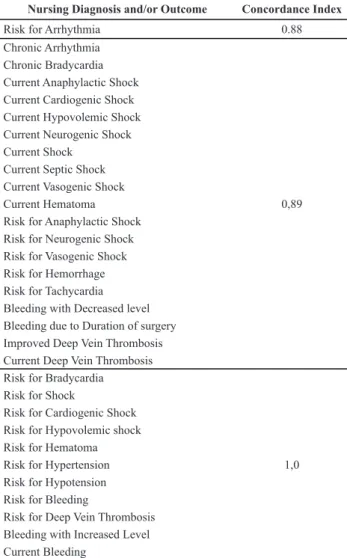
Table 1 – Diagnosis and Outcome titles supported in the litera-ture, with their respective concordance indices for use in health-care practice.
Nursing Diagnosis and/or Outcome Concordance Index
Risk for Arrhythmia 0.88
Chronic Arrhythmia Chronic Bradycardia Current Anaphylactic Shock Current Cardiogenic Shock Current Hypovolemic Shock Current Neurogenic Shock Current Shock
Current Septic Shock Current Vasogenic Shock
Current Hematoma 0,89
Risk for Anaphylactic Shock Risk for Neurogenic Shock Risk for Vasogenic Shock Risk for Hemorrhage Risk for Tachycardia Bleeding with Decreased level Bleeding due to Duration of surgery Improved Deep Vein Thrombosis Current Deep Vein Thrombosis Risk for Bradycardia Risk for Shock
Risk for Cardiogenic Shock Risk for Hypovolemic shock Risk for Hematoma
Risk for Hypertension 1,0
Risk for Hypotension Risk for Bleeding
Risk for Deep Vein Thrombosis Bleeding with Increased Level Current Bleeding
Table 2 – Diagnosis and Outcome titles not supported in the literature, with their respective concordance indices for use in healthcare practice.
Nursing Diagnosis and/or Outcome Concordance Index
Acute Arrhythmia
Frequent Arrhythmia
Intermittent Arrhythmia
Acute Bradycardia 0,89
Acute Tachycardia
Acute Hypotension 1,00
In the second stage, there was agreement from the experts regarding the use of 31 titles supported by the
literature (35%) and six unsupported titles (32%) in
healthcare practice, totaling 37 ND/NOs with a concor-dance of use and 71 without concorconcor-dance. The Diag-nosis and Outcome titles evaluated as candidates for use in healthcare practice, with their respective CIs, are
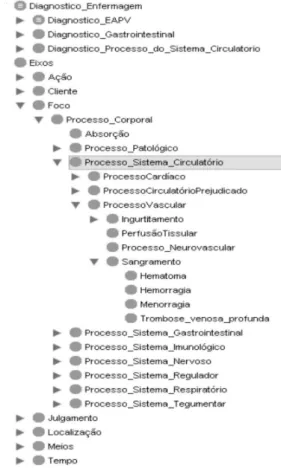
Figure 1 – Example of the Superclasses and Subclasses (Protégé Interface).
Figure 2 - Restrictions of the Acute_arrhythmia class. In the third stage, the inclusion, organization, and presenta-tion of the ontology of the valid ND/NO titles occurred accor-ding to the hierarchical model of ICNP® 2.0, thereby yielaccor-ding
the following results: The scope of the ontology was deined as
the Circulatory System Process, and there was reuse of the on-tology proposed for Brazil(6). The 37 ND/NO titles were listed. The terms that comprised the ND/NO titles for the Circulatory System Process were considered subclasses of the Focus class, which had the Axis class as a superclass (Figure 1). All the ND/ NO titles were considered subclasses of the Diagnostic Circu-latory System Process class, which is a subclass of the Nursing Diagnostic class and has two subclasses: Circulatory System Process and Impaired Vascular System Process.
The properies of the uilized classes were hasFocus,
hasJudgment, hasLocaion, hasMeans, hasClient,and
has-Time.The restricions for each itle were created for each
individual class, with a scieniic basis, to avoid construct
-ing inconsistent itles.
Figure 2 presents an example of restricions of the
Acute_arrhythmia class, with which it is possible make the
following inferences: hasClient onlyIndividual, hasFocus
only Arrhythmia, hasJudgment only Current, hasTime only
Acute, and hasMeanssome drug or dialysis technique.
Of the 31 itles whose composiion was supported by the
literature and evaluated by nursing experts for use in
health-care pracice, 35.5% obtained a CI of 1.00 (Table 1). In this category, the presence of 48% of the itles in the Risk context was highlighted, and the percentage was 82% in the group
that exhibited a CI of 1.00. This result is related to the fact that professionals are increasingly concerned with
preven-ive intervenion measures.
The composiions of 58 ND/NO itles were supported
in the literature but did not obtain agreement from
ex-perts regarding their use in pracice. Because the explana
-ion was op-ional, the reasons that these itles were not
used was not obtained for eight itles. A lack of scienii
-cally based explanaions was observed although the com
-pleion instrucions requested a reference that supported
the disagreement. The main reasons for non-concordance
were as follows: a) refusal of ND, understood as NO; b)
refusal of the judgment, means, or ime ofered to the fo
-cus; c) failure to understand the composiion of the itle
or how to respond; d) use of the focus term alone,
with-out combining it with a judgment; e) wording of the itle diferently than ofered; and f) use of the broader term
that was superior to the hierarchical subclass.
This result displayed limitaions, given the understanding
of the concept of NO applied to ICNP®, although the
instru-ment for collecing the deiniion was present in the guidelines provided to the paricipants. For example, for the Diagnosis
iniiated cardiogenic shock, the Outcome interrupted
cardio-genic shock was expected as one of the possibiliies. The pro
-fessionals who did not use this reasoning had diiculty com
-posing the referred focus with the judgment interrupted and
generaing comments such as, I do not understand this
state-ment, or, The interrupted term does not apply to a diagnosis.
This fact can be explained by two circumstances. The irst
regards a limitaion resuling from the form given to the ex
-perts, which did not separate the ND from the NO, thereby
creaing the belief that if these categories were displayed in diferent spreadsheets, the understanding of the itles’ use by the experts would be beter and would minimize the
problem related to the concept.
The second circumstance is directly related to the deini
-ion of NO. For the ICNP®, the NO is one measure or status of
a diagnosis ater the NI, i.e., they are changes in the diagno
-sis in response to the intervenions, which are evaluated at diferent imepoints. In this view, the NO can be used as an
expected result, meaning what is desired, and as a result that
has been achieved and became efecive ater the interven
-ion(15). Nurses who use NANDA Internaional(16) use the
con-cept of outcome as a descripion of a client’s state, behav
-iors, percepions, or(17) atercare. The results of the nurses’
acions are measured by indicators, using a scale from 1 to
5(15), and the NO is not viewed as a modiied ND.
Regarding the reasons for not acceping the judgment, means, or ime ofered for the focus, and using the focus in
isolaion, some experts limited themselves to the presence
of the sign and/or symptom that directed the focus but did
not provide a judgment. The following comment exempliies the situaion: I think, in these cases, we are ‘forced’ to include
a judgment term.
Establishing diagnoses using a classiicaion system is
a skill that must be learned and reinforced by using the NP
pracice. Insuicient theoreical knowledge about taxono
-mies was reported as the most important cause for diiculty in the pracical applicaion of ND by nurses in a university
hospital in São Paulo(17).
Certain nurses, by using a reducion of the itle diferently than was provided, jusiied the non-concordance by staing
that the other axes were factors related to composing the
raionale of the diagnosis decision. For example, an expert
stated, in relaion to the term of the ime axis duraion of
surgery, [...] in our pracice, we use the factor related to all diagnoses, which makes me have this type of relecion.
Other nurses suggest the necessity of including the
re-lated factor and the deining characterisics in ICNP®, similar
to the perspecive of NANDA Internaional(16). Although this
step is not one of the purposes of classiicaion, the ICNP®
does contemplate the deiniion of certain terms that mini
-mize the requirement stated by the experts. An example is the term Bleeding, whose concept in the ICNP®(4) includes an
associaion with the destrucion of blood vessels, rupture of the outer skin or internal organs, or spaces between issues.
In total, 14 ND/NOs whose composiion was not support
-ed by the literature also did not obtain an evaluaion of use in pracice. The main reasons from the nurses were similar to those ofered for the itles with descripions supported
by the literature. However, in this set, it was perceived that
the experts had diiculty establishing thetemporality of the
focuses or did not have suicient knowledge to use this tem
-porality more appropriately.
From the perspecive and the context of accuracy in the
nursing diagnosis process, experts can reach diferent diag
-nosic conclusions regarding the same set of paient data, which is a situaion that is present in other clinical seings,
not only nursing diagnosis(18). This fact can support the
argu-ment that some of the itles, even those supported by the literature, have not reached a CI above 0.80; and other itles,
although there is no evidence in the literature, are used in
pracice. This argument is combined with the discussion that the clinical reasoning used to deine diagnoses is a complex and dynamic mental process, which occurs in idenifying
situaions and acions necessary for care, and that the dif
-iculies in establishing diagnoses are related, among other
factors, to the degree of knowledge required to observe
nor-mal manifestaions or behavioral changes(19).
A study conducted in diferent clinics of the Lauro Wanderly Hospital /UFPB exposed a set of 257 ND/
NOs from ICNP®, with their respecive nursing interven
indings were compared with the results from the present
study, terms from Circulatory System Process were ideni
-ied in the requirement for Vascular Regulaion, with only
Bleeding (current) and Risk for Bleeding being common to
the itles presented in this manuscript, out of the 21 pro
-posed diagnosic statements(20).
Although not only ND/NOs that are based on the IC-NP® are used, five titles were identified in the lists of an information system database to support the implemen-tation of the NP developed by the Brazilian Nursing As-sociation(21) and to verify the presence of the ND Risk of Shock and Risk of Bleeding in the diagnoses proposed by NANDA International(16).
Regarding the inclusion of statements in the pro-posed Brazilian ontology(6), this procedure followed the above-described method and was consistent after ap-plying the Pellet inference mechanism, resulting in a coherent classification with the developed structure.
The construction of ontologies is a necessarily in-terdisciplinary process that requires constant revisions and enables the development of a shared vision of a knowledge domain(22). The challenge lies in organizing
the specific domain of knowledge in a coherent man-ner and in improving the reasoning power of machines to support the decision-making of the various partici-pants in the process(22).
CONCLUSION
This study involved 17 terms from a single ICNP® subclass
and presented 37 ND/NO itles evaluated as feasible for use
in healthcare pracice and that subsequently can be em
-ployed to form terminology subsets.
The construcion of ND/NO itles based on the ICNP® is
a task that requires further understanding of the concepts
used in nursing theory and pracice, as well as an adjustment to the constant reviews of the classiicaion. It is believed that the itles that were presented in the present study and that
are available in an ontology will facilitate the performance and learning of professional nurses and nursing students, thereby yielding diagnoses that are more coherent with
pro-fessional pracice.
REFERENCES
1. Conselho Federal de Enfermagem. Resolução COFEn
358/2009. Dispõe sobre a Sistematização da Assistência de
Enfermagem e a implementação do Processo de Enferma-gem em ambientes, públicos ou privados, em que ocorre o
cuidado profissional de Enfermagem, e dá outras providên
-cias [Internet]. Rio de Janeiro; 2009 [citado 2012 mar. 22]. Disponível em: http://novo.portalcofen.gov.br/resoluo-cofen-3582009_4384.html
2. Campos MLA. Modelização de domínios de conhecimen
-to: uma investigação de princípios fundamentais. Ci Inf. 2004;33(1):22-32.
3. Dykes PC, Kim H, Goldsmith DM, Chol J, Ezumi K, Goldberg HS. The adequacy of ICNP version 1.0 as a representational model for electronic nursing assessment documentation. J
Am Med Inform Assoc. 2009;16(2):238-46.
4. Conselho Internacional de Enfermeiros. CIPE - Classificação Internacional para a Prática de Enfermagem. Versão 1.0.
São Paulo: Algol; 2007.
5. Cruz DALM. Diagnóstico de enfermagem. In: Garcia TR,
Egry EY. Integralidade da atenção no SUS e sistematização
da assistência de enfermagem. São Paulo: Artmed; 2010.
p.111-7.
6. Silva RR, Malucelli A, Cubas MR. Em direção à ontologia
CI-PESC®. J Health Inform. 2009 [citado 2012 mar. 22];1(1):22-6. Disponível em: http://www.jhi-sbis.saude.ws/ojs-jhi/
index.php/jhi-sbis/article/view/89/74
7. Gruber TR. A translaion approach to portable ontology espe
-ciicaion [Internet]. Stanford, CA: Knowledge Systems Labo
-ratory; 1993 [cited 2012 Feb 20]. Available from: htp://www.
dbis.informaik.hu-berlin.de/dbisold/lehre/WS0203/Sem
-Web/lit/KSL-92-17.pdf
8. Uschold M, Gruninger M. Ontologies: principles, methods and
applicaions. Knowl Eng Rev. 1996;11(2):93-126.
9. Lima RL, Pereira SVM, Chianca TCM. Diagnósticos de enfer
-magem pós-cateterismo cardíaco: contribuição de Orem. Rev Bras Enferm 2006;59(3):285-90.
10. Galdeano LE, Rossi LA, Pezzuto TM. Diagnósticos de en
-fermagem de pacientes no pré-operatório de cirurgia
cardíaca. Rev Esc Enferm USP. 2004;38(3):307-16.
11. Cubas MR, Denipote AGM, Malucelli A, Nóbrega MML.
The ISO 18.104-2003: as Integraive Model of Nursing Ter
-minologies. Rev Laino Am Enferm. 2010;18(4): 669-74.
12. Garcia TR, Nóbrega MML, Sousa MCM. Validação das deinições de termos ideniicados no projeto CIPESC para
o eixo foco da práica em enfermagem da CIPE. Rev Bras En
-ferm. 2002;55(1):52-63.
13. Noy NF, McGuinness DL. Ontology development 101: a
14. Ori Z, Monir G, Weiss J, Sayhouni X, Singer DH. Heart
rate variability: frequency domain analysis. Cardiol Clin. 1992;10(3):499-537.
15. Garcia TR, Cubas MR, Almeida MA. Resultados de
enferma-gem. In: Garcia TR, Egry EY. Integralidade da atenção no SUS e sistemaização da assistência de enfermagem. São Paulo: Artmed; 2010. p. 127-34.
16. NANDA Internaional. Diagnósicos de enfermagem da NAN
-DA: deinições e classiicação 2009-2011. Porto Alegre: Art
-med; 2010.
17. Takahashi AA, Barros ALBL, Michel JLM, Souza MF. Dii
-culies and faciliies pointed out by nurses of a university
hospital when applying nursing process. Acta Paul Enferm.
2008;21(1):32-8.
18. Matos FGOA, Cruz DALM. Development of an instrument
to evaluate diagnosis accuracy. Rev Esc Enferm USP
[Inter-net]. 2009 [cited 2012 Apr 25];43(n.spe1):1088-97. Avail
-able from: htp://www.scielo.br/pdf/reeusp/v43nspe/en_
a13v43ns.pdf
19. Carvalho EC, Jesus CAC, Bachion MM. Raciocínio clínico e
es-tabelecimento dos diagnósicos, dos resultados e das inter
-venções de enfermagem. In: Garcia TR, Egry EY. Integralidade
da atenção no SUS e Sistemaização da Assistência de Enfer
-magem. Porto Alegre: Artmed; 2010. p. 135-41.
20. Nóbrega MML, organizadora. Diagnósicos, resultados e in
-tervenções de enfermagem para clientes hospitalizados nas
unidades clínicas do HULW/UFPB uilizando a CIPE®. João Pessoa: Ideia; 2011.
21. Garcia TR, Cubas MR, organizadoras. Diagnósicos, inter
-venções e resultados de enfermagem: subsídios para siste
-maização da práica proissional. Rio de Janeiro: Elsevier; 2012.
22. Miguel V, Lopez MG, Montano N. Desarrollo de una ontología
para la conceptualización de un ambiente virtual de