RESUMEN
Objeivo: Evaluar el uso y llenado de la
Li-breta de Salud Infanil (LSI), especialmente el crecimiento y el desarrollo. Método:
Es-tudio transversal con 358 pares de madres e hijos matriculados en 12 Unidades Bási
-cas de Salud (UBS) de una ciudad pequeña. Las madres fueron entrevistadas en el UBS desde febrero a abril 2013 mediante un cuesionario. Se uilizó Epi-info y sotware SPSS. Resultados: 53% de las madres esta
-ban llevando LSI durante la entrevista, pro
-porción similar a las madres que recibieron instrucciones para llevar el LSI a la atención de la salud. Anotaciones en LSI durante las visitas se registraron en un 49%. Calendario de vacunas fue completa en el 97% de LSI, pero sólo el 9% y el 8% de LSI tenido, res
-pecivamente, las curvas de crecimiento y desarrollos debidamente cumplimentados. Conclusión: El uso y el relleno saisfactorio de LSI refuerzan la necesidad de inversión en la formación profesional y el acerca
-miento a la comunidad para la LSI se con
-vierte efecivamente en un instrumento de promoción de la salud infanil.
DESCRIPTORES Salud del niño
Crecimiento y desarrollo Promoción de la Salud Atención Primaria de Salud RESUMO
Objeivo: Avaliar uso e preenchimento da Caderneta de Saúde da Criança (CSC), especialmente crescimento e desenvolvi
-mento. Método: Estudo transversal com 358 pares mãe-criança atendidos em 12 Unidades Básicas de Saúde (UBS) de muni
-cípio de pequeno porte. As mães foram en
-trevistadas nas UBS, de fevereiro a abril de 2013, com o uso de quesionário. Uilizou-se sotwares Epi-info e Stata. Resultados: No momento da entrevista, 53% das mães portavam a CSC, proporção similar à de mães que referiram orientação para levar a CSC aos atendimentos de saúde. Anotações na CSC durante os atendimentos foram re
-feridos por 49%. Esquema vacinal estava completo em 97% das CSC, mas apenas 9% e 8% das CSC inham, respecivamente, gráicos de crescimento e desenvolvimento adequadamente preenchidos. Conclusão: O uso e o preenchimento insaisfatório da CSC reforçam a necessidade de invesimen
-tos na capacitação dos proissionais e na sensibilização da comunidade para que a CSC se torne efeivamente um instrumento de promoção da saúde infanil.
DESCRITORES Saúde da criança
Crescimento e desenvolvimento Promoção da Saúde
Atenção Primária à Saúde ABSTRACT
Objecive: To evaluate the use and records of the Child Health Handbook (CHH), espe
-cially growth and development. Method:
Cross-secional study with 358 mother-child pairs registered in 12 Primary Health Centers (PHCs) of a small municipality. Mo
-thers were interviewed at the PHC from Fe
-bruary to April 2013 using a quesionnaire. Data analysis was done using WHO Anthro sotware, Epi InfoTM and Stata. Results: Fif
-ty-three percent of the mothers were car
-rying the CHH at the ime of the interview, similar to the proporion of mothers who were instructed to bring the CHH to health appointments. Annotaions in the CHH du
-ring the visits were reported by 49%. The vaccinaion schedule was completed in 97% of the CHH, but only 9% and 8% of the CHH, respecively, contained growth charts and properly completed developmental milestones. Conclusion: Low rates of use and unsaisfactory record-keeping in the CHH reinforce the need for investment in professional training and community awa
-reness for the CHH to become an efecive instrument of promoion of child health.
DESCRIPTORS Child health
Growth and development Health Promoion Primary Health Care
Use and records of child health handbook
focused on growth and development
Claudia Nery Teixeira Palombo1, Luciane Simões Duarte2 , Elizabeth Fujimori3,
Áurea Tamami Minagawa Toriyama4
USO E PREENCHIMENTO DA CADERNETA DE SAÚDE DA CRIANÇA COM FOCO NO CRESCIMENTO E DESENVOLVIMENTO
USO Y LLENADO DE LA LIBRETA DE SALUD INFANTIL CON EL FOCO EN EL CRECIMIENTO Y EL DESARROLLO
1 Doctoral Student, Graduate Program in Sciences, Nursing School, University of São Paulo, São Paulo – São Paulo, Brazil. 2 Master’s Student, Graduate
Program in Sciences, Nursing School, University of São Paulo, São Paulo – São Paulo, Brazil. 3 Associate Professor, Department of Collective Health Nursing,
Nursing School, University of São Paulo. 4 Ph.D. Professor, Department of Mother-Child and Psychiatric Nursing, Nursing School, University of São Paulo,
São Paulo – São Paulo, Brazil.
DOI: 10.1590/S0080-623420140000600009
O
riginal
a
INTRODUCTION
The Child Health Handbook (CHH) is provided for all children born in Brazilian territory and its purpose is to gather records of the most important events related to child health. The records must start at birth, with the reg
-istering of informaion regarding childbirth, the baby’s condiion at the ime of discharge, irst vaccinaions and exams or tests performed; and its coninuity must be maintained, preferably by the professionals in the primary health centers (PHCs), where analysis of the CHH must be the irst care provided for newborns(1).
Nevertheless, studies concerning the use of the CHH are sill scarce and all publicaions note important laws mainly involving the quality of its records(2-6). A review of literature published in Brazil between 2005 and 2011 con
-cerning the factors that hinder adequate use of the CHH by health professionals shows as main factors lack of ap
-preciaion and knowledge regarding the CHH by mothers/ family members and lack of training for the professionals concerning its correct use(7).
It is thought that appreciaion and sense of owner
-ship of the CHH by mothers/family members are strongly linked to adequate use of the CHH by health professionals, which includes the records of the following evaluaions: weight, height, nutriional and developmental status, and vaccinaions and complicaions, as well as guidance dur
-ing all appointments for the mother/family/caregiver in regard to feeding, hygiene, simulaion and vaccinaions(8).
With these consideraions in mind, the objecive of this study was to evaluate the use of and records in the CHH, especially regarding growth and development, in PHCs , with the aim of promoing use of this important instrument for monitoring health, growth and develop
-ment, as well as improving the child’s health care.
METHOD
This observaional, cross secional study is part of a larger project itled Efects of nutriional counseling based on the Integrated Management of Childhood Illness (IMCI) program on feeding pracices, nutriional status and child
development, approved by the Research Ethics Commitee
(Process no. 193.468). It was conducted in a small munici
-pality in the state of São Paulo, with a populaion around 45,000 people, which has 12 Primary Health Centers (PHCs) where there are 13 physicians, 12 nurses, 26 nursing assis
-tants and 32 community health agents.
The size of the sample was calculated using the Epi In -foTM sotware, taking into account an esimate that 50% of
children show inadequate feeding pracices(9-12); a popula -ion of 3,904 children under the age of three, registered in the PHCs; a conidence level of 95%; and a margin of error of 5%. The calculaion showed the need for 350 mother-child pairs. The sampling selecion was representaive and
proporional to the number of children registered in each PHC. From a total of 399 mothers approached in the PHCs, 35 did not agree to paricipate in the research and six did not meet the criteria for inclusion: three had twins, two had neurological disease and one had a child that was not her biological child. Therefore, there were 358 mother-child pairs in the study.
Data were gathered from February to April 2013, by 11 nurses and one undergraduate nursing student, properly trained. The mothers were interviewed in the PHCs with a pre-tested questionnaire. The use of the CHH was evaluated with the following questions: Did the mother have the CHH at the time of the interview? Does the mother take the CHH to the child’s appoint
-ments? Was she instructed to take the CHH to health appointments? Does the mother observe health pro
-fessionals making annotations in the CHH? To evaluate the records, direct inspection of the CHH was carried out concerning the child’s identification, information about childbirth, recordings of anthropometric mea
-surements, weight and height curves, records of the chart for development and vaccination. We considered
incomplete any CHH that was missing one of the items
related to each topic, respecting age and the calendar of the child’s follow-ups(13).
For this article, the mothers were classified accord
-ing to age, education level, parity and work outside of the household. The children were classified according to age, sex, weight and length at birth, attendance at day care, main caregiver and nutritional and child devel
-opment status. In order to evaluate nutritional status, weight and length/height of the children were analyzed according to techniques standardized by the Brazilian Ministry of Health(14). For children under the age of two, a digital pediatric scale (manufactured by Welmy) and a wooden anthropometer were used. For children from two to three years of age, an anthropometric platform scale (manufactured by Welmy) was used. The nutri
-tional status was evaluated by the Body Mass Index (BMI) according to age expressed in a z-score and clas
-sified as: low weight (accentuated thinness <-3; thin
-ness ≥-3 and <-2), normal weight (≥-2 and <+1) and excessive weight (at risk of overweight >+1 and <+2; overweight >+2 and <+3; obesity >+3)(15). For the analy -sis of nutritional status the WHO Anthro software, ver
-sion 3.1.0, was used. Child development was evaluated with the Development Monitoring Form, adopted by the Brazilian Ministry of Health(16), with the categories
Normal development (presence of all the signs of de
-velopment in accordance with the analyzed age group)
and Development alert (absence of one or more signs
of development)(13).
Data were inserted in a bank created using Epi In -foTM 6.04 sotware (Centers for Disease Control and Pre
the chi-squared test and the Fisher’s exact test were used with Stata sotware.
RESULTADOS
Table 1 presents the maternal and children’s charac
-terisics. Most mothers were over the age of 19 (87.5%),
had more than 8 years of educaion (64.9%) and did not work outside the household (61.3%). As for the children, there was a predominance of children under the age of 1 (59%), males (54.7%), and with a birth weight over 2,500 grams (88.3%). Most did not atend daycare cen
-ters (87.1%) and had their mothers as main caregivers (88.3%). Underweight was present in 7.2% of the chil
-dren, and excessive weight was present in almost a third.
Table 1 - Distribuição das características maternas e infantis - Município do Estado de São Paulo, 2013
Variablesa N %
Maternal characteristics Age (years)
≤ 19 43 12.5
> 19 302 87.5
Education level (years in school)
≤ 8 124 35.1
> 8 229 64.9
Parity
Primiparous 153 42.7
Multiparous 205 57.3
Works outside of the household
Yes 137 38.7
No 217 61.3
Children's characteristics Age (months)
< 6 129 36.2
6├ 12 81 22.8
12├ 18 51 14.3
18├ 24 40 11.2
24├ 30 26 7.3
≥ 30 29 8.2
Gender
Male 196 54.7
Female 162 45.3
Birth weight (grams)
< 2,500 42 11.7
≥ 2,500 315 88.3
Birth length (centimeters)
< 47 69 21.4
≥ 47 253 78.6
Attends day care center (full time or part time)
Yes 46 12.9
No 311 87.1
Main caregiver (except for children who attend full-time day care centers)
Mother 279 88.3
Others 37 11.7
Nutritional status
Underweight 25 7.2
Normal weight 213 61.2
Excess weight 110 31.6
Child Development
Normal 165 49.4
Alert 169 50.6
As for development, half of the children presented absence of one or more signs of development, 56.8% (n=96) of them had absence of two or more signs of de
-velopment (data not presented in Table 1).
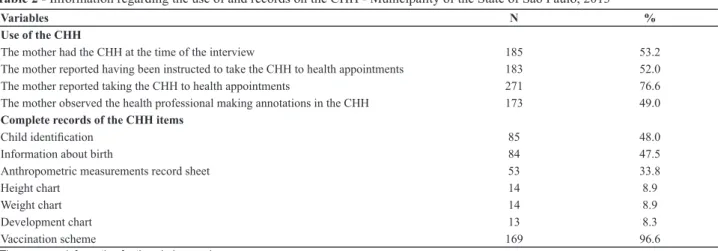
It is concluded from Table 2 that only about half of the mothers had the CHH at the ime of the interview. A pro
-porion similar to that had been instructed to take the CHH to the child’s appointment. The same proporion observed
the professionals making annotaions in the CHH. Con
-cerning the records, the child’s ideniicaion and the in
-formaion about birth were absent or incomplete in more than half of the CHHs analyzed. Only a third (33.8%) of the CHHs presented a complete record of anthropometric measurements, and the weight and height charts were ad
-equately recorded in less than 10% of the CHHs, with the same for the development chart. However, the vaccina
-ion scheme was complete in 96.6% of the CHHs (Table 2).
Table 2 - Information regarding the use of and records on the CHH - Municipality of the State of São Paulo, 2013
Variables N %
Use of the CHH
The mother had the CHH at the time of the interview 185 53.2
The mother reported having been instructed to take the CHH to health appointments 183 52.0
The mother reported taking the CHH to health appointments 271 76.6
The mother observed the health professional making annotations in the CHH 173 49.0
Complete records of the CHH items
Child identiication 85 48.0
Information about birth 84 47.5
Anthropometric measurements record sheet 53 33.8
Height chart 14 8.9
Weight chart 14 8.9
Development chart 13 8.3
Vaccination scheme 169 96.6
aThere was no information for the whole sample.
Table 3 - Characteristics of use of the CHH, nutritional status, development and age group of the children according to mothers who
had the CHH at the time of the interview - Municipality of the State of São Paulo, 2013.
Characteristicsa
Mother with CHHa
pb
Yes No
n % n %
Mother instructed to take the CHH to the appointments
Yes 112 61.9 67 41.9 0.000
No 69 38.1 93 58.1
Mother observed that the professional made annotations
Yes 125 68.7 85 52.8 0.012
No 57 31.3 76 47.2
Mother was informed of the weight gain and height of the child
Yes 161 88.0 126 78.8 0.029
No 22 12.0 34 21.2
Nutritional status
Underweight 12 6.5 13 8.4 0.788
Normal weight 112 60.9 93 60.4
Excess weight 60 32.6 48 31.2
Adequate development
Normal 84 51.2 87 54.0 0.611
Alert 80 48.8 74 46.0
Age Group
≤1 year of age 122 66.0 75 50.7 0.005
>1 year of age 63 34.0 73 49.3
aThere is no information for the whole sample. bChi-squared test.
Regardless of whether or not they had a CHH at the time of the interview, all of the mothers were ques
-tioned about the use of this instrument by the health professionals. Having the CHH at the time of the in
-terview was statistically associated with having been
No associaion was observed between the items being completed in the CHH and the nutriional status, develop
-ment and age group of the children (Table 4).
DISCUSSION
The Child Health Handbook (CHH) was created by the Brazilian Ministry of Health in 2005 to replace the Child Card (Cartão da Criança), iniially promoted in the 1970s to monitor the child’s growth. With the establishment of the Comprehensive Child Healthcare Program (Programa de Atenção Integral à Saúde da Criança) in 1984, the CHH
became crucial for the care directed at children, consider
-ing that growth and development became the referenial axis for all child health care aciviies(17).
Despite of this history, only half of the mothers receiv
-ing atenion at the PHC had the CHH at the ime of the interview (53.2%). This is a low percentage in comparison to other inquiries performed in PHCs, where 81%(18) and 77%(19) of the interviewed mothers had the CHH. These percentages are more similar to the percentage of moth
-ers who reported being in the habit of taking the CHH to health appointments (76.6%), but did not do so on the day of the interview.
Table 4 - Preenchimento dos itens da CSC segundo estado nutricional, desenvolvimento e faixa etária das crianças - Município do
Estado de São Paulo, 2013
CHH item annotationa
Nutritional statusa Developmenta Age Group
Adeqb Inadeqc
pd
Normal Alert
pd
≤1 year >1 year
pd
n n n n n n
(%) (%) (%) (%) (%) (%)
Registration sheet
Complete 29 24
0.300
27 22
0.160
36 17
0.384
(30.5) (39.3) (40.3) (28.6) (36.7) (28.8)
Incomplete 66 37 40 55 62 42
(69.5) (60.7) (59.7) (71.4) (63.3) (71.1)
Weight Chart
Complete 8 6
0.576
6 7
1.000
11 3
0.255
(8.0) (10.5) (9.1) (8.7) (11.1) (5.0)
Incomplete 92 51 60 73 88 56
(92.0) (89.5) (90.9) (91.3) (88.8) (94.9)
Height chart
Complete 9 5
1.000
6 7
1.000
10 4
0.576
(8.9) (8.9) (9.0) (8.7) (10.0) (6.9)
Incomplete 92 51 (91.1) 61 73 90 54
(91.1) (91.0) (91.3) (90.0) (93.1)
Development chart
Complete 7 6
0.550
5 6
1.000
9 4
0.768
(53.9) (10.5) (7.7) (7.5) (9.1) (6.7)
Incomplete 92 51 60 74 89 55
(64.3) (89.5) (92.3) (92.5) (90.8) (93.2)
aThere was no information for the whole sample. bAdeq = adequate
cInadeq = inadequate (low weight and overweight) dFisher’s exact test.
The percentage of mothers without the CHH in the health appointments at the PHCs (46.8%) is noice
-able; however, it is notable that there is an associaion between the age group below or equal to one year and the possession of the CHH by the mothers at the ime of the interview. Children under the age of one are in a more vulnerable stage, when the monitoring must be more frequent. The Brazilian Ministry of Health pro
-poses a minimum of seven medical consultaions in the child’s irst year of life(13). Moreover, the current vacci -naion schedule imposes monthly returns for children under one year old, and at least in this kind of service the mother must have the CHH at hand. Regardless of reason, each contact between child and health service should be seen as an opportunity for a comprehensive
and resoluive evaluaion of health, and the CHH could be even more beneicial as an instrument for this service. Lack of appreciaion and knowledge by the mothers re
-garding the use of the CHH have been reported as some of the main challenges to efecive use of this instrument in health acions(7). This may be related to historical and cultural aspects, because health acions were always handed over to the professionals; acive interference by the mothers was not allowed or simulated in the process(5). However, health pro -fessionals also do not appreciate this important instrument for monitoring health, nutriion and child development(1).
The weight and height charts presented a low percent
-age of recordings (8.9%), conirming the results of similar
The low percentage of recorded weight and height charts is extremely worrying when taking into account the nutriional status of the children analyzed in this study, since the anthropometric extremes (underweight in 7.2% and excess weight in 31.6% of the children) are over the naional averages. Data from the Naional Demography and Child and Female Health Research (Pesquisa Nacional de Demograia e Saúde da Criança e da Mulher) showed that weight deicits in relaion to height, which are signs of acute cases of malnutriion, do not go beyond 2% of the children in any region or social level of the populaion. Meanwhile, excess weight afects 7.4% of Brazilian chil -dren(12). Certainly, if the CHH were being used adequately,
it would fulill its role in the monitoring and promoion of children’s health.
A recent study showed that the themes of growth and development are analyzed in 90% of nursing consul
-taions(21); however, lack of preparaion by health profes -sionals to handle the new concepts incorporated in the handbook, such as the reference curves in z-scores and the BMI-for-age chart, could jusify, in part, the low per
-centage of growth chart records found in this study(7). However, a review of the literature that analyzed the pracice of integrality in publicaions that addressed child health in basic care made it clear that inadequate use of the CHH is a constant, which led the authors to reinforce the need to invest in the organizaion of the services and in the development of the professionals, since the CHH is an essenial instrument to guarantee in
-tegrality in childcare(22).
The low percentage of children with recorded de
-velopment charts is also noticeable, especially because half of the children analyzed presented absence of one or more signs of development, which marks an alert
situation(13).
We emphasize that the fact that the health profession
-al is the one who records the development chart is funda
-mental in guiding the mothers/families in relaion to the importance of observing and simulaing the child for the acquisiion of new skills. This simple care acion acquires a vital role in the promoion of adequate development and prevenion of possible delays(23).
Similar to other studies that analyzed CHH records(2-3), data referring to vaccinaion were complete in almost all of the analyzed CHHs (96.6%). This result is certainly due to the excellence of the Brazilian Naional Program of Immunizaion (Programa Nacional de Imunização), which has mobilized the enire populaion for more than 40 years around naionwide vaccinaion campaigns(24). Moreover, the Naional Program of Immunizaion has a coninued development of structures for human re
-sources, surveillance and supervision of aciviies in vaccinaion rooms that standardize the procedures and bring stability to the acions directed at vaccinaion.
The lack of records or incomplete records of the oth
-er items in CHHs make the families think that CHHs have litle importance in the child’s monitoring; thus, they are not taken to the PHC, they are not properly kept, and they lose their character as health documents. Adequate use of CHHs consists of correct recording of monitor
-ing informaion on the child’s health and of instruc-ing families regarding annotaion and contents, enabling ap
-preciaion and appropriaion of the CHH by families(3). If families understood the funcion of this instrument, they would appreciate it more and demand its adequate recording. In addiion, the lack of conscieniousness by health professionals regarding the importance of the CHH suggests that it is just one more form to ill out(3).
Nutritional status and development were analyzed in this study with the objective of verifying the follow
-ing hypotheses: 1) Children with adequate nutritional and development status would have a higher propor
-tion of growth and/or development charts recorded, making it evident that the CHH fulfills its role in the monitoring and promotion of the child’s health; 2) Chil
-dren with inadequate nutritional and development sta
-tus would have a higher proportion of growth and/or development charts recorded, showing the priority in these children’s monitoring by the health profession
-als; and 3) Children of one year or less would have a higher proportion of the growth and/or development charts recorded, showing the priority in the monitor
-ing of these children by the health professionals. None of these hypotheses could be confirmed because, in addition to the small number of recorded charts, the growth and development conditions and the age group of the children were not statistically associated to ad
-equate recording of the CHH.
Although studies of the CHH are scarce, all are unanimous in saying that it is necessary to promote raised awareness and educate professionals, strength
-ening the use of the CHH in an integral approach to the child’s health(7).
CONCLUSION
Considering that the evaluaions were conducted in PHCs, it is a big concern the low percentage of mothers who had the CHH at the ime of the interview and the el
-evated proporion of children with altered nutriional and development status .
Moreover, the poor quality of the records in the CHH reairms the importance of health professionals’ qualii
-caion in relaion to the correct use of the handbook. The need for investment in organizaion of services is also em
-phasized, as well as the importance of raising the aware
-ness of the enire community so that the CHH truly con
REFERENCES
1. Brasil. Ministério da Saúde; Secretaria de Atenção à Saúde, De
-partamento de Ações Programáicas Estratégicas. Área Temái
-ca de Saúde da Criança e Aleitamento Materno. Caderneta de Saúde da Criança: passaporte para a cidadania. Brasília; 2013. 2. Alves CRL, Lasmar LMLBF, Goulart LMHF, Alvim CG, Maciel
GVR, Viana MRA, et al. Qualidade do preenchimento da Ca
-derneta de Saúde da Criança e fatores associados. Cad Saúde Pública. 2009;25(3):583-95.
3. Goulart LMHF, Alves CRL, Viana MRA, Moulin ZS, Carmo GAA, Costa JGD, et al. Caderneta de Saúde da Criança: avaliação do
preenchimento dos dados sobre gravidez, parto e recém-nas
-cido. Rev Paul Pediatr. 2008;26(2):106-12.
4. Frota MA, Pordeus AMJ, Forte LB, Vieira LJES. Acompanha
-mento antropométrico de crianças: o ideal e o realizado. Rev Baiana Saúde Pública. 2007;31(2):212-22.
5. Vieira GO, Vieira TO, Costa MCO, Santana Neto PV, Cabral VA. Uso do cartão da criança em Feira de Santana, Bahia. Rev Bras Saúde Matern Infant. 2005;5(2):177-84.
6. Rais CAS, Baista Filho M. Aspectos estruturais e processuais da vigilância do crescimento de menores de cinco anos em serviços públicos de saúde do Estado de Pernambuco. Rev Bras Epidemiol. 2004;7(1):44-53.
7. Abreu T, Viana L, Cunha C. Desaios na uilização da cader
-neta de saúde da criança: entre o real e o ideal. J Manag Prim Health Care. 2012;3(2):80-3.
8. Brasil. Ministério da Saúde; Secretaria de Atenção à Saúde, Departamento de Ações Programáicas Estratégicas. Agenda de Compromisso para a Saúde Integral da Criança e Redução da Mortalidade Infanil. Brasília; 2004.
9. Alves MN, Muniz LC, V MFA. Consumo alimentar entre crian
-ças brasileiras de dois a cinco anos de idade: Pesquisa Nacio
-nal de Demograia e Saúde (PNDS), 2006. Ciênc Saúde Cole
-iva. 2013;18(11):3369-77.
10. Broilo MC, Louzada MLC, Drachler ML, Stenzel LM, Vitolo MR. Maternal percepion and aitudes regarding healthcare professionals’ guidelines on feeding pracices in the child’s irst year of life. J Pediatr. 2013;89(5):485-91.
11. Garcia MT, Granado FS, Cardoso MA. Alimentação comple
-mentar e estado nutricional de crianças menores de dois
anos atendidas no Programa Saúde da Família em Acrelân
-dia, Acre, Amazônia Ocidental Brasileira. Cad Saúde Pública. 2011;27(2):305-16.
12. Brasil. Ministério da Saúde; Centro Brasileiro de Análise e Planejamento. Pesquisa Nacional de Demograia e Saúde da Criança e da Mulher – PNDS, 2006: dimensões do processo reproduivo e da saúde da criança. Brasília; 2009.
13. Brasil. Ministério da Saúde; Secretaria de Atenção à Saúde,
Departamento de Atenção Básica. Saúde da Criança: cresci
-mento e desenvolvi-mento. Brasília; 2012. (Caderno da Aten
-ção Básica, nº 33).
14. Brasil. Ministério da Saúde; Secretaria de Atenção à Saúde, Departamento de Atenção Básica. Orientações para a coleta e análise de dados antropométricos em serviços de Saúde:
Norma Técnica do Sistema de Vigilância Alimentar e Nutri
-cional – SISVAN. Brasília; 2011.
15. World Health Organizaion (WHO). Child Growth Standards. Length/height-for-age, weight-for-age, weight-for-length, weight-for-height and body mass index-for-age: methods and development. Geneva: WHO; 2006.
16. Brasil. Ministério da Saúde; Secretaria de Atenção à Saúde, De
-partamento de Ações Programáicas Estratégicas. Acompanha
-mento do cresci-mento e desenvolvi-mento infanil. Brasília; 2002. 17. Trapé CA, Fujimori E, Bertolozzi MR. O Sistema Único de
Saúde e as políicas de atenção à saúde da criança. In: Fuji
-mori E, Ohara CVS, organizadoras. Enfermagem e a saúde da criança na atenção básica. Barueri: Manole; 2009. p. 25-43. 18. Carvalho MF, Lira PIC, Romani SAM, Santos IS, Veras AACA,
Baista Filho M. Acompanhamento do crescimento em crian
-ças menores de um ano: situação dos serviços de saúde em Pernambuco, Brasil. Cad Saúde Pública. 2008;24(3):675-85. 19. Costa GD, Cota RMM, Reis JR, Ferreira MLSM, Reis RS,
Franceschini SCC. Avaliação da atenção à saúde da cri
-ança no contexto da Saúde da Família no município de Teixeiras, Minas Gerais (MG, Brasil). Ciênc Saúde Coleiva. 2011;16(7):3229-40.
20. Moreira MDS, Gaíva MAM. Acompanhamento do cresci
-mento e desenvolvi-mento infanil: análise dos registros das consultas de enfermagem. Rev Pesq Cuid Fundam Online
[Internet]. 2013 [citado 2014 mar. 15];5(2):3757-66. Dis
-ponível em: htp://www.seer.unirio.br/index.php/cuidado
-fundamental/aricle/view/2150/pdf_774
21. Loureiro FM, Silva JANF, Quiterio MMSL, Charepe ZB. Par
22. Cursino EG, Fujimori E. Integralidade como uma dimensão
das práicas de atenção à saúde da criança: uma revisão bib
-liográica. Rev Enferm UERJ. 2012;20(n.esp1):676-80. 23. Clendon J, Dignam D. Child health and development record
book: tool for relaionship building between nurse and mother. J Adv Nurs. 2010;66(5):968-77.
24. Brasil. Ministério da Saúde; Secretaria de Atenção à Saúde. Programa Nacional de Imunização: 30 anos. Brasília; 2003.