RESUMEN
Objeivo: Ideniicar la asociación entre el trauma y el dolor perineal en 473 primípa
-ras. Método: Estudio transversal, en el que el dolor se midió por medio de la escala nu
-mérica del dolor (0 a 10; 0 = ningún dolor y 10 = dolor máximo). Resultados: La preva
-lencia y el promedio de intensidad del dolor fueron 33,0% y 4,7 (Desviación Estándar = 2,0) puntos en la escala, respecivamente. La episiotomía fue el trauma más frecuen
-te (46,7%). La ocurrencia y la in-tensidad del dolor se asociaron con el trauma y el iempo del postparto. Tener trauma perineal tripli
-ca la probabilidad de tener dolor. Cada hora transcurrida después del nacimiento reduce la posibilidad de dolor en 4,8%. Conclusión:
Las primíparas están sujetas a altas tasas de trauma perineal, especialmente episio
-tomía. El dolor perineal afecta aproxima
-damente a un tercio de las primíparas y se asocia con el iempo de postparto y el trau
-maismo perineal.
DESCRIPTORES:
Dolor Espisiotomía Paridad
Período de postparto Enfermería obstétrica
RESUMO
Objeivo: Ideniicar a associação entre trauma perineal e dor em 473 primíparas. Método: Estudo transversal, no qual a dor foi mensurada por meio da escala numéri
-ca de dor (0 a 10 – sendo 0 ausência de dor e 10 dor máxima). Resultados: A prevalên
-cia e a média de intensidade de dor foram 33,0% e 4,7 (Desvio Padrão = 2,0) pontos na escala numérica, respecivamente. A episiotomia foi o trauma mais frequente (46,7%). A ocorrência e a intensidade da dor foram associadas ao trauma perineal e ao tempo de pós-parto. Ter trauma pe
-rineal triplicou a chance de dor. Cada hora decorrida depois do parto reduziu a chance de dor em 4,8%. Conclusão: As primíparas estão sujeitas a elevada frequência de trau
-ma perineal, sobretudo episiotomia. A dor perineal afeta, aproximadamente, um ter
-ço das primíparas e está associada ao tem
-po de pós-parto e aos traumas perineais.
DESCRITORES:
Dor Episiotomia Paridade Período pós-parto Enfermagem obstétrica
ABSTRACT
Objecive: To idenify the associaion be
-tween perineal trauma and pain in 473 pri
-miparous women. Method: Cross-secional study in which pain was measured by the numerical pain scale (0 to 10 - 0 being no pain and 10 maximal pain). Results: The prevalence and mean intensity of pain were 33.0% and 4.7 points (standard deviaion = 2.0) in the numeric scale, respecively. Episi
-otomy represented the most frequent trau
-ma (46.7%). The occurrence and intensity of the pain were associated with perineal trauma and postpartum ime. Having peri
-neal trauma tripled the chance of pain. Each hour elapsed following the birth reduced the chance of pain by 4.8%. Conclusion: Primiparous women are subject to a high frequency of perineal trauma, with episi
-otomy being the most prominent. Perineal pain afects approximately one-third of pri
-miparous women and is associated with the postpartum ime and perineal traumas.
DESCRIPTORS:
Pain Episiotomy Parity
Postpartum period Obstetrical nursing
Association between perineal trauma
and pain in primiparous women
*Adriana Amorim Francisco1, Mirian Hiromi Kinjo2, Caroline de Souza Bosco3, Renata Luana
da Silva4, Edilaine de Paula Batista Mendes5, Sonia Maria Junqueira Vasconcellos de Oliveira6
ASSOCIAÇÃO ENTRE TRAUMA PERINEAL E DOR EM PRIMÍPARAS
ASSOCIACIÓN ENTRE EL TRAUMA PERINEAL Y DOLÓR EM PRIMÍPARAS
* Extracted from the study “Length of perineal analgesia using cryotherapy: a randomized controlled trial,” 1st Showing of Studies of the Postgraduate Nursing Program, School of Nursing, University of São Paulo, 2013. 1 Doctorate Student, School of Nursing, University of São Paulo, São Paulo - São Paulo, Brazil. 2
Nurse Graduate from the School of Nursing, University of São Paulo, São Paulo - São Paulo, Brazil. 3 Masters Degree Student, School of Nursing, University
of São Paulo, São Paulo - São Paulo, Brazil. 4 Masters Degree Student of the School of Nursing, University of São Paulo, São Paulo - São Paulo, Brazil. 5 Masters Degree Student of the School of Nursing, University of São Paulo, São Paulo - São Paulo, Brazil. 6 Associate Professor, Department of
Maternal-DOI: 10.1590/S0080-623420140000600006
O
riginal
a
INTRODUCTION
As a result of vaginal birth, most women have a cer
-tain extent of perineal trauma, which can be character
-ized by the occurrence of spontaneous laceraions, episi
-otomy or both. The rates of occurrence of these injuries vary internaionally, especially in relaion to episiotomy. In Asian countries such as China and Taiwan, the rate ex
-ceeds 82%, while in European countries such as Sweden, Denmark and England, it is between 9.7% and 13%(1). In Brazil, the Naional Survey on Demography and the Health of Women and Children (PNDS - Pesquisa Nacio
-nal de Demograia e Saúde da Criança e da Mulher), car
-ried out by way of a naional survey that included about 4,000 women, found that in the ive years preceding the survey, episiotomy was praciced in 70% of the births in the country, with smaller proporions found only in women with at least three children(2).
When considering parity, the rates are shown to be even higher. It has been observed that primiparous wom
-en are more exposed to perineal trauma (3-4) , principally as a result of episiotomy. Women without previous vaginal birth were three imes more likely to be subjected to this procedure(5), while among muliparous women the likeli -hood to undergo such an intervenion is 55% lower(4). In certain South American countries, the proporion of pri
-miparous women who had an episiotomy exceeds 90%(1). Other data indicates that the rate of this procedure in nul
-liparous women was on average 44% higher than that ob
-served in all vaginal deliveries recorded in hospitals in six emerging countries(6).
Therefore, one must consider that episiotomy is as
-sociated with complications, including increased risk of posterior perineal trauma, need for suturing, complica
-tions in the healing of the wound(7), risk of infection, anal and urinary incontinence(8), dyspareunia and peri
-neal pain(9-10).
Perineal pain is a common symptom among mothers that may occur immediately following birth and persist beyond the postnatal period. A survey conducted with 2,400 women in the United States showed that among 1,656 women who underwent vaginal delivery, 40% re
-ported perineal pain in the irst two months following the delivery. At or ater six months, some of them sill report
-ed pain in the perineum as a persistent problem(11). In general, the occurrence and intensity of perineal pain are related to the severity of injury in this region. A study conducted with 215 Australian women 72 hours ater vaginal delivery showed that the intensity of peri
-neal pain was signiicantly afected by the degree of the trauma(12). The survey cited above showed that the se -verity of the pain was strongly related to the existence of an episiotomy; among mothers with vaginal delivery 7% reported a painful perineum six months ater birth, while for those who had an episiotomy, the rate was 9% .
However, even if the perineum is intact, some women may report pain(12).
Perineal pain is debilitaing and afects the mobil
-ity of women. Many reported pain when siing, walking, breasfeeding and while taking care of the baby(12-13). This interference varies from mild to extreme(11) and may nega -ively impact the experience of motherhood.
Therefore, understanding that the postpartum is a period of many adaptaions, especially for women expe
-riencing motherhood for the irst ime, and being that the perineal pain is a factor that complicates the carrying out of self-care aciviies, as well as the interacion between the binomial, to invesigate whether there is an associa
-ion between pain and the occurrence of perineal trauma in primiparous women is important in order to ofer evi
-dence in an efort to support obstetric care.
The aim of the study was to idenify the occurrence of the associaion between perineal trauma and pain in primiparous women.
METHOD
A cross-sectional study conducted in the Rooming-in Care Unit (RCU) of a philanthropic hospital lRooming-inked to the Brazilian Unified Health System (Sistema Único de Saúde - SUS), which serves pregnant women with low to medium risk.
In this insituion, obstetricians are responsible for leading the care of women admited to maternity hospi
-tals who have a high risk pregnancy and/or require caesar
-ean secion. During labour and spontaneous birth among low risk women admited to a midwifery-led birth centre, care is provided by midwives and nurse-midwives.
Data collecion occurred between December 10, 2012 and February 8, 2013. We included in the study women who gave birth at the insituion during this period while also meeing the inclusion criteria: normal delivery; no previous vaginal delivery; pregnancy of single live fetus in a vertex presentaion, no spinal or epidural analgesia during labor; no clinical or obstetric complicaions; no dif
-iculies in communicaion or understanding of the Por
-tuguese language; and the newborn (NB) in good clinical condiion at the ime of inclusion in the study.
Perineal pain was measured by the numerical pain scale(14) (0 to 10 - 0 being no pain and 10 maximal pain). The woman was quesioned about the occurrence of pain in the perineum, by asking Are you in pain in the
perine-um, now? If the answer was airmaive, the pain scale
was applied in order to measure intensity. Being consid
-ered as pain were the reports of pain, burning, stabbing, discomfort and discomfort in the perineal region.
taining informaion idenifying the paricipant, sociode
-mographic characterisics (age, ethnicity and educaion), informaion regarding the delivery (date and ime of the delivery, presence of perineal trauma and suturing, type of trauma, and birth weight of the NB) and the occur
-rence and severity of perineal pain.
The ethnicity variable was obtained according to the woman’s own statement. The number of perineal traumas was classiied according to the occurrence of lesions in one or more locaions (0 to 2), recorded in the medical record. In the event of more than one type of trauma oc
-curring simultaneously, the most serious was considered. For staisical analysis, the Shapiro-Wilk, chi-square, Mann-Whitney and Kruskal-Wallis tests were used. In addiion to these tests, a logisic regression model was adjusted in order to evaluate independent factors asso
-ciated with the presence of perineal pain. All tests were performed considering a signiicance level of 5%.
This study was approved by the Research Ethics Committee of the School of Nursing of USP (Case No. 1119/2012/CEP-EEUSP). The participation of the post
-partum women was voluntary, after signing the In
-formed Consent Form.
RESULTS
The study included 473 postpartum women who were predominantly black (50.7%), with a mean of 22 (SD = 4.8) years of age, 9.9 (SD = 2.0) years of educaion and 16 (SD = 11.6) hours postpartum. The newborn weight was on average 3,179 g (SD = 379 g - range 2,130 g to 4,485 g).
The prevalence and mean intensity of pain were 33.0% and 4.7 points (SD = 2.0) in the numeric scale, respecively.
Seventy-one women (15.0%) had an intact perineum. Episiotomy was the most frequent trauma (46.7%), followed by irst (32.4%) and second (5.1%) degree laceraions. In four of the paients’ medical records the degree of perineal trau
-ma was not found. No cases of third- or fourth-degree lacera
-ions were recorded.
Perineal suturing was performed in 83.5% of the parici
-pants. When considering only irst-degree laceraions, 96.3% of them were sutured.
When comparing women according to the occurrence of pain, there was a signiicant staisical diference in the peri
-neal trauma number (p = 0.017) and the postpartum ime (p = 0.001). The rate of intact perineum was higher among women without pain (12.3% versus 2.7%), while those with pain had one or two perineal traumas. However, when com
-paring the pain complaint among women with one or two traumas, no signiicant diference was shown (p = 0.930). At the ime they were interviewed, the women with perineal pain had a shorter mean length of postpartum ime (12.9 and SD = 7.3 versus 17.6 and SD = 12.9 hours).
Regarding the type of perineal trauma, it was observed that episiotomy was more frequent among the mothers in pain, whereas among those without pain, irst-degree lac
-eraions prevailed as the most common. However, this difer
-ence was not staisically signiicant (p = 0.703).
The intensity of perineal pain was also related to the number of traumas (p = 0.027) and the postpartum ime (p <0.001). Postpartum women with one perineal trauma reported about four imes more moderate pain than those with an intact perineum (5.6% versus 20.7%). Among the groups with perineal trauma, there was no signiicant difer
-ence in terms of pain intensity. Primiparous women with less postpartum ime reported more intense perineal pain.
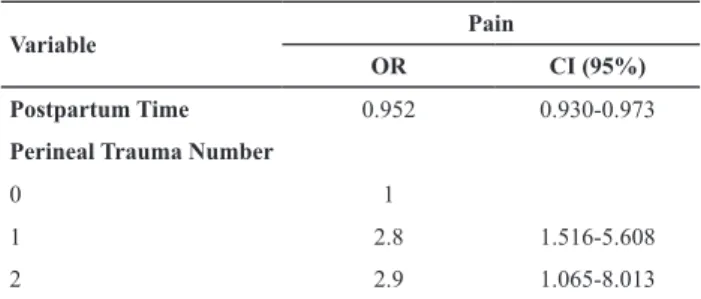
The logisic regression analysis showed that, compared to women with an intact perineum, the primiparous women with one or two perineal traumas were nearly three imes more likely to have perineal pain. Regarding the postpartum ime, it was observed that, for each hour elapsed ater birth, the chance of pain occurring decreased by 4.8%, being that the odds raio for each hour elapsed was 0.952; as the coef
-icient of postpartum ime equal to 0.048 was obtained from the diference (1-0.952) (Table 1).
Table 1 - Estimated odds ratio (OR) and conidence interval (CI)
of the postpartum time and number of perineal traumas for peri
-neum pain, according to the logistic regression model - São Pau
-lo, 2012 and 2013
Variable Pain
OR CI (95%)
Postpartum Time 0.952 0.930-0.973
Perineal Trauma Number
0 1
1 2.8 1.516-5.608
2 2.9 1.065-8.013
DISCUSSION
The purpose of this study was to identify the asso
-ciation between perineal trauma and pain in primipa
-rous women.
The high frequency of pain and perineal trauma ideni
-ied in this study strengthens the evidence that primipar
-ity predisposes women to trauma(5,15-16) and perineal pain ater childbirth(17).
The associaion between the occurrence of pain and the number of perineal traumas showed that women with one or two perineal traumas were nearly three imes more likely to have pain than those with an intact perineum. However, it can be said that this efect was only a result of having a le
Pain intensity was also higher among women with per
-ineal trauma. They reported about four imes more mod
-erate pain than those with an intact perineum. However, compared to women with perineal trauma, the frequency distribuion of pain scores did not follow the expected patern, i.e., that those with the highest number of trau
-ma would result in higher levels of pain.
Regarding the type of trauma, we found that episi
-otomy stood out as the most common lesion, especially among those women who reported perineal pain. More
-over, among those without pain, irst-degree laceraion was predominant. However, we found no associaion be
-tween the type of perineal trauma and the occurrence and intensity of pain.
Yet, previous studies have indicated a direct rela
-ionship between the type of perineal trauma and pain. Episiotomy was associated with the occurrence and per
-sistence of pain. This procedure raised the chance of perineal pain by four imes and was ideniied as a pre
-dicive factor for pain in that region following vaginal de
-livery, regardless of parity(15). Six months ater delivery, episiotomy was associated with higher proporions of complaints of pain(11).
In an Australian study regarding the intensity of pain, women with episiotomy or sutured laceraions reported more intense perineal pain than those with an intact perineum or non-sutured laceraions(18).
In another study, a policy of selecive episiotomy among primiparous women increased the possibility of maintaining the perineum intact, while rouine use of this procedure signiicantly increased the intensity of perineal pain at 24 and 48 hours following delivery(10).
The postpartum ime also difered between the par
-icipant groups of this study. Women who reported peri
-neal pain were in an earlier postpartum period compared to those who did not report perineal pain. The logisic regression model showed that the chance of having pain decreased almost 5% with every hour elapsed follow
-ing delivery. However, this variable refers to the ime at which the paricipants were interviewed; thus it should be interpreted with cauion, as they may not necessarily relect, the moment in which the painful sensaion began. It is noteworthy that high rates of perineal suturing were found in this study, especially in relaion to irst-degree laceraions. It was therefore not possible to analyze the associaion between this variable and the occurrence of pain. However, a randomized clinical trial demonstrated that primiparous women with irst- and second-degree laceraions that were sutured had more perineal discom
-fort (p = 0.038), as compared to the non-sutured group(19). In this sense, we quesion what factors inluence the pro
-fessional when repairing the trauma. An Australian explor
-factors that include: the characterisics of the lesion, the experience of the professional, the woman’s consent and the potenial discomfort that this procedure can cause, among others(20). On the other hand, in Brazil, where de -livery care is characterized by authoritarian relaionships between the professionals providing the obstetrical care and the women(21), the opinion of the women is hardly ever considered.
In addiion, in the insituion where the study was conducted, catgut and tradiional suture technique are convenionally used in perineal repair. However, two sys
-temaic reviews showed that the coninuous suture tech
-nique is associated with less pain, as well as less need for analgesia and suture removal, as compared to the inter
-rupted technique(22), while the catgut thread increased complaints of perineal pain during the immediate post
-partum period(23).
Due to the impact of perineal trauma on maternal health during the postpartum period, including pain, its prevenion is considered to be an important component when measuring the quality of obstetric care.
The frequency of these traumas varies considerably and can be atributed to factors that include maternal and fetal condiions along with the characterisics of the obstetric care. Among primiparous women, the weight of the newborn, the use of oxytocin and the semi-siing maternal posiion during the second stage of giving birth were ideniied as risk factors for perineal trauma(4).
Moreover, the introducion of pracices aimed at pro
-tecing the perineum, such as posiions other than the lithotomy posiion during the second stage of birth, peri
-neal massage(24-25), selecive policy for episiotomy(7), the hands-on and hands-of technique(26), and selecive use of oxytocin(17) could contribute to increased rates of perineal integrity and reduce the number of episiotomy. However, adopion of these pracices requires changes in the care model and training of the professionals responsible for obstetric care.
The contrast between scientific evidence and healthcare practice is influenced by the professionals who provide the healthcare and how the care is struc
-tured in the institution.
In a study comparing perineal trauma rate of women whose birth occurred in three different environments (hospital, freestanding midwifery-led units, home birth), there was a significant association between giv
In the maternity ward where this study was conduct
-ed, the model of care was structured to promote a physi
-ological birth. According to the Cochrane Systemaic Re
-view, in this model of care there are fewer intervenions and perineal laceraions and higher rates of spontaneous delivery compared with care in obstetric units(27), but the proporion of perineal trauma indicated in the current study was high, paricularly the rate of episiotomy, which was about ive imes higher than recommended by WHO for this parity (10%)(28).
The educaion and training of professionals who as
-sist with childbirth also has an impact on handling the perineal region. Professionals may be educated to be
-lieve that intervenions ensure a successful delivery; therefore, they resist changes in the standardized prac
-ices(29). Moreover, the insecurity of professionals in im -plemening evidence-based pracices can also be a limit
-ing factor for healthcare changes.
A study of 338 midwives working in the UK revealed that most of these professionals felt insecure regarding performing episiotomies along with perineal assessment and repair ater childbirth. Only midwives with 20 years or more of experience and those with higher levels of qualiicaion were more likely to implement evidence-based recommendaions and felt more conident about perineal care(30).
Changes in perineal care can be achieved through pro
-fessional training based on the understanding and use of the available evidence. A study showed that a reducion in
the number of episiotomies and third- and fourth-degree laceraions, as well as an increase in rates of an intact pe
-rineum, were obtained ater a program of professional training in the use of evidence-based pracices(31), resul -ing in improvements in health care and in reduc-ing the severity of outcomes resuling from obstetric care.
CONCLUSION
Primiparous women are subjected to a high frequency of perineal trauma, with episiotomy being most frequent. Most perineal traumas are sutured, especially the irst-degree laceraions. Perineal pain afects approximately one-third of primiparous women following spontaneous delivery and is associated with the postpartum ime and the presence of perineal traumas. The chance of a primip
-arous woman having perineal pain is about three imes higher ater trauma in this region, as compared to those with an intact perineum, and 4.8% lower for each elapsed hour following delivery.
The recogniion of the associaion between pain and the occurrence of perineal trauma in this group of women is important in order to improve obstetric care. On the oth
-er hand, the results presented h-ere provoke relecion on the contrast between the care provided to a primiparous woman during a spontaneous delivery and the scieniic ev
-idence for procedures which can prevent perineal trauma, such as the restricted use of episiotomy, the type of peri
-neal suture (coninuous suture and the type of thread) and posiions other than the lithotomy posiion for delivery.
REFERENCES
1. Graham ID, Carroli G, Davies C, Medves JM. Episiotomy rates around the world: an update. Birth. 2005;32(3):219-23.
2. Brasil. Ministério da Saúde; Centro Brasileiro de Análise e Plane -jamento. Pesquisa Nacional de Demograia e Saúde da Criança e da Mulher – PNDS 2006: Relatório inal [Internet]. Brasília; 2008 [citado 2014 mar. 16]. Disponível em: htp://bvsms. saude.gov.br/bvs/pnds/img/relatorio_inal_pnds2006.pdf
3. Smith LA, Price N, Simonite V, Burns EE. Incidence of and risk factors for perineal trauma: a prospecive observaional study. BMC Pregnancy Childbirth. 2013;13(1):59.
4. Silva FMB, Oliveira SMJV, Bick D, Osava RH, Tuesta EF, Riesco MLG. Risk factors for birth-related perineal trauma: a cross-secional study in a birth centre. J Clin Nurs. 2012;21(15-16):2209-18.
5. Riesco MLG, Costa ASC, Almeida SFS, Basile ALO, Oliveira SMJV. Episiotomia, laceração e integridade perineal em par -tos normais: análise de fatores associados. Rev Enferm UERJ. 2011;19(1):77-83.
6. Kropp N, Hartwell T, Althabe F. Episiotomy rates from eleven developing countries. Int J Gynaecol Obstet. 2005;91(2):157-9.
7. Carroli G, Mignini L. Episiotomy for vaginal birt. Cochrane Da -tabase Syst Rev. 2009;(1):CD000081.
8. Laine K, Skjeldestad FE, Sanda B, Horne H, Spydslaug A, Staf AC. Prevalence and risk factors for anal inconinence ater obstetric anal sphincter rupture. Acta Obstet Gynecol Scand. 2011;90(4):319-24.
9. Chang SR, Chen KH, Lin HH, Chao YM, Lai YH. Comparison of the efects of episiotomy and no episiotomy on pain, urinary incon -inence, and sexual funcion 3 months postpartum: a prospec -ive follow-up study. Int J Nurs Stud. 2011;48(4):409-18.
11. Declercq ER, Sakala C, Corry MP, Applebaum S, Herrlich A. Major Survey Findings of Listening to Mothers(SM) III: New Mothers Speak Out: Report of Naional Surveys of Women’s Childbearing Experiences. J Perinat Educ. 2014;23(1):17-24.
12. East CE, Sherburn M, Nagle C, Said J, Forster D. Perineal pain following childbirth: prevalence, efects on postnatal recov -ery and analgesia usage. Midwif-ery. 2012;28(1):93-7.
13. Beleza ACS, Ferreira CHJ, Sousa LD, Nakano AMS. Men -suração e caracterização da dor após episiotomia e sua relação com a limitação de aividades. Rev Bras Enferm. 2012;65(2):264-8.
14. Pimenta CAM, Cruz DALM, Santos JLF. Instrumentos para avaliação da dor: o que há de novo em nosso meio. Arq Bras Neurocir. 1998;17(1):15-24.
15. Francisco AA, Oliveira SMJV, Silva FMB, Bick D, Riesco MLG. Women’s experiences of perineal pain during the immediate postnatal period: A cross-secional study in Brazil. Midwife -ry. 2011;27(6):e254-9.
16. Landy HJ, Laughon SK, Bailit J, Kominiarek MA, Gonzalez-Quintero VH, Ramirez M, et al. Characterisics associated with severe perineal and cervical laceraions during vaginal delivery. Obstet Gynecol. 2011;117(3):627-35.
17. Leeman L, Fullilove AM, Borders N, Manocchio R, Albers LL, Rogers RG. Postpartum perineal pain in a low episiotomy seing: associaion with severity of genital trauma, labor care, and birth variables. Birth. 2009;36(4):283-8.
18. East CE, Begg L, Henshall NE, Marchant PR, Wallace K. Lo -cal cooling for relieving pain from perineal trauma sus -tained during childbirth. Cochrane Database Syst Rev. 2012;(5):CD006304.
19. Lundquist M, Olsson A, Nissen E, Norman M. Is it neces -sary to suture all laceraions ater a vaginal delivery? Birth. 2000;27(2):79-85.
20. Cioi JM, Swain J, Arundell F. The decision to suture ater childbirth: cues, related factors, knowledge and experience used by midwives. Midwifery. 2010;26(2):246-55.
21. de Carvalho VF, Kerber NPD, Busanello J, Goncalves BG, Ro -drigues ED, de Azambuja EP. How the workers of a birthing center jusify using harmful pracices in natural childbirth. Rev Esc Enferm USP. 2012;46(1):30-7.
22. Ketle C, Dowswell T, Ismail KM. Coninuous and inter -rupted suturing techniques for repair of episiotomy or second-degree tears. Cochrane Database Syst Rev. 2012;(11):CD000947.
23. Ketle C, Dowswell T, Ismail KM. Absorbable suture materials for primary repair of episiotomy and second degree tears. Cochrane Database Syst Rev. 2010;(6):CD000006.
24. Karacam Z, Ekmen H, Calisir H. The use of perineal massage in the second stage of labor and follow-up of postpartum peri -neal outcomes. Health Care Women Int. 2012;33(8):697-718.
25. Eason E, Labrecque M, Wells G, Feldman P. Prevening peri -neal trauma during childbirth: a systemaic review. Obstet Gynecol. 2000;95(3):464-71.
26. Aasheim V, Vika Nilsen AB, Lukasse M, Reinar LM. Peri -neal techniques during the second stage of labour for reducing perineal trauma. Cochrane Database Syst Rev. 2011;(12):CD006672.
27. Hodnet ED, Downe S, Walsh D. Alternaive versus conven -ional insitu-ional seings for birth. Cochrane Database Syst Rev. 2012;(8):CD000012.
28. World Health Organizaion. Care in normal birth: a pracical guide. Report of a Technical Working Group [Internet]. Ge -neva; 1996 [cited 2014 Apr 17]. Available from: htp://www. who.int/maternal_child_adolescent/documents/who_frh_ msm_9624/en/
29. Diniz SG. Gênero, saúde materna e o paradoxo perinatal. Rev Bras Crescimento Desenvolv Hum. 2009;19(2):313-26.
30. Bick DE, Ismail KM, Macdonald S, Thomas P, Tohill S, Ketle C. How good are we at implemening evidence to support the management of birth related perineal trauma? A UK wide survey of midwifery pracice. BMC Pregnancy Childbirth. 2012;12:57.