An instrument to analyze secondary-level
students’ images about nurses
*ELABORAÇÃO DE INSTRUMENTO PARA ANÁLISE DA IMAGEM DO ENFERMEIRO FRENTE A ALUNOS DO ENSINO MÉDIO
ELABORACIÓN DE UN INSTRUMENTO PARA ANALIZAR LA IMAGEN DEL ENFERMERO ENTRE LOS ALUMNOS DE LA ENSEÑANZA MEDIA
* Extracted from the thesis “Imagem do Enfermeiro sob a ótica de alunos do ensino médio: elaboração de instrumento”, Ribeirão Preto College of Nursing, University of São Paulo, 2005. 1 Nurse, Doctor Professor of the Department of Psychiatric Nursing and Human Sciences at the Ribeirão Preto College of
Nursing, University of São Paulo. Ribeirão Preto, SP, Brazil. [email protected] 2 Nurse. Full Professor of the Department of General and Specialized Nursing
at Ribeirão Preto College of Nursing, University of São Paulo. Ribeirão Preto, SP, Brazil. [email protected] 3 Psychologist, Doctor Professor at the
Ribeirão Preto Faculty of Administration, Economy and Accounting, University of São Paulo. Ribeirão Preto, SP, Brazil. [email protected] 4 Statistician,
Free-Lecturer of the Department of Psychiatric Nursing and Human Sciences at the Ribeirão Preto College of Nursing, University of São Paulo. Ribeirão Preto, SP,
O
RIGINAL
A
R
TICLE
RESUMO
O objetivo do presente trabalho foi a reali-zação de um estudo quantitativo-descriti-vo piloto, que apoiará a futura validação de constructo de um instrumento de coleta de dados para analisar a percepção de alunos do terceiro ano do ensino médio sobre a Enfermagem. O instrumento de coleta de dados teve como base a literatura de His-tória da Enfermagem, Psicologia Social e Escolha de Carreira e foi submetido à vali-dação de conteúdo por juízes. A amostra de conveniência foi constituída de 46 alu-nos, sendo 28 do sexo feminino. A Enfer-magem ficou em 8º lugar no status social em um ranking de 14 profissões. Com rela-ção à perceprela-ção salarial à Enfermagem caiu para o 9º lugar. A associação da Enferma-gem com aspectos que denotam conheci-mento científico sugere a atualização da imagem do Profissional de Enfermagem junto aos estudantes no município de Ri-beirão Preto-SP.
DESCRITORES: Enfermagem.
História da enfermagem. Atitude.
Escolha da profissão.
Luciana Barizon Luchesi1, Isabel Amélia Costa Mendes2, Gilberto Tadeu Shiniyashiki3
Moacyr Lobo da Costa Junior4
ABSTRACT
The objective of the present study was to perform a quantitative-descriptive pilot study, which would provide the support for a further construct validation of a data col-lection instrument to assess the perception of third-year secondary-level students about nursing. The data collection instru-ment was founded on Nursing History, So-cial Psychology, and Career Choice litera-tures, and was submitted to content vali-dation by judges. The convenience sample consisted of 46 students, 28 of whom were women. Nursing occupied the eighth place in the ranking of social status among 14 professions. Regarding salary perception, nursing dropped to the ninth place. The association of Nursing with aspects that denote scientific knowledge suggests that the image of Nursing Practitioners should be updated among students in the city of Ribeirão Preto-SP.
KEY WORDS: Nursing.
History of nursing. Attitude.
Career choice.
RESUMEN
El objetivo del presente trabajo fue realizar un estudio cuantitativo y descriptivo piloto que apoyará la futura validación de constructo de un instrumento de recolección de datos para analizar la percepción, de los alumnos del tercer año de enseñanza media, sobre la Enfermería. El instrumento de recolec-ción de datos tuvo como base: la literatura de la Historia de la Enfermería, la Psicolo-gía Social y la Elección de una Carrera; fue sometido a la validación del contenido por jueces. La muestra por conveniencia fue constituida de 46 alumnos, siendo 28 del sexo femenino. La Enfermería quedó en 8º lugar en el status social en un ranking de 14 profesiones. Con relación a la percep-ción salarial la Enfermería cayó al 9º lugar. La asociación de la Enfermería, con aspec-tos que denotan conocimiento científico, sugiere la actualización de la imagen del Pro-fesional de Enfermería junto a los estudian-tes en el municipio de Ribeirao Preto-SP. DESCRIPTORES:
Enfermería.
Historia de la enfermería. Actitud.
INTRODUCTION
Even in the 21st century, the nursing profession still faces
problems in showing its true image. This context becomes a problem considering the global crisis of human resources in health, which has already affected Canada and the United States, causing an increasing immigration of practitioners, attracted by seductive advertisements. This, in turn, in-creases the crisis in their countries of origin.
In fact, America has turned its look to health profes-sionals and named the period from 2006 – 2015 the De-cade of Human Resources in Health, with the purpose of validating practitioners and improving access to health(1).
There is a need for immediate solutions to the evident re-cruitment problem in nursing, Many articles have addressed the social image of nurses; however, few are evidence-based, hence, the need for further studies in this area.
Though our experience leads us to Nursing History to justify the presence of negative stereotypes in today’s so-ciety, one cannot disregard the cognitive process in the de-velopment of these myths. Hence, it is crucial to under-stand not only history itself, but also the construction of stereotypes and the career choice process in order to derstand the current image of the profession. To better un-derstand the phenomenon, marketing strategies could be designed for specific needs.
In the field of stereotypes, Social Psychology offers a great contribution. Within this subject, stereotypes are usually found in the construction of attitude, which can be defined as
a lasting organization of beliefs and general cognitions, filled with an affective load in favor of or against a specific social object that presumes action coherent with the cognitions and feelings related to this object.
Attitudes consist of three components: 1) cognitive, 2) affective, and 3) behavioral(2). The functions of attitude
in-clude an instrumental function (specifically expressing want-ing rewards and avoidwant-ing punishments); knowledge func-tion (helping to understand the world and to organize schemes); expression of values; an ego defense function; and a social adjustment function (help individuals see them-selves as part of a social community)(3).
Prejudice can be defined as hostile or negative attitudes against certain groups, not necessarily implying hostile ac-tions, and being created and perpetuated by culture and society(2-3).
Building an attitude requires having a cognitive repre-sentation of the social object, which corresponds to beliefs and other cognitive components, such as one’s view and knowledge about the object. The cognitive component of prejudice is called a stereotype; therefore, stereotypes are the beliefs about individual aspects that one attributes to certain groups or individuals. The justification given to the
are submitted to everyday. By stereotyping, we are simpli-fying our view of the world and saving energy(2).
For this reason, just the fact of seeing stereotypes as a cognitive component of an attitude, we see the relation be-tween cognitive, affective, and behavioral components as something connected and changeable at points with pos-sible intervention strategies (i.e. by changing the social be-liefs it is possible to change attitudes). With regard to nurs-ing, changes would be in the negative beliefs, towards favor-able changes in the attitude of choosing the career so as to accept this possibility, and also increase its value in society. The three attitude components, however, are not inde-pendent from a series of external factors, which can pro-mote a behavior opposite to the individual’s beliefs. There-fore, understanding these external factors and acting on them could promote significant changes. In nursing, special atten-tion should be given to the cultural factor in particular(2).
Culture exerts a strong influence in the construction of stereotypes. Therefore, it is possible to evaluate cultural influence on the profession through the analysis of Nurs-ing History and its place in the historical and socio-political context in the world.
The image of nursing comprises:
a network of social representations of nursing, which, through a group of concepts, statements, and explanations reproduces and is reproduced by the ideologies that origi-nate from social practices, internal/external to it. The pro-fessional image refers to propro-fessional identity per se, in its entwined network of meanings than mean to be exclusive and, thus, inherent to that profession. Hence, the profes-sional image consubstantiates in the representation of pro-fessional identity itself, which in itself is a historical, social, and political phenomenon(4).
In a bibliographic review about nurses’ images, most studies refer to Nursing History and the female role over time. This phenomenon has implications for today, causing anachronism and hindering the process of defining nurses’ professional identity(5).
The negative stereotypes related to the nursing-medi-cine professional interaction, as a submissive relationship, are very clear in society. Patients believe physicians are the ones capable of solving their problems, because nursing is seen as a mere complement to medical actions(6).
This interaction can also be discussed in the gender sphere, since the conflicts for spaces of power between nursing and medicine also occur in the gender sphere, so-cially considered feminine and masculine domains, respec-tively. Once the connotation of feminine domain has been attributed, it bears the social connotations of that gender, such as the stereotypes related to domestic work.
of the career, when students bring beliefs acquired from the media and their families, which are gradually replaced by the reality of the profession throughout the course(7-8).
In a study with 25 nurses/mothers from a hospital in the city of Rio de Janeiro, the practitioners described nursing as multi-valued, low-paid, and with reduced acknowledgement for the work performed. The lack of incentives, among other aspects, can cause work dissatisfaction in practitioners(9).
An analysis of 278 nursing students from two different colleges in the State of São Paulo revealed that only 39.9% had the nursing career as their first option, and 32.8% would change professions if possible. The study also points out that a wrong career choice can cause fragility in the pro-cess of socializing values like status, incorporating profes-sional competencies, and valuing the career(10).
These data are concerning because, if the initial pre-judg-ments are dissonant from the profession, students tend to drop out. In this situation, support from faculty and practi-tioners, through a good interpersonal relationship, has a cru-cial role in maintaining students who are going through a dissonance process, helping them in the quest for their own concept about the profession, improving their self-esteem, improving their awareness and criticism about
its social importance(7).
Moreover, the dissonance of individuals who believe that the social image of their profession is inferior to the image that they have of themselves as professionals can have a negative effect on their work satisfaction, self-esteem and self-concept(11).
In terms of career choice, for young people, image is a fundamental component. To solve
recruitment deficiency, it is essential to identify the image that these young individuals have about the profession. This type of study should take place before initiating any marketing cam-paigns, saving financial resources and time, and it is possible to achieve central stereotypes that need to be changed(12).
Stu-dents tend to choose careers they have affinity with, and this occurs through the knowledge, understanding, and image that the student has of a certain profession.
A study in Hong Kong among 19 students (10 women and 9 men) from three schools analyzing the perception of secondary-level students about nursing, reported that the activities attributed to nurses included: helping patients with hygiene and medication; helping the doctor; obeying orders; cleaning; and teaching new nurses. The profession was also identified as being stressful and dangerous (physi-cal contamination)(13).
In Ribeirão Preto, in the 1960s, a survey was performed about the image of nurses among 202 individuals to un-derstand the low number of candidates at the University of São Paulo at Ribeirão Preto College of Nursing. Answers to the following question were analyzed: In your opinion, what are the activities that a nurse performs? The
follow-tenderness, patience, sympathy, self-denial, caring, and some related to the mother role), activities with a religious nature (missionary work), arduous and distressing work, low intellectual level, dependent, having less initiative than men, but with no mentions about morals(14).
The issue regarding the social image of nurses is a glo-bal phenomenon, as are articles about the subject and the concern with young people, which corresponds to the field of professional recruitment in Brazil. However, in most ar-ticles about nurses’ social image, the discussion is held in the light of theory, and does not present study results.
For this reason, it is necessary to develop directive actions to improve student recruitment and awaken true vocations for modern, scientific nursing. Marketing campaigns could pro-mote the social acknowledgement of the professionals, im-proving their self-esteem, for a more effective recruitment that will transmit trustworthy information. Nevertheless, the nega-tive stereotypes found in society and among professionals evoke discussions necessary in both spheres.
To improve nurses’ social image is to intervene in the social image of nursing that exists in the general public and among professionals of this area. The lack of research on this theme, however, shows that nursing is still in the process of understand-ing the phenomenon; and the lack of analy-sis instruments scientifically validated for the Portuguese language hinders this advance-ment even more.
In the attempt to contribute to this ad-vancement, this study investigates the first stages in the construction of a data collec-tion instrument for Brazilians.
OBJECTIVE
To analyze the perception about nursing among third-year secondary-level students from public schools and de-velop hypotheses about the presence or absence of nega-tive stereotypes.
METHOD
This was a quantitative-descriptive pilot study to pro-vide support for a further construct validation of a data collection instrument developed to study the theme the social image of nursing. The questions used to design a for-mal quantitative instrument were derived from clinical ex-perience, theory, or a previous study. These items were then submitted to rigorous tests(15).
The instrument items are designed based on Social Psy-chology literature, in terms of some variables, which influ-ence the construction of attitudes, stereotypes, career choice, and on Nursing and Nursing History literature about
In most articles about nurses’ social image, the discussion
is held in the light of theory, and does
The data collection instrument consists of two question-naires (A and B), which are filled out either separately or subsequently. Questionnaire A consists of 24 closed and open questions referring to age, gender, career choice, fac-tors of interest for choosing a career, exposure to the cho-sen profession, social and economic status of 14 profes-sions (nine of which are from the health field, including nursing and 5 are among the courses most applied for at FUVEST - University Foundation for Entrance Exam, 2004), family relationship and their familiarity with gender roles. Instrument B contains eight closed and open questions (five with sub-items) referring to factor-based questions, which influence the development of stereotypes reported in the literature, the differentiation between nursing prac-titioners, contact with the practitioner (quantity and qual-ity), nurse’s attributions, and the identification of stereo-types reported in the literature.
The instrument was tested for content validity, which consists of asking evaluators/experts to answer if each item evaluates a characteristic or dimension of the theme un-der study(16). To do this, a group of four professional
ex-perts: two psychologists (one professor with a Ph.D. de-gree and one expert, due to their knowledge in social psy-chology and career choice), one nurse (professor with a Ph.D. degree and Nursing History researcher), and one mathematician (professor with a Ph.D. degree, experienced in opinion polls). The judges were informed about the study objectives and ethical procedures, and signed an informed consent form. The judges also received an instruction guide that stated the objectives of the question and data from the literature, and were asked to evaluate if the item measured what the researcher was proposing, and if the item would be clear to a group of third-year secondary-level students.
The study population consisted of regular students en-rolled in the third year of a secondary-level municipal school, studying in the daytime in the city of Ribeirão Preto, Sao Paulo, Brazil, in 2005. After the judges had approved all items, an intentional sample consisting of two schools (A and B) was selected, considering their location in the city’s central area. Authorization to perform this study was obtained from the Ribeirao Preto Municipal Education Sec-retary and from the schools. After contacting the schools, School B was excluded because all third-year students were enrolled in night classes and, thus, did not meet the de-sired population profile.
A convenience sample consisted of every third-year sec-ondary-level student enrolled in School A, who could par-ticipate in the single-day data collection, avoiding commu-nication between students and the possibility of causing changes in their attitudes. There were four third-year classes, but it was not possible to perform the collection in one of the classes because it would be the final class of the day (when students were already quite tired and anxious to go home) or physical education class (an activity that students look forward to and can thus cause a negative
re-action towards the study). Therefore, three classes took part in the pilot study.
Efforts were made so as to maintain neutrality by not revealing the researcher’s profession or the profession fo-cused on in the study, trying to assure there was no influ-ence from the parents while filling out the informed con-sent form, or any influence caused by the researcher’s pro-fession. Since questionnaire A presents nursing among other professions and without any exclusive questions about the career, the student could not discover that nursing is fo-cused on. This protocol was used as an attempt to elimi-nate any previous influence from parents on questionnaires A and B, and of the researcher on questionnaire A, since questionnaire B focuses exclusively on nursing, a moment when students realize the focus on this profession. This protocol was carefully justified and approved by the Re-search Ethics Committee, the school board, and by the stu-dents’ parents through the informed consent form,.
Students from School A were informed about the pur-pose of the study, which would address aspects about choosing a career and what they thought about a specific profession . The researcher presented herself as a master’s degree student from the University of São Paulo, and ex-plained the reasons why she would not reveal her profes-sion before the data collection stage. A quick talk about the university entrance exam and nursing was carried out with the students, after completing the data collection, to provide important information on the topic. At that moment, the researcher revealed her profession and explained, once again, that students could change their minds about partici-pating if they wished to. All students remained in the study.
RESULTS AND DISCUSSION
Of all 69 students present on the collection day, 46 (67%) participated in the study, 28 (60.9%) of whom were women. A student did not provide a date of birth or gender, so that his or her identification was not possible. When asked about perspective regarding studies in the following year, 28 stu-dents (60.9%) stated they wished to go to university. The most desirable courses were: Law: 5 students (10.9%), Psy-chology: 5 students (10.9%), Business Administration: 3 stu-dents (6.5%), Mathematics: 3 stustu-dents (6.5%), and Medi-cine: 3 students (6.5%).
The most important factors for career choice reported by the students were personal fulfillment, the job market, salary, few work hours per week, and family support, re-spectively. Social prestige ranked sixth.
Table 1 - Ranking of the professions per social status/reputation, according to secondary-level students - Ribeirão Preto - 2005
Profession Mean
1. Medicine 1.8
2. Law 3.1
3. Engineering 4.9
4. Dentistry 6.2
5. Business Administration 6.8
6. Psychology 7.0
7. Physiotherapy 7.3
8. Nursing 7.7
9. Computer Science 8.2
10. Pharmaceutics 8.8
11. Languages 9.2
12. Speech Therapy 9.8
13. Social Service 11.4
14. Nutrition 11.5
Regarding the social reputation of professions (Table 1), nursing ranked 8th. When students were asked to rank the
professions per salary, few changes occurred, and it was observed that nursing lost the 8th place to computer
sci-ence. This result suggests that there has been a change in social roles of the profession over the last 40 years, consid-ering that, in a similar study performed in the same city in the 1960s, nursing was below every university-level pro-fession and above occupations(14).
As to the mothers’ education level, 20 (43.5%) had com-pleted secondary-level studies and only one of every five mothers had university-level education. Two of every five mothers were housewives. This factor indicated the possi-bility of high indexes for gender stereotypes, because many students grew up in an environment in which the mother looked after the house and the father worked. The family environment is pointed out by social psychology as an im-portant variable in accepting gender roles, especially for the female gender(1).
This information is important because the identification of a profession can be linked to the individuals’ experiences with their family during childhood and their life story(18).
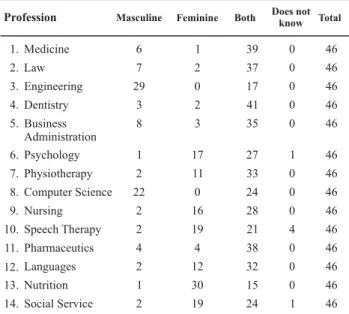
Table 2 shows the subjects’ perception as to the femi-nine or masculine nature of professions. The students’ opin-ions were neutral for most professopin-ions, which could be a sign that, hypothetically, there was a reduction in the ac-ceptance of gender stereotypes concerning professions in this city. Only nutrition and engineering received a gender classification by most students. Interestingly, the professions with most indications as appropriate for the male gender had high ranking positions regarding salary, except for com-puter science. However, most professions that received indi-cations as female were inferior in the salary ranking.
Table 2 - Secondary-level students’ perception about professions socially considered as feminine or masculine professions - Ribeirão Preto - 2005
Profession 1. Medicine 2. Law 3. Engineering 4. Dentistry 5. Business Administration 6. Psychology 7. Physiotherapy
8. Computer Science
9. Nursing 10. Speech Therapy
11. Pharmaceutics
12. Languages 13. Nutrition 14. Social Service
Masculine 6 7 29 3 8 1 2 22 2 2 4 2 1 2 Feminine 1 2 0 2 3 17 11 0 16 19 4 12 30 19 Both 39 37 17 41 35 27 33 24 28 21 38 32 15 24 Does not know 0 0 0 0 0 1 0 0 0 4 0 0 0 1 Total 46 46 46 46 46 46 46 46 46 46 46 46 46 46
Many studies have appointed an over-valuing of fam-ily for the female gender, presuming that this is the place for women. This was reflected in the professions discrimi-nated by the professional’s gender. One result is that women tend to choose feminine professions. Hence, these professions become devalued and have a low remunera-tion because men tend to underestimate these careers in their professional choice, contributing to these feminine
courses becoming less competitive in the university en-trance exams(19).
However, the current job market change for women and the increasing exposure of strong female leaders in the media combine to change this scenario. Women are enter-ing areas that were previously dominated by men, a fact that entails consequences for nursing in the long term, caus-ing a recruitment crisis for both genders.
As for the contact with the nursing professional, most students had been seen at health service locations and over 35 students (76%) considered the service competent, sym-pathetic and considerate, which is in agreement with the good position of nursing in the status ranking. The positive contact with nursing professionals can affect a reduction in the level of stereotypes in the population, since every time an individual is confronted with the reality of the social object, he or she can rebuild or maintain the existing ste-reotypes.
In the present study, 14 students (30.4%) knew that nurses have a higher educational level than nursing auxilia-ries and nursing technicians, 17 students (37%) answered that, in terms of education, nurses working at hospitals com-pleted secondary education, followed by a technical course; however, 25 students (54.2%) answered correctly. When asked about the low rates of men in the nursing profession, most students answered that the profession is more attrac-tive to women, with no stereotype of an effeminate nurse.
Students were also asked to give their opinion about 21 characteristics, stating which ones referred to medicine, nursing, or both. Most students who answered the ques-tion (excluding those who did not know) assigned the fol-lowing characteristics as being mainly of physicians: pre-scribing medications, leadership/leader, knowledge about diseases and diagnoses, manager/management, authori-tarian. The characteristic Obeying orders from other pro-fessionals was pointed out by 22 students (47.8%) as being an isolated characteristic of nursing. However, another 22 students (47.8%) answered that Obeying orders from other professionals is characteristic of nursing and medicine, which suggests the hypothesis of greater visibility assigned to the work of multiprofessional teams and removes the focus on cure as an action exclusive of medicine.
Most students (except those who did not know) ap-pointed the following characteristics as pertaining to nurs-ing and medicine: skills to perform physical exams, work manager, guides family and patient when returning home, fast reasoning, knowledge about eating, knowledge about anatomy and physiology, knowledge about bandages, pre-scribing care; dominion of math calculations, humanitar-ian/humanitarianism, knowledge about medications, all of which show the importance they give to nursing, since the majority of the sample recognized their knowledge.
CONCLUSION
It should be noticed that it is a small sample, which might not be representative of the population. Therefore, the
study conclusions should not be interpreted as an infer-ence for the population, but rather as a hypothesis to be tested in a future study, with a sample that is statistically representative of the population.
Most of the students lived in traditional family envi-ronments: stay-home mothers and working fathers. Nonetheless, most professions were rated neutrally in terms of gender, even though, apparently, a higher sta-tus value was assigned to careers with a masculine so-cial connotation.
In the profession ranking, nursing held an important position (8th in status and 9th in salary), and most
stu-dents attributed important characteristics regarding knowledge detention as belonging to nursing and medi-cine. However, it is observed that, in the sample, there is a confusing comprehension about the nursing team components and nurses’ education level. Although this does not refer to the majority of the students, it is an index that deserves intervention (over 30%). It should also be highlighted that medicine is seen as a coordina-tor of health work.
Therefore, the present study points to the following hypotheses:
1. An update about the social image of nurses is taking place in the population;
2. Students are still unaware of the nursing team cat-egories, and;
3. Students assign the coordination of health work to medicine.
In this sense, we intend to continue this study with a sample that is representative of secondary-level public school students in Ribeirão Preto, thus completing the vali-dation of the instrument and beginning a broad study of the effectiveness of professional marketing with pre-uni-versity-candidates, wherever this need is indicated by evalu-ation results based on the instrument.
REFERENCES
1. Mendes IAC, Marziale MHP. Década de recursos humanos em saúde: 2006-2015. Rev Lat Am Enferm. 2006;14(1):1-2. 2. Rodrigues A, Assmar EML, Jablonski B. Psicologia social. 22ª
ed. Petrópolis: Vozes; 2003.
3. Atkinson RL, Atkinson RC, Smith EE, Bem DJ, Nolen-Hoeksema S. Introdução à psicologia de Hildgard. 13ª ed. Porto Alegre: Artmed; 2002.
4. Silva AL, Padilha MICS, Borenstein MS. Imagem e identidade profissional na construção do conhecimento em Enfermagem. Rev Lat Am Enferm. 2002;10(4):586-95.
5. Nauderer TM, Lima MADS. Imagem da enfermeira: revisão da literatura. Rev Bras Enferm. 2005;58(1):74-77.
6. Baptista SS, Barreira IA. A luta da enfermagem por um espaço na universidade. Rio de Janeiro: Escola de Enfermagem Anna Nery/UFRJ; 1997.
7. Brodie DA, Andrews GJ, Andrews JP, Thomas GB, Wong J, Rixon L. Perceptions of nursing: confirmation, change and the student experience. Int J Nurs Stud. 2004;41(7):721-33.
9. Spindola T, Santos RS. O trabalho na enfermagem e seu sig-nificado para as profissionais. Rev Bras Enferm. 2005;58(2): 156-60.
10. Shinyashiki GT, Mendes IAC, Trevizan MA, Day RA. Professional socialization: students becoming nurses. Rev Lat Am Enferm. 2006;14(4):601-7.
11. Takase M, Kershaw E, Burt L. Does public image of nurses matter? J Prof Nurs. 2002;18(4):196-205.
12. Mendez D, Louis M. College students’ image of nursing as a career choice. J Nurs Educ. 1991;30(7):311-9.
13. Foong ALS, Rossiter JC, Chan PT. Socio-cultural perspectives on the image of nursing: the Hong Kong dimension. J Adv Nurs.1999;29(3):542-8.
14. Alcântara G. A Enfermagem moderna como categoria profis-sional: obstáculos à sua expansão na sociedade brasileira [cá-tedra]. Ribeirão Preto: Escola de Enfermagem de Ribeirão Preto da Universidade de São Paulo; 1963.
15. Polit DF, Beck CT, Hungler BP. Fundamentos de pesquisa em Em-fermagem. 5ª ed. Trad. de Ana Thorell. Porto Alegre: Artmed; 2004. 16. Silva JA, Ribeiro-Filho NP. Avaliação e mensuração de dor:
pesquisa, teoria e prática. Ribeirão Preto: FUNPEC; 2006. 17. Primi R, Munhoz AMH, Bighetti CA, Di Nutti EP, Pellegrini MCK,
Moggi MA. Desenvolvimento de um inventário de levanta-mento das dificuldades da decisão profissional. Psicol Reflex Crit. 2000;13(3):451-63.
18. Medina NVJ, Takahashi RT. A busca da graduação em enfer-magem como opção dos técnicos e auxiliares de enferma-gem. Rev Esc Enferm USP. 2003;37(4):101-8.
19. Meyer DEE. Ao olhar-se no espelho, a enfermeira não tem gostado da imagem que aí vê refletida. Rev Bras Enferm. 1992; 45(2/3):176-82.
20. Luchesi LB, Santos CB. Enfermagem: o que esta profissão sig-nifica para adolescentes: uma primeira abordagem. Rev Lat Am Enferm. 2005;13(2):158-64.
Acknowledgements
The authors thank The Brazilian Council of Technological and Scientific Development (Conselho Nacional de Desenvolvimento Científico e Tecnológico - CNPq) for offering the Master’s grant, the data collection