Communication and education in health
consultations to children with acute
respiratory infections
O
r
i
g
i
n
a
l
a
r
ti
c
le
ComuniCação e eduCação nas Consultas de Crianças Com infeCções respiratórias agudas
ComuniCaCión y eduCaCión en las Consultas de niños Con infeCCiones respiratorias agudas
RESUmo
Este estudo objeivou ideniicar as orien -tações de cuidado à criança com infecções respiratórias agudas (IRA) e descrever o processo de comunicação entre proissio -nais e mães na consulta. Os dados foram coletados em Unidades Básicas de Saúde, em entrevistas e observação de consultas de enfermeiras e médicos a crianças com IRA. Os resultados mostram orientações variáveis e incompletas entre os proissio -nais, predominantemente prescriivas e centradas na doença, principalmente no tratamento medicamentoso. A comunica -ção é centrada no proissional, o que não favorece um processo educaivo emanci -patório. Conclui-se a necessidade de incluir esses conteúdos na formação inicial e per -manente dos proissionais.
dESCRitoRES Criança
Infecções respiratórias Comunicação em saúde Educação em saúde Relações proissional-família Saúde da criança
AbStRACt
The objecive of this study was to iden -ify the recommendaions for the care of children with acute respiratory infecions (ARI) and to describe the process of com -municaion between professionals and mothers during the consultaion. Data collecion was performed in Primary Care Units, through interviews and observaion of physicians’ and nurses’ consultaions to children with ARI. The recommendaions ranging between professionals and were incomplete and focusing on the disease, mainly on the treatment; communicaion is focused on the professional, which does not promote an emancipatory educaion process. The results conirmed the need to include such issues in the iniial and ongo -ing train-ing of professionals.
dESCRiPtoRS Child
Respiratory tract infecions Health communicaion Health educaion
Professional-family relaions Child health
RESUmEn
Este estudio objeivó ideniicar las orien -taciones de cuidado al niño con infecciones respiratorias agudas (IRA) y describir el pro -ceso de comunicación entre profesionales y madres en la consulta. Los datos se re -cogieron en Unidades Básicas de Salud, en entrevistas y observación de consultas de enfermeras y médicos a niños con IRA. Los resultados muestran orientaciones varia -bles entre los profesionales e incompletas, predominantemente prescripivas y enfoca -das en la enfermedad, principalmente en el tratamiento medicamentoso; la comunica -ción se centra en el profesional, lo que no favorece un proceso educaivo emancipa -torio. Se concluye en la necesidad de incluir tales contenidos en la formación inicial y permanente de los profesionales.
dESCRiPtoRES Niño
Infecciones del sistema respiratorio Comunicación en salud
Educación en salud
Relaciones profesional-familia Salud del niño
intRodUCtion
Despite improvements obtained in the rates of mor
-bidity and mortality of children, they sill sufer from di
-verse diseases such as diarrhea, malnutriion, parasiic diseases, dehydraion and respiratory infecions. These diseases mainly occur due to social inequaliies character -isic of poor countries.
Among such diseases, acute respiratory infecions (ARI) are one of the main causes of infant morbidity and mortal -ity(1). ARIs are the main reasons for medical consultaions in the public network in the city of São Paulo, SP, Brazil, com -prising about 40% of pediatric hospitalizaions(1) and are the main cause of death among children 1 to 5 years old; pneu -monia is the main isolated cause. The fact that pneu-monia is one of the main causes of infant mortality and mainly occurs in peripheral areas indicates the poor living condi
-ions for those families and the ineiciency of the health service(2-3) in meeing the needs of this populaion.
To cope with these rates of infant mortal -ity, the World Health Organizaion (WHO), the Pan-American Health Organizaion (PA -HO) and the United Naions Children’s Fund (UNICEF) devised a strategy called Integrated Management of Childhood Illnesses (IMCI). Such a strategy promotes a systemized and integral view of children, including compo -nents of care and control of the most preva -lent diseases during childhood. Its inclusion in the primary health care rouine provided to children has been recommended by these insituions since the mid-1990s(4).
Both PAHO and WHO classiied deaths due to pneumonia into three basic types in order to establish a sequence in which acions to control it would be implemented(4): deaths
due to health professionals or health services’ malpracice, whether in the ideniicaion or treatment stages; deaths from not seeking out health services or delaying seeking help due to a delayed realizaion of severity; deaths that occur at home in which no health services or professionals are con -sulted due to a failure to realize the condiion’s severity.
According to PAHO, the strategies to control ARI that ofer immediate beneits to children in developing coun -tries are(4): a) appropriate treatment of cases: early classi
-icaion of the severity of infecion on the part of families and workers in primary care; use of animicrobial thera -py and other appropriate support measures; deiniion of referral criteria and appropriate treatment in referral units; b) improvement of childcare knowledge, conduct and pracices on the part of mothers and families through their direct paricipaion in educaional intervenions.
Some studies idenify a close relaionship between morbidity and mortality due to ARI and the poor knowl -edge of families concerning the disease and quality of
care provided at home(5-7), which demand health educa -ion ac-ions appropriate to the characterisics of caregiv -ers, promoing home care needed by children, the early recogniion of signs and symptoms of the disease and seeking out health services in ime.
Another study concerning maternal knowledge re -lated to home care provided to children with diarrhea or ARI revealed that only a small share of mothers ideniied ‘increasing supply of luids’ or ‘nourishment’ an important aspect for the care of children with ARI despite these be -ing acknowledged as essenial care acions in the recovery of children with this type of disease(7).
Given the importance of the communicaion process in health educaion, the characterizaion and analysis of this process during consultaions can contribute to the evaluaion of educaional acions in childcare.
obJECtiVES
This study’s objecives included: iden -ifying instrucions provided during care delivered to children with ARI in medical and nursing consultaions and describing the communicaion process established by health professionals during consultaions with children with ARI.
mEtHod
This exploratory and descripive study was carried out both in Primary Care Units (PHU) and Family Health Units (FHU) in the region of Butantã, São Paulo, SP, Brazil in two phases. The irst phase was composed of semi-structured and individual interviews with physicians and nurses. The second phase included observaion of consultaions provided by these professionals to children with ARI. Both phases were carried out with proper forms developed for these purposes based on the protocols for evaluaing units pro -viding training concerning ARI(8), based on the stages of communicaion process(9) and IMCI recommendaions(10).
In relaion to ethical concerns, the Research Ethics Com -mitee at the City Health Department approved the project (process 379/2004CEPSMS Registraion number 259/2004 CEPSMS). Addiionally, all the paricipants and the legal guardians of the children cared for in the observed consul
-taions signed free and informed consent forms.
The IMCI recommendaions concerning childcare were considered in the analysis, in addiion to speciic recom -mendaions for care provided at home to children with ARI since they encompass care prioriies. Such recom -mendaions include establishing appropriate communica -ion with mothers and providing guidance concerning the following: coninuing feeding, ofering addiional luids to given the importance
of the communication process in health
education, the characterization and analysis of this process
during consultations can contribute to the evaluation of educational actions in
children during the disease, idenifying danger signs that require immediate return to the health service, and sched
-uling a return visit. The strategy highlights the importance of providing guidance according to speciic needs, which depends on the ideniicaion of care pracices usually used by the family and other family characterisics.
RESULtS
A total of seven workers from the PHU (two nurses and ive pediatric physicians) and 12 workers from the FHU (eight nurses and four physicians) were interviewed, total -ing 19 interviews. Addiionally, 21 consultaions provided by 11 of these professionals were observed (six nurses from the FHU, two physicians from the FHU and two phy -sicians from the PHU); 15 consultaions took place with those within the FHU (11 with nurses and ive with physi -cians) and ive consultaions were provided by pediatric physicians.
No nurses from the PHU were observed because they do not usually give consultaions. Six of the interviewed professionals were not found for the observaions either because they had let the service, were transferred to a unit not paricipaing in the study, or were on maternity leave.
Most paricipants completed college in public universi
-ies in the Southeast region of Brazil, especially in the state of São Paulo, and had at least one specializaion in the fol -lowing ields: collecive health, public health, or pediatrics.
Most paricipants reported they acquired knowledge concerning IMCI strategy in congresses and by reading; only one nurse from the PHU reported speciic training, which reveals that the implementaion of this strategy was not completely accomplished in the city of São Paulo, even in the FHU units. Nonetheless, two nurses and two physicians from the FHU and one physician from the PHU reported parially using it in their pracice.
Nurses from the FHU reported they provide a larger amount of informaion than the remaining professionals with the following results: nurses from the PHU reported they provide an average of 19.5 instrucions, physicians of the FHU reported they an average of 19.75 instruc -ions, physicians from the PHU reported an average of 21 instrucions; nurses from the FHU reported 24.1 instruc
-ions. However, these results were not conirmed by ob -servaions; physicians from the FHU actually provided 19 guidelines per consultaion, physicians from the FHU pro -vided 17.73 guidelines by consultaion and nurses from the FHU provided 13.25 guidelines by consultaion.
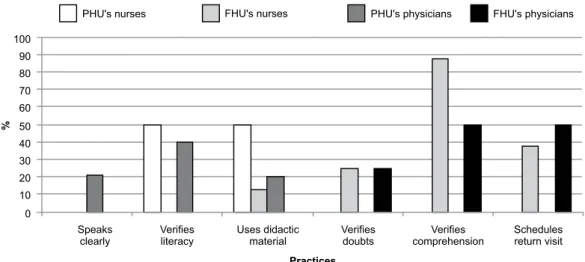
The professionals reported few pracices that favor ad -herence to their instrucions but the most frequent were: schedule a home visit; verify whether the mother under -stood the informaion; check whether there were any ad
-diional doubts (Figure 1). This informaion was proven in the observaions. Many reported that no addiional mea -sures were used nor did they provide any addiional infor -maion staing that mothers are not capable of complying or have no means to comply with it.
0 10 20 30 40 50 60 70 80 90 100
Speaks clearly
Verifies literacy
Uses didactic material
Verifies doubts
Verifies comprehension
Schedules return visit
Practices
%
PHU's nurses FHU's nurses PHU's physicians FHU's physicians
Figure 1 - Practices adopted by professionals to increase mothers’ adherence to their recommendations, according to profession and
type of health unit - São Paulo - 2006
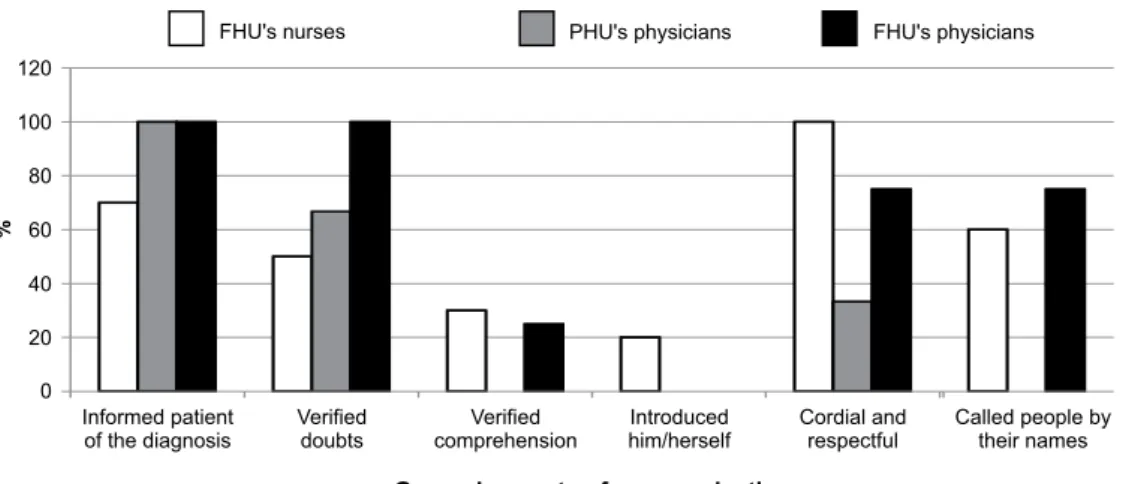
According to the general aspects of communicaion, professionals were cordial and respecful in most part of consultaions: their tone of voice was considered pleas -ing; they looked at the mothers while talking, listened to them atenively without interruping, and instructed them in a friendly manner. In most of the consultaions, though, the professionals did not introduce themselves or call the mother and child by their names (Figure 2).
In most of the consultaions, they asked whether the mother had any doubt and informed them of the diagnosis or diagnosic hypothesis. The only explanaion concerning the di -agnosis was provided by a nurse from the FHU who said: the
lungs are too full of mucus, which hinders respiraion. In 30%
0 20 40 60 80 100 120
General aspects of communication
%
FHU's nurses PHU's physicians FHU's physicians
Informed patient of the diagnosis
Verified doubts
Verified comprehension
Introduced him/herself
Cordial and respectful
Called people by their names
Figure 2 - General aspects of communication observed during consultations with children with ARI according to professions and type
of health unit - São Paulo - 2006
Anipyreic medicaion was prescribed in 90% of the observed consultaions; physicians explained how much (dose) and when the mother should administer it in most of the cases. No professional explained to mothers the purpose of the medicaion and which measures to take if the child refused it or vomited. Anibioic medicaion was prescribed in 80% of the medical consultaions (Table 1). Professionals explained for how many days the mothers should administer the medicaion in all the consultaions; how many imes a day and imes the medicaion should be administered were explained in most cases.
Table 1 - Medical instructions concerning the administration of
antibiotics to children with ARI at home according to type of he-alth unit - São Paulo - 2006
PHU's physician (N=4)
FHU's physicians (N=4)
Total (N=8) Instructions
concerning the use
of antibiotics N (%) N (%) N (%)
Importance of maintaining regular schedule of administration
Importance of administering all the doses
How to prepare it For how many days How many times a day/time
1 (25.0) 2 (50.0) 3 (37.5)
2 (50.0) 1 (25.0) 3 (37.5)
- 3 (75.0) 3 (37.5)
4 (100.0) 4 (100.0) 8 (100.0)
4 (100.0) 1 (25.0) 5 (62.5)
Concerning feeding, professionals asked in 45% of the consultaions (60% of the nurses of the FHU, 50% of the physicians from the FHU and 16.7% of physicians from the PHU) whether the children were having problems eaing. In 60% of the cases, they instructed the mother to feed the child in the following ways: breaking their daily diets into smaller porions, keeping a habitual diet, or ofering the diet recommended for the child’s age. None of the professionals advised the caregivers what to do if the chil -dren refused food. Although in one consultaion a nurse
from the FHU did tell the caregivers how to proceed if the child vomited.
In most of the consultaions (70% of nurses of the FHU, 100% of the physicians from the FHU and 83% of the physicians from PCU) the professionals communi -cated the need to increase the ingesion of luids. In one quarter of the consultaions (none of those provided by FHU’s physicians), the professional recommended luids should preferably be water, tea and natural juices. Only one nurse from the FHU explained in one consultaion what to do if the child refused food or vomited and pro -vided informaion on the signs of dehydraion. In the only consultaion provided by a nurse from the FHU to chil -dren younger than six months of age, the professional recommended increased breasfeeding frequency; an -other consultaion provided by a physician from the PHU to a child this same age was also observed but he did not made this recommendaion.
In order to facilitate the removal of nasal secreion, the professionals recommended irrigaing nasal passages with saline soluion to clean the child’s nostrils in most of the consultaions. More than a quarter of workers recom -mended nasal inhalaion or spray. Only one nurse from the FHU recommended the mother blow the child’s nose with a issue or toilet paper to remove secreion.
0 20 40 60 80 100 120
Rapid breathing Difficult breathing Worsening general state
Onset or worsening fever
Suprasternal and intercostal retractions
Signs of severity
%
FHU's nurses PHU's physicians FHU's physicians
Figure 3 - Signs of severity, recommended during consultations, to be monitored according to professions and type of health units - São
Paulo - 2006
Mothers were advised to return immediately in the event of any sign of severity in 70% of the consultaions (50% of nurses from the FHU, 100% of physicians from the PHU and 70% of physicians from the FHU). Only in two consultaions (one physician from the FHU and another from the PHU) did the professionals explain why these signs should be observed. In relaion to reevaluaion, in 50% of the consultaions provided by nurses from the FHU (1/4 of the total), the professional referred the child for immediate medical evaluaion and it was the responsibil -ity of the physician to schedule the return visit. Return vis -its were scheduled in 33% of the total (two consultaions provided by nurses from the FHU, one consultaion by the FHU’s physician and two physicians from the PHU).
diSCUSSion
According to the results obtained during observa
-ions, the nurses from the FHU provided the smallest number of instrucions per consultaion, very diferent from what was reported in the interviews in which they provided more informaion than other professionals. A possible explanaion is that in 50% of their consultaions they concluded the children needed a medical evaluaion and immediately referred the child to a physician. Hence, the FHU nurses may have held the view that the physician should provide any instrucion because he would con -clude the clinical evaluaion and establish the appropriate conduct to be followed; they did provide a larger number of guidelines when consultaions did not require medical evaluaion.
The recommendaion of the IMCI (11) strategy concern -ing evaluaion, treatment and guidance related to care to be provided to children at home indicates that, when the mothers seek the health service, professionals should take the opportunity with the children to evaluate other as
-pects besides those related to the complaint per se, that is, beyond respiratory problems as is the case of this study. Hence, every child brought to the health service with cough or diiculty breathing should also be evaluated in relaion to diarrhea, fever, anemia or malnutriion in addiion to
feeding habits and immunizaion. Therefore, these aspects should be observed and related guidance provided at the ime of consultaions. Even though most professionals re -ported some knowledge concerning the IMCI strategy, none of them completely assessed the children.
One of the aspects not clearly proposed in the IMCI and that was invesigated in this study is instrucions pro -vided in relaion to the disease, disclosure and clariica -ion concerning the diagnosis. Providing informa-ion is the irst step to promote the populaion’s autonomy, aim
-ing to ensure the condiions necessary for people to make
autonomous choices, minimizing the circumstances that hinder or impede them in the exercise of autonomy(12). There is no autonomy without knowledge.
Most of the studied professionals informed the moth
-ers about the diagnosis though only one nurse explained what it meant. However, the professional was not clear and used words in the diminuive, which in addiion to acing in a patronizing manner toward the mother, does not facilitate understanding of the disease, its importance and impact on the child’s life. The use of words in the di -minuive by health professionals is a frequent occurrence in maters related to children and even though some re
-port its use because it sounds afecionate, there is a pos -sibility its use may actually seem an atempt to “belitle” the other person. Other studies have shown a tendency on the part of professionals not to disclosure the diagno
-sis to the paient or not to clearly explain it nor verify its comprehension(12-13). They should, in addiion to recom
-mending a treatment, explain the reasons such a treat -ment was adopted.
In most of the cases, instrucion provided was speciic for respiratory diseases with a greater emphasis on med
-tering medicaion to children may be a challenge even for the family, who frequently use inappropriate strategies.
According to the IMCI strategy(11,14), when prescribing a medicaion, the professional should explain to the mother or the companion the reason it is being prescribed, com -municate how many imes it should be administered, observe the administraion of the irst dose, and verify whether the mother understood the enire procedure before she leaves the services. These steps enable one to efecively idenify the diiculies faced by the populaion and help to solve them.
Also contrary to what is recommended by the IMCI strategy, the professionals did not perform a complete as -sessment of the children concerning their habitual feeding, which would enable the ideniicaion of inappropriate or correct pracices, and also individualizing guidance to the needs of mothers and the families’ economic situaion. This in addiion to reinforcing correct pracices, would reduce potenial fears and increase the mothers’ self-conidence in relaion to the care they provide to their children(7).
Most of the professionals did not inform the mothers about how to encourage children to eat during their dis
-ease, which is essenial since loss of appeite is common in this situaion. Inappropriate feeding contributes to the deterioraion of one’s nutriional state, one of the main risk for infecions, leading to a vicious cycle that if it does not ulimately compromise the paients’ lives, does negaively inluence the child’s growth and development(13-16). Hence, recommendaions concerning eaing and coninuity of breasfeeding are key elements in care provided at home to children with ARI because they reduce the impact of the disease on the child’s growth and development(13-14).
Also, the child may refuse an appropriate quanity of luids given poor appeite and compromise their hydra -ion and the luidiza-ion of respiratory secre-ions, which favors the eliminaion of agents causing the disease from the body. Fluids prevent dehydraion that may arise as a result of tachypnea, vomiing, anorexia, diarrhea or fever and decrease respiratory distress caused by the increased secreion in airways(10,15).
Hence, one of the main care acions provided to sick children is to increase the ingesion of luids, which is an instrucion provided in most of the consultaions. How -ever, few professionals told the mothers how it should be implemented, considering that the increase of luids should be through ofering fruit juices, soups or vegeta -ble broth, water and natural gelain or by increasing the frequency of breasfeeding for children younger than six months of age(10,16). For such purposes, oral hydraion is more eicient than the use of any medicaion or other type of intervenion, such as inhalaion. Hence, all profes -sionals are expected to make such recommendaions.
In regard to the removal of mucus and nasal cleansing, irrigaion with saline soluion and removal of the mucus
are important measures because if mucus is not removed, it may obstruct the nostrils, causing respiratory distress in addiion to favoring the onset of secondary infecions(10,15). Most of the professionals recommended nasal irrigaion in their consultaions, though only one nurse from the FHU instructed the mother to blow the child’s nose to remove mucus. This measure may have been seldom recommend -ed by the professionals because it may be seen a mater of hygiene obvious to mothers. However it is necessary to reinforce such procedures mainly due to the young age of most of the afected children. Infants tend not to present much coughing and are not able to remove the mucus by themselves, while nasal obstrucions may hinder eaing and sleeping, causing sickness. Someimes, it is necessary to induce nasal drainage to promote comfort(10,15).
Professionals instructed mothers in most of the con -sultaions to monitor for signs that indicate the disease is worsening and immediately return to the service if these were observed. The main signs related to ARI such as rapid breathing, diiculty breathing, onset or worsening of fever, worsening of general state, were stressed in 60% of the consultaions. Only one professional instructed the mother to observe whether the child had diiculty drink -ing; and whether the mother had diiculty in feeding a child younger than two months of age was recommended in the only consultaion it was appropriate to do so.
These signs indicate the disease is worsening and it is expected that professionals instruct mothers in all the consultaions to monitor danger signs and return imme -diately to the health service if they appear(15). However, none of the professionals instructed mothers regarding all the signs in their consultaions and in some consultaions they did not reinforce the need to immediately return to the service. Even though it seems obvious that mothers should return to the health service if they observe any of these signs, studies addressing the mortality of children with ARI indicate that caregivers are oten slow to return to the service, possibly due to inappropriate guidance concerning the ideniicaion of these signs and acions to be taken in the event they are ideniied(6).
The IMCI strategy also recommends that if symptoms do not improve, regardless of the disease, the child should to be reassessed by the health professional in pre-deined intervals. In cases of pneumonia, the child should be reas -sessed in two days, regardless of whether the symptoms improved or not(14). Only one child cared for by a nurse from the FHU was suspected to have pneumonia and was immediately referred for a medical evaluaion. In another four consultaions by FHU nurses, the children were also referred to the physician and it was his responsibility to schedule a return visit. Few professionals scheduled re
-turn visits in the remaining consultaions.
such adherence were restricted to prescripions and repeiions of the therapeuic plan. The implementaion of more paricipaive pedagogical measures to promote greater understanding of the health-disease coninuum in children in order to facilitate treatment adherence was not observed.
Hence, guidance followed the tradiional educaional model that considers individuals to be “empty boxes” who need technical knowledge for their survival(17-18). Instruc
-ions were direcive, that is, the professionals transferred scieniic knowledge to the mothers in an asymmetric re
-laionship in which maternal knowledge and the mean -ings they atribute to the health-disease coninuum were ignored. The professionals did not ask about such knowl -edge and meanings nor did they let the mothers sponta
-neously talk about them; only the professionals’ opinions were conirmed and mothers were excluded from deci -sion-making concerning care provided to their children.
Such a method of health educaion focused on profes -sional knowledge, which devalues interpersonal relaion
-ships and disregards meanings of care held by families, generates a gap between the professionals’ thinking/prac -ice and mothers’ acions, hindering their learning in rela -ion to prescrip-ions and required care(17).
Overcoming this tradiional model of health educaion requires health professionals to understand knowledge as a process of collecive construcion and valorizaion of the populaion’s knowledge. Hence, professionals need to leave their role of keepers of knowledge and start to establish a relaionship of exchange with the populaion in which all are considered actors in the health-disease
coninuum. Therefore, communicaion, which in the tra
-diional model of health educaion is direcive, becomes paricipaive and based on dialogue and interacion among people(18).
ConCLUSion
The study achieved the proposed objecives. It al -lowed determining that instrucions provided to mothers concerning care delivered at home to children with ARI does not follow a standard, hence, guidance is variable and incomplete; the communicaion process is focused on the professional, which does not favor an emancipatory educaional process.
Therefore, the professionals’ concepts related to educa -ional pracice should be reviewed in order to establish par -icipaive communicaion between professionals and care -givers, sharing knowledge in an emancipatory approach to promote the control of families concerning the health-dis -ease coninuum. The educaional process of health profes -sionals should include opportuniies to learn competencies and skills for health educaion considering communicaion as a care acion so as to promote exchange that supports projects toward a beter quality of life.
Addiionally, considering this study’s indings and given the central role that health promoion and educa -ion play in primary health care and also that such ac-ions do not occur separately from a dialogical communicaive process, it is essenial to include this issue and the IMCI strategy in the permanent educaional processes of pro -fessionals in the primary health care system.
REFEREnCES
1. Brasil. Ministério da Saúde. DATASUS. Indicadores de morbi
-dade e fatores de risco [Internet] Brasília; 2005 [citado 2005 maio 11]. Disponível em: htp://tabnet.datasus.gov.br/cgi/ tabcgi.exe?idb2004/d13.def
2. São Paulo (Cidade). Secretaria Municipal da Saúde. Programa de Informações sobre Mortalidade - Pro-AIM. São Paulo: SMS; 2002.
3. Chiesa AM, Westphal MF, Akerman M. Doenças respiratórias agudas: um estudo das desigualdades em saúde. Cad Saúde Pública. 2008;24(1):55-69.
4. Organizaion Panamerica de la Salud (OPAS). Infecciones respiratorias agudas: guía para la planiicación, ejecución y evaluación de las acividades de control dentro de la atención primaria de salud. Washington: OPAS; 1988.
5. Sigaud CHS. Concepções e práicas maternas relacionadas à criança com pneumonia: estudo realizado no município de São Paulo [tese doutorado]. São Paulo: Faculdade de Saúde Pública, Universidade de São Paulo; 2003.
6. Chiesa AM, Bertolozzi MR. Estudo epidemiológico da mortali -dade por infecções do aparelho respiratório em menores de cinco anos da região do Butantã, São Paulo, Brasil. In: Ben -guigui Y, organizador. Invesigações operacionais sobre o con -trole de infecções respiratórias agudas. Washington: OPAS; 1997. p. 19-29.
7. Prado SRLA, Fujimori E. Conhecimento materno/familiar so
-bre o cuidado prestado à criança doente. Rev Bras Enferm. 2006;59(4):492-6.
8. Benguigui Y, editor. Avaliação das unidades de capacitação no tratamento das infecções respiratórias agudas: entrevista ao pessoal de saúde. Washington: OPAS; 1997. Controle das infecções respiratórias agudas: implementação, acompanha
-mento e avaliação; p. 88-90.
9. Chiesa AM, Veríssimo MLÓR. A educação em saúde na práica do PSF. In: Brasil. Ministério da Saúde. Insituto para o Desen
10. Brasil. Ministério da Saúde. Atenção Integral as Doenças Prevalentes na Infância: tratar a criança. Brasília; 2003.
11. Brasil. Ministério da Saúde. Atenção Integrada às Doenças Prevalentes na Infância: quadros de condutas. Brasília; 1999.
12. Capra A, Rodrigues J. A relação assimétrica médico-pacien -te: repensando o vínculo terapêuico. Ciênc Saúde Coleiva. 2004;9(1):139-46.
13. Valdivia DC, Barreira S. Conocimientos, acitudes y praci
-cas del personal de salud y la madre (o cuidador del niño), frente a los casos de infecciones respiratorias agudas en La Paz, Cochabamba y Santa Cruz, 1995. Rev Chil Pediatr. 2001;72(4):384-95.
14. Brasil. Ministério da Saúde. Atenção Integrada às Doenças Prevalentes na Infância: aconselhando a mãe e acompan
-hante. Brasília; 1999.
15. Veríssimo MLÓR, Sigaud CHS. Assistência de enfermagem à criança com agravos respiratórios. Brasil. Ministério da Saúde. Insituto para o Desenvolvimento da Saúde. Pro
-grama de Saúde da Família. Manual de enfermagem. Brasí
-lia: MS/IDS/USP; 2001. p. 95-8.
16. Benguigui Y, editor. Infecções respiratórias agudas: funda -mentos técnicos das estratégias de controle. Washingto: OPAS; 1997. Bases técnicas das recomendações da OPAS/ OMS sobre o tratamento da pneumonia em crianças no pri -meiro nível de atenção; p. 2-21.
17. Grippo MLVS, Fracolli LA. Avaliação de uma carilha educai -va de promoção ao cuidado da criança a parir da percepção da família sobre temas de saúde e cidadania. Rev Esc Enferm USP. 2008;42(3):430-6.
18. Jorge MSB, Queiroz MVO. Ações educaivas no cuidado in