Pediatric Dentistry
Ayah Qassem Shqair(a) Genara Brum Gomes(a) Adauê Oliveira(a) Marília Leão Goettems(a) Ana Regina Romano(b)
Lisandrea Rocha Schardozim(b) Maria Laura Menezes Bonow(b) Dione Dias Torriani(b)
(a)Graduate program in Dentistry, School of Dentistry, Federal University of Pelotas, Pelotas, RS, Brazil.
(b)Infant Clinic, Department of Social and Preventive Dentistry, School of Dentistry, Federal University of Pelotas, Pelotas, RS, Brazil.
Corresponding author: Dione Dias Torriani E-mail: [email protected]
Received for publication on Jul 06, 2011 Accepted for publication on Oct 31, 2011
Dental emergencies in a university
pediatric dentistry clinic: a retrospective
study
Abstract: A signiicant number of children visit a dentist for the irst time due to emergency situations. However, little is known regarding the prevalence, etiology, and treatment provided for children at emergency dental visits. This study aimed to evaluate the proile of children attend-ing a dental school emergency clinic, the reasons for seekattend-ing dental care, and the treatment provided. Records of 270 patients who attended an emergency clinic during 2010 were analyzed, and 253 were selected. De-mographic, diagnostic, and procedural information was collected. The mean child age was 7.8 years. For 208 children (82%), pain was the main reason for the emergency visit. Nearly 79% of the visits were due to car-ies, and the most frequently required treatment was endodontic inter-vention (31.22%). Of the decayed teeth, 61.70% were primary posterior teeth and 31.9% permanent posterior teeth. Pain caused by dental decay was the most frequent chief complaint. A large number of children were brought to the dentist with complaints that had started long before, for which over-the-counter medications had been used.
Descriptors: Pain; Pediatric Dentistry; Dental Care; Emergencies; Dental Caries.
Introduction
The recommendation that a child’s irst dental visit should occur dur-ing the child’s irst year of life has had a signiicant effect on dental dis-ease prevention,1 with long-term beneits for the child. Nevertheless, a
signiicant number of children have limited access to dental services,2
and parents often take their children to the dentist only when a problem becomes serious and causes discomfort or pain. A signiicant number of the patients who come to the emergency clinic are children.3,4 It has been
reported that 25.7% of the children visit a dentist for the irst time due to emergency situations.3
Emergency visits can be deined as the care of patients who present oral problems that interfere in their lives or with organ function.3
Pa-tients who require urgent dental care generally present severe dental and facial pain that is not controllable by over-the-counter preparations, as well as dental and soft-tissue acute infections, uncontrollable dental hem-orrhage, dental trauma, or rapidly increasing facial swelling.5 Studies
have shown that most emergency visits result from dental decay.6-8
Due to the described signs and symptoms, the emergency visits can
represent an uncomfortable situation for both pa-tient and professional. It is important that the den-tist possess suficient knowledge to make quick de-cisions, to relieve pain and discomfort, especially when dealing with children. Some studies have ad-dressed the situations that most often lead children to seek emergency care. However, most of them were performed in hospital settings and only a few in universities. Thus, this study aimed to describe the proile of children seeking treatment for a dental emergency at a dental school in Pelotas, RS, Brazil, as well as their reasons for seeking dental care and the treatment provided.
Methodology
The project was approved by the Human Re-search Ethics Committee of the Federal University of Pelotas (215/2011). All parents signed an in-formed consent form prior to consultation, autho-rizing their child’s participation in the studies as well as any treatment.
Two authors reviewed the emergency records of 270 patients who attended the emergency clinic of the Pelotas dental school of the Federal University of Pelotas during the two semesters of 2010. Incom-plete iles with respect to diagnosis and treatment, and those with illegible information, were excluded. Pelotas is located in southern Brazil and has nearly 327.000 inhabitants.9 According to the 2001 census,
73% of its inhabitants belong to social classes D and E, 23% to classes B and C, and 4% to class A.
The following information was collected:
• demographics (age, gender);
• the main complaints reported by parents/chil-dren (pain, bleeding, trauma, ectopic eruption/ exfoliation problems, soft-tissue lesions, and dental caries);
• the diagnosis (dental decay, dental trauma, soft-tissue lesions, exfoliation and eruption problems, and malocclusion); and
• the treatment performed (restoration, endodon-tic procedures, extractions, medical evaluation/ referral, oral hygiene instructions, follow-up, medication, splinting).
Also, the attitudes adopted by the parents before
the child was taken for dental emergency services were categorized as follows:
• had no previous attitude;
• had taken the child to another dentist previously;
• had taken the child to a doctor/emergency room; or
• had given the child over-the-counter drugs.
If a drug had been given, it was categorized as analgesic/anti-inlammatory, antibiotics, or ‘other’. Information on the month of the visit, the accompa-nying person, the place of residence, the problem’s duration, and the affected teeth was also collected. Only the irst treatment was thought valuable, ex-cept when subsequent visits were necessary for the same complaint.
The data were numerically coded and entered into a computer equipped with Stata 10.0 software (Stata Corporation, College Station, USA). Summa-ry statistics were calculated to include frequencies, percentages, and means where indicated. Fisher’s exact test was used to assess the signiicance of dif-ferences (p < 0.05).
Results
In total, 270 iles were analyzed, 253 of which (93.7%) were included. Children’s ages ranged from 1 to 16 years, and their mean age was 7.8 (SD = 6.4). One hundred and thirty-one (51.79%) were male, and 122 (48.21%) were female. Most children were accompanied by their mothers (78.80%), 10% by their fathers, and 11.20% by others. Most chil-dren came from distant suburbs (67.59%), 22.13% lived near the university, and 10.28% came from other towns. October was the month with the high-est number of visits (47). No visits were registered in February, since this month corresponds to the school vacation period in Brazil, when the infant clinic does not offer emergency services. Children needing treatment were treated at another emergen-cy clinic during this month, and the data were not available.
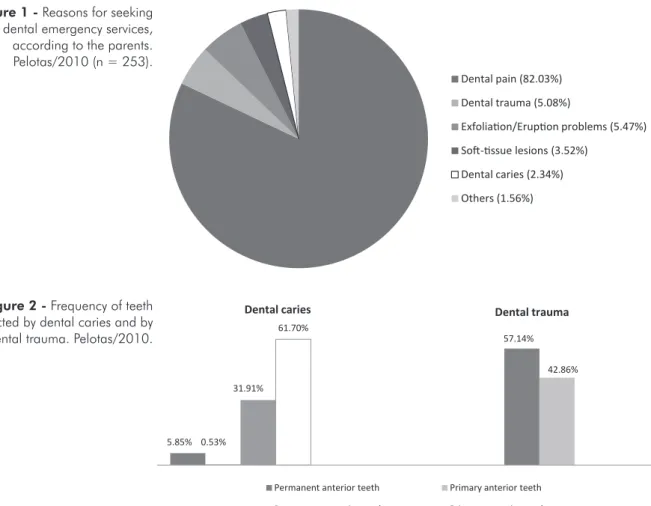
visit. Others reasons given were dental trauma, ex-foliation/eruption problems, soft-tissue lesions, and dental caries.
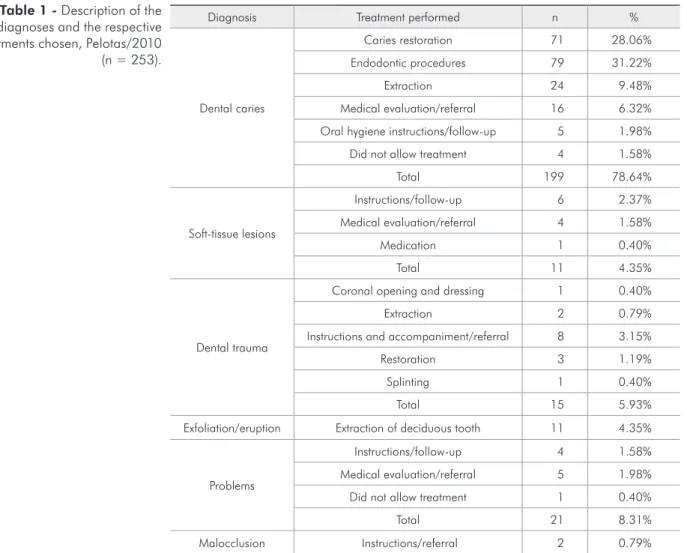
Table 1 shows the numbers of emergency visits by main problem according to the clinical examina-tion and the types of intervenexamina-tion chosen. Nearly 79% of the clinical visits were due to caries, and the most frequently required treatment was endodontic intervention, which includes coronal opening and dressing. Exodontics procedures were needed for 24 (9.48%) children, 14 of whom had residual roots.
Table 2 shows the distribution of children ac-cording to age and diagnosis. There were no dif-ferences regarding the cause of the emergency visit among the different age groups (p > 0.05).
Figure 2 shows the frequency of affected teeth among children presenting with symptoms arising as a result of dental caries and dental trauma. When differences among tooth groups were compared, posterior teeth were signiicantly more affected by
dental caries (p < 0.001), and anterior teeth were more affected by dental trauma (p < 0.001).
Table 3 shows the attitudes adopted by parents before taking their children to the dental emergency clinic. The parents of 123 children had given over-the-counter drugs before deciding on emergency attendance. In 96 cases (64%), analgesic/anti-in-lammatory drugs had been given as pre-medication before attendance. Some parents had done nothing, whereas others had looked for a dentist, and some had consulted with a doctor before coming to the university clinic. When the parents were asked about the duration of the complaint, 33.65% answered for “over 30 days”, while 14.42% answered “from one to three days” (Table 3).
Discussion
Emergency visits are one of the main reasons for parents to take their children to the dentist. Elimi-nating pain and avoiding emergency complications
Figure 1 - Reasons for seeking dental emergency services, according to the parents. Pelotas/2010 (n = 253).
Figure 2 - Frequency of teeth affected by dental caries and by dental trauma. Pelotas/2010.
Dental pain (82.03%)
Dental trauma (5.08%)
Exfoliaion/Erupion problems (5.47%)
Sot-issue lesions (3.52%) Dental caries (2.34%)
Others (1.56%)
31,91% 61,70%
Permanent anterior teeth Primary anterior teeth
Permanent posterior teeth Primary posterior teeth
Dental caries
61.70%
31.91%
5.85% 0.53%
57.14%
42.86%
are an important part of the pediatric dental prac-tice. This descriptive study assessed the demograph-ic and clindemograph-ical characteristdemograph-ics of children attending an emergency dental service at a south Brazilian
university. An assessment was carried out involving several factors, ranging from the attitudes adopted by parents before seeking the service to the treat-ment performed at the emergency departtreat-ment. Pain
Diagnosis
Age (years)
1-3 4-6 7-9 ≥ 10
N % n % n % n %
Dental caries 22 88.00 57 82.61 68 73.91 52 77.61
Dental trauma 1 4.17 5 7.25 5 5.43 4 5.97
Soft-tissue lesion 2 8.33 2 2.90 2 2.17 5 7.46
Exfoliation/eruption problems 0 - 4 5.80 12 13.04 5 7.46
Malocclusion 0 - 0 - 2 2.17 0
-No alteration 0 - 1 1.45 3 3.26 1 1.49
Total 25 100 69 100 92 100 67 100
Table 2 - Distribution of children according to age and diagnosis, Pelotas/2010 (n = 253).
Table 1 - Description of the diagnoses and the respective treatments chosen, Pelotas/2010 (n = 253).
Diagnosis Treatment performed n %
Dental caries
Caries restoration 71 28.06%
Endodontic procedures 79 31.22%
Extraction 24 9.48%
Medical evaluation/referral 16 6.32%
Oral hygiene instructions/follow-up 5 1.98%
Did not allow treatment 4 1.58%
Total 199 78.64%
Soft-tissue lesions
Instructions/follow-up 6 2.37%
Medical evaluation/referral 4 1.58%
Medication 1 0.40%
Total 11 4.35%
Dental trauma
Coronal opening and dressing 1 0.40%
Extraction 2 0.79%
Instructions and accompaniment/referral 8 3.15%
Restoration 3 1.19%
Splinting 1 0.40%
Total 15 5.93%
Exfoliation/eruption Extraction of deciduous tooth 11 4.35%
Problems
Instructions/follow-up 4 1.58%
Medical evaluation/referral 5 1.98%
Did not allow treatment 1 0.40%
Total 21 8.31%
Malocclusion Instructions/referral 2 0.79%
was found to be the main complaint, and the main cause of this symptom was dental decay. The most frequently required treatment was endodontic pro-cedures.
The primary posterior teeth were the most fre-quently affected by dental caries, being responsible for 116 (45.85%) out of 253 treated cases. The pos-terior teeth were also the most frequently affected in the permanent dentition. This is in agreement with results of previous studies involving children in a similar age range.6,10 In this study, a higher
propor-tion of children (92; 36.36%) were from 7 to 9 years old, and most of them had dental caries in primary posterior teeth. This is worrying, given the impor-tance of these teeth in masticatory function and in preserving space for the successor teeth.
Dental caries evolves slowly, and its treatment is relatively simple when it is diagnosed at an early stage. However, when left untreated, it may lead to pulpitis and then to necrosis and subsequent swell-ing, istulae, and diffuse cellulite.3 In most cases, oral
health preventive programs must address this evolu-tion as well as develop community awareness on the importance of regular visits to the dentist. Preventive measures have the potential to signiicantly reduce the current number of emergency visits.
Despite the fact that dental trauma is a frequent cause of emergency attendance,3,6 only a small
per-centage of children in this study attended the emer-gency center because of this, possibly because the dentistry school offers specialized service in dental trauma care. Thus, most trauma-affected children are immediately referred to this service. Of the 15 patients who presented with traumatic dental inju-ries, a higher proportion was boys and older chil-dren. According to the literature, dental trauma in school-age children is indeed associated with gender and age, with boys11,12 and older children more
fre-quently affected.13
Some of the complaints were due to causes that did not necessarily need immediate attention, such as problems with permanent tooth eruption and primary tooth exfoliation. There were also some patients just seeking oral evaluation or tooth extrac-tion for orthodontic reasons. This is in agreement with results from a previous study on clinical care in which almost 15% of the children who sought treat-ment either had no major complaint or complained mainly about physiological events, such as perma-nent tooth eruption and primary tooth exfoliation.8
The preference for urgent dental appointments for non-urgent situations may relect the “conve-nience” of using such appointments as a primary care source instead of regularly scheduled dental care.3,14 Dental triage systems exist to prioritize
pa-tients who need immediate attention such that a de-lay could jeopardize their treatment or their health. The fact that patients often look for urgent dental appointments instead of regularly scheduled dental care indicates that the dental practitioner needs to develop a screening method to determine true den-tal emergencies, triaging urgent care and discerning which children really need urgent attention.8
In this study, an assessment was performed on how the various conditions diagnosed were man-aged. Caries restoration and endodontic procedures were the most frequently required treatments. The
Table 3 - Duration of main complaint and attitudes adopt-ed by parents before seeking emergency care, Pelotas/2010 (n = 253)
Variable* N %
Duration of main complaint (days)
• 1 to 3 30 14.42
• 4 to 7 48 23.08
• 8 to 30 60 28.85
• > 30 70 33.65
• Total 208 100
What was previously done
• Nothing 40 19.61
• Taken to dentist 47 23.04
• Taken to doctor/emergency room 13 6.37
• Given over-the-counter drugs 104 50.98
• Total 204 100
Previous use of medication
• Did not take 27 18.00
• Analgesic/anti-inflammatory drugs 96 64.00
• Antibiotics 27 18.00
• Total 150 100
treatments proposed were in accordance with those indicated for this type of service, eliminating pain and avoiding complications.8 Five children did not
allow dental treatment to be performed. It is possible that children appearing at a dental emergency clinic have limited dental experience. Such a demanding, perhaps painful, early or even irst encounter with the dentist might be a fear-inducing dental factor.15
The duration of the problem presented by the pa-tients raises concerns, since it can be a determining prognostic factor. For 34% of the children, the chief complaint was found to have started more than 30 days before the visit. In contrast, a study assessed the time lapse between luxation injuries in primary den-tition and treatment. The authors found that most of the patients sought treatment after “1 day”.16 The
delay in seeking treatment found in this study may be due to the fact that parents were unaware of the problem until it interfered with the child’s quality of life, and luxation injuries are prone to cause bleed-ing and pain. Furthermore, the Dentistry School is a referral center in the town, so many of the chil-dren, including from other towns, who come to the dental emergency clinic have had previous dental consultation in places such as private practices and health care centers, with no deinitive resolution of the problem. The fact that some children come from other towns and many live on the outskirts of town, far from the facility, contributes to this situation.
In total, 123 children were using medication when they came to the university. Of these, 104 chil-dren (84.55%) had received over-the-counter medi-cations before the dental visit, and only 19 (15.45%) of them had prescriptions. Of these children, 27 (18.00%) were taking antibiotics. Reports in the literature show concern regarding the high rate of the use of antibiotics to manage urgent treatment of infections caused by caries.5,17 Antibiotics were not
prescribed at any dental visits, due to their limited indication for caries complications, when more
lo-calized measures should be provided.18,19 However,
other studies have shown that antibiotic prescrip-tion alone is a common treatment in emergency ser-vices.5,7
Despite the decline in dental caries prevalence and the efforts to improve the quality of oral health, most of the population, mainly those who do not have guaranteed dental assistance, seek dental treat-ment for the relief of pain and discomfort.8 Various
studies agree that the disease still accounts for the majority of dental emergencies in child patients.8,20
In Brazil, only a few studies have assessed the de-mand for emergency care,8 and this knowledge is
based mainly on anecdotal information from clini-cians.
It is recognized that children from low-income families tend to receive episodic or emergency den-tal care, while those from higher-income households will visit the dentist more regularly for preventive check-ups.21 However, one of the limitations of this
study is that no information on socio-economic con-ditions was collected. Further studies should assess the socio-economic proile of patients attending the dental emergency services and differences in dental service use between social classes.
Despite the decrease in caries occurrence, the present study showed that this disease is still a key cause of dental emergencies. It is expected that, over time, with a greater reduction in disease prevalence, this situation will change.
Conclusions
This study revealed that toothache due to dental caries was the most frequent complication and main source of patient complaints. A signiicant number of the emergency visits were due to caries in prima-ry posterior teeth. A large number of children were brought to the dentist with complaints that had started long before and had used over-the-counter medication.
References
1. Cunha RF, Pugliesi DM, de Mello Vieira AE. Oral trauma in Brazilian patients aged 0-3 years. Dent Traumatol. 2001 Oct;17(5):210-2.
crian-ças de 0 a 5 anos de idade no Município de Canela, Rio Grande do Sul, Brasil. Cad Saude Publica. 2008 Jan;24(1):150-6. 3. Agostini FG, Flaitz CM, Hicks MJ. Dental emergencies in a
university-based pediatric dentistry postgraduate outpatient clinic: a retrospective study. ASDC J Dent Child. 2001 Sep-Dec;68(5-6):316-21, 300-11.
4. Andreasen JO. Traumatic dental injuries in children. Int J Paediatr Dent. 2000 Sep;10(3):181.
5. Tulip DE, Palmer NO. A retrospective investigation of the clinical management of patients attending an out of hours dental clinic in Merseyside under the new NHS dental con-tract. Br Dent J. 2008 Dec;205(12):659-64; discussion 648. 6. Lygidakis NA, Marinou D, Katsaris N. Analysis of dental
emergencies presenting to a community paediatric dentistry centre. Int J Paediatr Dent. 1998 Sep;8(3):181-90.
7. Quinonez C, Gibson D, Jokovic A, Locker D. Emergency department visits for dental care of nontraumatic origin. Com-munity Dent Oral Epidemiol. 2009 Aug;37(4):366-71. 8. Sakai VT, Magalhaes AC, Pessan JP, Silva SM, Machado
MA. Urgency treatment profile of 0 to 15 year-old children assisted at urgency dental service from Bauru Dental School, University of Sao Paulo. J Appl Oral Sci. 2005 Dec;13(4):340-344.
9. Instituto Brasileiro de Geografia e Estatística. Estimativas de População. 2009; 2009 [citado 14 ago 2009]. Disponível em: http://www.ibge.gov.br/home/estatistica/populacao/estima-tiva2009/POP2009_DOU.pdf.
10. Von Kaenel D, Vitangeli D, Casamassimo PS, Wilson S, Pre-isch J. Social factors associated with pediatric emergency de-partment visits for caries-related dental pain. Pediatr Dent. 2001 Jan-Feb;23(1):56-60.
11. Díaz JA, Bustos L, Brandt AC, Fernández BE. Dental inju-ries among children and adolescents aged 1-15 years attend-ing to public hospital in Temuco, Chile. Dent Traumatol. 2010 Jun;26(3):254-61.
12. Traebert J, Marcon KB, Lacerda JT. Prevalência de trauma-tismo dentário e fatores associados em escolares do município de Palhoça (SC). Cien Saude Colet. 2010 Jun;15 Suppl 1:1849-55.
13. Cavalcanti AL, Bezerra PK, de Alencar CR, Moura C. Trau-matic anterior dental injuries in 7- to 12-year-old Brazilian children. Dent Traumatol. 2009 Apr;25(2):198-202. 14. Graham DB, Webb MD, Seale NS. Pediatric emergency room
visits for nontraumatic dental disease. Pediatr Dent. 2000 Mar-Apr;22(2):134-40.
15. Liddell A, Locker D. Changes in levels of dental anxi-ety as a function of dental experience. Behav Modif. 2000 Jan;24(1):57-68.
16. Assunção LR, Ferelle A, Iwakura ML, Nascimento LS, Cunha RF. Luxation injuries in primary teeth: a retrospective study in children assisted at an emergency service. Braz Oral Res. 2011 Mar-Apr;25(2):150-6.
17. Dailey YM, Martin MV. Are antibiotics being used appro-priately for emergency dental treatment? Br Dent J. 2001 Oct;191(7):391-3.
18. Keenan JV, Farman AG, Fedorowicz Z, Newton JT. Antibiotic use for irreversible pulpitis. Cochrane Database Syst Rev. 2005 Apr 18 (2):CD004969.
19. Nagle D, Reader A, Beck M, Weaver J. Effect of systemic peni-cillin on pain in untreated irreversible pulpitis. Oral Surg Oral Med Oral Pathol Oral Radiol Endod. 2000 Nov;90(5):636-40. 20. Milsom KM, Tickle M, Blinkhorn AS. Dental pain and den-tal treatment of young children attending the general denden-tal service. Br Dent J. 2002 Mar 9;192(5):280-4.