ORIGIN
AL RESEAR
CH
Corresponding address: Flávia Alexandra Silveira de Freitas – Rua Vitório Ferraciole, 340, Jardim Olímpico – Pouso Alegre (MG), Brazil – Zip Code: 37.550-000 – E-mail: [email protected] – Finance source: The research was funded by the authors themselves– Conlict of interest:nothing to declare – Presentation: Apr. 5, 2016 – Accepted for publication: July 10, 2017 – Approved by the Ethics Committee Approval: Certiicate for Aesthetic Appreciation Presentation 42924715.3.0000.5149
1Health Multi-Professional Residency program. Clinic Hospital from Universidade Federal de Minas Gerais. 2Professor. Department of Physical Therapy. Universidade Federal de Minas Gerais.
ABSTRACT | Vulnerability is the individual’s capacity to suffer damage in response to a stimulus. We identified physical vulnerability in older people in hospital discharge; the association of this condition with sociodemographic factors was verified, and we compared vulnerable with not-vulnerable individuals, as well as those referred or not to physical therapy during hospitalization. This was an exploratory study, and the sample consisted of 122 hospitalized older adults. Data were collected using a socio-clinical demographic questionnaire, the Mini-mental State Examination, the Geriatric Depression Scale and the Vulnerable Elders Survey-13. Spearman’s correlation test was used to identify the correlation between vulnerability and socio-clinical demographic data, and the Mann-Whitney test was used to compare vulnerable and not-vulnerable older adults, and those accompanied or not by physical therapy. The significance level was 5%. Vulnerability has been identified in 75.4% of older people. A significant correlation was found between vulnerability and age (r=0.52 p=0.01), length of hospital stay (r=0.25 p=0.01) and number of comorbidities (r=0.25 p=0.01), and a negative association between vulnerability and educational level (r=-0.20 p=0.02). Statistical differences were found between vulnerable and not-vulnerable elders, for age (p=0.01), comorbidities (p=0.01), length of stay (p=0.01), MMSE (p=0.01) and GDS (p=0.01); and among older adults accompanied or not by physical therapy, for vulnerability (p=0.04) and length of hospital stay (p=0.01). Most older adults were physically vulnerable in hospital discharge, being them older, presenting more comorbidities, longer hospitalization, cognitive decline and depressive
253
symptoms. Those treated by physical therapy showed greater vulnerability and longer hospital stay.
Keywords | Aged; Hospitalization; Vulnerability Study.; Health Vulnerability.
RESUMO | Vulnerabilidade é a capacidade de um indivíduo sofrer dano em resposta a um estímulo. Identificou-se a vulnerabilidade física de idosos na alta hospitalar e a associação dessa condição com fatores clínicos e sociodemográicos, e foram comparados idosos vulneráveis com os não vulneráveis e aqueles acompanhados ou não pela isioterapia durante a internação. Este foi um estudo exploratório, com amostra de 122 idosos hospitalizados. Os dados foram obtidos por meio de questionário clínico e sociodemográico, Mini Exame do Estado Mental, Escala de Depressão Geriátrica e Vunerable Elders Survey-13. Utilizou-se para tanto o teste de correlação de Spearman para identiicar a correlação entre vulnerabilidade e dados clínicos e sociodemográicos e o teste de Mann-Whitney. O nível de signiicância foi de 5%. A vulnerabilidade foi identiicada em 75,4% dos idosos. Houve correlação signiicativa entre vulnerabilidade e idade (r=0,52 p=0,01), tempo de internação (r=0,25 p=0,01) e número de comorbidades (r=0,25 p=0,01), e negativa entre vulnerabilidade e escolaridade (r=-0,20 p=0,02). Houve diferença estatística entre idosos vulneráveis e não vulneráveis para idade (p=0,01), comorbidades (p=0,01), tempo de internação (p=0,01), MEEM (p=0,01) e GDS (p=0,01), e entre idosos acompanhados ou não pela isioterapia para vulnerabilidade (p=0,04) e tempo de internação (p=0,01). A maioria dos idosos era isicamente vulnerável na alta hospitalar, sendo eles mais velhos, com mais comorbidades, maior tempo de internação, presença
Physical vulnerability of older adults in hospital
discharge
Vulnerabilidade física de idosos na alta hospitalar
Vulnerabilidad física de ancianos en el alta hospitalaria
de declínio cognitivo e sintomas depressivos. Aqueles que receberam acompanhamento isioterapêutico apresentaram maior vulnerabilidade e tempo de internação
Descritores | Idoso; Hospitalização; Estudo sobre Vulnerabilidade; Vulnerabilidade em Saúde.
RESUMEN | Vulnerabilidad es la capacidad de un individuo sufrir daño en respuesta a un estímulo. Se identiicó la vulnerabilidad física de ancianos en el alta hospitalaria y la asociación de esa condición con factores clínicos y sociodemográicos, y fueron comparados ancianos vulnerables con los no vulnerables y aquellos acompañados o no por la isioterapia durante el ingreso. Este fue un estudio exploratorio, con muestra de 122 ancianos hospitalizados. Los datos fueron obtenidos por medio de cuestionario clínico y sociodemográico, Mini Prueba del Estado Mental, Escala de Depresión Geriátrica y Vulnerable Elders Survey-13. Se utilizó para tanto la prueba de correlación de Spearman para identiicar la correlación entre la vulnerabilidad y los datos clínicos y los sociodemográicos y la prueba de Mann-Whitney. El
nivel de signiicancia fue de un 5%. La vulnerabilidad fue identiicada en el 75,4% de los ancianos. Hubo correlación signiicativa entre la vulnerabilidad y la edad (r=0,52 p=0,01), el tiempo de ingreso (r=0,25 p=0,01) y el número de comorbidades (r=0,25 p=0,01), y la negativa entre la vulnerabilidad y la escolaridad (r=-0,20 p=0,02). Hubo diferencia estadística entre ancianos vulnerables y los no vulnerables para la edad (p=0,01), las comorbidades (p=0,01), el tiempo de ingreso (p=0,01), el MEEM (p=0,01) y el GDS (p=0,01), y entre los ancianos acompañados o no por la isioterapia para la vulnerabilidad (p=0,04) y el tiempo de ingreso (p=0,01). La gran parte de los ancianos era físicamente vulnerable en el alta hospitalaria, siendo ellos más mayores, con más comorbidades, el tiempo de ingreso más grande, la presencia de descenso cognitivo y los síntomas depresivos. Aquellos que recibieron acompañamiento isioterapéutico presentaron la vulnerabilidad y el tiempo de ingreso más grandes.
Palabras clave | Anciano; Hospitalización; Estudio de Vulnerabilidad; Vulnerabilidad en Salud.
INTRODUCTION
The Brazilian population aging is a progressive and accelerated scenario, implying a change in the epidemiological profile, which is marked by greater prevalence of chronic degenerative diseases that require continuous care and higher investment1.hus, aging
impacts the health service and imposes new demands and challenges2. Besides, the aging process is characterized
by organic and physiological changes, which hinders the maintenance of homeostasis when the older adults are under stress3,4, making them more vulnerable.
he term “vulnerability” comes from the Latin vulnerare (to hurt) and vulvabilis (that injures). Vulnerability can be deined as the capacity of an individual to sufer damage in response to a stimulus. We use this term to characterize a person in vulnerable condition, not only from the biomedical viewpoint, but also from social and economic aspects, among others. In older adults, vulnerability varies according to the level of dependency for activities of daily living 3,5,6.
In this context, hospitalized older adults present slower and more complicated recovery, higher rates of morbidity and prolonged hospital stay7.From 2002 to 2011, the older
population was accountable for 27.9% of the hospitalizations in the Uniied Health System (UHS), and 34.5% of the resources were spent on them7. Correspondingly, the
hospitalization can reduce the autonomy, independence and functionality of older adults3,7,8.
his way, it is important to identify the vulnerability of older people at the end of hospitalization. Public administrators and basic health professionals are believed to have a better knowledge of the older adults that will return to their care and, based on such information, they will be able to develop interventions that can prevent or postpone the functional incapacity.
hus, the objectives of our study were (i) to identify the physical vulnerability of hospitalized older adults at the moment of hospital discharge, which was done through the Vulnerable Elders Survey-13 (VES-13)6,
(ii) to verify the correlations between length of hospital stay, age, income, educational level, comorbidities and vulnerability in hospital discharge; (iii) to compare clinical sociodemographic data of vulnerable older adults with the not-vulnerable ones; (iv) to compare the vulnerability index between individuals that received or not physical therapy treatment during hospitalization.
METHODOLOGY
cardiology and clinical inirmaries in a university hospital from Belo Horizonte, Minas Gerais, from May to July 2015. We used a non-probabilistic sample, including people aged 65 years or older from both sexes, with programmed discharge in the medical records, who agreed to participate in the research and signed an informed consent form. he older adults who were transferred from sector before discharge were excluded, as well as those who had no companion in the moment of evaluation, or who died.
Physical vulnerability was identiied through the Vulnerable Elders Survey-13 (VES-13)6 , which is
composed of 13 questions, divided into four items that evaluate age, self-perceived health, and presence of physical limitations and inabilities5,6,9. his survey has a
score range from 0 to 10, and a value equal or greater than 3 indicates the older adult presents a risk of functional decline and death in the next two years, which is a risk 4.2 times higher than for older adults that present a score of 2 or less6.he questionnaire was translated and adapted
to the Brazilian population, with means of 79% and 94% in the cultural and conceptual idiomatic equivalence evaluation, respectively. For internal consistency analysis5,
it presented α=0.70, and the questionnaire could be responded by the patient or caregiver, showing a intraclass correlation coeicient of 0.889.
he remaining variables were obtained with a socio-clinical demographic questionnaire (age, educational level, income, marital status, comorbidities, medications, length of hospital stay, referred or not to physical therapy during hospitalization), the Mini Mental State Examination (MMSE)10 and the Geriatric Depression Scale (GDS)11,12.
MMSE is a cognitive tracking questionnaire, consisting of 30 points. he adapted version and the cut-of points were considered, according to educational level, as proposed by Bertolucci et al., 199410.
GDS-15 is a scale of depressive symptoms that presents validity and reliability for the Brazilian population11 ,12.
First, MMSE was conducted. Older adults who have reached the cut-of points10 answered the other
questionnaires according to the level of education. In cases where the MMSE indicated possible cognitive deicit, the interview was held with the older adult responsible.
Descriptive analysis was obtained with frequency distribution and median. he normality of data distribution was checked by the Kolmogorov-Smirnov test, indicating the need to use non-parametric statistics. he correlation between vulnerability, age, income, educational level, length of hospital stay, and comorbidities was obtained through Spearman correlation test. Vulnerability comparison among individuals who had or had not received physical therapy, and among vulnerable or not-vulnerable groups, was assessed through the Mann-Whitney test. he signiicance level was of 5%.
RESULTS
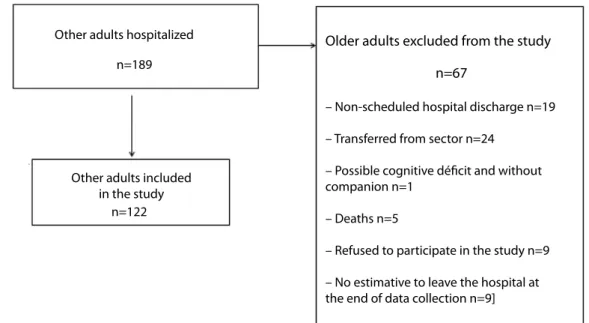
During the study period, 189 older adults were hospitalized. Of these, 122 were included. Sixty-seven individuals were excluded from the research, the reasons for it are outlined in Figure 1.
Other adults hospitalized
Other adults included in the study
n=189
n=122
– Non-scheduled hospital discharge n=19
– Transferred from sector n=24
– Possible cognitive déficit and without companion n=1
– Deaths n=5
– Refused to participate in the study n=9
– No estimative to leave the hospital at the end of data collection n=9]
Older adults excluded from the study
n=67
Most older adults were men, married, with less than two minimum wages income, up to four years of education, and used ive or more medicines (TABLE 1). In addition, the majority (56.6%) declared to be of mixed ethnicity; lived with spouse/children and grandchildren (80.3%) and were hospitalized for pulmonary heart diseases (54.1%).
Table 1: Clinical and sociodemographic characterization of older adults in hospital discharge (n=122)
Variables N (%)
Sex
Female Male
56 (49,6) 66 (54,1)
Marital status
Married Widower
Divorced and single
59 (48,4) 37 (30,3) 26 (21,3)
Income
Less than 2 minimum wages More than 2 minimum wages
97 (79,5) 25 (20,5)
Educational level
Up to 4 years. 5 years or more
74 (60,7) 48 (39,3)
Number of medicines
≤4 ≥5
31 (25,4) 91 (74,6)
Physical therapy treatment
Yes No
75 (61,47) 47 (38,53)
Variable Median (interquartile
range Q3-Q1) Age (years)
Number of comorbidities Hospitalization period (days)
Mini-mental State Examination (points) Geriatric Depression Scale (points)
71,0 (12,0) 3,0 (2,0) 17,0 (15,3) 22,0 (11,8) 4,0 (4,3)
Concerning the physical vulnerability, 92 (75.4%) older adults were identiied as vulnerable, the median of 6 points being found by means of VES-13. Regarding the correlation analyses, signiicant and moderate correlation was observed between vulnerability and age (RHO-0.52; P=0.01); and a weak and signiicant correlation was found between educational level (rho=0.20; p=0.02) and length of hospital stay (rho=0.25; p=0.01). Other correlations were not signiicant (p>0.05).
When comparing vulnerable older adults with the not-vulnerable ones, a statistically signiicant diference was observed for age (p=0.01), number of comorbidities (p=0.01), length of hospital stay (p=0.01), cognitive changes (p=0.01) and depressive symptoms (p=0.01). he results showed that those most vulnerable were
older, with greater number of comorbidities, prolonged periods of hospitalization, lower score in the MMSE, and greater number of depressive symptoms. Other comparisons were not signiicant (p>0.05).
When the older adults were compared regarding physical therapy treatment, a significant statistical diference was observed for duration of hospitalization (p=0.01) and vulnerability (p=0.04). Individuals who received physical therapy treatment were hospitalized for a longer period and were more vulnerable when compared with those who had not received treatment. No statistical diference was found for other variables (p>0.05)
DISCUSSION
his research aimed to study the physical vulnerability of hospitalized older adults in hospital discharge. he results show that most individuals were physically vulnerable in hospital discharge, being them older, presenting more comorbidities, longer hospitalization, cognitive decline, and depressive symptoms. Older adults accompanied by physical therapy showed longer hospitalization period and physical vulnerability, suggesting that those who were referred to physical therapy could be in worse health conditions.
We could observe vulnerability in 75.4% of the older adults assessed. In cross-sectional studies with north-American people, vulnerability was identiied in 54% and 52.6% of the individuals on the irst week of hospitalization13,14.In a Brazilian longitudinal study,
the vulnerability was identiied in 38.1% of community older adults in 2000, and in 52.7% of those in 200615.
We demonstrated here a vulnerability percentage greater than the values found in the literature. his can be justiied by the fact that the evaluation was conducted at the end of the hospitalization process, which can negatively impact older adults’ functionality due to their need to rest. Functionality reduction is estimated to reach from 34% to 50% of older people during hospitalization3,16.
A literature review showed depression, delirium, cognitive and physical impairment, environmental factors, prior functional incapacity, and polypharmacy as risk factors for functional decline in hospitalized older people17. Such information reinforces our indings. One
be longer and ofers greater risk of complications18.
Hospitalization also afects older adults’ autonomy and independence, considering that they are in an unfamiliar environment, exposed to diferent routines, limited in their daily activities, conined to bed, presenting sleep changes, iatrogenesis, malnutrition, and delirium14,19.
he weak correlations between vulnerability and educational level, comorbidities and length of hospital stay were statistically signiicant. Considering the association magnitude, these data should be interpreted cautiously, because they may not have clinical signiicance. However, it is worthwhile to remember that educational level is a determinant factor for health condition, particularly in older adults. he literature points out that a low educational level relates to a greater chance of individuals presenting health problems and negatively impacts their functionality15,20,21. In sequence,
a greater functional impairment is related to multiple comorbidities, and both are risk factors for frailty20,21.
On the other hand, still concerning the associations, age was mildly correlated, demonstrating that vulnerable individuals are older than the not-vulnerable ones, which conirms the fact that the older the age, the greater the diiculty in homeostasis maintenance, and the greater the susceptibility to harm15.
Regarding the older adults’ characteristics, we point out that the majority was male, corroborating the UHS
data3,22,23. his fact can be justiied by the Brazilian
culture, in which men only seek health services when the disease is at a very advanced stage and is more diicult to control with basic care22. Other sociodemographic
data also resemble other Brazilian studies22,24
On the other hand, the length of hospitalization for the older participants of this study (median of 17 days) contradicts the current literature22,24. Studies
have shown a mean length of stay of 8.9 days for the Southwest region22 and 6.2 days for the Central-West
region24. Such a diference can be explained by the proile
of the research institution, i.e., a reference hospital from moderate to high complexity health conditions that normally treats greater severity and risk patients. his may also be related to diferences found in groups who received or not physical therapy care.
Furthermore, we should highlight that, when analyzed in general, the older people studied did not present signs of cognitive decline and depressive symptoms. However, when analyzed in groups, vulnerable individuals presented possible cognitive decline and depressive symptoms, indicating that the
vulnerability can inluence cognition and depression, and vice versa. However, this assertion, for now, it is just speculation and should be examined in future studies.
Regarding physical therapy, 61.5% of the participants received treatment and presented longer hospitalization periods and vulnerability. Such fact can be justiied by the hospital routine, which refers the patient to physical therapy after a request for medical referral and consultation. his is requested mainly for patients with pulmonary or cardiovascular involvement, in postoperative period, with mobility deicit, restricted to the bed and/or with some activities limitations, which means the worst clinical and functional conditions. In line with this result, a U.S. study has identiied a greater likelihood of functional impairment, a month after hospital discharge, in physically vulnerable hospitalized older adults who received a “mobility plan”14. he
authors justiied it with the fact that the individuals indicated to “mobility plan” presented greater risk of functional impairment, greater number of associated geriatric symptoms (iatrogenesis, immobility, postural instability, dementia and incontinence), prior frailty and longer hospitalization14.
We observed a mean vulnerability of 4.5 (±3.1) points to older adults without physical therapy treatment. his value classiies the individuals as vulnerable, which means an increased risk of functional decline. It is not possible to say that, although they have not received physical therapy treatment, this would not be a necessary and beneicial resource to the individual. hus, results concerning the comparison of groups that had or had not received physical therapy treatment must be interpreted with caution, because data about the beginning of physical therapy, monitoring goals, duration, frequency, pre- and post-intervention evaluation were not analyzed. his should be a goal for future studies, with an adequate methodological design.
CONCLUSION
Most older adults were physically vulnerable in hospital discharge, older, presenting more comorbidities, longer hospitalization, cognitive decline, and depressive symptoms. Yet, individuals who received physical therapy treatment presented longer hospitalization and greater vulnerability. hese results may relate to the previous severity of the older adults referred to physical therapy.
REFERENCES
1. Vasconcelos AMN, Gomes MMF. Transição demográica: a experiência brasileira. Epidemiol Serv Saúde. 2012;21(4):539-48. DOI: 10.5123/S1679-49742012000400003
2. Loyola Filho AI, Matos DL, Giatti L, Afradique ME, Peixoto SV, Lima-Costa MF. Causas de internações hospitalares entre idosos brasileiros no âmbito do Sistema Único de Saúde. Epidemiol Serv Saude. 2004;13(4):229-38. DOI: 10.5123/ S1679-49742004000400005
3. Sthal HC, Berti WB, Palhares VC. Grau de dependência de idosos hospitalizados para realização das atividades básicas da vida diária. Texto Contexto Enferm. 2011;20(1):59-67. DOI: 10.1590/S0104-07072011000100007
4. Bonardi G, Souza VBA, Moraes JFD. Incapacidade funcional e idosos: um desaio para os proissionais. Sci Med. 2007;17(3):138-44.
5. Maia FOM, Duarte YAO, Secoli SR, Santos JLF, Lebrão ML. Adaptação transcultural do Vulnerable Elders Survey-13 (VES-13): contribuindo para a identiicação de idosos vulneráveis. Rev Esc Enferm USP. 2012;46(Esp):116-22. DOI: 10.1590/S0080-62342012000700017
6. Saliba D, Elliott M, Rubenstein LZ, Solomon DH, Young RT, Kamberg CJ, et al. The vulnerable elders survey: a tool for identifying vulnerable older people in the community. J Am Geriatr Soc. 2001;49(12):1691-9. DOI: 10.1046/j.1532-5415.2001.49281.x
7. Siqueira AB, Cordeiro RC, Perracini MR, Ramos LR. Impacto funcional da internação hospitalar de pacientes idosos. Rev Saúde Pública. 2004;38(5):687-94. DOI: 10.1590/ S0034-89102004000500011
8. Maxwell CA. Screening hospitalized injured older adults for cognitive impairment and pre-injury functional impairment. Appl Nurs Res. 2013;26(3):146-50. DOI: 10.1016/j. apnr.2013.03.003
9. Maxwell CA, Dietrich MS, Minnick AF, Mion LC. Preinjury physical function and frailty in injured older adults: self–versus proxy responses. J Am Geriatr Soc. 2015 Jul;63(7):1443-7. DOI: 10.1111/jgs.13486
10. Bertolucci PHF, Brucki SMD, Campacci SR, Juliano Y. O mini-exame do estado mental em uma população geral. Arq Neuropsquiatr. 1994;52(1):1-7. DOI: 10.1590/ S0004-282X1994000100001
11. Almeida OP, Almeida SA. Coniabilidade da versão brasileira da Escala de Depressão em Geriatria (GDS) versão reduzida. Arq Neuropsiquiatr. 1999;57(2B):421-6. DOI: 10.1590/ S0004-282X1999000300013
12. Paradela EMP, Lourenço RA, Veras RP. Validação da escala de depressão geriátrica em um ambulatório geral. Rev Saúde Pública. 2005;39(6):918-23. DOI: 10.1590/ S0034-89102005000600008
13. Bell SP, Schnelle J, Nwosu SK, Schildcrout J, Goggins K, Cawthon C, et al. Development of a multi-variable model to predict vulnerability in older American patients hospitalized with cardiovascular disease. BMJ open 2015;5: e008122. DOI: 10.1136/bmjopen-2015-008122
14. Arora VM, Plein C, Chen S, Siddique J, Sachs GA, Meltzer DO. Relationship between quality of care and functional decline in hospitalized vulnerable elders. Med Care. 2009;47(8):895-901. DOI: 10.1097/MLR.0b013e3181a7e3ec.
15. Maia FOM. Vulnerabilidade e envelhecimento: panorama dos idosos residentes no município de São Paulo – Estudo SABE. [Tese]. São Paulo: Escola de Enfermagem da Universidade de São Paulo, Universidade de São Paulo; 2011.
16. King BD. Functional decline in hospitalized elders. Medsurg Nurs. 2006;15(5):265-71.
17. Cunha FCM, Cintra MTG, Cunha LCM, Couto EAB, Giacomin KC. Fatores que predispõem ao declínio funcional em idosos hospitalizados. Rev Bras Geriatr Gerontol. 2009;12(3):475-87. DOI: 10.1590/1809-9823.2009.00013
18. Min L, Ubhayakar N, Saliba D, Kelley-Quon L, Morley E, Hiatt J, et al. The vulnerable elders survey–13 predicts hospital complications and mortality in older adults with traumatic injury: a pilot study. J Am Geriatr Soc. 2011;59(8):1471-6. DOI: 10.1111/j.1532-5415.2011.03493.x
19. Lourenço TM, Lenardt MH, Kletemberg DF, Seima MD, Carneiro NHK. Independência funcional em idosos longevos na admissão hospitalar. Texto Contexto Enferm. 2014;23(3):673-9. DOI: 10.1590/0104-07072014001500013 20. Paula AFM, Ribeiro LHM, D’Elboux MJ, Guariento ME.
Avaliação da capacidade funcional, cognição e sintomatologia depressiva em idosos atendidos em ambulatório de Geriatria. Rev Soc Bras Clin Med. 2013;11(3):212-8.
21. Storti LB, Fabrício-Whebe SCC Kusumota L, Rodrigues RAP, Marques S. Fragilidade de idosos internados na clínica médica da unidade de emergência de um hospital geral terciário. Texto Contexto Enferm. 2013;22(2):452-9. DOI: 10.1590/S0104-07072013000200022
22. Silveira RE, Santos AS, Sousa MC, Monteiro TSA. Gastos relacionados a hospitalizações de idosos no Brasil: perspectivas de uma década. Einstein. 2013;11(4):514-20. DOI: 10.1590/S1679-45082013000400019
23. Marques AP, Montilla DER, Almeida WS, Andrade CLT. Internação de idosos por condições sensíveis à atenção primária à saúde. Rev Saude Publica. 2014;48(5):817-26. DOI: 10.1590/S0034-8910.2014048005133