DETERMINATION OF THE MOST SUITABLE OIL PIPELINE
ROUTE USING GIS LEAST COST PATH ANALYSIS.
Shahin Huseynli
DETERMINATION OF THE MOST SUITABLE OIL
PIPELINE ROUTE USING GIS LEAST COST PATH
ANALYSIS.
Case Study: Keystone XL, Nebraska State - USA
Dissertation supervised by
Dr.Marco Painho Dr.Sven Casteleyn
Dr.Rauf Amanov
ACKNOWLADGEMENTS
I would like to express my gratitude to all who was responsible on this educational program and especially Dr.Prof.Marco Painho. I would like to give special thanks to my co-supervisor Dr. Sven Casteleyn and Dr. Rauf Amanov because of their help on this thesis.
DETERMINATION OF THE MOST SUITABLE OIL
PIPELINE ROUTE USING GIS LEAST COST PATH
ANALYSIS.
Case Study: Keystone XL, Nebraska State - USA
Abstract
The Keystone XL has a big role for transforming Canadian oil to the USA. The function of the pipeline is decreasing the dependency of the American oil industry on other countries and it will help to limit external debt. The proposed pipeline seeks the most suitable route which cannot damage agricultural and natural water recourses such as the Ogallala Aquifer.
Keywords
Keystone XL Pipeline
The Ogallala Aquifer GIS
Least Cost Analysis Nebraska
Acronyms
GIS –Geographical Information System
KXL –KeystoneeXport Limited
LCP – Least Cost Path
SCP –Straight Line Path
CSD –Conversation and Survey division
US -
United States
DEM
–
Digital Elevation Model
USGS
–
United States Geological Survey
SRTM
–
Shuttle Radar Topography Mission
GPS
–
Global Positioning System
INDEX OF CONTENT
ACKNOWLADGEMENT………...…ii
ABSTRACT ...iii
KEYWORDS………...iv
ACRONYMS...v
INDEX OF TABLES………..…… vi
INDEX OF FIGURES ………...……… vii
1.INTRODUCTION………...1
1.1 Overview..…...………..1
1.2 Keystone XL……….2
1.3 Geo-political and Economic issues………...3
1.4 Least Cost Analyses….….………5
1.5 Objectives……….…6
2 .LITERATURE REVIEW ………...7
3. STUDY AREA ……….…11
4. METHODOLGY AND DATA ……….…….14
4.1 Methodology……….…….14
4.2 Data Sets……….…...16
4.3 Accumulative Cost Surface………...21
5. RESULT……….……...24
5.1 Equal Weighted Overlay ……….24
5.2 Weighted Overlay………....27
5.3 The Ogallala Aquifer and Proposed Keystone XL………..34
6. DISCUSSION……….………..…40
7. CONCLUSION………44
8 .BIBLIOGRAPHICAL REFERENCES…...45
ANNEX A………48
INDEX OF THE TABLES
Table 1. Least Cost route lengths and Straight Line route length, which based on
Equal Weighted Cost surface………..26
Table 2. All three Weighted Overlays with specific weighted percentage for each criterion………...28
Table 3. Least Cost route lengths and Straight Line routes length, which based on Weighted Overlay 1, Weighted Overlay 2 and Weighted Overlay 3 cost surfaces....33
Table 4. The percentages and length of the routes, which passed through the Ogallala Aquifer………37
TABLES IN ANNEX 1 Table 1. Data processing for “Environmental Criterion”………...48
Table 2. Data processing for “Geology” Criterion………49
Table 3. Data processing for “Land Use” criterion………50
INDEX OF THE FIGURES
Figure1. Keystone Pipeline Route. (TransCanada Corporation 2012)……….3
Figure 2. Top Oil Exports to the United States .1973-2013 (U.S. Energy Information
Agency)……….……5
Figure 3. Ogallala Aquifer. (Map applies to
1997)……….….12
Figure 4. The first Keystone XL proposed pipeline. (Keystone-XL.com)…………..13
Figure 5. Data proccesing and factor rasters shown as a criterion
datasets…………...15
Figure 6. Geological map data for Geology criterion of Nebraska
(USGS)…………16
Figure 7. Elevation data for Slope criterion of Nebraska (NASA JPL)………..18
Figure 8. Land Use data for land use critertion of Nebraska (University of
Nebraska)………19
Figure 9. Envirnonmental data map for environmental criterion(Census)………….20
Figure 10. Equal Weight cost surface that was formed for the study area………….24
Figure 11. Equal Weighted LCP and straight-line route, which achieved for cost surface Equal Weights overlay……….………...25 Figure 12. Least Cost Route and Straight Line path for Weighted Overlay Surface
1……….……….…..…………..30
Figure 13. Least Cost Route and Straight Line path for Weighted Overlay Surface
2………...31
Figure 14. Least Cost Route and Straight Line path for Weighted Overlay Surface
Figure 15. The proposed Keystone XL from Trans Canadian Corporation and all least cost path routes displayed on the slope surface……….……….35 Figure 16. The Least Cost Path route, which is related to the Weighted Overlay 3 and
shown with the Ogallala Aquifer geological map………...38
FIGURES IN ANNEX B.
Figure 1. Displays the procedure of least cost path………....52
Figure 2. “Weighted Overlay 2 Least Cost Path” and not understandable part of the
1
1. Introduction
1.1
Overview
Nowadays natural resources are one of the key factors of developing the economic situation of any country. U.S and some other countries in North America are more famous for their natural resources more than other regions in the world. Fertile soils, plentiful freshwater, natural gas and oil, mineral deposits and forestry are the key elements of natural resources in North America which directly have influenced their economy.
Pipelines are the most efficient, cost effective and environment friendly means of fluid transport and reduce the highway congestion, pollution and spill (Dubey, 2005). Careful planning of the pipeline route can save cost, time and operating expenses to ensure longer operational life and help in preventing environmental fallouts. Proper planning and management are considered essential means of guiding and accelerating the development of an industry. It can mobilize and utilize the available resources in the best interest of the company and eliminate business fluctuation (Nasir and Hyder, 2001). Routing a pipeline is an important task thus proper planning is essential in-order to maximize the benefits derivable from the use of pipelines. With the scientific planning of a route, cost, time, and operating expenses can be saved, ensuring longer operational life and minimizing environmental fallouts.
2
type that according to their capability, they can manage really big projects. But in the other hand, even small mistakes can create huge problems. Hence, GIS in this more suitable way to protect areas from hazards and also solve problems such as oil spills, gas leak and etc.
GIS in different trends can help to understand specific fields of the pipeline and also it can help to routing process. With influence of GIS it was already possible to create route corridors for different transportation types. Special algorithm for routing first time done by Dutch scientist Edser Djikstra in 1956 and for more detailed information written in literature review part of the thesis. Later famous American geographer Michael Goodchild with using the Djikstra Algorithm have founded evaluation of lattice solution to the corridor locations in 1977. With the same methodology M. Goodchild gave new breath to the modern technology and science. But thesis more concentrated on the route analysing and that is why, study concentrated on Djikstra Algorithm.
1.2
Least Cost Analyses.
The study is converged on finding the least cost routing strategy applying GIS analysis to the geographic area where Keystone XL will pass through Nebraska State. The routing model defines the most economical and environmentally safe route through the given study area. The study is highly concerned about avoiding geological, social and environmental hazards. This study would allow working with large-scale projects in the future and it will help also to find less hazardous methodology for routing the pipeline.
3
1.3
Keystone XL
The Keystone Pipeline System is an oil pipeline system between Canada and the U.S which has been authorized since 2010. It starts from Alberta City which is located in the West part of Canada and it ends in the other cities in U.S (Houston, Illinois). Some parts of pipeline are done and some parts still have further constructions and some parts are proposed for the future constructions. Therefore, there are six different phases of this project (Figure 1).
4
Figure 1 displayed parts of the pipeline which have been already done as well as the proposed parts. The study focuses on Phase 4 which also called Keystone XL (Keystone eXport Limited), with a special interest in the second edition of pipeline extension proposed in 2008 by National Energy Board of Canada. On March 11, 2010 the Canadian National Energy Board approved the project.
Keystone XL starts from Hardesty City in Canada and it ends in Steele City in Nebraska State. The length of the proposed pipeline is 18.974 km (1.179 mile), but there is a big issue about environmental hazards. In 2011 a scientist from NASA James Hansen, mentioned that Keystone XL can make a big global warming with one small mistake, such as, oil spill. According to the State Department’s review, the 830,000 barrels are going to be transformed through the Keystone pipeline daily and it means that it would add extra amount of carbon dioxide which approximately ranges from 1.3 to 27.4 million metric tons to the atmosphere. These numbers are only recorded in 2013, so it means that this hazard can be more serious than any expectations. Keystone XL is the most suitable choice for U.S government to transport oil from neighbor country. It tried to find more options for shipping Canada’s oil to US but it did not work (Brad Plumer 2015).
5
1.4
Geo-political and Economic issues.
U.S House of Representatives, Committee on Energy and Commerce proponents made a lot of debates about Keystone XL. In their opinion, Keystone XL would allow U.S to increase energy security in the region and reduce its dependence on foreign oil. U.S is on the top of oil importing country, it imports oil almost from all continents (Figure 2).
Figure 2. Top Oil Exports to the United States .1973-2013 (U.S. Energy Information
Agency).
American authorities have another idea about a project that KXL can help to increase the price of the oil in Midwestern United States. It can help to partially solve their dept. The Keystone XL would also create approximately 42,000 job opportunities during the next few years and 3900 temporary constructions (The State Department, 2015). The project would push approximately 3.4 billion dollars to the economy which represents 0.02% of US GDP (Brad Plumer 2015, www.vox.com).
6
is not passing through the area. The Ogallala Aquifer is the one of the hugest aquifer which underlies approximately 450.000𝑘𝑚2. The Aquifer is part of the high plains aquifer system which is the principal geologic unit covering 80% of the high plains. It has really big role in agricultural and environmental trends. Therefore, 70% of the aquifer protecting by U.S government and other 30% using as a water resource for the agriculture and for environmental issues.
.
1.5
Objectives
7
2. Literature Review
Large-scale linear projects, such as natural gas and oil pipelines, are planned and designed about a short route to limit the costs and materials of production. The most effective process to determine this route is through the use of GIS and a least-cost routing model (Aissi, Chakhar, and Mousseau 2012; Rees 2004; Feldman et al. 1995).The latest GIS techniques helps us for large amounts of cost-analysis data to be collected, stored and analyzed and improve the route accuracy for large-scale projects (Luettinger and Clark 2005). During the research of some studies as an example in previous studies, the methodology formulated to create least cost model for specific and various criteria evaluations and corporate simple criteria into one of least cost model. The complications of least cost models have limited with different categories of criteria and also they have been examined during studies. Most of criteria have been examined with physical characteristics of geographic area during the straightforward point of view to weighting the alteration of special factors. (Chakhar, and Mousseau 2012). In general there are not enough studies which have included impacts when to find the unique route selections of a pipeline and in included these criteria inside of model. Only one, (Lovett 1997) and one theses about least cost path analyses to route risky waste through study area and specific paths and both of this research provided a risk assessment due to biological hazards as an example population and environmental risk. (Lovett, Parfitt, and Brainard 1997; Kelly 2014)
8
given area. This kind of analyzes related on the neighborhood of cells around the proposed starting point and moves external from starting point to finally encompass the given study area. There are a lot of types of model that the algorithm can create cost accumulated surface with different patterns offering a different approach to solve the problem (Iqbal, Sattar, and Nawaz 2006; Luettinger and Clark 2005). The algorithm of Dijkstra is one of the commonly used tools to determine the least cost route through a surface and one of the simplest methods. That is already one fact that only with that algorithm can analyze various criteria and complied together into a cost accumulated surface and need only analyze knot across the surface. Only one restriction; however to using this type of algorithm is that it is computationally demanding and produces large amounts of data (Saha 2005).
To improve on this computationally demanding process has been used more and more companies began to develop new GIS packages to restrict computation time and accelerate results. The Environmental Systems Research Institute (ESRI) made a
tool which called “Pathdistance” and it uses a smaller scale neighborhood analysis in
order to try and control the effects of the model and make the path more realistic (Saha 2005). In effect to use of this smaller scale would help to make the compiled path less irregular and sleeker. This is a key when planning pipeline route due to the fact that a pipeline is connected together much more rigidly than a road. That is why
“Pathdistance” tool became more prominent in studies due to their accessibility and
9
to a destination point, all of these methods calculate the cost that path acquires across the surface (Collischonn and Pilar 2000; Rees 2004).
Current case studies have been performed to determine the least cost routes of major pipelines are mainly founded by major operators in the study. In the study researchers utilize both remote sensing and GIS data develop necessary criteria for analysis, For example: Bechtel Corporation in its analysis to develop a route a proposed pipeline in the Caspian Sea region provided one such case study. The researchers made a factors from the terrain, land use, geology and etc. through the use of geospatial data sets (Saha 2005; Feldman 1995).Using the remotely sensed data allows for areas all over the globe to be examined and evaluated without the physically travelling to the specific locations. The cost associated with the construction in each specific criterion was determined from previous study that was not published by Bechtel, permitting the researchers to obtain a greater accuracy on the real world costs. There were some factors that costs were also environmental and future liability costs should the pipeline to faults, river crossings (Feldman 1995). Feldman is one of the first studies actively and effectively integrate these types of criteria into the least cost routing model during the availability of remotely sensed and previously researched cost data. Due to researching time the use of ArcGIS software, the route that was proposed was 9 km longer than the straight line path but 14% less costly to construct (Feldman 1995). This kind of research helped to us determine the study area for less costly amount and with the available works which could help to researchers to examined the studies through the use of geospatial data. There was some another methods to determine the least costly routes through study
10
methodology do not need some factors which have a big role in routing pipeline. For analysis there were no factors such as geology, terrain or land use etc. (Saha 2005; Lee and Stucky 1998). Therefore for pipeline routing and the focus of this thesis, view- shed did not use into the methodology.
There were some studies which have been done more currently focused on the costs of crossing water bodies and the built environmental (roads, bridge, etc) and on the slopes (Iqbal, Sattar and Nawaz 2006). The areas analyzed by researcher Iqbal in 2006, was more focused on the mountainous region of the North part of India, where the changes of grades of the terrain in short distances played a key role for determining where pipeline could be located. The criteria that were analyzed were first reclassified through a Spatial Decision Support System (SDSS) to make the system more result oriented and simpler to process (Iqbal, Sattar and Nawaz 2006). As a result of this least cost route was 1 km longer than existing pipeline in area but it was 29% less costly compare with existing pipeline. The use of the least cost model accurately displayed a more economical route and can be integrated into many other fields such as the planning water pipelines which also require more economical routing plans (Iqbal, Sattar and Nawaz 2006).
11
3. Study Area
12
Figure 3. Ogallala Aquifer. (Map applies to 1997)
Another key element of study area is located in the Ogallala Aquifer (Figure 3). This aquifer is one of the biggest water bodies in the world and also it has a significant influence on importing water to Nebraska and other neighbor states.
Initial steps about Keystone XL were proposed to pass through the East part of aquifer. But this issue could be more dangerous for following study area. Dr Jim Goeke, a research hydrologist and professor said that the Ogallala Aquifer providing
13
and also this shows us first proposed pipeline was not good enough for routing
process. Keystone XL’s path is east of more than 80% of the Ogallala Aquifer. Impact modeling conducted by the State Department and the Nebraska Department of Environmental Quality has shown that in the very unlikely event of an incident, impacts would be localized to as little as tens of feet (Keystone-xl.com).
14
4. Methodology and Data
4.1 Methodology
15
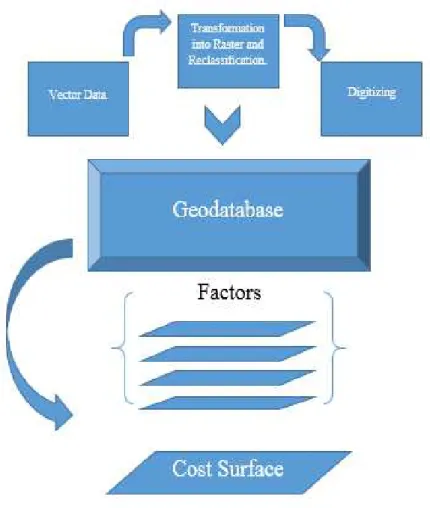
Figure 5. Data proccesing and factor rasters shown as a criterion datasets.
16
In case of the study determinations of the certain rankings, the same techniques were used (Feldman 1995).
The created routes were compared to one another and also a straight-line path through the study area to determine the cost benefits of the analysis and to make sure that the routes were realistic. Multiple routes were created with differing weights for each criterion in order to see what geographic locations are most affected by each specific factor. The unit calculations that were derived from the tool were also compared to one another to identify if the weighting system increased the costs associated with the pipeline or decreased them.
4.2 Data Sets
17
Figure 6. Geological map data for Geology criterion of Nebraska. (USGS)
The geological map of the Nebraska included different kinds of geological surveys, such as, hidrology, soils, oil shales, different kinds of rocks, water recources and etc. From that point of view, this map was perfect choice for using in the study. The geological data of Nebraska was downloaded and extracted from United States Geological Survey (USGS). Fur more detailed information possible o see in the following link. (http://mrdata.usgs.gov/catalog/lithclass-color.php). Table 1 in the Annex displays data processing for geology criterion and how effectiveness can effect to each
weighted overlay surface.
18
digitized and the scales were chosen in this coordinate system. The creation of these criteria rasters were completed in order to reclassify and rank the
different costs associated with each specific criterion. When reclassifying and ranking the created criteria rasters the scale from 0-10 was used where 10 would indicate the highest cost value and 0 the lowest. This scale was used both for simplicity and for the ability to easily recognize high/low cost areas visually on the cost accumulated surface when all of the criteria rasters were combinedtogether. For example, steeper slopes are much more hazardous and difficult to construct large linear features; therefore, the areas encompassing the steepest slopes were assigned the highest values in the output raster (Rees 2004). The determinants for the specific rankings for each criterion was done arbitrarily but referenced specific case studies such as Feldman et al. (1995)Data processing calculated by “Reclassified” tools in ArcMAP and after reclassfied data criterion using for the each weighted overlay ( Annex A. Table 4).
19
Other compulsive option of the routing pipeline through the study is to determine the acqiution of the accurate location, thus there is a need for a very exact data to define the area. It is almost impossible to find this kind of data in available data storages. At the same time, to understand the accurate area it is needed to make new land use classification for the routing system. In this study it was not possible to create a precise data for the study area. Therefore, just simple classsifaction method was carried out and compared with the data, which was downloaded from the official website of University of Nebraska. The data was rasterized and digitized for the study area. During the digitizing period, there was not any changes and almost nothing changed from 2005 till 2014. Besides, land use criterion would permit the least cost paths to take into account the types of surface that are most comfortable for the construction and less hazardous (Kelly 2014).
Figure 8. Land Use data for land use critertion of Nebraska (University of Nebraska).
20
The values were changed only for computation of the landcover. Because, each class had a different values which is not good for routing. The lowest values were used with 1, such as agriculutre, other lands and etc; while the highest values mostly were about water parts and urban places. Since, exploring the study area mentioned that Keystone XL passed through area mostly covered water recources (The Ogallala Aquifer) and also there were some small lakes and rivers. Routing the pipeline through water areas is dangerous and it would cost the construction lots of money. Given this fact, before planning the routing, it is better to calculate each classes of the land use just for insurance not to get any problem in the future. Table 3 in the Annex A displayes how data proccesing prepared for the each weighted overlay surfaces.
21
The last data facor is about different environmental issues which more concentrated on the population, houses, block, and etc. The data map have collected by using the U.S Census TIGER Data Resources and using the ArcMap tools data have been created for one main data factor. The main goal of the using the environmental criterion is because to protect state from different kinds of the hazards. Each year in different states of the U.S some hazards calculated arround 1-2 billion dollars because of the various hazards (oil spills, gas leaks or natural hazards such as hurricane). Hence, data try choosed to protecting the study area from hazards and during routing period to not make some cunstructural affects to the environments. The spatial resolution was set to the same as the slope and lithology rasters and the
raster was clipped to the extent of the study area. The water bodies’ raster was then
reclassified in the same 1-10 but much differently from the other criteria rasters. Figure 8 displays environmental data converted to raster file and following figure also displays result after reclassfying. About data values more detailed information shown in the Annex A. Table 1.
4.3 Accumulative Cost Surface
22
amount of percentage and then combined together for creating a cost accumaltve surface using the map algebra. All of the weighted criterions of the four criteria were collected inside of 100%.
Except the equal weighting overlay, other weighted overlays accounted for each specific criterions in order to determine and understand the difference between propoesed pipeline and least cost pathes.
For the first weighted overlay is mostly about the elevation model of the region. With accurate slope criterion it would help to define the heavy slopes and topographical partiality of the region. The terrain which includes vertical slopes are more acceptable to fail.
The second weighted overlay more is about geological stability and geology of the area. The geological segment has a big role for the routing pipeline. It would help to predict the area about natural hazards and protect from future hazards. The geological overlay part is determined from USGS that provides compositions and age.
The third overlay adopts the land use charasteristics of the study area. The land use had a more detailed information about the study area. Almost all natural and agricultural criteria are combined insde of this criterion. It could help constructors to determine more suitable places and protect agricultural areas from future hazards such as oil spills and etc.
The study area limited in each specific criterion and also other limitations were about to figure out the resolution of the each raster datasets and making them more suitable for applied study area. Resolutions of each cell were different in each raster format, also other datasets such as population and geology datasets were converted to raster and cell of each of raster formats modified as a resolution of the elevation data and in order to get effective costs it was very useful to understand that.
During analyzing of the weighted overlay surface and reclassifyng period there were
some necessery issues such as “NO DATA” values. In each category (except land
23
displaying in the map some how it can make confusion with error of the cell. Note
that ‘No Data’ cells are excluded from the possibility of travel. The procedure described “ensures that the lowest accumulative cost is guaranteed for each cell”. Therefore, cost assigned to every link reflects a resistance value of moving over one geographic distance unit (ESRI Desktop Help and Belka 2005). More formation about data processing for each criterion detailed in Annex A.
4.4 Least Cost Routing Tool
After the creation of cost accumulative surfaces using the ArcGIS, least cost tool and cost path were handled to define the least cost rout through the study area. The source and destionation points were appointed to the accumulated cost surface based on the proposed pipeline. The source point was located in the North-West part of a city which was called Key Paha and the destination point was located in the South part of Steele city. It was not possible to get point by downloading or searching, so the special vector data inside Keyston XL geodatabase was made. The starting and ending points were used due to the accumulated cost surfaces and had the role to control them as an input and output location inside of the model. Afterward, next stages were to understand roles of cost distance tool and backling rasters, while these rasters were used in conjuction inside of cost path tool to create a linear feature between source and destination point.
24
5. Result
5.1 Equal Weighted Overlay
25
Figure 10. Equal Weight cost surface that was formed for the study area.
26
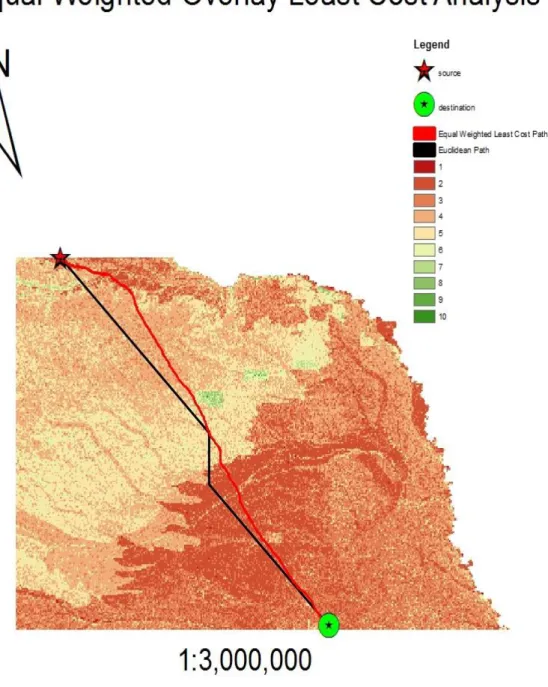
Figure 11. Equal Weighted LCP and straight-line route, which achieved for cost surface Equal Weights overlay.
27
Table 1. Least Cost route lengths and Euclidean Path route length, which based on Equal Weighted Cost surface.
This study has different values from the different lengths of the routes. The relative cost was impossible to use as a quantitative measurement of the cost of the pipeline (Kelly 2014). In addition, straight-line path cost was used as a prototype of the original pipeline. It was not possible to get GPS points from the original Keystone XL, as there was no chance to get the relative cost of the Euclidean Path to compare the effectiveness between both paths. The following Table 1 shows that the LCP is 23.18 km longer than STP. Table 1 displays the units that are associated with each route and also the percent effectiveness that the least-cost path obtains when compared to the straight-line path across the same cost surface. The least-cost path is almost 23 km longer than the straight-line path but is 424 units less indicating that the least-cost path is 17% more effective
5.2 Weighted Overlays
This part of the study is more about Weighted Overlay surface that had big effective influences for each specific study field. Multiple cost surfaces were created using the Weighted Overlay tool in the ArcMap software that designated specific weights to
Route Length (km) Units per path Influence by percentage
Least Cost Path 423.18 2052
17.1%
28
each criterion. Table 2 below displays the weight amounts for each of the weighted cost surfaces that were created. Each Weighted Overlay surface that was created highlighted a specific criterion or criteria more than others to detail the impact that they had on the least-cost path.
Surfaces Criterion Percentage
Weighted Overlay 1
Environment 15%
Land Use 10%
Slope 45%
Geology 30%
Weighted Overlay 2
Environment 30%
Land Use 40%
Slope 20%
29
Weighted Overlay 3
Environment 10%
Land Use 10%
Slope 35%
Geology 45%
Table 2. All three Weighted Overlays with specific weighted percentage for each criterion.
All criterions were explored, digitized and reclassified with the help of “Reclassify” tool in ArcMap and divided into 10 classes. There was one simple and main reason for the land use criterion that criterion was not reclassified. This is because, the land use had 25 basis classes in itself that were given special values just to determine least hazardous routing through agricultural areas of the study area. In order to define the routing areas, it is necessary to have digitized values for each class. For instance, water land, wetland and other similar classes were exploited with high value such as 10, according to methodology part it can be explained that it would be very costly for construction after planning (constructing bridges, hanging bridges or etc.). The others were mostly computed between 3 and 4, the values which were taken as standard class values for land use (Annex B).
30
31
32
33
Route Surface Length (km) Units per path Influence Percentage Least Cost Path Weighted Overlay 1 447.28 1867 27.1%
Euclidean Path Weighted Overlay 1
400.25 2561
Euclidean Path Weighted Overlay 2
421.04 2048
14.7%
Euclidean Path Weighted Overlay 2 400.25 2401 Least Cost Path Weighted Overlay 3 515.56 1404 37.0%
Euclidean Path Weighted Overlay 3
400.25 2236
34
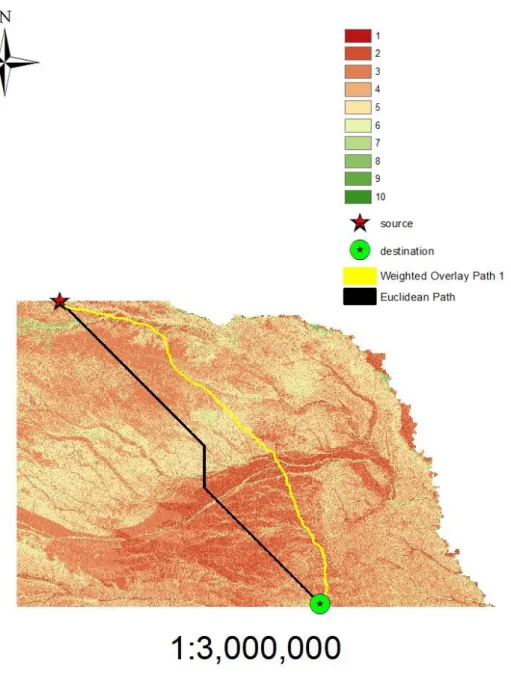
The costs for the straight-line paths through each of these cost surfaces are higher than the costs for the least-cost paths, although the lengths of the least-cost paths are longer. By examining each Weighted Overlay surface one can see that the highest percent effectiveness was calculated from the third weighted overlay surface with its value of 37% The third weighted overlay surface placed emphasis on the geological hazards within the area more so than any of the other criteria. This indicated that the major criteria for the routing in this study region were the geological hazards that are present. The Least Cost Path 2 concentrated on the Weighted Overlay which has more influences from Environmental and Land Use criterion. It is because of the most environments and agriculture located on the middle part of the study area. Location of this both criterion is in the high plains area which is very useful for agriculture and that is why, result displayed 14.7% (less than compare other results). LCP 1 displayed average result compare Weighted Overlay 1 and 2. Because, more slopes of the area more upper in the middle and west part of the East part of Nebraska but effectiveness of geology criterion effect cannot let to analyses to route path from the East part it is therefore, LCP 1 displayed 27.1% more effective compare with Euclidean Path.
There can be some confusion about LCP 2 that route passing through area where there is no data calculated. In the Annex B. Figure 1 displays more details about this issue. All analyses behaved perfectly and more accurately according to the data sets.
5.3 The Ogallala Aquifer and Proposed Keystone XL Route.
35
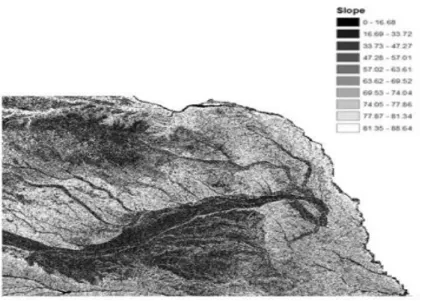
the project has not started yet. As a result, it is not possible to get further information about the data. The proposed pipeline and least cost route features are shown in Figure 15 with reclassified slope surface. In this slope surface, the legend is a little bit different from the previous figure legends. The white parts of surface display the lowest slopes in the study area.
36
Due to some problems, it was not possible to compare all pipelines with their further information. The study was about which routes are more effective and which of least cost routes pass through the Ogallala Aquifer. The results have been discussed in the discussion part of the thesis. Another issue was about the study that some of the routes passing through the area are protected by the State Department of the U.S and some other governmental organizations. The Ogallala Aquifer has been explored in the study area part and Table 4 displays that which routes passing through the aquifer and results shown with percentage of the. The results were expectable from my side of view. So, the least cost path route which was represented on the Weighted Overlay surface 3 was more effective and less hazardous compared to the other routes and proposed pipeline.
Surface Length of the routes, which passed through,
protected area.(km)
Percentage
Weighted Overlay 1 LCP route
303.54 68%
Weighted Overlay 2 LCP route
358.43 85%
Weighted Overlay 3 LCP route
210.56 40%
37
LCP route
Proposed Pipeline 340.13 86%
Table 4. The percentages and length of the routes, which passed through the Ogallala Aquifer.
38
39
40
6. Discussion
During the examination period the results were composed from the different four cost surfaces within the study clearly showed that the least cost tool is more effective then compare with a normal Euclidean Path. Euclidean Path chosen for as a prototype of the proposed Keystone XL and generated between two points (source and destination). It is because of during the study, it was not possible to get an available exact data about proposed pipeline which is concentrated on the usual GPS points. Starting with the Equal Weighted cost surface, least cost path route detailed units were around 17% lower than standard Euclidean Path. According to the Austin Kelly., 2014, this is not the case though due to the specific criteria that were combined together to form the cost surface. This is where the logic of the least-cost algorithm that is coded within the ArcGIS tool displays its worth in navigating the highest cost cells while traversing the cost surface from source to destination. (Kelly 2014)
The cost that are accumulated for each derived path are not numerical figures that can be used in projects. For example, in engineering methods as these values only helping to determine the units of each cost that is generated from transom of the specific cost surface. The units of the costs displayed on the Table 1 for Equal Weighted cost surface and Table 3 for following Weighted Overlays. It is also appropriate to note that the units of the each path costs that were calculated for Equal Weighted Overlay cannot be comparable with other Weighted Overlay’s results. It is because of the factors of Equal Weighted Overlays divided between equal percentage effectiveness but Weighted Overlays have their own specific effectiveness values which generated on specific values. Another point that issue to according to Kelly 2014, is about different scaling of the cost units between two types of surface (Equal Overlays and Weighted Overlays).
41
surfaces. In displayed table 3 the least cost path was made across Weighted Overlay 3 was the most efficient route to compare with the Euclidean Path. Actually, all of results behaved in very nice way but the thing is that each routes were dependent on their specific criterion. The percentages of the each criterion have gotten after few analyses period which have given by ArcMap. Initial steps about feedbacks of the each criterion were random and then with starting the analyses feedbacks changed according to their accumulated cost cells. In this case, Weighted Overlay 3 cost surface percentages feedbacks were getting by their cost and table 3 it is more detailed. Weighted Overlay 3 more effective by geologic values of the units which is more concentrated about lithology, rock, water resources and etc. in the study area. The Least Cost Path 3 was more effective to compare with other overlay surfaces and supposedly it is because of the data was more accurate for the region. It is already clear that in the study are there is a big aquifer which has influences for the Least Cost Path and I was one of the main goal to determine the route which is not passing through the aquifer area. The available data set downloaded from the USGS official website and Conservation and Survey Division (CSD) provided this data more beneficial. CSD provided beneficial dataset which had beneficial effect on the study. They engaged in geologic mapping, researches about soils, settlings of different rocks and etc. Studies conducted by CSD personnel provide the basis for effective resource management and use, water resource safety and security, the exploration and exploitation of industrial mineral and fuel resources, natural-hazard mitigation, and building-site evaluation (University of Nebraska 2015). The Least Cost Path which generated on the Weighted Overlay 3 cost surface and it is more effective compare with Euclidean Path and other LCP routes percentage. Secondly, only 40% of the route passing through protected the Ogallala Aquifer and in this issue also has more effective result to compare with other routes.
42
higher than the West part of Nebraska State and study generated on the East part that is why, level alttidue less than the Middlewest of Nebraska. The elevation data downloaded from official website of the NASA JPL and digitized for the study area. The results showed that LCP 2 was 14% cheeper and less hazardous compare with the Euclidean Path but this route connot apply for construction. Because, 68% of the least cost path route croosing through the Ogallala Aquifer. Compare it to Equal Weighted and Weighted overlay 2 it is seems more suitbale but compare it with LCP 3 that the route LCP 1 is more longer.
The latest overlay is displaying agricultural and evinormental issues for Nebraska State. The mostly agricultural issues located in the central parts of the study area and it is because of the high plain location. Ususally agricultural areas are locating on the area which is suitable for them. Following Weighted Overlay 2 more concentrated about agricultural issues and from the Figure 13 it is more visible that central areas are more about this criterion. Dataset for the this criterion downloaded from University of Nebraska-Lincoln which is providing accurate and available data sets for Nebraska state. It does not make sense to provide criterion more about population areas, it is because of the study area population calculated around 2 million and heavy population more located in the Midwest and kind of central area and environmental data is not providing exact data about population there includes houses and block into environmental critertion.
43
A key maintenance to take into account when examining the results from the proposed
Keystone XL route and the least cost routes that were practically created was that even though these practical routes only took into account a very selected few criteria they almost simulated the proposed route. In Figure 12 shows that the eximined routes were sourced from the exact location where the proposed route inputted the study area. This is not due to the changing condition when routing large projects such as this pipeline. Although the source locations for each route were different, this did not affect the practical routes significantly enough to document.
Another key limition of this study was about the obtaining more accurate data for Nebraska State. It is not possible to understand how and which datasets used by Transcanadian Coorpoartion to propose Keystone XL but in case of the study all datasets were more accurately and they behaved from the begining which results were expecting. Only problem about original data for proposed Keystone XL. It needed because to understand atrributes and make more observations for area which
44
7. Conclusion
The created least-cost paths from this thesis provides the least hazardous pipeline routes by using the available data that covers the region of Nebraska State. When comparing the created routes to the proposed Keystone XL the least-cost paths accurately detail routes that are strikingly similar and effective in providing a path from the documented source and destination points within Nebraska. This thesis, using similar studies as background and for reference, combined the key factors in routing a large-scale pipeline project into a relevant cost surface that was then able to perform a least-cost path analysis and deliver a connected route. While the thesis had some limitations with the amount of data available and its precision, the overall result was a viable least-cost path that satisfied the main regulations with routing this type of infrastructure.
The study concentrated on the four different weighted overlays and demonstrated with different least cost paths routes which helped to determine least hazardous route for the study area. The results were more precision compare with proposed pipeline and it could be more accurately with more precision data sets. Least Cost Path analyses distributed in various criterion which last results (Table 2) of the each criterion calculated by logic of the algorithm.
45
Bibliographical References
1) Mahmoud Reza Delavar, Fereydoon Naghibi., 2005, Pipeline Routing Using Geospatial Information System Analysis.
2) M.F. Goodchild., 1976, An evualation of lattice solutions to the problem of corridor location.
3) Abdul-Lateef Balogun, Abdul-Nasir Matori, Khamaruzaman Yussof, Dano Umar Lawal, Imtiaz Ahmed Chandio., 2012, GIS in Pipeline Route Selection: Current Trend and Challenges.
4) Volkan Yildirim, Tahs in Yomralioglu., 2012,GIS Based Pipeline Route Selection by ArcGIS in Turkey.
5) Volkan Yildirim, Recep Nisanci, Selcuk Reisş, October 8-13, 2006, A GIS Based Route Determination in Linear Engineering Structures Information Management (LESIM). Shaping the Change XXIII FIG Congress Munich, Germany.
6) Maheen Iqbal, Farha Sattar, Muhammad Nawaz., 2006 IEEE, Planning a Least Cost Gas Pipeline Route A GIS & SDSS Integration Approach.
7) Imtiaz Ahmed Chandio, Abd Nasir B Matori, Khamaruzaman B WanYusof, Mir Aftab Hussain Talpur, Dano Umar Lawal, Abdul-Lateef Balogu., Routing of road using Least-cost path analysis and Multi-criteria decision analysis in an uphill site (Development. Department of Civil Engineering, Universiti Teknologi Petronas, Seri Iskandar, 31750, Perak, Malaysia).
8) Avinash Kumar, S.K. Ghosh, Dr. Mili Ghosh, Kishore Kumar, Siddhartha Khare., 2012, Pradeep Chaudhry GIS based planning for finding optimal gas pipeline route in IITR campus. (Department of Civil Engineering, IIT Roorkee and Department of Remote Sensing, BIT Mesra, Ranchi. Paper Reference Number: PN-131. INDIA Geospatial Forum).
46
10) www.Keystone-xl.com
11) Fotios G., 2011, Method for route selection of transcontinental natural gas pipelines. Thomaidis.National and Kapodistrian. (University of Athens Department of Informatics and Telecommunications).
12) Aissi, Hassene, Salem Chakhar, Vincent Mousseau., 2012, GIS-based Multicriteria Evaluation Approach for Corridor Siting. (Environment and Planning B-Planning & Design 39 (2): 287–307. doi: 10.1068/b37085).
13) Collischonn, Walter, Jorge Victor Pilar., 2000, A Direction Dependent Least-costpath Algorithm for Roads and Canals. (International Journal of Geographical Information Science).
14) Dijkstra, E. W., 1959. A Note on Two Problems in Connexion with Graphs. (Numerische Mathematik 1 (1): 269–71. doi: 10.1007/BF01386390).
15) Feldman, Sandra C., Ramona E. Pelletier, Ed Walser, James C. Smoot, Douglas Ahl., 1995, A Prototype for Pipeline Routing Using Remotely Sensed Data and Geographic Information System Analysis. (Remote Sensing of Environment).
17) Lee, Jay, Dan Stucky., 1998, On Applying View-shed Analysis for Determining Least-cost Paths on Digital Elevation Models. (International Journal of Geographical Information Science).
18) Rees, W.G., 2004, Least-cost Paths in Mountainous Terrain. (Computers & Geosciences. 2003).
19) Saha, A. K., M. K. Arora, R. P. Gupta, M. L. Virdi, E. Csaplovics. 2005. GIS•based
Route Planning in Landslide Prone Areas. (International Journal of Geographical Information Science 19 (10): 1149–75).
20) Yang, Si-Zhong, Hui-Jun Jin, Shao-Peng Yu, You-Chang Chen, Jia-Qian Hao, Zhen- Yuan Zhai., 2010, Environmental Hazards and Contingency Plans Along the Proposed China–Russia Oil Pipeline Route, Northeastern China. (Cold Regions Science and Technology 2009).
47
22) Kamila Małgorzata Belka., 2005, Multicriteria analysis and GIS application in the selection of sustainable motorway corridor.
23) Abdul-Lateef Balogun., 2013, Geographic Information System (GIS) in Offshore Pipeline Route Selection: Past, Present, and Future. (Department of Civil Engineering, Universiti Teknologi PETRONAS (UTP), Perak, Malaysia.).
24) Mahmoud Reza Delavar, Fereydoon Naghibi., 2009, Pipeline Routing Using Geospatial Information System Analysis.
25) Eurostat. 2007. (Eurostat Statistical Books - Gas and Electricity Market Statistics).
26) Denise Chow, Staff Writer., 2013, Water Woes: Vast US Aquifer Is Being 27)Tapped
Out. (URL: http://www.livescience.com/39186-kansas-aquifer-water depletion.html)
28) Austin Kelly., 2014, GIS Least-Cost Route Modeling of the Proposed Trans-Anatolian Pipeline in Western Turkey (Georgia State University).
29) Brad Plumer., 2015, 9 questions about the Keystone XL pipeline debate you were too embarrassed to ask. (URL: http://www.vox.com/2014/11/14/7216751/keystone-pipeline-facts-controversy).
30) University of Nebraska. School of Natural Recourses. Collage of Agricultural Sciences and Natural Recourses.
31) Communication Sciences & Disorders (CSD) Education Survey Nebraska Aggregate Data Report 2012-2013 Academic Year.
32) Xiaoge, Z., Wentong, D., 2005, GIS Technology and Application on Oil-gas Pipeline Construction.(URL: http://ieeexplore.ieee.org/iel5/7719/21161/00982754.pdf).
33) Nasir, M. S, Hyder, S. K., 2001, “Economics of Pakistan”. (New United Booksellers, Lahore, pp 248)
34) Dubey, R.P., 2005, A Remote Sensing and GIS based least cost routing of pipelines. (URL: http://www.gisdevelopment.net/application/Utility/transport/utilitytr0025pf.htm).
48
36) Luettinger, Jason, Thayne Clark., 2005, Geographic Information System-based Pipeline Route Selection Process. (Journal of Water Resources Planning & Management).
Annex A.
The annex describes data processing for each criterion after
reclassifying.
№ Calculated
Values Weights
1 174196 2
2 176923 2
3 177252 2
4 178312 3
5 181538 4
6 181780 4
7 186012 4
8 190821 6
9 197257 6
10 517252 10
No Data No Data
Table 1. Data
processing for “Environmental Criterion”.
Table 1 displays data processing for “Environmental Criterion” and population, houses,
blocks and etc. included into the data. During the weighted overlay analysis special
49
№ Geologic
Names Weights
1 Shale 3
2 Limestone 3
3 Clay or Mud 2
4 Mudstone 3
5 Sand 1
6 Sandstone 3
7 Water 10
No Data No Data
Table 2. Data processing for “Geology”
Criterion.
There were special geologic units in the study area. Data reclassified for criterion High
50
№ Classes Weights
1 Corn 3
2 Sugar Beets 3
3 Soybeans 3
4 Sorghum 3
5 Dry Edible Beans 3
6 Potatoes 3
7 Alfalfa 3
8 Small Grains 2
9 Range/Pasture/Grass 1
10 Urban Land 5
11 Open Water 10
12 Woodlands 8
13 Other Ag.Lands 3
14 Sunflower 3
15 Summer Fallow 5
16 Barren 1
Table 3. Data processing for “Land Use” criterion
Data was not reclassified for the criterion. It is because of the special units inside of the
data and with changing the special unit’s data can lose its effectivity. Specific numbers
51
№ Slope
(degrees)
Wieghts
1 0 - 16.68 1
2 16.69 – 33.72 2 3 33.73 – 47.27 3 4 47.28 – 57.01 4 5 57.02 – 63.61 5 6 63.62 – 69.52 6 7 69.53 – 74.04 7 8 74.05 – 77.86 8 9 77.87 – 81.34 9 10 81.35 – 88.64 10
No Data No Data
Table 4. Data processing for “Slope” criterion.
Data describes values with degrees which have gotten after reclassification period. Given
52
Annex B.
The annex B descries the methodology and examples of the least cost algorithm.
Furthermore, the appendix describes invisible part of the “Weighted Overlay 2 Least Cost
Path” which can make confusion for
readers.
Figure 1. Displays the procedure of least cost path.
Figure 1 displays example for least-cost path algorithm which routes calculated into
53
the cost value is lower, the old accumulative cost is replaced. The cells that are already
assigned to the output raster are not recalculated and treated as ‘permanent’. The process
is repeated until the least accumulative cost is assigned to all cells and the back link raster
is completed. Generation of the weighted-distance raster is based on graph theory and the
shortest path is based on the Dijkstra algorithm (ESRI Desktop Help and Belka., 2005).