online | memorias.ioc.fiocruz.br The Bacillus cereus group comprises six valid
spe-cies, including B. cereus, Bacillus thuringiensis, Bacillus anthracis and Bacillus mycoides that are distinguished based on plasmid content and the expression of morpho-logical characteristics that confer distinctive pathogenic-ity features. These species are highly related and in the opinion of many researchers they may be considered as a single species based on genetic and genomic features (Helgason et al. 2000a, b,Anderson et al. 2005, Zahner et al. 2005, Han et al. 2006). B. cereus and B. thuringiensis are frequently found as components of the normal micro-flora of the gastrointestinal tract of a variety of mammal and insects (Jensen et al. 2003). However, the importance of this group of bacteria is related to food safety, their role as mammalian and/or insect pathogens and their application as biological control agents. B. cereus is an opportunistic human pathogen involved primarily in food poisoning incidents and increasingly as a source of nosocomial infections, while B. thuringiensis is one of the world’s most widely used biopesticides. Although the symptoms of B. cereus food-borne illness are relatively mild, severe cases have been reported, including death by cereulide toxin (emetic toxin) and necrotic enterotoxin, cytotoxin CytK producing strains (Mahler et al. 1997,
Lund et al. 2000). The heterogeneity among strains of B. cereus in the context of virulence is also a point of study. In this context, B. cereus strains have been shown to har-bour diverse plasmids which shared conserved sequences with the B. anthracis virulence plasmids pXO1 and pXO2 (Jackson et al. 1998), an example is strain G9241, respon-sible for a case of severe pneumonia, that contained the plasmid pBCX01 which was 99.6% similar to the B. an-thracis pXO1 virulence plasmid (Hoffmaster et al. 2004). Moreover, sequences encoding toxins or capsular poly-saccharide of B. anthracis (pagA, lef, cya and capBCA) were detected in several B. cereus strains recovered from patients (not known to be immune compromised) with fatal pneumonia (Jackson et al. 1998).
In Brazil, the isolation of B. cereus from food is not infrequent, but food poisoning is not commonly reported. In a previous study the presence of a variety of sequenc-es (bceT, hblA, nheBC, plcA, sph and vip3A), encoding putative virulence factors was assessed by polymerase chain reaction (PCR) assays in a collection of 80 Brazil-ian B. cereus and B. thuringiensis strains (Zahner et al. 2005). Amplicons were detected for all of the sequences encoding factors suggested to play a role in infections of mammals. Interestingly, the majority of the sequences were detected more frequently in B. thuringiensis iso-lates than in B. cereus.
Multiple locus sequence typing (MLST) studies are based on detailed analysis of the nucleotides sequence of housekeeping genes. This approach has been extensive-ly used in the identification of genetic variation within different groups of bacteria in order to develop evolu-tionary frameworks, to conduct epidemiological surveil-lance, for the identification of epidemic clones of anti-Financial support: FAPERJ, CNPq, CIEE
+ Corresponding author: [email protected] Received 10 April 2012
Accepted 17 July 2012
Extended genetic analysis of Brazilian isolates
of
Bacillus cereus
and
Bacillus thuringiensis
Viviane Zahner1/+, Ana Carolina Telles de Carvalho e Silva1, Gabriela Pinhel de Moraes1, Douglas McIntosh3, Ivano de Filippis2
1Laboratório de Transmissores de Leishmanioses, Setor de Entomologia Médica Forense, Instituto Oswaldo Cruz 2Departamento de Microbiologia, Instituto Nacional de Controle de Qualidade em Saúde-Fiocruz, Rio de Janeiro, RJ, Brasil
3Departamento de Parasitologia Animal, Universidade Federal Rural do Rio de Janeiro, Rio de Janeiro, RJ, Brasil
Multiple locus sequence typing (MLST) was undertaken to extend the genetic characterization of 29 isolates of Bacillus cereus and Bacillus thuringiensis previously characterized in terms of presence/absence of sequences encod-ing virulence factors and via variable number tandem repeat (VNTR). Additional analysis involved polymerase chain reaction for the presence of sequences (be, cytK, inA, pag, lef, cya and cap), encoding putative virulence factors, not investigated in the earlier study. MLST analysis ascribed novel and unique sequence types to each of the isolates. A phylogenetic tree was constructed from a single sequence of 2,838 bp of concatenated loci sequences. The strains were not monophyletic by analysis of any specific housekeeping gene or virulence characteristic. No clear association in relation to source of isolation or to genotypic profile based on the presence or absence of putative virulence genes could be identified. Comparison of VNTR profiling with MLST data suggested a correlation between these two meth-ods of genetic analysis. In common with the majority of previous studies, MLST was unable to provide clarification of the basis for pathogenicity among members of theB.cereus complex. Nevertheless, our application of MLST served to reinforce the notion that B. cereus and B. thuringiensis should be considered as the same species.
Genotypic analysis of B. cereus group • Viviane Zahner et al. 66
biotic resistant strains and to examine the evolution of virulence properties and population structure (Maiden et al. 1998, Priest et al. 2004, Helgason et al. 2004, Ko et al. 2004, Barker et al. 2005, de Filippis & Vicente 2005, Hoffmaster et al. 2008). In this method, relationships among isolates are based on comparisons of allelic pro-files: isolates sharing four or more alleles are considered as closely related sequence types (STs).
Different groups have provided evidence for associa-tions between specific STs or lineages and the virulence potential of strains, exemplified by pathogenic B. cereus isolates from periodontal disease and emetic gastroin-testinal illness that were associated with specific clonal groups (Helgason et al. 2000a, b, Barker et al. 2005, Ehling-Schulz et al. 2005, Vassileva et al. 2006, Hoff-master 2008). Yet, the overall population structure of the B. cereus group is not clear due to the limited numbers of strains present in the data bank. It is generally accepted that there exists a necessity to expand the number house-keeping gene sequences deposited in the data bank in order to more clearly elucidate the existence of lineages or clonal complexes associated with specific diseases.
The first objective of the current study was to use MLST to determine the genetic relationships of 29 strains of B. cereus and B. thuringiensis with 18 of them isolated from different sources in Brazil and the remain-der remain-derived from a range of countries and sources. The second objective was to extend our earlier investigation in relation to the distribution of genes encoding putative virulence factors, specifically be, responsible for synthe-sis of the emetic toxin cereulide (Toh et al. 2004), cytK encoding necrotic enterotoxin (Fagerlund et al. 2004), inA encoding a metalloprotease of B. cereus (Gutmann & Ellar 2000), the sequences pag, lef and cya located on the pXO1 plasmid of B. anthracis and the B. cereus plasmid pBCX01 and finally the gene cap encoding the capsular antigen of pXO2 (Jackson et al. 1998). The pres-ent work complempres-ents and enhances the previous study of Zahner et al. (2005) where the relationship between B. cereus and B. thuringiensis was investigated.
MATERIALS AND METHODS
Bacterial strains - Twenty-nine strains including B. cereus or B. thuringiensis and B. mycoides were includ-ed in this study (Table I). All these strains were original-ly present in Coleção de Culturas do Gênero Bacillus e Gêneros Correlatos - Bacillus Collection/Oswaldo Cruz Institute/Oswaldo Cruz Foundation. Details of each strain can be found in Zahner et al. (2005).
Molecular methods - Extraction and purification of genomic DNA has been described previously (Zahner et al. 2005). The presence the gene be, encoding emet-ic toxin, was examined by PCR as described by Toh et al. (2004) and be-PCR amplification products were se-quenced. The cytK sequences were detected according to the protocol of Fagerlund et al. (2004), with the primers CytkF 5’-CCAACCCAGTTACCAGTTCC-3’ and CytkR 5’-AACAGATATCGGTCAAAATGC-3’ and the inA gene was amplified according to the methods of Gutmann and Ellar (2000). Nested-PCR for amplification of the
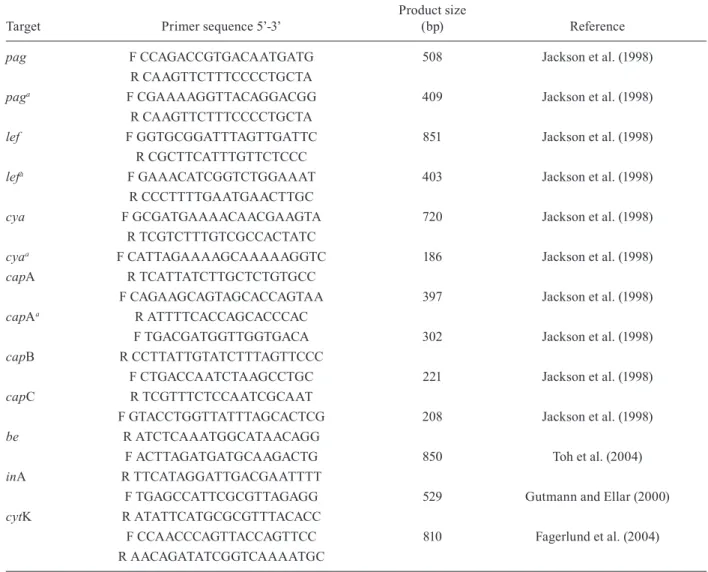
structural genes of the entire complement of B. anthra-cis toxins found on pXO1 (pag, lef, cya) and the capsular antigen gene of pXO2 (cap) was carried out as described by Jackson et al. (1998). Details of primers used are pro-vided in Table II. Strains showing a negative result for the be sequence by PCR assay were submitted to Southern blotting and hybridization with a be probe as previously reported (Zahner et al. 1998). Each PCR reaction was re-peated at least three times to confirm reproducibility. This publication made use of the Bacillus cereus Multi Locus Sequence Type website (pubmlst.org/bcereus) developed by Jolley et al. (2004) analyzing the seven housekeeping genes (glp, gmk, ilvD, pta, pur, pycA and tpi) employing PCR conditions as described in the MLST database. PCR products from MLST genes and emetic toxin gene (be) were purified using the GFX-PCR DNA Kit (GE Health-care Life Sciences). PCR fragments were sequenced in both directions, using the amplification primers to pro-vide unambiguous sequence data, by use of the BigDye Ready Reaction mix (ABI Corp) and reaction products were analyzed on a Prism 3700 automated DNA analy-ser (ABI Corp). All the sequencing procedures were per-formed as published by Otto et al. (2008).
Data analysis - Sequencher 4.8 software (Genecodes) was used for assembly of contigs and determination of consensus sequences. The nucleotide sequences of each housekeeping gene were trimmed to the appropriate length (348-504 bp), as previously described (Jolley et al. 2004), and then queried to the MLST database. STs were assigned based on the combination of the seven alleles in a specific order. New alleles and allele sets were de-posited in the Bacillus MLST database. Designation of new alleles and ST was determined by MLST database curators. A phylogenetic tree was constructed based on the multiple alignments of the concatenated sequences of the seven MLST genes through the neighbour-joining method using Mega 4.0 software (Tamura et al. 2007).
Split decomposition analysis of allelic profiles was car -ried out with the SplitsTree 4.0 software (Huson 1998). Some known strains from the MLST Bacillus databank were included to assess the relationships of those isolates with the ones identified in our study.
RESULTS
Table I presents the distribution of virulence genes, variable-number of tandem repeats (VNTR) types, STs and origin of the Bacillus species examined.
result-67
Mem Inst Oswaldo Cruz
, Rio de Janeiro, V
ol.
108
(1), F
ebruary 2013
Distribution of virulence genes, variable-number of tandem repeats (VNTR) types, sequence types (STs) and origin of the Bacillus species examined
Isolate Bacterial species Source of isolation
Country of isolation
Year
of isolation ST
VNTR
typea cytk inA be
pag,
lef, cya cap
LFB563 Bacillus thuringiensis pakistani Soil Brazil NA 534 4 P N N N N
LFB683 B. thuringiensisfinitimus Soil Brazil NA 529 3 N N N N N
LFB891 B. thuringiensisaizawai Food - black pepper Brazil 1994 535 4 P N N N N
LFB472 B. thuringiensis sotto Insect Pakistan NA 518 1 P P N N N
LFB858 B. aizawai Food - black pepper Brazil 1994 526 3 P P N N N
LFB860 B. thuringiensisisraelensis Food - black pepper Brazil 1994 537 5 P P N N N
LFB862 B. thuringiensis Food- black pepper Brazil 1994 523 2 P N N N N
LFB861 B. thuringiensis israelensis Food - black pepper Brazil 1994 538 5 P N N N N
LFB914 B. thuringiensis israelensis Soil Brazil 1992 540 5 P N N N N
LFB584 B. thuringiensis israelensis Insect Israel NA 527 2 N N N N N
LFB476 B. thuringiensis morrisoni Soil Brazil 1998 522 2 P N N N N
LFB120 Bacillus mycoides ATCC1120 NA NA NA 524 2 P N N N N
LFB208 Bacillus cereusATCC 33018 Food Colombia NA 519 1 N N N N N
LFB476 B. cereus ATCC 33019 Food Colombia NA 516 3 N N N N N
LFB406 B. cereus NCTC 2599 NA NA NA 517 5 P N N N N
LFB1123 B. cereus Insect Madagascar NA 520 5 P N N N N
LFB1125 B. cereus Insect Madagascar NA 528 3 P N N N N
LFB1130 B. cereus Insect Egypt NA 539 5 NA N NA N N
LFB1131 B. cereus Insect Czechoslovakia NA 536 5 P N NA N N
LFB1133 B. cereus Insect USA NA 533 4 P N NA N N
LFB513 B. cereus Food - rice mousse Brazil 1987 542 3 N N N N N
LFB693 B. cereus Food - ice cream Brazil 1987 530 4 P N N N N
LFB704 B. cereus Food - soup Brazil 1987 541 5 P N N N N
LFB585 B. cereus Urinary infection Brazil < 2001 525 3 P N N N N
LFB586 B. cereus Urinary infection Brazil < 2000 531 4 P N N N N
LFB598 B. cereus Diarrheal stools Brazil < 2001 532 4 P N P N N
LFB600 B. cereus Diarrheal stools Brazil 2001 543 3 P N N N N
LFB601 B. cereus Diarrheal stools Brazil < 2001 521 2 P N N N N
LFB1181 B. cereus Bird - septicaemia Brazil 2002 544 NA N P N N N
Genotypic analysis of B. cereus group • Viviane Zahner et al. 68
ed in the average number of alleles per locus of 14.8. A phylogenetic tree (Figure) was constructed from a single sequence of 2,838 bp of concatenated loci sequences. The tree was derived using the novel isolates and included se-quence data derived from previously characterized
iso-lates stored in the Bacillus cereus Multi Locus Sequence Type website (pubmlst.org/bcereus). The overall struc-ture of the maximum-likelihood tree generated from con-catenated sequences resulted in two major phylogenetic groups (Figure): G1 (group 1), includes strains of clade 1, and G2 (group 2), includes strains pertaining to clade 2 as defined by Priest et al. (2004).
DISCUSSION
The first objective of the current study work was to increase the number of strains in the MLST database, in an attempt to more confidently assess if there are spe-cific lineages or clonal complexes containing clinical isolates that might be associated with a specific illness or defined biological characteristics. For this reason we selected a range of B. cereus and B. thuringiensis strains isolated from a variety of environments and countries, with the majority (64.3%) of them isolated in Brazil.
The study of Zahner et al. (1989) focused on popu-lation structure and diversity of the B. cereus and B. thuringiensis group based on the use of multilocus en-zyme electrophoresis (MLEE) and concluded that the isolates examined represented a single species, it was also demonstrated that the B. cereus complex presented a high level of genetic diversity. Similar conclusions were reached from subsequent studies applying MLEE to evaluation of this group of bacteria (Helgason et al. 2000a, b, Villas-Boas et al. 2002). However, it is gener-ally accepted that MLEE has limited applicability es-pecially in relation to data analysis and the interchange of results between laboratories, while MLST provides some solutions to those shortcomings. The main ad-vantages of MLST, over MLEE (the basis for MLST), are that DNA is more variable than encoded proteins (on account of primarily synonymous mutations) and fewer loci need to be examined in MLST. Furthermore,
nucleotide sequence data are generic, definitive, read -ily compared among laboratories and eas-ily analyzed by a range of phylogenetic and population genetic tech-niques. Such data can be made freely accessible via the internet, establishing virtual isolate collections that en-able the rapid and accurate comparison of the genetic
profiles of isolates obtained anywhere in the world
(Maiden et al. 1998).
Different authors have used MLST in attempts to elucidate intra and inter B. cereus relationships. In order to characterize the population structure and epidemiol-ogy of B. cereus group, different MLST schemes have been developed: the Priest scheme (pubmlst.org/bce-reus/), the Tourasse-Helgason scheme (mlstoslo.uio.no/) (spock.jouy.inra.fr/cgi-bin/bacilliMLSopen.cgi) (Sorokin et al. 2006), the Ko scheme (Ko et al. 2004) and the Su-perCat scheme (Tourasse & Kolstø 2008). Helgason et al. (2004) and Priest et al. (2004) using different MLST genes suggested a weakly clonal population structure for B. cereus. In this case, according to the authors, the evolutionary changes occurred via point mutations. Subsequently, Sorokin et al. (2006) studying localized populations of B. cereus group in soil suggested that B. cereus and B. thuringiensis are clonal. In addition, Hoff-master et al. (2008) examined the phylogenetic diversity Relationships between novel isolates of this study and selected reference
and relatedness of B. cereus clinical isolates present in a collection of B. cereus recovered along 50 years and ob-served that those isolates were phylogenetically diverse.
Among the different MLST schemes we opted to use the one described by Priest et al. (2004) because of the advantage of allele and ST number facilitating immedi-ate identification of the strain, a feature which is lacking in other methods such as the SuperCat scheme. In addi-tion, this databank holds sequences produced from nu-merous Brazilian isolates facilitating strain comparison. Corroborating previous observations, it was determined that the B. thuringiensis and B. cereus isolates were in-termixed within the phylogenetic clusters. However, no B. thuringiensis or B. cereus clustered within the B. an-thracis group. The overall topology of the tree also pro-vided support to previous data (Hoffmaster et al. 2008), showing that the B. cereus complex population is clonal with clinical and environmental isolates emerging from different phylogenetic positions.
The 29 test strains were recovered from different sources including soil, insects, human infections, food-stuffs and a lethal case of avian septicaemia; with the majority isolated in Brazil. Each of the strains analyzed belonged to a novel ST and occurred only once (STs 516-544) (Table I), demonstrating that, as suggested by other authors, MLST is a useful and powerful tool for molecular epidemiology (Maiden et al. 1998 , Sorokin et al. 2006, Ibarz & Maiden 2009). Analysis of the al-lelic diversity among the isolates resulted in the average number of alleles per locus of 14.8, which is relatively low in comparison to the values of 19.9, 33.6 and 30.5 which were obtained by other authors (Helgason et al. 2004, Priest et al. 2004, Hoffmaster et al. 2008). No spe-cific allele could be associated with either the origin of isolation or country. Given the fact that the strains were obtained from a variety of sources, the observed values strongly indicated the clonal aspect of evolution within the B. cereus complex.
TABLE II
Sequences of DNA oligonucleotides used as primers in polymerase chain reaction for detection of virulence genes
Target Primer sequence 5’-3’
Product size
(bp) Reference
pag F CCAGACCGTGACAATGATG 508 Jackson et al. (1998) R CAAGTTCTTTCCCCTGCTA
paga F CGAAAAGGTTACAGGACGG 409 Jackson et al. (1998)
R CAAGTTCTTTCCCCTGCTA
lef F GGTGCGGATTTAGTTGATTC 851 Jackson et al. (1998) R CGCTTCATTTGTTCTCCC
lefa F GAAACATCGGTCTGGAAAT 403 Jackson et al. (1998)
R CCCTTTTGAATGAACTTGC
cya F GCGATGAAAACAACGAAGTA 720 Jackson et al. (1998) R TCGTCTTTGTCGCCACTATC
cyaa F CATTAGAAAAGCAAAAAGGTC 186 Jackson et al. (1998)
capA R TCATTATCTTGCTCTGTGCC
F CAGAAGCAGTAGCACCAGTAA 397 Jackson et al. (1998)
capAa R ATTTTCACCAGCACCCAC
F TGACGATGGTTGGTGACA 302 Jackson et al. (1998)
capB R CCTTATTGTATCTTTAGTTCCC
F CTGACCAATCTAAGCCTGC 221 Jackson et al. (1998)
capC R TCGTTTCTCCAATCGCAAT
F GTACCTGGTTATTTAGCACTCG 208 Jackson et al. (1998)
be R ATCTCAAATGGCATAACAGG
F ACTTAGATGATGCAAGACTG 850 Toh et al. (2004)
inA R TTCATAGGATTGACGAATTTT
F TGAGCCATTCGCGTTAGAGG 529 Gutmann and Ellar (2000)
cytK R ATATTCATGCGCGTTTACACC
F CCAACCCAGTTACCAGTTCC 810 Fagerlund et al. (2004) R AACAGATATCGGTCAAAATGC
Genotypic analysis of B. cereus group • Viviane Zahner et al. 70
The phylogenetic tree (Figure) demonstrated that the strains examined in this study were not monophyl-etic by analysis of any specific housekeeping gene or characteristic previously known or described herein; instead, they were distributed among the Bacillus group G1 and G2 and in different previously defined lineages (Priest et al. 2004).
Analysis was undertaken to investigate if any of the examined virulence factors could be considered as char-acteristic for a specific phylogenetic lineage. Our results demonstrated that there was no clear association in rela-tion to source of isolarela-tion or to genotypic profile based on the presence or absence of putative virulence genes (Ta-ble I), confirming the findings of an earlier but less ex-tensive genotypic examination of these isolates (Zahner et al. 2005). Furthermore, B. cereus and B. thuringiensis were shown to be distributed among several lineages, al-though unique species could be associated with specific STs, such as 522 and 529, 526 and 537, all B. thuringien-sis isolated from soil and food, respectively, or STs 532 (clinical) and 542 (food), both B. cereus, ascribed to lin-eage Cereus I (Priest et al. 2004). The B. cereus isolate LFB 1181(ST-544) was recovered from an outbreak of fatal septicaemia in captive birds in Brazil. Interestingly, when this strain was tested for cytotoxicity towards Chi-nese hamster ovary cells it presented the highest level (titre 1:256) of toxicity among the test isolates (data not shown). Moreover, isolate LFB1181 was the only strain of B. cereus which was recorded as inhA PCR positive, suggesting a possible correlation between this enzyme and the disease outbreak in birds. In this context, Guil-lemet et al. (2010) suggested that the InhA metallopro-teases of B. cereus are important virulence factors that may allow bacteria to counteract the host immune sys-tem. Intriguingly, this sequence was also detected in two Brazilian isolates of B. thuringiensis (serotypes aizawai and israelensis), both from black pepper, and a strain of B. thuringiensis (serotype sotto) isolated from an insect in Pakistan. The presence of sequences encoding this protease in environmental isolates, generally considered as non-pathogenic for mammals, suggests that as noted for other putative virulence factors (bceT, hblA, nheBC, plcA and sph), the role of this protein is not primarily the establishment or maintenance of infection in warm blooded hosts (Zahner et al. 2005).
Ehling-Schulz et al. (2005) using data based on MLST, reported that cereulide-producing emetic B. cereus pre-sented a clonal population structure, forming a highly clonal complex. The panel of isolates used in this study did not include any strains involved in food poisoning, but interestingly the presence of the sequence be, which in emetic strains is carried on mega plasmids of more than 200 kilobase pairs and is involved in cereulide synthesis, was detected in LFB598 (ST-532) by PCR (Table I). The be derived amplicon of the positive strain LFB598 (ST-532) were sequenced and BLAST analysis indicated that it shared 96% homology with be gene sequences deposited in the database. The strain LFB598 was isolated from a Brazilian stool sample and was placed in GII. Yet, it should be stressed that no tests were performed to determine if the PCR positive isolate expressed functional cereulide toxin.
The presence of sequences encoding the tripartite toxin and poly-D-glutamate capsule of B. anthracis was inves-tigated via PCR however no isolates, including the avian pathogenic strain LFB1181, generated amplicons for any of the genes examined. The B. cereus isolate which was placed closest to B. anthracis in our comparative analysis (Figure) was strain LFB585 (ST-525), a Brazilian isolate recovered from a urinary tract infection (Table I). The ge-netic profile of this strain, in terms of putative virulence factors, as previously demonstrated (Zahner et al. 2005) and enhanced by data from the present work, indicates that the strain is PCR positive for cytK, hbl, nheBC, bceT, sph, but there was no evidence by PCR or nested PCR for B. anthracis pXO1 and pXO2 virulence genes. The prox-imity of ST-525 with B. anthracis adds some support to the hypothesis that B. cereus isolates that cluster closely with B. anthracis are associated with clinical cases (Hel-gason et al. 2000a, b, Hill et al. 2004). Yet on the other hand, an additional clinical isolate recovered from faeces (ST-543) and placed in GII was distant from B. anthracis (Figure). This apparent contradiction highlights the afore-mentioned shortcomings of the existing MLST database. Although the majority of our B. cereus samples were either environmental or food associated, we also ana-lyzed a number of clinical isolates. In the cladrogram, using strains already present in the MLST database (Figure), numerous environmental strains were firmly placed in the same group as our clinical isolates. Thus, it could be suggested that all B. cereus sensu latu posses pathogenic potential, but what triggers the pathogenicity is still not known. Clearly the mere presence of sequenc-es encoding the putative virulence factors examined in this study is not sufficient to definitively confer patho-genicity. Hence, it is worth considering the observation of Hoffmaster et al. (2004), who stated that the isolation of B. cereus in a clinical laboratory is frequently con-sidered as contamination, with strains commonly being discarded rather than followed up with further charac-terization and reporting. Consequently, the analysis of clinical isolates is often inadequate resulting in an un-derestimation of both the frequency and significance of non-gastrointestinal infections caused by B. cereus and possibly other members of the B. cereus group.
In light of their abundance and extensive polymor-phism, VNTR have proven to be fundamental genetic markers in bacterial population and/or phylogenetic analy-sis. Analysis based on VNTR compares the strain-specif-ic numbers of repeats of short DNA sequences at different positions of the bacterial genome and provides functional and evolutionary information concerning genetic relation-ships in microbial species (Van Belkum 1999). Moreover, in the case of some highly clonal bacterial species, e.g. Acinetobacter baumanni, VTNR analysis may serve as a powerful discriminatory method for the identification of distinct populations of highly similar isolates associ-ated with disease (Turton et al. 2011). The 29 test strains were previously characterized by VNTR analysis, using a variable region of the vrrA open reading frame as the target and were ascribed to five different fragment length categories (Zahner et al. 2005). A comparison of VNTR profile and STs was performed in the present study (Table I). In contrast to the analysis in relation to the presence/ab-sence of putative virulence factors, a correlation between VNTR profile and MLST was suggested. Specifically 63% of strains identified as VNTR 4 or 5 were placed in GI, while in GII 73% presented the VNTR profiles 1, 2 or 3. However, once again this apparent association between genetic features was unable to provide a means of confi-dently discriminating between clinical and environmental members of the B. cereus complex.
With the possible exceptions of emetic and periodon-tal isolates of B. cereus (Ehling-Schulz et al. 2005, Vassi-leva et al. 2006, Hoffmaster et al. 2008) and the plasmid encoded virulence factors of B. anthracis, the use of genetic characterization, including the data reported in the current study, has largely failed to explain the basis for pathogenicity of members of the B. cereus complex. Recent proteomic analysis (Claire et al. 2010) has served to increase the repertoire of putative virulence factors expressed by B. cereus, with 31 novel virulence related molecules identified in the secretome. The expression of these factors by other members of the B. cereus complex has yet to be investigated. However, it is becoming in-creasingly apparent that molecular characterization in the absence of functional analysis of putative virulence gene expression is unlikely to clarify the mechanisms which allow a given isolate to cause disease. On the other hand, our application of MLST has served to reinforce the no-tion that B. cereus and B. thuringiensis should be consid- ered as the same species (Helgason et al. 2000a, b, An-derson et al. 2005, Zahner et al. 2005,Han et al. 2006).
REFERENCES
Anderson I, Sorokin A, Kapatral V, Reznik G, Bhattacharya A, Mikhailova N, Burd H, Joukov V, Kaznadzey D, Walunas T, MarkD’Souza, Larsen N, Pusch G, Liolios K, Grechkin Y, Lapi-dus A, Goltsman E, Chu L, Fonstein M, Ehrlich SD, Overbeek R, Kyrpides N, Ivanova N 2005. Comparative genome analysis
of Bacillus cereus group genomes with Bacillus subtilis. FEMS
Microbiol Lett250: 175-184.
Barker M, Thakker B, Priest FG 2005. Multilocus sequence typing reveals that Bacillus cereus strains isolated from clinical infec-tions have distinct phylogenetic origins. FEMS Microbiol Lett 245: 179-184.
Clair GS, Roussi S, Armengaud J, Duport C 2010. Expanding the known repertoire of virulence factors produced by Bacillus
ce-reus through early secretome profiling in three redox conditions.
Mol Cell Proteomics9: 1486-1498.
de Filippis I, Vicente AC 2005. Multilocus sequence typing and repet-itive element-based polymerase chain reaction analysis of
Neis-seria meningitides isolates in Brazil reveal the emergence of 11
new sequence types genetically related to the ST-32 and ST-41/44 complexes and high prevalence of strains related to hypervirulent lineages. Diagn Microbiol Infect Dis53: 161-167.
Ehling-Schulz M, Svensson B, Guinebretiere MH, Lindback T, An-dersson M, Schulz A, Fricker M, Christiansson A, Granum PE, Martlbauer E, Nguyen-The C, Salkinoja-Salonen M, Scherer S 2005. Emetic toxin formation of Bacillus cereus is restricted to a single evolutionary lineage of closely related strains.
Microbiol-ogy 151: 183-197.
Fagerlund A, Ween O, Lund T, Hardy SP, Granum PE 2004. Genetic and functional analysis of the cytK family of genes in Bacillus
cereus. Microbiology 150: 2689-2697.
Guillemet E, Cadot C, Tran SL, Guinebretière MH, Lereclus D, Ra-marao N 2010. The InA metalloproteases of Bacillus cereus con-comitantly to virulence. J Bacteriol192: 286-294.
Guinebretière MH, Velge P , Couver O, Carlin F, Debuyser ML, Nguy-en C 2010. Ability of Bacillus cereus group strains to cause food poisoning varies according to phylogenetic affiliation (groups I
to VII) rather than species affiliation. J Clin Micro48: 3388-3391.
Guttman DM, Ellar DJ 2000. Phenotypic and genotypic comparisons of 23 strains from the Bacillus cereus complex for a selection of known and putative B. thuringensis virulence factors. FEMS
Microbiol Lett 188: 7-13.
Han CS, Xie G, Challacombe JF, Alther MR, Bhotika SS, Brown N, Bruce D, Campbell CS, Campbell M L, Chen J, Chertkov O, Cleland C, Dimitrijevic M, Dogget NA, Fawcett JJ, Glavina T, Goodwin LA, Green LD, Hill KK, Hitchcock P, Jackson PJ, Keim P, Kevalramani AR, Longmire J, Lucas S, Malfatti S, Mc-Murry K, Meincke LJ, Misra M, Moseman BL, Mundt L, Munk AC, Okinaka RT, Parson-Quintana B, Reilly LP, Richardson P, Robinson DL, Rubin E, Saunders E, Tapia R, Tesmer JG, Thayer N,Thompson LS, Tice H, Ticknor LO, Wills PL, Brettin TS, Gilna P 2006. Pathogenomic sequence analysis of Bacillus cereus and
Bacillus thuringiensis isolates closely related to Bacillus
anthra-cis. J Bacteriol188: 1662-1833.
Helgason E, Caugant DA, Olsen I, Kolsto AB 2000a. Genetic struc-ture of population of Bacillus cereus and B. thuringiensis isolates associated with periodontitis and other human infections. J Clin
Microbiol38: 1615-1622.
Helgason E, Økstad OA, Caugant DA, Johansen HA, Fouet A, Mock M, Hegna I, Kolstø A-B 2000b. Bacillus anthracis, Bacillus
cere-us and Bacillusthuringiensis. One species on the basis of genetic
evidence. Appl Environ Microbiol66: 2627-2630.
Helgason E, Tourasse NJ, Meisal R, Caugant DA, Kolstø AB 2004. Multilocus sequence typing scheme for bacteria of the Bacillus
cereus group. Appl Environ Microbiol70: 191-201.
Hill K, Ticknor LO, Okinaka RT, Asay M, Blair H, Bliss KA, Laker M, Pardington PE, Richardson P, Tonks M, Beecher DJ, Kemp JD, Kolsto AB, Lee WAC, Keim P, Jackson PJ 2004. Fluorescent amplified fragment length polymorphism analysis of Bacillus
an-thracis, Bacillus cereus and Bacillus thuringiensis isolates. Appl
Environ Microbiol 70: 1068-1080.
Hoffmaster AR, Novak RT, Marston CK, Gee JE, Helsel L, Pruckler JM, Wilkins PP 2008. Genetic diversity of clinical isolates of
Genotypic analysis of B. cereus group • Viviane Zahner et al. 72
Hoffmaster AR, Ravel J, Rasko DA, Chapman GD, Chute MD, Mar-ston CK, Barun KD, Sacchi CT, Fitzgerald C, Mayer LW, Maiden MC, Priest FG, Barker M, Jiang L, Cer RZ, Rilstone J, Peterson SN, Weyant RS, Galloway DR, Read TD, Popovic T, Fraser CM 2004. Identification of anthrax toxin genes in a Bacillus cereus
associated with an illness resembling inhalation anthrax. Proc
Natl Acad SciUSA101: 8449-8454.
Huson DH 1998. SplitsTree: a program for analyzing and visualizing evolutionary data. Bioinformatics14: 68-73.
Ibarz PAB, Maiden MC 2009. Multilocus sequence typing. Method
Mol Biol551: 129-140.
Jackson PJ, Hugh-Jones ME, Adair DM, Green G, Hill KK, Kuske CR, Grinberg LM, Abramova FA, Keim P 1998. PCR analysis of tissue samples from the 1979 Sverdlovsk anthrax victims: the presence of multiple Bacillus anthracis strains in different vic-tims. Proc Natl Acad Sci USA95: 1224-1229.
Jensen GB, Hansen BM, Eilenberg J, Mahillon J 2003. The hidden lifestyles of Bacillus cereus and relatives. Environ Microbiol 5: 631-640.
Jolley KA, Chan MS, Maiden MC 2004. MlstdbNet-distributed multi-locus sequence typing (MLST) databases. BMC
Bioinfor-matics5: 86.
Ko KS, Kim JW, Kim JM, Kim W, Chung SI, Kim IJ, Kook YH 2004. Population structure of the Bacillus cereus group as determined by sequence analysis of six housekeeping genes and the plcR gene. Infect Immun 72: 5253-5261.
Lund T, de Buyser ML, Granum PE 2000. A new cytotoxin from
Bacillus cereus that may cause necrotic enteritis. Mol Microbiol
38: 254-261.
Mahler H, Pasi A, Kramer JM, Schulte P, Scoging AC, Bär W, Krähen-bühl S 1997. Fulminant liver failure in association with the emetic toxin of Bacillus cereus. New Engl J Med336: 1142-1148.
Maiden MC, Bygraves JA, Feil E, Morelli G, Russell JE, Urwin R, Zhang Q, Zhou J, Zurth K, Caugant DA, Feavers IM, Achtman M, Spratt BG 1998. Multilocus sequence typing: a portable approach to the identification of clones within populations of pathogenic microorganisms. Proc Natl Acad Sci USA95: 3140-3145.
Otto TD, Vasconcellos EA, Gomes LHF, Moreira AS, Degrave WM, Mendonça-Lima L, Alves-Ferreira M 2008. 15ChromaPipe: a pipeline for analysis, quality control and management for a DNA sequencing facility. Genet Mol Res7: 861-871.
Priest FG, Barker M, Baillie L, Holmes EC, Maiden MC 2004. Popu-lation structure and evolution of the Bacillus cereus group. J
Bac-teriol186: 7959-7970.
Sorokin A, Candelon B, Guilloux K, Galleron N, Wackerow-Kouzova N, Ehrlich SD, Bourguet D, Sanchis V 2006. Multiple-locus se-quence typing analysis of Bacillus cereus and Bacillus thuringien-sis reveals separate clustering and a distinct population structure of psychotropic strains. Appl Environ Microbiol72: 1569-1578.
Tamura K, Dudley J, Nei Kumar S 2007. MEGA4: Molecular Evo-lutionary Genetics Analysis (MEGA) software version 4.0. Mol
Biol Evol 24: 1596-1599.
Toh M, Moffitt MC, Henrichsen L, Raftery M, Barrow K, Cox JM, Marquis CP, Neilan BA 2004. Cereulide, the emetic toxin of
Ba-cillus cereus, is putatively a product of nonribosomal peptide
synthesis. J Appl Microbiol97: 992-1000.
Tourasse NJ, Kolstø AB 2008. SuperCAT: a supertree database for combined and integrative multilocus sequence typing analysis of
the Bacillus cereus group of bacteria (including B. cereus, B.
an-thracis and B. thuringiensis). Nucl Acids Res36: 461-468.
Turton JF, Baddal B, Perry C 2011. Use of the accessory genome for characterization and typing of Acinetobacter baumannii. J Clin
Micro49: 1260-1266.
Van Belkum A 1999. Short sequence repeats in microbial pathogen-esis and evolution. Cell Mol Life Sci 56: 729-734.
Vassileva M, Torii K, Oshimoto M, Okamoto A, Agata N, Yamada K, Hasegawa T, Ohta M 2006. Phylogenetic analysis of Bacillus
cereus isolates from severe systemic infections using multilocus
sequence typing scheme. Microbiol Immunol50: 743-749.
Villas-Boas G, Sanchis V, Lereclus D, Lemos MVF, Bourguet D 2002. Genetic differentiation between sympatric populations of
Bacillus cereus and Bacillus thuringiensis. Appl Environ
Micro-biol68: 1414-1424.
Zahner V, Cabral DA, Regua-Mangia AH, Rabinovitch L, Moreau G, McIntosh D 2005. Distribution of genes encoding putative viru-lence factors and fragment length polymorphism in the vrrA gene among Brazilian isolates of Bacillus cereus and Bacillus thu-
ringiensis. Appl Environ Microbiol71: 8107-8114.
Zahner V, Momen H, Priest FG 1998. Serotype H5aH5b is a major clone within mosquito-pathogenic strains of Bacillus sphaericus.
Sys Appl Microbiol 21: 162-170.
Zahner V, Momen H, Salles CA, Rabinovitch L 1989. A comparative study of enzyme variation in Bacillus cereus and Bacillus thu-