ACPD
12, 31413–31438, 2012Insights into dissolved organic matter complexity
R. N. Mead et al.
Title Page
Abstract Introduction
Conclusions References
Tables Figures
◭ ◮
◭ ◮
Back Close
Full Screen / Esc
Printer-friendly Version Interactive Discussion
Discussion
P
a
per
|
Dis
cussion
P
a
per
|
Discussion
P
a
per
|
Discussio
n
P
a
per
|
Atmos. Chem. Phys. Discuss., 12, 31413–31438, 2012 www.atmos-chem-phys-discuss.net/12/31413/2012/ doi:10.5194/acpd-12-31413-2012
© Author(s) 2012. CC Attribution 3.0 License.
Atmospheric Chemistry and Physics Discussions
This discussion paper is/has been under review for the journal Atmospheric Chemistry and Physics (ACP). Please refer to the corresponding final paper in ACP if available.
Insights into dissolved organic matter
complexity in rainwater from continental
and coastal storms by ultrahigh
resolution Fourier transform ion cyclotron
resonance mass spectrometry
R. N. Mead1, K. M. Mullaugh1, G. B. Avery1, R. J. Kieber1, J. D. Willey1, and D. C. Podgorski2
1
Department of Chemistry and Biochemistry University of North Carolina, Wilmington, Wilmington NC 28403-5932, USA
2
National High Magnetic Field Laboratory 1800 East Paul Dirac Dr., Tallahassee, FL 32310-4005, USA
Received: 24 October 2012 – Accepted: 6 November 2012 – Published: 6 December 2012 Correspondence to: R. N. Mead ([email protected])
ACPD
12, 31413–31438, 2012Insights into dissolved organic matter complexity
R. N. Mead et al.
Title Page
Abstract Introduction
Conclusions References
Tables Figures
◭ ◮
◭ ◮
Back Close
Full Screen / Esc
Printer-friendly Version Interactive Discussion
Discussion
P
a
per
|
Dis
cussion
P
a
per
|
Discussion
P
a
per
|
Discussio
n
P
a
per
|
Abstract
A series of seven rainwater samples were collected in Wilmington, North Carolina (USA), originating from both continental and coastal storms and analyzed by ultrahigh resolution Fourier transform ion cyclotron resonance mass spectrometry (FTICR-MS). This data set is unique in that it represents a detailed comparison of the molecular level
5
composition of DOM in rainwater collected from distinctly different air mass back trajec-tories by FTICR-MS. Approximately 25 % of the roughly 2000 assigned CHO molecular formulas are unique to each storm classification indicating the importance of air mass back trajectory on the composition of rainwater dissolved organic matter (DOM). Anal-ysis of the unique molecular formula assignments highlighted distinct groupings of
vari-10
ous bio- and geo-molecule classes with coastal storms containing unique formulas rep-resentative of lignin and cellulose-like formulas, while continental storms had lipid-like formulas. A series of 18 distinct methylene oligomers were identified in coastal storms with 13 unique methylene oligomers in continental storms suggesting oligomer forma-tion is ubiquitous in rainwater albeit different for each storm classification. Oligomers of
15
small acids and C3H4O2were detected in both storm types indicating their processing may be similar in both back trajectories. Black carbon (BC) was detected in continental storms with phenol moieties that are not as oxidized as aquatic DOM black carbon. The discovery of BC in continental rainwater has significant ramifications towards climate change, because atmospheric BC is such a potent chromophore that reemits absorbed
20
sunlight at longer wavelengths thereby warming the lower atmosphere.
1 Introduction
Dissolved organic matter (DOM) is a major component of both marine and con-tinental rain present in concentrations greater than nitric and sulfuric acids com-bined (Willey et al., 2000a). Rain is a significant source of DOM to surface seawater
25
ACPD
12, 31413–31438, 2012Insights into dissolved organic matter complexity
R. N. Mead et al.
Title Page
Abstract Introduction
Conclusions References
Tables Figures
◭ ◮
◭ ◮
Back Close
Full Screen / Esc
Printer-friendly Version Interactive Discussion
Discussion
P
a
per
|
Dis
cussion
P
a
per
|
Discussion
P
a
per
|
Discussio
n
P
a
per
|
and half the magnitude of carbon buried in marine sediments per year on a global scale (Willey et al., 2000b). DOM plays a central role in many important rainwater reactions including free radical generation and trace metal complexation. Recent studies also demonstrate that a significant fraction of DOM is chromophoric suggesting this ma-terial plays a pivotal role in the wavelength-dependent spectral attenuation of solar
5
radiation by atmospheric waters (Kieber et al., 2012; Muller et al., 2008; Santos et al., 2012).
Despite the global significance of DOM to climate change and the chemistry of the troposphere, its composition, source and patterns of variation remain poorly con-strained. Attempts to characterize rainwater DOM have utilized a combination of
spec-10
troscopic and molecular level measurements such as nuclear magnetic resonance (NMR) and excitation emission fluorescence spectroscopy (EEMs) (Santos et al., 2012; Miller et al., 2009). Recent studies have also employed the isotopes of carbon (13C and 14
C) to estimate the relative contribution of natural and anthropogenic inputs to rainwa-ter organic matrainwa-ter (Avery et al., 2006b; Raymond, 2005).
15
Characterizing organic matter in rainwater is a challenge primarily because of the complexity and number of compounds present in the mixture. Usually chromatographic or other preparative techniques (e.g., ultrafiltration or solid phase extraction) are per-formed prior to analysis to reduce the background or lessen matrix effects potentially altering the composition of rain DOM (e.g., Santos et al., 2012; Decesari et al., 2005).
20
Recently there have been significant advances made in the characterization of rainwa-ter DOM and aerosol warainwa-ter-soluble organic carbon using ultrahigh resolution Fourier transform ion cyclotron resonance mass spectrometry (FTICR-MS) (Nizkorodov et al., 2011; Altieri et al., 2009, 2012). FTICR-MS offers ultra-high resolving power to assign molecular formulas at environmentally relevant concentrations in complex aquatic
ma-25
ACPD
12, 31413–31438, 2012Insights into dissolved organic matter complexity
R. N. Mead et al.
Title Page
Abstract Introduction
Conclusions References
Tables Figures
◭ ◮
◭ ◮
Back Close
Full Screen / Esc
Printer-friendly Version Interactive Discussion
Discussion
P
a
per
|
Dis
cussion
P
a
per
|
Discussion
P
a
per
|
Discussio
n
P
a
per
|
present study represents the first detailed analysis of C, H, O containing compounds in rain water by FTICR-MS collected on an event basis from a series of continental and coastal storms. The data generated provide the most comprehensive examination to date of the chemical formulas present in rainwater DOM of various air mass back trajectories.
5
2 Methods
2.1 Sample collection
Rainwater samples were collected on the University of North Carolina Wilmington cam-pus (34◦13.9′N, 77◦52.7′W) located approximately 8.5 km from the Atlantic Ocean.
Four Aerochem-Metrics (ACM) Model 301 automatic sensing wet/dry precipitation
10
collectors were used to collect event rain samples which housed a 4 l glass beaker placed within a HDPE plastic bucket. Samples were collected on an event basis, less than 12 h after precipitation stopped. Rainwater was filtered (0.2 µm pore size, poly-sulfone) and stored at 4◦C prior to analysis. All glassware used for rain collection, filtration apparatus and storage containers was baked at 450◦C in a muffle furnace for
15
a minimum of 4 h to remove organics prior to use. Meteorological data including rain amounts, rain duration, time of day, surface temperature and storm origin were also recorded. Real time precipitation maps were used to define the end of specific rain events, which initiated the sampling process.
2.2 Sample handling and mass spectrometry
20
All solvents used were purchased from Burdick and Jackson. Filtered rainwater was transferred to a 250 ml round bottom flask and flash frozen by placing the flask into a vessel containing a slurry of dry ice and acetone. The temperature of this mixture (−78◦C) is such that the rainwater water freezes within minutes. Once frozen the round
bottom flask containing the sample was placed on a Labconco 4.5 Freezone lyophilizer
ACPD
12, 31413–31438, 2012Insights into dissolved organic matter complexity
R. N. Mead et al.
Title Page
Abstract Introduction
Conclusions References
Tables Figures
◭ ◮
◭ ◮
Back Close
Full Screen / Esc
Printer-friendly Version Interactive Discussion
Discussion
P
a
per
|
Dis
cussion
P
a
per
|
Discussion
P
a
per
|
Discussio
n
P
a
per
|
until dry usually within 4–5 h and dissolved in HPLC grade methanol prior to FTICR-MS analysis. Lyophilization was chosen as pre-concentration technique to recover as much of the rainwater DOM as possible. It has been found that C18SPE (solid phase extrac-tion) only recovers on average 36 % of DOM total integrated fluorescence in rain sam-ples (Miller et al., 2009). Based upon this most of the chromophoric material present in
5
rainwater is hydrophilic and not effectively bound to the C18non-polar stationary phase. A second study compared solution state1H NMR of C18 extractable rainwater DOM to freeze-dried rainwater DOM, and there was considerable difference between the two preparation techniques. The freeze-dried sample had a richer, more abundant1H NMR spectrum compared to the analogous C18 SPE fractionated rain sample (Seaton et al.,
10
2012).
FTICR-MS data were acquired with a passively shielded 9.4 Tesla superconduct-ing magnet (Oxford Instruments, Absuperconduct-ingdon, Oxfordshire OX13 5QX UK) located at the National High Magnetic Field Laboratory in Tallahassee, Florida (Kaiser et al., 2011). Data were acquired over a scan range of m/z 155–1200. Time-domain
tran-15
sient signals were collected and processed by a modular ICR data acquisition system (Blakney et al., 2011). Sample was sprayed at a flow rate of 0.3 µl min−1, and nega-tive ions were produced at atmospheric pressure by an external electrospray source with needle voltage at−2300 V (Gonsier et al., 2011). Ions were accumulated in the
first radio frequency (rf)-only octopole for approximately 0.5 s before transfer through
20
a quadrupole into a second rf-only octopole where they were collisionally cooled with helium gas, then transferred through a rf-only quadrupole to a seven segment open cylindrical cell with capacitively coupled excitation electrodes similar to the configu-ration of Tolmachev et al. (2008). Chirp excitation (∼700–90 kHz at a sweep rate of 50 Hz µs−1 and 360 Vp−p amplitude) accelerated the ions to a detectable cyclotron
ra-25
ACPD
12, 31413–31438, 2012Insights into dissolved organic matter complexity
R. N. Mead et al.
Title Page
Abstract Introduction
Conclusions References
Tables Figures
◭ ◮
◭ ◮
Back Close
Full Screen / Esc
Printer-friendly Version Interactive Discussion
Discussion
P
a
per
|
Dis
cussion
P
a
per
|
Discussion
P
a
per
|
Discussio
n
P
a
per
|
internally calibrated from extended homologous alkylation series (compounds that dif-fer in elemental composition by integer multiples of CH2) of high relative abundance. Mass accuracy for all assignments was equal to or less than 500 ppb. Given the re-producibility of (-) ESI FTICR-MS between replicates, single measurements were done (Mesfioui et al., 2012; Kido Soule et al., 2010).
5
Molecular formulas were assigned from measured m/z values with the Predator Analysis algorithm developed at the NHMFL. Elemental constraints for the assign-ment of DOM molecular formulas were based upon the literature (Kujawinski and Behn, 2006). Every signal in the mass spectra for which a unique molecular formula could be assigned was sorted by elemental composition (C, H, O N and S). For this manuscript
10
only C, H and O will be discussed while the other elements will be presented in an-other future manuscript. The double bond equivalents parameter (DBE=number of rings plus double bonds to carbon) measures hydrogen deficiency and is calculated from the elemental composition, CcHhNnOoSs(DBE=C−h/2+n/2+1) as determined
by FTICR-mass spectrometry (Kramer et al., 2004; Stenson et al., 2003a). Each
molec-15
ular formula was assigned an aromaticity index (AI) based on the system proposed by Koch and Dittmar (2006). Here, formulas are conservatively classified as non-aromatic (AI<0.5), aromatic (AI>0.5) and condensed aromatic (AI≥0.67). Individual storm event data from the same storm classification were pooled and considered as one. This was done to mitigate any mass spectral peak differences observed between
sam-20
ples due to variations in concentration, ionization efficiencies and salt content between samples.
2.3 Storm classification
Storm events were classified using air-mass back-trajectories generated by the Hy-brid Single-Particle Lagrangian Integrated Trajectory (HYSPLIT) model developed at
25
ACPD
12, 31413–31438, 2012Insights into dissolved organic matter complexity
R. N. Mead et al.
Title Page
Abstract Introduction
Conclusions References
Tables Figures
◭ ◮
◭ ◮
Back Close
Full Screen / Esc
Printer-friendly Version Interactive Discussion
Discussion
P
a
per
|
Dis
cussion
P
a
per
|
Discussion
P
a
per
|
Discussio
n
P
a
per
|
from the National Center for Environmental Prediction’s Global Data Assimilation Sys-tem (GDAS) using the Medium Range Forecast(MRF) model to produce the forecast wind fields. Beginning at the end of each recorded rain event at the UNCW rain site, a 72 h hind-cast was generated starting at the 500 m level. This was chosen to repre-sent the air mass near the well-mixed boundary layer likely to contribute more heavily
5
to in-cloud processes and wet deposition (Walker et al., 2000). Storms were visually classified as continental where the air mass was strictly over land and coastal storms a mixture of continental and marine influences (Avery et al., 2006a,b; Kieber et al., 2006b). Storms classified according to this scheme have been shown to reveal clear differences between coastal and continental rain events in both inorganic and organic
10
constituents (Avery et al., 2006a,b; Kieber et al., 2005, 2006a; Southwell et al., 2010; Willey et al., 2009).
3 Results and discussion 3.1 Bulk parameters
A total of seven rain samples collected from both continental and coastal storms types
15
(S1) were analyzed in this study. Back trajectories of each storm can be found in Sup-plement section (S2). The volume of each event ranged from 1.52–18.8 mm while DOM concentrations ranged from 49–312 µM which are typical of previously reported val-ues for this site suggesting these events were representative (Willey et al., 2000a). Each combined storm type had approximately 2000 identifiable CHO formulas of which
20
nearly 25 % were unique, in other words not common, to the storm types (Table 1). This is similar to other studies where the distribution of unique CHO formulas was 13 % to 36 % of the total assigned from rain events originating from continental sources (Altieri et al., 2009). The average H : C elemental ratios for continental and coastal rain were 1.2 and 1.4 respectively while the O : C ratio for both storm types were 0.4. The average
25
ACPD
12, 31413–31438, 2012Insights into dissolved organic matter complexity
R. N. Mead et al.
Title Page
Abstract Introduction
Conclusions References
Tables Figures
◭ ◮
◭ ◮
Back Close
Full Screen / Esc
Printer-friendly Version Interactive Discussion
Discussion
P
a
per
|
Dis
cussion
P
a
per
|
Discussion
P
a
per
|
Discussio
n
P
a
per
|
storm types respectively. These elemental ratios are not statistically different from one another, but instead there are molecular formulas with different numbers and combi-nations of CHO that have similar elemental ratios between storm types. For example, one molecular formula assignment in the continental storm was C8H16O8with elemen-tal ratios of H : C 2 and O : C 1. In comparison, an assigned molecular formula from
5
a coastal storm was C9H18O9 with elemental ratios of H : C 2; and O : C 1. This is just one example of similar elemental ratios between storm types but different molecular formulas.
3.2 Van Krevelen analysis
Van Krevelen plots visually present the molar ratios of H : C (ordinate) and O : C
(ab-10
scissa) of assigned formulas generated by FTICR-MS. This approach has been used extensively in the organic geochemical studies of fossil fuels (Majid et al., 1991; Curi-ale and Gibling, 1994; Bostick and Daws, 1994). The van Krevelen analysis can be used to identify biological/geochemical classes of organic compounds in dissolved organic matter by distinct elemental ratios (Wu et al., 2004; Kim et al., 2003).
Dia-15
genetic processes can be identified within the van Krevelen plot as well as methy-lation/demethylation, oxidation/reduction and decarboxylation reactions. Areas within the van Krevelen diagram can also be classified according to molar ratio ranges which allows for a conservative assessment of the type of organic matter present in the DOM (Podgorski et al., 2011).
20
The van Krevelen plots of the unique molecular formulas for continental and coastal storms are presented in Fig. 1. Coastal storms had major groupings of unique formu-las representative of cellulose-like compounds while continental storms had lipid- and soot/black carbon-like formulas. Upon closer examination of Fig. 1, it is evident that there are assigned formulas from coastal storms that have a high O : C ratio (>0.6)
25
ACPD
12, 31413–31438, 2012Insights into dissolved organic matter complexity
R. N. Mead et al.
Title Page
Abstract Introduction
Conclusions References
Tables Figures
◭ ◮
◭ ◮
Back Close
Full Screen / Esc
Printer-friendly Version Interactive Discussion
Discussion
P
a
per
|
Dis
cussion
P
a
per
|
Discussion
P
a
per
|
Discussio
n
P
a
per
|
shed light on the environmental processing that occurred to form the material. It has been hypothesized that aerosol organic matter “ages” or becomes more oxidized as exposure to atmospheric processing increases (Jimenez et al., 2009). A similar pro-cess may be occurring for rainwater DOM where, as the atmospheric residence time of rain DOM sources increases during transport over the oceans, the O : C ratio increases
5
concurrently. Highly oxidized rainwater DOM (O : C≈3.0) over a scan range of 50–500 m/zhas also been observed from an urban industrialized location in New Jersey, USA. However, direct comparison should be made with caution because the rainwater data in this study were only from continental trajectory (Altieri et al., 2009).
3.3 Kendrick mass analysis
10
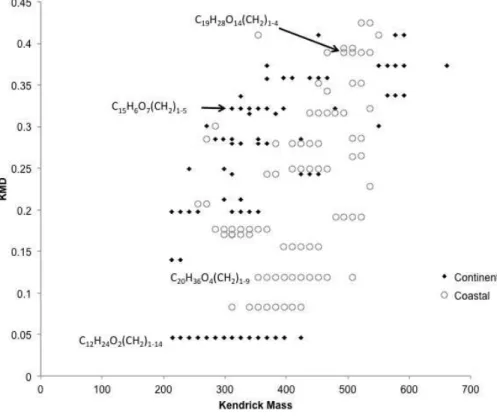
The van Krevelen plot of the unique formulas of continental and coastal storms revealed possible homologous sets or families of compounds that differ in mass by CH2 units (Fig. 1). These homologous series can be explored further by determining the Kendrick mass (KM) (Hughey et al., 2001; Kendrick, 1963). This is determined by taking the measured IUPAC mass and normalizing to 14.0000 u instead of the IUPAC 14.01565 u
15
as shown in Eq. (1).
KM=IUPAC mass measured
14.0000 14.01565
(1)
The Kendrick mass defect (KMD) can then be calculated using Eq. (2), which deter-mines the difference between the nominal mass and the Kendrick mass.
KMD=[NM−KM] (2)
20
ACPD
12, 31413–31438, 2012Insights into dissolved organic matter complexity
R. N. Mead et al.
Title Page
Abstract Introduction
Conclusions References
Tables Figures
◭ ◮
◭ ◮
Back Close
Full Screen / Esc
Printer-friendly Version Interactive Discussion
Discussion
P
a
per
|
Dis
cussion
P
a
per
|
Discussion
P
a
per
|
Discussio
n
P
a
per
|
within a homologous series is due to differences in CH2unit (Hsu et al., 1992).
z∗ =
modulus
NM 14
−14 (3)
Taking the unique assigned formulas and plotting the KMD vs. Kendrick mass of z∗=−10 reveals several homologous sets in the continental and coastal storms. The z∗
value of−10 was chosen for this study since this represents differences between
for-5
mulas of exactly 14 caused by addition of a CH2unit (Stenson et al., 2003b). Several homologous series are observed when plotting KMD vs. Kendrick mass for az∗of−10 that differ by CH2 units (Fig. 2). If a homologous set is considered to contain a min-imum of three formulas, as represented by a point, then the continental and coastal storms had 10 and 11 families respectively. Several series highlighted in Fig. 2 lie
10
within predetermined areas on the van Krevelen plot including cellulose (C20H30O14), char (C16H8O7) and lipid (C13H26O2) like materials. Of particular interest is the lipid-like component with assigned molecular formula C12H24O2(CH2)1−14 that was only de-tected in continental storms. All individual homologues in this family have a KMD of 0.04605 and a DBE of 1. One possible starting structure based upon this information
15
is tridecanoic acid (C13H26O2) with 1 DBE rendering the remainder of the homologue series tetradecanoic through heptacosanoic acid. This is the first time long chain fatty acids have been determined in rainwater, although linear acids with fewer than 5 car-bons have been observed previously (Avery et al., 2006a).
3.4 Oligomers
20
Recently it has been shown that esterification of small molecular weight acids (e.g., oxalic) andβ-hydroxy-acids produces oligomers detected in rain and fog waters (Altieri et al., 2009; Mazzoleni et al., 2010). The oligomer series begins by either radical or acid catalyzed esterification of an organic acid with a hydroxyacid with loss of water leading to the constant addition of C3H4O2. Some oligomers identified in this study
ACPD
12, 31413–31438, 2012Insights into dissolved organic matter complexity
R. N. Mead et al.
Title Page
Abstract Introduction
Conclusions References
Tables Figures
◭ ◮
◭ ◮
Back Close
Full Screen / Esc
Printer-friendly Version Interactive Discussion
Discussion
P
a
per
|
Dis
cussion
P
a
per
|
Discussion
P
a
per
|
Discussio
n
P
a
per
|
have been observed before in laboratory studies involving photo-oxidation of methyl-glyoxal and glycolaldehyde (Altieri et al., 2008; Perri et al., 2009). There were several oligomer series in this study that belong to families of mono- and dicarboxylic acids found in the common formula assignments for both continental and coastal waters (Table 2). The presence of these oligomers in both continental and coastal rainwater
5
samples suggests their widespread occurrence in atmospheric waters. Many of the same acids have been measured in precipitation collected at the same station as in this study (Avery et al., 2006a). The acids were detected year-round but varied by sea-son and trajectory. For example, formic acid has the highest annual volume-weighted concentration in precipitation and is the most abundant during the growing season in
10
precipitation originating from coastal and continental storms. However, in the current study, there was one oligomer series found only in coastal storms with a parent formula of glyoxylic acid (C2H2O3) and six additions of C3H4O2 to yield a final molecular for-mula assignment of C20H26O15. This oligomer has an H : C and O : C ratio of 1.3 and 0.75 respectively putting it in the cellulose portion of the van Krevelen plot (Fig. 1). The
15
location of this compound on the plot and the fact it was only detected in coastal storms suggest the DOM is relatively more oxidized than continental rainwater DOM.
3.5 Black carbon
Black carbon (BC) derived from combustion sources is an important component of the global carbon cycle that has been detected in a variety of environmental settings
20
including aerosols and ocean sediments (Goldberg, 1985; Chylek et al., 1999). An-nual atmospheric aerosol emissions of BC from biomass burning and fossil fuels are estimated at 3281 Gg yr−1 and 2710 Gg yr−1, respectively (Bond et al., 2004). Atmo-spheric BC is recognized as a potent chromophore, absorbing shortwave radiation and re-emitting this energy at longer wavelengths thereby warming the lower atmosphere
25
ACPD
12, 31413–31438, 2012Insights into dissolved organic matter complexity
R. N. Mead et al.
Title Page
Abstract Introduction
Conclusions References
Tables Figures
◭ ◮
◭ ◮
Back Close
Full Screen / Esc
Printer-friendly Version Interactive Discussion
Discussion
P
a
per
|
Dis
cussion
P
a
per
|
Discussion
P
a
per
|
Discussio
n
P
a
per
|
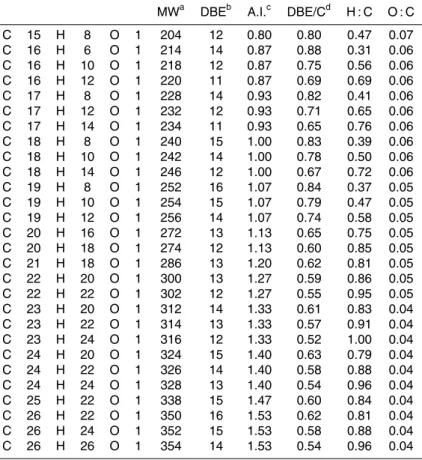
While BC has been observed in many environmental matrices, there are currently limited studies documenting its presence in rainwater (Chylek et al., 1999; Hadley and Kirchstetter, 2012). The van Krevelen diagram of unique assignments had molecu-lar formulas with elemental ratios typical of char- and coal-like material in continental storms (Fig. 1). The molecular formulas all had aromaticity index (AI) values greater
5
than 0.5 which can be classified as aromatic or condensed aromatic structures (Ta-ble 3) (Koch and Dittmar, 2006). Another proxy to further validate BC component is DBE/C ratio where a ratio greater than 0.7 indicates condensed aromatic structures (Hockaday et al., 2006). Approximately 40 % of the assigned formulas in this study were higher than the 0.7 threshold suggesting the presence of BC in continental
rain-10
water (Table 3).
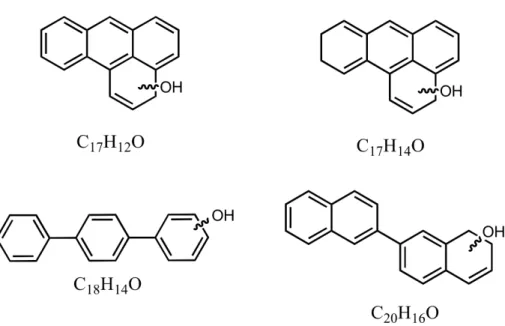
The BC assigned formulas in this study are all mono-oxygenated which is in stark contrast to BC identified in aquatic DOM and soils which are much more highly oxy-genated with carboxylic functional groups (Kramer et al., 2004; Kim et al., 2004). A phe-nol moiety is hypothesized as the functional group as opposed to an ether, because the
15
phenolic proton is slightly acidic making these compounds ionizable by (–) mode ESI. Potential structures of BC in rainwater are proposed in Fig. 3 for several formula assign-ments that were generated taking the unique assigned formulas and current knowledge regarding black carbon composition (Hockaday et al., 2006). The proposed structures were based upon the type and number of atoms present and further constrained by
20
the double bond equivalents. All proposed structures had aromatic moieties with one hydroxyl group whose position on the structure, given the possibility of isomers, is un-certain.
Unprocessed BC is emitted as particulate organic matter with very limited water solubility. The BC identified in this study is partially oxidized by atmospheric processes
25
ACPD
12, 31413–31438, 2012Insights into dissolved organic matter complexity
R. N. Mead et al.
Title Page
Abstract Introduction
Conclusions References
Tables Figures
◭ ◮
◭ ◮
Back Close
Full Screen / Esc
Printer-friendly Version Interactive Discussion
Discussion
P
a
per
|
Dis
cussion
P
a
per
|
Discussion
P
a
per
|
Discussio
n
P
a
per
|
sheds insight into the oxidation state of this material as it is scavenged by rain in the atmosphere.
4 Implications
Data presented in the current study represent the first detailed analysis of rain water dissolved organic matter by FTICR-MS collected on an event basis from a series of
5
continental and coastal storms. This study highlights the complexity of rainwater DOM where approximately 2000 CHO formulas were found in each trajectory class with the type and distribution of organics dependent on storm origin. Analysis of the unique assignments suggested distinct groupings of organic matter in continental and coastal storms in various bio- and geo-molecule classes such as lipids, amino sugars, proteins
10
and cellulose. This study highlights the variation in DOM composition between different air-mass back trajectories and greatly expands upon earlier rainwater FTICR-MS data where samples were pooled or were collected from a single storm type.
One interesting characteristic of rainwater DOM suggested by the data in Figs. 1 and 2 is that it does not closely resemble marine DOM with regards to molecular weight
15
range and complexity by other FTICR-MS studies (Sleighter and Hatcher, 2008). This dissimilarity sheds light on the uncertainty regarding the origin of humic-like substances (HULIS) in atmospheric waters. Earlier proposed sources of HULIS include biomass burning, secondary organic aerosols and marine sources (Mayol-Bracero et al., 2002; Hung et al., 2005; Cavalli et al., 2004).The marine sources of HULIS have been
hy-20
pothesized to originate from bubble bursting processes where marine water DOM is ejected into the atmosphere as a fine aerosol, which contributes 27 % HULIS to the water-soluble organic carbon fraction of a fine-mode marine aerosol (Cavalli et al., 2004). It should be noted that this earlier study was conducted on aerosols collected directly adjacent to the coast. The results of the current study suggest marine sources
25
ACPD
12, 31413–31438, 2012Insights into dissolved organic matter complexity
R. N. Mead et al.
Title Page
Abstract Introduction
Conclusions References
Tables Figures
◭ ◮
◭ ◮
Back Close
Full Screen / Esc
Printer-friendly Version Interactive Discussion
Discussion
P
a
per
|
Dis
cussion
P
a
per
|
Discussion
P
a
per
|
Discussio
n
P
a
per
|
marine origin rain collected at our coastal location approximately 10 km from the At-lantic Ocean.
Natural and anthropogenic impacts on the chemistry of atmospheric waters have been well documented, but this is the first study to characterize black carbon in rain-water at the molecular level. This has significant ramifications towards climate change,
5
because atmospheric BC is such a potent chromophore that reemits adsorbed sun-light at longer wavelengths thereby warming the lower atmosphere. Understanding the molecular level composition of black carbon is also important in determining its trans-formation in the lower atmosphere, because as BC is oxidized it becomes more hy-drophilic thus significantly shorting its lifetime via washout (McMeeking et al., 2011).
10
The processing of BC may accelerate in the future as potent oxidants such as hy-drogen peroxide increase in concentration due to the continued desulfurization of the atmosphere (Mullaugh et al., 2011). This in turn has significant implications towards climate prediction models especially as natural and anthropogenic emissions of black carbon change.
15
Supplementary material related to this article is available online at: http://www.atmos-chem-phys-discuss.net/12/31413/2012/
acpd-12-31413-2012-supplement.pdf.
Acknowledgements. This work was supported by National Science Foundation Grant AGS 1003078. We would like to thank the many students who assisted in the collection and
pro-20
cessing of rain samples. The authors gratefully acknowledge the NOAA Air Resources Labo-ratory (ARL) for the provision of the HYSPLIT transport and dispersion model and/or READY website (http://www.arl.noaa.gov/ready.php) used in this publication. The authors also gratefully acknowledge the National High Magnetic Field Laboratory, NSF Division of Materials research through DMR-06-54118 for FTICR-MS instrument time and data processing.
ACPD
12, 31413–31438, 2012Insights into dissolved organic matter complexity
R. N. Mead et al.
Title Page
Abstract Introduction
Conclusions References
Tables Figures
◭ ◮
◭ ◮
Back Close
Full Screen / Esc
Printer-friendly Version Interactive Discussion
Discussion
P
a
per
|
Dis
cussion
P
a
per
|
Discussion
P
a
per
|
Discussio
n
P
a
per
|
References
Altieri, K. E., Seitzinger, S. P., Carlton, A. G., Turpin, B. J., Klein, G. C., and Marshall, A. G.: Oligomers formed through in-cloud methylglyoxal reactions: chemical composition, proper-ties, and mechanisms investigated by ultra-high resolution FT-ICR mass spectrometry, At-mos. Environ., 42, 1476–1490, doi:10.1016/j.atmosenv.2007.11.015, 2008.
5
Altieri, K. E., Turpin, B. J., and Seitzinger, S. P.: Oligomers, organosulfates, and nitrooxy organosulfates in rainwater identified by ultra-high resolution electrospray ionization FT-ICR mass spectrometry, Atmos. Chem. Phys., 9, 2533–2542, doi:10.5194/acp-9-2533-2009, 2009.
Altieri, K. E., Hastings, M. G., Peters, A. J., and Sigman, D. M.: Molecular characterization
10
of water soluble organic nitrogen in marine rainwater by ultra-high resolution electrospray ionization mass spectrometry, Atmos. Chem. Phys., 12, 3557–3571, doi:10.5194/acp-12-3557-2012, 2012.
Avery, G. B., Kieber, R. J., Witt, M., and Willey, J. D.: Rainwater monocarboxylic and dicarboxylic acid concentrations in Southeastern North Carolina, USA, as a function of air-mass
back-15
trajectory, Atmos. Environ., 40, 1683–1693, doi:10.1016/j.atmosenv.2005.10.058, 2006a. Avery, G. B., Willey, J. D., and Kieber, R. J.: Carbon isotopic characterization of dissolved
or-ganic carbon in rainwater: terrestrial and marine influences, Atmos. Environ., 40, 7539–7545, doi:10.1016/j.atmosenv.2006.07.014, 2006b.
Blakney, G. T., Hendrickson, C. L., and Marshall, A. G.: Predator data station: a fast data
acqui-20
sition system for advanced FT-ICR MS experiments, Int. J. Mass. Spectrom., 306, 246–252, doi:10.1016/j.ijms.2011.03.009, 2011.
Bond, T. C., Streets, D. G., Yarber, K. F., Nelson, S. M., Woo, J.-H., and Klimont, Z.: A technology-based global inventory of black and organic carbon emissions from combus-tion, J. Geophys. Res., 109, D14203, doi:10.1029/2003jd003697, 2004.
25
Bostick, N. H. and Daws, T. A.: Relationships between data from Rock-Eval pyrolysis and prox-imate, ultprox-imate, petrographic, and physical analyses of 142 diverse US coal samples, Org. Geochem., 21, 35–49, doi:10.1016/0146-6380(94)90086-8, 1994.
Cavalli, F., Facchini, M. C., Decesari, S., Mircea, M., Emblico, L., Fuzzi, S., Ceburnis, D., Yoon, Y. J., O’Dowd, C. D., Putaud, J. P., and Dell’Acqua, A.: Advances in
characteriza-30
ACPD
12, 31413–31438, 2012Insights into dissolved organic matter complexity
R. N. Mead et al.
Title Page
Abstract Introduction
Conclusions References
Tables Figures
◭ ◮
◭ ◮
Back Close
Full Screen / Esc
Printer-friendly Version Interactive Discussion
Discussion
P
a
per
|
Dis
cussion
P
a
per
|
Discussion
P
a
per
|
Discussio
n
P
a
per
|
Chylek, P., Lesins, G. B., Videen, G., Wong, J. G. D., Pinnick, R. G., Ngo, D., and Klett, J. D.: Black carbon and absorption of solar radiation by clouds, J. Geophys. Res.-Atmos., 101, 23365–23371, doi:10.1029/96jd01901, 1996.
Chylek, P., Kou, L., Johnson, B., Boudala, F., and Lesins, G.: Black carbon concentrations in precipitation and near surface air in and near Halifax, Nova Scotia, Atmos. Environ., 33,
5
2269–2277, doi:10.1016/s1352-2310(98)00154-x, 1999.
Curiale, J. A. and Gibling, M. R.: Productivity control on oil shale formation – Mae Sot Basin, Thailand, Org. Geochem., 21, 67–89, doi:10.1016/0146-6380(94)90088-4, 1994.
Decesari, S., Facchini, M. C., Matta, E., Mircea, M., Fuzzi, S., Chughtai, A. R., and Smith, D. M.: Water soluble organic compounds formed by oxidation of soot, Atmos. Environ., 36, 1827–
10
1832, doi:10.1016/s1352-2310(02)00141-3, 2002.
Decesari, S., Facchini, M. C., Fuzzi, S., McFiggans, G. B., Coe, H., and Bower, K. N.: The water-soluble organic component of size-segregated aerosol, cloud water and wet depositions from Jeju Island during ACE-Asia, Atmos. Environ., 39, 211–222, doi:10.1016/j.atmosenv.2004.09.049, 2005.
15
Draxler, R. R. and Hess, G. D.: An overview of the Hysplit 4 modeling system for trajectories, dispersion, and deposition, Aust. Met. Mag., 47, 295–308, 1998.
Goldberg, E. D.: Black Carbon in the Environment: Properties and Distribution, Publisher John Wiley & Sons Inc; New York City, NY, 1985.
Hadley, O. L. and Kirchstetter, T. W.: Black-carbon reduction of snow albedo, Nat. Clim. Chang.,
20
2, 437–440, doi:10.1038/nclimate1433, 2012.
Hockaday, W. C., Grannas, A. M., Kim, S. K., and Hatcher, P. G.: Direct molecular evidence for the degradation and mobility of black carbon in soils from ultrahigh-resolution mass spectral analysis of dissolved organic matter from a fire-impacted forest soil, Org. Geochem., 37, 501–510, 2006.
25
Hsu, C. S., Qian, K. N., and Chen, Y. N. C.: An innovative approach to data analysis in hy-drocarbon characterization by online liquid chromatography mass spectrometry, Anal. Chim. Acta, 264, 79–89, doi:10.1016/0003-2670(92)85299-l, 1992.
Hughey, C. A., Hendrickson, C. L., Rodgers, R. P., Marshall, A. G., and Qian, K. N.: Kendrick mass defect spectrum: a compact visual analysis for ultrahigh-resolution broadband mass
30
spectra, Anal. Chem., 73, 4676–4681, doi:10.1021/ac010560w, 2001.
ACPD
12, 31413–31438, 2012Insights into dissolved organic matter complexity
R. N. Mead et al.
Title Page
Abstract Introduction
Conclusions References
Tables Figures
◭ ◮
◭ ◮
Back Close
Full Screen / Esc
Printer-friendly Version Interactive Discussion
Discussion
P
a
per
|
Dis
cussion
P
a
per
|
Discussion
P
a
per
|
Discussio
n
P
a
per
|
Jimenez, J. L., Canagaratna, M. R., Donahue, N. M., Prevot, A. S. H., Zhang, Q., Kroll, J. H., DeCarlo, P. F., Allan, J. D., Coe, H., Ng, N. L., Aiken, A. C., Docherty, K. S., Ulbrich, I. M., Grieshop, A. P., Robinson, A. L., Duplissy, J., Smith, J. D., Wilson, K. R., Lanz, V. A., Hueglin, C., Sun, Y. L., Tian, J., Laaksonen, A., Raatikainen, T., Rautiainen, J., Vaatto-vaara, P., Ehn, M., Kulmala, M., Tomlinson, J. M., Collins, D. R., Cubison, M. J., Dunlea, E. J.,
5
Huffman, J. A., Onasch, T. B., Alfarra, M. R., Williams, P. I., Bower, K., Kondo, Y., Schnei-der, J., Drewnick, F., Borrmann, S., Weimer, S., Demerjian, K., Salcedo, D., Cottrell, L., Grif-fin, R., Takami, A., Miyoshi, T., Hatakeyama, S., Shimono, A., Sun, J. Y., Zhang, Y. M., Dzepina, K., Kimmel, J. R., Sueper, D., Jayne, J. T., Herndon, S. C., Trimborn, A. M., Williams, L. R., Wood, E. C., Middlebrook, A. M., Kolb, C. E., Baltensperger, U., and
10
Worsnop, D. R.: Evolution of organic aerosols in the atmosphere, Science, 326, 1525–1529, doi:10.1126/science.1180353, 2009.
Kaiser, N., Quinn, J., Blakney, G., Hendrickson, C., and Marshall, A.: A novel 9.4 Tesla FTICR mass spectrometer with improved sensitivity, mass resolution, and mass range, J. Am. Soc. Mass Spectrom., 22, 1343–1351, doi:10.1007/s13361-011-0141-9, 2011.
15
Kendrick, E.: A mass scale based on CH2=14.0000 for high resolution mass spectrometry of organic compounds, Anal. Chem., 35, 2146–2154, doi:10.1021/ac60206a048, 1963. Kido Soule, M. C., Longnecker, K., Giovannoni, S. J., and Kujawinski, E. B.:
Im-pact of instrument and experiment parameters on reproducibility of ultrahigh resolu-tion ESI FT-ICR mass spectra of natural organic matter, Org. Geochem., 41, 725–733,
20
doi:10.1016/j.orggeochem.2010.05.017, 2010.
Kieber, R. J., Skrabal, S. A., Smith, B. J., and Willey, J. D.: Organic complexation of Fe(II) and its impact on the redox cycling of iron in rain, Environ. Sci. Technol., 39, 1576–1583, doi:10.1021/es040439h, 2005.
Kieber, R., Whitehead, R., Reid, S., Willey, J., and Seaton, P.: Chromophoric dissolved organic
25
matter (CDOM) in rainwater, Southeastern North Carolina, USA, J. Atmos. Chem., 54, 21– 41, doi:10.1007/s10874-005-9008-4, 2006a.
Kieber, R. J., Whitehead, R. F., Reid, S. N., Willey, J. D., and Seaton, P. J.: Chromophoric dissolved organic matter (CDOM) in rainwater, Southeastern North Carolina, USA, J. Atmos. Chem., 54, 21–41, doi:10.1007/s10874-005-9008-4, 2006b.
30
ACPD
12, 31413–31438, 2012Insights into dissolved organic matter complexity
R. N. Mead et al.
Title Page
Abstract Introduction
Conclusions References
Tables Figures
◭ ◮
◭ ◮
Back Close
Full Screen / Esc
Printer-friendly Version Interactive Discussion
Discussion
P
a
per
|
Dis
cussion
P
a
per
|
Discussion
P
a
per
|
Discussio
n
P
a
per
|
chromophoric dissolved organic matter (CDOM) in rainwater, Atmos. Environ., 50, 112–119, doi:10.1016/j.atmosenv.2011.12.054, 2012.
Kim, S., Kramer, R. W., and Hatcher, P. G.: Graphical method for analysis of ultrahigh-resolution broadband mass spectra of natural organic matter, the van Krevelen diagram, Anal. Chem., 75, 5336–5344, doi:10.1021/ac034415p, 2003.
5
Kim, S. W., Kaplan, L. A., Benner, R., and Hatcher, P. G.: Hydrogen-deficient molecules in natural riverine water samples – evidence for the existence of black carbon in DOM, Mar. Chem., 92, 225–234, doi:10.1016/j.marchem.2004.06.042, 2004.
Koch, B. P. and Dittmar, T.: From mass to structure: an aromaticity index for high-resolution mass data of natural organic matter, Rapid. Commun. Mass Sp., 20, 926–932,
10
doi:10.1002/Rcm.2386, 2006.
Kramer, R. W., Kujawinski, E. B., and Hatcher, P. G.: Identification of black carbon derived structures in a volcanic ash soil humic acid by Fourier transform ion cyclotron resonance mass spectrometry, Environ. Sci. Technol., 38, 3387–3395, doi:10.1021/Es030124m, 2004. Kujawinski, E. B. and Behn, M. D.: Automated analysis of electrospray ionization fourier
trans-15
form ion cyclotron resonance mass spectra of natural organic matter, Anal. Chem., 78, 4363– 4373, doi:10.1021/ac0600306, 2006.
Ledford Jr., E. B., Rempel, D. L., and Gross, M. L.: Space charge effects in Fourier transform mass spectrometry, mass calibration, Anal. Chem., 56, 2744–2748, 1984.
Majid, A., Sparks, B. D., and Ripmeester, J. A.: Characterization of solvent-insoluble organic
20
matter isolated from Alberta oil sands, Fuel, 70, 78–83, doi:10.1016/0016-2361(91)90098-u, 1991.
Mayol-Bracero, O. L., Guyon, P., Graham, B., Roberts, G., Andreae, M. O., Decesari, S., Fac-chini, M. C., Fuzzi, S., and Artaxo, P.: Water-soluble organic compounds in biomass burning aerosols over Amazonia 2, apportionment of the chemical composition and importance of
25
the polyacidic fraction, J. Geophys. Res., 107, 8091, doi:10.1029/2001jd000522, 2002. Mazzoleni, L. R., Ehrmann, B. M., Shen, X., Marshall, A. G., and Collett Jr., J. L.:
Water-soluble atmospheric organic matter in fog: exact masses and chemical formula identifica-tion by ultrahigh-resoluidentifica-tion Fourier transform ion cyclotron resonance mass spectrometry, Environ. Sci. Technol., 44, 3690–3697, doi:10.1021/es903409k, 2010.
30
ACPD
12, 31413–31438, 2012Insights into dissolved organic matter complexity
R. N. Mead et al.
Title Page
Abstract Introduction
Conclusions References
Tables Figures
◭ ◮
◭ ◮
Back Close
Full Screen / Esc
Printer-friendly Version Interactive Discussion
Discussion
P
a
per
|
Dis
cussion
P
a
per
|
Discussion
P
a
per
|
Discussio
n
P
a
per
|
Mesfioui, R., Love, N. G., Bronk, D. A., Mulholland, M. R., and Hatcher, P. G.: Reactivity and chemical characterization of effluent organic nitrogen from wastewater treatment plants de-termined by Fourier transform ion cyclotron resonance mass spectrometry, Water Res., 46, 622–634, doi:10.1016/j.watres.2011.11.022, 2012.
Miller, C., Gordon, K. G., Kieber, R. J., Willey, J. D., and Seaton, P. J.: Chemical
characteris-5
tics of chromophoric dissolved organic matter in rainwater, Atmos. Environ., 43, 2497–2502, doi:10.1016/j.atmosenv.2009.01.056, 2009.
Mullaugh, K. M., Kieber, R. J., Willey, J. D., and Avery, G. B.: Long-term temporal variability in hydrogen peroxide concentrations in Wilmington, North Carolina, USA rainwater, Environ. Sci. Technol., 45, 9538–9542, doi:10.1021/es202634s, 2011.
10
Muller, C. L., Baker, A., Hutchinson, R., Fairchild, I. J., and Kidd, C.: Analysis of rainwater dis-solved organic carbon compounds using fluorescence spectrophotometry, Atmos. Environ., 42, 8036–8045, doi:10.1016/j.atmosenv.2008.06.042, 2008.
Nizkorodov, S. A., Laskin, J., and Laskin, A.: Molecular chemistry of organic aerosols through the application of high resolution mass spectrometry, Phys. Chem. Chem. Phys., 13, 3612–
15
3629, doi:10.1039/c0cp02032j, 2011.
Perri, M. J., Seitzinger, S., and Turpin, B. J.: Secondary organic aerosol production from aque-ous photooxidation of glycolaldehyde: laboratory experiments, Atmos. Environ., 43, 1487– 1497, doi:10.1016/j.atmosenv.2008.11.037, 2009.
Podgorski, D. C., Hamdan, R., McKenna, A. M., Nyadong, L., Rodgers, R. P., Marshall, A. G.,
20
and Cooper, W. T.: Characterization of pyrogenic black carbon by desorption atmospheric pressure photoionization Fourier transform ion cyclotron resonance mass spectrometry, Anal. Chem., 84, 1281–1287, doi:10.1021/ac202166x, 2011.
Raymond, P. A.: The composition and transport of organic carbon in rainfall: insights from the natural (13C and 14C) isotopes of carbon, Geophys. Res. Lett., 32, 1–4,
25
doi:10.1029/2005gl022879, 2005.
Santos, P. S. M., Santos, E. B. H., and Duarte, A. C.: First spectroscopic study on the structural features of dissolved organic matter isolated from rainwater in different seasons, Sci. Total Environ., 426, 172–179, doi:10.1016/j.scitotenv.2012.03.023, 2012.
Seaton, P. J., Kieber, R. J., Willey, J. D., Avery, G. B., and Dixon, J. L.: Seasonal and
tem-30
ACPD
12, 31413–31438, 2012Insights into dissolved organic matter complexity
R. N. Mead et al.
Title Page
Abstract Introduction
Conclusions References
Tables Figures
◭ ◮
◭ ◮
Back Close
Full Screen / Esc
Printer-friendly Version Interactive Discussion
Discussion
P
a
per
|
Dis
cussion
P
a
per
|
Discussion
P
a
per
|
Discussio
n
P
a
per
|
Shi, S. D. H., Drader, J. J., Freitas, M. A., Hendrickson, C. L., and Marshall, A. G.: Comparison and interconversion of the two most common frequency-to-mass calibration functions for Fourier transform ion cyclotron resonance mass spectrometry, Int. J. Mass Spectrom., 196, 591–598, 2000.
Sleighter, R. L. and Hatcher, P. G.: Molecular characterization of dissolved organic matter
5
(DOM) along a river to ocean transect of the lower Chesapeake Bay by ultrahigh resolu-tion electrospray ionizaresolu-tion Fourier transform ion cyclotron resonance mass spectrometry, Mar. Chem., 110, 140–152, 2008.
Southwell, M. W., Smith, J. D., Avery, G. B., Kieber, R. J., and Willey, J. D.: Seasonal variability of formaldehyde production from photolysis of rainwater dissolved organic carbon, Atmos.
10
Environ., 44, 3638–3643, doi:10.1016/j.atmosenv.2010.06.044, 2010.
Stenson, A. C., Marshall, A. G., and Cooper, W. T.: Exact masses and chemical formulas of individual Suwannee River fulvic acids from ultrahigh resolution electrospray ionization Fourier transform ion cyclotron resonance mass spectra, Anal. Chem., 75, 1275–1284, doi:10.1021/ac026106p, 2003.
15
Tolmachev, A. V., Robinson, E. W., Wu, S., Kang, H., Lourette, N. M., Pasa-Tolic, L., and Smith, R. D.: Trapped-ion cell with improved DC potential harmonicity for FT-ICR MS, J. Am. Soc. Mass Spectrom., 19, 586–597, doi:10.1016/j.jasms.2008.01.006, 2008.
Walker, J. T., Aneja, V. P., and Dickey, D. A.: Atmospheric transport and wet deposition of ammonium in North Carolina, Atmos. Environ., 34, 3407–3418,
doi:10.1016/s1352-20
2310(99)00499-9, 2000.
Willey, J. D., Kieber, R. J., Eyman, M. S., and Avery, G. B.: Rainwater dissolved or-ganic carbon: concentrations and global flux, Global Biogeochem. Cy., 14, 139–148, doi:10.1029/1999gb900036, 2000.
Willey, J., Kieber, R., and Yavari, J.: Fe(II) in coastal rainwater: changing stability and
concen-25
trations, Aquat. Sci., 71, 144–150, doi:10.1007/s00027-009-9176-4, 2009.
Wu, Z., Rodgers, R. P., and Marshall, A. G.: Two- and three-dimensional van Krevelen di-agrams: a graphical analysis complementary to the Kendrick mass plot for sorting ele-mental compositions of complex organic mixtures based on ultrahigh-resolution broadband Fourier transform ion cyclotron resonance mass measurements, Anal. Chem., 76, 2511–
30
ACPD
12, 31413–31438, 2012Insights into dissolved organic matter complexity
R. N. Mead et al.
Title Page
Abstract Introduction
Conclusions References
Tables Figures
◭ ◮
◭ ◮
Back Close
Full Screen / Esc
Printer-friendly Version Interactive Discussion
Discussion
P
a
per
|
Dis
cussion
P
a
per
|
Discussion
P
a
per
|
Discussio
n
P
a
per
|
Table 1.Total assigned CHO formulas, unique formulas to each storm type and % unique of total assigned CHO formulas for the rain events analyzed during this study.
Storm Total Assigned Unique % Unique Unique Unique Unique Type CHO Formulas Formulas Formula Mean±(SD) Mean±(SD) Mean MW
H : C O : C
ACPD
12, 31413–31438, 2012Insights into dissolved organic matter complexity
R. N. Mead et al.
Title Page
Abstract Introduction
Conclusions References
Tables Figures
◭ ◮
◭ ◮
Back Close
Full Screen / Esc
Printer-friendly Version Interactive Discussion
Discussion
P
a
per
|
Dis
cussion
P
a
per
|
Discussion
P
a
per
|
Discussio
n
P
a
per
|
Table 2.Parent acid and C3H4O2oligomer series detected in all continental and coastal storms. Each addition of C3H4O2to the parent acid is denoted by corresponding number (n) and results in a loss of water.
Parent Acid Number (n) of C3H4O2additions
ACPD
12, 31413–31438, 2012Insights into dissolved organic matter complexity
R. N. Mead et al.
Title Page
Abstract Introduction
Conclusions References
Tables Figures
◭ ◮
◭ ◮
Back Close
Full Screen / Esc
Printer-friendly Version Interactive Discussion
Discussion
P
a
per
|
Dis
cussion
P
a
per
|
Discussion
P
a
per
|
Discussio
n
P
a
per
|
Table 3.Proposed neutral molecular formulas of the black carbon (BC) compounds.
MWa DBEb A.I.c DBE/Cd H : C O : C
C 15 H 8 O 1 204 12 0.80 0.80 0.47 0.07 C 16 H 6 O 1 214 14 0.87 0.88 0.31 0.06 C 16 H 10 O 1 218 12 0.87 0.75 0.56 0.06 C 16 H 12 O 1 220 11 0.87 0.69 0.69 0.06 C 17 H 8 O 1 228 14 0.93 0.82 0.41 0.06 C 17 H 12 O 1 232 12 0.93 0.71 0.65 0.06 C 17 H 14 O 1 234 11 0.93 0.65 0.76 0.06 C 18 H 8 O 1 240 15 1.00 0.83 0.39 0.06 C 18 H 10 O 1 242 14 1.00 0.78 0.50 0.06 C 18 H 14 O 1 246 12 1.00 0.67 0.72 0.06 C 19 H 8 O 1 252 16 1.07 0.84 0.37 0.05 C 19 H 10 O 1 254 15 1.07 0.79 0.47 0.05 C 19 H 12 O 1 256 14 1.07 0.74 0.58 0.05 C 20 H 16 O 1 272 13 1.13 0.65 0.75 0.05 C 20 H 18 O 1 274 12 1.13 0.60 0.85 0.05 C 21 H 18 O 1 286 13 1.20 0.62 0.81 0.05 C 22 H 20 O 1 300 13 1.27 0.59 0.86 0.05 C 22 H 22 O 1 302 12 1.27 0.55 0.95 0.05 C 23 H 20 O 1 312 14 1.33 0.61 0.83 0.04 C 23 H 22 O 1 314 13 1.33 0.57 0.91 0.04 C 23 H 24 O 1 316 12 1.33 0.52 1.00 0.04 C 24 H 20 O 1 324 15 1.40 0.63 0.79 0.04 C 24 H 22 O 1 326 14 1.40 0.58 0.88 0.04 C 24 H 24 O 1 328 13 1.40 0.54 0.96 0.04 C 25 H 22 O 1 338 15 1.47 0.60 0.84 0.04 C 26 H 22 O 1 350 16 1.53 0.62 0.81 0.04 C 26 H 24 O 1 352 15 1.53 0.58 0.88 0.04 C 26 H 26 O 1 354 14 1.53 0.54 0.96 0.04
aMolecular weight calculated using the average atomic weight of the atoms in the assigned
molecular formulas.
bDouble bond equivalents is a measure of the number of rings and double bonds calculated
using the equation in the text.
ACPD
12, 31413–31438, 2012Insights into dissolved organic matter complexity
R. N. Mead et al.
Title Page
Abstract Introduction
Conclusions References
Tables Figures
◭ ◮
◭ ◮
Back Close
Full Screen / Esc
Printer-friendly Version Interactive Discussion
Discussion
P
a
per
|
Dis
cussion
P
a
per
|
Discussion
P
a
per
|
Discussio
n
P
a
per
|
Fig. 1. Van Krevelen plot of unique assigned formulas containing CHO in continental and
coastal storms. The indicated areas are based upon earlier literature descriptions (Kim et al., 2003). AS represents amino sugars.
ACPD
12, 31413–31438, 2012Insights into dissolved organic matter complexity
R. N. Mead et al.
Title Page
Abstract Introduction
Conclusions References
Tables Figures
◭ ◮
◭ ◮
Back Close
Full Screen / Esc
Printer-friendly Version Interactive Discussion
Discussion
P
a
per
|
Dis
cussion
P
a
per
|
Discussion
P
a
per
|
Discussio
n
P
a
per
|
Fig. 2.Kendrick mass plot of neutral unique molecular formulas normalized to CH2 for con-tinental and coastal storms. Horizontal lines with the same Kendrick mass defect represent molecular formula families that increase by one methylene unit.
ACPD
12, 31413–31438, 2012Insights into dissolved organic matter complexity
R. N. Mead et al.
Title Page
Abstract Introduction
Conclusions References
Tables Figures
◭ ◮
◭ ◮
Back Close
Full Screen / Esc
Printer-friendly Version Interactive Discussion
Discussion
P
a
per
|
Dis
cussion
P
a
per
|
Discussion
P
a
per
|
Discussio
n
P
a
per
|
Fig. 3.Proposed black carbon structures based upon the assigned molecular formulas. The position of the hydroxyl group is uncertain as indicated by the wavy bond on the structure.