RESEARCH ARTICLE
Wood Usage and Fire Veneration in the
Pamir, Xinjiang, 2500 yr BP
Hui Shen1,2, Xinhua Wu3, Zihua Tang4, Xinying Zhou1, Nan Sun5, Xiaoqiang Li1*
1Key Laboratory of Vertebrate Evolution and Human Origin of Chinese Academy of Sciences, Institute of Vertebrate Paleontology and Paleoanthropology, Chinese Academy of Sciences, Beijing, China,
2Department of Earth Science, University of Chinese Academy of Sciences, Beijing, China,3The Institute of Archaeology, Chinese Academy of Social Sciences, Beijing, China,4Key laboratory of Cenozoic Geology and Environment, Institute of Geology and Geophysics, Chinese Academy of Sciences, Beijing, China,
5Department of earth science and resources, Chang’an University, Shaanxi, China
Abstract
Located on the Pamir Plateau in Xinjiang Province, China, the Ji’erzankale Necropolis dates back to 2500 yr BP. Many materials that have been unearthed in this cemetery, including shoo konghou (musical instrument), bronze mirrors and glass beads, suggest cultural transference between East and West. Furthermore, small-sized and rounded fire altars made from sweet-scentedSabinawere found for the first time and regarded as im-plements for fire veneration. We identified 70 wooden objects from 25 tombs within the Necropolis, and found that each object had been made from one of seven tree species. Analysis revealed that the inhabitants of the region mainly used the most widely available types of wood, namelyBetulaandPopulus. People also specifically chose inflammable Populuswood to make hearth boards and hand drills (both are used for making fire by dril-ling), rigidBetulawood to craft wooden plates.Salixwas used for fashioning wooden sticks, while sweet-scentedSabinawas the preferred choice for making fire altars.Lonicerawas selected for arrow shaft manufacture andFraxinus syriaca, which has a beautiful grain, was chosen for making musical instruments. Conscious selection of different types of wood indicates that people of the Pamir Plateau were aware of the properties of various types of timbers, and were able to exploit these properties to the full. In turn, this demonstrates their wisdom and their ability to survive in, and adapt to, their local environment.
Introduction
The Pamir Plateau is situated in an arid region of central Asia. Since the late Stone Age, this area has been a cultural crossroad [1,2]. Around 3500 yr BP, the Pamir was influenced by the Andronovo culture which was then widespread in Siberia and central Asia. After that, a series of exotic religions, including Zoroastrianism, Buddhism, Nestorianism and Islam, spread to this region [3,4]. Furthermore, opening of the southern route of the Silk Road led to more fre-quent and varied cultural exchanges. Merchants, tourists, monks, and ambassadors from
OPEN ACCESS
Citation:Shen H, Wu X, Tang Z, Zhou X, Sun N, Li X (2015) Wood Usage and Fire Veneration in the Pamir, Xinjiang, 2500 yr BP. PLoS ONE 10(8): e0134847. doi:10.1371/journal.pone.0134847
Editor:Liping Zhu, Institute of Tibetan Plateau Research, CHINA
Received:March 7, 2015
Accepted:July 15, 2015
Published:August 26, 2015
Copyright:© 2015 Shen et al. This is an open access article distributed under the terms of the Creative Commons Attribution License, which permits unrestricted use, distribution, and reproduction in any medium, provided the original author and source are credited.
Data Availability Statement:All relevant data are within the paper and its Supporting Information files.
Funding:This study was supported by the National Natural Science Foundation of China (grant nos. 41172161, XL and 41371003, XZ [http://www.973. gov.cn/]) and the National Basic Research Program of China (grant no. 2015CB953803, XL [http://www. nsfc.gov.cn/]). The funders had no role in study design, data collection and analysis, decision to publish, or preparation of the manuscript.
various civilizations all introduced to the Pamir their own cultures, which later spread to, inter-acted with and integrated into central China to the east, Mesopotamia to the west, the Indus Valley to the south and Semiryechye to the north [5]. Therefore, this region is an ideal place for research into cultural transmission.
According to stone inscriptions from Naqsh-e Rustam in Persia, the majority of the Pamir population 2000 years ago belonged to the Saka [6], a nomadic people who left little in the way of a permanent cultural layer due to their itinerant lifestyle. Their tombs therefore provide vital clues regarding their social life, culture, religion and environmental adaptability [6]. However, knowledge of these questions remains sketchy and reliant on secondary historical documents because of the paucity of relevant archaeological sites [6,7]. The Ji’erzankale Necropolis in Tashkurgan County is located in the interior of the Pamir Plateau, and many objects have been unearthed from this site. Among these remains, wooden objects provided direct evidence of palaeovegetation and resource exploitation.
In addition, fire altars with rounded shape were unearthed for the first time [3]. Black com-bustion marks were clear in the inwall and inside of it, 15 stones with black burning traces on the surface were placed [3]. This burning feature showed that they were on fire when buried near the dead and thus provided important clues bearing on early forms of burial custom and belief [3]. Abundant bamboo combs, glass beads, and tin and bronze mirrors shed light on the intercultural exchanges that were characteristic of this region.
Early peoples were invariably dependent for their survival on the local environment, and especially on the use of timber. Evidence of timber use is often well-preserved in archaeological sites [8–10]. Under conditions of incomplete burning, and/or in dry or waterlogged environ-ments in which microorganic activity is weak, wood can keep its anatomical structure [11,12]. Integrated identification and study of wood and charcoal found in archaeological sites started at the end of the last century. As a primary plant record, preserved wood provides important clues that are helpful in reconstructing palaeovegetation and revealing how local residents used wood and interacted with their local environment [13–15].
In this paper, we studied a total of 70 wood samples unearthed from the Ji’erzankale Necropo-lis, identifying them taxonomically and analyzing their properties in order to reveal the burial customs and patterns of plant utilization of the people lived in Pamir Plateau 2500 yr BP. We also attempted to shed light on the cultural communications between East and West at that time.
Materials and Methods
In 2013 and 2014, Ji’erzankale Necropolis was unearthed by the Xinjiang Archaeological Team of the Chinese Academy of Social Sciences directed by Prof. Wu (the second author of this paper). This project was authorized by the State Administration of Cultural Heritage with archaeological excavation license number 349 (2014). In regard to sampling method, we took a small piece of sample from each woodware for identifying, avoiding damaging to these objects. Subsequently, boiling test was used for some rigid samples for softening purpose, with permis-sion of the Xinjiang Archaeological Team of the Chinese Academy of Social Sciences.
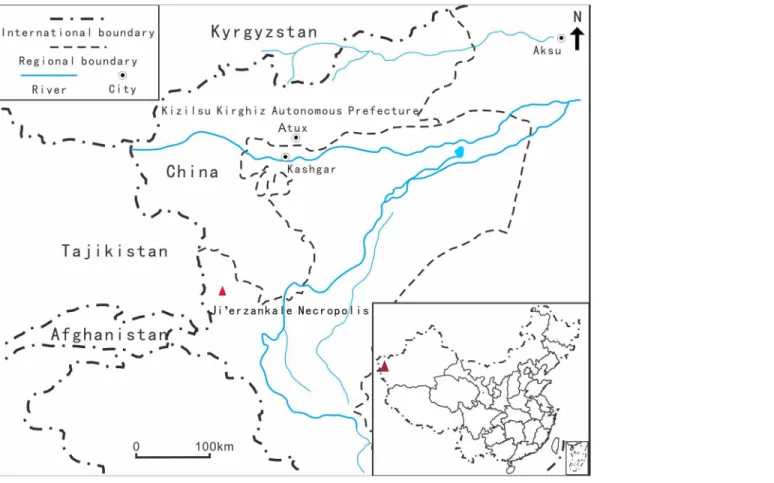
The Ji’erzankale Necropolis is located in Qushiman Village, Tashkurgan Tajik Autonomous County, Xinjiang (75°12'11", 37°50'54") (Fig 1). This region lies in the southwestern part of Xinjiang, east Pamir Plateau, north of the Karakoram, and west of the Tarim Basin. The mean annual temperature is 3.6°C, mean annual precipitation is<70mm, and mean annual
evapora-tion can reach 2300mm. It is thus a cold, dry, high-radiaevapora-tion climate [16].
graves and built on bedrock or gravel layer in flood plain. On the basis of human bone study, both primary and secondary burial existed [3]. Apart from graves with human corpse, some tombs like M4 were only buried with hawk cranium [3]. Abundant pottery items, stone tools, copper objects, ironware, wooden items, bone objects, glass beads, and a variety of other arte-facts were found during this process [3]. AMS14C Beta Analytic dating of two wood samples, representing an arrow shaft from M14 and a fire altar from M15, yielded respective dates of 2750–2710 yr BP and 2540–2355 yr BP showed inTable 1. The dates show that the Ji’erzankale Necropolis is about 2500 years old.
For this paper, we studied a total of 70 selected wooden objects from 25 tombs within the Necropolis, including 11 fire altars (Fig 3A and 3B), 8 arrow shafts (Fig 3C), 4 hand drills (Fig 3D and 3E), 3 hearth boards (Fig 3D and 3F), 3 wooden sticks, 30 wooden plates (Fig 3G), 6 woodwares, 2 pieces of shoo konghou (Fig 3H), 1 harp, 1 crutch and 1 wooden bowl (full details inS1 Table). About a volume of 4 cm3samples were taken from each wood object for identification. Because some samples were highly rigid, hydrothermal softening was used in the laboratory tests [17]. First, we put them into beakers full of boiled water, and applied heat con-tinuously for 24 hours. Second, we cut a transverse section through the softened wood, after drying, and examined the section through a microscope in order to arrive at a preliminary identification for the sample. Third, three sections (transverse, radial and tangential) were handmade and then metal-sprayed to allow clear images to be captured using a scanning elec-tron microscope (ZEISS MA EVO25). Fourth, we identified the species of wood, based on the arrangement, shape and size of the pipes or tracheids, the presence or absence of resin canal in
Fig 1. Location of Ji’erzankale Necropolis.The red triangle represents the Ji’erzankale Necropolis site. doi:10.1371/journal.pone.0134847.g001
the transverse section, the height and width of woodray on the surface of the tangential section, the arrangement of the pits in the walls of the pipes or tracheids, and the pattern of ray paren-chyma cells and cross-field pitting in the joint ray and tracheid cell walls in the radial section. Identifications were made using standard reference works [18–21].
Results
The 70 objects considered in this study were categorized with respect to both object type and the taxonomic identity showed inTable 2. All taxonomic identifications are based on anatomi-cal features visible in the transverse, radial and tangential sections. Four samples, representing two wooden plates from tombs M22 and M24, one wooden bowl from M33, and one fire altar from M35, could not be identified because of deformation of the wood-ray parenchyma exposed in the transverse section.
Sabina
sp.
In transverse section, pores in early wood are rounded, quadrate and polygonal, whereas pores in late wood are oblong and polygonal. The transition from early wood to late wood is gradual.
Fig 2. Photograph of Ji’erzankale Necropolis.Tombs were surrounded by stone circles and a large area of black and white stones was laid on the surface. doi:10.1371/journal.pone.0134847.g002
Table 1. Accelerator mass spectrometry (AMS) radiocarbon dates from the Ji’erzankale Necropolis.
Tomb.no use Lab.no Sample type δ13C AMS age(BP) Calibrated age (cal BP,2σ)
M14 arrow shaft Beta-400296 wood -21.7 2570±30 2750–2700
M15 fire altar Beta-400297 wood -22.3 2430±30 2540–2355
Fig 3. Photographs of wooden objects from Ji’erzankale Necropolis.(a)Top view of fire altar; (b) Front view of fire altar; (c) Arrow shaft; (d) Hearth board and hand drill; (e) Hand drill; (f) Hearth board; (g) Top view of wooden plate; (h) Top view of shoo konghou.
doi:10.1371/journal.pone.0134847.g003
Pits are single-row and rounded or oval. Cross-field pits are cupressoid. Pore walls have warty layers. Thread-thickening is absent. Rays are uniseriate and approximately 10 cells in height. Resin canals are absent (Fig 4A and 4B).
Populus
sp.
Growth rings are moderately distinct, and the transition from early wood to late wood is grad-ual. Vessels are rounded or oval in transverse section and mostly occur in radial multiples of 2–5, with a either clustered or solitary. Perforations are simple in slight-oblique end walls. Inter-vessel pits are rounded or oval, and included. Axial parenchyma is rare. Most of the rays are uniseriate, and the majority of them are 10–18 cells in height. Spiral thickening is absent (Fig 4C and 4D).
Betula
sp.
Growth rings are distinct and the wood is diffuse porous. Pores are mostly solitary, but a few occur in radial multiples or clusters. Vessels are rounded or oval in transverse section. Perfora-tions are scalar form and oblique. Inter-vessel pits are oval. Radial parenchyma is rare or termi-nal. Wood rays are uniseriate with a height of 3–10 cells, or multiseriate with a width of 2–3 cells and a height of about 20 cells. Heterocellular and homocellular rays coexist (Fig 4E and 4F).
Salix
sp.
Growth rings are moderately distinct and the wood is diffused porous. Pores are mostly soli-tary, but a few occur in radial multiples or clusters. Vessels are oval or elliptical in transverse section. Perforations are simple in slight-oblique to oblique end walls, and inter-vessel pits are alternate and mainly polygonal. Axial parenchyma is rare. Rays are heterocellular and uniseri-ate, with a height of about 10 cells. Spiral thickening is absent (Fig 4G and 4H).
Lonicera
sp.
Growth rings are distinct. Vessels in transverse sections are diffuse and pores are mostly soli-tary, with a few in radial multiples of 2–3. Perforations are mostly simple in very oblique end walls. Inter-vessel pits are alternate to opposite, and are rounded, polygonal or oblong. Rays
Table 2. The use and species of wood found in Ji’erzankale Necropolis.
Sabinasp. Populussp. Betulasp. Salixsp. Lonicerasp. Elaeagnus angustifolia Fraxinus syriaca unidentified
fire altar 3 1 6 1
wooden plate 8 19 1 2
hearth board 1 2
hand drill 2 2
arrow shaft 8
wooden stick 3
woodware 1 3 1 1
shoo konghou 1 1
harp 1
crutch 1
wooden bowl 1
total 4 15 28 8 8 1 2 4
are 1-3(4) seriate, with a height of about 10–20 cells. Spiral thickening appears on the wall of vessels (Fig 4I and 4J).
Elaegnus angustifocia
Growth rings are distinct. Early wood vessels are solitary, in tangential to radial multiples of 2–4, or in small clusters, and are rounded in transverse section. Late wood vessels, by contrast, are rounded to angular. Perforations are simple in oblique to transverse end walls. Rays are homocellular, and composed of procumbent cells. Uniseriate rays are usually 2–10 cells high,
Fig 4. Microphotographs of archaeological wood from Ji’erzankale Necropolis.(a)Sabina, transverse section; (b)Sabina, radial section; (c)Populus, transverse section; (d)Populus, radial section; (e)Betula, transverse section; (f)Betula, radial section; (g)Salix, transverse section; (h)Salix, radial section; (i)Lonicera, transverse section; (j)Lonicera, radial section; (k)Elaeagnus angustifolia, transverse section; (l)Fraxinus syriaca, transverse section.
doi:10.1371/journal.pone.0134847.g004
and multiseriate rays are 2–5 cells wide and up to 35(58) cells high. Crystal is not observed (Fig 4K).
Fraxinus syriaca
Growth rings are distinct. Vessels are usually solitary, in radial multiples of 2-3(4) or rarely in small clusters. The vessels are rounded in cross-section. Perforations are simple in horizontal to oblique end walls. Parenchyma is vasicentric in the early wood, but aliform and confluent in the end of growth ring. Rays are homocellular, 1–4 cells wide, and usually 3–10 cells high. Crys-tal is not observed (Fig 4L).
Looking at our 70 wooden remains, we found that a total of seven species (28Betulasp., 15
Populussp., 8Salixsp., 8Lonicerasp.,4 Sabinasp., 2Fraxinus syriaca, and 1Elaegnus angusti-focia) were selected and utilized by the early residents of the Pamir Plateau. The timber from different trees was worked in different ways and for a range of purposes, including the produc-tion of fire altars for fire veneraproduc-tion, wooden plates for holding produce, and wood sticks and arrow shafts for protection. Among the selected trees,BetulaandPopuluswere widely used, wood from one of these taxa having been used to manufacture 61% of the objects.Sabina, Frax-inus syriaca, andElaegnus angustifociawere used less often, and account for a total of 10% of the objects.SalixandLonicera, were each used to produce 11% of the objects (Fig 5). For indi-vidual tombs, we analyzed the tombs M14, M23 and M25 as these three tombs yielded the most wooden objects. Eleven objects made from four species of wood (in this caseBetula,
Populus,Salix, andLonicera) were found in M14, while six objects made from two species were found in M23 and six objects made from four species were found in M25. This analysis revealed that people used a wide range of available local resources, rather than just selecting one kind of timber.Vis-à-visthe different timbers used to manufacture objects of specific types, the fire altars investigated in the analysis were made fromBetula,Populus, orSabina, with one fire altar made from unidentified wood. Wooden plates were made fromBetula,
PopulusorSalix, with two from unidentified wood, and hearth boards were crafted from
SabinaorPopulus. Hand drills were made fromPopulusorSalix. All eight arrow shafts were fromLonicera, whereas the three wooden sticks and one crutch were manufactured fromSalix. The three musical instruments were made fromFraxinus syriacaorPopulus.
Fig 5. Percentage of different wood species from Ji’erzankale Necropolis.Betulasp. is the most species with percentage of 40%, whilePopulussp. (21%),Salixsp. (11%),Lonicerasp. (11%), unidentified (7%), Sabinesp. (6%),Fraxinus syriaca(3%),Elaeagnus angustifol(1%).
Discussion
The wooden remains unearthed in archaeological sites provide direct proof of the utilization of different timber types by ancient peoples. They also shed light upon tribal, cultural, religious and human activity, and provide evidence of ancient humans’adaptation to, and influence on, the local environment [22,23]. In addition, wooden remains play a vital role in the reconstruc-tion of fire [14,15,24], vegetation[8,9,25] and palaeoclimate histories [13,26].
Obviously, fire use is inseparable from a dependence on local timber. The criteria governing the selection by indigenous peoples of particular wood types have long been debated, and can be summarized thus: 1) function,e.g. pine was widely used for funerary pyre in three prehis-toric necropolises from Poland, possible in part because pine can release a turpentine perfume while burning [27]; 2) availability, as more widely-distributed species will clearly be selected and used more often than less readily available ones according to the Principle of Least Effort [28,29]; and 3) symbolism,e.g. mango and sandalwood are regarded as sacred by the Aryans in India because of their sacred association and often used on special occasions such as cremation and sacrifice[30], and in fact are still used by Buddhists in Bangladesh when building cremation pyres [31].
Alpine desert vegetation dominated byCeratoides compactaandArtemisia rhodanthais found in the dry, high-altitude Tashkurgan area [32]. Alpine cushion-like vegetation and alpine desert steppe are also present. In flood plains,CaprifoliaceaeandRosaceaeshrubs are common, whileHippophaer hamnoidesL.,Salix dasycladosandSalix carmanicaare the dominant species in river valleys. With the increase of altitude, fruticous desert dominated byephedra, alpine desert consist ofSeriphidiumand alpine steppe composed ofstipaare in belt shaped distribu-tion. Above the alpine steppe, alpine swamp and meadow can be found in small area [33]. Natural forest in mountainous regions is composed principally ofSabina chinensis,Picea schrenkianaandBetula[33,34].
At the Ji’erzankale Necropolis, the timber came from taxa includingSabinasp.,Populussp.,
Betulasp.,Salixsp.,Lonicerasp.,Elaeagnus angustifoliaandFraxinus syriaca, mainly the com-mon woody plants in the Pamir region. Local residents appear to have chosen timber based upon its immediate availability in the harsh environment of this dry, high-altitude plateau, and to have adapted their needs to the particular characteristics of these local woods rather than ranging more widely in order to find other timber.
Properties such as density, intensity, rigidity, inflammability, and corrosion resistance usually represent significant criteria in wood selection. In general, the higher the density, the higher pyroconductivity, which means that denser wood, is more difficult to ignite (requiring a greater specific heat and longer ignition time) than lighter timber andvice versa[35–37]. Popu-lushas a relatively low density, and is thus easy to ignite [18].Salixis characterized by abun-dant and coriaceous straight-grained branches with high impact resistance and considerable elasticity. Being hard to crack after drying, it is suitable as a material for stick-shaped objects such as sports mallets and shoulder poles [18].Sabinahas a fine structure, oblique texture and low tensile strength, and releases a full-bodied turpentine perfume odour upon burning [18,38].Betulapossesses a straight-grained, homogeneous structure, relatively high rigidity and intensity, a high density, and low inflammability [18].Fraxinus syriacahas a beautiful grain and is easy to process.Lonicerais notable for its high rigidity and numerous, straight branches.
At the Ji’erzankale Necropolis, relatively inflammablePopuluswas frequently selected for hearth board and hand drill manufacture. The three wooden sticks from the M14 tomb are all
Salix. This wood was most likely used for its abundance of tough branches, which do not usu-ally deform after drying. Combined with its durability over time, this property makesSalix
excellent for stick manufacture.Betula,PopulusandSabinawere selected for the 11 fire altars.
Betulamay have been preferred for the manufacture of wooden objects since it was the com-monest species in the Tashkurgan region.Populuscan be ignited easily and so is an obvious choice for the manufacture of objects intended to be burned. As forSabinaused for making fire altar the smell released by this wood as it burns makes it useful during particular rites. In New Zealand and Melanesia, sandalwood, mango, wood-apple and juniper, which are all per-fumed, were used to obscure the smell of burning corpses [39,40].Sabinamay well have been chosen, therefore, for its tendency to produce a full-bodied turpentine smell.
Most (19) of the 30 wooden plates excavated at the site were made fromBetula. The high rigidity and density of this wood, as well as its homogeneous texture, all make it suitable for the manufacture of objects for holding produce.
Ancient peoples knew that arrow shafts needed to be made from wood with a high rigidity. One famous example was brought to light by one German couple who found the Ötzi‘Iceman’
(ca. 5300 yr BP) in Italy. For the shafts of his arrows, the iceman chose the wood of the com-mon wayfaring tree (Viburnum lantana), whose rigidity makes it superior for that purpose to any other wood type indigenous to the region. Only one of his 14 arrows did he make use of a second-best material, namely the wood of the cornel tree (Cornussp.)[41]. The eight arrow shafts found at the Ji’erzankale Necropolis were all ofLonicera, which has straight branches and high rigidity. The abundance of branches with an even diameter of 1–2 cm makes it partic-ularly easy to produce arrow shafts by simply wiping off the rhytidome and soft bark.Lonicera
is therefore an ideal material and was widely used throughout the Pamir for making arrow shafts.
The shoo konghou originated in Egypt (where it was called the harp) and West Asia (the Assyrians called it Cank). Painted wooden figurines playing harps were buried in Pharaoh’s tomb, 3000 BC [42]. Six konghous were found in Zagunluk and Yanghai graveyard, Xinjiang, in 1996 and 2004 [43,44]. The resonating chambers of these six instruments were all made fromPopulus euphratica. The two konghous recovered from the Ji’erzankale Necropolis were made fromPopulusandFraxinus syriaca. One harp was fromFraxinus syriaca.Populuswas probably selected for the purpose of making instruments because of its high availability, whereas the beautiful grain ofFraxinus syriacamade it highly suitable for musical instrument manufacture. The konghou was transmitted from West Asia to the Western Regions and then to Central China. Evidence from the Ji’erzankale Necropolis showed that this distinctive musi-cal instrument had been transported as far as western China by 2500 years ago.
Among the seven types of timber found in the Ji’erzankale Necropolis,SabinaandBetula
and considerable elasticity, was used for making sticks and crutches.Fraxinus syriaca, which has a beautiful grain, was often chosen for crafting musical instruments.
Besides an integrated analysis of wood usage, some valuable information of burial custom was also revealed by fire altars. They were placed in this cemetery along with the dead as burial objects with 15 stones inside. The diameter of central burning hole is less than 15 cm (one object is only 7 cm), and all of them were made from inflammable timber rather than some fireproof materials like stone, crockery, or bronze (all were found in this cemetery). In addition,Sabina
is rare in Tashkurgan region as only 4Sabinaobjects were found in our total 70 samples and among the fourSabina, three were used for fire altar making, one for hearth board crafting. The small size and conscious selection ofSabinawood probably gave an implication that they were not used as ordinary practical brazier for warming purpose but some extraordinary appliances with symbolic meaning. In conclusion, fire played an important role in funerary and veneration of fire, presumably, was prevalent among the peoples lived in Pamir region 2500 years ago.
In the light of current archaeological evidence from central Asia, fire veneration was preva-lent among the Scythians and Persians. They regarded fire as sacred and offered sacrifices to it [6,45]. Veneration of fire was clearly also practiced by the Zoroastrian [46,47]. For them, fire is sacred and regarded as a means to communicate with the divinityĀtar who lived among men as their servant and master [48–51]. Therefore, fire was present at their religious ceremonies and sacrificial fire objects were buried with the dead [51–54]. According to the integrated study of excavated 50 tombs, secondary burial of corpse after a transitory exposure in air and fire altar showing veneration of fire revealed that the influence of Zoroastrianism may have reached the Tashkurgan region where was regarded as an important culture crossroad between West and East.
Conclusion
The wood used to manufacture various objects found in the Ji’erzankale Necropolis came from seven plant taxa:Betulasp.,Populussp.,Salixsp.,Sabinasp.,Lonicerasp.,Fraxinus syriacaand
Elaeagnus angustifolia. These represent the principal locally occurring trees and shrubs. On the one hand, people largely used the widely distributedBetulaandPopulus. On the other hand, they made more selective and specific use ofPopulusfor hand drills and hearth boards,Betula
for wooden plates,Sabinafor fire altars,Lonicerafor arrow shafts,Salixfor wooden sticks and crutches, andFraxinus syriacafor musical instruments. Conscious selection of given wood types for particular purposes indicated that the early residents of the Pamir Plateau made full use of the available timber and were adept at crafting objects out of wood in a manner that took into account the properties of specific types of timber. This highlights their sophistication and ability to adapt to the local environment. Fire veneration revealed by small-sized and rounded fire altars made from aromaticSabina, as well as the secondary burial after a short-time exposure implied Tashkurgan region which was characteristic of culture transmission between East and West, may have been influenced by Zoroastrianism 2500 years ago.
Supporting Information
S1 Table. Full details of the wood objects from Ji’erzankale Necropolis.
(XLSX)
Acknowledgments
Jing Wu and Liangliang Wei are warmly acknowledged for assistance in the field. Thanks also to Edward Derbyshire and Corwin Sullivan for linguistic correction of the manuscript.
Author Contributions
Conceived and designed the experiments: HS NS XZ. Performed the experiments: HS NS. Ana-lyzed the data: XL HS. Contributed reagents/materials/analysis tools: XW ZT. Wrote the paper: HS XL. Archaeological excavation: ZT XW.
References
1. Liu XT. Toward the cultural communication between East and West during the Stone Age. Journal of Xinjiang Normal University (Social Sciences). 2012; 33:47–56.
2. Hou YM. Shuidonggou: A vane of intercommunication between the East and the West? Discussion about small tool culture in north China and a hypothesis of the Lithic Road. Quaternary Sciences. 2005; 25: 750–761.
3. Wu XH. Archaeological excavation of Ji'erzankale necropolis in Tashkurghan, Xinjiang, 2013. The Western Regions Studies. 2014; 4: 36–46.
4. Li JX. Religion research in Silk Road. Urumqi: Xinjiang People’s Publishing House; 2009.
5. Wu Y. Bronze Age cultural of Xiabandi tomb in Kashgar, Xinjiang. The Western Regions Studies. 2012; 4: 36–46.
6. Wang ZL. General history of central Asia. Urumqi: Xinjiang People’s Publishing House; 2007.
7. Stausberg M. On the state and prospects of the study of Zoroastrianism. Numen. 2008; 55: 561–600.
8. Li XQ, Sun N, Dodson J, Zhou XY. Human activity and its impact on the landscape at the Xishanping site in the western Loess Plateau during 4800–4300 cal yr BP based on the fossil charcoal record. Jour-nal of Archaeological Science. 2012; 39: 3141–3147.
9. Sun N, Li XQ, Dodson J, Zhou XY, Zhao KL, Yang Q. Plant diversity of the Tianshui Basin in the west-ern Loess Plateau during the mid-Holocene–Charcoal records from archaeological sites. Quaternary International. 2013; 308–309: 27–35.
10. Wang SZ. Brief history of wood remains in archaeological sites. Southern Heritage. 2011; 1: 156–162.
11. Carcaillet C. Charred particles analyses. Encyclopedia of Quaternary Science. 2007; 1582–1593.
12. McGinnes E Jr, Szopa P, Phelps J. Use of scanning electron microscopy in studies of wood charcoal formation. Chicago: Inst; 1974.
13. Figueiral I, Carcaillet C. A review of Late Pleistocene and Holocene biogeography of highland Mediter-ranean pines (Pinus type sylvestris) in Portugal, based on wood charcoal. Quaternary Science Reviews. 2005; 24: 2466–2476.
14. Scott AC, Damblon F. Charcoal: Taphonomy and significance in geology, botany and archaeology. Palaeogeography, Palaeoclimatology, Palaeoecology. 2010; 291: 1–10.
15. Scott AC. Charcoal recognition, taphonomy and uses in palaeoenvironmental analysis. Palaeogeogra-phy, Palaeoclimatology, Palaeoecology. 2010; 291: 11–39.
16. Yang SP, Xu HY, Yan P. Floristic Elements of Seed Plants in the Pamirs Region of China. Chinese Bul-letin of Botany. 2007; 24: 597–602.
17. Cao SQ. Softening method and bending technique. Technology. 2006; 26–28.
18. Cheng JQ, Yang JJ, Liu P. Atlas of Wood in China. Beijing: China Forestry Publishing House; 1992.
19. Zhou Q, Jiang XM. Wood anatomy and ultrastructure of gymnospermous woods in China. Beijing: China Forestry Publishing House; 1994.
20. Fahn A, Werker E. Wood anatomy and identification of trees and shrubs from Israel and adjacent regions. Jerusalem: The Israel Academy of Sciences and Humanities; 1986.
21. Xu F. Anatomical figures for wood identification. Beijing: Chemical industry press; 2008.
22. Deforce K, Haneca K. Ashes to ashes. Fuelwood selection in Roman cremation rituals in northern Gaul. Journal of Archaeological Science. 2012; 39: 1338–1348.
23. Deforce K, Haneca K. Tree-ring analysis of archaeological charcoal as a tool to identify past woodland management: The case from a 14th century site from Oudenaarde (Belgium). Quaternary International. 2014; 1–11.
24. Pessenda LCR, Gouveia SEM, Aravena R, Boulet R, Valencia EPE. Holocene fire and vegetation changes in southeastern Brazil as deduced from fossil charcoal and soil carbon isotopes. Quaternary International. 2004; 114: 35–43.
26. Cope MJ, Chaloner WG. Fossil Charcoal as Evidence of Past Atmospheric Composition. Nature. 1980; 283: 647–649.
27. Moskal-del Hoyo M. The use of wood in funerary pyres: random gathering or special selection of spe-cies? Case study of three necropolises from Poland. Journal of Archaeological Science. 2012; 39: 3386–3395.
28. Prior J, Price Williams D. An investigation of climatic change in the holocene epoch using archaeolog-ical charcoal from Swaziland, Southern Africa. Journal of Archaeologarchaeolog-ical Science. 1985; 12: 457–475.
29. Shackleton CM, Prins F. Charcoal analysis and the“Principle of least effort”—A conceptual model. Journal of Archaeological Science. 1992; 19: 631–637.
30. Upadhyaya KD. Indian botanical folk lore. Asian Folk lore Studies. 1964; 23: 15–34.
31. Barua DK. Funeral rituals of Buddhist in Bangladesh. Journal of Indian and Buddhist Studies. 2003; 51: 1017–1021.
32. Zhang XS. China's vegetation and its geographical pattern. Beijing: Geological Publishing House; 2007.
33. Xinjiang integrated Expedition Team and Institute of Botany CASS. Vegetation and its utilization in Xin-jiang. Beijing: Science Press; 1978.
34. Guo K, Zheng D. Regional differentiation of vegetation on the west Kunlun, the west Karakorum, and the north- west Himalaya and the implication for the ecological environment. Acta Phytoecologica Sinica. 2002; 26(1): 17–22.
35. Hollman JR. Ignition characteristics of plastics and rubber, Ph.D. Dissertation. Norman: Univ. of Okla-homa; 1971.
36. Lawson D, Simms D. The ignition of wood by radiation. British Journal of Applied Physics. 1952; 3: 288–292.
37. Wu YZ, Toshiro H. Study on the Burning Behaviour of Plantation Wood. Scientia Silvae Sinicae. 2004; 40: 131–136.
38. Editorial Board of“flora of china”CAS. Flora of China. Beijing: Science Press; 2004.
39. Malanggan KS. Art, Memory and Sacrifice. Berg: Oxford; 2002.
40. Williams HMR. Death warmed up: the agency of bodies and bones in Early Anglo-Saxon cremation rites. Journal of Material Culture. 2004; 9: 263–291.
41. Bortenschlager S, Oeggl K. The Iceman and his Natural Environment. Wien: Springer-Verlag; 2000.
42. Lin MC. Fifteen lectures on archaeology of the Silk Roads by Lin Meicun. Beijing: Peking University Press; 2006.
43. Academia Turfanica, Xinjiang and Xinjiang institute of Culture Relics and Archaeology. Excavation on the Yanghai cemetery in Shanshan (Pian) country, Xinjiang. Acta Archaeologica Sinica. 2011; 1: 99– 150.
44. He ZL. Shape origin of the relic harp of Uigur area. Musicology in China. 2006; 1: 43–52.
45. Herodotus. History (Chinese Translation, 1985 version). Beijing: Commercial Press; 1985.
46. Han X. Exotic religion in Tang dynasty and civilization of central Asia. Journal of Shanghai Normal Uni-versity. 2006; 35: 57–62.
47. Mary B. On the orthodoxy of Sasanian Zoroastrianism. London: Cambridge University Press; 2013.
48. Li JX. The transmission of Zoroastrianism in Xinjiang and its regional character. The Western Regions Studies. 2007; 1: 81–87.
49. Zhou JB. Zoroastrianism civilization in the Western Region. North West Ethno-national Studies. 1991; 1: 115–125.
50. Mary B. On the Zoroastrian temple cult of fire. Journal of the American Oriental Society. 1975; 95(3): 454–465.
51. Mary B. Zoroastrians: Their religious beliefs and practices. London: Routledge & Kegan Paul Ltd; 1979.
52. Lin MC. The first transmission of Zoroastrianism in China from archaeological evidence. The Western Regions Studies. 1996; 4: 54–60.
53. Wang BH. Brief report on the excavation of Alagou tomb in Xinjiang. Cultural Relics. 1981; 1:18–23.
54. Yang JX. Silk Road. Lanzhou: Gansu People’s Publishing House; 1988.