Journal of Science and Technology
ISSN 1905-7873Available online at www.mijst.mju.ac.th
Report
Phenological observation and population dynamics of six
uncommon medicinal plants in the grasslands of Nilgiris,
Western Ghats, India
Duraisamy Suresh and Subramaniam Paulsamy*
Post Graduate and Research Department of Botany, Kongunadu Arts and Science College, Coimbatore-641 029, India
* Corresponding author, e-mail: [email protected]
Received: 5 August 2009 / Accepted: 9 May 2010 / Published: 11 May 2010
Abstract: Phenological observation and a population density study for six uncommon medicinal plant species were made in four grasslands in Nilgiri Biosphere Reserve, Western Ghats, viz. Thiashola, Korakundah, Ebbenadu and Wenlockdown, at monthly intervals from April 2007 to March 2008. The six plant species were Anaphalis elliptica DC. (Compositae), Ceropegia pusilla Wight & Arn. (Asclepiadaceae), Hedyotis articularis R. Br. ex G. Don (Rubiaceae), Heracleum rigens Walli. ex DC. (Umbelliferae), Leucas vestita Benth. (Lamiaceae) and Luzula campestris (L.) DC. (Juncaceae). Generally, all six species exhibited peak bud formation between February and May and bud break in June. Most of the leaves were produced in a single flush. Leaf expansion continued up to August in L. vestita. Flowering phenophase was observed from July to October, but in A. elliptica it extended to December. The active period of fruit formation occurred during August to December for all species except A. elliptica, which was during January and February. Seed maturation and seed dispersal happened during December - February for all the species except A. elliptica which happened during May-June. The study of population dynamics shows that there was a net decrease in the population of
A. elliptica, L. vestita and L. campestris over a period of one year at Korakundah, Ebbenadu and Wenlockdown grasslands. C. pusilla, H. articularis and H. rigens maintained their populations at the same level in the respective grasslands without any major change during the study period.
Introduction
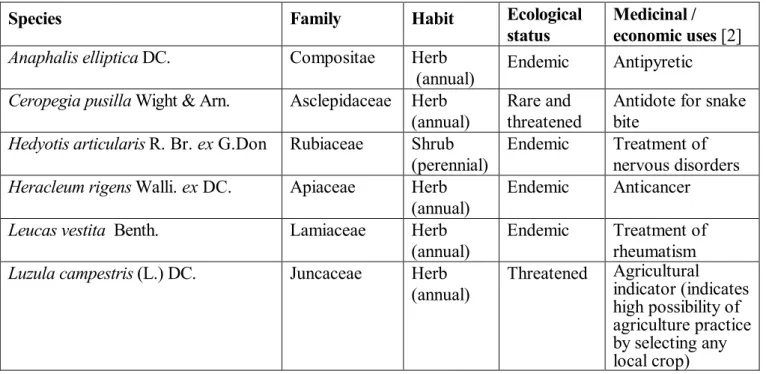
Plants respond biologically to various parameters in the holocoenotic environment [1]. Besides this, many extrinsic factors, e.g. the time of phenophase and seed dispersal, are very important in distribution, survival and success in the establishment of a species in the community. Considering these facts, it is known that phenological studies are important for the conservation of genetic resources and forest management as well as for a better understanding of ecological capabilities of plant species and community-level interactions. Another important attribute which decides the establishment of a species is population size. This is regulated by an array of environmental factors. In this study we have observed the times of phenophase and determined the influence of environmental variables on the population density of six uncommon medicinal plants in four grasslands in Nilgiri Biosphere Reserve, Western Ghats. These are Anaphalis elliptica, Ceropegia pusilla, Hedyotis articularis, Heracleum rigens, Leucas vestita and Luzula campestris. Since no attempts have been made in the conservation of these six species in these grasslands, they have been selected for this study. The ecological and medicinal characters of these species are given in Table 1.
Table 1. Ecological and medicinal attributes of the six studied species
Species Family Habit Ecological
status Medicinal / economic uses [2]
Anaphalis elliptica DC. Compositae Herb
(annual) Endemic Antipyretic
Ceropegia pusilla Wight & Arn. Asclepidaceae Herb
(annual) Rare and threatened Antidote for snake bite
Hedyotis articularis R. Br. ex G.Don Rubiaceae Shrub
(perennial) Endemic Treatment of nervous disorders
Heracleum rigens Walli. ex DC. Apiaceae Herb
(annual) Endemic Anticancer
Leucas vestita Benth. Lamiaceae Herb
(annual) Endemic Treatment of rheumatism
Luzula campestris (L.) DC. Juncaceae Herb
(annual) Threatened Agricultural indicator (indicates high possibility of agriculture practice by selecting any local crop)
Methods of Observation
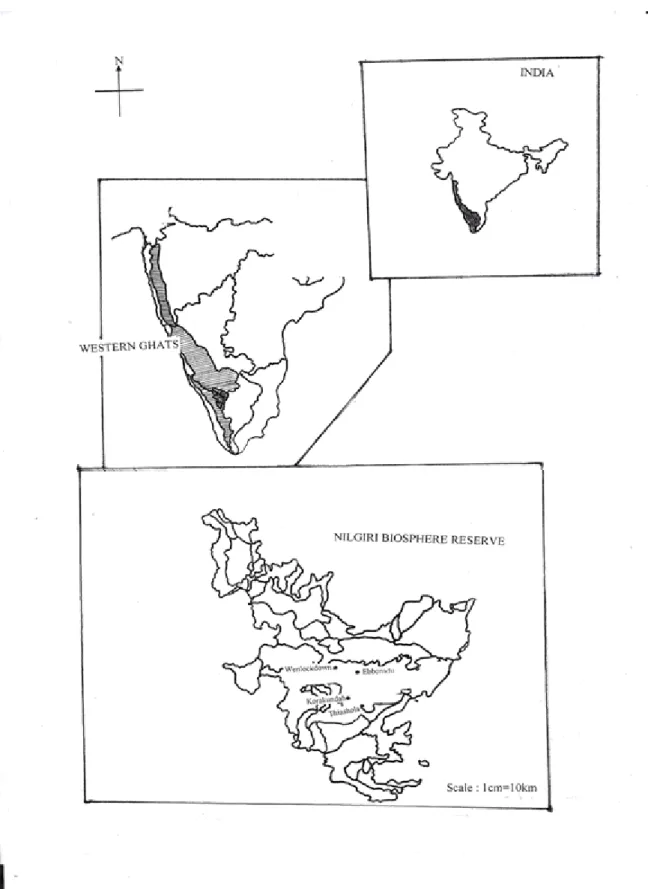
(Figure 1) and under uniform macroclimatic conditions (1560-mm annual rainfall and temperature between 5C during January and 26C during April : Table 2), the phenological observations were made at only one grassland where the species was present. The associated species in the plots were generally grasses with a few dicot herbs. When a phenophase was noticed in about 10% of individuals under observation, it was considered to be initiated and considered at a peak when it occurred in more than 80% of individuals. The phenograms were drawn according to phenophases which occurred in more than 80% of individuals following the methodology of Lodhiyal et al [3].
The study on population density and the results were expressed in a 100-m2 scale. In the grasslands of the species occurrence, five 1-m2 quadrats were made. In the case of adults, each plant with a height of 30 cm was considered as an individual. For the study of seedling population, seedling cohorts were marked in each of the quadrats in April 2007 and February 2008. Individuals arising from seeds were marked with dots of different colours. The survival of adults and seedlings were recorded at monthly intervals.
Results and Discussion
Phenological observations of bud formation, vegetative growth, flowering, fruiting, seed maturity and seed dispersal for each species are presented in Figure 2. Generally, for all species studied, bud formation occurred during February and May. For Anaphalis elliptica and Leucas vestita
Table 2. Climate in the study area
Year and month
Temperature
(°C) Rainfall (mm) No. of Rainy days
Relative humidity
(%) Max. Min.
2007 Apr May Jun Jul Aug Sep Oct Nov Dec 2008 Jan Feb Mar Apr 26.1 25.3 22.8 21.5 19.4 21.8 16.9 16.6 15.3 14.6 15.6 16.8 21.9 15.6 17.6 17.6 16.8 17.4 16.6 15.8 15.6 9.8 5.3 11.7 13.1 14.7 25 68 212 210 161 86 298 240 82 0 51 85 42 7 6 15 14 13 15 19 13 4 0 7 11 6 95 94 90 95 95 94 97 96 92 85 78 75 83
Data Source: Government Meteorological Station, Ootacamund, the Nilgiris
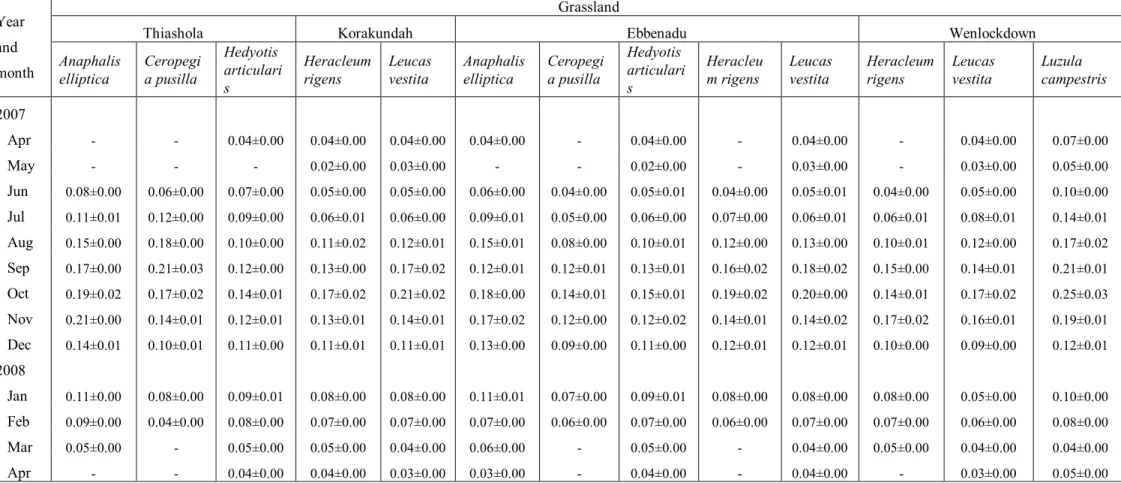
Variation in population density of the six species is presented in Table 3. Anaphalis elliptica
and Ceropegia pusilla, which were only present in Thiashola and Ebbenadu grasslands varied between 0.03 (in Ebbenadu during April 2008) and 0.21/m2 (in Thiashola during November 2007), and 0.04 (in both Ebbenadu and Thiashola during June and February) and 0.21/m2 (in Thiashola during September, 2007). Hedyotis articularis, which was present in Thiashola, Korakundah and Ebbenadu grasslands, had population density variations between 0.02 (during May, 2007 in Korakundah and Ebbenadu) and 0.17/m2 (during October, 2007 in Korakundah). The species density of Heracleum
Figure 2. Phenograms for the six uncommon medicinal plant species studied
Phenophases 1. Budding
2. Vegetative growth (stem and leaves) 3. Flowering
Table 3. Population density (individuals/m2) of the six species studied in the four grasslands
Year and month
Grassland
Thiashola Korakundah Ebbenadu Wenlockdown
Anaphalis
elliptica Ceropegia pusilla
Hedyotis articulari s
Heracleum
rigens Leucas vestita Anaphalis elliptica Ceropegia pusilla
Hedyotis articulari s
Heracleu
m rigens Leucas vestita Heracleum rigens Leucas vestita Luzula campestris
2007
Apr - - 0.04±0.00 0.04±0.00 0.04±0.00 0.04±0.00 - 0.04±0.00 - 0.04±0.00 - 0.04±0.00 0.07±0.00
May - - - 0.02±0.00 0.03±0.00 - - 0.02±0.00 - 0.03±0.00 - 0.03±0.00 0.05±0.00
Jun 0.08±0.00 0.06±0.00 0.07±0.00 0.05±0.00 0.05±0.00 0.06±0.00 0.04±0.00 0.05±0.01 0.04±0.00 0.05±0.01 0.04±0.00 0.05±0.00 0.10±0.00
Jul 0.11±0.01 0.12±0.00 0.09±0.00 0.06±0.01 0.06±0.00 0.09±0.01 0.05±0.00 0.06±0.00 0.07±0.00 0.06±0.01 0.06±0.01 0.08±0.01 0.14±0.01
Aug 0.15±0.00 0.18±0.00 0.10±0.00 0.11±0.02 0.12±0.01 0.15±0.01 0.08±0.00 0.10±0.01 0.12±0.00 0.13±0.00 0.10±0.01 0.12±0.00 0.17±0.02
Sep 0.17±0.00 0.21±0.03 0.12±0.00 0.13±0.00 0.17±0.02 0.12±0.01 0.12±0.01 0.13±0.01 0.16±0.02 0.18±0.02 0.15±0.00 0.14±0.01 0.21±0.01
Oct 0.19±0.02 0.17±0.02 0.14±0.01 0.17±0.02 0.21±0.02 0.18±0.00 0.14±0.01 0.15±0.01 0.19±0.02 0.20±0.00 0.14±0.01 0.17±0.02 0.25±0.03
Nov 0.21±0.00 0.14±0.01 0.12±0.01 0.13±0.01 0.14±0.01 0.17±0.02 0.12±0.00 0.12±0.02 0.14±0.01 0.14±0.02 0.17±0.02 0.16±0.01 0.19±0.01
Dec 0.14±0.01 0.10±0.01 0.11±0.00 0.11±0.01 0.11±0.01 0.13±0.00 0.09±0.00 0.11±0.00 0.12±0.01 0.12±0.01 0.10±0.00 0.09±0.00 0.12±0.01
2008
Jan 0.11±0.00 0.08±0.00 0.09±0.01 0.08±0.00 0.08±0.00 0.11±0.01 0.07±0.00 0.09±0.01 0.08±0.00 0.08±0.00 0.08±0.00 0.05±0.00 0.10±0.00
Feb 0.09±0.00 0.04±0.00 0.08±0.00 0.07±0.00 0.07±0.00 0.07±0.00 0.06±0.00 0.07±0.00 0.06±0.00 0.07±0.00 0.07±0.00 0.06±0.00 0.08±0.00
Mar 0.05±0.00 - 0.05±0.00 0.05±0.00 0.04±0.00 0.06±0.00 - 0.05±0.00 - 0.04±0.00 0.05±0.00 0.04±0.00 0.04±0.00
Apr - - 0.04±0.00 0.04±0.00 0.03±0.00 0.03±0.00 - 0.04±0.00 - 0.04±0.00 - 0.03±0.00 0.05±0.00
Recommendations
Based on the results of this study it is suggested that the seeds of all six species be collected and kept in cold storage until the next growing season. These seeds can be air sown in the grasslands to augment population levels. To confirm this concept, experiments on seed germination as influenced by cold storage must be conducted.
References
1. R. C. Sundriyal, A. P. Joshi and R. Dhasimana, “Phenology of high altitude plants at Tungnath in the Garhwal Himalaya”, Trop. Ecol., 1987, 28, 289-299.
2. J. K. Maheshwari, “Ethnobotany and Medicinal Plants of Indian Subcontinent”, Scientific Pablishers, Jodhpur (India), 2000.
3. L .S. Lodhiyal, S. P. Singh and N. Lodhiyal, “Phenology, population structure and dynamics of Ringal bamboo (Arundinaria falcata) in Nainital Hill of Central Himalaya”, Trop. Ecol., 1998,
39, 109-115.
4. S. F. Oberbauer and W. D. Billings, “Drought tolerance and water use by plants along an alpe topographic gradient”, Oecologia (Berlin), 1981, 50, 325-331.
5. A. A. Lindsey and J. E. Newman, “Use of the official weather data in spring time-temperature analysis of an Indian phenological record”, Ecology, 1956, 37, 812-823.
6. W. D. Billings and H. A. Mooney, “The ecology of arctic and alpine plants”, Biol. Rev., 1968, 43, 481-529.
7. B. A. Auld and P. M. Martin, “The autecology of Eupatorium adenophorum Spreng, in Australia”, Weed Res., 1975, 15, 27-31.
8. D. Senthilkumar, “Ecological status of weeds in the understorey of three different habitats in Topslip of Anaimalais, the Western Ghats, India”, PhD. Thesis, 2000, Bharathiar University, Coimbatore, India.
9. S. Padmavathy, “Ecological investigations for the identification of plants of conservation importance in the understories of certain shola forests at Manjur, the Nilgiris, Western Ghats, India”, PhD. Thesis, 2005, Bharathiar University, Coimbatore, India.
10. J. G. Holway and R. T. Ward, “Phenology and alpine plants in Northern Colorado”, Ecology,
1965, 46, 73-83.
11. S. S. Parihar, P. Agarwal and Vinodshankar, “Seed production and seed germination in blue panic grass (Panicum antidotale Retz.)”, Trop. Ecol., 1999, 40, 75-78.
12. R. S. Tripathi and R. P. Dwivedi, “On the dynamics and regulation of population with special reference to plants”, in “Glimpses of Ecology” (Ed. J. S. Singh and B. Gopal), International Scientific Publications, Jaipur (India), 1978, pp. 425-437.