Networking Education for the New Economy
Robert P. Minch and Sharon W. Tabor
Boise State University , Boise, Idaho USA
[email protected] [email protected]
Executive Summary
Universities face two important challenges in educating the IT workers of tomorrow. First, aside from occasional economic downturns, the number of graduates in programs such as computer science and management information systems has been inadequate to meet worldwide industry demand. Second, teaching methods have been slow to evolve to meet the needs of students and employers in a modern knowledge society. These challenges are particularly difficult in specialized fields of IT that combine rapid technological change with growing industry demand, such as networking/telecommunications and electronic commerce. As part of an economic recovery process, organizations of all sizes typically in-crease their dependency on technology and electronic business transactions. Recovery means they will again be looking for qualified people to fill positions such as network managers, Web administrators, e-Commerce developers, and security specialists.
This paper relates one university’s experiences in addressing technical complexity by increasing the ex-periential learning component in each of their major courses, while still delivering a quality business education. A new major in Networking and Telecommunications was developed at Boise State Univer-sity in the College of Business in 2000 that strives to combine a solid foundation in core business courses, the technical theory important to understanding complex networking environments, and hands-on experiences that reinforce theory and bring it to life. A cornersthands-one of the experiential learning ap-proach is an upper division elective course that runs BSU.net, a fully functional Internet Service Pro-vider, continuously operating since 1996. This non-traditional, semi-structured course gives students the opportunity to apply technical skills along with business decision- making related to the application of technology, and the real world requirement of supporting live customers.
Additionally, the authors present a summary of the foundation literature on the benefits of experiential learning, highlight the efforts of other universities to include experiential learning in their curriculums, and offer a set of criteria for universities who seek answers to the challenges of offering a combined business and technical curriculum. With this challenging methodology, universities can attract students to technical programs and better prepare them with the education and experience to qualify for and suc-ceed in rapidly changing technical positions.
Keywords: curriculum development, networking and telecommunications, hands-on learning, experien-tial learning, business education.
Introduction
The demand for qualified IT workers rose steadily over the last decade and is likely to become strong again as the global economy recovers from the current recession. Two specific areas where de-mand for talent has been consistently growing are those of networking/telecommunications and e-Commerce. This demand is a worldwide phe-nomenon, with technology-based regions such as
Southeast Asia banding together to form a National Information Infrastructure plan (Bui, 1997). Organi-zations of all sizes are increasing their dependency on technology and electronic transactions, moving toward what Straub and Watson (2001) call the network-enabled organization (NEO). The infrastructure that supports this trend requires technical talent to fill positions such as network managers, Web admin-istrators, e-Commerce developers, and security specialists. Universities, on the other hand, face impor-tant challenges in educating the IT workers of tomorrow in these highly technical fields. Even with in-creasing enrollments, the number of graduates in computer science and information systems has been inadequate to meet worldwide industry demand (West and Bogumil, 2001), and our teaching methods have not evolved to meet the needs of students and employers in these rapidly changing technical fields (Laurillard, 2002). We face additional challenges in curriculum design with the changing student popu-lation. Stein and Craig (2000) note that the “dot.com generation” enters the university with an intensive education in technology (p.220). Their experiences in Australian universities reveal that incoming stu-dents exhibit increased computer knowledge, have more confidence in their skills, and use IT applica-tions more extensively than prior generaapplica-tions (Stein and Craig, 2000).
Boise State University, located in a growing high-tech area of the U.S., has embarked on a program to meet these challenges that might be used as a model for other universities or university-industry partne r-ships. To enhance our business curriculum and better meet industry demand we developed and imple-mented a new degree program in Networking and Telecommunications (NTCOMM) in the spring of 2000. Housed in a College of Business, but with a technical emphasis, the program’s goal is to produce graduates who are not only technically proficient, but who understand the diverse business functions and organizational drivers that dictate technical solutions. The program builds upon and extends the value of a traditional university education.
To address the problem of teaching methods not meeting the needs of students and employers, we cre-ated a dynamic learning environment that integrates theory with practice and supports technical concepts with hands-on experience. Designed to maximize the hands-on experience, all NTCOMM classes at BSU are taught in our new Networking and Telecommunications Teaching Lab, sponsored in part by a grant from the Micron Technology Foundation. Thirty individual PCs with flat-screen monitors, dozens of project systems with swappable hard drives, rack-mounted class servers, and a large collection of network devices and management systems give students many opportunities to learn the application of technology along with the theory. A cornerstone of the experiential learning approach is an upper divi-sion elective that runs BSU.net, a fully functional Internet Service Provider business, continuously oper-ating since 1996 (Minch and Tabor, 2001).
In the following sections we will frame problems of networking education and training in industry and universities, describe our approach for addressing the problems, and summarize the benefits we have realized. While discussing our approach, we will propose a set of desirable success criteria and measure our efforts against those criteria. Significant emphasis will be placed on our use of techniques that marry business and technical topics, as well as conceptual and hands-on activities.
Network Training in Industry
Network training in industry paralleled the evolution of computer networking. During the 1970s and early 80s Unix-based remote access to files and other system resources was one of the few networking alternatives. Novell developed the first practical PC-based network operating system, leading to a boom in local area networking in the late 80s. While some organizations had technical staff capable of retrain-ing themselves and others in networkretrain-ing systems, others turned to major computer vendors who saw the potential for increased revenues through offering network services.
formed Technology Service Solutions (TSS) Network Services (later merged into IBM Global Systems) specifically to address the networking needs of their existing customer base. Network Services was an immediate success, but fulfilling customer demand was a major challenge. TSS initially supplemented a small group of technical experts with newly hired IS and CS graduates and ran them through a six-week “Boot Camp” at the Texas-based headquarters. This program included the development of a composite set of technical, communication, and customer skill sets that formed the basis for future development and ongoing education. One of the authors consulted with TSS on this phase of their staff development plan, first building a networking skills model, and then later using a self-assessment software tool to build an organizational skills inventory and help project future development needs. The skills-based ap-proach to hiring and employee development is still very successful for the IBM services business.
Technical Training Alternatives
In addition to corporate training programs such as IBM’s, many organizations and independent contrac-tors rely on training through professional certification programs. Sources, such as ITcertinfo.com, list over 70 certifications, primarily from hardware or software vendors. Some vendors, such as Cisco, have over a dozen distinct certification programs, with the total universe of IT certification tests and programs now numbering several hundred. Many two-year colleges, technical schools, and even high schools have begun offering programs geared toward one or more of these certifications.
We see significant limitations in vendor and product-specific training and certification programs, ho w-ever. They are often narrowly focused on relatively perishable knowledge that is tightly linked to par-ticular vendor software products and even, in many cases, specific versions or platform-specific editions of those products. While this may meet immediate needs in some organizations, it is an insufficient foundation upon which to base a long-term adaptable work force for an information economy. Further-more, it ignores the expressed needs of IT managers for a workforce having business knowledge and skills in user support, systems planning, and other non-technology-specific areas (Noll and Wilkins, 2002).
Networking Education in Universities
-- A New Economy Solution
While we are skeptical of training programs such as those that are narrowly focused on proprietary products, we reserve some of our strongest criticism for higher education’s response to IT education needs. Networking and telecommunications have been among the fastest- growing areas of business in recent years, yet most universities in the U.S. offer only a single or occasionally, two, networking courses in their business school IT curriculums. Computer science programs may offer a few more, but often without strong links to business needs and current applications. Other networking-related course offerings are often found only in scattered locations such as schools of mass communication, electrical engineering, and secondary education.
Clearly the time is right for a more proactive response from university programs. Teaching networking technology, however, is a challenge requiring the melding of theory and practice, with both technical and managerial aspects. While formal approaches such as the ISO’s five-part taxonomy for network management may be covered extensively in lectures, it is very difficult for students to appreciate the im-portance and applicability of these concepts without experiencing them in practice. Students also have trouble integrating technical and managerial issues, often neglecting important but abstract business considerations, and over-emphasizing concrete but narrowly defined software tools and technologies.
change the level of participation of students, increasing expectations and making students more respon-sible for their own learning (Lankewitcz, 1998; McDonald, et al., 2001). It has also been acknowledged that, while the ideal approach to teaching network topics may be to allow students to learn using real networks, cost and implementation factors have made this method difficult (Dixon, et al., 1997; Pattinson and Dacre, 1998). Only a few universities, such as Washington State University with their ATM-based Network Instructional Facility (Sivalingam and Rajaravivarma, 1999), have incorporated realistic production networks into their teaching environment, while others rely on small experimental networks or simulations, such as the artificial yet functioning marketplace for teaching e-commerce at George Washington University (Dhamija, et al., 1999).
We propose that a set of desirable criteria, met fully or substantially, would allow a University to pro-vide its constituent students, industry employers, and larger society with a high quality solution for tech-nical business education. These criteria include the following:
1. Traditional benefits of a liberal arts education, including a broad understanding and appreciation for things scientific, cultural, and artistic.
2. Continuing emphasis on the mastery of basic concepts and theory that may be applied in a wide range of contexts over long periods of time.
3. Demonstrated relevance of concepts and theory by applying them to realistic real- world problems.
4. Academic/industry partnerships for program design, support and staffing.
5. Experiential learning that lets students solidify concepts through direct observation and experience.
6. Collaborative learning among students to lessen dependence on the “instructor transmission” mode of learning.
7. Service learning that allows students to contribute to their communities.
8. Student participation in industry internships.
9. Response to local, national, and global needs for skilled workers
10.Possibilities for revenue-generating activities such as providing services on a fee basis that can help make programs self-supporting.
Boise State’s solution is a carefully designed technical business major combining an IS/IT core with a set of required and elective networking classes. Based upon survey results from the local business com-munity, in-depth conversations with major employers and vendors, and past experiences in industry, we’ve developed a balanced technical and business curriculum to better meet the demands of this grow-ing field. With 74 majors at the end of its first year and a Decision Sciences Institute Instructional Inno-vation Award for the BSU.net class, the authors feel confident we have a viable program. Along with the hands-on approach, internships among our local business and government organizations give our net-working majors the needed experience to graduate with marketable skills and the potential to move rap-idly beyond entry- level jobs.
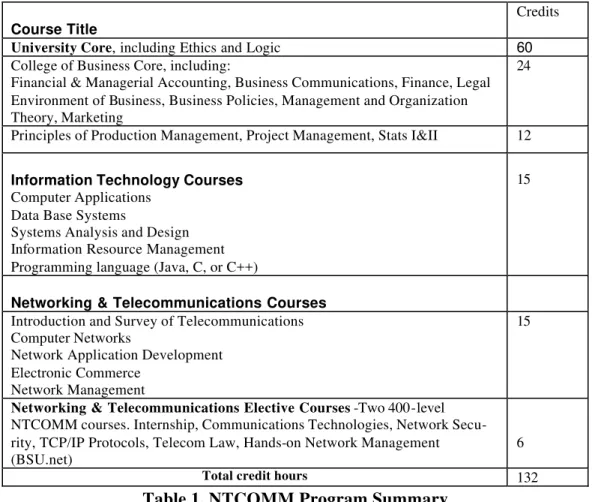
The 132-hour major includes university and business core requirements that support a 36-hour technical component. Students are required to take the major courses in a pre-defined order, designed to insure they build technical skills upon solid foundations. A summary of the degree program is shown in Table 1.
learning exercises. As we begin our second full academic year in the new lab environment, we now have a basic hands-on component for each of our courses, which will evolve as development time, imagina-tion, and resources permit. Rack- mounted servers support each major course, with supplemental systems for long-term storage of student projects and alternative operating system or application demonstrations. A part-time lab manager and a student assistant resolve lab configuration and maintenance issues.
Delivering on the Experiential Promise
Although simulated environments have their benefits, real hands-on exercises give students a chance to apply the theory they learn from textbooks. Starting with our introductory concepts class, lab exercises complement and demonstrate the functions of the OSI model and insure students master major concepts of networking. While students work individually on their lab exercises, hexagonal worktables encourage group sharing and learning. Students with more technical experience readily assist the novices, support-ing the in-class demonstrations and one-on-one time the professor can provide. Many of our exercises are then reviewed and graded in class, to ensure each student understands key concepts before moving on. Student evaluations consistently comment on the quality of the lab and ask for more hands-on exe r-cises.
The computer networking class builds upon the basic concepts and uses project systems configured as client workstations and servers. Removable hard-drives are assigned to teams in each of our multiple sections to maximize the use of the project systems, and allow teams to continue on with their lab exe r-cises from one class meeting to the next. Working primarily through the Microsoft Academic Alliance program, software licensing is no longer a major hurdle for small group projects. Alternative operating systems are demonstrated from the instructor console, and internetworked as time permits. Multiple
Course Title
Credits
University Core, including Ethics and Logic 60
College of Business Core, including:
Financial & Managerial Accounting, Business Communications, Finance, Legal Environment of Business, Business Policies, Management and Organization Theory, Marketing
24
Principles of Production Management, Project Management, Stats I&II 12
Information Technology Courses
Computer Applications Data Base Systems
Systems Analysis and Design Information Resource Management Programming language (Java, C, or C++)
15
Networking & Telecommunications Courses
Introduction and Survey of Telecommunications Computer Networks
Network Application Development Electronic Commerce
Network Management
15
Networking & Telecommunications Elective Courses -Two 400-level NTCOMM courses. Internship, Communications Technologies, Network Secu-rity, TCP/IP Protocols, Telecom Law, Hands-on Network Management (BSU.net)
6
power and network ports are available for each worktable with under-floor cabling to a central rack. Each table can be configured as its own network or can be internetworked as a multi- segmented LAN.
In the network applications development class, students develop and implement operational Web-based applications that meet a real existing need. Example applications have included textbook auction sites, graduation requirement auditing systems, employee time card entry systems, and many other web sites for businesses and non-profit organizations. Technologies used include server-side tools such as Cold-Fusion, client-side tools such as JavaScript, and emerging tools including XML and web service stan-dards. Many systems are still in use several years after their creation. Throughout the class, emphasis is placed not only on initial development but also those things that add long-term usability and value to a business, including system documentation, maintainability, and extensibility. Many students ask to keep their class projects operational after the class to use as functional resumes to show prospective employ-ers.
Electronic commerce falls under our major primarily due to the impact on network infrastructures and importance of privacy and security. For the past two years, the e-Commerce classes have built prototype systems for small businesses in our area. The business owners present an overview of their companies to the class, and two or three teams build alternative e-Commerce solutions to complement each business model. Teamwork exercises and role-playing help develop consulting skills, and a formal e-commerce proposal is developed that includes an appropriate e-Commerce model, an analysis of competitive sites, and a technology overview that describes and supports the prototype. Developing prototypes of live companies often includes educating the small business owner, and adds a service- learning aspect to the class. The prototype projects complement technology modules and traditional lectures to give the stu-dent a more realistic experience than a typical static team project.
The network management class is a partly conceptual and partly experiential class that allows students to learn and appreciate the issues and complexities of managing large-scale networks in organizations. It also prepares them for the fully experiential hands-on network management class (discussed in the next section). Network management techniques, such as device polling and event trapping, as well as stan-dards such as SNMP are first covered in concept and then implemented through examples and projects. Each student participates on a team that administers one or more sub-networks and manageable network devices, including intelligent switches, routers, firewalls, and wireless access points. Functionality and manageability of team-administered devices and sub- networks are tested through structured exercises that load the entire network with traffic and perform tests for connectivity, conformity with configura-tion guidelines, etc. Throughout the class, it is emphasized that business needs drive technology imple-mentation.
Achieving Hands-on Reality - The HONM Class
talent for the struggling ISP industry, but to allow students the opportunity to learn both technical and business issues experientially while supporting a live customer base.
Students must apply for permission to take the Hands-On Network Management class after completing the introductory data communications class with a grade of A, or that class and the computer networking class with a grade of B or better in both. They are encouraged to take as many other networking classes as possible before taking this one. Exceptions are sometimes granted, but we have found that success in the previous classes impacts the ability of the student to get the most from an unstructured class experi-ence. Each student expressing interest in the class is interviewed to determine their course achievement in prior classes, experiences with computers and networks, and desire to learn in a nontraditional envi-ronment. During semesters when we attract particularly strong technical talent, we can also open en-rollment to students with lower levels of experience, but with the motivation and capacity to learn from their peers. During some semesters, students from other programs such as Computer Science, Secondary Education, and graduate students from our MIS or MBA program have been admitted on an experimen-tal basis.
Students are advised to expect a minimum of ten hours per week of lab time in addition to regular class meetings, although past graduates tell us this estimate is optimistic. They must be willing to carry a cell phone during their on-call time for network monitoring and customer support, and respond to network system alerts whenever they occur. Weekly journal reports, role documentation, a semester project, plus a specific team contribution to the business round out the stated requirements for the course. More subtle is the student's ability and desire to work in a team environment and pitch in when and where needed to keep the network running.
Major Educational Objectives & Learning Outcomes in HONM
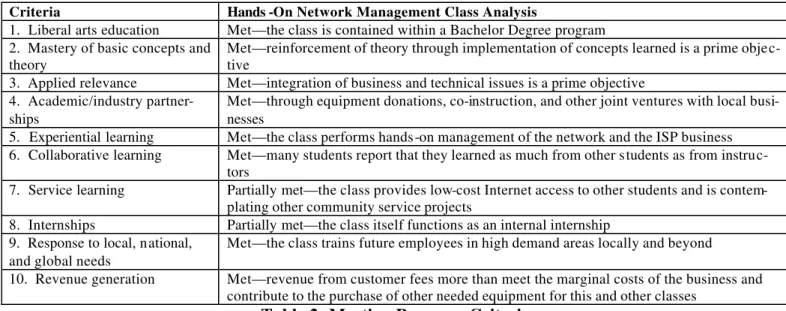
While we strive for a hands-on component in each of our major courses, the HONM class blends the de-velopment of practical, real-world skills with the application of technical theory and broader business knowledge. It strongly supports the “active learning” approach advocated by Lee (2001). Although no single class should be expected to meet all the desirable criteria we proposed earlier, we believe that this class meets many of them. Table 2 reflects our assessment of the class according to previously proposed program criteria:
Learning outcomes are measured through a combination of traditional and nontraditional methods. Stu-dent participation is monitored via personal journals of their learning activities published to a class
Criteria Hands -On Network Management Class Analysis
1. Liberal arts education Met—the class is contained within a Bachelor Degree program 2. Mastery of basic concepts and
theory
Met—reinforcement of theory through implementation of concepts learned is a prime objec-tive
3. Applied relevance Met—integration of business and technical issues is a prime objective 4. Academic/industry
partner-ships
Met—through equipment donations, co-instruction, and other joint ventures with local busi-nesses
5. Experiential learning Met—the class performs hands-on management of the network and the ISP business 6. Collaborative learning Met—many students report that they learned as much from other s tudents as from
instruc-tors
7. Service learning Partially met—the class provides low-cost Internet access to other students and is contem-plating other community service projects
8. Internships Partially met—the class itself functions as an internal internship 9. Response to local, national,
and global needs
Met—the class trains future employees in high demand areas locally and beyond
10. Revenue generation Met—revenue from customer fees more than meet the marginal costs of the business and contribute to the purchase of other needed equipment for this and other classes
intranet. Each class member selects an individual learning project, with the joint goals of exploring a new technology or gaining a new skill, and sharing the results with their peers. The class also proposes a semester group project that will leave a lasting legacy to the ISP operation. Formal systems performance parameters throughout the semester and end-of-semester network viability measure the successful at-tainment of basic technology, operational, and business skills. The more traditional aspects of learning are measured through a combination in-class and take- home exam, which also lends structure to knowl-edge acquisition over the course of the term.
The team aspect of the class presents intangible challenges and benefits, such as the student who helps others to the extent that his own deliverables suffer. This kind of learning environment is clearly not for every student. While the screening process is essentially sound, some students cannot handle a semi-struc tured environment in spite of their initial interest and agreement on fulfilling course requirements. But, perhaps this is also strength of the class. These are aspects of education the traditional classroom environment does not address. With this small slice of real- life learning, our students learn the impor-tance of the customer and quality customer support; they carry away the ability to isolate and trouble-shoot a problem; they make technology decisions with the business in mind; they learn a real world level of team-building and gain a sense of accomplishment they don't get in a traditional classroom setting and small group project.
The external marketplace and the interests/ambitions of the students themselves largely drive the evolu-tion of the HONM class. Students are continually assessing market demand, available technologies, and their own skill sets as they attempt to implement a manageable technology infrastructure that meets cus-tomer needs and maintains administrative and economic viability. As an example of several issues pres-ently under consideration, students are studying options for offering higher speed access to customers, as well as considering an infrastructure modification to allow redundant firewall coverage.
Teaching Challenges with the Experiential Learning Method
Over time we plan to increase the hands-on component of each of the NTCOMM courses, although that goal presents its own set of challenges. The simultaneous operation of many networks—some in produc-tion mode and some in experimental mode—brings many challenges in configuraproduc-tion management, se-curity, and resource sharing. Attracting the right talent to our teaching ranks is also a challenge. We’ve addressed the problem in our more technical courses with a team-teaching approach of a faculty member plus an industry expert drawn from a local organization. The latter seems to be a workable solution for the time being, but current faculty members are stretched to stay current, and new faculty candidates of-ten lack the technical and pedagogical skills to teach in this environment.
Summary and Conclusions
Despite many initial challenges, we believe our innovative program is a good example of how to address the networking education needs of the new economy. These needs should be of concern to both industry and academia, and probably can only be met through the cooperative efforts of both. While we feel tra-ditional undergraduate programs have value, both student and employer groups acknowledge the need for better prepared students who are able to ramp up rapidly to become valuable employees. Other aca-demic institutions should be able to apply similar ideas in a variety of contexts wherever there are op-portunities for hands-on experiences or service provider applications that can be linked to curriculum. The business community can help by being willing partners with universities to support these efforts and will gain better prepared high tech employees in return.
resources and the learning of new teaching methods by faculty. However, our early experiences with it have proven to be effective and rewarding, with our students benefiting in the marketplace. As a next step and for future research, we would like to more formally investigate the effects of our pedagogical strategies on student perceptions of their educational experiences, and on employers’ recognition of its value-added benefits.
References
Bui, Tung X. (1997). PRIISM workshop on information technology policy and national information infrastructure in pacific asia. DATA BASE 28(1), 10-13.
Dhamija, R., Heller, R., and Hoffman, L. (1999). Teaching E-Commerce to a multidisciplinary class, Communications of the ACM 42(9), 50-55.
Dixon, M., McGill, T., & Karlsson, J. (1997). Using a network simulation package to teach the client-server model.
Proceed-ings of the Conference on Integrating Technology into Computer Science Education, 71-73.
Lankewitcz, L. (1998). Resources for teaching computer networks. SIGSCE 98, Atlanta GA, 112-116.
Laurillard, D. (2002). Rethinking teaching for the knowledge society. Educause Review, January/February, 16-25.
Lee, J. (2001). Teaching and learning in the 21st century: The development of “Future CS Faculty.” SIGCSE Bulletin 33(2), 25-30.
McDonald, M., Rickman, J., McDonald, G., Heeler, P., & Hawley, D. (2001). Practical experiences for undergraduate com-puter networking students . JCSC 16(3), 261-270.
Minch, R. & Tabor, S. (2001). Teaching network management hands-on: experiences with a student-run internet service pro-vider. Decision Line, May, 4-6.
Noll, C & Wilkins, M. (2002). Critical skills of IS professionals: A model for curriculum development. Journal of
Informa-tion Technology EducaInforma-tion 1(3), 143-154.
Pattinson, C & Dacre, T. (1998). A network model for network management teaching. Proceedings of the Third Australasian
Conference on Computer Science Education, 62-66.
Sivalingam, K. & Rajaravivarma, V. (1999). Education of wireless and ATM networking concepts u sing hands-on laboratory experience. Proceedings of the Thirtieth SICCSE Technical Symposium on Computer Science Education, 114-118. Stein, A. & Craig, A. (2000). The Dot.Com Generation: IT Practices & Skills of Transition Students. Proceedings of the on
Australasian Computing Education Conference, 220-227.
Straub, D.W. & Watson, R.T. (2001). Research commentary: Transformational issues in researching IS and net-enabled or-ganizations. Information Systems Research 12(4), 337-345.
West, L. & Bogumil, W. (2001). Immigration and the global IT work force. Communications of the ACM 44(7), 34-38.
Biographies
Robert Minch is Professor and John C. Elorriaga Fellow in the College of Business at Boise State Uni-versity. He holds a PhD from Texas Tech University in Management Information Systems. He has pub-lished in a variety of outlets including MIS Quarterly, Human Factors, and Decision Sciences, with cur-rent research interests related to emerging technologies such as mobile computing. In recent years he has been involved in curriculum development for a new undergraduate degree program in Networking and Telecommunications.