Gender and incidence of functional disability
in the elderly: a systematic review
Gênero e incidência de incapacidade funcional
em idosos: revisão sistemática
1 Programa de Pós-graduação
em Epidemiologia, Universidade Federal de Pelotas, Pelotas, Brasil.
Correspondence M. A. P. Rodrigues Programa de Pós-graduação em Epidemiologia, Universidade Federal de Pelotas.
Rua Marechal Deodoro 1160, 3o andar, Pelotas, RS
96020-220, Brasil.
Maria Aparecida Pinheiro Rodrigues 1 Luiz Augusto Facchini 1
Elaine Thumé 1 Fátima Maia 1
Abstract
This systematic review aimed to assess the ef-fect of gender on the incidence of functional disability in the elderly. The search for publi-cations in the MEDLINE, EMBASE, and Pro-Quest electronic databases from January 1990 to March 2008 identified 879 publications, from which 21 cohort studies were selected that evaluated gender as an independent vari-able and incidence of functional disability in elderly as the outcome. Review of the studies found that after adjusting for socioeconomic, health, and social relations indicators, inci-dence of functional disability was similar be-tween genders. The main risk factors for func-tional disability in the elderly, regardless of gender, were: lack of schooling, living in rental housing, chronic diseases, arthritis, diabetes, visual impairment, body mass index above 25, poor self-perceived health, cognitive impair-ment, depression, slow gait, sedentary lifestyle, tiredness while performing daily activities, and limited diversity in social relations.
Disabled Health; Frail Elderly; Gender and Health
Introduction
Functional disability is an important health in-dicator in the elderly, jeopardizing quality of life and causing heavy social impact with long-term institutionalization and increased use of medical care 1.
To reduce functional disability – a major chal-lenge for public health – requires knowledge of the risk factors involved in the process loss of autonomy by the elderly in order to allow effi-cient preventive strategies. In this context, it is necessary to determine the role of gender in the incidence of functional disability in the elderly, in order to establish preventive measures, and the healthcare supply needs to be adjusted for men and women.
The higher prevalence of functional disability in women has been attributed mainly to greater female longevity 2,3, but a study that replaced
female mortality rates with male mortality rates observed a greater impact in the survival differ-ence than in the differdiffer-ence between the genders in prevalence of functional disability 4, suggesting
the possibility of higher incidence of functional disability among elderly women as compared to men. Meanwhile, research on the incidence of functional disability in elderly men and women has shown conflicting results, with some studies indicating higher incidence in women 4,5, others
in men 6, and still others with no difference
The aim of this systematic review was to ver-ify whether functional disability risk factors and incidence vary according to gender in the elderly, to help ensure adequate planning of public poli-cies for the prevention of functional limitations and organization of health services.
Methods
Definition of functional disability
The definition of disability encompasses vari-ous aspects. Illness, impairment, limitation, and handicap are terms that are directly associated with the concept of disability. Functional disabil-ity in the elderly is defined as an acquired diffi-culty in performing basic everyday tasks or more complex tasks needed for independent living 10.
Performance in functional disability includes three dimensions: physical, emotional, and men-tal 11. Physical performance relates to the body’s
sensory and motor function, and is evaluated through activities like walking, crouching, and running. Emotional performance is measured through the individuals’ adaptation to various events in their lives. Mental performance is eval-uated through tests that measure the individuals’ intellectual and rational capacity. The current re-view study covered only the physical dimension of functional disability.
Some theoretical models have been developed with the aim of explaining these concepts, facili-tating knowledge, and understanding the terms used and backing their applicability in research, public policies, and clinical practice 8,12,13. The
model adopted by the World Health Organization (WHO) in 2001 combines a biological, individual, and social perspective, establishing a standard-ized language to describe functional status ac-cording to the individual’s health conditions. Ac-cording to this definition, functionality encom-passes all body functions, tasks, or actions, and disability includes impairment, limited capacity, or restricted performance of activities 12,13.
The most widely used measurements of func-tional disability in the literature are those that assess basic activities of daily living, instrumental activities of daily living, and mobility. These indi-cators can be evaluated by means of the degree of difficulty (no difficulty, little difficulty, great diffi-culty, incapable of performing the task or activity) and/or dependence (need for help from others or inability to perform a task). The most frequently used indicator for measuring basic activities of daily living is the scale developed by Katz & Ak-pom 14, according to which the elderly lose the
capacity to perform tasks in the inverse order that
they acquire them in childhood. Basic activities of daily living include self-care tasks, which in the most famous version includes six items: bathing, getting dressed, going to the bathroom, getting from bed to a chair and vice-versa, maintaining sphincter continence, and eating. Instrumental activities of daily living are more adaptive tasks, necessary for independent living in the commu-nity, whose most widely used scale is that devel-oped by Lawton & Brody 15, with eight items:
us-ing the telephone, shoppus-ing, cookus-ing one’s own meals, housecleaning, laundry, using transporta-tion, taking medicatransporta-tion, and managing finances. The evaluation of mobility refers to tasks related to the individual’s locomotor system and that are measured through various instruments. The selected studies used the following instruments, although partially: Rosow-Breslau 16 (three items:
walking 800m; climbing stairs; and performing heavy work around the home), Nagi 11 (five items:
stooping, crouching, or kneeling; pulling or push-ing an object like an armchair; raispush-ing one’s arms above the shoulders; writing or holding small ob-jects; and carrying more than 5kg), Mobility-Help Scale17 (six items: need for help to get from bed to
a chair; walking inside the home; going out; walk-ing on the street in good weather; walkwalk-ing on the street in bad weather; and climbing stairs). There are also instruments that combine various items from basic activities of daily living, instrumental activities of daily living, and mobility: the Stan-ford Health Assessment Questionnaire18, which
measures functional disability through 20 items subdivided into eight categories (getting dressed; getting up; eating; walking; personal hygiene; reaching objects; grasping objects; and mobil-ity outside the home) and the instrument of the Office for National Statistics 19, from the United
Kingdom, which measures functional disability through 13 items (locomotion; flexibility; dexter-ity; grooming; sight; hearing; continence; com-munication; awareness; behavior; intellectual function; digestion; and overall status).
Sources
and book chapters were not included. The re-view only included studies in English, Spanish, or Portuguese.
Study selection
The review included cohort studies published from January 1990 to March 2008, performed in individuals 55 years or older, living in the com-munity, where the outcome was incidence of functional disability and in which gender was evaluated as an independent variable or the analyses were stratified by gender. Figure 1 sum-marizes the exclusion process for the retrieved studies. Of the 879 initially identified studies,
78 were excluded because they failed to present original results. Next, 232 studies were excluded because the measures of disability failed to meet the current review’s criteria. Another 182 studies were then excluded because the samples consist-ed partially or totally of institutionalizconsist-ed elderly. Lack of quantitative data analysis was cause for exclusion of 104 studies. Next, 236 cross-sectional studies were excluded. Finally, 26 studies were ex-cluded that only evaluated changes in the degree of functional disability as the outcome, leaving 21 studies that analyzed incidence of functional dis-ability in elderly who did not present functional limitations at the start of follow-up.
Figure 1
Diagram of study selection.
879 studies
Results already published (N = 78)
Other definitions of functional desability (N = 232)
Samples with institutionalized elderly (N = 182)
Qualitative studies (N = 104)
Cross-sectional studies (N = 236)
Outcome did not evaluate onset of disability (N = 26)
21 studies
8 conducted analyses stratified by gender
Evaluation of studies
The methodological quality of the selected stud-ies was evaluated by applying the Downs & Black criteria 20, which analyzed data quality,
inter-nal validity, and exterinter-nal validity in the studies through 19 items, with a maximum score of 20.
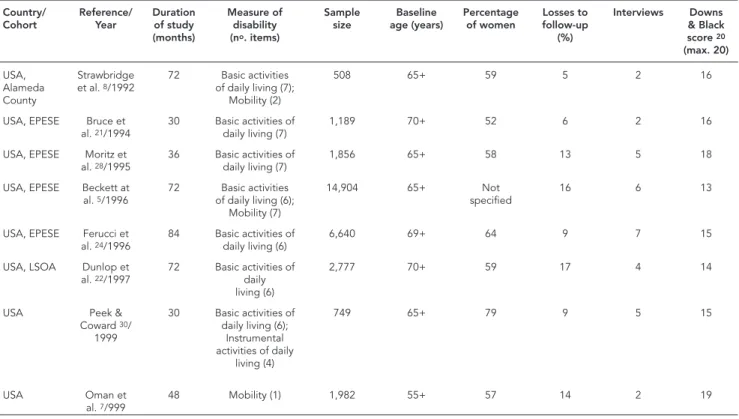
The main characteristics of the studies were described: country in which the study was per-formed, principal author, year of publication, duration of study follow-up, measure(s) of dis-ability used, sample size, baseline age, percent-age of women, percentpercent-age of losses to follow-up, number of interviews performed, and Downs & Black score. Two independent reviewers evaluat-ed the studies’ methodological quality and other characteristics listed in Table 1. When there was disagreement between the evaluations, a third reviewer evaluated the study and the final deci-sion was made by consensus between the three reviewers.
In the 21 selected studies, 30 analyses of in-cidence of functional disability were performed. To investigate the cause of the different results in incidence rates for functional disability between genders in the elderly according to the analyses in
the selected studies, they were divided according to the measures of disability used (basic activities of daily living, instrumental activities of daily liv-ing, and mobility) and according to adjustment of the respective analyses (crude, age-adjusted, and multivariate).
Risk factors for functional disability were de-fined as those evaluated through multivariate analyses and that showed a statistically signifi-cant association with higher incidence of func-tional disability in two or more analyses in the selected studies.
Results
Description of studies
A total of 879 articles were identified for review according to this review study’s inclusion and ex-clusion criteria.
Table 1 provides a list of the 21 selected studies, in chronological order of publication. The studies were based on cohorts from the United States 4,5,7,8,21,22,23,24,25,26,27,28,29,30, United
Kingdom 6,31, Netherlands 9, Taiwan 32, Denmark
Table 1
Characteristics of cohort studies that evaluated incidence of functional disability according to gender in the elderly (N = 21).
Country/ Cohort
Reference/ Year
Duration of study (months)
Measure of disability (no. items)
Sample size
Baseline age (years)
Percentage of women
Losses to follow-up
(%)
Interviews Downs & Black score 20 (max. 20)
USA, Alameda County
Strawbridge et al. 8/1992
72 Basic activities of daily living (7);
Mobility (2)
508 65+ 59 5 2 16
USA, EPESE Bruce et al. 21/1994
30 Basic activities of daily living (7)
1,189 70+ 52 6 2 16
USA, EPESE Moritz et al. 28/1995
36 Basic activities of daily living (7)
1,856 65+ 58 13 5 18
USA, EPESE Beckett at al. 5/1996
72 Basic activities of daily living (6);
Mobility (7)
14,904 65+ Not specifi ed
16 6 13
USA, EPESE Ferucci et al. 24/1996
84 Basic activities of daily living (6)
6,640 69+ 64 9 7 15
USA, LSOA Dunlop et al. 22/1997
72 Basic activities of daily living (6)
2,777 70+ 59 17 4 14
USA Peek & Coward 30/
1999
30 Basic activities of daily living (6);
Instrumental activities of daily
living (4)
749 65+ 79 9 5 15
USA Oman et al. 7/999
48 Mobility (1) 1,982 55+ 57 14 2 19
Table 1 (continued)
United Kingdom
Grundy & Glaser 6/
2000
66 Basic activities of daily living (2);
Mobility (3)
2,717 55+ 54 26 2 15
USA, EPESE Leveille et al. 4/2000
84 Mobility (2) 10,100 65+ 61 2 8 15
United Kingdom
Jagger et al. 31/2001
70 Basic activities of daily living (7)
1,344 75+ 59 20 5 15
USA, EPESE Melzer et al. 27/2001
84 Mobility (2) 8,871 65+ 60 5 8 15
USA, LSOA Dunlop et al. 23/2002
72 Basic activities of daily living (7)
4,205 70+ 67 13 4 16
Denmark and Finland, NORA
Avlund et al. 33/2002
60 Basic activities of daily living (8);
Mobility (3)
517 75+ 62 8 2 15
USA Gill et al. 25/2004
36 Basic activities of daily living (4)
344 70+ 65 4 36 17
Taiwan Chiu et al. 32/2004
48 Basic activities of daily living (7); Instrumental activities of daily
living (8)
903 65+ 50 4 2 15
Denmark, DISPHV
Avlund et al. 34/2004
18 Mobility (6) 1,396 75+ 52 4 2 18
USA Murtagh & Hubert 29/
2004
156 Basic activities of daily living (3); Instrumental activities of daily living (3); Mobility
(2)
1,348 60+ 23 Ignored 13 15
Netherlands Tas et al. 9/2007
72 Basic activities of daily living (3);
Mobility (5)
3,642 55+ 59 15 3 19
USA Hardy et al. 26/2008
72 Basic activities of daily living (4)
754 70+ 65 4 72 15
Denmark, DISPHV
Nilsson et al. 35/2008
54 Mobility (6) 2,533 74+ 56 3 4 19
EPESE: Established Populations for Epidemiologic Studies of the Elderly; LSOA: Longitudinal Study of Aging; NORA: Nordic Research on Ageing; DISPHV: Danish Intervention Study on Preventive Home Visits.
Country/ Cohort Reference/ Year Duration of study (months) Measure of disability (no. items)
Sample size Baseline age (years) Percentage of women Losses to follow-up (%) Interviews Downs & Black score 20 (max. 20)
33,34,35, and Finland 33 (one study was based on a
sample of elderly individuals from both Denmark and Finland). Duration of follow-up ranged from 18 to 156 months. Definition of functional dis-ability varied according to degree of disdis-ability, number of items used in each scale, and cutoff point used in each scale. Thirteen studies used a single measure of functional disability 4,7,21,22, 23,24,25,26,27,28,31,34,35 and the other eight studies
used two to three measures of functional disabil-ity 5,6,8,9,29,30,32,33, resulting in 30 analyses of
func-tional disability. The study’s sample size was de-fined as that used in the data analyses and ranged from 344 to 14,904 individuals. Baseline age
var-ied from 55 to 75 years. The percentage of women in the samples varied from 23 to 67%, while one study 5 failed to specify the percentage of women
in the sample. The percentage of losses ranged from 8 to 26%, although one study 29 failed to
provide the number of losses to follow-up. All the selected studies evaluated the functional condi-tion of individuals in the sample at baseline, and those that already presented functional disability were excluded from the analyses. Evaluation of the studies’ quality based on the Downs & Black criteria 20 for non-intervention studies ranged
the studies were failure to describe the character-istics of losses to follow-up and random variation in the main findings.
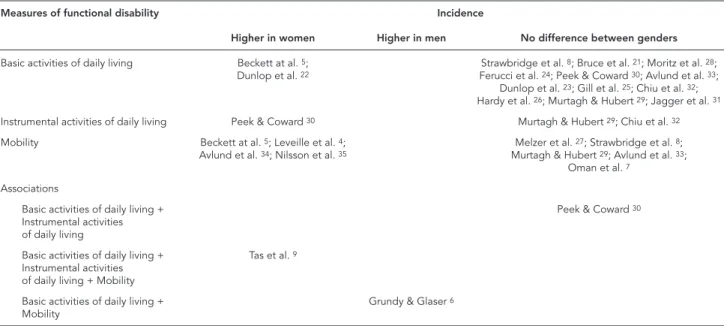
Table 2 shows the results for incidence of functional disability according to gender in the elderly and the measure of disability used. As shown in this Table, functional disability in ba-sic activities of daily living was evaluated in 14 studies 5,8,21,22,23,24,25,26,28,29,30,31,32,33. Of these,
two observed higher incidence of functional dis-ability in women 5,22 and 12 found no difference
in the incidence between genders 8,21,23,24,25,26, 28,29,30,31,32,33. Disability in instrumental
activi-ties of daily living was examined in three studies
29,30,32; one found a higher incidence of
func-tional disability in women 30 and two found no
difference in incidence between the genders 29,32.
Mobility disability was evaluated in nine studies
4,5,7,8,27,29,33,34,35, four of which 4,5,34,35 observed
higher incidence of functional disability in wom-en, while five 7,8,27,29,33 found no difference in
cidence between genders. Three studies used in-struments that combined two to three measures of functional disability 6,9,30. One found higher
incidence of functional disability in women 9,
an-other found higher incidence in men 6, and the
third found no difference in incidence between the genders 30.
Table 3 shows the results for incidence of functional disability according to gender, based on measure of disability and adjustment of the analysis (crude or multivariate). Of the 21 studies
Table 2
Incidence of functional disability in the elderly according to gender in analyses of functional disability measure (N = 30) in 21 selected studies.
Measures of functional disability Incidence
Higher in women Higher in men No difference between genders
Basic activities of daily living Beckett at al. 5;
Dunlop et al. 22
Strawbridge et al. 8; Bruce et al. 21; Moritz et al. 28;
Ferucci et al. 24; Peek & Coward 30; Avlund et al. 33;
Dunlop et al. 23; Gill et al. 25; Chiu et al. 32;
Hardy et al. 26; Murtagh & Hubert 29; Jagger et al. 31
Instrumental activities of daily living Peek & Coward 30 Murtagh & Hubert 29; Chiu et al. 32
Mobility Beckett at al. 5; Leveille et al. 4; Avlund et al. 34; Nilsson et al. 35
Melzer et al. 27; Strawbridge et al. 8; Murtagh & Hubert 29; Avlund et al. 33;
Oman et al. 7
Associations
Basic activities of daily living + Instrumental activities of daily living
Peek & Coward 30
Basic activities of daily living + Instrumental activities of daily living + Mobility
Tas et al. 9
Basic activities of daily living + Mobility
Grundy & Glaser 6
4,5,6,7,8,9,21,22,23,28,29,30,31,32,33,34,35, twelve 6,7,21,23,25, 26,27,28,29,30,32,33 conducted 18 analyses adjusted
for multiple factors when analyzing incidence of functional disability. One found higher incidence of functional disability in instrumental activities of daily living in women, another found higher incidence for basic activities of daily living and mobility in men, and the others found no differ-ences between the genders in the incidence of functional disability. The other nine studies 4,5,8, 9,22,24,31,34,35 conducted 12 analyses adjusted for
one or two factors, of which eight identified high-er incidence of functional disability in women and four found no difference in incidence be-tween the genders.
Risk factors for functional disability
Table 4 describes the risk factors for functional disability in at least two of the selected studies that performed adjusted analyses. Studies that performed gender-stratified analyses 9,21,27,28,29,34
allowed observing whether risks for functional disability differ between men and women.
Increasing age was the most frequent risk fac-tor for functional disability in the selected studies
6,7,9,21,23,27,28,29,30,32, present in studies that
strati-fied by gender, and in those whose analyses did not evaluate gender. Among the socioeconomic factors, lack of schooling 6,32 and living in rental
housing 6,33 were risk factors for incidence of
Table 3
Incidence of functional disability in the elderly according to gender and adjustment of analyses (N = 30) in 21 selected studies.
Incidence of functional disability
Measure of functional disability Multivariate analysis Crude analysis
Higher in women Basic activities of daily living Beckett at al. 5; Dunlop et al. 22
Instrumental activities of daily living Peek & Coward 30
Mobility Beckett et al. 5; Leveille et al. 4;
Avlund et al. 34; Nilsson et al. 35
Basic activities of daily living + Mobility Tas et al. 9
Higher in men Basic activities of daily living + Mobility Grundy & Glaser 6
No difference between genders
Basic activities of daily living Bruce et al. 21; Moritz et al. 28;
Peek & Coward 30; Avlund et al. 33; Dunlop et al. 23; Gill et al. 25;
Chiu et al. 32; Hardy et al. 26; Murtagh & Hubert 29
Stawbridge et al. 8; Ferucci et al. 24;
Jagger et al. 31
Instrumental activities of daily living Murtagh & Hubert 29; Chiu et al. 32
Mobility Melzer et al. 27 Strawbridge et al. 8
Mobility Murtagh & Hubert 29
Mobility Avlund et al. 33
Mobility Oman et al. 7
Basic activities of daily living + Instrumental activities of daily living
Peek & Coward 30
Chronic conditions (stroke, arthritis, cancer, heart disease, chronic lung disease, obesity, hip fracture, and systemic arterial hypertension) were a risk factor for functional disability, regardless of gender 7,30. Diabetes was a risk factor for
func-tional disability according to two studies, regard-less of gender 23,32. Arthritis was a risk factor for
functional disability in three studies: two that did not evaluate gender as a predictor of functional disability 26,32 and one study only in women 9.
Visual impairment was a risk factor for functional disability in two studies 7,23, regardless of gender.
Body mass index (BMI) greater than 25kg/m2 was
a risk factor for incidence of functional disabil-ity in both genders according to one study 9, and
BMI greater than 26kg/m2 was a risk factor for
in-cidence of functional disability in another study, regardless of gender 7. Poor self-rated health was a
risk factor for incidence of functional disability in both genders in one study 9 and in another study
that did not adjust for gender 6. Cognitive deficit
was a predictor of incidence of functional dis-ability in both genders in one study 28, in women
in another study 9, and in two studies that did
not evaluate gender as a risk factor 7,33.
Depres-sion was a predictor of incidence of functional
disability in both genders according to two stud-ies 9,21 and according to two other studies that
did not evaluate gender as a risk factor 7,26. Slow
gait, defined as taking more than ten seconds to walk approximately three meters, increased the likelihood of incidence of functional disability in two studies that did not adjust for gender 25,26.
Sedentary lifestyle increased the risk of incidence of functional disability in two studies 26,33 that
did not evaluate gender in their analyses. Tired-ness while performing activities of daily living increased the likelihood of functional disability in both genders in one study 34 and in another
study that did not evaluate gender as a predic-tor of functional disability 33. Limited diversity in
social relations increased the likelihood of func-tional disability in both genders in three studies
28,34 and in one study that did not evaluate gender
Table 4
Distribution of risk factors for functional disability in the elderly in the 21 selected studies, according to gender.
Risk factors Incidence of functional disability
Women Men Gender independent
Socio-demographic
Age Bruce et al. 21 (Basic activities of daily living); Moritz et al. 28 (Basic activities of
daily living); Melzer et al. 27 (Mobility);
Tas et al. 9 (Basic activities of daily living + Mobility); Murtagh & Hubert 29 (Basic
activities of daily living + Instrumental activities of daily living + Mobility)
Moritz et al. 28 (Basic activities of daily living); Melzer et al. 27
(Mobility); Tas et al. 9
(Basic activities of daily living + Mobility)
Oman et al. 7 (Mobility); Peek & Coward 30 (Basic activities of daily living + Instrumental activities of daily living);
Grundy & Glaser 6 (Basic activities of daily living +
Mobility); Dunlop et al. 23 (Basic activities of daily living); Chiu et al. 32 (Basic activities of daily living + Instrumental
activities of daily living)
Lack of schooling Grundy & Glaser 6 (Basic activities of daily living +
Instrumental activities of daily living + Mobility); Chiu et al. 32 (Basic activities of daily living + Instrumental
activities of daily living)
Rental housing Avlund et al. 33 (Mobility); Grundy & Glaser 6 (Basic activities of daily living + Instrumental activities of daily
living + Mobility) Health conditions
Chronic conditions
Oman et al. 7 (Mobility); Peek & Coward 30 (Basic activities
of daily living)
Diabetes Chiu et al. 32 (Basic activities of daily living + Instrumental activities of daily living); Dunlop et al. 23 (Basic activities
of daily living) Arthritis Tas et al. 9 (Basic activities of daily living
+ Mobility)
Chiu et al. 32 (Basic activities of daily living); Hardy et al. 26
(Basic activities of daily living)
Visual impairment Oman et al. 7 (Mobility); Dunlop et al. 23 (Basic activities
of daily living) BMI > 25kg/m2 Tas et al. 9 (Basic activities of daily living
+ Mobility)
Tas et al. 9 (Basic
activities of daily living + Mobility)
BMI > 26kg/m2 Oman et al. 7 (Mobility)
Poor self-perceived health
Tas et al. 9 (Basic activities of daily living
+ Mobility)
Tas et al. 9 (Basic
activities of daily living + Mobility)
Grundy & Glaser 6 (Basic activities of daily living +
Instrumental activities of daily living + Mobility)
Poor cognitive function
Moritz et al. 28 (Basic activities of daily
living); Tas et al. 9 (Basic activities of daily living + Mobility)
Moritz et al. 28 (Basic
activities of daily living)
Avlund et al. 33 (Mobility); Oman et al. 7 (Mobility)
Depression Tas et al. 9 (Basic activities of daily
living + Mobility); Bruce et al. 21 (Basic activities of daily living)
Tas et al. 9 (Basic
activities of daily living + Mobility); Bruce et al. 21 (Basic activities of
daily living)
Oman et al. 7 (Mobility); Hardy et al. 26 (Basic activities of
daily living)
Slow gait * Gill et al. 25 (Basic activities of daily living); Hardy et al. 26
(Basic activities of daily living)
Sedentary living Hardy et al. 26 (Basic activities of daily living); Avlund et al.
33 (Basic activities of daily living)
Tiredness during physical activities
Avlund et al. 34 (Mobility) Avlund et al. 34
(Mobility)
Avlund et al. 33 (Basic activities of daily living + Mobility)
Social relations Little diversity in social relations
Moritz et al. 28 (Basic activities of daily
living); Avlund et al. 34 (Mobility)
Moritz et al. 28 (Basic
activities of daily living); Avlund et al. 34
(Mobility)
Avlund et al. 33 (Basic activities of daily living + Mobility)
Discussion
The diversity of instruments used to measure functional disability, study populations, follow-up period, number of interviews, and data analy-sis methods hindered the comparison of results between the selected studies. Nevertheless, ac-cording to this review, regardless of the measure adopted, the incidence of functional disability was higher in women in the majority of the stud-ies that used bivariate analysis or adjustment for one or two factors, while there was no dif-ference between the genders in the incidence of functional disability when adjusting for socio-economic and health conditions and social rela-tions. A previous review study of risk factors for functional disability 36 had already observed that
two studies that adjusted the analyses for chronic health conditions 37,38 found a similar onset of
functional disability between the genders.
Analyses with different adjustments in studies with the same cohort of elderly
Using data from the EPESE study (Established Populations for Epidemiologic Study of the El-derly), Leveille et al. 4, in an analysis stratified by
sex and adjusted for age only, observed higher incidence of mobility disability in women. Using data from the same cohort, Melzer et al. 27 found
that by stratifying for schooling, the incidence of mobility disability was higher in the group with less schooling (0-7 years), making the risk of functional disability similar between men and women.
Dunlop et al. 22, using data from LSOA
(Lon-gitudinal Study of Aging), in an analysis of inci-dence of functional disability in basic activities of daily living, adjusting for age and schooling, ob-served higher incidence of functional disability in women. In data from the same cohort, Dunlop et al. 23, without adjusting for chronic health
con-ditions (arthritis, cancer, cardiovascular diseases, diabetes, hearing impairment, obesity, osteopo-rosis, and visual impairment), found similar inci-dence of functional disability in basic activities of daily living in men and women.
By using data from the same cohort, these studies allow ruling out the hypothesis that pop-ulation differences could explain the differential effect of gender on functional disability. Mean-while, these studies confirmed that the studies’ variability on the effect of gender on functional disability in the elderly is due to the indicators for which the analyses are adjusted.
Adjusted analyses that found a difference between genders in the incidence of functional disability
Only two of the studies that conducted multi-variate analyses showed different incidences between genders. Methodological issues may explain the disparity between results of these studies and others that adjusted for various fac-tors. Grundy & Glaser 6 found higher incidence
of functional disability in basic activities of daily living and mobility in men in a study that used an instrument that measures less severe limitations than the majority of studies, facilitating the per-ception of functional disability by men, and that evaluates hearing loss which usually has higher incidence and prevalence in men, in addition to not being included in the traditional instru-ments that measure functional disability 39,40.
Peek & Coward 30 observed higher incidence of
functional disability in instrumental activities of daily living in women in a study whose sample consisted of elderly individuals with arthritis. The instrument that measures instrumental activi-ties of daily living uses some questions like doing housework, preparing meals, and grocery shop-ping, which are considered “women’s work”, and which lead to a differential assessment between genders 41. The study showed the highest
propor-tion of women among the selected studies (79%), since arthritis is more prevalent in women 42,43.
Risk factors for functional disability
Increasing age was the most frequent risk factor for functional disability among the selected stud-ies, independently of gender, which had already been observed in a previous review study 36 and
proved the trend towards functional decline with increasing age in the elderly.
Among the socioeconomic factors, low schooling and living in rental housing increased the risk of functional disability, regardless of gen-der, showing that elderly individuals in worse so-cioeconomic conditions are more vulnerable to incidence of functional disability, as previously observed in other studies 44,45,46,47.
Among the health indicators, chronic health conditions increased the risk of incidence of functional disability, regardless of gender, as ob-served in other studies 37,48,49. Considering that
only one study evaluated arthritis as an indepen-dent variable in a gender-stratified analysis, it is not possible to rule out that arthritis may repre-sent a greater risk of functional disability in wom-en, as observed in previous studies 42,43.
social relations highlights the importance of so-cial ties for their health 50.
Despite the small number of studies that used gender-stratified analyses, except for arthri-tis, the predictors of functional disability are the same in men and women.
Conclusions
According to this review, gender is not a risk fac-tor for incidence of functional disability in the elderly. Rather, age, socioeconomic and health conditions, and social relations determine the incidence of functional disability. Prevention of functional disability in men and women should act on the risk factors that are amenable to in-tervention, like sedentary lifestyle and limited diversity of social relations. In relation to these factors, measures like physical activity and main-taining social ties should be encouraged, regard-less of gender.
The results of this review were reinforced by the opportunity to compare findings from stud-ies that used crude analyses 4,22 with others that
used adjusted analyses 23,27 based on the same
cohort’s database. Studies that used crude analy-ses observed a different incidence of functional disability between the genders in the elderly, while studies that adjusted their analyses for socio-demographic, socioeconomic, and health factors observed no difference between the gen-ders in the incidence of functional disability. Methodological difficulties in this review indicate the need for standardized measures of functional disability to allow comparability of the studies’ results and taking precautions starting with the study’s initial planning in order to prevent losses
to follow-up, thus avoiding analyses from being performed with data from the healthiest indi-viduals. Equally important is to avoid dichoto-mization of functional disability when the study instrument contains more than one question on functional capacity. Dichotomization inappro-priately simplifies the information on functional capacity, leading to classification errors and false conclusions. The use of multiple measures of functional disability allows better capturing of subtle differences in functional capacity in the el-derly. Another observation in this review study is that data collection instruments should draft the questions on functional disability in the present tense, since hypothetical questions can induce answers that are influenced by cultural factors and family arrangements.
Limitations
Except for one article 32, the studies selected in
this review were conducted in developed coun-tries, which limits extrapolation of the findings to developing countries, where there is greater social and economic inequality, with probable impact on functional disability in the elderly.
The possibility of publishing bias cannot be ruled out, since only one study showed higher incidence of functional disability in men.
Measures of functional disability were col-lected through self-reported data, except in one of the studies 7. However, besides the fact that
the validity of self-reported (as compared to ob-served) data has already been proven in both genders 51, this issue does not compromise
Resumo
Esta revisão sistemática teve por objetivo avaliar o efei-to do gênero sobre a incidência de incapacidade fun-cional em idosos. A pesquisa de publicações nas bases eletrônicas de dados MEDLINE, EMBASE e ProQuest no período de janeiro de 1990 a março de 2008 iden-tificou 879 publicações, das quais foram selecionados 21 estudos de coortes que avaliaram gênero como va-riável independente e incidência de incapacidade fun-cional em idosos como desfecho. A revisão dos estudos selecionados demonstrou que após ajuste para indica-dores sócio-econômicos, de saúde e de relações sociais a incidência de incapacidade funcional foi semelhan-te entre os gêneros. Os principais fatores de risco para incapacidade funcional, independente do gênero dos idosos, foram: falta de escolaridade, moradia aluga-da, doenças crônicas, diabetes, déficit visual, índice de massa corporal acima de 25, autopercepção de saúde como não boa, déficit cognitivo, depressão, marcha lenta, sedentarismo, cansaço ao realizar as atividades diárias e pouca diversidade nas relações sociais.
Saúde do Portador de Incapacidade; Idoso Fragiliza-do; Gênero e Saúde
Contributors
M. A. P. Rodrigues participated in all stages of the study, including the planning, literature search, study selec-tion, evaluation of studies, and final elaboration of the article. L. A. Facchini participated in the planning, eva-luation of selected studies, and final revision. E. Thumé participated in the evaluation of the selected studies and elaboration of the article. F. Maia participated in the literature search, study selection, and elaboration of the article.
References
1 Guralnik JM, Fried LP, Salive ME. Disability as a public health outcome in the aging population. Annu Rev Public Health 1996; 17:25-46.
2. Newman AB, Brach JS. Gender gap in longev-ity and disabillongev-ity in older persons. Epidemiol Rev 2001; 23:343-50.
3. Crimmins EM. Mixed trends in population health among older adults. J Gerontol B Psychol Sci Soc Sci 1996; 51:S223-5.
4. Leveille SG, Penninx BW, Melzer D, Izmirlian G, Guralnik JM. Sex differences in the prevalence of mobility disability in old age: the dynamics of in-cidence, recovery, and mortality. J Gerontol B Psy-chol Sci Soc Sci 2000; 55:S41-50.
5. Beckett LA, Brock DB, Lemke JH, Mendes de Leon CF, Guralnik JM, Fillenbaum GG, et al. Analysis of change in self-reported physical function among older persons in four population studies. Am J Epi-demiol 1996; 143:766-78.
6. Grundy E, Glaser K. Socio-demographic differ-ences in the onset and progression of disability in early old age: a longitudinal study. Age Ageing 2000; 29:149-57.
8. Strawbridge WJ, Kaplan GA, Camacho T, Cohen RD. The dynamics of disability and functional change in an elderly cohort: results from the Alameda County Study. J Am Geriatr Soc 1992; 40:799-806. 9. Tas U, Verhagen AP, Bierma-Zeinstra SM, Hofman A,
Odding E, Pols HA, et al. Incidence and risk factors of disability in the elderly: the Rotterdam Study. Prev Med 2007; 44:272-8.
10. Alves LC, Leite IC, Machado CJ. Conceituando e mensurando a incapacidade funcional da popula-ção idosa. Uma revisão de literatura. Ciênc Saúde Coletiva 2008; 13:1199-207.
11. Nagi S. An epidemiology of disability among adults in the United States. Milbank Mem Fund Q 1976; 54:439-68.
12. World Health Organization. Towards a common language for functioning, disability and health: ICF. The International Classification of Function-ing, Disability and Health. Geneva: World Health Organization; 2002.
13. Verbrugge LM, Jette AM. The disablement process. Soc Sci Med 1994; 38:1-14.
14. Katz S, Akpom CA. 12. Index of ADL. Med Care 1976; 14(5 Suppl):116-8.
15. Lawton MP, Brody EM. Assessment of older peo-ple: self-maintaining and instrumental activities of daily living. Gerontologist 1969; 9:179-86.
16. Rosow I, Breslau N. A Guttman health scale for the aged. J Gerontol 1966; 21:556-9.
17. Avlund K, Kreiner S, Schultz-Larsen K. Functional ability scales for the elderly: a validation study. Eur J Public Health 1996; 6:35-42.
18. Fries JF, Spitz PW, Young DY. The dimensions of health outcomes: the health assessment question-naire, disability and pain scales. J Rheumatol 1982; 9:789-93.
19. Martin J, Meltzer H, Elliot D. The prevalence of dis-ability among adults. London: Her Majesty’s Sta-tionery Office; 1988.
20. Downs SH, Black N. The feasibility of creating a checklist for the assessment of the methodological quality both of randomised and non-randomised studies of health care interventions. J Epidemiol Community Health 1998; 52:377-84.
21. Bruce ML, Seeman TE, Merrill SS, Blazer DG. The impact of depressive symptomatology on physical disability: MacArthur Studies of Successful Aging. Am J Public Health 1994; 84:1796-9.
22. Dunlop DD, Hughes SL, Manheim LM. Disability in activities of daily living: patterns of change and a hierarchy of disability. Am J Public Health 1997; 87:378-83.
23. Dunlop DD, Manheim LM, Sohn MW, Liu X, Chang RW. Incidence of functional limitation in older adults: the impact of gender, race, and chronic con-ditions. Arch Phys Med Rehabil 2002; 83:964-71. 24. Ferrucci L, Guralnik JM, Simonsick E, Salive ME,
Corti C, Langlois J. Progressive versus catastroph-ic disability: a longitudinal view of the disable-ment process. J Gerontol A Biol Sci Med Sci 1996; 51:M123-30.
25. Gill TM, Allore H, Holford TR, Guo Z. The devel-opment of insidious disability in activities of daily living among community-living older persons. Am J Med 2004; 117:484-91.
26. Hardy SE, Allore HG, Guo Z, Gill TM. Explaining the effect of gender on functional transitions in older persons. Gerontology 2008; 54:79-86. 27. Melzer D, Izmirlian G, Leveille SG, Guralnik JM.
Educational differences in the prevalence of mo-bility disamo-bility in old age: the dynamics of inci-dence, mortality, and recovery. J Gerontol B Psy-chol Sci Soc Sci 2001; 56:S294-301.
28. Moritz DJ, Kasl SV, Berkman LF. Cognitive func-tioning and the incidence of limitations in activi-ties of daily living in an elderly community sample. Am J Epidemiol 1995; 141:41-9.
29. Murtagh KN, Hubert HB. Gender differences in physical disability among an elderly cohort. Am J Public Health 2004; 94:1406-11.
30. Peek K, Coward RT. Gender differences in the risk of developing disability among older adults with arthritis. J Aging Health 1999; 11:131-50.
31. Jagger C, Arthur AJ, Spiers NA, Clarke M. Patterns of onset of disability in activities of daily living with age. J Am Geriatr Soc 2001; 49:404-9.
32. Chiu HC, Mau LW, Tasi WL. Chronic medical con-ditions as predictors of functional disability in an older population in Taiwan. Aust J Ageing 2004; 23:19-24.
33. Avlund K, Damsgaard MT, Sakari-Rantala R, Lauk-kanen P, Schroll M. Tiredness in daily activities among nondisabled old people as determinant of onset of disability. J Clin Epidemiol 2002; 55: 965-73.
34. Avlund K, Lund R, Holstein BE, Due P. Social rela-tions as determinant of onset of disability in aging. Arch Gerontol Geriatr 2004; 38:85-99.
35. Nilsson CJ, Lund R, Avlund K. Cohabitation sta-tus and onset of disability among older Danes: is social participation a possible mediator? J Aging Health 2008; 20:235-53.
36. Stuck AE, Walthert JM, Nikolaus T, Bula CJ, Ho-hmann C, Beck JC. Risk factors for functional sta-tus decline in community-living elderly people: a systematic literature review. Soc Sci Med 1999; 48: 445-69.
37. Boult C, Kane RL, Louis TA, Boult L, McCaffrey D. Chronic conditions that lead to functional limita-tion in the elderly. J Gerontol 1994; 49:M28-36. 38. Guralnik JM, Kaplan GA. Predictors of healthy
aging: prospective evidence from the Alameda County Study. Am J Public Health 1989; 79:703-8. 39. Cruickshanks KJ, Wiley TL, Tweed TS, Klein BE,
Klein R, Mares-Perlman JA, et al. Prevalence of hearing loss in older adults in Beaver Dam, Wis-consin. The Epidemiology of Hearing Loss Study. Am J Epidemiol 1998; 148:879-86.
40. Helzner EP, Cauley JA, Pratt SR, Wisniewski SR, Zmuda JM, Talbott EO, et al. Race and sex differ-ences in age-related hearing loss: the Health, Ag-ing and Body Composition Study. J Am Geriatr Soc 2005; 53:2119-27.
41. Allen SM, Mor V, Raveis V, Houts P. Measurement of need for assistance with daily activities: quantify-ing the influence of gender roles. J Gerontol 1993; 48:S204-11.
43. Theis KA, Helmick CG, Hootman JM. Arthritis bur-den and impact are greater among U.S. women than men: intervention opportunities. J Womens Health (Larchmt) 2007; 16:441-53.
44. Maddox GL, Clark DO. Trajectories of functional impairment in later life. J Health Soc Behav 1992; 33:114-25.
45. Coppin AK, Ferrucci L, Lauretani F, Phillips C, Chang M, Bandinelli S, et al. Low socioeconomic status and disability in old age: evidence from the InChianti study for the mediating role of physio-logical impairments. J Gerontol A Biol Sci Med Sci 2006; 61:86-91.
46. Amaducci L, Maggi S, Langlois J, Minicuci N, Bal-dereschi M, Di Carlo A, et al. Education and the risk of physical disability and mortality among men and women aged 65 to 84: the Italian Longi-tudinal Study on Aging. J Gerontol A Biol Sci Med Sci 1998; 53:M484-90.
47. Adamson J, Hunt K, Ebrahim S. Socioeconomic position, occupational exposures, and gender: the relation with locomotor disability in early old age. J Epidemiol Community Health 2003; 57:453-5. 48. Rudberg MA, Parzen MI, Leonard LA, Cassel CK.
Functional limitation pathways and transitions in community-dwelling older persons. Gerontologist 1996; 36:430-40.
49. Woo J, Ho SC, Yu LM, Lau J, Yuen YK. Impact of chronic diseases on functional limitations in el-derly Chinese aged 70 years and over: a cross-sec-tional and longitudinal survey. J Gerontol A Biol Sci Med Sci 1998; 53:M102-6.
50. Verbrugge LM, Reoma JM, Gruber-Baldini AL. Short-term dynamics of disability and well-being. J Health Soc Behav 1994; 35:97-117.
51. Merrill SS, Seeman TE, Kasl SV, Berkman LF. Gen-der differences in the comparison of self-reported disability and performance measures. J Gerontol A Biol Sci Med Sci 1997; 52:M19-26.
Submitted on 17/Mar/2009