AR
TICLE
1 Universidade São Judas Tadeu. R. Taquari, 546, Mooca. 03166-000 São Paulo SP Brasil. [email protected]
Older people’s concepts of spirituality, related to aging
and quality of life
Abstract Increased life expectancy and the prospect of longevity lead to reflection on the importance of spirituality while aging. This article aims to inves-tigate and analyze the concepts that older people have of spirituality and how this concept affects their quality of life. It is a descriptive, exploratory, quantitative-qualitative study, with a sample of 12 participants over the age of 60. The following tools were used: semi-structured interviews, social-de-mographic questionnaires and WHOQOL (Bref, SRPB and Domain VI). The statistical program SPSS 21.0, and Content Analysis, were used in the analysis. The average score on the Psychological Health and Social Relationship domains was high, and the WHOQOL-SRPB showed high averages in all facets, and positive association with the Bref do-mains. Content analysis showed a relationship be-tween Quality of Life and Spirituality. The latter is conceptualized as: Support, Relationship with the Sacred, and Transcendence; and is distinguished from Religion, which is defined by Religious Af-filiation, Cultural AfAf-filiation, and Dogmas. The relationship between spirituality and old age takes place through the capacity to bear the limitations, difficulties and losses inherent to the process; thus, the nature of living a spiritual life was observed to be heterogeneous, while all had in common the rec-ognition of its importance and its significance for living an old age with Quality of Life.
Key words Old age, Meaning of life, Well-being, Religion
Lindanor Jacó Chaves 1
C
ha
v
es LJ
Introduction
All over the world the process of aging has at-tracted attention and been the subject of research and debate. It is being studied in a wide and in-terdisciplinary manner1; and raises challenge for
the human being’s resources of adaptation, due to the losses and limitations that are inherent to it, which call upon the elderly person to reflect on his or her existence, achievements and also on death2,3.
Old age and spirituality are themes that have long been far from the center of interest of sci-entific discussions. Old age was considered only as the final stage of life4; and spirituality – the
quest for the meaning of life5-9 – was always seen
as something in the contrary direction to the ra-tionality of science. The recognition by the World Health Organization of the importance of spiri-tuality for quality of life led to inclusion of these domains in the assessment and promotion of health at all phases and ages10-12.
The study of the association between spiritu-ality, health, quality of life and old age is still in-cipient and to understand this phenomenon it is necessary to look not only in quantitative terms of data, but to look more deeply, qualitatively, at the means of the terms, and their relationships, for older people. Being aware of the complexity of the human being and the possibilities of wid-ening of knowledge in the phase of old age, this study seeks to establish and analyze what is the older person’s conception of spirituality and how it relates to her/his quality of life. It also aims to identify the meanings of religion/religiosity, and also the relationship between aging and spiritu-ality.
Method
Due to the nature of the objectives, a quanti-tative-qualitative, descriptive and exploratory study was adopted, with a view to understand-ing and description of the characteristics of the population in question and establishment of the relationship between the variables13.
Participants
The study used a convenience sample, com-prising 12 participants over the age of 60, of both sexes, who made their participation official by signing an Informed Consent Form.
Procedures
Collection of data was begun after approval by the Research Ethics Committee. The social-de-mographic questionnaire was applied; partici-pants were then submitted to a semi-structured interview (recorded in audio), with guiding questions formulated by the researchers; and an-swered the questionnaires of assessment of qual-ity of life (WHOQOL-Bref, WHOQOL-SRPB and Domain VI – Spirituality/Religion/Personal Beliefs – of the WHOQOL-100).
For an initial assessment of the feasibility of the stages and the appropriateness of the instru-ments, a pilot study was carried out with three participants. To avoid any bias caused by the or-der of application of the instruments, two sepa-rate orders of application were applied (half the participants answered the WHOQOL-Bref ques-tionnaire first, followed by the SRPB and Domain VI, and the rest responded in the inverse order).
Analysis of the data
The data were analyzed quantitatively and qualitatively, with the application of statistical analysis and analysis of concordance between judges, the results obtained through interviews were analyzed qualitatively based on Content Analysis.
Statistical analysis
Descriptive statistics were used (frequency, average, standard deviation, minimum and max-imum), to demonstrate the results of the mea-sures of quality of life of the participants (WHO-QOL-Bref, SRPB, Domain VI); and Pearson cor-relation tests (r) and Spearman corcor-relations (rs) were used to verify the association between the domains and facets of the instruments and in verification of concordance of the responses by each pair of judges. For analysis of the concor-dance of all the judges, the Kendall (W) test was used. The level of significance considered in this study was 0.01 to 0.05, and the Statistical Package
for Social Sciences (SPSS) 21.0 software was used.
aúd e C ole tiv a, 20(12):3641-3652, 2015 Qualitative analysis
For treatment and analysis of the interviews, Bardin’s Content Analysis technique14 was used,
applied to analysis of the written texts. The tran-scriptions of the interviews were submitted to the following phases of analysis: pre-analysis, explo-ration of the material, treatment and interpreta-tion of the results. They were then analyzed in the light of the literature, taking into account the questions that gave rise to the study.
Results and discussion
The study was carried out with a sample of 12 participants: seven women (58.3%) and five men (41.7%). The names of the participants were replaced by names of flowers, followed by
the participant’s age, to protect their identities and maintain confidentiality. The participants were between the ages of 61 and 93, the average being 73.92 (Chart 1). Though unintentionally, these results tend toward agreement with the data found by recent Brazilian studies with old-er people that undold-erline the highold-er prevalence of women in old age15. All the participants in
this study professed some religion, the majority (83.4%) being Catholics and evangelicals; only the participant Jasmine reported having no reli-gion, although having a history of some religious practice.
Measures of quality of life
The results referring to the averages of the domains obtained by the WHOQOL-Bref in-strument are presented in Table 1. The lower
Chart 1. Participants.
Participant Rose Tulip Carnation Hydrangea Anthurium Jasmine Lily Sunflower Orchid Azalea Arum Lily Hyacinth Gender* F F M F M F F M F F M M
Level of education
Primary not completed
University
Primary not completed
Average
Average
University
Primary not completed
Primary not completed
Average
University
Secondary not completed
Primary not completed
Religion Catholic Spiritist Evangelical Catholic / Spiritist Evangelical None Evangelical Catholic / Spiritist Catholic Evangelical Catholic Evangelical Age 68 61 93 88 78 79 89 68 63 64 65 71 Profission Housewife
Director of School
Retired Receptionist Accounting technician Teacher Housewife Carpenter Judiciary inspection agent Psychologist Retired Retired Marital status** M D M W M M W S W S D W Children 2 1 8 3 7 3 13 0 3 0 2 5 Lives with
Husband and daughter
Mother
Wife
Daughter and grandson
Wife Husband Daughter Brother Son Brother No-one
Daughter and son
C
ha
v
es LJ
levels of quality of life in the Environment, and, principally, Physical Health domains, do not ap-pear to have influence on the higher results in the Psychological Health domain. The results indi-cate that, although the process and experience of aging is individual in character, negative aspects can be suffered – such as inappropriate environ-ments, illnesses and losses of function – without a great impact on psychological quality of life.
In the Social Relationships domain, the par-ticipants obtained higher scores, which could be directly related either to life in the family or to religious practice – the latter, since it is largely practiced in a group, characterizing a social sup-port network16. According to Jung17, one feature
of old age can be the giving of specific attention and greater value to what is inside oneself, thus seeking a purpose for life. In the analysis of the SRPB domains and also in the domain VI, the average scores are high in all facets, revealing a considerable degree of value given to the aspects related to spirituality, religion/religiousness and personal beliefs for quality of life in old age.
The highest scores in general were in Mean-ing of Life and Spiritual Strength (Table 1). The giving of greater value to the subject’s beliefs in the search for meaning for life adds importance to spirituality for older people18. This
corrobo-rates the study by Costa19, with 158 old people,
to establish whether religiosity/spirituality were predictors of quality of life, which revealed that the facets Connection with a Higher Being, Meaning in Life, Spiritual Strength, Faith and
Spirituality showed significant correlations in the participants with more advanced age.
In a systematic review of the studies on the re-lationship between religiosity and mental health, in the 850 articles20 the levels of religious
involve-ment have a positive correlation with aspects related to psychological well-being. The greater portion of the elderly people show high scores in the Psychological Health domain; among them, some have lower scores in the Physical Health do-main and have a variety of pathologies. Also, this domain does not show damage associated with greater ages (r = – 0.024; p = 0.941).
In ascertaining correlations between the do-mains, a positive correlation was found between Physical Health (Bref) and the facet Meaning in Life (r = 0.69; p = 0.035). Some participants (33%) showed higher scores in the facet SRPB and also in the Physical Health domain. The Psy-chological Health domain showed higher results in the comparison with the averages between domains of the whole of the group. Thus, in the analysis of the correlations between this domain and the SRPB facets, there was a positive correla-tion with Spiritual Strength (r = 0.73; p = 0.007), Interior Peace (rs = 0.63; p = 0.029) and Faith (r = 0.61; p = 0.034). The SRPB facets largely relate to aspects of the relationship of the individual with the transcendental and her/his own beliefs, and not only to religious practice in a group. This relationship is essential, because in the develop-ment of a healthy old age based on spirituality, family support and faith in a Higher Being are
Maximum
85.7 95.8 100.0 81.2
93.7 100 93.7 87.5 100 93.7 100 100 100 WHOQOL – BREF
Physical health Psychological health Social relationships Environment WHOQOL – SRPB
Connection with a higher being Meaning in life
Admiration Totality
Spiritual strength Inner peace Hope Faith
Domain VI – Spirituality
Average
63.4 75 73.6 62.2
78.1 82.8 79.2 79.7 82.3 76.6 78.1 81.2 86.5
Table 1. Measures of Quality of Life.
Minimum
32.1 50.0 25.0 31.2
31.2 62.5 56.2 56.2 68.7 68.7 68.7 43.7 75
SD
18.5 12.4 20.4 15.3
aúd
e C
ole
tiv
a,
20(12):3641-3652,
2015
necessary, and these enable the elderly person to confront and adapt to the gains and losses in all the spheres that comprise living8.
The relationship between spirituality/religi-osity and health is frequently cited in the liter-ature21,22; in this study, domain VI of the
WHO-QOL-100 did not show correlations with the Bref domains, and the SRPB facets had a strong positive correlation only with the facet Hope (r = 0.64; p = 0.025). This underlines the need to consider not only the aspects related to personal belief, but also the effect of spirituality and reli-giousness in proper assessment of the quality of life of older people.
Analysis of the categories
To establish the reliability and validity of the results, an analysis of the concordance of the cat-egories by judges was carried out23. In the content
analysis, the first steps were carried out initially by Judge 1 (investigators); the Categories (04) and the Sub-categories (12), prepared based on the assimilation of this content, were defined based on the 74 Units of meaning found. Two months after the first analysis, they were once again evaluated by Judge 1 (Intra-judge), and then submitted to analysis by Judges 2 and 3. To analyze the concordance between the judges, the Spearman Correlation (rs) was applied, to estab-lish the concordance between the pairs. For the
concomitant concordance between all the judges, the Kendall (W) test was used. All the categories, Sub-categories and Units of Meaning were con-sidered valid and concordant and are presented in diagrams (Figures 1 and 2), and discussed as follows:
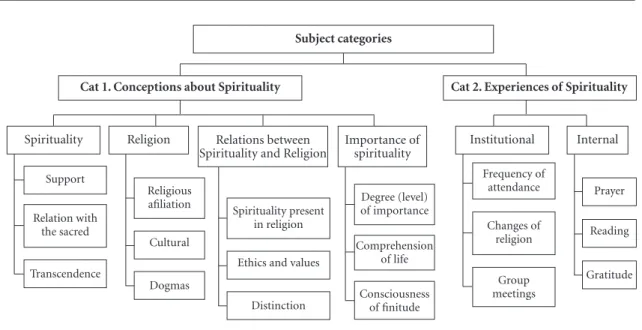
To conceptualize spirituality is not a simple task and, in light of this, Category 1 – Concep-tions of Spirituality was divided into: Spirituality, Religion, Relations existing between Spirituality and Religion, and Importance of Spirituality (Figure 1). The concept of Spirituality was shown to be very wide-ranging. However, only the units that received the largest number of references, being the most important for the elderly people, were presented: Support, Relation with the Sa-cred, and Transcendence. Half of the interviewees considered Spirituality to be a source of Support:
... if we don’t have a spiritual support... life is so difficult... Violence is spreading... It seems to me that life has become very banal... – so we have to
have a spiritual support... Hydrangea, 88
He is my strong support, my refuge... Azalea, 61
According to Frankl24, one of the roles of
re-ligion is to provide a sensation of support and refuge. For these elderly people, Support is re-lated not only to a religious practice or belief; spirituality is seen as a fundamental form of sustaining support. These results are in agree-ment with what was emphasized by Guerrero25:
in cancer patients, support from the concept of
Figure 1. Subject Categories 1 and 2.
Subject categories
Spirituality
Support
Relation with the sacred
Transcendence
Religion
Religious afiliation
Cultural
Dogmas
Relations between Spirituality and Religion
Spirituality present in religion
Ethics and values
Distinction
Importance of spirituality
Degree (level) of importance Comprehension
of life Consciousness
of finitude
Group meetings Institutional
Frequency of attendance
Changes of religion
Internal
Prayer
Reading
Gratitude
C
ha
v
es LJ
God is a need, and favors a greater confrontation of the feelings and emotions inherent to the pro-cess of illness and treatment. For older people, it goes further; since the feeling that one’s life is sustained by something or by someone makes it possible to live with confidence and security in one’s daily routine.
In the literature, spirituality can be consid-ered to be a quest for comprehension of the ex-istential questions related to the Sacred7,26,27. The
older people in our study also perceive it in this relationship with the Sacred. The term also de-notes the existential questions about the meaning of life, that are articulated through this relation-ship5,27, which may be through the belief in saints,
as indicated by Rose, 68, or in the relationship with the Divine, and cited by Carnation, 93:
...but I believe in God, I have my favorite
saints... Rose, 68
I and God, and Jesus and the Holy Spirit of God, it’s these three that command my spiritual strength, I can understand that without them and without their orientation, from these people of the Trinity I might not have the knowledge, the meaning, what a
spiritual life means for me. Carnation, 93
The quest for the meaning of life is achieved through the individual’s relationship with the Sacred, which in religion has the role of offering
values for life and in spirituality as an experience of the meaning of life28. This corroborates the
statements of Jung17 on the need for
introspec-tion and seeking for the interior god, experienced by the elder person. The speech of Jasmine, 79, even though the subject is not professing reli-gion, relates the subject with a Higher Being and refers to God as father:
So, thus I finished up giving up everything, I said no, I will stick to my own opinions and feel-ings, when I have to fight with him (she looks and points upward), I fight with him, sometimes, when I think that he’s too relaxed with us, I complain, too, I know that we shouldn’t, but we have to
com-plain too, we are after all children... Jasmine, 79
All the speeches that relate to the Transcen-dental are in the direction of the relationship with what is beyond the visible. This strength emerges from the individual and connects him/her with something greater, it can take place through the relationship with other people, the sacred or the Universe29. It also relates to the elderly person’s
capacity to go beyond his own limitations, not only physical, but also of understanding of the world, of being and of existing.
The term Spirituality, in the speech of some participants is not always unlinked from aspects of religion; but this spiritual contact and
direc-Figure 2. Subject Categories 3 and 4.
Subject categories
Limitations
Physiological limitations
General difficulties of
old age
Losses
Relations of affection
Experience of spirituality
in old age
Satisfaction Wisdom Continuity
Physical
Control of negative thoughts and
feelings
Psychological Social relations
Inter-relationships
Family relationship
Spirituality and Old Age Spirituality and Quality of Life
Meaning of life
Health Energy
Well-being Facing up to
aúd
e C
ole
tiv
a,
20(12):3641-3652,
2015
tion make it possible for the individual who is aging to reflect on him/herself. The connection between what is within and what is outside and/ or above oneself favors growth of the individu-al and expansion of his/her consciousness30, as
some have pointed out.
The meanings of Religion are mostly associ-ated with the Religious Affiliation, Culture and Dogmas: Most stated that they professed or had professed some religion. This is in line with what was shown in the multi-centric Health, Wellbe-ing and AgWellbe-ing (SABE) Survey on religious profile and the importance given to religion by old peo-ple in the municipality of São Paulo, associated with the conditions of health. This study found that in 2006, 98% of the old people participating were part of a religion31. Religious affiliation also
comes with a strong component of the sense of belonging:
... I think that the Catholic religion is the one
where I fit in best... Rose, 68
There is a social interaction that takes place when the individual is involved in religion, en-abling the exchange of information between the group32; the sense of belonging enables the
indi-vidual to have the perception that his feelings are understood and accepted, which leads to a feel-ing of welcome, acceptance and support. Most older people consider that the terms spirituality
and religion are not synonymous, but they do
not use a specific identification to differentiate them. However, there is a consensus that spiri-tuality does not depend on religion. Jasmine, 79, refers to Spirituality as something more ‘flexible and free’, which cannot be imposed, as tends to happen with religion. By using the term ‘religi-osity’, this participant presents his/her view on spirituality; the two expressions are often used as synonyms in empirical studies33.
There is a difference... Spirituality is
indepen-dent of religion... Tulip, 61
I think it has. Hyacinth, 71
(Spirituality)... religiosity is a more natural thing of the human being that we have not devel-oped, because we put a child, as from birth, into a religion, and we don’t know whether it’s that reli-gion that the interior of her will wish later to
devel-op... Jasmine, 79
For those interviewed, there is the possibil-ity of professing a religion, without this mean-ing that one has a spiritual life; and the contrary can also occur. This comprehension that there is a relationship or a superimposition between the terms does not denote a requirement that for spiritual life to take place there has to exist
a religious practice; and this is underlined and strengthened both by the elderly participants and by the literature8,12. The importance given to
Spirituality by the interviewees stands out, since all the participants recognize it as important in their lives, in different levels of intensity and at-tribution of value, and it is lived by all in its prac-tical and subjective aspects.
For me, the great important thing is that you are in communion with God and in communion with the brothers and sisters of the church, that’s an
extremely important part. Anthurium, 78
I think that, independently of having or not having a religion, it’s important for a person to
cul-tivate spirituality. Jasmine, 79
Spirituality is very important – in my life, it is. I don’t even know if it’s important in the life of a lot
of people out there, but in mine, it is. Lilly, 89
As can be seen in Figure 1, the ways of living spirituality can be both institutional and through internal experience. For the majority of the in-terviewees, reading of the Bible, books and mag-azines related to the religion professed is frequent and develops positive feelings and emotions in all those who practice it. These data corroborate what Souza31 revealed in his study on the profile
and importance given to religion by old people living in the municipality of São Paulo: 100% of the participants read the Bible, which was the grounds for their beliefs, and made possible a self-reflection.
To be older, for the interviewees, is not only a chronological question, because within a single age group there are great differences in the way in which they perceive, feel and live this stage of life. This is due in part to the heterogeneity of old age – the fact that there are specific demands for each individual34. Thus, we cannot leave out
of account that aging is part of the cycle of life and, for this reason itself, it is a time of changes, transformations and development34-36. In Figure
2, Category 3 − Spirituality in Old Age – high-lights this relationship, and was divided into three sub-categories: Limitations of Old Age; Losses; and Experience of Spirituality in Old Age, which include the demands and specificities of this phase presented by the interviewees and the role of Spirituality in this experience.
C
ha
v
es LJ
active and do not consider themselves to be liv-ing old age, as in the case of Tulip, 61. Thus, one can differentiate old age into two moments: the initial phase, seen as positive, because the elderly person keeps himself active, and thus has many perspectives and possibilities to be lived; and in the second stage, with advancing age, a period of vulnerability takes over, with limitations that can alter and adversely affect functional perfor-mance, and also cause emotional fragility29, such
as in Jasmine, 79, and Lily, 89.
Elderly people suffer from fragility and the wear and tear caused by chronic illnesses. Even having resources for confronting these, a great-er physical and psychological suffgreat-ering appears, showing that the illness has had a strong impact on physical health, causing a significant reduc-tion in mobility, with progressive limitareduc-tions.
... I increasingly have limitations in my life, and I have always been very free, independent. My husband always allowed me to travel around the world, without any restriction, because I would give lectures, I would go to Mexico and give a course, I’d go here and there... and he always let me, I went without ... but we spoke everyday on the telephone,
at that time... Jasmine, 79.
Now because of this illness, I have to walk de-pending on a cane, I only go to church on Sunday, sometimes I go on Wednesday [...]... I very much miss going to church, it’s really something very
strong! Lily, 89.
Jasmine, 79, and Lily, 89, are living with func-tional incapacity. Suffering limitations not only causes physical pain37; it involves a loss of oneself
by remitting the individual to the end of life, of productive capacity and of relationships. Physio-logical limitations create a pain that is not limit-ed to their objective and concrete meaning, but involves subjective aspects. However, as Frankl38
highlighted, the suffering can only destroy the individual if it is a suffering without meaning. Having possession of a spiritual liberty expressed in words, gestures and attitudes, even if under-going continuous daily suffering, elderly people seem to have a higher meaning, both for their lives and for the suffering. In spite of their ‘total pain’39, they in some way succeed in transforming
the situation, through their beliefs and attitudes, which is characterized as a possibility of finding the meaning for life.
Aging can stimulate and promote changes of different types and impacts. The acceptance of difficulties and capacity for accommodation to limitations makes possible a greater satisfaction in old age. In view of so many aspects, the
spiri-tuality related to aging is also revealed, for two el-derly people, in the losses of affectionate relation-ships, caused by death and separation of spouses:
It’s really not easy being widowed after 50 years and 6 months of marriage! But the Holy Spirit is helping me a lot ... Until maybe one year goes by
and I manage to find someone [...]
I only want God to give me a [female] compan-ion. Let’s see what happens further on, yes?! Let’s
see what I decide! Hyacinth, 71.
...I separated from my wife after 30 years and I see that a lot of people when this happens, go to a bar and do things they shouldn’t. And I was not like that, I was just fine. Now it’s a good opportunity for
me and God to just be... Arum Lily, 65.
Faced with these losses and the proximity of death, there is a greater need for self-under-standing and meaning; resistance to this existen-tial crisis can only take place through an interior transformation. Through spirituality, by finding support and opportunities to reflect, if it possible to overcome the losses39. Hyacinth, 71, revealed
dedication to – and being supported by – the church, as well as receiving help from the Holy Spirit. Through this report it is observed that, when talking about the church, this elderly per-son refers to the support received from people of his community, as well as the activities in which he is engaged, thus underlining the role of the re-ligious community as a source of social support for an elderly person who is in mourning39. Thus,
spirituality is represented by the relationship with the faith community and also with the transcen-dental. Further, it is used in the understanding of suffering as a possibility of change and adapta-tion in the construcadapta-tion of a new meaning of ex-istence, which permeates the speech of Hyacinth, 71, with the hope of a new start. In response to the losses of old age there is always the possibil-ity of adapting oneself40; this happens when the
older person succeeds in selecting his life targets, classifying what is really important and, with the help of the necessarily and available resources, he/she succeeds in compensating for them.
aúd
e C
ole
tiv
a,
20(12):3641-3652,
2015
Satisfactory perception of spirituality was very much strengthened by the elderly subjects, as an indicator of subjective wellbeing10. Krause41
concluded that the meaning of life is responsible for generating positive emotions, which have a beneficial effect even in the immunological func-tioning of individuals; thus, elder people who develop a strong sense of meaning have better conditions of health and satisfaction, living more than the others who do not have this perception. This comprehension of the Meaning of Life is considered as “what every man thirsts for”38, that
is to say giving meaning to things and seeking the interpretation of the world is an anxiety that for the human being is as vital as the biological de-mands42.
Old age without God is an empty old age. Old age with God, you fill up the emptiness with God. ... the majority don’t work, but I work... I have a lot to do, but people who don’t work, for example, if they
don’t look for God, they are empty. Anthurium,78.
As highlighted by Anthurium, 78, there is in the human being an ‘emptiness’ which, for him, can only be filled by God. This existential vacu-um is no more, and no less, than the absence of meaning38. His expressions remit to what Jung17
highlights as the quest for the totality of one’s self, and from this point of view, in every indi-vidual there is the need for a meeting with God.
Some participants reveal that spirituality is also experienced in old age through Continuity. For them, this aspect has always been important. Tulip, 61, Hydrangea, 88, and Jasmine, 79, have always given value to this dimension, and Carna-tion, 93, perceives him/herself to be more experi-enced and grounded in a wide knowledge of her/ his beliefs and convictions – as in the perspec-tive of a lifespan, which affirms that older people have reserves or potential that enables them to carry out routine activities, and also the capacity to acquire new knowledge in old age, strength-ened when the individuals have favorable rela-tionships, social environments and conditions of health43.
It can be observed that, in general, this group of old people, both from their statements, and also from the levels of Quality of Life, give val-ue and importance to the living of Spirituality in this phase of life. The high scores in the Psycho-logical Health and Social Relationships domains also indicate this positive influence. Corrobo-rating these data are Moraes and Witter44, who
investigated the extrinsic and intrinsic quality of life of old people between age 65 and 86, and the importance of religion. And its practice was
evaluated as positive by all the participants in the study.
Thus, in Category 4 – Spirituality and Quality of Life in Old Age, in the Sub-category Physical Health (Figure 2), the interviewees revealed that the influence of the construct on their perception of the quality of life refers to Health and Energy. For some, their spiritual life helps them in main-taining, promoting and restoring health, through their relationship of connection with the Higher Being. The changes of habits and behavior re-sulting from the development of spirituality and the building of new meaning of life are also high-lighted in various spheres of living18,45.
The soul is the vital or spiritual force17, as
de-nominated in the SRPB facet, and to which the participants refer; it is responsible for mobilizing the human being. Thus, according to the results of this correlation, the greater the levels and in-tensity of this connection and life experience, the greater too will be the energy and physical vigor that propel the individual forward in life and for confronting challenges. It was found that for some elderly people spiritual life influences all the aspects and moments of their daily life, which affects how they feel emotionally and also physically.
The Psychological Health sub-category had the highest number of Units of Meaning in Cat-egory 4 – Spirituality and Quality of Life in Old Age, corroborating the high levels of Quality of Life in the Psychological domain and justifying the correlations. The results of the application of the instruments and of the interviews reveal that the domain is extremely influenced by spir-ituality, in the perception of the elderly subjects. For them, having a spiritual life also offers the development of positive feelings and thoughts. The SRPB facets significantly correlated to the domain are also highlighted by the subjects, who recognize the strengthening given by Spirituality for confronting adverse situations of life, through and by means of a connection with the sacred and the transcendental.
In a review study46, seeking guidelines and
psy-C
ha
v
es LJ
chological aspects of individuals. For the elderly people in this study, spiritual experience through their personal beliefs confers quality of life through hope, since they succeed in developing positive expectations and confronting the reality and the uncertainties of the future. There is an indication that the strengthening of the Psycho-logical Health domain through having spiritual experience in life is used as a strategy to enable them to deal with the difficulties, losses and lim-itations lived through in this process. Building of emotional capacity makes it possible to return to the past without the pity, frustration and despair of someone who cannot change their reality. The Sub-category Social Relations highlighted In-ter-relationships and Family Relationships, and reinforced aspects of spiritual experience, which include social interactions, in turn associated not with the process of relating in a connection with a Higher Being, but with the practical aspects, of institutional experiences and life in which the life experiences shared with other members who have the same faith as in the religious community that is a support for the elderly people, including those who are facing mourning39. This
relation-ship is also in the older person’s capacity to re-late to her/his family, and thus guarantee her/his wellbeing and that of family members.
According to Frankl38, what is important for
each individual should be given value, and the experiences lived over the length of a life help in confronting adverse situations. This favors the choices and the quest for the meaning of exis-tence; because faced with the challenges of old age, the individual could give in to suffering and be overcome, or learn through the lessons offered by the difficulties and strengthen the experiences of life related to the development and mainte-nance of Quality of Life.
Final considerations
Spirituality was conceived principally as Support, Relationship with the Sacred, and Transcendence. Spirituality involves the relationship of the in-dividual with what is beyond oneself – what is transcendent; and religion/religiosity is related to more restricted aspects of this relationship; the distinction between the terms was defined using the concept of Religious Affiliation.
All the elderly people in the study recognized the importance of spirituality in their lives, and
its relationship with old age is in the capaci-ty to bear the limitations, losses and difficulties that are inherent to the process, confronting the suffering involved. These things are experienced in this phase, through the satisfaction of living through them continuously: there is not an in-tensification in their importance, but rather a maturing and deepening of this experience of living with these factors.
The influence of this capacity on Quality of Life is perceived, principally, in the Psychological Health domain, favoring the development of pos-itive thoughts and feelings which give the partici-pants high levels of satisfaction with their quality of life. In view of the findings, we can consider that the choice of instruments has shown itself to be adequate to the needs of this study.
One limitation of the study is the small num-ber of participants which, although it is appro-priate to the qualitative approach, does not en-able any deeper quantitative analysis, and makes it impossible to arrive at any real generalizations. However, it is hoped that this study has contrib-uted to clarifying the role and importance of spirituality in old age and for the quality of life of elderly people. It is suggested that complemen-tary studies should be carried out, to provide a wider and deeper understanding of this subject; meanwhile a conclusion is that it is very import-ant for health professionals to give value to Spiri-tuality as part of a holistic care that will promote the health and quality of life of elderly people.
Collaborations
aúd e C ole tiv a, 20(12):3641-3652, 2015
Moreira-Almeida A, Lotufo Neto F, Koenig HG. Re-ligiousness and mental health: a review. Rev Bras Psi-quiatr 2006; 28(3):242-250.
Park CL. Religious and Spiritual Issues in Health and Aging. In: Aldwin CM, Park CL, Spiro A, editors. In:
Handbook of health psychology and aging.New York: Guilford Press; 2007. p. 227-249.
Guimarães HP, Avezum A. O Impacto da espiritualida-de na Saúespiritualida-de Física. Rev Psiq Clín [periódico na Inter-net]. 2007 [acessado 2012 nov 14]; 34(Supl. 1):[cerca de 6 p.]. Disponível em: <http://www.scielo.br/scielo.php? script=sci_arttext&pid=S0101-60832007000700012& lng=en&nrm=iso>.
Witter C. Psicologia Escolar: produção científica, forma-ção e atuaforma-ção (1990-1994) [tese]. São Paulo: Universi-dade de São Paulo; 1996.
Frankl VE. A presença ignorada de Deus.2ª ed. Petró-polis: Vozes; 1992.
Guerrero GP. Associação da Espiritualidade na Qualida-de Qualida-de Vida relacionada à SaúQualida-de Qualida-de Pacientes com Câncer de Cabeça e Pescoço [dissertação]. Ribeirão Preto: Ri-beirão Preto da Universidade de São Paulo; 2011. Crowther MR, Parker MW, Achenbaum WA, Larimore WL, Koenig HG. Rowe and Kahn’s model of successful aging revisited: positive spirituality – the forgotten fac-tor. The Gerontologist 2002; 42(5):613-620.
Sawatzky R, Ratner PA, Chiu LA.A Meta-Analysis of the Relationship Between Spirituality and Quality of life. Social Indicators Research 2005; 72(2):153-188. Freitas ACP. Espiritualidade e sentido de vida na velhice tardia [dissertação]. Belo Horizonte: Pontifícia Univer-sidade Católica de Minas Gerais; 2010.
Seligman MEP. Felicidade autêntica. Rio de Janeiro: Objetiva; 2004.
Arcuri IPG. Velhice e Espiritualidade - Metanoia, “A segunda metade da vida”, segundo Carl Gustav Jung.
Revista Kairós 2012; 15(3):87-104
Souza TBG. Religiosidade e envelhecimento: panorama dos idosos do município de São Paulo [dissertação]. São Paulo: Universidade de São Paulo; 2011.
Pietrukowicz MCLC. Apoio Social e Religião: uma for-ma de enfrentamento dos problefor-mas de saúde [disserta-ção]. Rio de Janeiro: Escola Nacional de Saúde Pública; 2001.
Sanchez ZVDM, Nappo SA. A religiosidade, a espiritua-lidade e o consumo de drogas. Rev de Psiq Clín 2007; 34(Supl. 1):73-81.
Minayo MCS. Visão antropológica do envelhecimento humano. In: Minayo MCS. Velhices: reflexões contempo-râneas.São Paulo: SESC; 2006.
Moraes JFD, Souza VBA. Factors associated with the successful aging of the socially-active elderly in the metropolitan region of Porto Alegre. Rev Bras Psiquiatr
2005; 27(4):302-308.
Santos NC. Crenças dos alunos de graduação em enfer-magem sobre o cuidar do idoso [dissertação]. São Paulo: Universidade de São Paulo; 2006.
Santos WJ. A Religiosidade como Estratégia de Enfrenta-mento do processo de Incapacidade Funcional dos Idosos da Cidade de Bambuí, Minas Gerais [dissertação]. Rio de Janeiro: Fundação Oswaldo Cruz; 2012.
20. 21. 22. 23. 24. 25. 26. 27. 28. 29. 30. 31. 32. 33. 34. 35. 36. 37. References
Bassit AZ, Witter C. Envelhecimento: objeto de estudo e campo de intervenção. In: Witter GP, organizadora.
Envelhecimento: referenciais teóricos e pesquisas. Cam-pinas: Alínea; 2010. p. 15-31;
Sommerhalder C. Religiosidade, suporte social, expe-riência de eventos estressantes e sintomas depressivos entre idosos residentes na comunidade: dados do PENSA
[tese]. Campinas: UniversidadeEstadual de Campinas; 2006.
Santana MC, Cupertino APFB, Neri AL. Significados de religiosidade segundo idosos residentes na comunida-de. Geriat & Geront 2009; 3(2):70-77.
Vieira MGO. Velhice e espiritualidade: reflexões sobre as transformações do envelhecer [dissertação]. Brasília: Universidade de Brasília, 2009.
Koenig HG, Mccullough M, Larson DB. Handbook of religion and health: a century of research reviewed. New York: Oxford University Press; 2001.
Kovács MJ. Espiritualidade e psicologia – cuidados compartilhados. O mundo da saúde 2007; 31(2):246-255.
Lucchetti G, Lucchetti ALG, Bassi RM, Nasri F, Nacif SAP. O idoso e sua espiritualidade: impacto sobre di-ferentes aspectos do envelhecimento. Rev Bras Geria-tr e Gerontol [periódico na Internet]. 2011 Jan-Mar [acessado 2014 jun 26]; 14(1):[cerca de 10 p.]. Dispo-nível em: http://revista.unati.uerj.br/pdf/rbgg/v14n1/ v14n1a16.pdf
Goldstein LL, Sommerhalder C. Religiosidade, espiri-tualidade e significado existencial na vida adulta e na velhice. In: Freitas EV, organizadora. Tratado de geria-tria e gerontologia. Rio de Janeiro: Guanabara-Koogan; 2002. p. 950-955.
Socci V. Religiosidade e o adulto idoso. In: Witter GP, organizadora. Envelhecimento: referenciais teóricos e pesquisas. Campinas: Alínea; 2010. p. 87-101.
Neri AL. Palavras-chave em gerontologia.3ª ed. Campi-nas: Alínea; 2008.
Neri AL. Envelhecimento e qualidade de vida na mu-lher. In: Congresso Paulista de Geriatria e Gerontologia; 2001; São Paulo.
Rocha NS, Panzini RG, Fleck MPA. Desenvolvimento do módulo para avaliar espiritualidade, religiosidade e crenças pessoais do WHOQOL (WHOQOL-SRPB). In: Fleck MPA, organizador. A Avaliação da Qualidade de Vida: Guia para profissionais da saúde. Porto Alegre: Artmed; 2008. p. 93-101.
Gil AC. Métodos e técnicas de pesquisa social.6ª ed.São Paulo: Atlas; 2010.
Bardin L. Análise de conteúdo. Lisboa: Edições 70; 2011. Belo I. Velhice e mulher: vulnerabilidade e conquistas.
Rev Feminismos da UFBA 2013; 1(3).
Silva CMJS. Espiritualidade e religiosidade das pessoas idosas consequências para a saúde [tese]. Lisboa: Uni-versidade Católica Portuguesa; 2012.
C
ha
v
es LJ
Frankl VE. Em busca de sentido: um psicólogo no campo de concentração. Petrópolis: Vozes; 1994.
Farinasso ALC. A vivência do luto em viúvas idosas e sua interface com a religiosidade e espiritualidade: um estudo clínico-qualitativo [tese]. Ribeirão Preto: Universidade de São Paulo; 2011.
Lichtenfels H. Satisfação e sentido de vida no envelheci-mento [dissertação]. São Leopoldo: Escola Superior de Teologia de São Leopoldo; 2002.
Krause N. Meaning in life and mortality.Journal of Gerontology: Social Sciences 2009; 64B(4):517-527. Francileudo FA, Martins JCO, Brasileiro FNV. O ser humano diante do absoluto: uma leitura da experiência religiosa-espiritual por meio da óptica psicológica. Rev Kairós 2012; 10(2):200-218.
Staudinger UM, Marsiske M, Baltes PB. Resiliência e níveis de capacidade de reserva na velhice: perspectivas da teoria do curso da vida. In: Neri AL, organizador.
Psicologia do envelhecimento: temas selecionados na perspectiva de curso de vida. Campinas: Papirus; 1995. p. 195-228.
Moraes NAS, Witter GP. Velhice: qualidade de vida in-trínseca e exin-trínseca. Bol de Psicol 2007; 57(127):215-238.
Abdala GA. Religiosidade e Qualidade de Vida relacio-nada a saúde de idosos: estudo populacional na cidade de São Paulo [tese]. São Paulo: Universidade de São Paulo; 2013.
Moreira-Almeida A, Koenig HG, Lucchetti G. Clinical implications of spirituality to mental health: review of evidence and practical guidelines. Rev Bras Psiquiatr
2014; 36(2):176-182.
Article submitted 24/07/2014 Approved 05/12/2014
Final version submitted 07/12/2014 38.
39.
40.
41. 42.
43.
44.
45.