Is hepatic venous pressure gradient assessment
required before liver resection in patients with
cirrhosis and hepatocellular carcinoma?
Mauricio F. Silva,
ISimone I. Strasser,
IIFlair J. Carrilho
IIIISanta Casa General Hospital, Department Liver Transplantation, Porto Alegre/RS, Brazil.IIRoyal Prince Alfred Hospital, AW Morrow Gastroenterology and Liver Centre, Sydney/Australia.IIIFaculdade Medicina da Universidade de Sa˜o Paulo, Gastroenterology Department, Sa˜o Paulo/SP, Brazil.
The importance of the hepatic venous pressure gradient
(HVPG) in selecting patients with hepatocellular carcinoma
(HCC) for liver resection (LR) has been somewhat
controver-sial. Recently, Boleslawski et al. prospectively evaluated a
cohort of 40 patients undergoing LR for HCC; the authors
aimed to identify the impact of HVPG values and clinical signs
of portal hypertension (esophageal varices or splenomegaly
with a platelet count
,
100,000/mm
3) on postoperative
outcomes (1). The study showed that liver dysfunction and
90-day postoperative mortality rates were associated with
high HVPG values (
p
= 0.017 and 0.026, respectively). In
contrast, the presence of clinical features of portal
hyperten-sion was not associated with either liver dysfunction or
short-term mortality. The authors concluded that the HVPG should
be measured routinely in HCC patients prior to LR. Clinical
practice guidelines from the European Association for the
Study of the Liver (EASL) and the American Association for
the Study of Liver Diseases (AASLD) suggest that clinical
parameters can be used as an alternative to HPVG in
determining the presence of clinically relevant portal
hyper-tension (2,3). Consequently, HVPG assessment may not be
necessary in all LR candidates (4). Although the Boleslawski et
al. study examined an important aspect of LR for HCC
patients, some concerns should be addressed.
There is no clear maximum tumor size that
contra-indicates LR in HCC patients with a single nodule (2,3).
Nevertheless, in a patient with well-preserved liver function
and a single tumor up to 5 cm, the presence of portal
hypertension is accepted as an adverse prognostic factor
that is associated with reduced and long-term patient
survival (5,6). In 1996, Bruix et al. first reported the negative
impact of significant portal hypertension on liver resection
outcomes (5). Twenty-nine cirrhotic Child-Turcotte-Pugh
(CPT) class A patients who underwent LR were evaluated to
determine the role of increased portal pressure in developing
postoperative hepatic decompensation. Eleven of the 29 patients
developed persistent liver decompensation within the first three
months after surgery, and HVPG was the only independent
factor that predicted hepatic decompensation in a multivariate
analysis (
p
,
0.001). Subsequently, the same researchers updated
their results, suggesting that either HVPG or clinical signs of
portal hypertension could be used to select HCC patients for
resection or liver transplantation (6). Note that patients with a
single tumor
.
5 cm do not fulfill the Milan criteria, and liver
transplantation is not usually considered a treatment alternative
(2,3,7). Therefore, the presence of portal hypertension as an
absolute criterion for selecting patients for liver transplantation,
rather than resection, is of most relevance to the subgroup of
patients who could undergo either resection or transplantation.
Given the limited efficacy of other treatment options for this
patient subset, such as transarterial chemoembolization,
patients with a single tumor
.
5 cm may still be best served
by liver resection, even in the presence of portal hypertension.
The study by Boleslawski et al. did not mention tumor number
or size in the 40 enrolled patients, and this information may aid
in interpreting their data and conclusions. Note that in their
series, not all of the patients performed poorly (despite liver
resection in the presence of a HVPG
.
10 mmHg), and portal
hypertension clinically-based (PH-CB) was not predictive of
patient outcomes.
In light of the uncertainties surrounding the role of portal
hypertension in selecting HCC patients for liver resection, we
recently undertook a multicenter (in Australia, Spain, and
Brazil), exploratory analysis of 105 CPT A HCC patients (with a
single nodule
#
5 cm on imaging) who were treated with
primary liver resection (unpublished data). After a median
follow up of 51 months (range, 1–159 months), the 1-, 3-, and
5-year survival rates were 97%, 83%, and 66%, respectively. As in
other studies, significant portal hypertension was defined as
having an HVPG
$
10 mmHg or the presence of
gastro-esophageal varices, splenomegaly (spleen length
$
12 cm) with
a platelet count
,
100,000/mm
3, or the need for diuretics to
control ascites. PH-CB was defined with the same criteria but
without the HVPG variable. No pre-operative characteristic
predicted the likelihood of survival after assessing all of the
variables recommended by the Panel of Experts in HCC-Design
Clinical Trials (7). In other words, our results suggest that liver
resection for CPT A HCC patients with a single tumor
#
5 cm
offers survival rates similar to liver transplantation,
indepen-dent of any pre-operative characteristics (8).
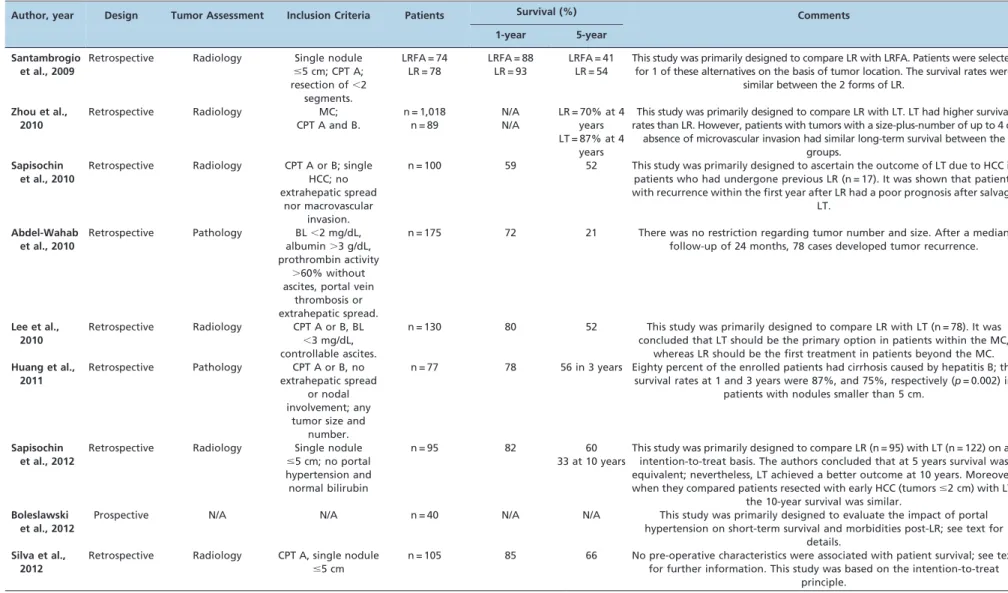
We have summarized the published studies evaluating liver
resection for patients with cirrhosis and HCC (Table 1). It is
clear that the data regarding the prognostic factors for HCC
Email: [email protected]Tel.: 55 51 9767-1801
Copyrightß2013CLINICS– This is an Open Access article distributed under the terms of the Creative Commons Attribution Non-Commercial License (http:// creativecommons.org/licenses/by-nc/3.0/) which permits unrestricted non-commercial use, distribution, and reproduction in any medium, provided the original work is properly cited.
No potential conflict of interest was reported.
DOI:10.6061/clinics/2013(04)01
EDITORIAL
Table 1 -
Results of a series evaluating liver resection in patients with hepatocellular carcinoma and cirrhosis.
Author, year Design Tumor Assessment Inclusion Criteria Patients Survival (%) Comments
1-year 5-year
Llovet et al., 1999
Retrospective Radiology Single nodule up to 5 cm, well-preserved
liver function.
n = 77 85 51 SPH and BL were the factors associated with survival. The subset of patients with neither SPH nor BL$1 mg/dL had a 5-year survival rate of 74%. This study compared
the results of 2 independent arms of HCC patients undergoing LR or LT. Chiappa
et al., 2000
Retrospective Pathology Not defined n = 51 89 53 at 3 years After a median follow-up of 28 months, tumor recurrence occurred in 45% of cases. Microvascular invasion and symptomatic tumors were associated with poor
long-term survival. Grazi et al.,
2001
Retrospective Pathology CPT A or B without ascites, HE, or esophageal varices.
n = 264 N/A 41 Patients who underwent resection after 1992 (n = 157) had higher 5-year survival rates than the remainder (49%versus32%,p,0.05).
Yamamoto et al., 2001
Retrospective Radiology Without ascites or jaundice;.3 cm and
.3 nodules.
n = 58 96 61 This study was primarily designed to compare resection (n = 58) to PEI (n = 39). The survival rates were similar between the groups (p= 0.96), although the cohorts had
different baseline characteristics. Poon et al.,
2002
Prospective Pathology Neither extrahepatic spread nor macrovascular
invasion.
n = 206 Group 1 = 70 Group 2 = 161
Group A = 33 Group B = 44
This study was primarily designed to compare extended LR (Group 1, n = 45) to lesser extent liver resection (Group 2, n = 161). Eighty-six percent of the patients had
hepatitis B cirrhosis.
Ercolani et al., 2003
Retrospective Pathology Not defined n = 224 83 42 Ninety-eight patients received TACE prior to LR. Patients with a single nodule had higher long-term survival in the multivariate analysis.
Ferrero et al., 2005
Retrospective Pathology Not defined n = 241 #70 yrs = 74 .70 yrs = 81
#70 yrs = 32 .70 yrs = 48
This study was primarily designed to compare LR according to age (#70 yrs, n = 177) and (.70 yrs, n = 64). The survival rates were similar between the groups (p= 0.081).
Wu et al., 2005
Retrospective Pathology Absence of vein invasion or extrahepatic spread
n = 426 N/A N/A
Group 1 = 61 Group 2 = 46
This study was primarily designed to compare LR according to the period (1991-1996, n = 161, Group 1) and (1997 – 2002, n = 265, Group 2). The 5-yeear survival
rates were higher in Group 2 (p,0.001). Margarit
et al., 2005
Retrospective Radiology CPT A, single nodule up to 5 cm,,70 yrs, normal BL, without
SPH.
n = 73 LR = 92 LT = 78
LR = 70 LT = 65
This study was primarily designed to compare LR (n = 37) to LT (n = 36). TACE prior to LR and LT was performed in selected cases.
Capussotti et al., 2006
Retrospective Pathology Not defined n = 217 N/A SPH = 29 No SPH = 39
Patients with SPH had poor long-term survival rates (p= 0.020); however, when
considering only CPT A patients, the survival rates were similar between the groups (p= 0.503).
Taura et al., 2007
Retrospective Pathology MC CPT A = 129 CPT B = 37
N/A N/A
54 28
This study included a third subgroup of non-cirrhotic patients (n = 127). The presence of cirrhosis was associated with lower overall survival and a greater risk of
recurrence. Ishizawa
et al., 2008
Retrospective Pathology Depending on ascites, BL, and
ICGR15.
n = 434 N/A SPH = 56 No SPH = 71
This study was primarily designed to compare patients with SPH (n = 136) to those without PH (n = 250). CPT B patients had a 5-year survival rate of 19%. The results shown in the table correspond to the subset of CPT A patients. Eighteen percent of
the enrolled cases had no cirrhosis. Park et al.,
2009
Retrospective Radiology CPT A, MC
n = 213 92 69 Patients were followed for 34 (1–145) months. Six patients underwent salvage living donor LT. The overall survival between patients with a single nodule and 2-3
nodules separately were not shown.
Resection,
portal
hypertensio
n
and
HCC
Silva
MF
et
al.
CLINICS
2013;68
(4):437-440
Author, year Design Tumor Assessment Inclusion Criteria Patients Survival (%) Comments
1-year 5-year
Santambrogio et al., 2009
Retrospective Radiology Single nodule #5 cm; CPT A; resection of,2
segments.
LRFA = 74 LR = 78
LRFA = 88 LR = 93
LRFA = 41 LR = 54
This study was primarily designed to compare LR with LRFA. Patients were selected for 1 of these alternatives on the basis of tumor location. The survival rates were
similar between the 2 forms of LR.
Zhou et al., 2010
Retrospective Radiology MC; CPT A and B.
n = 1,018 n = 89
N/A N/A
LR = 70% at 4 years LT = 87% at 4
years
This study was primarily designed to compare LR with LT. LT had higher survival rates than LR. However, patients with tumors with a size-plus-number of up to 4 or
absence of microvascular invasion had similar long-term survival between the groups.
Sapisochin et al., 2010
Retrospective Radiology CPT A or B; single HCC; no extrahepatic spread
nor macrovascular invasion.
n = 100 59 52 This study was primarily designed to ascertain the outcome of LT due to HCC in patients who had undergone previous LR (n = 17). It was shown that patients with recurrence within the first year after LR had a poor prognosis after salvage
LT.
Abdel-Wahab et al., 2010
Retrospective Pathology BL,2 mg/dL, albumin.3 g/dL, prothrombin activity
.60% without ascites, portal vein
thrombosis or extrahepatic spread.
n = 175 72 21 There was no restriction regarding tumor number and size. After a median follow-up of 24 months, 78 cases developed tumor recurrence.
Lee et al., 2010
Retrospective Radiology CPT A or B, BL ,3 mg/dL, controllable ascites.
n = 130 80 52 This study was primarily designed to compare LR with LT (n = 78). It was concluded that LT should be the primary option in patients within the MC,
whereas LR should be the first treatment in patients beyond the MC. Huang et al.,
2011
Retrospective Pathology CPT A or B, no extrahepatic spread
or nodal involvement; any
tumor size and number.
n = 77 78 56 in 3 years Eighty percent of the enrolled patients had cirrhosis caused by hepatitis B; the survival rates at 1 and 3 years were 87%, and 75%, respectively (p= 0.002) in
patients with nodules smaller than 5 cm.
Sapisochin et al., 2012
Retrospective Radiology Single nodule #5 cm; no portal hypertension and normal bilirubin
n = 95 82 60 33 at 10 years
This study was primarily designed to compare LR (n = 95) with LT (n = 122) on an intention-to-treat basis. The authors concluded that at 5 years survival was equivalent; nevertheless, LT achieved a better outcome at 10 years. Moreover, when they compared patients resected with early HCC (tumors#2 cm) with LT,
the 10-year survival was similar. Boleslawski
et al., 2012
Prospective N/A N/A n = 40 N/A N/A This study was primarily designed to evaluate the impact of portal hypertension on short-term survival and morbidities post-LR; see text for
details. Silva et al.,
2012
Retrospective Radiology CPT A, single nodule
#5 cm
n = 105 85 66 No pre-operative characteristics were associated with patient survival; see text for further information. This study was based on the intention-to-treat
principle.
Abbreviations: SPH, significant portal hypertension; BL, serum total bilirubin; HCC, hepatocellular carcinoma; LR, liver resection; LT, liver transplantation; CPT, Child-Pugh-Turcotte; N/A, not available; HE, hepatic encephalopathy; PEI, percutaneous ethanol injection; TACE, transarterial chemoembolization; ICGR15, indocyanine green retention rate at 15 minutes; MC, Milan criteria; LRFA, laparoscopic radiofrequency ablation.
Table 1 -
Continued.
CLINICS
2013;68(4):
437-440
Resection,
portal
hyperten
sion
and
HCC
Silva
MF
et
al.
patients undergoing liver resection are scarce. Current
recommendations for patient selection for liver resection
versus
liver transplantation for tumors
#
5 cm are still based on the
original Barcelona group publication, which was based on a
retrospective analysis of a case series from the 1990s (5). Note
that given the limitations of retrospective studies, the robustness
of evidence supporting this finding must be validated following
evidenced-based ranking systems (9). Basing recommendations
on the results of liver resection performed in the 1990s ignores
recent improvements in the perioperative care of cirrhotic
patients (10). These recommendations may also limit access to
liver resection for patients who have no or limited access to liver
transplantation.
In conclusion, further well-designed trials are warranted
to evaluate the role of significant portal hypertension in
predicting liver resection outcomes for HCC patients.
Nevertheless, until further well-designed prospective
stu-dies are undertaken, the recommendations of the EASL–
HCC Clinical Practice Guidelines should remain in place.
&
AUTHOR CONTRIBUTIONS
All of the authors declare that they contributed equally to the text.
&
REFERENCES
1. Boleslawski E, Petrovai G, Truant S, Dharancy S, Duhamel A, Salleron J, et al. Hepatic venous pressure gradient in the assessment of portal hypertension before liver resection in patients with
cirrhosis. Br J Surg 2012;99(6):855-63, http://dx.doi.org/10.1002/ bjs.8753.
2. European Association For The Study Of The Liver; European Organisation For Research And Treatment Of Cancer. EASL–EORTC Clinical Practice Guidelines: Management of hepatocellular carcinoma. J Hepatol. 2012;56(4):908-43.
3. Simpson KJ, Finlayson ND. Clinical evaluation of liver disease. Baillieres Clin Gastroenterol 1995;9(4):639-59, http://dx.doi.org/10.1016/0950-3528(95)90054-3.
4. Bruix J, Castells A, Bosch J, Feu F, Garcia-Pagan JC, Visa J, et al. Surgical resection of hepatocellular carcinoma in cirrhotic patients: prognostic value of preoperative portal pressure. Gastroentrology. 1996; 111(4):1018-22, http://dx.doi.org/10.1016/S0016-5085(96)70070-7. 5. Llovet JM, Fuster J, Bruix J. Intention-to-Treat analysis of surgical
treatment for early hepatocellular carcinoma: resection versus trans-plantation. Hepatology. 1999;30(6):1434-40, http://dx.doi.org/10.1002/ hep.510300629.
6. Bruix J, Sherman M. Management of hepatocellular carcinoma: an update. Hepatology. 2011;53(3):1020-2, http://dx.doi.org/10.1002/hep. 24199.
7. Llovet JM, Di Bisceglie AM, Bruix J, Kramer BS, Lencioni R, Zhu AX, et al. Design and endpoints of clinical trials in hepatocellular carcinoma. J Natl Cancer Inst. 2008;100(10):698-711.
8. Germani G, Gurusamy K, Garcovich M, Toso C, Fede G, Hemming A, et al. Which matters most: Number of tumors, size of the largest tumor, or total tumor volume? Liver Transpl. 2011;17(suppl 2);S58-S66, http:// dx.doi.org/10.1002/lt.22336.
9. Guyatt GH, Oxman AD, Vist G, Kunz R, Falck-Ytter Y, Alonso-Coello P, et al. GRADE: an emerging consensus on rating quality of evidence and strength of recommendations. BMJ. 2008;336(7650):924-6, http://dx.doi. org/10.1136/bmj.39489.470347.AD.
10. Tremosini S, Reig M, De Lope CR, Forner A, Bruix J. Treatment of early hepatocellular carcinoma: towards personalized therapy. Dig Liver Dis. 2010;42 Suppl:S242-S8, http://dx.doi.org/10.1016/S1590-8658(10)60512-9.
Resection, portal hypertension and HCC
Silva MF et al. CLINICS 2013;68(4):437-440