ISSN 0102-695X http://dx.doi.org/10.1590/S0102-695X2012005000078 Received 01 Nov 2011 Accepted 12 Jan 2012 Available online 5 Jun 2012
Ocean, Northeast Brazil
Ingrid B. Silva,
1Mutue T. Fujii,
2Eliane Marinho-Soriano
*,11Departamento de Oceanografia e Limnologia, Universidade Federal do Rio
Grande do Norte, Brazil,
2Instituto de Botânica, São Paulo-SP, Brazil.
Abstract: The worldwide increase in recreational activities and marine tourism is reason for concern due to its impact on reef environments. In order to assess the effect of tourism on the reef area in Maracajaú (Northeast Brazil), a study was conducted based on the presence of different seaweed species. A region of intense tourist activity was chosen, and another where tourism is prohibited. Result comparison used richness (S), biomass, diversity (H), and dominance (D), as well as an analysis of similarity between
samples. Both areas exhibited differences in specii c composition, biomass, diversity,
richness and seaweed dominance. The highest values for biomass, richness and diversity were recorded in the tourism-free region, while the greatest dominance rates were found in the area of intense tourist activity. The latter was characterized by the dominant presence of Caulerpa racemosa (Forsskål) J. Agardh (Chlorophyta) and turf algae. These characteristics are a clear indication that the reef area subject to heavy tourist activity is undergoing degradation.
Keywords: reef environment macroalgae diversity tourism
Introduction
Seaweeds are considered to be important ecological and economic components of marine ecosystems around the world. They occupy a variety of
habitats usually i xed upon a hard (organic or inorganic)
substrate, including reefs, rocky shores, mangrove roots, sea grass meadows, and, less commonly, growing
i xed on sandy bottoms or even free l oating. Algae are organisms of great signii cance in reef environments and
are present in diverse conditions, carrying out several functions. These include primary production, construction and cementation of reefs, as well as facilitating the establishment of coral and formation of habitats for other
species. Despite their ecological benei ts, they can also
contribute to degradation in coral reefs, particularly in “phase shift” where coral species are replaced by seaweed species (McCook, 1999).
Natural and anthropogenic disturbances can cause one dominant organism to replace another (Petraitis & Dudgeon, 2004). These changes in natural
communities can affect the l ow of energy, abundance
and diversity of the native community and valuable services to human society (Sousa, 1984; Pickett & White,
1985). Reduction in herbivores due to overi shing and an
increase in nutrient and sediment loads are contributing factors in this process.
Healthy reef environments provide signii cant economic and ecological benei ts to coastal communities, including i shing, protection from coastal erosion,
food and tourism. The wide biological diversity of these environments is also being explored for bioactive compounds used in drug manufacturing. Despite their obvious value to humans, most coral reefs around the world are endangered or have already been destroyed by human activities (Bryant et al., 1998).
The effect of increased tourist and recreational activities on reef areas has been cause for concern with regard to balance in these environments. Recreational marine activities affect corals in many ways, such as trampling, breakages, physical contact with organisms, sediment resuspension, behavioral changes among marine life due to food offerings, animal harassment, trash and
debris production. There are also inl uences resulting from the trafi c and anchoring of vessels and exceeding
the carrying capacity of dive sites - little known in most conservation areas.
do Norte state coastline are the reefs of Maracajaú. This reef complex inserted within an environmental protection area has been the target of severe pressure in recent decades, showing signs of degradation caused primarily
by tourist exploitation, overishing and disordered coastal
occupation.
In order to assess the impact of tourism on Maracajaú reefs, a study was conducted based on the distribution of different seaweed species. These organisms are considered to be ideal bioindicators, since
their presence, density and dominance relect the status
of natural conditions in the environment. Seaweeds were studied in two areas, one with tourist presence (beside a
loating structure used as a dive base) and another where
visitation is prohibited. Indices of richness, diversity and dominance for both areas were compared, as well as biomass for the most abundant species. Analysis of similarity between samples was also carried out to determine clusters formed according to the area of occurrence and abundance of species. This enabled
identiication of possible differences not only in speciic
composition for the two study areas, but also in how these species are or are not forming associations or clusters.
Materials and methods
The present study was conducted in Maracajaú (5°24'40"S - 35°18'40"W), located in Rio Grande do Norte state, Northeast Brazil. These reefs integrate the Coral Reefs Environmental Preservation Area, a conservation unit created in June, 2001. It encompasses the coastal belt and shallow ocean platform, extending over three municipalities and totaling around 33 thousand hectares of protected area. At a distance of 7 km from the coast, the reefs of Maracajaú occupy an area 9 km long and 2 km wide. Shallow pools of clear, warm water are visible for most of the year at low tide. Several coral species associated with marine seaweed are commonly
found in this region. Artesanal and subsistence ishing are
permitted along the entire reef, while recreational diving is only allowed in part of the area.
Two collection sites were established for the investigation (mean depth of 2.5 m). One corresponded to a region where tourist activity is not allowed (A1), while
the other was 800 m from the irst and subject to intense
tourism (A2). Proximity between the areas is expected to minimize the environmental gradient, so that the main factor acting differently on seaweeds is the practice of recreational diving and all related impacts (physical
contact and trampling by visitors, vessel trafic, motor
oil and sediment resuspension). The size of the reef formation was also taken into account when selecting sampling sites, in addition to the direction of currents, type of sea bottom and distance between the sampling
sites and support base (an anchored loating structure)
used to receive tourists.
At each sampling location, seaweed biomass was measured monthly from April to September, 2005,
using a 25x25 cm square (ive repetitions) placed
randomly along a 10 m transect. All material collected was placed in labeled bags and stored in containers of seawater until arrival at the laboratory, where the
seaweed was examined, identiied and weighed. The nomenclature and classiication system used followed
Wynne (2011). Voucher material is deposited in the Macroalgae Laboratory collection of the Department of Oceanography and Limnology of the Federal University of Rio Grande of Norte.
Biomass for each taxon was determined separately every month. The structure of the seaweed community was analyzed through its taxonomic composition, species richness, the Shannon Wiener diversity index and Simpson’s index of dominance, and these indicators compared between the two collection
sites. The signiicance of the differences was tested using
the t-test and variance was assessed by ANOVA (one-way). Both were applied with Statistica 6.0 software (StatSoft®, 1998). Cluster analysis was applied using
the Bray-Curtis similarity index in order to determine clusters formed according to the area of occurrence.
This enabled the identiication of possible differences between speciic compositions for both study areas. The
proposed dendrograms were compiled with the Primer statistics package 5.0 (Plymouth Routines In Multivariate Ecological Research).
Results and Discussion
A total of 53 taxa, consisting of 5 Chlorophyta,
13 Ochrophyta and 35 Rhodophyta, were identiied at
the two sites sampled during this study. The selected
study areas exhibited differences in speciic composition,
species occurrence frequency, biomass, diversity and dominance indices. The number of species presented little difference among sample sites, the highest found at A1 (48) and the lowest at A2 (42) (Figure 1a). Among the collected species, 71.7% were common to both areas, 20.8% were only present in A1 and 7.6% in A2. The highest number of species recorded was for Dictyotaceae and Corallinaceae in A1 and Rhodomelaceae and Dictyotaceae in A2.
Biomass was signiicantly different between
the sites (p<0.05). As expected, the largest values were recorded in A1 and the lowest in A2 (Figure 1b). The means for the study period were 237.78±65.63 and 118.02±59.14 g dry weight for A1 and A2, respectively. A1 showed predominance of brown seaweed species from the order Fucales and Dictyotales (mainly Sargassum hystrix
J. Agardh and Dictyopteris delicatula J.V. Lamouroux).
similar biomass values, indicating no notable dominance of any particular species. In contrast, the dominance of Caulerpa racemosa (Forsskål) J. Agardh over other seaweed species in the community was observed in A2. In addition to C. racemosa, a large extension of turf algae was observed in this area throughout the study period.
The greatest diversity was seen in A1 (Figure 1c). This is likely due to habitat complexity, since the area is protected from tourist activity. In general, increased complexity of an environment generates higher numbers of distinct niches and, consequently, allows greater species coexistence (Dean & Connel, 1987). In contrast, in A2, which suffered the impact of tourists and all its consequences, including trampling and sediment resuspension, dominance was higher (Figure 1d). Frequent disturbance at this site caused by human presence lowers the attachment capacity of spores and prevents seaweeds from fully developing. Ecological imbalance in this location favors the presence of annual seaweeds with short life cycles, as well as that of the opportunistic C. racemosa.
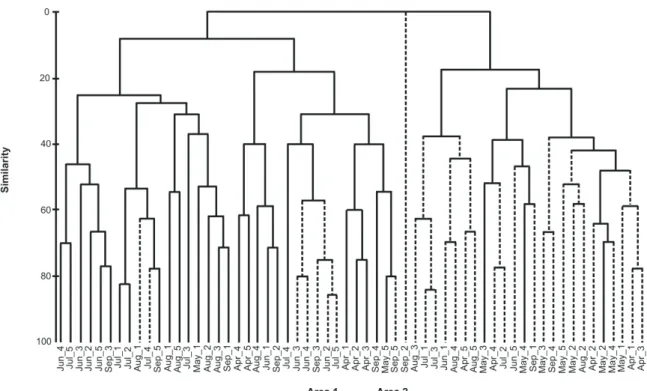
Another result demonstrating differences between the two sites was the dendrogram based on similarity analysis illustrating a division into two large, distinct clusters (Figure 2). Samples from area A1 were predominant in group 1 (G1), where brown seaweeds were more notable. According to previous investigations (Hughes, 1994; Szmant, 2001), the preponderance of foliose seaweed is more evident in locations with lesser pressure of herbivores. In this sense, the “top-down”
hypothesis contends that signiicant declines in herbivores,
such as herbivorous ish, are primarily responsible for
increased algal abundance (Hughes, 1994; Gardner et al., 2003).
Group 2 showed greater species representation
at site A2 and formed the three well-deined subgroups
discussed below. The isolated element in the center of the dendrogram (G3) corresponds to a subsample collected in September in the impacted area, consisting exclusively of the red seaweed Gelidiella acerosa (Forssk.) Feldmann & Hamel.
The three subgroups formed by the cluster analysis are a reflection of the three types of associations identified in A2, categorized in accordance with biological composition. The first association consisted of articulated coralline algae (Jania adhaerens J.V. Lamour., Amphiroa beauvoisii J.V. Lamour., Amphiroa anastomosans Weber Bosse), forming extensive banks with cortical (Hypnea spinella (C. Agardh) Kütz., Laurencia catarinensis Cord.-Mar & M.T. Fujii, Gelidiopsis planicaulis (W.R. Taylor) W.R. Taylor, Lomentaria corallicola Børgesenand Chondria dangaerdii E.Y. Dawson) and filamentous epiphyte algae (Ceramium dawsonii A.B. Joly, C. flaccidum (Kütz.) Ardiss., Neosiphonia gorgoniae (Harv.) S.M. Guim. & M.T. Fujii). A second association was made up of Pterocladiella caerulensces (Kütz.) Sant. & Homm.,
G. planicaulis and their epiphytes (mainly Ceramium dawsonii, C. vagans P.C. Silva and N. gorgoniae). The third consisted of Gelidiella ligulata E.Y. Dawson and epiphytes (primarily C. dawsonii). In general, these associations involved small algae with short life cycles
that can easily adapt to environments subject to frequent disruption (Kendrick, 1991; Semple, 1997; Soltan et al., 2001).
In addition to natural troubles, macroalgae communities are exposed to anthropogenic disturbances. Indeed, in the site frequently visited by tourists (A2), direct impacts include the effects of trampling and damage caused by vessels, including anchoring, propeller damage and chemical damage from release of petrochemicals and oil. This may have resulted in a shift in coverage in which turf algal species and C. racemosa became the dominant algae.
The present study shows that the seaweed communities are substantially different in the two areas sampled. As expected, the site without tourist presence exhibited greater species diversity, while the algal community in the area frequently visited by tourists was composed of small algae with short life cycles that easily adapt to frequently disturbed environments. These characteristics are a clear indication of degradation in the reef area subject to intense tourist activity. The results obtained in this study on the Maracajau reefs call for a serious discussion of the need for appropriate conservation this environment.
Acknowledgments
This study was supported by the CNPq and CAPES.The authors thank Estevão Martins, Vanessa Benigno, Marcelo Zigmond and the local dive operators
for support in the ield.
References
Bryant D, Burke L, McManus J, Spalding M 1998. Reefs at risk: a map-based indicator of potential threats to the world's coral reefs. Washington: Copyright.
Dean RL, Connell JH 1987. Marine invertebrates in algal succession. I. Variations in abundance and diversity with succession. J Exp Mar Biol Ecol 109: 195-215. Gardner TA, Côte IM, Gill JA, Grant A, Watkinson AR 2003.
Long-term region-wide declines in Caribbean corals.
Science 301: 958-960.
Hughes TP 1994. Catastrophes, phase shifts, and large-scale degradation of a Caribbean Coral Reef. Science 265: 1547-1551.
Kendrick GA 1991. Recruitment of coralline crusts and
ilamentous turf algae in the Galapagos archipelago:
effect of simulated scour, erosion and accretion. J Exp Mar Biol Ecol 147: 47-63.
Maida M, Ferreira BP 1997. Coral reefs of Brazil: an overview.
Proc 8th Coral Reef Sym 1: 263-274.
McCook LJ 1999. Macroalgae, Nutrients and phase shifts on coral reefs: scientific issues and management consequences for the Great Barrier Reef. Coral Reefs 18: 357-367.
Petraitis PS, Dudgeon SR 2004. Detection of alternative stable states in marine communities. J Exp Mar Biol Ecol 300: 343-371.
Pickett STA, White PS 1985. The ecology of natural disturbance and patch dynamics. Orlando: Academic Press. Semple K 1997. Biodegradation of phenols by a eukaryotic
alga. Res Microbiol 148: 365-367.
Soltan D, Verlaque M, Boudouresque CF, Francour P 2001. Changes in macroalgal commuties in the vicinity of a Mediterranean sewage outfall after the setting up of a treatment plant. Mar Pollut Bull 42: 59-70.
Sousa WP 1984. The role of disturbance in natural communities. Annu Rev Ecol Syst 15: 353-391. Szmant AM 2001. Why are coral reefs world-wide becoming
overgrown by algae? ‘Algae, algae everywhere, and nowhere a bite to eat!’ Coral Reefs 19: 199-302. Wynne MJ 2011. A checklist of marine benthic algae of tropical
and subtropical Western Atlantic: third revision. Nova Hedwigia 140: 1-166.
*Correspondence
Eliane Marinho-Soriano
Departamento de Oceanograia e Limnologia, Universidade
Federal do Rio Grande do Norte
Praia de Mãe Luiza, s/n, 59014-100 Natal-RN, Brazil [email protected]