www.fob.usp.br/revista or www.scielo.br/jaos
T
O
ABSTRACT
RESUMO
ATRAUMATIC RESTORATIVE TREATMENT (ART) –
FACTORS AFFECTING SUCCESS
TRATAMENTO RESTAURADOR ATRAUMÁTICO (ART) –
FATORES QUE AFETAM O SUCESSO
Steffen MICKENAUTSCH1, Elly GROSSMAN2
1 Division of Public Oral Health, University of the Witwatersrand, Johannesburg, South Africa. 2 Dental Research Institute, University of the Witwatersrand, Johannesburg, South Africa.
Correspondence address: Dr. S Mickenautsch - P.O. Box 2779, Houghton 2041 - Johannesburg, South Africa - Email: [email protected] Tel +27 11 646 7614 - Fax +27 11 646 7614.
he success of tooth restorations rendered according to principles of the Atraumatic Restorative Treatment (ART) approach is dependant on various clinical factors. The most common failures, due to these factors, are partial material loss; complete material loss; caries related to restoration margin and material wear > 0.5mm. The main reason for clinical ART failures are related to operator skills and performance. The prevention and management of ART failures includes emphasis on correct clinical indication and the repair of failed restorations. A new caries classification may provide guidance for clinical indication. The classification combines site and size of a lesion, which is reflected in a dual coding system. In addition, ART training and diligence during ART application are important for clinical success.
Uniterms: Atraumatic Restorative Treatment; Minimum intervention; Glass-ionomer cements.
sucesso de restaurações dentais resultante dos princípios do Tratamento Restaurador Atraumático (ART) é dependente de vários fatores clínicos. A falhas mais comuns decorrentes desses fatores estão relacionadas com o desgaste do material (>0,5 mm); perda parcial do material; perda completa do material e cárie associada à margem da restauração. A principal razão para as falhas clínicas do ART está relacionada com a habilidade e performance do operador. A prevenção e controle das falhas do ART incluem ênfase na correta indicação e no reparo de restaurações falhas. Uma nova classificação de cáries pode servir de guia para a indicação clínica. A classificação combina localização e extensão da lesão, a qual é expressa em um sistema de código duplo. Adicionalmente, o treinamento e domínio durante a aplicação do ART são fatores importantes para o sucesso clínico.
Uniterms: Tratamento Restaurador Atraumático; Minima invasão; Cimentos de ionômero de vidro.
The success of tooth restorations rendered according to principles of the Atraumatic Restorative Treatment (ART) approach is dependant on various clinical factors. The most common failures, due to these factors, are:
· Partial material loss · Complete material loss
· Caries related to restoration margin · Material wear > 0.5mm
In contrast to other ART failures, the occurrence of failures related to continued caries has steadily decreased due to improvements in restorative materials and operator skills2. ART failures may occur in combination or lead to
each other, e.g. material loss may promote occurrence of secondary caries, or partial defects may lead to complete
loss of the restorative material over time.
During caries progression beyond the enamel-dentine junction, dentine is first exposed to bacterial acids resulting in extensive demineralization of peritubular dentine and partial mineral loss of intertubular dentine. This early exposure is followed by bacterial invasion, together with the denaturation of dentinal collagen by proteolytic enzymes. As result carious dentine can be divided into affected dentine (a partially deminerialized thus harder inner layer, containing only few bacteria) and infected dentine (a largely demineralised, thus much softer denatured outer layer). The outer layer contains the majority of bacteria. In addition, the complete loss of odontoblast processes in this layer, caused by proteolysis, renders this layer
non-34
sensitive3. Hand excavation, as a mechanical form of
selective caries removal, is capable of removing most of the infected dentine. However, research shows that bacteria remain present after complete hand excavation within the tubuli of affected dentine1. The potential caries risk due to
the remaining bacteria can be successfully controlled by reducing bacterial activity and through remineralisation. Caries activity can be reduced through effective nutrient deprivation by sealing the cavity using filling materials which chemically bond to the cavity walls and which assist remineralisation of affected dentine through longtime fluoride and mineral release8. The current materials of choice
are high strength glass ionomer cements (GIC)2. Hence, a
loss of GIC filling material would also result in the loss of caries - arresting factors. Therefore, a good chemical bond between material and tooth tissue appears to be important for the success of ART restorations.
Clinical factors responsible for ART failures are 1. Material factors
2. Operator factors 3. Technique factors
Material factors
Material factors are directly related to material (GIC) properties, such as physical strength, flow rate and material consistency. With the development of newer high strength glass ionomer cements, physical properties have been improved. However, the strength of GIC remains inferior to traditional restorative materials, particularly amalgam and composite resin. The flow rate of GIC is directly related to the adaptability to the cavity surface. Improved GIC flow rate may reduce void formation. In addition, small void formation (diameter < 0.1mm) within the restoration, may depend on the type of material mix, capsule or hand mix. Hand mix is operator dependant and thus may incorporate more air entrapments then capsule mixing. A large number of voids may weaken the material and make it prone to higher wear and material loss on restoration margins4.
Operator factors
Operator factors relate to failures caused by insufficient operator performance, particularly in the areas of incorrect clinical indication, caries removal, moisture control, cavity conditioning, material mixing (hand mix) and material insertion2. Operator decisions leading to incorrect
application of ART under clinical conditions not favorable for ART may result in a too large restoration, with constant exposure to masticatory forces, exceeding GIC strength. In combination with limited physical strength of GIC (material factor) this may lead to restoration fracture and subsequent loss of restorative material. Insufficient removal of infected dentine, particularly on the cavity circumference may cause a reduced chemical bond between tooth tissue and material, higher residual bacteria count and the access of those bacteria to substrates via occurring leakage with subsequent further caries progression.
Insufficient cavity conditioning, as well as saliva contamination of the prepared cavity through insufficient
moisture control supports the retention of a smear layer attached to tooth tissue. Such smear layer compromises the chemical bonding process of GIC to the cavity walls. Weak bond strength causes an increased likelihood of material loss. In contrast, the reduction of the smear layer through effective dentine conditioning using a 10% poly acrylic acid (PAA) for 10-15 seconds improves the bond strength between material and tooth tissue. The correct material consistency is vital for effective material retention and physical strength. A too dry mixture has limited bond strength, a too moist mixture reduce resistance to wear and compressive strength. Furthermore, GIC needs to be inserted into the cavity in increments and condensed. Incorrect insertion and /or condensation will cause air entrapments, causing reduced physical strength of the restoration 3.
A study, measuring operator performance in relation to the level of void avoidance, showed that initial training is needed. It was also shown that after training, experience levels are less important than operator diligence during the ART procedure4,5.
Technique factors
Hand excavation and press finger technique are both components, unique to clinical ART protocol2. Hand
excavation causes enamel fracturing and irregularities in dentine. Both manifest as challenges to a good marginal GIC adaptation, important for effective bond strength of the material to the cavity walls. In addition, press finger technique causes a rough restoration surface with irregular margins, supporting potential plaque and bacteria retention. However, self-smoothening occlusal forces and the antibacterial action of GIC may counter act such negative effect5.
Failure prevention and management
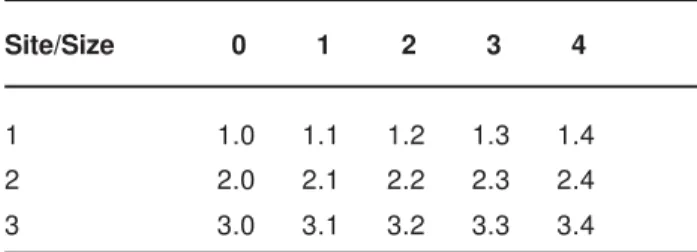
The prevention and management of ART failures includes emphasis on correct clinical indication and the repair of failed restorations. A new caries classification may provide guidance for clinical indication. The classification combines site and size of a lesion, which is reflected in a dual coding system and expressed in the form of a grid (Table 1)6,7. The classification of sites follows the three
surface areas on which caries occurs.
· Site 1: pits & fissures (occlusal and other smooth tooth surfaces)
· Site 2: contact area between two adjacent teeth · Site 3: cervical area in contact with gingival tissues The classification of size follows four stages of the carious lesion:
Site/Size 0 1 2 3 4
1 1.0 1.1 1.2 1.3 1.4
2 2.0 2.1 2.2 2.3 2.4
3 3.0 3.1 3.2 3.3 3.4
TABLE 1- New caries classification / Summary of classes
· Size 0: carious lesion without cavitation and can be remineralized
· Size 1: small cavitation- just beyond healing through remineralisation
· Size 2: moderate cavity not extended to cusps · Size 3: enlarged cavity, with at least one cusp which is undermined and which needs protection from occlusal load · Size 4: extensive cavity, with at least one cusp or incisal edge which is lost
Clinical studies on the success rates of ART fillings show a higher success related to one surface restoration, without any occlusal or proximal contact with antagonistic or neighboring teeth (Site 1 / Size 1 and 2), particularly in the permanent dentition2.
The management of ART failures follows principles of restoration repair instead of replacement2. Table 2 provides
an overview how to repair failed ART restorations.
CONCLUSION
The main reason for clinical ART failures are related to operator skills and performance (operator factor). Against this background, ART training and diligence during ART application are important for clinical success.
ART failure Management
Material wear > 0.5mm Cleaning GIC surface, Application of dentine conditioner
Placement of new GIC layer
Partial material loss Cleaning fracture surface, Application of dentine conditioner
Placement of new GIC layer
Complete material loss Cleaning cavity surface, Application of dentine conditioner
Placement of new GIC layer
Caries related to restoration margin Caries removal using hand excavator
Cleaning GIC surface
Application of dentine conditioner
Placement of new GIC layer
TABLE 2- ART failure management
REFERENCES
1- Bönecker M, Grossman E, Cleaton-Jones PE, Parak R. Clinical, histological and microbiological study of hand-excavated carious dentine in extracted permanent teeth. SADJ. 2003;58:273-8.
2- Frencken JE, Holmgren CJ. Atraumatic restorative treatment for dental caries. Nijmegen, STI Book b.v.; 1999. ISBN 906759024X.
3- Fusayama T. A simple pain-free adhesive restorative system by minimal reduction and total etching. Tokyo: Ishiyaku EuroAmerica Inc Tokyo; 1993. p. 1-21.
4- Grossman ES, Mickenautsch S. Microscope observations of ART excavated cavities and restorations. SADJ. Sep 2002;57:359-63
5- Mickenautsch S, Harkison B, Grossman E. Voids in ART restorations: Effect of operator expertise and mixing mode. J Dent Res. 2003;82:C-623 (Abstract 75).
6- Mount GJ, Ngo H. Minimal intervention dentistry –the early lesion. Quintessence Int. 2000;31:535-46.
7- Mount GJ, Hume RW. A new classification for dentistry. Quintessence Int. 1997;28:301-3.
8- Weerheijm KL, Groen HJ. The residual caries dilemma. Community Dent Oral Epidemiol. 1999;27:436-41.