RBCCV 44205-1515 DOI: 10.5935/1678-9741.20140005
Use of EuroSCORE as a predictor of morbidity
after cardiac surgery
Uso do EuroSCORE como preditor de morbidade no pós-operatório de cirurgia cardíaca
Isaac Newton Guimarães Andrade
1, MD; Fernando Ribeiro de Moraes Neto
2, MD, PhD; Tamirys
Guimarães Andrade
2, MD
1Institute of Cardiovascular Surgery of Paraíba, Campina Grande, PB, Brazil. 2Heart Institute of Pernambuco (INCOR-PE), Recife, PE, Brazil.
Work carried out at the Royal Portuguese Hospital of Recife, Recife, PE, Brazil.
No inancial support.
Correspondence address: Isaac Newton Guimaraes Andrade
Rua Capitão João Alves de Lira, 1004 – ap. 1302 – Prata – Campina Grande, PB, Brazil – Zip Code: 58400-560
E-mail: [email protected]
Article received on May 16th, 2013
Article approved on September 10th, 2013
Abstract
Objective: To evaluate the use of the EuroSCORE as a pre-dictor of postoperative morbidity after cardiac surgery.
Methods: We retrospectively analyzed the charts of 900 patients operated on and admitted to the intensive care unit postoperatively at the Royal Portuguese Hospital of Recife. We included all patients with complete medical records, excluding those who died during surgery, underwent transplantation or correction of congenital heart disease. We evaluated the devel-opment of respiratory infection, cerebrovascular accident, and dialysis-dependent renal failure, and the EuroSCORE was com-pared in terms of the three complications using the Mann-Whit-ney test. The calibration model for predicting the morbidities being studied was evaluated using the test set of Homer-Leme-show goodness. The accuracy of the model was assessed using the area under the ROC curve (AUROC).
Results: The model showed good calibration in predicting
respiratory infection, acute renal failure and stroke (P=0.285,
P=0.789, P=0.45, respectively), with good accuracy for re-spiratory infection (AUROC=0.710 and P<0.001) and dial-ysis-dependent renal failure (AUROC=0.834 and P<0.001), but no accuracy to predict stroke (AUROC=0.519). The high-risk patients were more likely to develop respiratory infec-tion (OR=9.05, P<0.001) and dialysis-dependent renal failure (OR=39.6, P<0.001). The probability of developing respirato-ry infection and dialysis-dependent renal failure was less than 10% with EuroSCORE up to 7 and more than 70% with Euro-SCORE greater than 15.
Conclusion: EuroSCORE proved to be a good predictor of major postoperative morbidity in cardiac surgery: respiratory and dialysis-dependent renal failure.
ies, there are no speciic scores derived from major studies
capable of predicting the chances of developing such compli-cations and, hence, capable of predicting morbidity.
This study sets out to evaluate the EuroSCORE as a pdictor of morbidity, since it is simple and practical, has a re-duced number of variables, and is widely used throughout the world, having been validated several times, including in our midst, with good results [11,12].
METHODS
This cross-sectional observational study was developed at the Thoracic Surgery Recovery Unit of the Royal Portu-guese Hospital of Recife. Medical records of 900 out of 1036 patients operated on from July 1, 2008 to July 30, 2009 were analyzed. Patients with complete medical records were in-cluded in the study and patients who died during surgery or who had undergone either cardiac transplant or correction of congenital heart disease were excluded. Data was col-lected from electronic medical records and inserted into an Excel spreadsheet containing all the variables included in
the study. A speciic calculator was used to obtain the Eu -roSCORE, classifying patients into the following three risk groups, according to additive score values: high, medium,
INTRODUCTION
Risk stratiication has become more relevant in cardiac surgery practice with the use of speciic scores, which are
important tools to measure risk, analyze quality of care, and evaluate costs [1,2]. Thus, several scores have been devel-oped and applied to predict mortality in cardiac surgery [3,4]. Calculating surgical risk, i.e., death, is relatively simple since the response variable “death” is an obvious excluding vari-able. However, studying causes of death is often a lot more
complex as there are multiple variables, making it dificult to develop speciic scores to predict mortality. In addition, the
relationship between the development of a complication and death does not always hold true; nonetheless, it can prolong hospital stay and change patients’ quality of life [5].
In cardiac surgery, when the following three major events
are present, there is greater risk of death: onset of respiratory tract infection (RTI), preoperative cerebrovascular accident (CVA), and dialysis-dependent renal failure (DDRF) [6-9]. Besides being associated with higher mortality rates, those events are the leading cause of readmission to the intensive care unit, increasing hospital costs [10].
Even though it is known that those adverse events can
deinitely contribute to unfavorable results in cardiac surger
-Abbreviations, acronyms & symbols
AUROC Area under the ROC curve CVA Cerebrovascular accident
EuroSCORE European System for Cardiac Operative Risk Evaluation
DDRF Dialysis-dependent renal failure RTI Respiratory tract infection ROC Receiver Operating Characteristic SPSS Statistical Package for the Social Sciences ITU Intensive therapy unit
Resumo
Objetivo: Avaliar o uso do EuroSCORE como preditor de morbidade no pós-operatório de cirurgia cardíaca.
Métodos: Foram analisados, retrospectivamente, os prontu-ários de 900 pacientes operados no Real Hospital Português do Recife e admitidos na unidade de terapia intensiva pós-opera-tória. Foram incluídos todos os pacientes com prontuários com-pletos, sendo excluídos aqueles que foram a óbito no transope-ratório, submetidos a transplante ou a correção de cardiopatia congênita. Foi avaliado o desenvolvimento de infecção respira-tória, acidente vascular cerebral e insuiciência renal dialítica,
sendo o EuroSCORE comparado em relação às três complica-ções, usando-se o teste de Mann-Whitney. A calibração do mo-delo para predição das morbidades estudadas foi avaliado com o teste de ajuste de bondade de Homer-Lemeshow. A acurácia do modelo foi avaliada utilizando-se a área sob a curva ROC (ASROC).
Resultados: O modelo apresentou boa calibração na predi-ção de infecpredi-ção respiratória, insuiciência renal dialítica e aci -dente vascular cerebral (P=0,285; P=0,789; P=0,45, respectiva-mente), tendo boa acurácia para infecção respiratória (ASROC =0,710 e P<0,001) e insuiciência renal dialítica (ASROC=0,834
e P<0,001) e sem acurácia para acidente vascular cerebral (AS-ROC=0,519). Os pacientes de alto risco apresentaram maior chance de desenvolver infecção respiratória (OR=9,05; P<0,001) e insuiciência renal dialítica (OR=39,6; P<0,001). A probabili-dade de desenvolver infecção respiratória e insuiciência renal dialítica foi de menos de 10% com EuroSCORE até 7 e de mais de 70% com EuroSCORE maior que 15.
Conclusão: O EuroSCORE mostrou-se um bom preditor das principais morbidades pós-operatórias em cirurgia cardía-ca: infecção respiratória e insuiciência renal dialítica.
and low. Variables studied were EuroSCORE values, death, and development of RTI, DDRF or CVA, the occurrence of the latter being considered in the period between surgery and hospital discharge. RTI was diagnosed according to clinical
and radiological criteria, and it was conirmed by quantitative
culture of tracheal aspirate containing colony counts above one million. Patients who developed the need to have com-pulsory renal replacement therapy after surgery were consid-ered as having DDRF. Patients with CVA should have their
diagnosis conirmed by recent indings of brain damage as
evidenced by non-contrast computed tomography scan per-formed 72 hours after suspicion of the event. Continuous variables were expressed as means and/or medians and stan-dard deviation. Categorical variables were expressed as their relative and absolute frequencies.
The non-parametric Mann-Whitney test was applied to compare EuroSCORE in terms of death, CVA, RTI, and DDRF. Calibration of EuroSCORE was measured by the
Hosmer-Lemeshow goodness of it test for logistic regression
models, in which response was hospital mortality or morbid-ities (CVA, RTI, and DDRF) and the independent variable was EuroSCORE. Accuracy was assessed by the area under the ROC curve (receiver operating characteristic curve), built based on sensitivity (correct prediction of death) and
1 – speciicity (correct prediction of survival), which were
calculated for every score value studied. The relationship
be-tween the risk groups classiied by the score and the develop -ment of the afore-mentioned complications was measured by chi-square and Fischer’s exact test, as indicated. P-values of P<0.05 were considered statistically signiicant to reject the null hypothesis. The Statistical Package for the Social Sci-ences 16.0 (SPSS) was the software used for analysis.
The project was approved by the Ethics Committee of the
Royal Portuguese Hospital of Recife.
RESULTS
The sample studied consisted of 900 patients, with a mean age of 57.6 ± 13.9 years, ranging from 11 to 86 years old, and 518 (57.6%) being male. Mean EuroSCORE was 2.76 ± 2.27.
Most patients had undergone isolated coronary artery bypass grafting (67%), followed by isolated valve surgery (26%), and coronary artery bypass grafting associated with another cardiac surgery (4%) (Figure 1).
Population distribution in the high, medium, and low EuroSCORE risk groups was 12.1%, 38.4%, and 49.4%, re-spectively.
Prevalence of complications was 4.8% and sample mor-tality was 4.1%. In addition, EuroSCORE values were higher among patients who died. Mortality in the group with
com-plications was signiicantly higher than in the group without
complications (Table 1).
Analysis of the predictive ability of EuroSCORE for morbidities
Respiratory tract infection
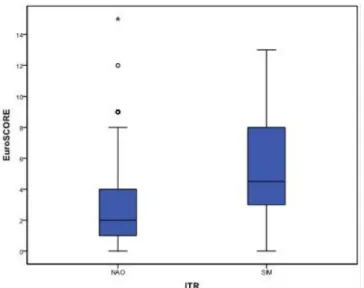
A comparison of score values revealed higher values for patients who developed RTI than those who did not, as shown in Table 2.
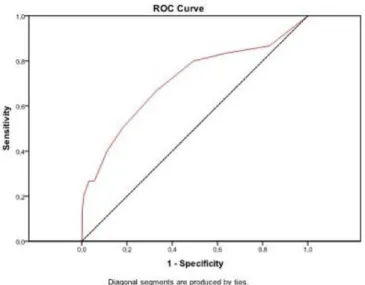
The predictive model for RTI showed good calibration, as presented in Table 3, and good accuracy, determined by analysis of the area under the ROC curve (Figure 2).
Fig.1 – Characteristics of the sample according to the surgery performed
Tipo de cirurgia realizada = surgery performed Valvular isolada = isolated valve
Cirurgia da Aorta = Aortic surgery
CRM isolada = isolated coronary artery bypass grafting
CRM associada = coronary artery bypass grafting associated with another cardiac surgery
Outras cirurgias = Another surgeries
Table 1. Incidence of complications and mortality.
Variable Comorbidities RTI
DDRF CVA
Complications General mortality
Mortality in the group without complications Mortality in the group with complications
n (%)
30 (3.3%) 17 (1.9%) 15 (1.7%) 43 (4.8%) 37 (4.1%)
1.8% 47.7%*
The area under the ROC curve was 0.710 (CL 95%, 0.600 – 0.821), with P-value<0.001. Results obtained show that EuroSCORE was good in discriminating between patients with and without RTI (Figure 3).
Dialysis-dependent renal failure
Just like RTI, higher EuroSCORE values were found among patients who developed DDRF than in those who did Table 2. Comparison of EuroSCORE according to RTI.
Death No Yes Total
N 870
30 900
P-value < 0.001 (Mann-Whitney test). RTI = respiratory tract infection
Mean 2.68 5.13 2.76
Median 2.00 4.50 3.00
Standard Deviation 2.17 3.59 2.27
Minimum 0 0 0
Maximum 15 13 15
Table 4. Comparison of EuroSCORE according to DDRF.
Death No Yes Total
N 883
17 900
P-value = 0.001 (Mann-Whitney test). DDRF = dialysis-dependent renal failure
Mean 2.68 6.88 2.76
Median 2.00 6.00 3.00
Standard Deviation 2.16 3.94 2.27
Minimum 0 1 0
Maximum 12 15 15
Table 3. RTI observed and predicted using EuroSCORE as predicting
variable in the groups deined according to the
Hosmer-Lemeshow test.
Step 1 1 2 3 4 5 6 7
Chi-square (5) = 6.221 (P-value = 0.285). RTI = respiratory tract infection
Observed 148 171 121 144 131 107 48
Expected 150.583 169.740 119.746 144.162 131.065 107.205 47.499
Observed 4 1 1 4 5 7 8
Expected 1.417 2.260 2.254 3.838 4.935 6.795 8.501 Contingency table for the Homer-Lemeshow test
Total 152 172 122 148 136 114 56 RTI = no RTI = yes
Fig. 2 – Comparison of EuroSCORE in patients with and without RTI
Fig. 3 – Graph of the ROC curve for RTI
Table 6. Crossing of EuroSCORE with RTI Risk Group Low Medium High
P-value < 0.001 (chi-square). RTI = respiratory tract infection
N % N % N % Não 439 98.7% 334 96.5% 97 89.0% Sim 6 1.3% 12 3.5% 12 11.0% Total 445 100.0% 346 100.0% 109 100.0% OR (CL 95%) 1.0 2.63 (0.98 – 7.08)
9.05 (3.32 – 24.70) RTI
Table 7. Crossing of EuroSCORE and DDRF.
Risk Group
Low
Medium
High
P< 0.001. DDRF = dialysis-dependent renal failure
N % N % N % No 444 99.8% 339 98.0% 100 91.7% Yes 1 0.2% 7 2.0% 9 8.3% Total 445 100.0% 346 100.0% 109 100.0% OR (CL 95%) 1.0 9.17 (1.1 – 74.9)
39.96 (5.0 – 78.9) RTI
Table 8. Cut-off points and sensitivity and speciicity values.
Variable RTI DDRF
DDRF = dialysis-dependent renal failure; RTI = respiratory tract infection Cut-off points ≥ 3,5 ≥ 3,5 Sensitivity 66.7% 82.4% Speciicity 67.1% 66.9%
not develop DDRF, as shown in Table 4 and Figure 4. The predictive model for DDRF showed good calibration, as presented in Table 5, and excellent accuracy, determined by analysis of the area under the ROC curve (Figure 2).
The area under the ROC curve was 0.834 (CL 95%, 0.738 – 0.930), with P-value<0.001. Results show that Eu-roSCORE was good in discriminating between patients with and without DDRF (Figure 5).
Cerebrovascular accident
With regard to occurrence of CVA, there was no differ-ence in EuroSCORE values between patients who devel-oped this complication and those who did not (P=0.484; Mann-Whitney test). In terms of the predictive model for this morbidity, despite good calibration (P=0.45), it was not
accurate to discriminate between patients who did and did not develop CVA in the postoperative period (area under the ROC curve = 0.519), as shown in Figure 3.
Analysis of the relationship between the risk group and the chance of developing postoperative complications
It was observed that patients in the high-risk group, ac-cording to EuroSCORE values, had greater chances of devel-oping RTI (OR: 9.05) and DDRF (OR: 39.96), as presented in Tables 6 and 7. However, the same association could not be said of the occurrence of CVA.
Cut-off points for greater speciicity and sensitivity for
prediction of RTI and DDRF are listed in Table 8.
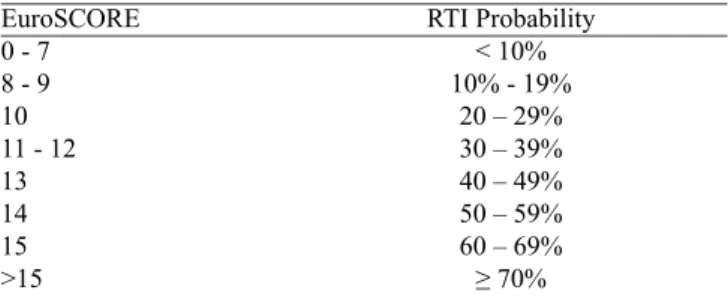
The probability of developing RTI and DDRF based on EuroSCORE was determined, varying from less than 10% to more than 70% (Tables 9 and 10).
Fig. 5 – Graph of the ROC curve for DDRF
Table 5. DDRF observed and predicted using EuroSCORE as
predicting variable in the groups deined according to the
Hosmer-Lemeshow test. Step 1 1 2 3 4 5 6 7
Chi-square (5) = 2.419 (P-value = 0.789). DDRF = dialysis-dependent renal failure
Observed 152 171 122 146 133 110 49 Expected 151.723 171.467 121.358 146.681 133.951 110.209 47.611 Observed 0 1 0 2 3 4 7 Expected 0.277 0.533 0.642 1.319 2.049 3.791 8.389 Contingency table for the Homer-Lemeshow test
DISCUSSION
The use of risk scores in surgical practice is a valid strate-gy, not only to measure risk but also to analyze and compare results. Risk scores are related to factors inherent to the mod-el itsmod-elf, the population for which they were devmod-eloped, and the characteristics of the population in which they will be
applied. As a result, the majority of scores show conlicting
results in the prediction of risks. In addition, the large num-ber of variables of a score also reduces its effectiveness when applied to distinct populations [13,14]. On the other hand, scores that are validated in diverse populations, such as the EuroSCORE, tend to show better results.
The prevalence of complications (RTI, DDRF, and CVA) was similar to what has been described in the literature. Like-wise, general mortality in the sample studied was also similar to previous results, drawing attention to the high mortality rate, an important fact that indicates the importance of both
early identiication of patients at risk for developing those
complications and aggressive intervention to reverse this sit-uation [8,15,16].
Even though the prevalence of complications was sim-ilar to what has been described in the literature, the use of strict diagnostic criteria to characterize complications may have left patients who had only clinical diagnoses out of the RTI and CVA groups, which could lead to underdiagnosis of those complications.
By using the score to predict RTI, it was observed that pa-tients with higher EuroSCORE values had greater chances of developing a complication, which could be considered an ob-vious outcome, but the score tool now presents numeric data. The model showed good calibration to that end, especially in patients with medium to high EuroSCORE values. The same
indings were obtained when predicting the development of
DDRF, with higher values (P=0.789).
In terms of discriminating power, assessed by the area under the ROC curve, the model was also deemed adequate, with predicting values for RTI and DDRF of 0.710 and
Table 10. Probability of developing DDRF according to EuroSCORE.
EuroSCORE 0 - 7 8 - 9 10 11 12 13 >14
DDRF = dialysis-dependent renal failure
DDRF Probability < 10% 10% - 19%
20 – 29% 30 – 39% 40 – 59% 60 – 69%
≥ 70%
Table 9. Probability of developing RTI according to EuroSCORE.
EuroSCORE 0 - 7 8 - 9 10 11 - 12 13 14 15 >15
RTI = respiratory tract infection
RTI Probability < 10% 10% - 19%
20 – 29% 30 – 39% 40 – 49% 50 – 59% 60 – 69%
≥ 70%
0.834, respectively, both statistically signiicant. In practice,
these data translates into good ability to discriminate which
patients will deinitely develop complications among those
with chances of developing them.
Similar to the model calibration, the values for predictive
ability were signiicant for both RTI and DDRF. However,
the results of the DDRF group were more robust, probably because of better characterization of the patients belonging to that group, and since diagnostic criteria is exclusive, i.e., whether or not the patient developed DDRF, there are no con-founding variables in the diagnosis of the complication.
The opposite was observed when the score was used to predict CVA. The score was not successful, showing neither effective calibration nor effective predictive ability, proba-bly due to the diagnostic method used: the computed tomog-raphy. Even though computed tomography was performed 72 hours after suspected clinical diagnosis, the scan might not show ischemic lesions and nuclear magnetic resonance is more accurate. However, due to the characteristics of the patients, such as hemodynamic instability at the time of the exam, the decision was made not to perform a longer exam that could put the patient at risk.
Finally, it is interesting to observe the exponential growth in the chance of developing RTI and DDRF as the
Euro-SCORE values increase, with sensitivity and speciicity
cut-off points starting at score 3.5. In patients with EuroSCORE values above this cut-off point, it allows for the possibility of implementing protective measures, directing human and
material resources, and deining the best surgical strategy so
that the occurrence of complications with potential mortality can be reduced.
The results and validations of the EuroSCORE II were published during this study [17-19]; however, we decided to continue using EuroSCORE I because of it has numerous validations, including in our midst, it is easy to use, and it is widely known to all professionals involved in the care of patients undergoing cardiac surgery, such as intensivists, sur-geons, and cardiologists.
Authors’ roles & responsibilities
INGA Main author
FRMN Coordination of data collection, data and bibliographic referencesorganization
TGA Tabulation and organization of data, partial drafting of the
inal text
REFERENCES
1. Granton J, Cheng D. Risk stratiication models for cardiac surgery.
Semin Cardiothorac Vasc Anesth. 2008;12(3):167-74.
2. Litmathe J, Kurt M, Feindt P, Gams E, Boeken U. Predictors and outcome of ICU readmission after cardiac surgery. Thorac Cardiovasc Surg. 2009;57(7):391-4.
3. Geissler HJ, Hölzl P, Marohl S, Kuhn-RégnieR F, Mehlhorn U,
Südkamp M, et al. Risk stratiication in heart surgery: comparison
of six score systems. Eur J Cardiothorac Surg. 2000;17(4):400-6.
4. Nashef SA, Roques F, Michel P, Gauducheau E, Lemeshow S, Salamon R. European system for cardiac operative risk evaluation (EuroSCORE). Eur J Cardiothorac Surg. 1999;16(1):9-13.
5. Shroyer AL, Coombs LP, Peterson ED, Eiken MC, DeLong ER, Chen A, et al; Society of Thoracic Surgeons. The Society of Thoracic Surgeons: 30-day operative mortality and morbidity risk models. Ann Thorac Surg. 2003;75(6):1856-64.
6. Hobson CE, Yavas S, Segal MS, Schold JD, Tribble CG, Layon AJ, et al. Acute kidney injury is associated with increased long-term mortality after cardiothoracic surgery. Circulation. 2009;119(18):2444-53.
7. Ngaage DL, Cowen ME, Grifin S, Guvendik L, Cale AR. Early neurological complications after coronary artery bypass grafting and valve surgery in octogenarians. Eur J Cardiothorac Surg. 2008;33(4):653-9.
8. Riera M, Ibañez J, Herrero J, Ignacio Sáez De Ibarra J, Enríquez F, Campillo C, et al. Respiratory tract infections after cardiac surgery: impact on hospital morbidity and mortality. J Cardiovasc Surg (Torino). 2010;51(6):907-14.
9. Carrascal Y, Guerrero AL. Neurological damage related to cardiac surgery: pathophysiology, diagnostic tools and prevention strategies. Using actual knowledge for planning the future. Neurologist. 2010;16(3):152-64.
10. Litmathe J, Kurt M, Feindt P, Gams E, Boeken U. Predictors and outcome of ICU readmission after cardiac surgery. Thorac Cardiovasc Surg. 2009;57(7):391-4.
11. Moraes F, Duarte C, Cardoso E, Tenório E, Pereira V, Lampreia D, et al. Avaliação do EuroSCORE, como preditor de mortalidade em cirurgia de revascularização miocárdica no Instituto do Coração de Pernambuco. Rev Bras Cir Cardiovasc. 2006;21(1):29-34.
12. Andrade ING, Moraes Neto FR, Oliveira JPSP, Silva ITC, Andrade TG, Moraes CRR. Avaliação do EuroSCORE como preditor de mortalidade em cirurgia cardíaca valvar no Instituto do Coração de Pernambuco. Rev Bras Cir Cardiovasc. 2010;25(1):11-8.
13. Geissler HJ, Hölzl P, Marohl S, Kuhn-Régnier F, Mehlhorn U,
Südkamp M, et al. Risk stratiication in heart surgery: comparison
of six score systems. Eur J Cardiothorac Surg. 2000;17(4):400-6.
14. Ivanov J, Borger MA, Rao V, David TE. The Toronto Risk Score for adverse events following cardiac surgery. Can J Cardiol. 2006;22(3):221-7.
15. Hobson CE, Yavas S, Segal MS, Schold JD, Tribble CG, Layon AJ, et al. Acute kidney injury is associated with increased long-term mortality after cardiothoracic surgery. Circulation. 2009;119(18):2444-53.
16. Guaragna JCVC, Bolsi DC, Jaeger CP, Melchior R, Petracco JB, Facchi LM, et al. Preditores de disfunção neurológica maior após cirurgia de revascularização miocárdica isolada. Rev Bras Cir Cardiovasc. 2006;21(2):173-9.
17. Nashef SA, Roques F, Sharples LD, Nilsson J, Smith C, Goldstone AR, et al. EuroSCORE II. Eur J Cardiothorac Surg. 2012;41(4):734-44.
18. Carnero-Alcázar M, Silva Guisasola JA, Reguillo Lacruz FJ, Maroto Castellanos LC, Cobiella Carnicer J, Villagrán Medinilla E, et al. Validation of EuroSCORE II on a single-centre 3800 patient cohort. Interact Cardiovasc Thorac Surg. 2013;16(3):293-300.
19. Noyez L, Kievit PC, van Swieten HA, de Boer MJ Cardiac operative risk evaluation: The EuroSCORE II, does it make a real difference? Neth Heart J. 2012;20(12):494-8.
20. Poullis M, Fabri B, Pullan M, Chalmers J. Sampling time error in EuroSCORE II. Interact Cardiovasc Thorac Surg. 2012;14(5):640-1.
of EuroSCORE II over EuroSCORE I [19,20] supports the decision to use EuroSCORE I and emphasizes the need for constant recalibration of risk scores, especially when used in populations other than the ones they were developed for.
CONCLUSION