Is cognitive decline in the elderly associated
with contextual income? Results of a
population-based study in southern Brazil
O declínio cognitivo em idosos está associado à
renda contextual? Resultados de um estudo de
base populacional no Sul do Brasil
¿El declive cognitivo en ancianos está asociado a
la renta contextual? Resultados de un estudio de
base poblacional en el sur de Brasil
1 Programa de Pós-graduação em Saúde Coletiva, Universidade Federal de Santa Catarina, Florianópolis, Brasil.
Ana Lúcia Danielewicz 1
Katia Jakovljevic Pudla Wagner 1
Eleonora d’Orsi 1
Antonio Fernando Boing 1
Abstract
The aim of this study was to estimate the association between contextual income and cognitive decline in the elderly in Florianópolis, a medium- sized city in southern Brazil. A nested cross-sectional study was performed in a cohort of elderly ≥ 60 years (n = 1,197), interviewed in the second wave (2013/2014) of the EpiFloripa cohort. Cognitive decline was assessed with the Mini Mental State Examination (MMSE) and contextual income was measured as the mean monthly income of the heads of households. Indi-vidual adjustment variables were sex, age, skin color, per capita household income, years of schooling, and time living in the neighborhood. The data were analyzed using multilevel logistic regression. The odds of cognitive decline were twice as high (OR = 1.99; 95%CI: 1.03; 3.87) in elderly living in census tracts with the lowest income quintile compared to those in the highest quintile, independently of individual characteristics. In conclu-sion, the socioeconomic environment is related to cognitive decline and should be considered in public policies with a focus on health of the elderly.
Cognition Disorders; Social Class; Aged
Correspondence
A. L. Danielewicz
Introduction
Cognitive decline is characterized by the impair-ment of important skills, such as memory, atten-tion, orientaatten-tion, verbal fluency and executive functions, and often precedes a more serious di-agnosis, in particular Alzheimer’s disease or other dementias 1.The preservation of cognitive
abil-ity is related to longevabil-ity and successful aging 2,
elderly people with cognitive decline are more dependent, have a higher number of comorbidi-ties 3 and a generally poor quality of life 4.
Different prevalence of cognitive decline has been observed in studies in Europe, North Amer-ica, Australia, Asia and Africa 5 with variations
of between 5.1% and 35.9%. In Brazil, the preva-lence in six states was 25% in 2008 and 2009 6,
higher than that observed in other countries in Latin America and the Caribbean, such as Argen-tina (8.3%) and Barbados (21.3%) 7.
Individual demographic and socioeco-nomic characteristics, such as older age, female gender and low level of education 8,9,10 have a
well-established association with cognitive de-cline. However, the influence of environmen-tal socioeconomic factors on cognitive loss among the elderly population has not been so thoroughly investigated.
Studies carried out in Asia 11, North Ame-
rica 12 and Europe 13 have found that elderly
peo-ple who lived in neighborhoods with worse so-cioeconomic indicators, such as lower income or education level and higher unemployment, had lower cognitive performance scores regardless of individual socioeconomic factors.
It is believed that elderly people who live in places with better socioeconomic conditions are likely to benefit more from physical, social and leisure activities available in these environments, which contributes to better cognitive function 14.
In addition, poorer neighborhoods may suffer more from the effects of crime, causing the elder-ly population to be socialelder-ly and psychologicalelder-ly isolated within their community 15.
It is also suggested that income assessed on a contextual level is directly related to the concepts of social capital and cohesion, which include the ways in which society is organized, through the establishment of norms of reciprocity and trust that help the formation of social ties and deter-mine health at the individual level 16,17.
In addition, a systematic review 18 showed
that the level of economic deprivation in the neighborhood, represented among other vari-ables by contextual average income, is one of the main factors that affect the characteristics of the physical and social environments which can af-fect cognitive ability.
In Brazil, some studies that used the income variable to characterize the context have shown that lower average income and greater concen-tration of wealth in the neighborhood are associ-ated with some health outcomes such as poor health self-assessment 19, greater prevalence
of functional disabilities 20, and higher systolic
blood pressure 21. However, as of September
2015, no study published in Brazil has been found with the aim of investigating the associa-tion between income and contextual cognitive decline. Because it is a country with wide socio-economic disparities and a growing elderly pop-ulation, further studies of this relationship are deemed important.
In addition, within public health policies there is evidence of a growing interest in studies to assess environmental features aimed at for-mulating strategies for prevention and/or inter-vention, with a focus on the entire community and not just specific individuals or groups. In this context, the aim of this study was to estimate the association between area level income of neigh-borhoods and cognitive decline among the el-derly in the city of Florianópolis, Santa Catarina State, Brazil.
Methods
Study area and population
The research involved a cross-sectional study nested in a cohort of elderly residents in Flo-rianópolis, the capital city of the state of Santa Catarina (EpiFloripa elderly study), located in southern Brazil. The data from this study were collected in 2013/2014, and the baseline study is from 2009/2010. The population of the city in 2010 was 421,000, of whom 11.4% were elderly (60 years or older), and of these, 14% were con-sidered very elderly (80 years or older) 22. In
ad-dition, Florianópolis is the Brazilian state capital with the highest level of quality of life according to United Nations indicators 23.
Data source and sampling design
The sample consisted of elderly men and women, aged 60 or older, who were non-institutionalized and residents of the urban area of Florianópolis at the time of the baseline study.
The cohort study sample at baseline was 1,705 elderly people, and details of the sampling procedures have been described elsewhere 24,25.
when the elderly person refused to participate in the study, and losses included all interviews for which the elderly person could not be located via telephone or after four home visits (including in the evenings and at the weekend).
Data collection was performed using net-books to apply a standardized questionnaire that had been pre-tested in a pilot study. Face-to-face interviews were conducted at home between No-vember 2013 and NoNo-vember 2014. Quality con-trol of the data was performed with a random sample of approximately 10% of the elderly peo-ple. The selected respondents were contacted by telephone and answered a short questionnaire consisting of ten questions. The kappa calcula-tion indicated moderate to very good agreement, with values ranging from 0.51 to 0.94.
Study variables
The outcome variable was cognitive decline, as-sessed using the Mini Mental State Examination
(MMSE) 26. The MMSE is a neuropsychological
cognitive assessment test that takes into account different cognitive domains such as temporal and spatial orientation, short-term memory, cal-culation, comprehension and writing. The score can range from 0 to 30 points, and in this study the cutoff points proposed by Almeida 27 were
used, that probable cognitive decline is indicated by a score of below 19 points for those who are il-literate, and below 24 points for those with some education. For data analysis, the elderly were classified into two categories according to the presence or absence of cognitive decline.
The independent contextual variable was the average monthly income of the head of each household in each of the 83 census tracts includ-ed in this study, according to the Brazilian Cen-sus of 2010 28, categorized into quintiles.
Indi-vidual explanatory variables were sex, age (60-69 years, 70-79 years and 80 or over), self-reported skin color (white, light-skinned black, and dark; yellow (n = 6) and indigenous (n = 4) were ex-cluded due to the small sample size), average equalized household income (divided into ter-tiles), and years of schooling (0-4 years, 5-8 years, 9-11 years, 12 or more years). Finally, the length of residence in the neighborhood (1-4 years, 5-9 years, 10 years or more) was also included as an explanatory variable.
Data analysis
First, descriptive analyses of the sample distri-bution were conducted and the prevalence and respective confidence intervals (95%CI) related to cognitive decline were calculated for each
in-dividual and contextual variable. After that, the nonparametric Kruskal-Wallis test was used to assess the mean difference in MMSE score ac-cording to contextual variables. A multilevel lo-gistic regression was performed to estimate the odds ratio (OR) and 95%CI between the outcome and the independent variable, considering the individual variables as the first level of analysis and the contextual variable as the second level.
The empty model (without covariates) was tested to estimate the total variance proportion of the outcome attributed to differences between census tracts. The other variables were then in-cluded by a forward selection method accord-ing to three models: model 1 (only contextual income); model 2 (individual variables including sex, age and skin color) and model 3 (included individual income and education variables, and the length of residence in the neighborhood).
All analyses were performed using Stata, ver-sion 13.0 (StataCorp LP, College Station, USA). P-values < 0.05 were considered statistically significant.
Ethical aspects
The Ethics Committee for Research with Human Beings of the Federal University of Santa Cata-rina approved the study, case number 352/2008 at baseline 2009/2010, and Certificate of Pre-sentation for Ethical Consideration number 16731313.0.0000.0121 in the 2013/2014 wave. The participants received guidance on the research objectives and signed an informed consent form. For the elderly people who were unable to sign the informed consent form, a legal guardian was asked to do so.
Results
The final sample of those who were effectively interviewed consisted of 1,197 elderly people, representing a response rate of 80.4%. Of these, 1,184 answered the MMSE and were included in the present analytic sample. The average age was 73.9 years (standard deviation 7.2 years), with a higher proportion of women (65%) and people who reported white skin color (86.7%). The average monthly income of the heads of the households in the census tracts was BRL 2,215.68 (interquartile range BRL 1,967.08), ranging from BRL 753.83 to BRL 10,311.25.
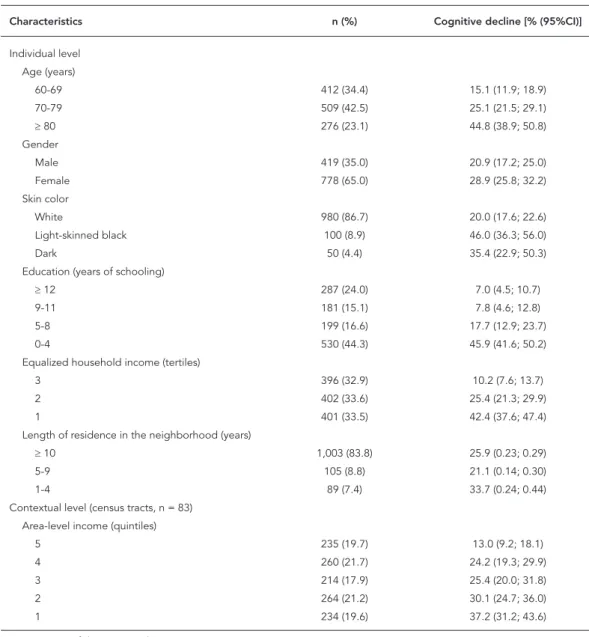
in the lowest tertile of average equalized income (42.4%). In addition, the prevalence of cognitive decline was higher among lower-income census tracts, being three times higher in the poorest quintile than in the richest (Table 1). The median MMSE score according to the quintiles of house-hold income in the census tracts ranged from 24 (lowest quintile) to 28 (highest quintile), p- value < 0.01 (Figure 1).
Table 2 shows the results of multilevel logis-tic regression. Variance was observed between groups of 13% in the empty model, a value that changed to 7.8% in the model adjusted for aver-age income for the census tracts, indicating that this contextual variable explained 40% of the variance of the second level. In the crude analysis (model 1), all categories of area-level income were inversely associated with cognitive decline. After
Table 1
Individual and contextual level characteristics of the sample of elderly people. Florianópolis, Santa Catarina State, Brazil, 2013-2014.
Characteristics n (%) Cognitive decline [% (95%CI)]
Individual level Age (years)
60-69 412 (34.4) 15.1 (11.9; 18.9)
70-79 509 (42.5) 25.1 (21.5; 29.1)
≥ 80 276 (23.1) 44.8 (38.9; 50.8)
Gender
Male 419 (35.0) 20.9 (17.2; 25.0)
Female 778 (65.0) 28.9 (25.8; 32.2)
Skin color
White 980 (86.7) 20.0 (17.6; 22.6)
Light-skinned black 100 (8.9) 46.0 (36.3; 56.0)
Dark 50 (4.4) 35.4 (22.9; 50.3)
Education (years of schooling)
≥ 12 287 (24.0) 7.0 (4.5; 10.7)
9-11 181 (15.1) 7.8 (4.6; 12.8)
5-8 199 (16.6) 17.7 (12.9; 23.7)
0-4 530 (44.3) 45.9 (41.6; 50.2)
Equalized household income (tertiles)
3 396 (32.9) 10.2 (7.6; 13.7)
2 402 (33.6) 25.4 (21.3; 29.9)
1 401 (33.5) 42.4 (37.6; 47.4)
Length of residence in the neighborhood (years)
≥ 10 1,003 (83.8) 25.9 (0.23; 0.29)
5-9 105 (8.8) 21.1 (0.14; 0.30)
1-4 89 (7.4) 33.7 (0.24; 0.44)
Contextual level (census tracts, n = 83) Area-level income (quintiles)
5 235 (19.7) 13.0 (9.2; 18.1)
4 260 (21.7) 24.2 (19.3; 29.9)
3 214 (17.9) 25.4 (20.0; 31.8)
2 264 (21.2) 30.1 (24.7; 36.0)
1 234 (19.6) 37.2 (31.2; 43.6)
Figure 1
Box-plot graph of Mini Mental State Examination (MMSE) scores by quintiles of area-level income (p < 0,01). Florianópolis, Santa Catarina State, Brazil, 2013-2014.
adjusting for all the individual variables (model 3) the same negative gradient associated with the outcome remained, but only the difference between the extreme quintiles was statistically significant. The odds of cognitive decline were approximately two times higher among residents of lower-income census tracts, regardless of age, gender, skin color, education, individual income or length of residence in the neighborhood.
Discussion
The main results indicated that cognitive de-cline is inversely related to the socioeconomic status of the neighborhood, and it is twice as likely to occur in elderly people living in the poorest areas compared to the richest, regardless of individual demographic and socioeconomic characteristics.
Similar results were observed in population studies of the elderly in Asia (> 60 years) 11, of
British adults and elderly (> 50 years) 13 and of the
American elderly (> 65 years) 12, in which
neigh-borhoods with low income and educational lev-els, higher unemployment and sources of public assistance were associated with cognitive de-cline. Similarly, institutionalized elderly people in Britain (> 65 years) living in neighborhoods with a higher deprivation index were twice as likely to experience cognitive decline compared to areas with less deprivation, regardless of indi-vidual education or social class 29.
Only two studies with similar objectives to this one have been carried out among older adults in Latin America (both Mexican) 30,31.
Sheffield & Peek 31 observed that socioeconomic
disadvantage assessed by lower income neigh-borhoods was associated with a higher incidence of cognitive decline over a period of five years, whereas there was no association for social dis-advantage, represented by low educational levels and lower occupational classes. The study by Al Hazzouri et al. 30 also found that lower
Table 2
Multivariate models of multilevel logistic regression for cognitive decline in the sample of elderly people. Florianópolis, Santa Catarina State, Brazil, 2013-2014.
Variables Empty model
[OR (95%CI)]
Model 1 [OR (95%CI)]
Model 2 [OR (95%CI)]
Model 3 [OR (95%CI)]
Fixed effects
Intercept 0.31 (0.25; 0.38) 0.14 (0.08; 0.22) 0.02 (0.01; 0.04) 0.01 (0.00; 0.02)
Contextual level (census tracts, n = 83)
Area-level income (quintiles)
5 1.00 1.00 1.00
4 2.11 (1.14; 3.92) * 2.71 (1.28; 5.75) * 1.41 (0.72; 2.75)
3 2.29 (1.21; 4.33) * 2.97 (1.37; 6.45) * 1.61 (0.81; 3.19)
2 2.98 (1.63; 5.47) * 4.91 (2.34; 10.3) * 1.69 (0.87; 3.29)
1 3.97 (2.17; 7.26) * 6.77 (3.24; 14.1) * 1.99 (1.03; 3.87) *
Individual level Age (years)
60-69 1.00 1.00
70-79 2.19 (1.49; 3.22) * 1.65 (1.10; 2.47) *
≥ 80 4.80 (3.08; 7.49) * 3.15 (1.99; 5.00) *
Gender
Male 1.00 1.00
Female 1.82 (1.29; 2.58) * 1.44 (1.00; 2.08) *
Skin color
White 1.00 1.00
Light-skinned black 3.34 (2.06; 5.43) * 3.01 (1.84; 4.94) *
Dark 1.75 (0.86; 3.56) 1.93 (0.93; 4.00)
Education (years of schooling)
≥ 12 1.00
9-11 1.39 (0.57; 3.41)
5-8 2.67 (1.20; 5.96) *
0-4 9.07 (4.36; 18.86) *
Equalized household income (tertiles)
3 1.00
2 1.31 (0.78; 2.20)
1 2.27 (1.36; 3.77) *
Length of residence in the neighborhood (years)
≥ 10 1.00
5-9 0.86 (0.44; 1.70)
1-4 1.55 (0.82; 2.92)
Random effects
Level-two variance (SE) 0.49 (0.15) 0.28 (0.11) 0.40 (0.16) 0.05 (0.09)
ICC (%) 13.0 7.8 10.9 1.4
95%CI: 95% confidence interval; ICC: intraclass correlation coefficient; OR: odds ratio; SE: standard error. * p-value < 0.05.
contextual income should be considered an im-portant feature associated with cognitive ability, especially among the elderly people in low and middle-income countries.
The relationship between socioeconomic environment and cognitive decline may be at-tributed to a number of issues, including access
to health services, areas for leisure and social activities, psychological and lifestyle factors 31.
Areas with higher deprivation may offer its residents fewer opportunities for social and cul-tural interaction, important factors for cognitive stimulation 33. On the other hand, more
afflu-ent neighborhoods are more likely to provide a healthier lifestyle, as they are generally more carefully constructed environments, with spaces dedicated to leisure and physical activity that help preserve the cognitive reserves, memory and executive functions of the brain 34,35. In
ad-dition, these places provide better access to the internet, cinemas, bookstores, libraries, muse-ums and theaters, which are related to the main-tenance of cognitive abilities 36.
It has been suggested that social isolation is one of the factors that explains the relationship between lower socioeconomic status and cog-nitive decline among the elderly, since poorer neighborhoods tend to have higher rates of vi-olence, vandalism and crime, which can make the elderly feel insecure about leaving their homes and cause them to have relations only with friends or relatives who live closer to their community 15,37.The insecurity experienced by
older people can have other implications, such as decreased levels of physical or leisure activity, loss of functional independence and the pres-ence of symptoms of depression 38,39, which are
considered to be factors associated with cogni-tive decline.
Despite the evidence, the lack of studies relat-ed to the influence of contextual socioeconomic status on cognitive health among the elderly in Latin America does not allow for direct com-parisons between economically similar areas. Many Brazilian cities have good quality of life indicators 23, however the country is marked by
socioeconomic inequalities, and certainly the population with lower incomes are more vulner-able to the negative effects that this has on health. Thus, environmental characteristics should be considered important factors for the planning of public health interventions.
Currently, some national programs have been implemented with a focus on promoting territo-rial health, such as increased access to physical activity and healthy foods, violence prevention, and stimulating sustainable development 40.
However, it is necessary to make improvements and advances in inter-sectoral health actions that facilitate the construction of healthy ur-ban spaces, reducing social inequality, offering more opportunities to people on low incomes, as well as the inclusion of special groups such as the elderly 41.
There are some limitations to this study that should be considered when interpreting the re-sults. The MMSE is a validated questionnaire
widely used in studies of elderly Brazilians, al-though its cut-off point has not yet been stan-dardized in the literature. The choice in this study of the point proposed by Almeida 27 for the
classi-fication of cognitive decline may have influenced the results, since the largest proportion of the sample was classified as having a low education level (0-4 years), and this proposes only different points among illiterate and educated elderly.
However, sensitivity analyses were car-ried out related to the cut-off point used in this study, comparing it with that suggested by Brucki et al. 42, Lourenço & Veras 43 and
Bertoluc-ci et al. 44. High values were verified for the first
two (99.7% and 97.7%, respectively), and only the comparison with Bertolucci et al. 44 showed
low sensitivity (33.3%), which is probably due to the greater difference of scores to detect cogni-tive decline in illiterate elderly people between the two points analyzed. The specificity analyses showed acceptable values when comparing with all the points analyzed; 69.8% for Brucki et al. 42,
90.3% for Lourenço & Veras 43 and 93.1%
forBer-tolucci et al. 44.
Although the analyses were adjusted for the time of residence in the neighborhood, the characterization of the neighborhood was based on the territorial unit for the collection of cen-sus data, which may not reflect the actual area of social and economic residence for many re-spondents. This limitation has been observed in multilevel epidemiological studies, largely due to the availability of data provided by national surveys, which often do not represent the ideal area for investigating health outcomes 45. The
definition of a neighborhood, its spatial delimi-tation and the choice of variables that best relate to the outcome, make use of fairly challenging contextual measures for observational studies, and should therefore be considered with caution in their analysis 46.
The cross-sectional design can also be con-sidered a limitation because of the possible bias of reverse causality. Individuals with cognitive decline are more likely to reside in areas with higher socioeconomic deprivation, due to diffi-culties in sustaining their capacity to work. On the other hand, it was observed that it is dur-ing adulthood that most people become fixed residents and choose where they will live in old age 18.
However, some relevant points are worth highlighting. This is a pioneering study in Bra-zil, which evaluated the contextual income and its relation to cognitive decline in the elderly. Moreover, among the variables investigated,
sta-tistically significant differences were not found between the loss group and respondents in the second wave of the study compared to the base-line, except for the age variable (p < 0.001), which showed greater loss in the group aged 80 years or over, justified by the higher number of deaths in this category.
It is clear from these results that further stud-ies are needed to investigate the relationship as well as the long-term influence of the social and economic contexts on the health of elderly Bra-zilians, because the country is undergoing an ac-celerated aging process and this elderly popula-tion should be considered a priority in strategies focusing on health promotion and quality of life.
Contributors
A. L. Danielewicz contributed to the study design and planning, data analysis and interpretation, writing, cri-tical review, and approval of the final version. K. J. P. Wagner contributed to the study design and planning, data analysis and interpretation, critical review, and ap-proval of the final version. E. d’Orsi contributed to the critical review and approval of the final version. A. F. Boing contributed to the study design and planning, critical review, and approval of the final version.
Acknowledgments
References
1. Alzheimer’s Association; Centers for Disease Con-trol and Prevention. The Healthy Brain Initiative: the public health road map for state and national partnerships, 2013-2018. Chicago: Alzheimer’s As-sociation; 2013.
2. Depp C, Vahia IV, Jeste D. Successful aging: focus on cognitive and emotional health. Annu Rev Clin Psychol 2010; 6:527-50.
3. Silva HS, Duarte YAO, Andrade FB, Cerqueira ATAR, Santos JLF, Lebrão ML. Correlates of above-aver-age cognitive performance among older adults: the SABE study. Cad Saúde Pública 2014; 30: 1977-86.
4. Beckert M, Irigaray TQ, Trentini CM. Quality of life, cognition and performance of executive func-tions in the elderly. Estud Psicol (Campinas) 2012; 29:155-62.
5. Ward A, Arrighi HM, Michels S, Cedarbaum JM. Mild cognitive impairment: disparity of incidence and prevalence estimates. Alzheimers Dement 2012; 8:14-21.
6. Neri AL, Yassuda MS, Araújo LF, Eulálio MC, Cabral BE, Siqueira MEC, et al. Metodologia e perfil socio-demográfico, cognitivo e de fragilidade de idosos comunitários de sete cidades brasileiras: Estudo FIBRA. Cad Saúde Pública 2013; 29:778-92. 7. Ashby-Mitchell K, Jagger C, Fouweather T, Anstey
KJ. Life expectancy with and without cognitive im-pairment in seven Latin American and Caribbean countries. PLoS One 2015; 10:e0121867.
8. Miranda LP, Silveira MF, Oliveira TL, Alves SF, Ju-nior HM, Batista AU, et al. Cognitive impairment, the Mini-Mental State Examination and socio-de-mographic and dental variables in the elderly in Brazil. Gerodontology 2012; 29:e34-40.
9. Ferreira PCS, Tavares DMS, Rodrigues RAP. Carac-terísticas sociodemográficas, capacidade funcio-nal e morbidades entre idosos com e sem declínio cognitivo. Acta Paul Enferm 2011; 24:29-35. 10. Machado JC, Ribeiro RCL, Leal PFG, Cotta RMM.
Evaluation of cognitive decline and its relationship with socioeconomic characteristics of the elderly in Viçosa, Minas Gerais. Rev Bras Epidemiol 2007; 10:592-605.
11. Wee LE, Yeo WX, Yang GR, Hannan N, Lim K, Chua C, et al. Individual and area level socioeconomic status and its association with cognitive function and cognitive impairment (low MMSE) among community-dwelling elderly in Singapore. De-ment Geriatr Cogn Disord Extra 2012; 2:529-42. 12. Shih RA, Ghosh-Dastidar B, Margolis KL, Slaughter
ME, Jewell A, Bird CE, et al. Neighborhood socio-economic status and cognitive function in women. Am J Public Health 2011; 101:1721-8.
13. Lang IA, Llewellyn DJ, Langa KM, Wallace RB, Huppert FA, Melzer D. Neighborhood deprivation, individual socioeconomic status, and cognitive function in older people: analyses from the Eng-lish Longitudinal Study of Ageing. J Am Geriatr Soc 2008; 56:191-8.
14. Clarke PJ, Ailshire JA, House JS, Morenoff JD, King K, Melendez R, et al. Cognitive function in the community setting: the neighbourhood as a source of ‘cognitive reserve’? J Epidemiol Commu-nity Health 2011; 66:730-6.
15. Aneshensel CS, Ko MJ, Chodosh J, Wight RG. The urban neighborhood and cognitive functioning in late middle age. J Health Soc Behav 2011; 52: 163-79.
16. Kawachi I, Berkman LF. Social cohesion, social capital, and health. In: Berkman LF, Kawachi I, edi-tors. Social epidemiology. New York: Oxford Uni-versity Press; 2000. p. 174-90.
17. Fone D, Dunstan F, Lloyd K, Williams G, Watkins J, Palmer S. Does social cohesion modify the as-sociation between area income deprivation and mental health? A multilevel analysis. Int J Epide-miol 2007; 36:338-45.
18. Wu Y-T, Prina AM, Brayne C. The association be-tween community environment and cognitive function: a systematic review. Soc Psychiatry Psy-chiatr Epidemiol 2014; 50:351-62.
19. Santos SM, Chor D, Werneck GL, Coutinho ESF. As-sociação entre fatores contextuais e autoavaliação de saúde: uma revisão sistemática de estudos mul-tinível. Cad Saúde Pública 2007; 23:2533-54. 20. Alves LC, Leite IC, Machado CJ. Fatores
associa-dos à incapacidade funcional associa-dos iassocia-dosos no Bra-sil: análise multinível. Rev Saúde Pública 2010; 44:468-78.
21. Höfelmann DA, Antunes JLF, Silva DAS, Peres MA. Is income area level associated with blood pres-sure in adults regardless of individual-level char-acteristics? A multilevel approach. Health Place 2012; 18:971-7.
22. Instituto Brasileiro de Geografia e Estatística. Si-nopse do Censo Demográfico – 2010. Rio de Janei-ro: Instituto Brasileiro de Geografia e Estatística; 2011.
23. Programa das Nações Unidas para o Desenvolvi-mento. Atlas do desenvolvimento humano no Bra-sil. Brasília: Programa das Nações Unidas para o Desenvolvimento; 2003.
24. Antes DL, Ribeiro DF, Schneider IJC, Benedetti TRB, d’Orsi E. Socioeconomic profile of the elderly in Florianópolis: comparative analysis studies Per-fil do Idoso 2002 and EpiFloripa Idoso 2009. Rev Bras Epidemiol 2014; 17:189-202.
25. Giehl MWC, Schneider IJC, Corseuil HX, Benedetti TRB, d’Orsi E. Atividade física e percepção do am-biente em idosos: estudo populacional em Floria-nópolis. Rev Saúde Pública 2012; 46:516-25. 26. Folstein MF, Folstein SE, McHugh PR.
“Mini-men-tal state”: a practical method for grading the cogni-tive state of patients for the clinician. J Psychiatr Res 1975; 12:189-98.
27. Almeida OP. Mini exame do estado mental e o diagnóstico de demência no Brasil. Arq Neuropsi-quiatr 1998; 56:605-12.
29. Basta NE, Matthews FE, Chatfield MD, Brayne C. Community-level socio-economic status and cognitive and functional impairment in the older population. Eur J Public Health 2008; 18:48-54. 30. Al Hazzouri AZ, Haan MN, Osypuk T, Abdou C,
Hinton L, Aiello AE. Neighborhood socioeconomic context and cognitive decline among older Mexi-can AmeriMexi-cans: results from the Sacramento Ar-ea Latino Study on Aging. Am J Epidemiol 2011; 174:423-31.
31. Sheffield KM, Peek MK. Neighborhood context and cognitive decline in older Mexican Americans: results from the Hispanic Established Populations for Epidemiologic Studies of the Elderly. Am J Epi-demiol 2009; 169:1092-101.
32. Robert SA. Socioeconomic position and health: the independent contribution of community socioeconomic context. Annu Rev Sociol 1999; 25:489-516.
33. Wight RG, Aneshensel CS, Miller-Martinez D, Bot-ticello AL, Cummings JR, Karlamangla AS, et al. Urban neighborhood context, educational attain-ment, and cognitive function among older adults. Am J Epidemiol 2006; 163:1071-8.
34. Garin N, Olaya B, Miret M, Ayuso-Mateos JL, Power M, Bucciarelli P, et al. Built environment and elder-ly population health: a comprehensive literature review. Clin Pract Epidemiol Ment Health 2014; 10:103-15.
35. Foubert-Samier A, Le Goff M, Helmer C, Pérès K, Orgogozo JM, Barberger-Gateau P, et al. Change in leisure and social activities and risk of demen-tia in elderly cohort. J Nutr Health Aging 2014; 18: 876-82.
36. Kobayashi LC, Wardle J, Wagner CV. Internet use, social engagement and health literacy decline dur-ing agedur-ing in a longitudinal cohort of older Eng-lish adults. J Epidemiol Community Health 2014; doi:10.1136/jech-2014-20473.
37. Ertel KA, Glymour MM, Berkman LF. Effects of so-cial integration on preserving memory function in a nationally representative US elderly population. Am J Public Health 2008; 98:1215-20.
38. King D. Neighborhood and individual factors in activity in older adults: results from the neighbor-hood and senior health study. J Aging Phys Activ 2008; 16:144-70.
39. Kubzansky LD, Subramanian S, Kawachi I, Fay ME, Soobader MJ, Berkman LF. Neighborhood contex-tual influences on depressive symptoms in the el-derly. Am J Epidemiol 2005; 162:253-60.
40. Secretaria de Vigilância em Saúde, Ministério da Saúde. Política Nacional de Promoção da Saúde. Brasília: Ministério da Saúde; 2006.
41. Malta DC, Silva MMA, Albuquerque GM, Lima CM, Cavalcante T, Jaime PC, et al. A implementação das prioridades da Política Nacional de Promoção da Saúde, um balanço, 2006 a 2014. Ciênc Saúde Co-letiva 2014; 19:4301-12.
42. Brucki SM, Nitrini R, Caramelli P, Bertolucci PH, Okamoto IH. Sugestões para o uso do mini-exa-me do estado mini-exa-mental no Brasil. Arq Neuropsiquiatr 2003; 61:777-81.
43. Lourenço RA, Veras RP. Mini-Exame do Estado Mental: características psicométricas em idosos ambulatoriais. Rev Saúde Pública 2006; 40:712-9. 44. Bertolucci PH, Brucki S, Campacci SR, Juliano Y. O
mini-exame do estado mental em uma população geral: impacto da escolaridade. Arq Neuropsiquiatr 1994; 52:1-7.
45. Diex-Roux AV. Next steps in understanding the multilevel determinants of health. J Epidemiol Community Health 2008; 62:957-9.
46. Diex-Roux AV. Neighborhoods and health: where are we and where do we go from here? Rev Epide-miol Sante Publique 2007; 55:13-21.
Resumo
O objetivo do estudo foi estimar a associação entre a renda contextual e o declínio cognitivo de idosos em Florianópolis, município de médio porte do Sul do Bra-sil. Realizou-se um estudo transversal aninhado numa coorte de idosos. Entrevistaram-se 1.197 indivíduos (≥ 60 anos) na segunda onda (2013/2014) da coorte Epi-Floripa. O declínio cognitivo foi avaliado por meio do Mini Exame do Estado Mental (MEEM) e a renda con-textual pelo rendimento médio mensal dos responsá-veis pelos domicílios. As variáresponsá-veis individuais de ajus-te foram sexo, idade, cor da pele, renda domiciliar per capita, anos de estudos e tempo de moradia no bairro. Os dados foram analisados valendo-se de regressão lo-gística multinível. A chance de declínio cognitivo foi duas vezes maior (OR = 1,99; IC95%: 1,03; 3,87) entre os idosos residentes nos setores do menor quintil de renda, quando comparados aos do maior quintil, indepen-dentemente das características individuais. Concluiu- se que o ambiente socioeconômico está relacionado ao declínio cognitivo e deve ser considerado em políticas públicas com foco na promoção da saúde dos idosos.
Transtornos Cognitivos; Classe Social; Idoso
Resumen
El objetivo del estudio fue estimar la asociación entre la renta contextual y el declive cognitivo de ancianos en Florianópolis, municipio de tamaño medio del sur de Brasil. Se realizó un estudio transversal con una cohor-te de ancianos. Se entrevistaron a 1.197 ancianos (≥ 60 años) en la segunda serie (2013/2014) de la cohorte Epi-Floripa. El declive cognitivo se evaluó mediante un Mi-ni Examen del Estado Mental (MEEM) y la renta con-textual por el rendimiento medio mensual de los res-ponsables de los domicilios. Las variables individuales de ajuste fueron sexo, edad, color de piel, renta domici-liaria per cápita, años de estudio y tiempo de residencia en el barrio. Los datos fueron analizados mediante re-gresión logística multinivel. La oportunidad de declive cognitivo fue dos veces mayor (OR = 1,99; IC95%: 1,03; 3,87) en los ancianos residentes en los sectores de menor quintil de renta, cuando se comparan con los de mayor quintil, independiente de las características individua-les. Se concluyó que el ambiente socioeconómico está relacionado con el declive cognitivo y debe ser conside-rado en políticas públicas centradas en la promoción de salud de los ancianos.
Trastornos del Conocimiento; Clase Social; Anciano
Submitted on 13/Jul/2015