0103 - 5053 $6.00+0.00
C
o
m
m
u
ni
c
a
ti
o
n
* e-mails: [email protected]; [email protected]
Trichloroisocyanuric Acid in H
2SO
4: An Efficient Superelectrophilic Reagent
for Chlorination of Isatin and Benzene Derivatives
Gabriela Fonseca Mendonça, Rejane Ramos Magalhães, Marcio C. S. de Mattos* and Pierre M. Esteves*
Instituto de Química, Universidade Federal do Rio de Janeiro, CP 68545, 21945-970 Rio de Janeiro - RJ, Brazil
O ácido tricloro-isocianúrico (TICA) em H2SO4 é um reagente eficiente para a cloração regioseletiva da isatina na posição 5 e compostos aromáticos desativados, como o nitro-benzeno. Cálculos de DFT sugerem a formação de uma espécie supereletrofílica poliprotonada que pode transferir Cl+ ao anel aromático mais eficientemente do que o TICA devido ao alívio da repulsão carga-carga.
Trichloroisocyanuric acid (TICA) in H2SO4 is an efficient reagent for regioselective chlorination of isatin at the 5-position and deactivated aromatic compounds, such as nitrobenzene. DFT calculations suggest formation of a superelectrophilic polyprotonated species that can transfer Cl+ to the aromatic ring more efficiently than TICA due to charge-charge repulsion relief.
Keywords: trichloroisocyanuric acid, chlorination, superelectrophile, aromatic compounds, DFT
calculations
Introduction
Isatin (1H-indole-2,3-dione) is a versatile molecule with important applications in synthetic organic chemistry.1 Some of its derivatives, specifically 5-haloisatins, show a wide range of biological and pharmacological activity, such as antibacterial, antifungal, and anti-HIV, to name a few.2 They can be prepared by the laborious Sandmeyer and similar methodologies from p-haloanilines or by direct halogenation
of isatin.1,3 Several reagents that perform the chlorination of isatin mainly in the 5-position are described in the literature.
Among them, we can find N-chloroamides and N
-chloroimides3 and recently we reported the regiospecific
preparation of 5-chloroisatin in 48% yield using N
-chlorosaccharin in a heterogeneous media (SiO2 / CH2Cl2).4 The chlorination of aromatic compounds is well-documented in the literature. However, direct chlorination of deactivated aromatic compounds is frequently disappointing. An efficient electrophilic chlorination of
deactivated aromatic compounds with NCS / BF3 / H2O
was recently published.5
Trichloroisocyanuric acid (TICA) has proven to be a mild oxidant6 and an efficient reagent for performing the
cohalogenation of alkenes under mild conditions, thus serving as a new source of electrophilic chlorine to prepare chlorohydrins, β-chloroethers and β-chloroacetates.7 This reagent is a stable and inexpensive solid frequently found in a large number of commercial products for swimming-pool disinfection and easily available in swimming-pool supply and some hardware stores.8
Continuing7,9 our desire to use TICA as a source of electrophilic chlorine, we now communicate our results on the chlorination of isatin and other aromatic compounds.
Results and Discussion
The results of the reaction of isatin with trichloroisocyanuric acid to produce 5-chloroisatin are
summarized in Table 1. Using CH2Cl2 as solvent, the
696 Mendonça et al. J. Braz. Chem. Soc.
isatin10 nor significant amount of the frequently formed isomeric 7-chloroisatin3 was detected in the crude reaction product by coinjection in HRGC (high-resolution gas chromatography) with authentic 7-chloroisatin.
We believe that the strongly acid media promotes the formation of a superelectrophilic species11 (e.g. Figure 1), where TICA being either polyprotonated or protosolvated,12 causing the “Cl+” transfer to isatin more efficiently due to the charge-charge repulsion relief.
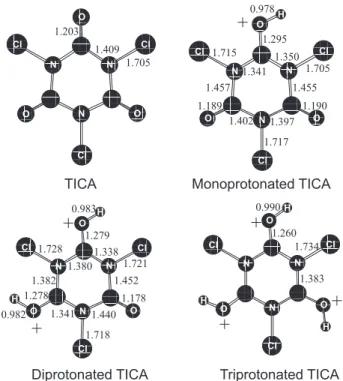
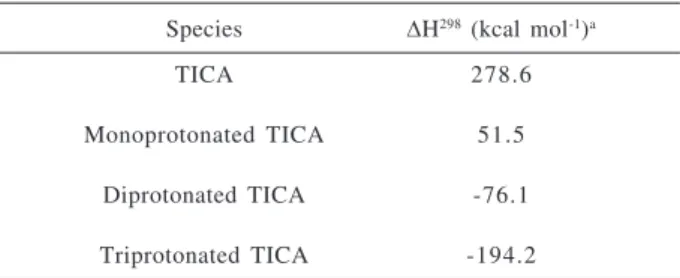
Density functional theory (DFT) calculations on TICA and its mono-, di- and triprotonated species13 (Figure 2) could estimate their ability to release Cl+, which would be correlated with its reactivity as an electrophile. Table 2 shows the heats of reaction for loss of Cl+ from TICA and its protonated forms. As one can see, the increase of the degree of protonation of TICA leads to a more reactive intermediate that can release Cl+ to a nucleophile (e.g. the
π system of an aromatic ring) more easily. This can be
understood if one considers that the release of the Cl+ in a highly protonated form of TICA leads to a decrease in
charge-charge (coulombic) repulsion into the molecule, thus decreasing its energy. Hence the highly protonated species works as a very powerful electrophile, whose reactivity can be regulated by the acid strength of the medium. As expected, bond lengths between N-Cl in the protonated species (Figure 2) increase when going from the unprotonated species (1.705 Å) to the triprotonated species (1.734 Å), which reflect these intramolecular coulombic repulsions. Actually, monoprotonation of TICA in H2SO4 is exothermic by 12.0 kcal mol-1. On the other hand, di- and triprotonation are endothermic respectively by 77.6 kcal mol-1 and 235.9 kcal mol-1 (see Supplementary Information). Thus, probably there is a higher concentration of monoprotonated species in this media. However, the de facto reacting species could either be any of the
polyprotonated species, with the species with higher protonation degree having a stronger electrophilic character, thus being able to chlorinate weaker π nucleophiles.
Based on the relative energies for the σ-complexes involved on the chlorination of isatin at B3LYP/6-31++G** level, chlorination should take place preferentially at the 5-position, followed by the product at the 7-position, which is 4.4 kcal mol-1 less stable than the former. Attacks in other positions afford intermediates that
are about 20 kcal mol-1 higher in energy (see
Supplementary Information), thus not being favorable from the energetic point of view.
In order to test this hypothesis we used both TICA Table 1. Results of chlorination of isatin with TICA
Reaction conditions Yield (%)a
CH2Cl2 / rt / 72 h < 2 CH2Cl2 / SiO2 / rt / 98 h 2 9 H2SO4 / rt / 5 min 7 2
aIsolated yield based on isatin.
Figure 1. Superelectrophilic species obtained by protonation of TICA.
and TICA / H2SO4 in the chlorination of aromatic rings of different reactivity (Table 3). Anisole gave o- and p-chloroanisole (91%) in 1.5 h by the reaction with 0.34
mol equiv. TICA. However, the same reaction performed
in the presence of H2SO4 produced mainly
2,4,6-trichloroanisole (28%) in only 5 min. Reaction of TICA
with toluene produced o- and p-chlorotoluene (50%
yield, incomplete reaction after 5 days) and a mixture of several chlorinated products in 20 min in the case of
reaction with TICA / H2SO4. Chlorobenzene gave no
reaction at all with TICA while its reaction with TICA /
H2SO4 produced a mixture of dichloro- and
Table 2. Enthalpy differences (298 K, 1 atm) for single Cl+ loss for TICA and its protonated forms
Species ∆H298 (kcal mol-1)a
TICA 278.6
Monoprotonated TICA 51.5
Diprotonated TICA -76.1
Triprotonated TICA -194.2
aPerformed at the B3LYP/6-311++G**// B3LYP/6-31++G** level, taking into account zero-point energy and thermal expansion correc-tion. All calculations were performed with the Gaussian 98 package.
Table 3. Results of chlorination of aromatics with TICA
G Reaction conditions Products Yield (%)a
OMe MeCN / rt / 1.5 h 9 1
OMe H2SO4 / rt / 5 min 2 8
Me MeCN / rt / 116 h 5 0
Me H2SO4 / rt / 20 min ndc
Cl H2SO4 / rt / 24 h 6 1
NO2 H2SO4 / 80 oC / 5 h 8 0
698 Mendonça et al. J. Braz. Chem. Soc.
trichlorobenzenes. Nitrobenzene was only chlorinated with TICA / H2SO4 at 80 oC after 5 h to produce m -chloro-nitrobenzene in 80 % yield. Our method is easier to execute than the reaction of nitrobenzene with NCS / BF3 / H2O in a closed pressure tube heated to 105-110 oC over 18 h to give the same product in 69 % yield.5
The DFT calculations corroborate the above experimental results which show that increasing the acidity of the media led to higher yields in shorter reaction times, even for non reactive substrates, such as chlorobenzene and nitrobenzene.
Conclusions
In summary, we have developed a very attractive and simple methodology for the regiospecific preparation of 5-chloroisatin in 72 % yield, in 5 min and using just 0.34 mol equiv. of trichloroisocyanuric acid.14 The reaction conditions employed and the isolated yield obtained seem to be considerably better than those reported in the literature.3 Furthermore, our methodology permits the chlorination of deactivated substrates, such as nitrobenzene in high yield.
Acknowledgements
We thank W. Bruce Kover (IQ/UFRJ) for helpful discussions and Flavio A. Violante (IQ/UFRJ) for the authentic samples of chloroisatins. GFM thanks PIBIC/ UFRJ for a fellowship. PME acknowledge to CNPq (PROFIX) and FAPERJ for financial support.
Supplementary Information
Tables containing the relative enthalpies (298K, 1 atm) of the protonation of TICA by H2SO4 (Table S1) and the σ-complexes involved in the chlorination of isatin (Table S2) are available free of charge as PDF file at http://jbcs.sbq.org.br.
References
1. da Silva, J.F.M.; Garden, S.J.; Pinto, A.C.; J. Braz. Chem. Soc.
2001, 12, 273.
2. Maysinger, D.; Movrin, M.; Saric, M.M.; Pharmazie 1980,
35, 14; Rajopadhye, M.; Popp, F.D.; J. Med. Chem. 1988, 31,
1001; Pandeya, S.N.; Sriram, D.; Nath, G.; DeClercq, E.; Eur.
J. Pharm. Sci.1999, 9, 25; El Ashry, E.S.H.; Ramadan, E.S.;
Hamid, H.A.; Hagar, M.; Synlett2004, 723
3. Popp, F.D.; Heterocycl. Chem.1975, 18, 1.
4. de Souza, S.P.L.; da Silva, J.F.M.; de Mattos, M.C.S.;
Heterocycl. Commun.2003, 9, 31.
5. Prakash, G.K.S.; Mathew, T.; Hoole, D.; Esteves, P.M.; Wang, Q.; Rasul, G.; Olah, G.A.; J. Am. Chem. Soc.2004, 126, 15770.
6. Tilstam, U.; Weinmann, H.; Org. Process Res. Dev.2002, 6,
384.
7. Mendonça, G.F.; Sanseverino, A.M.; de Mattos, M.C.S.;
Synthesis2003, 45.
8. For recent examples of the utilization of trichloroisocyanuric acid in organic synthesis see: Hiegel, G.A.; Lewis, J.C.; Bae, J.W.; Synth. Commun.2004, 34, 3449; De Luca, L.; Giacomelli,
G.; Synlett2004, 2180; Hiegel, G.A.; Faber, D.D.; Lewis, J.C.;
Tran, T.D.; Hobson, G.G.; Farokhi, F.; Synth. Commun.2004,
34, 889; Zolfigol, M.A.; Azarifar, D.; Maleki, B.; Tetrahedron
Lett. 2004, 45, 2181.
9. Wengert, M.; Sanseverino, A.M.; de Mattos, M.C.S.; J. Braz.
Chem. Soc.2002, 13, 700.
10. Berti, C.; Greci, L.; Synth. Commun. 1981, 11, 681.
11. Olah, G.A.; Klumpp, D.A.; Acc. Chem. Res.2004, 37, 211.
12. It was observed the splitting of the 13C NMR signals relative to the carbon atoms of TICA (a singlet in 142.9 ppm in acetonitrile) into 147.4 and 147.2 ppm of TICA in H2SO4. 13. We investigated all possible sites of protonation for each form (O
and N protonation, in all possible combinations), and the carbonyl
group was the preferred site of protonation for all cases. 14. Typical procedure for the halogenation of aromatics with TICA
/ H2SO4: Preparation of 5-chloroisatin:A suspension of isatin (10 mmol) and trichloroisocyanuric acid (3.4 mmol) in H2SO4 (4 cm3) was stirred at room temperature for 5 min. After the addition of cold water, the resulting solution was extracted with EtOAc (4 x 15 cm3), treated with 10% NaHCO
3 (20 cm3), filtered, washed with sat. NaCl sol. and then dried (anhyd. Na2SO4). The organic solvent was rotaevaporated at reduced pressure and 5-chloroisatin was isolated in 72 % yield, mp 247-250 oC (lit. 246-247 oC: Gassman, P.G.; Halweg, K.M.; J. Org.
Chem. 1979, 44, 628). 1H NMR (200 MHz, CDCl3/DMSO-d6)
δ 6.91 (d, J 9.0 Hz, 1H), 7.50 (m, 2H), 10.99 (br s, 1H, NH).
13C NMR (50 MHz, CDCl
3/DMSO-d6) δ 109.2 (CH), 113.8 (C), 120.0 (CH), 123.6 (C-Cl), 133.0 (CH), 144.6 (C), 154.4 [C(O)N], 182.9 [C(O)]. IR νmax/cm-1 (KBr): 3183, 3103, 3080, 2999, 1752, 1710, 1618, 1472, 1451, 847, 749, 701, 657.
0103 - 5053 $6.00+0.00
S
u
p
p
le
m
e
nta
ry
I
nf
o
rm
a
ti
o
n
Table S2. Enthalpy differences (298 K, 1 atm) for protonation of TICA
Reaction ∆H298 (kcal mol-1)a
H3SO4+ + TICA → H
2SO4 + H-TICA
+ -12.0
2 H3SO4+ + TICA → 2 H
2SO4 + H2-TICA
+2 77.6
3 H3SO4+ + TICA → H
2SO4 + H3-TICA
+3 235.9
a Performed at the B3LYP/6-31++G** level, taking into account zero-point energy and thermal expansion correction. All calculations were performed with the Gaussian 98 package.
Table S1. Enthalpy differences (298 K, 1 atm) for single Cl+ of isatin at several positions
Species ∆H298 (kcal mol-1)a
190.4
23.5
0.0
Species ∆H298 (kcal mol-1)a
21.8
4.4
23.1