to r. u fc. b r 1984-2201
Copyright © 2002, Universidade Federal do Ceará
SISAL IN BAHIA - BRAZIL
ABSTRACT
There is a space in the state of Bahia - Brazil, which has been historically diferentiated due to the predo
-minance of the productive process of sisal. The use of agave sisalana was able to establish a productive chain for export, which had suicient impact to spatially diferentiate a large portion of the semiarid in Bahia, known as the Sisaleira Region. Our investigation identiies the origin of this process and proposes its analysis from the deinition of periods that allow the temporal situation of the expansion and reduction
of the planted area of sisal in order to identify the inluence of this process on the economy and the po
-litics of the municipalities involved. We present a characterization of the productive process of sisal and attempt to understand the formation of the Sisaleira Region from the following periods: the beginnings of the sisaleira crop; the creation of the productive system of sisal; the apogee of the green gold of the sertão; the lost decade of sisal; and the current period of restructuring. Our analysis seeks to understand how economics and politics are articulated in the process of diferentiation that resulted in the formation of the Sisaleira Region.
Keywords: Sisal; Productive Process; Prosperity and Poverty..
RESUMO / RESUMEN
O SISAL NA BAHIA - BRASIL
Existe um espaço, no estado da Bahia – Brasil, historicamente diferenciado em função do predomínio do processo produtivo do sisal. O aproveitamento da agave sisalana constituiu uma cadeia produtiva para exportação com impacto suiciente para diferenciar, espacialmente, uma ampla porção do semiarido baiano, conhecida como Região Sisaleira. Nossa investigação identiica a origem desse processo e propõe sua análise a partir da deinição de períodos que permitem situar, temporalmente, a ampliação e redução da área plantada de sisal a im de identiicar a inluência desse processo para a economia e para a política dos municípios envolvidos. Apresentamos uma caracterização do processo produtivo do sisal e propomos entender a constituição da Região Sisaleira a partir dos seguintes períodos: gêneses da lavoura sisaleira; constituição do sistema produtivo do sisal; apogeu do ouro verde do sertão; a década perdida do sisal; e o atual período de reestruturação. Buscamos entender como economia e política se articulam no processo de diferenciação que resulta na formação da Região Sisaleira.
Palavras-chave: Sisal; Processo Produtivo; Prosperidade e Pobreza.
EL SISAL EN BAHIA - BRASIL
En el Estado de Bahía (Brasil), existe un territorio históricamente diferenciado debido al predominio del
proceso de producción de sisal. El uso de Agave Sisalana ha sido capaz de establecer una cadena pro
-ductiva enfocada para la exportación, lo cual fue suiciente para diferenciar espacialmente una gran parte de la Bahía semiárida, conocida como Región Sisaleira. La presente investigación identiica el origen de ese proceso y ofrece un análisis de la deinición de los períodos que permiten situar temporalmente la ampliación y reducción de la supericie plantada de sisal, a in de identiicar la inluencia de ese proceso en la economía y la política de los Consejos involucrados. Presentamos una caracterización del proceso productivo del sisal y proponemos entender la constitución de la Región Sisaleira a partir de los siguientes
periodos: génesis de la labor sisalera; constitución del sistema productivo del sisal; apogeo del “oro ver
-de” del Sertão; la “década perdida” del sisal; y el actual período de reestructuración. En nuestro análisis buscamos entender cómo economía y política han sido articuladas en el proceso de diferenciación que ha resultado en la formación de la Región Sisaleira.
Palabras clave: Sisal; Proceso Productivo; Prosperidad y Pobreza.
(*)CORRESPONDING AUTHOR
Address: UEFS, Avenida Transnordestina, S/N, CEP: 44036-900 - Feira de Santana (BA), Brasil. Tel (+55 75) 32248097
E-mail: [email protected]
A rti cl e h is tor y: Re ce ive
d 6 O
ct obe r, 2017 A cc ept
ed 17 N
ove m be r, 2017 Publ ishe
r 20 D
ec
em
be
r, 2017
(a) Phd in Geography, Professor of State University of Feira de Santana (UEFS). http://lattes.cnpq.br/9674908412734129
(b) Phd in Geography, Professor of State University of Feira de Santana (UEFS). http://lattes.cnpq.br/8778416604132250
w
w
w
.me
rca
to
INTRODUCTION
The Sisaleira Region of Bahia and Sisal Territory are names that have become a reference in people’s daily lives, both in Bahia’s municipalities, labeled as sisaleiros, and around Brazil. It is important to point out that there is a space, in the state of Bahia - Brazil, which has been diferentia
-ted historically due to an economic speciicity: the predominance of the productive process of sisal. The cultivation of agave sisalana and its economic uses were able to establish a productive chain of sisal for export. This chain also had a wide inluence in politics and in the social ield with suicient impact to spatially diferentiate a large portion of the Bahian semi-arid region, which became known as the Sisaleira Region of Bahia. Among the 27 municipalities in the Sisaleira Region are: Campo Formoso, with the largest planted area of sisal; Valente, with decortication and the carpet and rug factory; Conceição do Coite, with the iber industries and diversiied commerce; and Serrinha, that hosts regional public agencies, commerce and acts as a hub for the other municipalities with Feira de Santana (a regional city) and Salvador (capital of the State of Bahia).
Our investigation identiies the origin of this process of regional diferentiation and proposes to analyze it from the deinition of periods that are not rigid, since it is not possible to state that the processes were homogeneous, but can temporally situate the expansion and reduction of the planted area and the oscillation of the production of sisal in tons, with the objective of discussing the inluence of these aspects on the economy and the politics in the municipalities involved, with special attention to the spatial returns.
This text is subdivided into three more sections besides this introduction. In topic 2, entitled the productive process of sisal, there is a synthesis of how the agave leaf is transformed into an industrial product; in topic 3, entitled investigating sisal in Bahia: a proposal of periodization, we propose periods that we consider useful to characterize the fundamental aspects of the inluence of the productive chain of sisal on spatial diferentiation. Firstly, from the genesis of the sisaleira crop to the formation of the productive system, the apogee of the green gold of the sertão - with respective birth of the Sisaleira Region of Bahia, through the lost decade of sisal - until we reach the current stage in which innovation and associativism are the basis for productive restructuring. Topic 4 presents considerations about the main challenges for the production chain of sisal today.
Although this analysis starts from an economic aspect, it is noteworthy that it also seeks to understand how the political aspect is fundamental to comprehend the process that analyzes how a portion of space difers to the point of having a recognizable regional identity.
THE PRODUCTION PROCESS OF SISAL
Sisal or agave sisalana is not a native plant of the Bahian semi-arid, it originates from the Yu
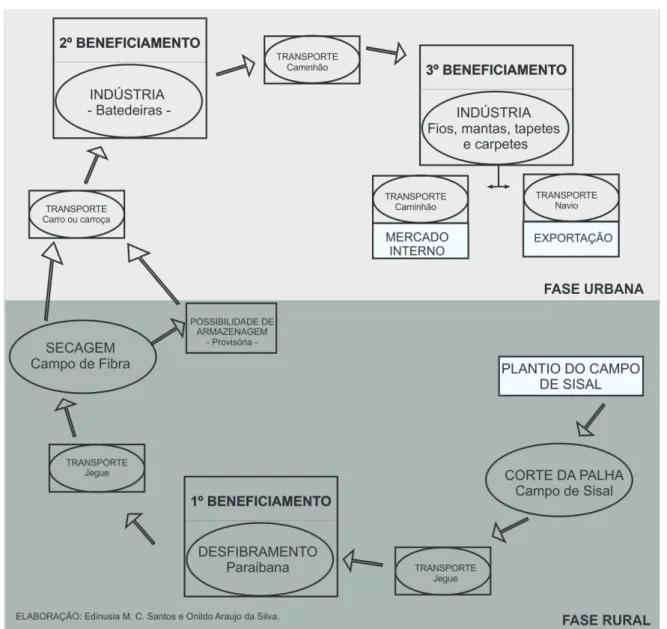
-catán peninsula in Mexico and found the appropriate socio-economic and soil-climatic conditions to become a commercial product in the semi-arid. Santos (2010) characterized the process of sisal processing by proposing to subdivide it into rural and urban phases (Figure 1).
According to the author, this agricultural product goes through the irst processing in the rural area in properties that set aside part of their land for the planting of sisal ields. Once cut, the leaves of the plants (popularly known as ibers) are decorticated in the paraibanas machines (an articulated set of cutting blades run on a diesel engine) and extended in the sun.
to
r.
u
fc.
b
r
Figure 1 - Schematic representation of the productive process of sisal
It is important to note that the completion of the rural phase of the process is usually the res
-ponsibility of the “driver”, who in this case is the person in charge of operating the sisal engine and is responsible for removing the dry iber, baling and taking care of its transport to the sisal beaters; it is very rare for a worker only to act as a “driver”, they are usually also the owner of the paraibanas machine or the landowner.
After this stage in the rural area, the sisal is transported to the cities where it receives a second processing in the beaters (industrial units that smooth and select sisal ibers). From the beater, the iber comes out ready to be sold as a raw material to other Brazilian regions and / or the foreign market. Export is still the largest destination of the sisal iber produced in semi-arid Bahia; however, part of the iber can also be reused in the productive spaces, manufacturing ropes, threads, blankets, carpets, and handicrafts, among others.
w
w
w
.me
rca
to
Sisal has by-products from the process of iber processing that have economic value: the re
-sidue, the wadding, the powder and the pulp. However, these by-products are not yet used to the point of generating another process on an industrial or commercial scale.
INVESTIGATING SISAL IN BAHIA:
PROPOSAL FOR PERIODIZATION
In Bahia, the agave sisalana was gradually introduced until it became the base of the economy of a group of semi-arid municipalities; it is possible to demarcate some periods in which a given characteristic of the process is more efective and evident than others. Silva (2012) argues that the process of establishing the sisaleira activity was characterized by aspects that allow speciic phases to be deined, namely:
[...] - from the beginning of the twentieth century to 1940, when the irst sisal processing plant was installed in the city of Valente. A period that marks the beginning of sisal planting with an explicit
commercial purpose; - in the 1940s and 1950s, a period that marks the consolidation of the
plantations and the ample incentive to plant sisal by the then governor of Bahia, Landulfo Alves; - in the 1960s and 1970s, a period that marks the heyday of sisal farming when sisal became known as the green gold of the sertão; - the 1980’s, a period of strong crisis when sisal ields were burnt and there was a sharp drop in production; - from the 1990s to the present, a period that marks a restructuring of the process of iber processing and industrialization, with an emphasis on the action of small landowners (pp. 217-218).
In accordance with the idea that these phases allow a characterization of the process of
re-gional diferentiation in focus, our next task is to present a set of arguments and data that validate a periodization capable of supporting an understanding of the forging of a sisal economy linked to local politics allowing the construction of the idea of a Sisaleira Region. It is important to note that, unlike Silva (2012), we chose to assign names to these periods that refer to their fundamental characteristics.
GENESIS OF SISALEIRA FARMING
The period we call genesis of sisaleira farming goes from the beginning of the twentieth cen
-tury until the beginning of the 1940s. This period marks the arrival in Bahia of the irst sisal bulbs and its transformation from ornamental planting (hedge) to commercial planting to obtain iber. According to Pinto (1969), at the beginning of the twentieth century, the irst sisal bulbs arrived in Brazil from Florida, which were introduced to the Bay of Bahia by Horacio Urpia Junior, with the intention of commercially exploiting the agave, but the frequent rains did not allow for commercial exploitation, since it is a xerophilous plant. Thus, sisal was only planted as a hedge. By 1919, the agave sisalana had spread throughout the Northeast of the State of Bahia and developed rapidly, passing from use as a hedge to become a commercial product.
After 1935, the state government began to encourage the cultivation of sisal, so that “[...] from 1939 sisal came to be seen as an economic possibility. In 1940, the Secretariat of Agriculture im
-planted a colonial nucleus in Nova Soure, initiating the planting of the agave sisalana “(SEAGRI, 1991, p.5).
Sisal found the key conditions to become a commodity: state encouragement, adequate and relatively cheap land, abundant labor, capitalized entrepreneurs, and export infrastructure.
to
r.
u
fc.
b
r
It is important to note that at this time there was a lot of available land that was used to enlarge the sisalais. The implementation of commercial cultivation began to generate employment, that is, it was necessary to teach the workers to use the machines, to care for the ields and carry out the irst processing, which still takes place today, totally in the rural area. The work was learned quickly and required little qualiication.
The “jump” to a new period occurred with the beginning of the industrialization of sisal in the municipalities, indicating an urban processing phase whose milestone was the setting up of a plant in the city of Valente, which at the time was still a village, the center of a district of the municipality of Conceição do Coité.
COMPOSITION OF THE PRODUCTION SYSTEM OF SISAL
The period we call the composition of the sisal productive system extends from the early 1940s to the late 1950s. This period marks the consolidation of the plantations, the installation of proces
-sing plants and the ample incentive to plant sisal by the then governor of Bahia Landulfo Alves.
In 1940, two experimental ields were created for sisal culture, one in the municipality of Feira de Santana and the other in the municipality of Nova Soure. The latter had a 2,000-foot plantation and had a processing plant equipped with the irst decortication machine (LAGE, 2002, p.
This state action, based on identifying the plant’s potential to produce a multipurpose iber, encouraged the generalization of planting. Associated with the idea of a plant able to withstand the long droughts, agave spread quickly through two dozen municipalities in semi-arid Bahia.
As has already been pointed out, one of the milestones of this expansion was the installation in 1940 of a processing plant in the town of Valente by Décio Monte Alegre and José de Araújo Góis, whose objective was to prepare the sisal iber for commercialization. According to Pinto (1969), other mills were also being created at the same time as new plantations were planted. In 1942, Brazil was on the list of sisal importing countries and, due to the development of sisal farming in Bahia and also in Paraíba, in 1946, Brazil was present in the statistics as an exporter of 2000 tons. In this sense, the sisaleira crop was established, having the external market as a foundational and propulsive demand. While boosting economic growth, the activity turned to the foreign market, deining the form of structuring and articulating a regional-based economy with the port of Salvador.
At the beginning of this period, the landowners also owned the sisal engines and organized the production process. Over time, a signiicant change took place that forged a new relationship between the owners of the sisal ields and the workers, that is, the sublease of the sisal ield began.
In the sublease, the landowner arranged a ixed percentage of the income to be earned with a third party (usually the owner of the sisal engine) and left it up to that third party to hire other workers. This always exempted the owner of the land and the sisal plantation from any labor liability. Santos; Silva; Araujo (2010) present a detailed analysis this aspect of labor in the sisal productive process, including highlighting the role of each worker.
Our argument, that the composition of a productive system occurs in this period, is also sup
w
w
w
.me
rca
to
Figure 2 - Production of sisal in tons of iber produced. Bahia State 1940-1959.
The gradual expansion of the planted area was accompanied by the installation of small pro
-cessing units known as beaters. The beaters were also implanted in the small villages of the main municipalities of the sisaleira area, such as Conceição do Coité, Serrinha and Riachão do Jacuípe.
THE APOGEE OF THE GREEN GOLD OF THE SERTÃO: THE SISALEIRA
REGION OF BAHIA WAS BORN
The period we call the apogee of the green gold of the sertão, the 1960s and 1970s, is charac
-terized by the expansion of the system set up to export sisal. We can say that in these decades “all the ways”, related to the sisal crop, “led to the port of Salvador”, the departure point of the iber to the world.
The data on planted areas (igure 3), the ton of iber produced (igure 4) and the emancipation of new municipalities ratiies our argument. It was veriied that between 1960 and 1970 the area planted gradually increased from 58,853 hectares in 1960 to 268,429 hectares in 1970, a peak re
-corded for planted area that had not been exceeded by 2010. Meanwhile, production in tons steadily increased throughout the series, from the 1960s to the 1970s, reaching 280,000 tons in 1970.
In addition, the expansion of the productive system directly inluenced the political action of local elites and the creation of new municipalities. According to Silva (2012), this process had already begun in the phase prior to that of the apogee with the emancipation of three municipali
-ties: in 1952, the emancipation of Cansanção, which was dismembered from the municipality of Monte Santo; in 1956, Araci was dismembered from the municipality of Serrinha; and, in 1958, the municipality of Valente was created, dismembering itself from the municipality of Conceição from the Coite. The consolidation of the productive process of sisal was fundamental for these dismem
to
r.
u
fc.
b
r
Figure 3 - Planted area of sisal in hectares. Bahia State 1940-2010.
w
w
w
.me
rca
to
The accumulated wealth, already strongly concentrated in the hands of a small elite, drove new actions to expand industry and political power through the election of mayors directly linked to the sisal business. During this period, the cultivation of sisal became the economic reference of a group of municipalities that turned into the Sisaleira Region of Bahia.
However, production was structured with particular characteristics such as:
• the low technological level of the entire sisal production process (planting, harvesting, de
-cortication, and processing);
• the under-utilization of the product (only the iber, equivalent to 5% of the plant’s potential); • the generation of unevenly distributed surplus;
• the intense exploitation of the workers, mainly due to informality and the existence of the igure of the “owner of the motor”.
Even so, Bahia became one of the world’s largest exporters of the iber. Selling in dollars to foreign companies and keeping the price of the kilo of iber at a level suicient to compensate the plantation owner and the sisal trader, entrepreneurs greatly expanded the industrial infrastructure. However, the owner of the engine was paid a pitiful price per kilo of iber, which contributed to the emergence of a discourse defending the impossibility of paying the thousands of workers properly.
Thus, the apogee phase led to the prosperity of a small regional elite at the expense of the misery and gradual pauperization of the worker. On this aspect it is opportune to present Figure 5, which records a historical series of the Human Development Index (HDI) of the municipalities that belong to the Sisaleira Region.
to
r.
u
fc.
b
r
During the 1960s and 1970s, when sisal reached its apogee, it can be seen that the HDI was extremely low: in the municipalities of Teoilândia and Cansanção, the index only reached 0.200, and solely the municipality of Ichú reached 0.300. It is clear that these igures express the extreme poverty of the majority of the population.
Thus, we identiied the already well-known contradiction between economic growth and the maintenance of very high levels of inequality that cause the extreme poverty of the majority. This was no diferent with the productive system of sisal. It is estimated that between 700 and 800 thou
-sand workers worked in the productive process; for them and their families, the prosperity of the sisalais had never been translated into efective beneits.
These two “golden decades” of the productive system of sisal generated a concentrated wealth and the creation of an inluential sisal elite in politics. The sisal businessmen became mayors in the existing municipalities and in those that were being emancipated due to the inluence that these business owners held with the state government. Moreover, this “fusion” of political and economic power perpetuated these groups in power for several decades. Noteworthy examples of this are given below:
• The Rios Family in Conceição do Coité, led by the politician and sisal businessman Hamilton Rios de Araujo, who was in power with Hamilton Rios himself as mayor of the municipality. This political group elected several state deputies such as Emilio Reseda and Tom Araujo (Ha
-milton Rios’s son). Finally, in the last municipal election of 2012, the Rios family’s political group lost the election to an opposition candidate, a public oicial ailiated to the Workers’ Party (PT). However, the maintenance of economic power is evident, as Hamilton Rios Ind. Com. e Exp. Ltda, owner of the sisal brand RISANA, in association with Cotesi Cia Téxteis e Sintéticos SA, a traditional Portuguese industrial group of yarns and ropes, commands Cotesi do Brasil, an industrial company, located in the city of Conceição do Coite, and regarded as the main exporter of sisal iber in Brazil.
• The Carneiro family, in the municipalities of Valente and São Domingos, and the Pinheiro family in São Domingos, were led by Florisvaldo Carneiro (State Representative for two ter
-ms). The Carneiro family and their allies have sisal companies and they commanded the city council of Valente. Florisvaldo Carneiro himself was mayor and, as a state deputy, worked intensely for the emancipation of the municipality of São Domingos, which occurred in 1989. That same year, the Carneiro family lost the election in Santo Domingo to the Pinheiro family, led by the then sisal entrepreneur Izaque Pinheiro, who became the irst mayor of the munici
-pality. This family is still in power (24 years of consecutive terms); including the mandates of Izaque Junior (son of Izaque Pinheiro). Both families have companies beneiting from sisal; in addition, the Carneiro family owns a iber factory and another making blankets, both located in São Domingos.
• The Martins Family, in the municipality of Retirolândia - led by the brothers Adevaldo Martins and Adelídio Martins (both had mandates as mayor). This family led the municipal prefecture for several mandates, including that of the present mayor of Retirolândia Andre Martins, the youngest son of Adevaldo Martins. They have iber industries and have worked with sisal for many decades.
This political and economic elite, whose tentacles spread throughout the sisal area of Bahia, constructed a discourse of belonging to the Sisaleira Region, which was absorbed by the munici
w
w
w
.me
rca
to an identity that continues to be reairmed by these traditional elites and even survives in the spe
-eches of new political actors linked to the social movements that ight the political action of these same elites.
These are examples of how the political and economic domain created an uneven and con
-centrated system in the sisaleira municipalities, resulting in the extreme poverty of thousands of workers who, with the Bolsa Família Program, of the Lula and Dilma governments, have begun now begun to be rescued from the condition of misery.
IN STEP WITH BRAZIL: SISAL’S LOST DECADE
The 1980s was a decade of severe crisis, sisal’s lost decade, with the burning of the sisal plantations, a large reduction in production and productivity and a drop in the price of iber on the international market. Initially the crisis was attributed to competition with synthetic ibers, later it transpired that the widespread age of the sisalais, the spread of disease, the inadequate upkeep of the ields, combined with sharp declines in international prices, plunged the cultivation of sisal into a crisis that had the heaviest impact on the workers, who saw their incomes sharply reduced.
Regarding production, it is evident that in 1950 the state of Bahia produced 2,147 tons of iber, gradually increasing to a peak of 280,000 tons in 1970. It is precisely from the mid-1970s and throughout the 1980s that there was a decreasing sequence in production, with the minimum of 129,703 tons produced in 1985.
The strong discourse of the crisis (since elites always proited a great deal from sisal, whether it was in crisis or not) served as the basis for reducing the price paid to workers, whether by work day or by production. This process signiicantly increased the poverty in the Sisaleira Region of Bahia; working with sisal became synonymous with poverty, illiteracy and incapacity, because
the “motor”, it was said in the region, is for the poor who have no other option, or place to work.
But for landowners, merchants, industrialists, and politicians already elected to work “for the poor,” it was the time to “use” the state in the form of various aid and amnesty plans in which public banks, such as the former Bank of the State of Bahia (BANEB), became a trading desk between the government and the local elite.
Traditional families involved in party politics continued to enrich and exploit the productive process of sisal. Even with the crisis, prosperity has continued for this small elite that is using political patronage all the more, and which can still be seen today.
In addition, landowners burned most of the sisalais (we cannot ind statistics on the quantity) replacing them with pastures. In several municipalities considered part of the Sisaleira Region, like Candeal and Gavião, the substitution was total.
It is important to note that while sisalais were burned in core municipalities of the Sisalei
-ra Region, they were being expanded in the municipalities of the Chapada Diamantina Norte, where there was land and labor in abundance, including due to the action of businessmen from municipalities such as Valente and São Domingos. The sisal purchased in these municipalities is still processed today in Conceição do Coite, Valente, São Domingos and Retirolândia, cities that concentrate the iber factories.
The recovery of the sisal productive system and its restructuring in the early 1990s focused on the idea that it was not enough to simply decorticate and export, it was necessary to industrialize the iber to add value, rescuing the worker for industrial employment and increasing the amount paid per kilo of iber. This is a path to restructuring, integrated with the action of small producers who have joined together to better compete in the sisal market.
SCIENCE AND ASSOCIATIVISM: THE RESTRUCTURING PERIOD
-to
r.
u
fc.
b
r
ploitation of workers to maintain the proit rate of landowners and business owners. The debate on the crisis, starting in the 1990s, generated a wide association between the State, companies and organized civil society to ind solutions.
In the scientiic ield there were investigations that revealed the reasons for the crisis; inclu
-ding the fundamental aspects given below:
• research that showed the low productivity of the sisal ields - due to the age of the sisalais, the inadequacy of cultivation practices and the action of pests - and indicated ways to over -come these problems;
• indings regarding the underutilization of sisal, since normally only the iber was used, discarding important products such as waste, pulp and wadding;
• identiication of diseases such as red rot, which reduces plant life;
• studies that showed the low capacity of businesspersons to add value to sisal.
With a more precise diagnosis, a period of restructuring started in the 1990s. Joint action has been observed by small producers of sisal and the State and Federal governments to ind solutions to the problems identiied and develop alternatives. As an example, there is the action of the uni
-versities in Bahia that have developed research in the ield of crop disease, the use of by-products and the generation (invention) of a new set of products that use sisal as raw material, an aspect which inluences the restructuring of the process of iber processing and industrialization.
The restructuring of the early 1990s was also driven by the organization of small landowners associated with the action of entrepreneurs who saw new possibilities with the expansion of the environmental discourse, including the expansion of the action of a union that brings together the businesspersons of the natural ibers sector, such as sisal, called the Federation of Vegetable Fiber Industries of Bahia (SINDFIBRAS).
Sisal iber is biodegradable and therefore perceived as environmentally correct, even though it is produced from the overexploitation of thousands of people, including children and the elderly. For the international market, the use of biodegradable iber to substitute synthetic ibers has resha
-ped the relationship of sisal iber with the idea of environmental protection. In addition, there has been a diversiication of production and a redirection to the domestic market, taking advantage of the expansion of consumption in Brazil in the last two decades.
The Solidary and Sustainable Development Association of the Sisaleira Region of Bahia (APAEB) played an important role in this restructuring, which succeeded in establishing a carpet and rug industry in the municipality of Valente and gradually increased the price of the kilo of iber. The data collected by us conirmed the 2000s as a period of expansion of both production and the planted area, since in 2010 Bahia had 252,224 hectares planted and produced 237,397 tons of iber, numbers that approximate those obtained in the 1960s and 1970.
Sisal remains a plant with broad economic potential for Brazilian semi-arid regions; however, without solving the main problem of the productive chain, the overexploitation of the worker and non-recognition of their labor rights, we have serious doubts about whether it will be possible to give new impetus to the productive chain with a view to a promising future in the coming decades.
FINAL CONSIDERATIONS
w
w
w
.me
rca
to
mass of workers; on the other hand, the extreme poverty of thousands of men, women, children and the elderly who have worked and continue to work without the guarantee of labor rights, without digniied remuneration, and without adequate working conditions.
Almost a century since the introduction of sisal in the Bahian semi-arid, we can paraphrase Euclides da Cunha and say that this plant “is irst and foremost strong”, surviving because of its extreme suitability to the semi-arid. Nevertheless, the restructuring of the 1990s succeeded in rai
-sing the price of iber and encouraged landowners to replant the ields. Unfortunately, even with an association of small producers as the protagonists of this process, there has been no change in the organization of labor in the countryside. The current pay remains at best unworthy, and the working conditions are shameful in a country trying to assert itself as a world power in the twenty-irst century.
Some actions in the sense of discussing these aspects are starting to form an alternative possi
-bility, especially with the actions of the Rural Workers’ Unions (STRs) of some municipalities like Retirolândia and Valente. However, it is urgent that society in Bahia, especially the “New” Territory of Sisal (the name adopted for the group of 20 municipalities that make up one of the 27 Identity Territories deined by the Secretariat of Planning of the State of Bahia, from 2007), mobilize to solve the problem and stop the overexploitation of the sisal worker.
In addition, we have fond that the Sisaleira Region is an “invention” of a political and economic elite linked to the productive process of sisal and has always been used by this same elite to access public resources. The idea of the existence of a Sisal Territory arises from the action of the Ministry of Agrarian Development (MDA) from the Territories of Citizenship and is strongly articulated with the action of relevant social movements such as the Community Organization Movement (MOC).
In this way, and due to the limits of this article, we end by raising some questions: does the birth of the Territory of the Sisal foresee the death of the old Sisaleira Region of Bahia? For the political and economic elites is the region the same as the territory is for the social movements that demand justice, equality and solidarity?
BIBLIOGRAPHIC REFERENCE
COMPANHIA DE DESENVOLVIMENTO E AÇÃO REGIONAL - CAR (BA). Alternativas
sócio-eco-nômicas para o desenvolvimento da Região Sisaleira. Salvador: CAR, 1994.
EMBRAPA.O agronegocio do sisal no Brasil. EMBRAPA, 1999.
MARQUES, Nonato. O sisal na Bahia. V convenção Regional do Sisal. Salvador, 1978.
PINTO, M. N. Contribuição ao Estudo da Inluência da Lavoura Especulativa do Sisal no Estado da Bahia.
Revista Brasileira de Geograia. Rio de Janeiro: AGB, n. 31(3), jul-set. 1969. p. 3-102.
SANTOS, E. M. C. Associativismo e desenvolvimento. Feira de Santana: UEFS Editora, 2010.
SANTOS, E. M. C. Reorganização Espacial e Desenvolvimento da Região Sisaleira da Bahia. Dissertação
(Mestrado de Geograia) - Universidade Federal da Bahia, Salvador, 2002.
SANTOS, E. M. C.; COELHO NETO, A. S.; SILVA, O. Araujo. Gente ajudando gente. Feira de Santana:
UEFS Editora, 2011.
SANTOS, E. M. C. e SILVA, O. A. da. Agentes sociais de produção do espaço rural no Território do Sisal
– Bahia. Revista Campo-Território, v. 5, n. 9, p. 71-88, fev., 2010.
SANTOS, E. M. C.; SILVA, O. A. da.; O. Araujo. A precarização do trabalho rural no processo produtivo
do sisal. In: Anais da XI Jornada do Trabalho. UFPB – João Pessoa. 2010.
SECRETÁRIA DA AGRICULTURA, IRRIGAÇÃO E REFORMA AGRÁRIA (SEAGRI) (BA). O Sisal
na Bahia. Salvador: CER, 1991.
SILVA, O. A. da. Rede urbana e dinâmica regional no estado da Bahia. In: Dias, P. C.; Santos, J. (orgs).
to
r.
u
fc.
b
r
SILVA, O. A. da; SANTOS, E. M. C. Associativismo e Desenvolvimento Local. In: El Desarrollo Local
em su Complejidad. Santiago de Compostela: USC, 2005.
LAGE, C. S.; ARGOLLO, J. L.; SILVA, M. A. (Orgs.). O Sisal Baiano Salvador: Ed. Governo do Estado