comparative study of the provision of sports arenas for the
2014 Fifa World Cup in Brazil
Cláudio José Oliveira dos Reis
Universidade Federal do Oeste da Bahia / Núcleo Docente de Ciências Sociais Aplicadas Barreiras / BA — Brazil
Universidade Federal da Bahia / Núcleo de Pós-Graduação em Administração Salvador / BA — Brazil
Sandro Cabral
Insper Instituto de Ensino e Pesquisa São Paulo / SP — Brazil
Universidade Federal da Bahia / Núcleo de Pós-Graduação em Administração (licenciado) Salvador / BA — Brazil
Due to its recent adoption, little is known about the performance of public-private partnerships (PPP) and their determinants. he present study aims to investigate the behavior of PPP and their contractual variations in the provision of sports arenas for the 2014 Fifa World Cup in Brazil, using a comparative perspective on traditional public and private provision modes. he research adopts a qualitative approach with an exploratory perspective and multiple case studies. he results suggest that, for Brazilian public administration, PPP presented good value for money, especially in terms of the time schedule, costs, diversiied revenues and bidding process as a result of incentive structures coming from PPP contracts and private partner lexibility.
Keywords: public-private partnerships; value for money; incentive structures; mega sporting events.
Parcerias público-privadas (PPP) em megaeventos esportivos: um estudo comparativo da provisão de arenas esportivas para a Copa do Mundo Fifa Brasil 2014
Em função do caráter recente de sua adoção, pouco se sabe ainda sobre o desempenho de projetos de Parcerias Públi-co-Privadas (PPP) e seus condicionantes. O presente estudo tem por objetivo investigar o comportamento das PPP e suas variações contratuais na provisão de arenas esportivas para a Copa do Mundo Fifa Brasil 2014 numa perspectiva comparada às modalidades de provisão pública tradicional e estritamente privada. Para tanto, utilizou-se uma abor-dagem metodológica qualitativa, inserida numa perspectiva exploratória por meio de estudo de casos múltiplos. Os resultados sugerem que os projetos de PPP geraram value for money para a administração pública brasileira, sobretudo no que se referente aos aspectos de prazo, custos, receitas diversiicadas e processo licitatório em decorrência das es-truturas de incentivos oriundas dos contratos de PPP e da própria lexibilidade gerencial inerente aos atores privados.
Palavras-chave: parcerias público-privadas; valor adicional; estruturas de incentivos; megaeventos esportivos.
Asociaciones público-privadas (PPP) en megaeventos deportivos: un estudio comparativo en la provisión de los estadios deportivos para el Mundial Fifa Brasil 2014
Debido al carácter reciente de su adopción, aún se conoce poco sobre lo desempeño de proyectos de Asociaciones Público-Privadas (PPP) y sus condiciones. El presente estudio tiene como objetivo investigar el comportamiento de las PPP y sus variaciones contractuales en la provisión de los estadios deportivos para el Mundial Fifa Brasil 2014 bajo una perspectiva comparada a las modalidades de provisión pública tradicional y estrictamente privada. Para este propósito, se utilizó un enfoque cualitativo, incluido en una perspectiva exploratoria a través del estudio de casos múltiples. Los resultados sugieren que los proyectos de PPP generan un valor agregado para la administración pública brasilera, princi-palmente con relación a plazos, costos, ingresos diversiicados e proceso licitatorio como consecuencia de las estructuras de incentivos provenientes de los contratos de PPP y de la propia lexibilidad gerencial, inherentes a los actores privados.
Palabras clave: asociaciones público-privadas; valor agregado; estructuras de incentivos; megaeventos deportivos.
DOI: http://dx.doi.org/10.1590/0034-7612158071
Article received on December 23, 2015 and accepted on October 7, 2016.
1. INTRODUCTION
Scholars in the area of public administration and strategy have been drawing attention recently to the interdependence between public and private actors and the need to understand the mechanisms that could lead to better (or worse) performance standards (Mahoney, Mcgahan and Pitelis, 2009; Bel, Brown and Warner, 2014). hey igure in these various collaborative forms between government oicials and private actors for the provision of public utility services, such as Public-Private Partner-ships (PPPs), like the ones that appear in this section. Fostered under the winds of the liberalizing reforms that have been undertaken over the last few decades, PPPs are a relatively recent phenomenon that still lack a lot of clariication, particularly pertaining to the evaluation of the performance and their constraints (Forrer et al., 2010; Kivleniece and Quelin, 2012). Brazil is no exception, of course, and although some recent studies have addressed the issue of PPPs within the country (Peci and Sobral, 2007; hamer and Lazzarini, 2015), little is known about the concrete results of the Brazilian experiences.
As a way to ill in this gap, this study seeks to investigate the behaviour of PPPs used for the con-struction and renovation of the stadiums that were used in the 2014 Fifa World Cup, in a perspective compared to traditional public provisions and to strictly private provisions. he matter is of importance insofar as the mechanisms that afect PPP performance in Brazil and the real pertinence of non-state forms in the provision of infrastructure equipment are not yet clear. Even in the international sphere, there are few studies that deal with the provision of sports and cultural equipment under the PPP (Cabral and Silva Jr., 2013). Despite the contributions of this study to literature on public admin-istration, strategy in organizations and sports management, it should be stressed that the authors’ goal is not to debate whether or not to hold mega sporting events. he objective is restricted to the understanding of the implications of the forms of the chosen provision, taking as principle that the decision to hold events such as the World Cup was determined exogenously.
In the Brazilian case, the choice of Brazil as a 2014 Fifa World Cup venue in October 2007 placed the country in a prominent position in the international landscape due to the event’s high visibility, unequivocally the object of interest by many countries over the last few decades. Sporting events like this, however, generally require high investments for the construction or adaption of a series of equipment, most notably football stadiums and complementary infrastructure. Faced with this, government investments are oten needed through involvement in their diferent spheres. Ater picking out the tournament’s 12 host cities in May 2009, the availability of stadiums in standards of excellence became a latent demand in the face of the decaying state of Brazilian sporting arenas. In fact, nine of the 12 Brazilian football stadiums chosen to host the huge sports event boasted out-dated infrastructure averaging about 55 years old.1 Following the tradition of other large-scale
sporting events (Roche, 2000; Cabral and Silva Jr., 2013; Preuss, Solberg and Alm, 2014), the public sector played a critical role in the provision of nine of the 12 stadiums planned to host the games for the tournament, with emphasis on the use of the PPP method for the provision of 5 of the 12 football stadiums.
1 his descriptive statistic was generated by the authors based on the arithmetic mean of the age of the nine public stadiums used in the
In order to comply with the proposed objectives, qualitative research was used, inserted in an exploratory and comparative perspective through a multi-case study on the ive stadiums provided by PPP for the 2014 Fifa World Cup Brazil (Belo Horizonte, Fortaleza, Natal, Recife and Salvador). hese initiatives are compared with the stadiums provided under the traditional public provision (Brasília, Cuiabá, Manaus and Rio de Janeiro, built under the traditional modes and later granted to private initiatives) and strictly private (Curitiba, Porto Alegre and São Paulo). he methodological instances of the ield research and its results are presented below ater a brief theoretical discussion related to the state of the art of the literature on PPP and large-scale sporting events.
2. MEGA SPORTS EVENTS: THE STATE’S ROLE
Mega sports events are major events involving participants from diferent locations and are held in a relatively brief period of time (Florek, Breitbarth and Conejo, 2008). Generally speaking, large-scale sporting events involve high investments in infrastructure (Malfas, heodoraki and Houlihan, 2004), oten taking on an important role in urban development and contributing to a generation of potential legacies in the regions where they are hosted (Gursoy and Kendall, 2006).
Literature regarding mega sporting events does not, however, provide a consensus on the scope of potential legacies, making it diicult to measure aspects afected by mega-events (Preuss, 2007). To this end, Preuss (2007) deines legacy as any change in the structure - be it planned or unplanned, positive or negative, tangible or intangible — created for and by the large-scale sports event that remains long ater the event itself has ended. Yet, the idea of a legacy is generally thought of as consistently positive, something that may be misleading. his is due to the fact that, depending on the circumstances of holding the mega-event, adverse legacies can also be generated (Pillay and Bass, 2008). Examples of unfavourable legacies are highlighted in the literature: the elevated costs for constructing sports equipment, investments in unnecessary structures and the debt within the public sector (Roche, 2000; Malfas, heodoraki and Houlihan, 2004; Gursoy and Kendall, 2006).
In this respect, Preuss, Solberg and Alm (2014) illustrate that the Fifa World Cup is a mega-sport event requiring substantial investments, both in the construction of new stadiums and in the provision of infrastructure surrounding these sports venues. Arenas that were constructed or renovated for this mega-event are generally considered a legacy, since intervention (renovation or construction) for the infrastructure of venues is oten only feasible because of the event (Fifa, 2011). In the meantime, some host cities already have infrastructure that allows them to hold major sporting events with a very low level of investment, while other cities need to invest substantially in their infrastructure to meet the standards demanded by Fifa, whose requirement levels increase each year due to their learning curve in holding each event.
the purchase of stadium tickets (Forrest and Simmons, 2002). Conversely, Mules (1998) contends that public investments in the execution of large scale sporting events can also be justiied by the possibility of market failures, mainly due to the presence of public assets and externalities that are oten associated with the long-term efects of huge sports events of this type, which can inhibit investments on the part of the private sector. hus, many governments have subsidized the construction of sports arenas for use by professional sports teams, claiming that such projects generate valuable public assets and positive externalities for the local economy, although these beneits are diicult to measure (Johnson and Whitehead, 2000). With this in mind, one of the ways governments can reduce public spending without compromising the event is through Public-Private Partnerships (PPP), which should theo-retically balance the construction of venues, their use during the event and, most importantly, their long-term sustainability (Cabral and Silva Jr., 2013). Such methods are discussed below.
3. PPP IN THE SUPPLY OF INFRASTRUCTURE AND PUBLIC SERVICES
Various contractual arrangements between public institutions and private enterprises can be adopted in the provision of public assets and services, including sports related facilities. Facing this, gov-ernments began to look for new provision methods through the involvement of private initiative in supplying public assets and services, and in this context, PPPs arise as a hybrid organizational arrangement formed between the public sector and the private initiatives. Two aspects are essential in understanding the potential of PPPs: value for money and incentives.
3.1 VALUE FOR MONEY
According to Marques and Berg (2011), the implementation of PPP projects in the infrastructure sector have garnered many beneits in terms of eiciency and quality in providing public assets and services. his is due to the fact that joint action by the private sector with the public sector can gener-ate a gregener-ater value for money2when compared to the traditional public provision method (European
Commission, 2003; IMF, 2004; World Bank, 2012). he comparison of the beneits of the economic intervention between the traditional public provision and the private provision has been the subject of a continuous debate, as PPPs have been seen as a provision method that renders a qualitative leap in the efort to combine the forces of the public and private sector (Hodge and Greve, 2007).
However, the use of PPP should also be related to the economic rationality provided by the inter-action between both public and private partners (Grimsey and Lewis, 2005; Välilä, 2005). he private partner’s role is to add value so that the public-private arrangement is economically superior to the traditional public ofering. he value for money measurement, in accordance with the European Com-mission (2003), generally uses the comparative evaluation technique between the lesser Net Present Value (NPV) of disbursements generated by the PPP project and the traditional public provision, which is normally known as the public sector comparator (PSC). According to Grimsey and Lewis (2005), the PSC concept has been widely adopted as a test to ind out if a PPP project reaches a lower
2 he expression “value for money” is used in literature regarding PPPs to express an improved economic advantage for the Public
NPV of disbursements when compared to the project implemented through the traditional public provision method. In short, the PPP method can have economic advantages if, when an analysis of the value for money is completed, the public-private arrangement exhibits the following factors in the provision of the public asset/service: (1) reduced costs; (2) shorter deployment time; (3) better quality; (4) better risk allocation; and (5) generating new diversiied revenues (European Commission, 2003; IMF, 2004; World Bank, 2012).
3.2 INCENTIVES IN PPP
he contractual aspects of a PPP favour the production of incentives when the project is being de-ployed because the private partner is encouraged to adopt a holistic vision of the entire life cycle of the project, stimulating the eiciency and the best quality in the provision of a public service (Hart, 2003). To this end, some sources of incentives (asset ownership, integration of construction/opera-tions and risk allocation) can add value to a PPP project because they afect the productive eiciency in the provision of the public assets and services (Hart, 2003; European Commission, 2003; World Bank, 2012).
he irst potential source of incentives relates to asset ownership. In a PPP, the private partner can hold large portions of property rights throughout the project’s life cycle. he concentration of property and decision rights in the private partner sphere would promote productive eiciency (a reduction of operating costs), particularly in areas of contractual incompleteness (Tirole, 1999; Hart, 2003). In this case, the private partner would have added motivations to carry out new investments in order to improve their productive performance. Innovations for improving cost eiciency, however, can happen at the expense of reduced quality (Hart, Shleifer and Vishny, 1997), which requires monitoring mechanisms by the public-sector to curb self-interested behaviour by private stakeholders (Cabral, Lazzarini and Azevedo, 2010).
Now with the second potential source of incentives, PPP methods were seen in which there is a higher integration of activities on the part of the private sector encouraging productive eiciency (European Commission, 2003; IMF, 2004; World Bank, 2012). According to Hart (2003), the BOT and DBOT methods are associated with the fact that the private partner is responsible at the same time for the construction of the equipment and operation of the public service, which is oten called bundling. In view of this, according to the World Bank (2012), bundling made possible by PPPs encourages the private partner to complete each phase of the project (construction, operation and maintenance) with more operational eiciency, minimizing the total costs incurred in the provision of equipment and public service. As a matter of fact, the integration between construction and operation creates additional incentives to mitigate behaviours that lead to a deterioration in ex post quality (Cabral and Saussier, 2013).
2004, World Bank, 2012). Objected to a rigorous analysis by PPP project lenders, the uncertainties associated with demand raise the public sector’s ofer of minimum cash low guarantees to make PPP projects more attractive as it pertains to economic sustainability (Cabral and Silva Júnior, 2013).
4. METHODOLOGY
he methodological approach used in this study is essentially characterized as qualitative, placed in an exploratory, comparative and analytical descriptive perspective (Flick, 2004; Poupart et al., 2010). his is not because measuring variables is an objective, but rather to perform analyses of organiza-tional phenomena related to the stages of implementation and management for PPP projects (chart 1) adopted in the provision of sports venues for the 2014 Fifa Brazil World Cup.
CHART 1 PROVISION METHODS USED IN THE 12 SPORTS ARENAS
No Stadium State Asset Ownership Type of Action
Provision Method
Contractual Choices %
1 Arena Fonte Nova BA Public Reconstruction PPP
42%
2 Arena Pernambuco PE Public Construction PPP
3 Arena das Dunas RN Public Reconstruction PPP
4 Arena Mineirão MG Public Renovation PPP
5 Arena Castelão CE Public Renovation PPP
6 Arena Maracanã RJ Public Renovation Public/PPP
33%
7 Arena Mané Garrincha BSB Public Reconstruction Public
8 Arena da Amazônia AM Public Reconstruction Public
9 Arena Pantanal MT Public Reconstruction Public
10 Arena Corinthians SP Private Construction Private
25%
11 Arena Beira-Rio RS Private Renovation Private
12 Arena da Baixada PR Private Renovation Private
Source: Elaborated by the authors.
PPP projects (Coscarelli et al., 2014). Additionally, the methodological approach of case studies was employed to deepen the knowledge regarding the similarities and diferences of PPP projects, seeking to distil the empirical knowledge through the theoretical systematization of this study’s theme (Yin, 2001). To this end, the methodological route for the collection and processing of data went through four phases: documental analysis, semi-structured interviews, participant observation in public events related to the Fifa 2014 World Cup, and a content analysis.
For collecting secondary data, an exploratory documentary analysis was initially adopted relat-ing to all sports arenas (public, private and PPP) that pointed out the followrelat-ing documents: public bidding documents and contracts for PPP projects and public projects; the economic proposals of the bid winners; business plans; economic feasibility studies; project performance indexes; i-nancing agreements; balance sheet reports on the World Cup; reports on external control agencies; and others.
hirty semi-structured interviews3 were conducted with the public and private stakeholders
involved in the construction of the 12 sports arenas for the irst phase of data collection (16 public managers and 14 private managers), totalling 28 hours and 48 minutes of recorded audio interviews. Choosing the key stakeholders to be interviewed had been done based on the criteria of their formal position in the public and private institutions involved in the management of projects (chart 2). Naturally, the availability of the key participants limited any expansion of the sample, which was compensated by the documentary analysis.
CHART 2 PROFILE OF INTERVIEWEES
INTERVIEW
CODE HOST CITY INTERVIEWER CODE
INTERVIEWER
POSITION LINKED ISTITUTION
E1 Salvador Public Manager #1 State Secretary Bahia State Government (Secopa-BA)
E2 Private Manager #1 President Fonte Nova Stadium
E3 Private Manager #2 Director Bahia Sports Club
E4 Private Manager #3 Director Bahia Sports Club
E5 Recife Public Manager #2 State Secretary Pernambuco State Government (Secopa-PE)
E6 Private Manager #4 President Pernambuco Stadium
E7 Natal Public Manager #3 State Secretary Rio Grande do Norte State Government (Secopa-RN)
E8 Belo
Horizonte
Public Manager #4 Chief of Staff Minas Gerais State Government (Secopa-MG)
E9 Private Manager #5 Manager Mineirão Stadium
3 he interviews held in the 12 host cities were subsidized with funding from the Ministry of Sports and the National Council for Scientiic
and Technological Development (CNPq).
INTERVIEW
CODE HOST CITY INTERVIEWER CODE
INTERVIEWER
POSITION LINKED ISTITUTION
E10 Fortaleza Public Manager #5 State Secretary Ceará State Government (Secopa-CE)
E11 Private Manager #6 Manager Castelão Stadium
E12 Private Manager #7 President Lagardère/Arena Castelão
E13 Private Manager #8 Director Ceará Sporting Club
E14 Private Manager #9 Construction
Supervisor
Galvão Engenharia
E15 Brasília Public Manager #6 District Secretary Government of the Federal District (UGP Copa)
E16 Public Manager #7 Director Mané Guarrincha Stadium/Fundação Vila Olímpica
E17 Manaus Public Manager #8 UGP Copa
Coordinator
Amazonas State Government (UGP Copa)
E18 Public Manager #9 Director Amazônia Stadium/Fundação Vila Olímpica
E19 Cuiabá Public Manager #10 State Secretary Mato Grosso State Government (Secopa-MT)
E20 Public Manager #11 Manager Pantanal Stadium
E21 Porto
Alegre
Public Manager #12 State Secretary Rio Grande do Sul Government (Secretary of Sports and Leisure)
E22 Public Manager #13 Coordinator UGP
Copa
Rio Grande do Sul Government (UGP Copa)
E23 Private Manager#10 Manager Arena Beira-Rio/Sport Club Internacional
E24 Curitiba Public Manager #14 Municipal
Secretary
Curitiba Municipal Government — PR (Secopa)
E25 Private Manager#11 President Arena da Baixada/Clube Atlético Paranaense
E26 São Paulo Public Manager #15 Executive
Coordinator
São Paulo State Government (World Cup Steering Committee)
E27 Public Manager #16 Consultant City of São Paulo (World Cup Steering Committee)
E28 Private Manager#12 President Corinthians Stadium/Sport Club Corinthians
E29 Private Manager#13 Sports Specialist Jornal Agora São Paulo
E30 Rio de
Janeiro
Private Manager#14 Director Maracanã Stadium
Source: Elaborated by the authors.
CHART 3 CODING USED FOR THE CONTENT ANALYSIS
Empirical Sources Subjects for Analysis Codes
(1) Theoretical reference; (2) Transcripts from interviews; (3) PPP public bids notices and annexes; (4) PPP contracts and annexes; (5) Public bidding projects notices and annexes; (6) Contracts and annexes for Public Projects; (7) Financing agreements; (8) PPP feasibility studies; (9) Business Plans; (10) World Cup balance sheet reports; (11) Reports by external control agents.
Value for Money
Implantation Period
Provision Costs
Diversified Revenues
Contractual Incentives
Asset Property Right
Bundling Method and Performance Measurement
Risks and Earnings Sharing
Source: Prepared by the authors.
5. CASES STUDIED
5.1 CONTEXT AND PUBLIC NEED FOR PPP PROJECTS
he PPP projects that were analysed (table 1) resemble some characteristics of the bidding process (the bidding and competition method) and difer in other aspects (capacity, concession terms and contract value).
TABLE 1 PPP PROJECT DATA SUMMARY
Stadium Host City
Total Capacity (Fixed + Temporary) Bidding Method Competition
Type Type of Auction
Concession Period (Years) Contract Value (in R$) Arena Mineirão Belo Horizonte 62,170 International Competition Administrative Concession Lowest Price and Best Technique 27 677,353,021.85 Arena Castelão
Fortaleza 63,763 International Competition Administrative Concession Lowest Price and Best Technique 8 518,606,000.00 Arena das Dunas
Natal 42,024 International Competition Administrative Concession Lowest Price and Best Technique 20 400,000,000.00 Arena Pernambuco
Recife 46,154 International Competition Administrative Concession Lowest Price and Best Technique 30 379,263,314.00 Arena Fonte Nova
Salvador 55,045 International Competition Administrative Concession Lowest Price and Best Technique 35 591,711,185.00
Taking a look at the public need for PPPs, the research revealed that the primary motivating factors for implementing the projects are related to: (1) expectations on generating potential legacies for the host city and state; and (2) the feasibility of the construction and/ or renovation of modern multipurpose sports venues to meet the technical requirements of Fifa’s speciications. Two factors stand out regarding the reasons for choosing a particular PPP method: (1) the absence of public i-nancial resources for direct investments; and (2) the search for a better value for money for the state government.
5.2 RISK MANAGEMENT AND ALLOCATION
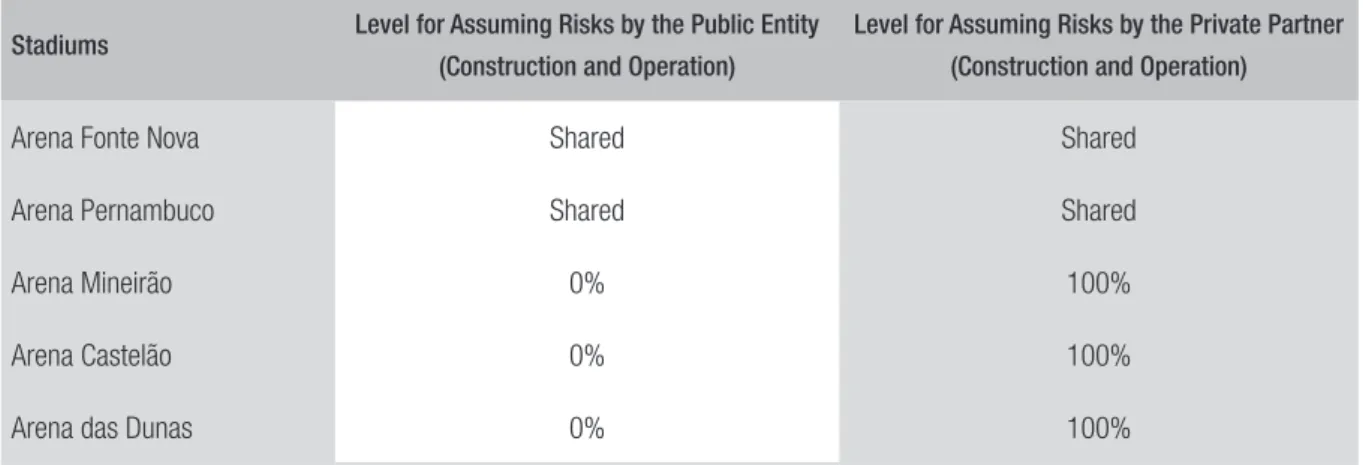
For the risk allocation process, diferent organizational arrangements between the public sector and the private sector were established, particularly regarding construction risks (implementation peri-od and provision costs) and the risks involved with operating the stadiums (demand risk). What is striking is the fact that, in two of the ive PPP projects, the public entity shared such risks, assuming a higher burden of risk in relation to the other states (table 2).
TABLE 2 MECHANISMS FOR ALLOCATING CONSTRUCTION AND OPERATION RISKS ADOPTED
IN THE PPP PROJECTS
Stadiums Level for Assuming Risks by the Public Entity (Construction and Operation)
Level for Assuming Risks by the Private Partner (Construction and Operation)
Arena Fonte Nova Shared Shared
Arena Pernambuco Shared Shared
Arena Mineirão 0% 100%
Arena Castelão 0% 100%
Arena das Dunas 0% 100%
Source: Elaborated by the authors and based on PPP contracts.
to the potential increase of future public disbursements, in case the private partners do not obtain the minimum cash low established in the PPP agreement (table 3). On the other hand, the high degree of risk assumed by the private stakeholders for the Belo Horizonte, Natal and Fortaleza Stadiums could lead to future contractual revisions, in the case that a real demand does not at the limit guarantee economic and inancial feasibility, causing the governments of these states to assume the entire operation and all their burdens if the private partners do not ind a inancial balance in the contract. he research pointed out that all the PPP projects that were analysed had adopted mechanisms to share additional gains (chart 4), in the case that the actual demand is higher than what was initially projected, which may contribute to a reduction of future public disbursements through deductions in the public counterpart.
TABLE 3 RULES FOR SHARING THE DEMAND RISKS IN PPP PROJECTS FOR THE STATES OF
BAHIA AND PERNAMBUCO
Stadiums
Annual Operating Income of the Base Case
(R$ millions)
Event triggering the sharing of demand risk Methodology for the sharing of demand risk
Arena Fonte
Nova 23.76
Variations taking place in the annual operating revenue earned by the private partner, the least, verified below 100% of the corresponding annual operating income of the base case
Share of the loss of operational revenue between both public and private partners, in a 50% ratio for each of the parties.
Arena
Pernambuco 73.26
Variations taking place in the annual operating revenue earned by the private partner, the least, verified between 90% and 50% of the annual operating income of the base case.
Sharing the loss between both public and private partners, in a 50% ration for each of the parties.
Variations taking place in the annual operating income earned by the private partner, the least, verified below 50% of the annual operating income of the base case, in a less than six-month period.
Sharing the loss between both public and private partners, in a 50% ratio for each of the parties.
Variations taking place in annual operating income earned by the private partner, the least, verified below 50% of the base year’s annual operating income in six consecutive months.
100% of the corresponding losses will be the responsibility of the public partner.
CHART 4 RULES FOR SHARING ADDITIONAL GAINS FROM PPP PROJECTS
Stadiums Revenue to be Shared Event triggering the sharing of
additional gains Methodology for sharing additional gains
Arena Fonte
Nova Total Operating Revenue
Variations in the real annual operating revenue earned by the private partner, the greater, verified above at 100% of the base case’s operating income (R$ 23.76 million).
Sharing of additional gains between both public and private partners, at a 50% percentage for each party that exceeds 100% of the operating revenue.
Arena
Pernambuco Total Operating Revenue
Variations in the real annual operating revenue earned by the private partner, the greater, verified above at 110% of the base case’s operating income (R$ 73.26 million).
Sharing of additional gains between both public and private partners, at a 50% percentage for each party that exceeds 110% of the operating revenue.
Arena Mineirão Total Operating Revenue
Variations in the real annual operating revenue earned by the private partner, the greater, verified above at the monthly consideration in the amount of R$ 3.7 million (Reference Value - VRR), whose value was established by the private partner itself in the bidding process.
Sharing of additional gains between both public and private partners, at a 50% percentage for each party that exceeds the Reference Value (VRR).
Arena Castelão
Additional revenue (Non-sporting events, advertising, parking etc.)
The calculation of complementary and ancillary revenues by the private partner.
Sharing of complementary and ancillary revenues at a 50% percentage for each of the parties.
Arena das Dunas
Additional revenue (Non-sporting events, advertising, parking etc.)
The calculation of complementary and ancillary revenues by the private partner.
Sharing of complementary and ancillary revenues at a 50% percentage for each of the parties.
Source: Elaborated by the authors based on PPP contracts.
5.3 FINANCIAL MODELLING
Pertains to the inancial modelling of PPPs, also taking into account the diferent organizational arrangements between the parties (chart 5).
Pernambu-co) or the entire cost of providing public sports facilities (Ceará). Even in cases in which the private partner became responsible for covering 100% of the total cost of providing sports stadiums (Minas Gerais and Rio Grande do Norte), a mechanism of public consideration was established that enables the coverage of almost all the costs of provision of such sports facilities in the operational modelling of both PPP contracts. With respect to the structure of the guarantees ofered to the private partners, the cases of the PPPs for Pernambuco and Ceará stand out, which have adopted the payment of 75% and 100%, respectively, as a guarantee mechanism for the construction costs of their stadiums. As a result, these experiences contradict the argument that there is a scarcity of public inancial resources invoked by public entities to justify the choice of the PPP method. Regarding the methodology for the re-composition of the economic-inancial balance, it should be pointed out that Bahia and Per-nambuco used the model of sharing demand risks as a mechanism, creating additional incentives for the generation of further revenues in facilities beyond football, such as shows and corporate events. Such mechanisms to share demand risk may however contribute to an additional increment of disbursements for future public resources, in the case of a non-fulilment of the minimum limit of the demand guarantee during the contract’s implementation, being characterized in a potential risk for the public administration due to the possibility of increasing future public debt (Cabral and Silva Jr., 2013).
CHART 5 SUMMARY OF THE FINANCIAL MODELLING OF PPP PROJECTS
Stadiums
Financing Structure Structure of the Guarantees offered by the
Public Entity
Methodology for Financial Rebalancing Public Entity Private Partner
Arena Fonte Nova
Assumed 61% of the PPP’s total value (R$ 689.4 M), using: (1) financing with BNDES ProCopa at R$ 323.6 M; (2) contribution of their own resources in the amount of R$ 97.7 M coming from the State Treasury.
Assumed 39% of the PPP’s total value, using R$ 250 M of financing with the BNB and R$ 18 M from their own resources.
Transfer of 12% of financial resources from the FPE for Desenbahia instituted as a guarantor agent.
Based on the sharing of demand risks.
Arena
Mineirão
---Assumed 100% of the PPP’s total value, using R$ 400 M of financing with the BNDES ProCopa and R$ 277.3 M from financial institutions and/ or their own resources
(1) Credit rights from the Development Incentive Fund (Findes), in the amounts of R$ 386.8 M (Pro-Invest) and R$ 406.7 M (Pro-Giro); (2) Securities from federal public debt in the amount of R$ 100M.
Taking into consideration the premise that the private partner is fully responsible for all the risks inherent in the construction (period and costs) and operation (demand) of the public sports venue.
Stadiums
Financing Structure Structure of the Guarantees offered by the
Public Entity
Methodology for Financial Rebalancing Public Entity Private Partner
Arena Pernambuco
Assumed 75% of the total value of PPP (R$ 532.6 M), using R$ 392.8 M of financing from BNDES ProCopa.
Assumed 25% of the PPP’s total value, using R$ 218 M of financing with the BNB (part of this financing was paid by the State) and R$ 34.6 M coming from financial institutions and/or their own resources.
(1) The state of Pernambuco contracted financing from BNDES Pro-Copa to repay the loan initiated by the concessionaire with the BNDES and part of the financing with BNB; (2) Creation of a guaranteed account linked to the 2014 World Cup Multipurpose Arena (FAMC) for a six-month guarantee of public consideration.
Based on the sharing of demand risks.
Arena Castelão
Assumed 100% of the total value of the PPP, using: (1) financing with BNDES ProCopa in the amount of R$ 351.5 M; (2) provision of its own funds in the amount of R$ 167 M from the State Treasury.
---(1) Full assumption of the payment for the construction of public sports venues by the state of Ceará; (2) Creation of an escrow account with Caixa Econômica Federal (PPP contract does not specify value offered in guarantee).
Taking into consideration the premise that the private partner is fully responsible for all the risks inherent in the construction (period and costs) and operation (demand) of public sports venues, as well as the fact that the state has fully paid the cost of Construction of the stadium in the delivery of the project.
Arena das
Dunas
---Assumed 100% of the value of PPP, using R$ 396.6 M of financing from BNDES ProCopa and R$ 3.4 million from financial institutions and/or their own resources.
(1) Constitution of the Guarantor Fund for Public-Private Partnerships in Rio Grande do Norte (FGPPP/ RN) with a minimum value of R$ 70 M, and the state may use FPE resources; (2) Offer of public assets from the state, totalling R$ 412 M.
Taking into consideration the premise that the private partner is fully responsible for all the risks inherent in the construction (period and costs) and operation (demand) of public sports venues.
Source: Elaborated by the authors and based on PPP contracts and inancing agreements with the BNDES and BNB.
5.4 OPERATIONAL MODELLING
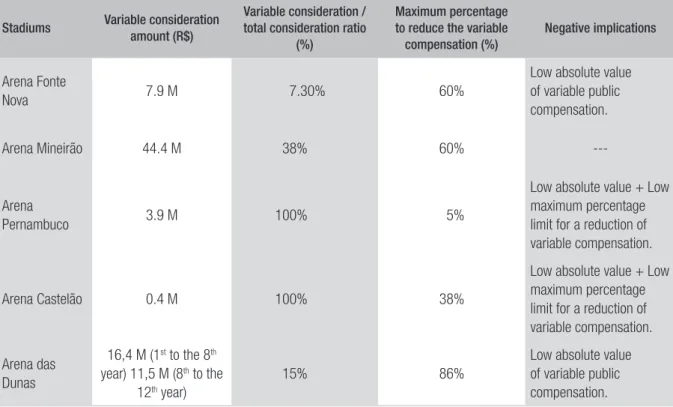
Rio Grande do Norte), the public entities adopted the ixed compensation for the amortization of inancing costs and the variable consideration for the amortization of part of the operational costs for the sports stadiums. Conversely, in the other PPP projects (Pernambuco and Ceará), public entities adopted only the variable compensation mechanism to amortize part of the operating costs, as ixed costs were settled at the time of delivery. With mechanisms for assessing the performance of the private partner, there are potential negative implications seen that may arise during the contractual execution due to the current evaluation methodology that shows a low penalization for the private partner in the case of a future unsatisfactory evaluation (table 4).
TABLE 4 MECHANISMS FOR EVALUATING THE PERFORMANCE OF PRIVATE PARTNERS IN PPP PROJECTS
Stadiums Variable consideration amount (R$)
Variable consideration / total consideration ratio
(%)
Maximum percentage to reduce the variable
compensation (%)
Negative implications
Arena Fonte
Nova 7.9 M 7.30% 60%
Low absolute value of variable public compensation.
Arena Mineirão 44.4 M 38% 60%
---Arena
Pernambuco 3.9 M 100% 5%
Low absolute value + Low maximum percentage limit for a reduction of variable compensation.
Arena Castelão 0.4 M 100% 38%
Low absolute value + Low maximum percentage limit for a reduction of variable compensation.
Arena das Dunas
16,4 M (1st to the 8th year) 11,5 M (8th to the
12th year)
15% 86%
Low absolute value of variable public compensation.
Source: Elaborated by the authors and based on PPP contracts.
6. DISCUSSION
6.1 EVALUATION OF THE VALUE FOR MONEY FOR PPP PROJECTS
he irst indicator to be analysed refers to the implementation period, a period considered to be a critical success factor for infrastructure projects, taking into account that a failure to comply with the execution schedule may inluence an increase in the costs for the provision (Cabral and Silva Jr., 2013). Given this context, the PPP projects performed better in terms of stadium delivery times as compared to totally state stadiums and strictly private stadiums, with the exception of the PPP project in Bahia, which showed a slight however minor relevant delay (table 5).
TABLE 5 TIME PERIOD FOR IMPLEMENTING THE 12 SPORTS ARENAS
Stadium Name Type of Provision Type of Intervention Contract Signing Date Start of Work Delivery Schedule Outlined in the Contract Actual Delivery Schedule Total Estimated Time (months) Total Actual Time (months) Var. (%) Arena Castelão
PPP Renovation Nov. 2010 Dec. 2010 Apr. 2013 Dec. 2012 29 24 83%
Arena Pernambuco
PPP Construction Jun. 2010 Jan. 2011 Jun. 2013 Apr. 2013 36 34 94%
Arena das Dunas
PPP Reconstruction Apr. 2011 Aug. 2011 Dec. 2013 Dec. 2013 32 32 100%
Arena Mineirão
PPP Renovation Dec. 2010 Jan. 2011 Dec. 2012 Dec. 2012 24 24 100%
Arena Beira-Rio
Private Renovation Not
published
Jul. 2010 Dec. 2013 Feb. 2014 41 43 105%
Arena Fonte Nova
PPP Reconstruction Jan. 2010 Jun. 2010 Dec. 2012 Mar. 2013 36 39 108%
Arena Maracanã
Public/PPP Renovation Aug/10 Aug. 2010 Feb. 2013 May 2013 30 33 110%
Arena Corinthians
Private Construction Not
published
May 2011 Dec. 2013 Apr. 2014 31 35 113%
Arena Mané Garrincha
Public Reconstruction Jul/10 Jul. 2010 Dec. 2012 Jun. 2013 30 36 120%
Arena da Amazônia
Public Reconstruction Jul/10 Jul. 2010 Jun. 2013 Mar. 2014 36 45 125%
Arena da Baixada
Private Renovation Not
published
Oct. 2011 Jun. 2013 May 2014 21 30 143%
Arena Pantanal
Public Reconstruction Apr/10 May 2010 Dec. 2012 May 2014 32 49 153%
It is worth noting that the Arena Fonte Nova Stadium was the only PPP project that exceeded the estimated initial implementation period due to Fifa’s new requirements, whose launch (2011) of the new speciications took place ater the signing of the PPP agreement (2010), leading to an increase in costs for the project. On the other hand, the PPPs in Pernambuco and Ceará completed their work ahead of schedule, a result of a political decision by their governors with a view towards anticipating the construction period of the stadium in order to apply as a host city for the 2013 Fifa Confederations Cup. his anticipation was not estimated and contributed to an increase in PPP costs in Pernambuco. With both the Arena Mineirão and Arena das Dunas Stadiums, it was noted that both projects managed to complete the work within the deadline established in the initial schedule, which can be justiied by the contractual modelling of both PPPs.
All in all, it can be inferred that there was a faster execution of PPP projects because of the lexibility and managerial agility of the private partner, coupled with the strong involvement and participation on the part of the public authority in implementing the project (Grimsey and Lewis, 2002). his last aspect becomes clear in the strictly private projects of Arena Corinthians and Arena da Baixada Stadiums, which, despite having the same beneits of a PPP related to the lexibility and managerial agility of the private actor, had signiicant delays in their implementation schedules. he results of the study suggest that the impossibility of the public sector to take inancing from strictly private projects can impact the larger fundraising process, resulting in delays in project implementation. With respect to public projects, it can be seen that the managerial rigidity imposed by Federal Law No. 8.666 of 19934 on public projects generated delays and increased project costs.
[...] We were only able to speed up the work schedule because it was a PPP. If it had been a proj-ect through Federal Law No. 8.666, we would not have had time to quickly execute the projproj-ect because we would not have the lexibility to adapt the construction process by implementing modern engineering techniques that had not been initially foreseen [...]. [Private Manager #9]
As to the indicators for provision costs — a critical factor in the provision of infrastructure ser-vices (Välilä, 2005) — compliance with the costs initially forecast and the cost-per-seat indicator was analysed (table 6).
Standing out in table 6, two of the three sports stadiums built under the private philosophy (Arena Beira-Rio and Arena da Baixada) showed a lower cost of provision per seat as compared to sports arenas built under the PPP philosophy and under the philosophy of traditional public provision. However, the lesser degree of physical intervention in these renovation projects should be accounted for in relation to other projects in which new facilities were built. In comparing PPP projects with traditional public provision projects, the inference is that PPPs performed better in terms of the cost-per-seat indicator and the budget that was irst forecast. It is worth noting that the Mané Garrincha and Maracanã Stadi-ums - both renovated under the traditional public provision method - were the stadiStadi-ums that obtained the highest respective costs of provision, and both presented indications of over-invoicing according to external control agencies (TCDF, 2013; TCU, 2013). he PPP for Maracanã Stadium referred only to the operation stage. However, despite evidence of above-budget costs and signs of over-invoicing on the part of some public sports facilities, the provision costs for Brazilian stadiums are consistent with
the costs of similar stadiums built in other countries for the 2006 Germany Fifa World Cup, in all likeli-hood because of the tireless performance of Brazilian control agencies (Cabral and Silva Jr., 2014). hese authors, based on a comparative analysis of relatively similar projects of the stadiums provided in both mega sporting events (construction and stadium size/capacity) and taking into account the correction of inlation rates and the Euro - Real exchange rate variances in the period between 2006 and 2013 (table 7), they found that the Munich stadium had a higher cost (EUR 5,782 per seat) than the strictly private Corinthians Stadium (EUR 4,330 per seat), as well as the Cologne stadium (EUR 5,227 per seat) posting a higher cost than the cost for the Fonte Nova PPP stadium (EUR 4,950 per seat). On the other hand, these authors also demonstrate that even the purely public Arena da Amazônia stadium (EUR 5,500 per seat), whose real budget was higher than expected, had a provision cost that was consistent with the stadiums built in Germany. Brasília’s strictly public stadium (EUR 7,000 per seat) had the highest costs and was the worst performing in terms of costs when compared to the stadiums from both countries, demonstrating that there is an indication in Brazil that the purely public stadiums have higher costs than strictly private or PPP arenas, which is in-line with the results found in this study.
TABLE 6 PROVISION COSTS FOR THE 12 SPORTS STADIUMS
Stadium Name
Provision Type
Intervention Type
Total Capacity (Fixed + Temporary)
Total Cost Expected in the Contract
(R$)
Total Real Cost (R$) Var. (%)
Estimated Cost Per Seat (R$)
Real Cost per Seat
(R$)
Var. (%)
Arena
Castelão PPP Renovation 63,763 518,606,000 518,606,000 100% 8,133 8,133 100%
Arena das
Dunas PPP Reconstruction 42,024 400,000,000 400,000,000 100% 9,518 9,518 100%
Arena
Mineirão PPP Renovation 62,170 677,353,022 677,353,022 100% 10,895 10,895 100%
Arena
Beira-Rio Private Renovation 49,989 330,000,000 330,000,000 100% 6,601 6,601 100%
Arena Fonte
Nova PPP Reconstruction 55,045 591,711,195 689,482,086 117% 10,750 12,526 117%
Arena
Pantanal Public Reconstruction 44,335 518,900,000 676,014,467 130% 11,704 15,248 130%
Arena
Corinthians Private Construction 68,000 820,000,000 1,080,000,000 132% 12,059 15,882 132%
Arena da
Amazônia Public Reconstruction 44,480 499,508,704 669,500,000 134% 11,230 15,052 134%
Arena da
Baixada Private Renovation 42,381 234,000,000 326,700,000 140% 5,521 7,709 140%
Arena
Pernambuco PPP Construction 46,154 379,263,314 532,600,000 140% 8,217 11,540 140%
Arena
Maracanã Public/PPP Renovation 78,639 705,589,144 1,201,740,672 170% 8,973 15,282 170%
Arena Mané
TABLE 7 COMPARISONS BETWEEN THE COSTS OF PROVIDING STADIUMS BUILT AT THE 2006 GERMANY FIFA WORLD CUP AND AT THE 2014 BRAZIL FIFA WORLD CUP
German Stadiums
Cost per Seat
(in EUR) Brazilian Stadiums
Cost per Seat (in EUR)
Per Seat Cost Ratio for Brazil × Germany
Stadiums (%)
Munich Stadium 5,782 Arena Corinthians 4,330 74.9%
Cologne Stadium 5,227 Arena Fonte Nova 4,940 94.5%
Stadium: Elaborated by the authors and based on Cabral and Silva Jr. (2014).
Based on the diversiied revenue indicator, it can be seen that PPP stadiums and private stadi-ums have a great potential for generating alternative operating revenues (Figure 1), while sports arenas under traditional public management cannot charge additional revenue for the commercial operation of public equipment due to the limits imposed by Federal Law No. 8.666 of 1993. In this way, private stakeholders can reduce the uncertainties associated with operating revenues from the football box-oice (Cabral and Silva Jr., 2013). Obtaining these revenues requires a business structure, whose competencies are rarely found within traditional public administration, which demonstrates the potential of PPPs compared to traditional public provision.
FIGURE 1 POSSIBILITIES OF GENERATING REVENUES FROM PPP STADIUMS AND PRIVATE ARENAS
REVENUES FROM SPORTING
EVENTS
• Football Tickets
REVENUES FROM NON-SPORTS
EVENTS • Mega Concerts; • Fairs and congresses; • Trade Shows;
• Social and cultural events.
FOLLOW ON REVENUES • Naming Rights;
• Advertising and marketing; • Parking;
• Bars and restaurants.
+ +
Source: Elaborated by the authors.
judgment for the technical/economic proposals, which is only provided for in PPP Law 11.079 of 20045 and can contribute to accelerating the bidding process, making it possible to only analyse the
eligibility of the winning bidder. In this case, in the event that the winning bidder is not approved, subsequent proposals were analysed. his expedient is an economic advantage in the implementation of infrastructure projects through PPP, as the total execution period of a project directly inluences its provision costs (Grimsey and Lewis, 2002). his is an essential factor in the context of mega-sporting events like the Fifa World Cup, characterized by a strict schedule that needs to be rigorously complied with in order for the competitions to be held on time (Fifa, 2011).
TABLE 8 IMPLEMENTATION TIME FOR THE BIDDING PROCESSES OF PPP AND PUBLIC SPORTS STADIUMS
Stadium Type of Provision Publication Date of
Public Bid Contract Signature Date
Implementation Time (months)
Arena Fonte Nova PPP Oct. 2009 Jan. 2010 3
Arena das Dunas PPP Dec. 2010 Apr. 2011 4
Arena Pernambuco PPP Feb. 2010 Jun. 2010 4
Arena Maracanã Public/PPP Mar. 2010 Aug. 2010 5
Arena Mineirão PPP Jun. 2010 Dec. 200 6
Arena Pantanal Public Oct. 2009 Apr. 2010 6
Arena da Amazônia Public Nov. 2009 Jul. 2010 8
Arena Castelão PPP Jan. 2010 Nov. 2010 10
Arena Mané Garrincha Public Jul. 2009 Jul. 2010 12
Source: Elaborated by the authors and based on public bidding notices and PPP/public works contracts.
Another potential advantage of PPPs that was found in relation to traditional public provision concerns the fact that all PPP bidding notices were international competition types, making it possible for bidding consortia to associate with foreign companies that have expertise in the management of multipurpose sports facilities, which contributes to maximising the potential for generating value for money ex post throughout the contractual execution of such projects. In the case of sports venues built under the traditional public provision, the national competition type of bid was adopted in all cases without the possibility of having an international manager with expertise in the management of multipurpose arenas, in view of Federal Law No. 8.666 of 1993, which imposes the state itself as responsible for the operational management of public sports facilities. his, contrarily, contributes to minimizing the potential of generating value for money ex post for public administration.
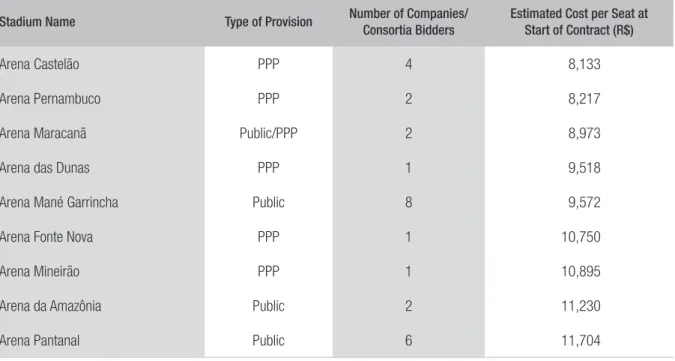
In terms of the level of competitiveness in the biddings being researched that are considered a critical success factor in infrastructure projects (Tiong, 1996), based on the cases studied, there is
a relationship between the number of companies/consortia bidders and the amount of the initial budget envisaged for public sports facilities (table 9), as can be observed in the case of the PPP stadiums (Castelão and Pernambuco), which had a higher competition and lower initially estimated costs per seat among the PPP venues, as well as in relation to the solely public Mané Garrincha stadium that had the highest competition and the lowest cost per seat initially planned between strictly public arenas, although its actual cost per seat was the highest among all mega-sporting event stadiums. he exception arises with the Pantanal stadium that, even with the second largest number of companies/consortia bidders, showed the highest initially estimated cost per seat be-tween strictly public stadiums.
TABLE 9 COMPETITIVENESS LEVEL OF THE BIDDING PROCESS FOR PPP AND STRICTLY
PUBLIC SPORTS STADIUMS
Stadium Name Type of Provision Number of Companies/ Consortia Bidders
Estimated Cost per Seat at Start of Contract (R$)
Arena Castelão PPP 4 8,133
Arena Pernambuco PPP 2 8,217
Arena Maracanã Public/PPP 2 8,973
Arena das Dunas PPP 1 9,518
Arena Mané Garrincha Public 8 9,572
Arena Fonte Nova PPP 1 10,750
Arena Mineirão PPP 1 10,895
Arena da Amazônia Public 2 11,230
Arena Pantanal Public 6 11,704
Source: Elaborated by the authors and based on PPP and Brazil contracts (2014).
Based on table 9, as observed in the other cases of PPP and strictly public stadiums, it can be inferred that the low competition contributed to minimize the potential for generating value for money for public administration in the construction phase of public sports facilities. In this manner, the results of this research show signs that the initially envisaged costs per seat could have been minimized, in the case of any higher competitiveness in the bidding processes investigated.
6.2 THE IMPLICATIONS OF INCENTIVE STRUCTURES IN THE IMPLEMENTATION OF PPP PROJECTS
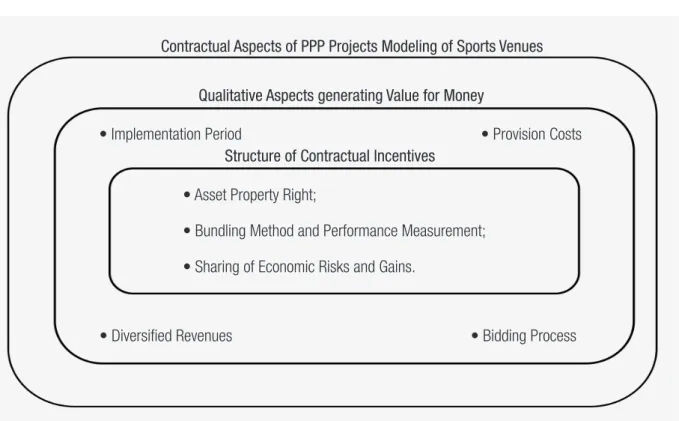
he results suggest that the contractual incentive structures found in PPP projects contribute to generating value for money for the public administration. his is due to the fact that the totally state method of such incentives are not provided for in public works contracts, which are prepared based on Federal Law No. 8.666 of 1993. he central idea coming from igure 2 is a result of the inspection of the previously presented results.
FIGURE 2 CONTRACTUAL ASPECTS OF PPP PROJECT MODELING
Contractual Aspects of PPP Projects Modeling of Sports Venues
Qualitative Aspects generating Value for Money
Structure of Contractual Incentives
• Implementation Period • Provision Costs
• Diversiied Revenues • Bidding Process
• Asset Property Right;
• Bundling Method and Performance Measurement;
• Sharing of Economic Risks and Gains.
Source: Elaborated by the authors and based on literature about PPPs.
as determined by Federal Law No. 8.666 of 1993, which is conigured in the absence of contractual lexibility in the implementation of the project (Brito and Silveira, 2005). For example, in the speciic case of sporting facilities constructed under the traditional public philosophy (Arena Mané Garrincha, Arena da Amazônia, Arena Pantanal and Arena Maracanã), several bidding processes were conduct-ed to procure diferent contractual objectives, which contributconduct-ed to the occurrence of delays in the implementation schedule and, consequently, boosting the costs in the provision of public projects.
[...] As it is a PPP and the responsibility as a private partner for the execution of the project is ours, we had the lexibility and agility to carry out the work. If the project had been under Federal Law 8.666, this process would be hampered because we would have to ask the government’s approval for every change we might need to make throughout the project, which could result in months of delays [...]. So, we can attribute our eiciency to the aspects of a lexibility in executing the engineering and structure of the PPP contract [...]. [Private Manager #9]
As for contractual incentives coming from the bundling method (an integration of the sports venue’s construction and operation under the responsibility of a sole agent) and the performance measurement of the private executing partner of the contract (Hart, 2003; European Commission, 2003; IMF, 2004; World Bank, 2012; Cabral and Saussier, 2013), the private partners of the ive PPP projects received a greater incentive for improved performance in the indicators of implementation time period and stadium provision costs. his is because the concessionaire’s poor performance in the construction and/or operation of public equipment inluences the payment value of the variable public compensation, which could sufer a reduction depending on the performance measured, weighing the problems identiied and presented in the section dealing with the cases being studied. Contrarily, the sports arenas built under the traditional public method are characterized by unbundling, as the private agent responsible for building the stadium (through the bidding procedure in Federal Law 8.666 of 1993) is diferent from the agent that will operate the sports facilities - the public entity itself. herefore, the stadium-building consortium does not earn future beneits or sanctions due to its performance in the stadium’s construction, which does not create any kind of incentive mechanism for a better performance in the construction phase of public facilities (Hart, 2003).
[...] During the stadium construction phase, we had the possibility of getting both penalties as well as bonuses. Although these penalties are not immediately inancial, this penalty could apply during the future operation of the facility. herefore, we realized that we could not only think about the facility’s construction, but also think about both the construction and the operation throughout the concession [...]. [Private Manager #5]
genera-tion of addigenera-tional public value in the interacgenera-tion between public and private partners, and generates a better performance when it comes to executing the project, especially due to positive incentives (in the event of the work being delivered inside the deadline/costs and/or fulilment of the operation indicators) and contractual penalties (if it is contrary to the previously presented situations).
[...] With PPP, if we divide the risks in a way that does not overwhelm any of the partners, both parties will engage in a more balanced and equitable manner for the success of implementing the venture [...]. [Public manager # 1]
CHART 6 SUMMARY CHART ON THE MAIN VARIABLES THAT INFLUENCED THE ALLOCATION RISK
OF PPP PROJECTS
Stadiums
Risk allocation of the construction (term and costs) and operation
(demand) Main inluence variables
Arena Fonte Nova Risks shared between the public
entity and the private partner. (1) The need to attract private initiative to the public project; (2) medium-low potential of generating demand for sporting events by
local football clubs; and (3) the political will of public entities in Bahia and Pernambuco to assume a greater burden of PPP costs.
Arena Pernambuco Risks shared between the public entity and the private partner.
Arena Castelão Risks wholly delegated to the private partner.
Despite the (1) necessity to attract private initiative to PPP and (2) the low potential for generating demand from local football clubs, (3) the decreased financial capacity of both public entities to assume a higher burden of construction costs and a possible increase in a public consideration in the PPP operations phase, as well as (4) the lack of expertise in the PPP preparation contributed to risk aversion on the part of both public entities of Ceará and Rio Grande do Norte. Arena das Dunas Risks wholly delegated to the
private partner.
Arena Mineirão Risks wholly delegated to the private partner.
(1) Reduced need for additional actions to attract potential private partners to the PPP, due to: (2) high potential demand from local football clubs; (3) absence of political will to take on more of the PPP costs; and (4) expertise of the Minas Gerais public entity in the preparation of PPP due to its pioneering and tradition in the use of this type of provision.
Source: Elaborated by the authors.
that this provision method contributed to higher public funding allocation eiciency on the part of the granting authority and to greater production eiciency by the private partners, due to the better allocation of risks between the parties (Oudot, 2005; Bing et al., 2005). On the other hand, projects executed under the traditional public management philosophy do not have any type of contractual mechanism that establishes the possibility of decreasing public payments during the operation of public facilities (Brito and Silveira, 2005).
[...] Among the many advantages of PPP, one that we can cite is that, depending on the performance of the private partner, the State government can reduce its disbursement in public compensation over the duration of the contract, thanks to the possibility of sharing the additional gains with the private partner [...]. [Public manager #4]
In this perspective, this research suggests that a greater performance of PPP in terms of the value for money indicators that were analysed can be justiied by the incentive structures, speciically the lexibility and lower restrictions imposed on the private partner in carrying out the contract, which is in line with literature on PPPs (European Commission, 2003; World Bank, 2012).
7. CONCLUSIONS
Based on the debate over public and private eiciency in the provision of public assets and services, this study sought to investigate the behaviour of the PPPs used for the construction of stadiums used for the 2014 Fifa World Cup, in a perspective compared to the traditional public provision and to the strictly private provision. To this end, although it cannot be considered a panacea, it can be deduced that the PPP projects adopted for providing new sports arenas generated a better value for money for the public administration with respect to the indicators that were analysed, highlighted by the switness and lower costs as compared to the traditional public provision method, which can be justiied according to the incentive structures identiied in the ive PPP contracts investigated.
In this context, the results from this study contribute to the growing debate related to on-going public-private interactions in the ields of public administration and strategy in organizations (Ma-honey, Mcgahan and Pitelis, 2009). Some theoretical and practical implications can be drawn from this research. More speciically, the examination of PPPs in Brazilian football stadium: it can contribute as part of educating public and private agents in the structuring and delivery of future PPP projects. In other words, the experiences and competences accrued by those involved in the structuring of projects designed for football stadiums are likely to be explored in other public utilities, enabling a generation of public value (Kivleniece and Quelin, 2012). Additionally, the PPPs analysed here can provide spillover for other public and private sector projects through the accumulation of idiosyn-cratic competencies related to the management of public-private interactions (Cabral, Lazzarini and Azevedo, 2013).
REFERENCES
BARDIN, Laurence. Análise de conteúdo. 5. ed. São Paulo: Edições 70, 2009.
BEL, Germà; BROWN, Trevor; WARNER, Mildred. Editorial overview: symposium on mixed and hybrid models of public service delivery. International Pu-blic Management Journal, v. 17, n. 3, p. 297-307, 2014.
BING, Li et al. he allocation of risk in PPP/PFI construction projects in the UK. International Jour-nal of Project Management, v. 23, n. 1, p. 25-35, 2005.
BRASIL. Copa transparente: portal de acompanha-mento de gastos para a Copa de 2014, 2014. Available at: <www.copatransparente.gov.br>. Acessed on: 30 July 2016.
BRITO, Barbara M. B. de; SILVEIRA, Antonio H. P. Parceria público-privada: compreendendo o modelo brasileiro. Revista do Serviço Público, Brasília, v. 56, n. 1, p. 7-21, Jan./Mar. 2005.
CABRAL, Sandro; LAZZARINI, Sergio G.; AZE-VEDO, Paulo F. Private entrepreneurs in public services: a longitudinal examination of outsourcing and statization of prisons. Strategic Entrepreneurship Journal, v. 7, n. 1, p. 6-25, 2013.
CABRAL, Sandro; LAZZARINI, Sergio G.; AZEVE-DO, Paulo F. Private operation with public super-vision: evidence of hybrid modes of governance in prisons. Public Choice, v. 145, n. 1, p. 281-293, 2010.
CABRAL, Sandro; SAUSSIER, Stéphane. Organizing prisons through Public-Private Partnerships: a cros-s-country investigation. Brazilian Administration Review, v. 10, n. 1, p. 100-120, 2013.
CABRAL, Sandro; SILVA JÚNIOR, Antonio F. A. A verdade sobre os custos dos estádios da Copa. A Tar-de, Salvador, 9 Abr. 2014. Caderno Opinião, p. A3.
CABRAL, Sandro; SILVA JÚNIOR, Antonio F. A. An approach for evaluating the risk management role of governments in Public-Private Partnerships for me-ga-event. European Sports Management Quarterly, v. 13, n. 4, p. 472-490, 2013.
COSCARELLI, Bruno et al. Guia prático para
estru-turação de programas e projetos de PPP. São Paulo:
Radar PPP, 2014. Available at: <www.radarppp.com/ wp-content/uploads/GuiaRadarPPP.pdf>. Accessed on: 2 Oct. 2014.
EUROPEAN COMMISSION. World Bank — Di-rectorate-General Regional Policy. Guidelines for successful public-private partnerships, 2003. Available at: <http://ppp.worldbank.org>. Accessed on: 10 Mar. 2014.
FIFA. Fédération Internationale de Football As-sociation. Estádios de futebol: recomendações e requisitos técnicos. 5. ed. 2011. Available at: <http:// img.ifa.com/mm/document/tournament/compe-tition/01/37/17/76/p_sb2010_stadiumbook_ganz. pdf>. Accessed on: 15 Dec. 2013.
FLICK, Uwe. Uma introdução à pesquisa qualitativa. 2. ed. Porto Alegre: Bookman, 2004.
FLOREK, Magdalena; BREITBARTH, Tim; CONE-JO, Francisco. Mega event = mega impact? Travelling fans’ experience and perceptions of the 2006 Fifa World Cup host nation. Journal of Sport & Tourism, v. 13, n. 3, p. 199-219, 2008.
FORRER, John et al. Public-private partnerships and the public accountability question. Public Adminis-tration Review, v. 70, n. 3, p. 475-484, 2010.
FORREST, David; SIMMONS, Robert. Outcome uncertainty and attendance demand in sport: the case of English soccer. Journal of the Royal Statisti-cal Society: Series D (he Statistician), v. 51, n. 2, p. 229-241, 2002.
GRIMSEY, Darrin; LEWIS, Mervyn K. Are public private partnerships value for money? Evaluating alternative approaches and comparing academic and practitioner views. Elsevier Accounting Forum, v. 29, n. 4, p. 345-378, 2005.
GRIMSEY, Darrin; LEWIS, Mervyn K. Evaluating the risks of public private partnerships for infras-tructure projects. International Journal of Project Management, v. 20, n. 2, p. 107-118, 2002.
GURSOY, Dogan; KENDALL, K. W. Hosting mega events: modeling locals’ support. Annals of Tourism Research, v. 33, n. 3, p. 603-623, 2006.
HART, Oliver. Incomplete contracts and public ownership: remarks, and an application to public‐
private partnerships. he Economic Journal, v. 113, n. 486, p. C69-C76, 2003.
application to prisons. Quarterly Journal of Econo-mics, v. 112, n. 4, p. 1127-1161, 1997.
HODGE, Graeme A.; GREVE, Carsten. Public-Pri-vate Partnerships: an international performance review. Public Administration Review, v. 67, n. 3, p. 545-558, 2007.
IMF. International Monetary Fund. Public-Private Partnerships, 2004. Available at: <www.imf.org/ex-ternal/np/fad/2004/pifp/eng/031204.pdf>. Accessed on: 10 Apr. 2014.
JOHNSON, Bruce K.; WHITEHEAD, John C. Value of public goods from sports stadiums: the CVM approach. Contemporary Economic Policy, v. 18, n. 1, p. 48-58, 2000.
KIVLENIECE, Ilze; QUELIN, Bertrand V. Creating and capturing value in public-private ties: a private actor’s perspective. Academy of Management Review, v. 37, n. 2, p. 272-299, 2012.
MAHONEY, Joseph T.; MCGAHAN, Anita M.; PI-TELIS, Christos N. Perspective-the interdependence of private and public interests. Organization Science, v. 20, n. 6, p. 1034-1052, 2009.
MALFAS, Maximos; THEODORAKI, Elena; HOU-LIHAN, Barrie. Impacts of the Olympic Games as mega-events. Municipal Engineer, v. 157, n. 3, p. 209-220, 2004.
MARQUES, Rui C.; BERG, Sanford V. Public-Pri-vate Partnership Contracts: a tale of two cities with diferent contractual arrangements. Public Adminis-tration, v. 89, v. 4, p. 1585-1603, 2011.
MULES, Trevor. Taxpayer subsidies for major spor-ting events. Sport Management Review, v. 1, n. 1, p. 25-43, 1998.
OUDOT, Jean-Michel. Risk-allocation: theoretical and empirical evidences, application to public-pri-vate partnerships in the defense sector. In: ANNU-AL CONFERENCE OF THE INSTITUTIONS OF MARKET EXCHANGE, 9, 2005, Barcelona.
PECI, Alketa; SOBRAL, Filipe. Parcerias Públi-co-Privadas: análise comparativa das experiências britânica e brasileira. Cad. EBAPE.BR, v. 5, n. 2, p. 1-14, 2007.
PILLAY, Udesh; BASS, Orli. Mega-events as a res-ponse to poverty reduction: the 2010 Fifa World
Cup and its urban development implications. Urban Forum, v. 19, n. 3, p. 329-346, 2008.
POUPART, Jean et al. A pesquisa qualitativa: enfo-ques epistemológicos e metodológicos. 2. ed. São Paulo: Vozes, 2010.
PREUSS, Holger. he conceptualization and measu-rement of mega sport event legacies. Journal of Sport & Tourism, v. 12, n. 3-4, p. 207-227, 2007.
PREUSS, Holger; SOLBERG, Harry A.; ALM, Jens. he challenge of utilizing the venues. In: FRAWLEY, Stephen; ADAIR; Daryl (Ed.). Managing the Football
World Cup. Basingstoke: Palgrave Macmillan, 2014.
ROCHE, Maurice. Mega-events and modernity: olympics and expos in the growth of global culture. New York: Routledge, 2000.
SIEGFRIED, John; ZIMBALIST, Andrew. he eco-nomics of sports facilities and their communities.
Journal of Economic Perspectives, v. 14, n. 3, p. 95-114, 2000.
SOLBERG, Harry A.; PREUSS, Holger. Major sport events and long-term tourism impacts. Journal of Sport Management, n. 21, n. 2, p. 213-234, 2007.
TCDF. Tribunal de Contas do Distrito Federal.
Relatório de auditoria permanente do Estádio Mané Garrincha, 2013. Available at: <www.tc.df.gov.br>. Accessed on: 5 Sept. 2014.
TCU. Tribunal de Contas da União da República Fe-derativa do Brasil. Acordão TCU TC-029.514/2013-4, 2013. Available at: <www.tcu.gov.br>. Accessed on: 5 Sept. 2014.
THAMER, Rogério; LAZZARINI, Sérgio G. Projetos de parceria público-privada: fatores que inluenciam o avanço dessas iniciativas. Rev. Adm. Pública, Rio de Janeiro, v. 49, n. 4, p. 819-846, 2015.
TIONG, R. L. K. CSFs in competitive tendering and negotiation model for BOT projects. Journal of
Construction and Engineering and Management, v.
122, n. 3, p. 205-2011, 1996.
TIROLE, Jean. Incomplete contracts: where do we stand? Econometrica, v. 67, n. 4, p. 741-781, 1999.
WORLD BANK. he World Bank Institute (WBI).
Public-Private Partnerships reference guide version 1.0, 2012. Available at: <https://wbi.worldbank.org>. Accessed on: 8 Apr. 2014.
YIN, Robert K. Estudo de caso: planejamento e mé-todos. 2. ed. Porto Alegre: Bookman, 2001.
Cláudio José Oliveira dos Reis
Holds a master’s degree in management from the School of Management of the Federal University of Bahia (UFBA) and is an assistant professor at the School of Management of the Federal University of Western Bahia (UFOB). E-mail: [email protected].
Sandro Cabral