RBGN
Review of Business Management
DOI: 10.7819/rbgn.v18i60.2746
245
Received on
10/05/2015
Approved on
06/07/2016
Responsible editor:
Prof. Dr. João Maurício Gama Boaventura
Evaluation process:
Double Blind Review
Business value of IT capabilities: effects
on processes and firm performance in a
developing country
Deyvison de Lima Oliveira
Federal University of Rondônia, Campus of Vilhena, Department of Accounting Sciences, Vilhena, RO, Brazil
Antonio Carlos Gastaud Maçada
Federal University of Rio Grande do Sul, Management School, Department of Management Sciences, Porto Alegre, RS, Brazil
Gessy Dhein Oliveira
Federal University of Rondônia, Campus of Vilhena, Department of Accounting Sciences, Vilhena, RO, Brazil
Abstract
Purpose –his article proposes an integrated three-stage model, which tests the
impact of IT capabilities at the irm level.
Design/methodology/approach – The measurement model was
constructed from the following research phases: i) assessment of the variables by experts in the ields of IS and business; ii) survey pretest; and iii) pilot survey. he full survey was applied to managers from IT and business ields in Brazil’s largest organizations, and was analyzed through Structural Equation Modelling.
Findings – he results of the full survey allow us to conclude about
the relationships that exist between IT capabilities, information quality and performance processes. Performance processes partially mediate the impact of IT capabilities on irm performance.
Originality/value – he results presented contribute to the academic
and management aspects, for they allow: i) to replicate the model in other research contexts (national, international) and evaluating incremental improvements of IT capabilities on irm performance; ii) the identiication of intermediate performance indicators, associated with the use of IT, and the concentration of energy of organizations in the measurement of IT efects on business processes; iii) the adoption of the model for horizontal analysis of IT performance in large companies, from the perspective of business and IT managers.
Keywords – IT beneits; IT return; Performance variables; Process and irm
1
Introduction
The application of technological and organizational resources in building IT capabilities by irms assumes that such capabilities signiicantly contribute to business performance (Cano & Baena, 2015; Chen et al., 2014). However, there is in literature and in the business ield a growing interest in consolidating tools and methodologies that appropriately measure the beneits generated by IT as well as the conditions under which the efects manifest themselves (Chen & Tsou, 2012; Chen, Wang, Nevo, Benitez-Amado, & Kou, 2015), so as to justify IT investments.
he pressure of competition, the need to stay in the market and the growing volume of data and information have given IT a strategic role for business in shaping technological capabilities (Soto-Acosta & Meroño-Cerdan, 2008).
Recent studies on the business value of IT have emphasized the aspect of technological capabilities, in contrast with the amounts of investments applied; however, the mechanisms under which IT contributes to irm performance are still inconclusive and require further studies (Crook, Ketchen, Combs, & Todd, 2008; Fink, 2011).
In one of the research streams on IT, recent studies based on archive data – directly linking IT capabilities (binary measurements) and aggregate performance measures of the company (book and market) – presented null and mixed results for IT value (Chae, Koh, & Prybutok, 2014; Oliveira, Maçada & Oliveira, 2015). hese results support other research stream that considers IT capabilities as multidimensional constructs [infrastructure, management, people, knowledge] (Kim, Shin, Kim, & Lee, 2011) and which analyzes IT value on intermediate performance (Garrison, Wakefield, & Kim, 2015), namely: business processes (Chen et al., 2014) and information quality (Hartono, Li, Na, & Simpson, 2010).
Based on this last stream, this research seeks to answer the following question: to what extent
are IT capabilities associated with the quality of information, with a firm’s processes and performance? As a response, our research ofers three contributions to IT business value.
First, this research uses continuous variables to measure the dimensions of IT capabilities, according to demands presented in studies that gave these capabilities binary nature. Binary measurements do not allow assessment of incremental improvements in IT capabilities on irm performance, as other approaches do, e.g. the use of scales (Chae et al., 2014; Santhanam & Hartono, 2003). he use of validated scales, such as the one presented here, enables horizontal analysis of the impact of IT capabilities on the managerial context.
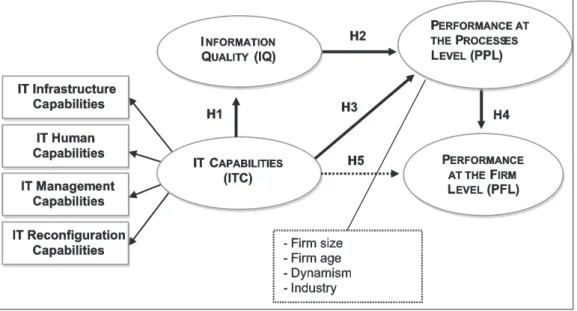
As a second contribution, we consider mediating constructs that potentially capture IT value directly, namely, information quality and processes performance. he mediation test within the research model (Figure 1) is aligned with the indirect impacts of IT on irm performance (Chen & Tsou, 2012) and the null results of the direct relationship between IT capabilities and aggregate performance of the irm (Chae et al., 2014). From a managerial perspective, the phenomenon of business process mediation could lead organizations to adequately measure IT performance at intermediate levels (e.g. processes), avoiding frustration with analysis at the irm level, directly.
can be tested in large companies in developing countries, from the perspective of IT and business managers, to compare IT performance over the years.
he results of the survey in Brazil are compared with results from research on IT capabilities in other developed and developing countries. This cross-country analysis can be explained by two aspects, namely: i) studies show that characteristics of countries (e.g., economic, social) could potentially afect IT business value (Dedrick et al., 2013; Lin & Chiang, 2011); ii) the results on IT value in diferent countries and over time present notable diferences (e.g., Chae et al., 2014; Ong & Chen, 2013); ii) there are few studies referring to IT capabilities in Brazil.
We present the model with the research hypotheses in the next section. The research method addresses collection and analysis procedures as well as variables. Next, the results are analyzed and discussed, based on previous literature. Additionally, we present a cross-country analysis in the results section. he last section presents conclusions, limitations and research recommendations.
2
IT capabilities and performance:
research model
The concept of IT capabilities in this study is derived from Bharadwaj (2000), who deined these capabilities as the ability of the irm to “mobilize and develop IT-based resources, in combination or co-presence with other resources and capabilities.” Studies from the 2000s until recently have intensively mentioned original research carried out by Bharadwaj (2000). his because it is tuned to the assumptions of Resource-Based View (RBV), which makes understandable the relationship tests between the technological capabilities and organizational performance (e.g. Ray, Barney & Muhanna, 2004; Kim, Shin, Kim & Lee, 2011). Additionally, models/concepts about IT capabilities are predominantly adapted from the original study by Bharadwaj (2000),
e.g.: Garrison, Wakeield, & Kim (2015); Chae, Koh, & Prybutok (2014); Liu, Ke, Wei, & Hua (2013); Chen & Tsou (2012); Lu & Ramamurthy (2011); Park, Im, & Kim (2011).
herefore, we adopt the three dimensions of IT capabilities used by Bharadwaj, namely: IT infrastructure capabilities, IT human capabilities, and IT intangible capabilities. hese dimensions are also adapted from recent studies (e.g Hartono et al., 2010; Kim et al., 2011), and a fourth dimension was added: IT reconfiguration capabilities (Pavlou & El Sawy, 2010; Wu, 2010). his approach enables: i) continuous assessment of IT capabilities and reduction of the problems of the binary nature in the measures, predominantly in the magazines’ rankings; ii) increase the scope of investigation, including irms with diferent levels of IT capabilities; and iii) comparative studies, before or after the research (Santhanam & Hartono, 2003).
The complementarity that integrates measurement of IT capabilities is aligned to RBV, whereas such capabilities become diicult for replication by competitors (Barney, 1991, 2001; Chen & Tsou, 2012), to the extent that they are sets of unique organizational resources, built over time and in connection with the history, culture and experience of the irm (Bharadwaj, 2000). he concept of IT capabilities adopted in this research covers aspects of IT ambidexterity, for it includes the ability to explore new IT resources (IT reconiguration) and existing IT resources (Lee, Sambamurthy, Lim, & Wei, 2015).
2.1
Research model and hypotheses
In accordance with the research model (Figure 1), we propose in this research that IT capabilities directly and positively inluence: i) the quality of information; and ii) performance processes.
According to Hartono et al. (2010), there is a positive relationship between IT infrastructure capabilities and the quality of shared information in the supply chain. In this line, the theoretical perspective of Dynamic Capabilities has also been used in studies about IT value, enabling: i) understanding IT capabilities as those which renew the resource base; and ii) the inclusion of the “information” resource between constructs “IT capabilities” and “organizational performance” (Hartono et al., 2010).
First-order Dynamics Capabilities explain how new resources are created and how the existing resource stocks are reconfigured in order to generate competitive advantages and performance in changing environments (Ambrosini & Bowman, 2009).
Information quality is reported in literature as a unique resource for organizational management. For Nevo and Wade (2011), IT assets deliver value to the business due to
their ability to contribute to the shaping of strategic resources linked to IT, and the quality of information meets the requirements of this type of resource (Barney, Wright, & Ketchen Jr., 2001; Nevo, Wade & Cook, 2007). herefore, we present the irst research hypothesis:
H1:Higher levels of IT capabilities (ITC) improve information quality (IQ).
From the Resource-Based View perspective, information contributes to organizational performance when it is a speciic resource of the irm (Barney, 1991). Studies conducted in the supply chain (Costa & Maçada, 2009; Li & Lin, 2006) have highlighted the relationship between organizational eiciency and sharing of quality information by chain partners. Hartono et al. (2010) found that the quality of shared information afects the operating performance of the chain, when there are high IT capabilities.
Figure 1. Research model
Source: Adapted from “Valor das capacidades de TI: Impactos sobre o desempenho de processos
e de irma nas organizações brasileiras”, by D. D. L. Oliveira and G. D. Oliveira, 2013.
For Gorla, Somers, & Wong (2010), information quality is positively associated with organizational performance, measured mostly by measures of organizational processes that require information quality directly.
relationship with customers; ii) production and operations; iii) improvement of product/services (Tallon & Kraemer, 2007).
From the results that associate information quality and performance (e.g Gorla et al., 2010; Hartono et al., 2010), and the demand to relate resources linked to IT and performance processes (Chen & Tsou, 2012), we present the following hypothesis:
H2: Higher levels of information quality (IQ)
improve performance at the processes level (PPL).
Research adopting assumptions of RBV and Dynamic Capabilities to analyze the IT business value has advocated the use of performance measures below the level of the irm (Chen & Tsou, 2012; Kim et al., 2011; Ray, Muhanna, & Barney, 2005). Studies of the ield show that IT tends to initially have an impact on organizational processes (Cano & Baena, 2015; Tallon, 2010) and, next, on inancial measures (Tallon & Kraemer, 2007) and organizational agility (Lee et al., 2015) at the irm level. Another reason lies in the fact that the aggregate values of a irm result from other variables, besides those related to IT (Ting-Peng, Jun-Jer, & Chih-Chung, 2010).
To support arguments about the relationship between IT capabilities and intermediate performance measures, we conducted a previous analytical study in order to identify in literature the type of association between IT capabilities and performance. Based on keywordsi linked to IT value and capabilities, we identiied 44 articles published in the Web of Knowledge and EBSCOhost databases between the years 2007 and 2011. We found that, in recent articles, researchers made intermediate performance measures (e.g. business processes, innovation) a priority, combined with firm performance measures (e.g. proitability, eiciency).
Business processes are the irst level of IT impact, given that they use IT resources and capabilities directly (Tallon, 2010). Chen et al. (2014) identiied a positive relationship between
IT capabilities and processes’ agility in the context of Chinese irms. In the same vein, another study found that IT capabilities inluence customer service and service process innovation (Chen & Tsou, 2012; Chen et al., 2015).
In Dynamic Capabilities assumptions, organizational capabilities focus on the strength and expertise of the irm as to adapting, integrating and reconiguring resources (Augier & Teece, 2008; Chen, Sun, Helms, & Jih, 2008), and these capabilities contribute to improve irm performance by improving organizational routines such as business processes (Chen & Tsou, 2012; Protogerou, Caloghirou, & Lioukas, 2012). herefore, we present hypothesis H3:
H3: Higher IT capabilities (ITC) improve
performance at the processes level (PPL).
Industry variables. In addition to hypothesis H3, four intervening variables which reflect industry characteristics are considered (Khallaf, 2012): i) irm size; ii) irm age (time of operation); iii) dynamism of the sector; iv) type of industry. Demand for these variables is reported in recent studies (e.g. Chae et al., 2014), justifying the need to understand the mechanisms of IT impact on performance.
Firm size is an indicator of past performance and may afect the current performance (Ortega, 2010), although null results have been observed (Kim et al., 2011). he operation time can ofer firms competitive advantage and enhanced performance (Ortega, 2010), although there are results that do not support this relationship (Oliveira & Maçada, 2013).
From a theoretical perspective, the dynamic capabilities of firms are fostered by environmental dynamism (D.-Y. Li & Liu, 2014). Dynamism as a moderator in the relationship between IT capabilities and performance (Stoel & Muhanna, 2009) enables an understanding that irms operating in more dynamic environments have more advantages from dynamic capabilities.
According to Stoel and Muhanna (2009), the industry in which the irm operates can also inluence the relationship between IT capabilities, IT resources and performance. Byrd and Byrd (2010) found greater impact of IT capabilities on performance in manufacturing irms, if compared to service irms. However, G. Kim et al. (2011) found opposite results; additionally, it is also possible to identify zero impact of this variable in the relationship (Oliveira & Maçada, 2013).
he mixed results mentioned above could be justiied by the fact that studies have examined the effect of these variables directly on the aggregate performance of the irm, and not at the processes level, such as we are proposing.
2.2
Mediation of performance at the
process level
We propose that performance at the process level mediates the relationship between IT capabilities and firm performance. Firm performance indicates the aggregate performance and can be represented by: i) executives’ measures of perception (Tallon & Kraemer, 2007) or ii) objective measures of performance drawn from irms’ inancial statements (Chae et al., 2014), the same essence as measures of perception. In this research, irm performance is a construct measured by measures of perception adapted from Tallon and Kraemer (2007).
Two studies published in the early 2000s, based on secondary data from the 1990s, demonstrated the positive and direct relationship between IT capabilities and irm performance (Bharadwaj, 2000; Santhanam & Hartono, 2003) ii. he irst one (Bharadwaj, 2000) was published in 2000, with data between 1991 to 1994, from
the magazine’s ranking, and performance measures based on proit and cost. hey concluded that IT leaders had better performances than the control sample (not leaders). hree years later, Santhanam and Hartono (2003) replicated the initial research of Bharadwaj (2000), with some methodological changes, conirming the results about the impact of IT capabilities on irm performance.
However, studies that followed in the 2000s and beginning of the following decade began to show mixed results for the direct relationship between IT capabilities and performance at the irm level (Ting-Peng et al., 2010).
Masli et al. (2011) identiied a positive relationship between higher IT capabilities and performance of the irm from 1988 to 2007 – but highlighted a trend towards reducing the impact of IT capabilities on performance from 1999 on, justiied by the crisis in the companies “dot.com” and the short life of competitive advantage driven by IT. Byrd and Byrd (2010) found a positive impact of IT on proitability and the reduction of some cost indicators, but zero impact on indicator “cost of goods sold by sales revenue.” Additionally, Quan (2008) analyzed the impact of IT on proitability and cost variables, identifying a partial positive impact on proitability and no impact on cost measures.
Recently, Chae et al. (2014) replicated the studies of the early years 2000 [(Bharadwaj, 2000; Santhanam & Hartono, 2003)] with American organizations. Based on secondary data (2001-2004), the authors found that performance indicators (based on proit and cost) of the leading irms in IT capabilities are no better than those of irms that are not leaders. Consequently, they did not detect the sustainability of IT capabilities in the following years (2005-2007). his null association was also conirmed in Brazilian irms (Oliveira & Maçada, 2013), considering that high IT capabilities are dissociated from a irm’s best measures of performance (such as ROI, ROA, sales growth etc.).
inserted mediating variables to capture IT value, preceding irm performance (Garrison et al., 2015; Mithas, Ramasubbu, & Sambamurthy, 2011; Tallon & Kraemer, 2007). his logic is based on the fact that irm performance can be inluenced by many variables, and IT is just one of them (Ting-Peng et al., 2010) – which implies complexity in capturing IT value (Fink, 2011). It also supports Tallon’s (2010) view, and studies by G. Kim et al. (2011) and Y. Chen et al. (2014) that identify the positive impact of some (isolated) IT capabilities on processes’ performance and the indirect impact on irm performance.
herefore, we present hypotheses H4 and H5:
H4: Higher performance at the processes level (PPL) improve performance at the firm level (PFL).
H5: Performance at the processes level (PPL) mediates the efect of IT capabilities (ITC) on performance at the irm level (PFL).
3
Method
3.1
Data collection and informants
he procedures of data collection and the informants are presented in Table 1, in the respective stages of the research – embracing consultation of experts and survey.
Studies in Information Systems have adopted consultation of experts before testing models, especially in order to build and validate the collection instrument (e.g., Wang & Wang, 2009). Additionally, the perception of managers concerning IT impacts at the levels of processes and irm has been found to present similar results to studies using objective metrics for assessment of IT performance (Tallon, 2013; Tallon & Kraemer, 2007). his recurrent practice conirms surveys as a reputable methodological approach to analysis of IT business value.
Table 1
Phases and stages of research
Stages Procedures
Consultation of experts
Evaluation of
variables’ permanence hree IS researchers participated in this stage, all of them with recent publications in the ield and with experience in research/teaching (Nevo & Wade, 2011).
Survey
Pre-test survey Pre-test survey checked the clarity in content of items, response time and related observations (Gable, Sedera, & Chan, 2008; G. Kim et al., 2011). Participants: two IS/IT researchers and a researcher from the business ield.
Pilot survey
Applied to professionals from the IT and business ields to reine the measurement model and conirm the constructs (Gable et al., 2008; Maçada, Beltrame, Dolci, & Becker, 2012). Informants: students and students from postgraduate courses (specialization and master’s degree) in IT and administration in Brazil. 144 professionals from the IT and business ields participated.
Full survey
Held with IT and business managers in proit organizations. he research sample for model testing is made up of the 500 largest companies in Brazil, based on “Best and Biggest” 2012 ranking by Exame magazine (Abril, 2012). We sent the survey to the irms’ addresses and followed-up by e-mail (Fink, 2011; Kmieciak, Michna, & Meczynska, 2012). Each company received four copies of the survey to mitigate the single response bias. Many organizations claimed they could not allow their employees to participate in the research, or inability to answer because this information belongs to its Strategic Plan (Bradley, Pratt, Byrd, Outlay, & Wynn Jr., 2012). Valid responses of the complete survey: 150 observations from large companies – criteria of the Brazilian Ministry of Development, Industry and Foreign Trade (MDIC); 57 observations of the sample come from ranking companies (2.9% return); 93 other observations are from the pilot survey (Angeles, 2009; Lunardi, Becker, & Maçada, 2010). When the invariance of the measure model in subsamples was conirmed, we treated them as one single sample.
Cross-country analysis
he results of this research in Brazil were compared with results of studies on the business value of IT
3.2
Variables and measurement
IT capabilities are measured by four constructs: (i) IT infrastructure – involving IT assets (hardware, software and data), systems and their components, communications facilities and network, and applications (Hartono et al., 2010); (ii) IT human capabilities – covering the technical and managerial skills in the ield of technological knowledge (Park, Im, & Kim, 2011); (iii) IT management capabilities – covering assets linked to knowledge, customer orientation and synergy (Bharadwaj, 2000), and the alignment of skills between IT and the business ields (G. Kim et al., 2011); (iv) and IT reconiguration capabilities – referring to the ability to adapt resources and IT capabilities to the irm’s business needs and market (Pavlou & El Sawy, 2010).
Information quality is a first-order construct, with four items that measure the adequacy of the information for use, seen from the perspective of the product (validity and utility) and service (reliability and usability) (Lee et al., 2002).
Performance at the processes level is measured by six items, including three processes: production and operations, customer relations and improving the product/service (Tallon & Kraemer, 2007).
Performance at the irm level is measured by increase in proit and market share (Tallon, 2010).
he constructs of the model are measured by Likert scale of 7 points, 1 being “strongly disagree” and 7 “strongly agree” or similar expressions.
Industry variables are measured as follows: i. Firm size – number of employees (Tian, Wang,
Chen, & Johansson, 2010);
ii. Firm age (operating time) – years in the market (Oliveira & Maçada, 2013);
iii. Environmental dynamics – the degree of changes in the market environment of companies (Nevo & Wade, 2011), measured by the Likert scale (1 to 7 – from stable environment to dynamic environment);
iv. Industry – trade/service firms versus manufacturing irms (Byrd & Byrd, 2010).
3.3
Measurement model and validation
We adopted Structural Equation Modeling for data analysis, verifying suitable intrinsic assumptions, namely: (i) independence of observations, (ii) data normality, (iii) outliers analysis and (iv) multiple indicators. he ratio of ive observations per variable was also maintained (Hair, Anderson, Tatham, & Black, 2005).
he bias of nonresponse was analyzed based on t-test for the firm’s performance variables, considering initial (pilot study) and inal (full study) observations, as was done before (Schmiedel, Vom Brocke, & Recker, 2014). No signiicant diferences were observed for these variables.
In order to validate the measurement model, conirmatory factor analysis (CFA) was used before structural model tests (Bradley et al., 2012), as well as analysis of adjustment indexes. We used software SPSS AMOS (v.20s) for data analysis.
Considering that data was collected for independent and dependent variables from the same respondents (Hsu, Chu, & Lo, 2014), bias of common method was analyzed in this study. We adopted the single factor Harman test (Podsakof, Mackenzie, Lee, & Podsakof, 2003). All items of the instrument were entered in the factor analysis of main components with Varimax rotation (Siponen, Adam Mahmood, & Pahnila, 2014). None of the factors were dominant and the analysis revealed ive factors with eigenvalues greater than 1, and the factors with the greatest variance represent 20.3% and 18.3%. Total variance was 73%.
Kim et al., 2011; Sharma, Mukherjee, Kumar, & Dillon, 2005). Additionally, the reliability coeicient for the model constructs are between 0.87 and 0.97, as recommended in literature (Hair et al., 2005).
he convergent validity of the constructs (Table 2) was calculated considering the Average Variance Explained (AVE> 0.50), according to Fornell and Larcker (1981).
Table 2
Convergent and discriminant validity (irst-order model)
Constructs 1 2 3 4 5 6 7
1. IT Infrastructure Capabilities (ITC) 0.94
2. IT Human Capabilities (ITHC) 0.65 0.87
3. IT Management Capabilities (ITMC) 0.55 0.78 0.89
4. IT Reconiguration Capabilities (ITRC) 0.52 0.73 0.72 0.88
5. Information Quality (IQ) 0.62 0.66 0.68 0.62 0.95
6. Performance at the Processes Level (PPL) 0.43 0.59 0.63 0.58 0.50 0.89
7. Performance at the Firm Level (PFL) 0.29 0.42 0.48 0.48 0.30 0.48 0.89
Notes: he values on the main diagonal are the square root of Average Variance Explained (AVE). Values below the main diagonal are correlations among the constructs.
For the discriminant validity, we found that the square root of the AVE in each factor exceeded the correlation between each pair of factors (Farrell, 2010; Tallon, 2010). he discriminant validity in second-order models is analyzed when there are more than a second-order construct (Koufteros, Babbar, & Kaighobadi, 2009); this
is less relevant in this research, considering the high correlations between constructs (irst-order).
4
Results and discussion
he key informants are professionals in big companies and are characterized by size, age and business sector of the companies (Table 3).
Table 3
Demographic data by activity ield
Characteristics IT managers Business managers n (%)
Firm size
From 80 to 999 1,000 to 4,999 5,000 to 9,999 Over 10,000
37 41 19 16
15 13 03 06
52 54 22 22
34.6 36.0 14.7 14.7
Firm age (operating time – years)
Up to 05 From 06 to 15 16 to 30 Over 30 years
02 19 31 61
01 07 08 21
03 26 39 82
2.0 17.3 26.0 54.7
Industry
Trade/services
Manufacturing 7736 2413 10149 67.332.7
4.1
Testing hypotheses
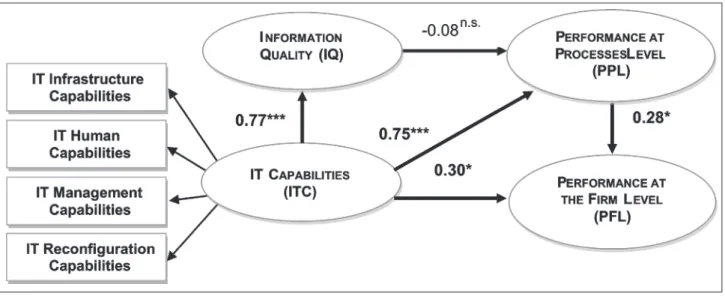
he structural model (Figure 2) shows that H1 is supported (β = 0.77; p <0.001), indicating that IT capabilities contribute to the information
quality. In contrast, H2 is not supported (β = -0.08; p = 0.54) – signaling to null association between information quality and processes performance.
Figure 2. Hypotheses results.
*p<0.05; **p<0.01; ***p<0.001. n.s.Non-signiicant (p>0.05).
Additionally, it is noted that H3 is supported (β = 0.75; p <0.001), which means the positive impact of IT capabilities on process performance. H4 also conirms the positive impact of the processes performance on irm performance (β = 0.28; p <0.05). IT capabilities explain 48% of the variance in processes performance. he variance of the irm’s performance (R2 = 0.28) is
explained by IT capabilities and performance at the processes level.
4.2
Mediation tests
In order to conclude about the mediation of “process performance” (H5 – Table 4), four
Table 4
Mediation tests
Relationship Model (1) Model (2) Model (3) Model (4)
Antecedent of the impact of ITC on PPL
ITC IQa 0.78** 0.78** 0.77** 0.77**
ITC PPLa 0.75** 0 0 0.75**
IQ PPL -0.08 n.s. 0 0 -0.08 n.s.
Impact of ITC on PFL, mediated by PPL
ITC PPL 0.75** 0 0 0.75**
PPL PFLa 0 0.48** 0 0.28*
ITC PFL 0 0 0.49** 0.30*
R2
PPL 0.48 - - 0.48
PFL - 0.23 0.24 0.28
χ2/df 1.642 1.846 1.848 1.589
CFI 0.949 0.923 0.923 0.947
TLI 0.942 0.914 0.913 0.940
IFI 0.949 0.924 0.924 0,948
PCFI 0.832 0.824 0.823 0.836
RMSEA 0.066 0.075 0.075 0.063
aITC: Information Technology Capabilities; IQ: Information Quality; PPL: Performance at the Processes Level; PFL:
Performance at the Firm Level. * p<0.05; ** p<0.001; n.s. Non-signiicant (p>0.05).
In this case, the conditions are satisied, with the exception of (4), in which the impact of the predictor on the dependent variable is reduced, concluding that there is partial mediation of the processes performance in the relationship between IT capabilities and irm performance.
4.3
Tests of industry variables
For the variable “size” and “irm age”, the sample was divided equally into two groups of irms (greater and lesser in size, and newest and oldest), according to the number of employees
Table 5
Moderation tests: multi-groups analysis
Path Firm size Firm age Dynamism Industry
Larger Smaller Larger Smaller High Low Trade/Serv Manuf.
ITC PPL 0.72** 0.79** 0.72* 0.81** 0.59* 0.89** 0.58** 1.56**
Note. * p<0.01; ** p<0.001.
For three moderating variables (firm size, firm age and dynamism), we compared the models with ixed factor weights and free weights, concluding about the invariance of the measurement model (χ2dif, with p> 0.05) between groups. he same analysis was performed for the variable “industry”, revealing that the model is variant (χ2dif, p <0.05), indicating that some items have diferent loadings between groups.
Additionally, we tested the equivalence of structural models with ixed coeicients and free structural coeicients. In the three variables (irm size, irm age and dynamism), structural models for the two groups (in each moderator) are invariant, which indicates that the coeicients of the trajectories are similar to irms among the groups.
In order to confirm the industry’s coeicient, considering the apparent diference, a Z test was undertaken, indicating that IT capabilities exert greater impact on processes in manufacturing irms than on processes in trade/ service irms.
4.4
Discussion
We found that IT capabilities are positively associated with information quality (H1), which converges with the assumptions of Dynamic Capabilities with regard to its role in the reconiguration of the resource base (Augier & Teece, 2008; Chen et al., 2008). We observed that IT capabilities also meet the concept of incremental dynamic capabilities, which are the irst level of capabilities deined by Ambrosini, Bowman, & Collier (2009).
In the context of studies on IS success, Gorla et. al., (2010) corroborate the impact of information quality on process performance,
although reduced. In this research, this efect was not observed. An interpretation for rejecting H2 focuses on the wide availability of IT resources and the ease of access to the same resources among irms, as well as standardization of ERP and rapid adoption of web technologies (Chae et al., 2014). his reality favors the volume of data and information for management with similar levels of quality, limiting the impact of the “information” resource to the routine decisions, not directly verifying improvements on business processes due to the higher levels of information quality. his inding is consistent with results from Soto-Acosta and Meroño-Cerdan (2008) referring to the reduction of the strategic role of IT assets [isolated], given the trend towards standardization in the “output” level (information) within organizations. herefore, information quality can be understood as an assumption for operation (houin, Hofman, & Ford, 2009).
For hypothesis H3, we found that higher levels of IT capabilities improve process performance. This result is convergent with literature (Chen et al., 2014; Kim et al., 2011). Regarding production processes, IT contributes signiicantly to improving the production and service volumes as well as improved productivity for operational work (Tallon & Kraemer, 2007). Toward improving products/services, IT capabilities are efective in reducing the time of launch of new products and services, and contribute to the quality of products/services (Bradley et al., 2012; Tallon, 2010). In the relationship with customers, IT capabilities contribute to attraction, retention and customer support in the sales process (Chen & Tsou, 2012).
as a “resource” (Barney, 1991; Nevo & Wade, 2011). As opposed to isolated IT resources [they rarely create value for the business] (Park et al., 2011; Soto-Acosta & Meroño-Cerdan, 2008), IT capabilities are developed over time by experience, and tend to be local and speciic to the organization, accumulated by interpersonal relationships – which makes them diicult to acquire and complex to imitate (Bharadwaj, 2000).
Literature has defended the positive relationship between process performance and irm performance (Chen & Tsou, 2012; Chen et al., 2014), which we conirmed. In this case, the partial mediation of performance at the process level to the relationship between IT capabilities and irm performance (H5) supports the assumption of IT beneits, primarily, at the business processes level (Bradley et al., 2012; Garrison et al., 2015; Iyer, 2011; Mithas et al., 2011; Soto-Acosta & Meroño-Cerdan, 2008; Tallon, 2010).
The insertion of moderating variables in the relationship between IT capabilities and performance contributes to the understanding of the impact mechanisms of IT (Mithas et al., 2011). Regarding irm size, we found that structural trajectories (ITC PPL) are similar
between larger and smaller irms (Kim et al., 2011), although this difers from studies that indicate a positive association (K. Kim, Xiang, & Lee, 2009; Muhanna & Stoel, 2010). hese results enable us to understand that isolated amount of resources and standardized IT [captured by size] are not the elements that provide competitive diferential (houin et al., 2009; Ting-Peng et al., 2010), but the way resources are gathered and used in the organizations in terms of internal IT capabilities do so (Soto-Acosta & Meroño-Cerdan, 2008).
As for firm age (operating time), the null result is in agreement with Oliveira and Maçada (2013), considering that new players can also establish suicient IT capabilities to bring beneits to business processes. he null result
for dynamism corroborates the assumption that dynamic capabilities contribute to processes, both in stable environments and in dynamic environments (Eisenhardt & Martin, 2000; Protogerou et al., 2012).
With regard to industry, there was a significant difference (p <0.05) between the groups, since the impact of IT capabilities is higher in manufacturing irms. his result is close to the results found by Byrd & Byrd (2010) and diverges from Kim et al. (2011). One interpretation of our results is that production companies use IT directly in their critical processes, and many of these processes do not involve human participation. Additionally, the production of tangible products facilitates planning and alignment between business and technology, strengthening IT value (Byrd & Byrd, 2010). It is noteworthy that the above studies considered the industry’s impact on irm level; however, we tested the industry’s efect on the relationship between IT capabilities and performance at the processes level.
4 . 5
Results of Brazil versus other
developed and developing countries
Studies referring to IT business value are prevalent in developed countries [research in developing countries is reduced]. Brazil is a developing country, with the world’s sixth economy. Some particularities are be noteworthy, namely: its continental dimension (8.5 million km2), the adoption of a single language throughout its territory (Pozzebon, Diniz, & Reinhard, 2011), its low investment in R&D (compared to Japan, USA, Finland etc.) and its incipient innovation and patents (Ministério da Ciência, Tecnologia e Inovação [MCTI], 2012). Next, we highlight in this section the similarities and diferences between this research and other studies carried out in other (developed and developing) countries.
infrastructure capabilities contribute to higher levels of information quality. Our study extends this inding, arguing that IT capabilities (human, management and reconiguration) contribute to the quality of organizational information.
he improvement of processes through IT capabilities, as we found in this study, is also supported by studies with irms in Korea (Kim et al., 2011), Taiwan (Chen & Tsou, 2012) and China (Chen et al., 2014). In addition, these studies confirmed, based on survey research (applied to managers), the total mediation of business processes in the relationship between IT capabilities and firm performance. This research with Brazilian companies also found the mediation of “processes”, however, partially. he improvement in business processes is justiied by the direct use of IT at this organizational level (Tallon, 2010), both in [processes] considered strategic, as well as at tactical or operational level.
When we analyzed industry characteristics (irm size and age), we found that the results conirm those by studies of Kim et al. (2011) and Chae et al. (2014) in the context of Korean and American irms, respectively. Unlike other studies, our research tested the impact of IT on business processes in companies of diferences in size and ages – identifying a similar impact among groups. his procedure allows for removing the potential efects of economic, tax and cultural diferences in aggregate measures of a irm across countries.
Differences. We found a difference between our results and those of Hartono et al. (2010) for the relationship between information quality and performance in the supply chain. Our study found no association between those variables. hus, we encourage further research to relate the efects of information quality on activities or strategic processes, as in studies in organizations that are intensive in information (e.g., banking industry, insurance etc.).
he studies conducted by Oliveira and Maçada (2013) with Brazilian irms and Chae et al. (2014) with American irms, recently, show the dissociation between larger IT capabilities
and irm performance. hose studies examined the direct relationship between IT capabilities and aggregate measures of performance. For Chae et al. (2014), this dissociation is based on the standardization of ERP and on the rapid adoption of web technologies, which means the possibility of access by all irms to IT resources and the construction of related capabilities. Our results propose and strengthen a stream of research that contributes to capturing IT value at the irm level: the inclusion of intermediate measures that capture the direct and efective use of IT within organizations. he results indicate the partial mediation of organizational processes in the relationship between IT capabilities and irm performance, partially, conirming previous studies that defend indirect impact of IT on irm performance (Chen & Tsou, 2012; Garrison et al., 2015; Kim et al., 2011).
Diferently from Lee et al. (2015), who found the moderating efect of dynamism on the relationship between IT and organizational agility measures [indicating that the impact of IT is greater in highly dynamic environments], our results with Brazilian irms does not conirm this moderation. hose authors present a potential response to diferences in the study ield, stating that their results may be subject to the speciic characteristics of Chinese economy. he compared results raise additional research opportunities in emerging countries.
5
Conclusions, limitations and
recommendations
5.1
Conclusions
The impact of IT capabilities on information quality allows us to infer that these capabilities favor the attribution of value and meaning to the data generated – enabling them to cause judgment changes in managers when making in decisions. In theory, this result is supported by Dynamic Capabilities, which defends the role of organizational capabilities in renewing the resource base (Ambrosini et al., 2009).
he results show that business processes directly capture the value of IT capabilities, as defended by recent studies. With regard to IT beneits on irms, we concluded that the internal capabilities impact performance aggregate measures through performance of business processes, conirming the indirect impact as a potential explanation for the null results identiied directly at the firm level (Chae et al., 2014; Oliveira & Maçada, 2013).
he Resource-Based View corroborates the results by stating that internal resources explain diferences in irms’ performances, when associated with strategic processes (Chen & Tsou, 2012; Qu, Oh, & Pinsonneault, 2010). From these indings, we infer that business processes represent dependent variables that capture the direct value of IT – responding to the demands of previous research (Kmieciak et al., 2012; Lu & Ramamurthy, 2011).
Therefore, it appears that differences in results at firm level could be related to methodological issues – especially those referring to the choice of independent (IT investment, IT capabilities, IT resources etc.) and dependent (irm innovation processes, operational performance) variables. In this research, we observed that the inclusion of business processes as a mediating construct was efective for capturing IT value indirectly in irm performance measures.
he results presented contribute to the academic and management aspects, mainly in three ways, for they allow: i) by means of the scale used, the model to be replicated in other research contexts (national, international) and incremental improvements of IT capabilities on irm performance to be assessed (Chae et al., 2014; Santhanam & Hartono, 2003); ii) intermediate performance indicators to de identiied, associated with the use of IT, and the concentration of energy of organizations in the measurement of IT efects on business processes, rather than directly searching for improvements in proit measures, productivity, inal cost reduction (at irm level); iii) the model to be adopted for horizontal analysis of IT performance in large companies, from the perspective of business and IT managers.
5.2
Limitations and recommendations
his research used as a sample IT and business managers in big Brazilian companies in order to test the research model. We disregarded possible diferences in the ields of activity among trade, production and services sectors. The results could be diferent if ields of activity were considered [e.g., information-intensive companies – banks, insurance companies (Maçada et al., 2012); irms operating in the food or automotive supply chain (Hartono et al., 2010)].
In addition, this research considers only one second-order construct (IT capabilities), making TI discriminant validity analysis by traditional means unfeasible (Koufteros, Babbar, & Kaighobadi, 2009). To reduce this restriction, we proceed to the analysis of discriminant validity for the irst-order model, which fully meets the criteria set by Farrell (2010).
(Dedrick et al., 2013), the results should be analyzed with caution.
Therefore, future research would be relevant to analyze: i) the complementarity/ integration of IT resources/capabilities and other organizational resources/capabilities, as stated in literature (Fink, 2011); ii) the application of the research model to other cultures and in speciic sectors of activity, for comparison of results; iii) the extent of the impact of the IT capabilities model to small and medium-sized enterprises; (iv) the cultural, economic and social characteristics, based on the cross-country perspective, that can afect the IT business value.
Notas
1 We used the following keywords in this
research:“IT-capabilit*” or “technology-research:“IT-capabilit*” or IT-competenc* or technology-competenc* AND “performance*” or “beneit*” or “impact*” AND “RBV” or “RBT” or “resource”.
2 Bharadwaj’s (2000) study has 847 citations in the Web of
Science database and 895 citations in all other databases. Santhanam and Hartono’s (2003) research has 218 citations in the Web of Science database and 229 citations in all other databases (2015, September).
References
Ambrosini, V., & Bowman, C. (2009). What are dynamic capabilities and are they a useful construct in strategic management? International Journal of Management Reviews, 11(1), 29-49. doi: 10.1111/j.1468-2370.2008.00251.x
Ambrosini, V., Bowman, C., & Collier, N. (2009). Dynamic capabilities: An exploration of how irms renew their resource base. British Journal of Management, 20, S9-S24. doi: 10.1111/j.1467-8551.2008.00610.x
Angeles, R. (2009). Anticipated IT infrastructure and supply chain integration capabilities for RFID and their associated deployment outcomes. International Journal of Information
Management, 29(3), 219-231. doi: 10.1016/j. ijinfomgt.2008.09.001
Augier, M., & Teece, D. J. (2008). Strategy as evolution with design: he foundations of dynamic capabilities and the role of managers in the economic system. Organization Studies, 29(8-9), 1187-1208. doi: 10.1177/0170840608094776
Barney, J. (1991). Firm resources and sustained competitive advantage. Journal o f M a n a g e m e n t , 1 7( 1 ) , 9 9 - 1 2 0 . d o i : 10.1177/014920639101700108
Barney, J., Wright, M., & Ketchen Jr., D. J. (2001). he resource-based view of the irm: ten years after 1991. Journal of Management, 27(6), 625-641.
Baron, R. M., & Kenny, D. A. (1986). The moderator-mediator variable distinction in social psychological research: Conceptual, strategic, and statistical considerations. Journal of Personality & Social Psychology, 51(6), 1173-1182.
Bharadwaj, A. S. (2000). A resource-based perspective on information technology capability and irm performance: An empirical investigation. Mis Quarterly, 24(1), 169-196.
Bradley, R. V., Pratt, R. M. E., Byrd, T. A., Outlay, C. N., & Wynn Jr., D. E. (2012). Enterprise architecture, IT efectiveness and the mediating role of IT alignment in US hospitals. Information Systems Journal, 22(2), 97-127. doi: 10.1111/j.1365-2575.2011.00379.x
Byrd, T. A., & Byrd, L. W. (2010). Contrasting IT capability and organizational types: Implications for irm performance. Journal of Organizational and End User Computing, 22(4), 1-23. doi: 10.4018/joeuc.2010100101
in international negotiation performance. Revista Brasileira de Gestão de Negócios (RBGN), 17(54), 751-768.
Chae, H. C., Koh, C. E., & Prybutok, V. R. (2014). Information technology capability and irm performance: contradictory indings and their possible causes. Mis Quarterly, 38(1), 305-326.
Chen, J. S., & Tsou, H. T. (2012). Performance efects of IT capability, service process innovation, and the mediating role of customer service. Journal of Engineering and Technology Management, 29(1), 71-94. doi: 10.1016/j.jengtecman.2011.09.007
Chen, R. S., Sun, C. M., Helms, M. M., & Jih, W. J. K. (2008). Aligning information technology and business strategy with a dynamic capabilities perspective: A longitudinal study of a Taiwanese semiconductor company. International Journal of Information Management, 28(5), 366-378. doi: 10.1016/j.ijinfomgt.2008.01.015
Chen, Y., Wang, Y., Nevo, S., Benitez-Amado, J., & Kou, G. (2015). IT capabilities and product innovation performance: he roles of corporate entrepreneurship and competitive intensity. Information & Management, 52(6), 643-657. doi: http://dx.doi.org/10.1016/j.im.2015.05.003
Chen, Y., Wang, Y., Nevo, S., Jin, J., Wang, L., & Chow, W. S. (2014). IT capability and organizational performance: he roles of business process agility and environmental factors. European Journal of Information Systems. doi: http://dx.doi.org/10.1057/ejis.2013.4
Costa, J. C., & Maçada, A. C. G. (2009, Julho - Dezembro). Gestão da informação interorganizacional na cadeia de suprimentos automotiva. RAE eletrônica, 8(2). Retirado de http:// rae.fgv.br/sites/rae.fgv.br/iles/artigos/10.1590_ S1676-56482009000200005.pdf
Crook, T. R., Ketchen, D. J., Combs, J. G., & Todd, S. Y. (2008). Strategic resource and performance: A meta-analysis. Strategic Management Journal, 29(11), 1141-1154. doi: 10.1002/smj.703
Dedrick, J., Kraemer, K. L., & Shih, E. (2013). Information technology and productivity in developed and developing countries. Journal of Management Information Systems, 30(1), 97-122. doi: 10.2753/mis0742-1222300103
Eisenhardt, K. M., & Martin, J. A. (2000). Dynamic capabilities: What are they? Strategic Management Journal, 21(10-11), 1105-1121.
Exame (2012, Julho). Melhores e maiores de 2012. Edição Especial.
Farrell, A. M. (2010). Insuicient discriminant validity: A comment on Bove, Pervan, Beatty, and Shiu (2009). Journal of Business Research, 63(3), 324-327. doi: 10.1016/j.jbusres.2009.05.003
Fink, L. (2011). How do IT capabilities create strategic value? Toward greater integration of insights from reductionistic and holistic approaches. European Journal of Information Systems, 20(1), 16-33. doi: 10.1057/ejis.2010.53
Fornell, C., & Larcker, D. F. (1981). Evaluating structural equation models with unobservable variables and measurement error. Journal of Marketing Research (JMR), 18(1), 39-50.
Gable, G. G., Sedera, D., & Chan, T. (2008). Re-conceptualizing information system success: he IS-impact measurement model. Journal of the Association for Information Systems, 9(7), 1-32.
Gorla, N., Somers, T. M., & Wong, B. (2010). Organizational impact of system quality, information quality, and service quality. The Journal of Strategic Information Systems, 19(3), 207-228. doi: doi.org/10.1016/j.jsis.2010.05.001
Hair, J. F., Jr, Anderson, R. E., Tatham, R. L., & Black, W. C. (2005). Análise multivariada de dados (5a ed.). Porto Alegre: Bookman.
Hartono, E., Li, X., Na, K. S., & Simpson, J. T. (2010). he role of the quality of shared information in interorganizational systems use. International Journal of Information Management, 30(5), 399-407. doi: 10.1016/j. ijinfomgt.2010.02.007
Hsu, J. S. C., Chu, T. H., & Lo, C. F. (2014). Coping knowledge boundaries between information system and business disciplines: An intellectual capital perspective. Information & Management, 51, 283-295.
Iyer, K. N. S. (2011). Demand chain collaboration and operational performance: Role of IT analytic capability and environmental uncertainty. Journal of Business & Industrial Marketing, 26(1-2), 81-91. doi: 10.1108/08858621111112267
Khallaf, A. (2012). Information technology investments and nonfinancial measures: A research framework. Accounting Forum, 36(2), 109-121. doi: 10.1016/j.accfor.2011.07.001
Kim, G., Shin, B., Kim, K. K., & Lee, H. G. (2011). IT capabilities, process-oriented dynamic capabilities, and firm financial performance. Journal of the Association for Information Systems, 12(7), 487-517.
Kim, J. K., Xiang, J. Y., & Lee, S. (2009). he impact of IT investment on irm performance in China: An empirical investigation of the Chinese electronics industry. Technological Forecasting and Social Change, 76(5), 678-687. doi: 10.1016/j. techfore.2008.03.008
Kmieciak, R., Michna, A., & Meczynska, A. (2012). Innovativeness, empowerment and IT capability: Evidence from SMEs. Industrial Management & Data Systems, 112(5), 707-728. doi: 10.1108/02635571211232280
Koufteros, X., Babbar, S., & Kaighobadi, M. (2009). A paradigm for examining second-order factor models employing structural equation modeling. International Journal of Production Economics, 120(2), 633-652. doi: 10.1016/j. ijpe.2009.04.010
Lee, O. K., Sambamurthy, V., Lim, K. H., & Wei, K. K. (2015). How does IT ambidexterity impact organizational agility? Information Systems Research, 26(2), 398-417. doi: 10.1287/ isre.2015.0577
Lee, Y. W., Strong, D. M., Kahn, B. K., & Wang, R. Y. (2002). AIMQ: A methodology for information quality assessment. Information & Management, 40, 133-146.
Li, D. Y., & Liu, J. (2014). Dynamic capabilities, environmental dynamism, and competitive advantage: Evidence from China. Journal of Business Research, 67(1), 2793-2799.
Li, S., & Lin, B. (2006). Accessing information sharing and information quality in supply chain management. Decision Support Systems, 1(16), 1641-1656. doi: 10.1016/j.dss.2006.02.011
Lin, W. T., & Chiang, C. Y. (2011). The impacts of country characteristics upon the value of information technology as measured by productive eiciency. International Journal of Production Economics, 132(1), 13-33. doi: 10.1016/j.ijpe.2011.02.013
Systems, 54(3), 1452-1462. doi: 10.1016/j. dss.2012.12.016
Lu, Y., & Ramamurthy, K. (2011). Understanding the link between information technology capability and organizational agility: An empirical examination. Mis Quarterly, 35(4), 931-954.
Lunardi, G. L., Becker, J. L., & Maçada, A. C. G. (2010). Impacto da adoção de mecanismos de governança de Tecnologia de Informação (TI) no desempenho da gestão da TI: Uma análise baseada na percepção dos executivos. Revista de Ciências da Administração, 12(28), 11-39. doi: 10.5007/2175-8077.2010v12n28p11
Maçada, A. C. G., Beltrame, M. M., Dolci, P. C., & Becker, J. L. (2012). IT business value model for information intensive organizations. Brazilian Administration Review (BAR), 9(1), 44-65.
Masli, A., Richardson, V. J., Sanchez, J. M., & Smith, R. E. (2011). Returns to IT excellence: Evidence from inancial performance around information technology excellence awards. International Journal of Accounting Information Systems, 12(3), 189-205. doi: 10.1016/j. accinf.2010.10.001
Meireles, F. S. (2015). Tecnologia de informação: 26ª pesquisa anual do uso de TI, 2015 (23 ed.). São Paulo: Fundação Getúlio Vargas - FGV/EAESP.
Ministério da Ciência, Tecnologia e Inovação (2012). Estratégia nacional de ciência, tecnologia e inovação: 2012-2015: Balanço das atividades estruturantes 2011. Brasília, DF: MCTI. Recuperado de http://www.mct.gov.br/upd_ blob/0218/218981.pdf
Mithas, S., Ramasubbu, N., & Sambamurthy, V. (2011). How information management capability inluences irm performance. Mis Quarterly, 35(1), 237-256.
Muhanna, W. A., & Stoel, M. D. (2010). How do investors value IT? An empirical investigation of the value relevance of IT capability and IT spending across industries. Journal of Information Systems, 24(1), 43-66. doi: 10.2308/jis.2010.24.1.43
Nevo, S., Wade, M. R., & Cook, W. D. (2007). An examination of the trade-of between internal and external IT capabilities. Journal of Strategic Information Systems, 16(1), 5-23. doi: 10.1016/j. jsis.2006.10.002
Nevo, S., & Wade, M. (2011). Firm-level beneits of IT-enabled resources: A conceptual extension and an empirical assessment. Journal of Strategic Information Systems, 20, 403-418. doi: 10.1016/j. jsis.2011.08.001
Oliveira, D. D. L., & Maçada, A. C. G. (2013). Capacidades de TI e desempenho da irma nas empresas brasileiras mais inovadoras no uso da TI. Revista de Administração e Inovação, 10(1), 79-97.
Oliveira, D. L., Maçada, A. C. G., & Oliveira, G. D. (2015). Valor da Tecnologia da Informação na irma: Estudo com empresas brasileiras. Revista de Administração Contemporânea, 19(2), 170-192. doi: 10.1590/1982-7849rac20151410
Oliveira, D. D. L., & Oliveira, G. D. (2013). Valor das capacidades de TI: Impactos sobre o desempenho de processos e de firma nas organizações brasileiras. Encontro de Administração da Informação - EnADI, Bento Gonçalves, RS, Brasil, 4. Recuperado de http://www.anpad.org. br/diversos/trabalhos/EnADI/enadi_2013/2013_ EnADI40.pdf
Ortega, M. J. R. (2010). Competitive strategies and irm performance: Technological capabilities’ moderating roles. Journal of Business Research, 63(12), 1273-1281. doi: 10.1016/j. jbusres.2009.09.007
Park, J. Y., Im, K. S., & Kim, J. S. (2011). he role of IT human capability in the knowledge transfer process in IT outsourcing context. Information & Management, 48(1), 53-61. doi: 10.1016/j. im.2011.01.001
Pavlou, P. A., & El Sawy, O. A. (2010). he “hird Hand”: IT-enabled competitive advantage in turbulence through improvisational capabilities. Information Systems Research, 21(3), 443-471. doi: 10.1287/isre.1100.0280
Podsakof, P. M., Mackenzie, S. B., Lee, J. Y., & Podsakof, N. P. (2003). Common method biases in behavioral research: A critical review of the literature and recommended remedies. Journal of Applied Psychology, 88(5), 879-903. doi: 10.1037/0021-9010.88.5.879
Pozzebon, M., Diniz, E., & Reinhard, N. (2011). Creating a brazilian school in international information systems research: opportunities and challenges. Revista de Administração de Empresas, 51, 10-14.
Protogerou, A., Caloghirou, Y., & Lioukas, S. (2012). Dynamic capabilities and their indirect impact on firm performance. Industrial and Corporate Change, 21(3), 615-647. doi: 10.1093/ icc/dtr049
Qu, W. G., Oh, W., & Pinsonneault, A. (2010). The strategic value of IT insourcing: An IT-enabled business process perspective. Journal of Strategic Information Systems, 19, 96-108.
Quan, J. (2008). Evaluating e-business leadership and its links to irm performance. Journal of Global Information Management, 16(2), 81-90. doi: 10.4018/jgim.2008040105
Ray, G., Barney, J. B., & Muhanna, W. A. (2004). Capabilities, business processes, and competitive advantage: Choosing the dependent variable in empirical tests of the resource-based view. Strategic Management Journal, 25(1), 23-37. doi: 10.1002/ smj.366
Ray, G., Muhanna, W. A., & Barney, J. B. (2005). Information technology and the performance of the customer service process: A resource-based analysis. Mis Quarterly, 29(4), 625-652.
Santhanam, R., & Hartono, E. (2003). Issues in linking information technology capability to irm performance. MIS Quarterly, 27(1), 125-153.
Schmiedel, T., Vom Brocke, J., & Recker, J. (2014). Development and validation of an instrument to measure organizational cultures’ support of Business Process Management. Information & Management, 51(1), 43-56. doi: http://dx.doi.org/10.1016/j.im.2013.08.005
Sharma, S., Mukherjee, S., Kumar, A., & Dillon, W. R. (2005). A simulation study to investigate the use of cutof values for assessing model it in covariance structure models. Journal of Business Research, 58(7), 935-943. doi: 10.1016/j. jbusres.2003.10.007
Siponen, M., Mahmood, M. A., & Pahnila, S. (2014). Employees’ adherence to information security policies: An exploratory field study. Information & Management, 51(2), 217-224. doi: http://dx.doi.org/10.1016/j.im.2013.08.006
Soto-Acosta, P., & Meroño-Cerdan, A. L. (2008). Analyzing e-business value creation from a resource-based perspective. International Journal of Information Management, 28(1), 49-60. doi: 10.1016/j.ijinfomgt.2007.05.001
type. Information & Management, 46(3), 181-189. doi: 10.1016/j.im.2008.10.002
Tallon, P. P. (2010). A service science perspective on strategic choice, IT, and performance in U.S. Banking. Journal of Management Information Systems, 26(4), 219-252.
Tallon, P. P. (2013). Do you see what I see? The search for consensus among executives’ perceptions of IT business value. European Journal of Information Systems, 23, p. 306-325.
Tallon, P. P., & Kraemer, K. L. (2007). Fact or Fiction? A Sensemaking Perspective on the Reality Behind Executives’ Perceptions of IT Business Value. Journal of Management Information Systems, 24(1), 13-54. doi: 10.2753/mis0742-1222240101
Thouin, M. F., Hoffman, J. J., & Ford, E. W. (2009). IT outsourcing and firm-level performance: A transaction cost perspective. Information & Management, 46(8), 463-469. doi: 10.1016/j.im.2009.08.006
Tian, J., Wang, K., Chen, Y., & Johansson, B. (2010). From IT deployment capabilities to competitive advantage: An exploratory study in
China. Information Systems Frontiers, 12(3), 239-255. doi: 10.1007/s10796-009-9182-z
Ting-Peng, L., Jun-Jer, Y., & Chih-Chung, L. (2010). A resource-based perspective on information technology and irm performance: A meta analysis. Industrial Management & Data Systems, 110(8), 1138-1158. doi: 10.1108/02635571011077807
Wang, Y. M., & Wang, Y. S. (2009). Examining the dimensionality and measurement of user-perceived knowledge and information quality in the KMS context. Journal of Information Science, 35(1), 94-109.
Wu, L. Y. (2010). Applicability of the resource-based and dynamic-capability views under environmental volatility. Journal of Business Research, 63(1), 27-31. doi: 10.1016/j. jbusres.2009.01.007
Acknowledgement
he authors are grateful for the support provided by CAPES (Coordenação de Aperfeiçoamento de Pessoal de Nível Superior – Brazil), CNPq (Conselho Nacional de Desenvolvimento Cientíico e Tecnológico – Brazil).
About the authors:
1. Deyvison de Lima Oliveira, PhD in Business Management, Federal University of Rio Grande do Sul,
Brazil. E-mail: [email protected].
2. Antonio Carlos Gastaud Maçada, PhD in Business Management, Federal University of Rio Grande do
Sul, Brazil. E-mail: [email protected].
3. Gessy Dhein Oliveira, Specialist in Management Controlling, Federal University of Rondônia, Brazil.
E-mail: [email protected].
Contribution of each author:
Contribution Deyvison de Lima Oliveira Antonio Carlos
Gastaud Maçada Gessy Dhein Oliveira
Deinition of research problem √ √
Development of hypotheses or research questions
(empirical studies ) √ √
3. Development of theoretical propositions
(theoretical Work ) √
4. heoretical foundation/Literature review √ √
5. Deinition of methodological procedures √ √
6. Data collection √ √
7. Statistical analysis √ √ √
8. Analysis and interpretation of data √
9. Critical revision of the manuscript √ √ √
10. Manuscript Writing √ √