Batista et al.: Octopus insularis where it lives and what it eats
Octopus insularis (
Cephalopoda: Octopodidae
) on the tropical coast of Brazil:
where it lives and what it eats
Octopus insularis is the dominant octopus in the
shallow tropical waters of the coast and oceanic
islands in the North and Northeast of Brazil. Is the
abundance, distribution, habitat and diet of this
species on the continent the same as in oceanic
islands? These factors were evaluated in seeking
these answers at two areas of occurrence of Octopus
insularis on the coast of Rio Grande do Norte, Brazil.
Three main types of habitats were described where the
species is concentrated, being: Deep Reefs (Reefs of
Risca) (> 15 m), Flat Biogenic Plateaus (Restingas)
(5-15 m) and Shallow Sedimentary Reefs (Pirangi
reefs) (< 5 m). An aggregate spatial distribution
was veriied, along with bathymetric segregation
in which small individuals occupied shallow areas.
Regarding diet, O. insularis consumed mainly
crustaceans (68%) in shallow reef areas, bivalves
(86%) in biogenic plateau areas, and gastropods
(33%) in deep reef areas. The characterization of
new occurring habitats, such as the area of biogenic
plateau, and changes in their diet due to habitat
function have shown that O. insularis occupies a
broader niche than has been described in literature to
date, expanding our knowledge on the ecology and
biology of this octopus species of economic interest.
A
bstrAct
Allan Torrecilla Batista*, Tatiana Silva Leite
Laboratório de Bentos e Cefalópodes (LABECE), Departamento de Oceanograia e Limnologia (DOL), Universidade Federal do Rio Grande do Norte (UFRN).
(Av. Sen. Dinarte Mariz, s/n, CEP: 59090-002, Natal, RN, Brazil)
*Corresponding author: [email protected]
Descriptors:
Octopus insularis, Habitat, Octopus,
Niche, Diet, Population.
Octopus insularis
é o polvo dominante das águas
rasas tropicais do litoral e ilhas oceânicas do Norte
e Nordeste do Brasil. O habitat e dieta desta espécie
seriam iguais no continente e nas ilhas oceânicas?
Foram analisados distribuição e abundância dos
polvos e a caracterização do habitat e dieta. Três
tipos de habitat principais foram descritos para
os locais onde a espécie se concentra, sendo eles:
Recifes fundos (Riscas) (> 15 m), Platôs biogênicos
planos (Restingas) (5-15 m) e Recifes sedimentares
rasos (recifes de Pirangi) (< 5 m). Veriicou-se uma
distribuição espacial agregada e uma segregação
batimétrica na qual os indivíduos pequenos ocuparam
as áreas rasas. Em relação à dieta,
O. insularis
consumiu principalmente crustáceos (68%) nas áreas
recifais rasas, bivalves (86%) nas áreas do platô
biogênico e gastrópodes (33%) na área recifal funda.
A caracterização de um novo habitat de ocorrência,
tal como a área do platô biogênico, e a variação na
sua dieta em função do habitat demonstram que o
O. insularis
ocupa um nicho mais amplo do que o
descrito na literatura até o presente. Desta forma,
o conhecimento sobre a ecologia e biologia desta
espécie de interesse econômico para o Norte/Nordeste
do Brasil tornou-se, assim, ampliado.
r
esumo
Descritores:
Octopus insularis, Habitat, Polvo,
Nicho, Dieta, População.
http://dx.doi.org/10.1590/S1679-87592016123406404
BJOCE
INTRODUCTION
Octopus insularis (LEITE et al., 2008) is the dominant octopus of tropical shallow coastal and oceanic islands waters in the North and Northeast of Brazil. They are benthic animals found in tide pools up to 35m deep
(LEITE et al., 2008). Since this species was irst described
on oceanic islands, their ecology and biology have been studied more extensively in these regions, leaving a gap of knowledge regarding coastal areas.
In the Archipelago of Fernando de Noronha (AFN), their distribution, abundance and description of occurring habitats have been investigated. As a result, it was discovered that O. insularis occurs distributed in clusters in bedrock openings, with smaller octopuses being more abundant in shallow waters (< 5 m) (LEITE et al., 2009c). Their food and foraging strategy were also investigated in this same environment, and a very diverse diet was observed, with more than 50 species of prey in food debris, mostly being crustaceans (70%) (small crabs). Furthermore, O. insularis proved to be an opportunistic visual predator, adopting a predatory strategy called “saltatory search” (LEITE et al., 2009b).
A study at Rocas Atoll revealed that the shallow inshore ring areas serve as a nursery for O. insularis, due
to the abundance of juvenile individuals found (BOUTH
et al., 2011). Also, a study of the diversity of cephalopods in the Archipelago of Saint Peter and Saint Paul (ASPSP)
registered O. insularis as the only species of benthic
octopus found in depths up to 35m (LEITE et al., 2009a), and most individuals were adults. Recently, its occurrence
was also conirmed in the Archipelago of Trinidade located
in the oceanic region of southeastern Brazil (LEITE et al., 2012), thus increasing the geographical range of this
species. Octopus insularis were found in habitats with
environments of reefs, rocky bottoms, pebbles, and gravel with or without algae; they were never found in completely sandy or muddy environments.
On the mainland, some recent studies have focused
on aspects related to ishing and the population biology of
O. insularis. This species is an important ishing resource
in northeastern states as an alternative source of income
for artisanal ishermen, especially during the lobster closed season. Since 2005 in the state of Ceará, proitable octopus ishing has been performed by long line lobster
pots (BRAGA et al., 2007). Thus, in order to contribute
to the management of this ishery resource, LIMA et al.
(2014b) investigated the structure of the population and
reproductive dynamics of the reef environment of Rio Grande do Norte (RN). The study found octopus in all gonadal maturity stages throughout the year; however, mature females were scarce, suggesting that they may migrate to deeper regions to achieve maturation and spawning. LIMA et al. (2014a) also described the gonadal development and reproductive strategy of this species, and despite having a gonadal development pattern similar to
O. vulgaris, some diferences were found, such as smaller
size of maturation and lower fertility in O. insularis. Thus, this study will aim to verify the hypothesis that aspects of habitat use, abundance, distribution and food
preferences of Octopus insularis on the continent are
similar to those found in oceanic islands, since this species
has been exploited by artisanal isheries throughout the
northeastern coast, having a great economic importance for the region.
MATERIAL AND METHODS
Study area
Octopus insularis ecology was studied at two areas of
the Rio Grande do Norte coast. The irst area is located
65 km from the capital, Natal, municipality of Rio do
Fogo (5º15’ S-35º20’ W), speciically the Environmental
Protected Area of Coral Reefs (APARC), where the most
productive octopus ishing of RN occurs (O. insularis)
(ANDRADE, 2015). Octopuses are caught in diferent
habitats in this area, ranging from shallow reefs to deeper areas known as Risca, including sedimentary reefs combined with coralline algae, corals and vermetidae interspersed with sand and gravel patches. An area of low complexity biogenic plateaus was also studied in the
region, known locally by ishermen as Restinga. These octopus and lobster ishing areas are quite exploited by local ishermen (Figure 1).
The second area is located on the southern coast of RN, 25 km from Natal, and is made up of coastal reefs formed by blocks of sandstone, calcareous algae, corals and rhodoliths (6º00’ S-35º06’ W). This site is a tourist
spot where recreational diving and ishing also occurs, including octopus ishing. This area is more shallow
(<5 m) than the sampled areas on the north coast, thus increasing the diversity of O. insularis habitats studied.
The climate of the areas located on the eastern coast of RN is sub-humid, with average annual rainfall between 800 and 1200 mm. According to the Koppen-Geiger
Figure 1. Study area, circles indicate sampling areas in APARC (Environmental Protected Area of Coral Reef) and Pirangi.
(Aw) with a dry winter, and the rainy season extends until July with annual average temperatures ranging between 22 and 27 ºC.
Data collection
Octopuses were observed in situ using visual search
methods while SCUBA diving and snorkeling. Collections
in the Environmental Protected Area of Coral Reef (APARC) were made in the periods of January, March and November 2010 and February 2011. In Pirangi, the dives were performed in the periods of March, April, and June 2011, and January and February 2012. Depths and temperature were recorded using dive computers and mercury thermometers. APARC sampling was carried out in the Restinga with intermediate depths (5-15m), and in Risca (deeper reef areas, >15m).
Evaluation of the density and spatial distribution of octopus was conducted in Pirangi, using an adaptation of
the visual ixed square (FS) method (LEITE et al., 2009c),
in a 50 x 50m (2500m2) area. This ixed square area was
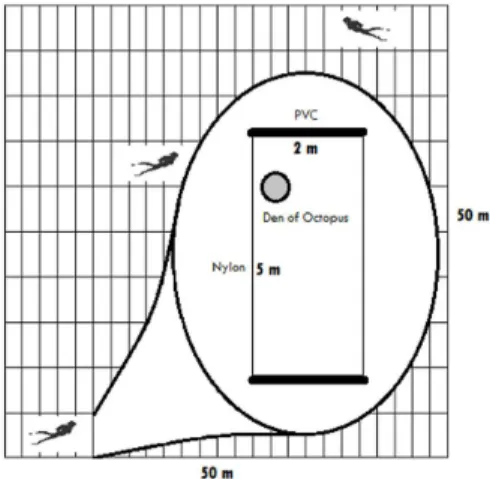
visually swept with the aid of a rectangle made from a PVC pipe, with smaller (2m) sides and nylon in the longer (5m) sides, for easy transportation and handling. This
gridded rectangle was lipped over after the search for holes in the area was inalized, so the search continued on
until completing the total FS area (Figure 2).
The standardized Morisita dispersion index (Ip) was used in order to evaluate the spatial distribution (KREBS, 1999). The relative abundance of octopus at depths greater than 5m was obtained through the Intensive Visual
Figure 2. Sample design Fixed Square method (FS). Highlighted rectangle used to assist in the visual search for Octopus insularis dens and control the size of the sampled area.
Search method (IVS), which consists of an adaptation of the sampling technique called Roving diver (SCHMITT;
SULLIVAN, 1996). This method allows for coverage
of a larger area in less time while diving, being more appropriate due to the limited scuba diving time (see adaptation in LEITE et al., 2009c).
The octopuses found were classiied into four size
categories based on mantle length (ML) and interocular distances: Extra-Small (ES) ML < 50mm, Small (S) 50-80 mm, Medium (M) 80-110 mm and Large (L) > 110mm. Morphometric relationships between mantle, arms, suckers and distance between the eyes facilitated visual
classiication of individuals in their dens. Octopus dens were classiied into four types: Under Rock (UR) - octopus
sheltered beneath rocks or other consolidated material such as coral, sponge, plateau reef, in sandy bottom; Rock (RO) - Octopus housed in holes in rock blocks (> 0.5m in length); Reef Flat (RF) - Octopus housed in horizontal holes on reef plateaus, or other consolidated bottom; Vertical Rock (VR) - octopus nestled among rocks in orthogonal position relative to the surface of the water (LEITE et al., 2009c).
The habitats where occupied dens were found were characterized based on the depth, vegetation cover and structural complexity. The coverage of the substrate was recorded by the transecting points method (TPM)
(MUNRO, 2013), which consists in logging the substrate
Rock (R) - rocky blocks, pebbles; Rodolith (ROD) - calcareous algae fragments of oval shape; Corals (CO) - hard or soft corals; Sponges (Sp) - Porifera species;
Filamentous Algae (FA) - unbranched ilamentous algae;
Calcareous Algae (CA) - algae incrusting on hard bodies; and Branched Seaweed (BS) - seaweed with branches. After the TMP recordings, the structural complexity of habitats were analysed as determined by the surface roughness, den size and percentage of living coverage through the Habitat Assessment Score (HAS) proposed by GRATWICKE and SPEIGHT (2005).
Diets were characterized from the collection of food scraps left in front of the dens, such as carapaces, shells,
and other bodies collected for later identiication in the
laboratory. Only newer materials, such as non-weathered debris or encrusted algae were not considered (MATHER,
1991). The identiication of prey was conducted through
specialized literature for molluscs (RIOS, 1994) and
shellish (MELO, 1996). Widths of shells and carapaces
were measured with the aid of a caliper.
Statistical analyses
Pearson’s chi-square test was used to check possible relationships between the categorical variables of: substrate and sampled area; size of octopus and type of den; size of octopus and depth; and size of octopus and diet. The density obtained in Fixed Square space
(2500 m2) was expressed in individual 100 m-2. The
relative abundance was expressed in number of octopuses found by the total diving time in each area (i-ividual time-1), and both sampled areas were compared using
Student’st-test. One-way ANOVA was used followed by
Tukey HSD test in order to test diferences between the
sizes of most consumed prey (shell width) in relation to octopus size category. Normality and homogeneity of data were tested by Kolmogorov and Levene tests, respectively (ZAR, 2010).
RESULTS
A total of 89 Octopus insularis individuals (12 ES,
26 S, 15 M, 24 L and 12 non-classiied) were found at
total depths between 0.5 and 25 m. Of this total, 71 were recorded during scuba diving (IVS method), and 17 on free snorkeling dives (Fixed Square method). Another
two species of octopuses were identiied in the study
sites during this study, being Octopus hummelinck Adam
(1936) and Amphioctopus burryi Voss (1950), and both
were being eaten by O. insularis.
Regarding abundance, a density of 0.4 ind. per 100 m-² was found in the shallow reefs of Pirangi, with a spatial aggregate distribution (Ip > 0; Ip = 0.03), higher than found to the oceanic island Fernando de Noronha, Rocas Atoll (Table 1). During Intensive Visual Search (IVS) in Rio do Fogo, 49 octopuses were found during 13.9 hours of diving in four sampling sites in the area of Restinga, resulting in an average of relative abundance of 3.2 ± 0.8 ind. h-1. In the deep reef, 32 octopuses were found in
7.8 hours of diving at ive sampling sites, resulting in a
relative abundance average of 2.7 ± 1 ind. h-1. Despite the relative abundance in Restinga being higher than in Risca,
there were no signiicant diferences between the areas
(T-Test; T = 0.7; df = 7; p = 0.48). These abundance values were also higher than found to Fernando de Noronha, and Trindade Archipelago (Table 2).
Regarding the habitats, substrate coverage between the Pirangi reef areas of Restinga and Risca showed
signiicant diferences (X² = 38.31, df = 8, p = 6.58e-6). Pirangi presented primarily bedrock (blocks and fragments) with rhodoliths covered for the most part by Branched Seaweed (49%). In the Restinga, the substrate was more homogeneous with little presence of solid bodies, composed of plateaus and sandy gravel, and the substrate cover is characterized by the following proportions: Sand (24%), Gravel (22%), Sponge (19%)
and Branched Seaweed (18%). This diferent environment
had not yet been previously described for O. insularis
(Figure 3 and Table 1). In deeper reefs (> 15m), the substrate was formed by reef plateaus fragments with higher amounts of solids, with substrate formed primarily of Sand (31%), Branched Seaweed (27%) Gravel (12 %)
and ilamentous algae (10%) (Figure 4).
HAS analysis indicated that the three evaluated areas were similar in relation to the size of the dens
Table 1. Descriptions of substrate, depth and HAS (Habitat Assessment Score) of sampled areas.
Area Substrate Depth (m) HAS
Roughness Den size Live cover
Pirangi Rocky (fragments and blocks), rhodoliths, algae and little sand. 0-5 3 2 4 Restinga Sandy plateau with gravel and sponge, few hard bodies. 5-15 1 1 4
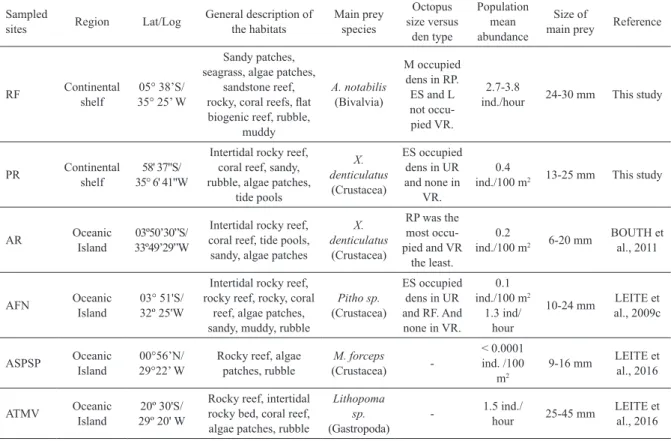
Table 2. Comparative of the environmental characteristics among continental and oceanic areas: Rio do Fogo (RF), Pirangi (PR), Rocas Atoll (RA), Fernando de Noronha archipelago (AFN), Saint Peter and Saint Paul archipelago (ASPSP), and Trindade and Martim Vaz
Archipelago (ATMV). Octopus size: Extra-small (ES), Small (S), Medium (M), Large (L); dens type: Under Rock (UR), Rock (RO), Reef
Plateau (RP), Vertical Rock (VR).
Sampled
sites Region Lat/Log
General description of the habitats Main prey species Octopus size versus den type Population mean abundance Size of
main prey Reference
RF Continental shelf
05° 38’S/ 35° 25’ W
Sandy patches, seagrass, algae patches,
sandstone reef,
rocky, coral reefs, lat
biogenic reef, rubble, muddy
A. notabilis
(Bivalvia)
M occupied dens in RP. ES and L not occu-pied VR.
2.7-3.8
ind./hour 24-30 mm This study
PR Continental shelf
58' 37"S/ 35° 6' 41"W
Intertidal rocky reef, coral reef, sandy, rubble, algae patches,
tide pools
X. denticulatus
(Crustacea)
ES occupied
dens in UR
and none in VR.
0.4
ind./100 m2 13-25 mm This study
AR Oceanic
Island
03º50’30”S/ 33º49’29”W
Intertidal rocky reef, coral reef, tide pools, sandy, algae patches
X. denticulatus
(Crustacea)
RP was the most occu-pied and VR
the least.
0.2
ind./100 m2 6-20 mm
BOUTH et al., 2011 AFN Oceanic Island 03° 51'S/ 32º 25'W
Intertidal rocky reef, rocky reef, rocky, coral
reef, algae patches, sandy, muddy, rubble
Pitho sp.
(Crustacea)
ES occupied
dens in UR
and RF. And none in VR.
0.1 ind./100 m2
1.3 ind/ hour
10-24 mm LEITE et al., 2009c
ASPSP Oceanic Island
00°56’N/ 29°22’ W
Rocky reef, algae patches, rubble M. forceps (Crustacea) -< 0.0001 ind. /100 m2
9-16 mm LEITE et al., 2016
ATMV Oceanic Island
20º 30'S/ 29º 20' W
Rocky reef, intertidal rocky bed, coral reef, algae patches, rubble
Lithopoma sp.
(Gastropoda)
- 1.5 ind./
hour 25-45 mm
LEITE et al., 2016
(HAS = 2) and percentage of live coverage (HAS = 4), which represents 40-79% of live coverage. Pirangi had the highest roughness score (HAS = 3); and Restinga had
the lowest (HAS = 1), which relects the low structural
heterogeneity of the substrate, with the latter also featuring the smallest den sizes (HAS = 1). Deep reef roughness and den size was slightly larger than those in the area of Restinga, both with a score of 2 (Table 1).
Environmental variables versus octopus sizes
When analyzing the relationship between environmental variables and the sizes of octopus, the overall result was that the most used type of den was Reef
Flat (39% of cases), followed by Under Rock (36%), and
the least attractive type was Vertical Rock, with only 3%.
A signiicant relationship between the size of the octopus and type of den was found (X² = 97.03, df = 9, p = 2.2e-16),
with Medium size occupying reef lat dens, and Large and
Extra Small animals not been found in Vertical Rock dens (Figure 5). The octopus dens preference at the continental
shelf was very similar to the oceanic islands, showing a similarity at habitat of occurrence (Table 2).
Regarding depth, there was a signiicant relationship
between this variable and the size of octopus, with a trend towards larger individuals inhabiting deeper areas
(X² = 14.38, df = 6, p = 0.025). Large individuals did not occur in shallow waters (<5 m), and were more abundant in intermediate areas (5-15 m). Conversely, Extra Small individuals were not found in deeper areas (> 15m) (Figure 6).
Diets
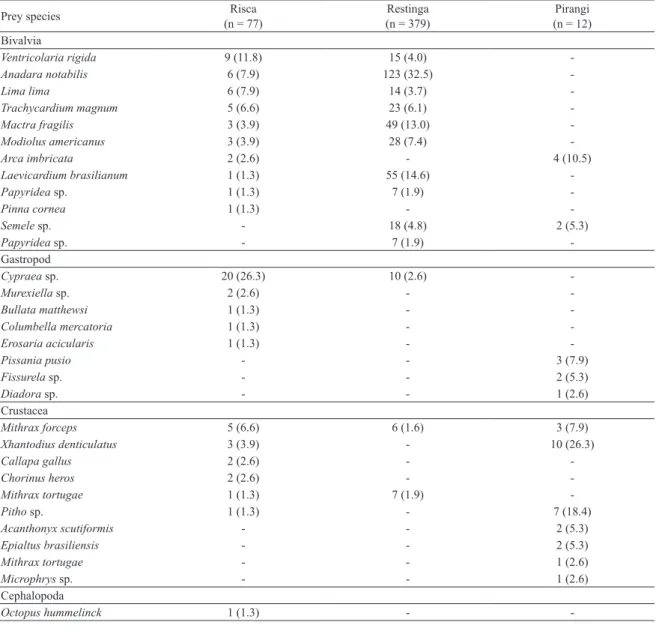
A total of 37 food items were found in 12 dens in the shallow reefs of Pirangi. Crustaceans were the most consumed items, with 7 species (68.4%, n = 26), followed by 3 species of gastropods, (15.8%, n = 6), and 2 species of bivalves (15.8%, n = 6). More than half of the items consumed in this area (71.1%, n = 27) were comprised of 5 species; Crustacea: Xanthodius denticulatus White (1848)
(26.3%), Pitho sp. Bell (1835) (18.4%) and Mithrax
Figure 3. New habitat occurrence for Octopus insularis. Called Restinga with depth between 5 and 15m, inside the Environmental Protection Area of Coral Reefs (APARC), Rio do Fogo/RN, Brazil.
Figure 4. Percentage of substrate coverage in the sampled areas: Pirangi - shallow sedimentary reef; Restinga - biogenic plateaus; Risca Reefs. Legend: BS - branched seaweed; S - Sand; ROD - Rodolith;
Gr - Gravel; FA - ilamentous algae; Others - less frequent categories.
Figure 5. Percentage of occurrence of den types across Octopus insularis size categories. Extra-Small (ES, n = 12), Small (S, n = 24), Medium (M, n = 12) and Large (L, n = 23).
Figure 6. Percentage occurrence of Octopus insularis size categories across depth categories. Extra-Small (ES, n = 12), Small (S, n = 26), Medium (M, n = 14) and Large (L, n = 24).
imbricata Bruguière (1789) (10.5%) and Gastropod:
Pissania pusio Linnaeus (1758) (7.9%) (Table 3). The main crustaceans species found at the dens remains at this continental reef correspond with the main prey found at Rocas Atoll, Fernando de Noronha and Saint Peter Archipelago (Table 2).
In Restinga, 379 food items were collected in 30 dens, where bivalves were the most consumed items (91%, n = 43), with 15 species, followed by Gastropod (0.05%, n = 19), with 10 species, and Crustacea (0.04%, n = 16) with 5 species. Among the most consumed items, 5 species of bivalve accounted for over 70%,
Anadara notabilis Roding (1798) (32%) occurred in 77%
of sampled dens; Laevicardium brasilianum Lamarck
(1819) (15%) were found in 50% of dens; Mactra fragilis
Gmelin (1791) (13%) occurred in 57% of dens; and
Modiolus americanos Leach (1815) (7%) found in 43% of dens. In this area, we observed a large (L) O. insularis
feeding on an octopus of a diferent species, Amphioctopus burryi Voss (1950).
At Risca, 77 food items were collected in 8 dens; bivalves were the most consumed items (59%, n = 45) with 11 species, followed by Gastropods (33%, n = 25) with 5 species, and Crustacea (18%, n = 14) with 6 species.
Among the most consumed items, the gastropod Cypraea
sp. was the irst (20%) and it was found in half (50%) of
the analyzed dens, followed by bivalves Ventricolaria
rigida Dillwyn (1817) (12%) occurring in 37% of dens,
A. notabilis and Lima lima Linnaeus (1758) (8%) and
Trachycardium magnum Linnaeus (1758) (6.6%) found
in 25% of dens, and the Crustacean M. forceps (6.6%)
was found in 62% of the sampled dens (Table 3). In this area we observed a large (L) O. insularis feeding on an
Table 3. Prey of O. insularis (n and %, representing 1% or more of prey consumed) found in middens/debris at Risca, Restinga and Pirangi, between 2010 and 2011.
Prey species Risca
(n = 77)
Restinga (n = 379)
Pirangi (n = 12) Bivalvia
Ventricolaria rigida 9 (11.8) 15 (4.0)
-Anadara notabilis 6 (7.9) 123 (32.5)
-Lima lima 6 (7.9) 14 (3.7)
-Trachycardium magnum 5 (6.6) 23 (6.1)
-Mactra fragilis 3 (3.9) 49 (13.0)
-Modiolus americanus 3 (3.9) 28 (7.4)
-Arca imbricata 2 (2.6) - 4 (10.5)
Laevicardium brasilianum 1 (1.3) 55 (14.6)
-Papyridea sp. 1 (1.3) 7 (1.9)
-Pinna cornea 1 (1.3) -
-Semele sp. - 18 (4.8) 2 (5.3)
Papyridea sp. - 7 (1.9)
-Gastropod
Cypraea sp. 20 (26.3) 10 (2.6)
-Murexiella sp. 2 (2.6) -
-Bullata matthewsi 1 (1.3) -
-Columbella mercatoria 1 (1.3) -
-Erosaria acicularis 1 (1.3) -
-Pissania pusio - - 3 (7.9)
Fissurela sp. - - 2 (5.3)
Diadora sp. - - 1 (2.6)
Crustacea
Mithrax forceps 5 (6.6) 6 (1.6) 3 (7.9)
Xhantodius denticulatus 3 (3.9) - 10 (26.3)
Callapa gallus 2 (2.6) -
-Chorinus heros 2 (2.6) -
-Mithrax tortugae 1 (1.3) 7 (1.9)
-Pitho sp. 1 (1.3) - 7 (18.4)
Acanthonyx scutiformis - - 2 (5.3)
Epialtus brasiliensis - - 2 (5.3)
Mithrax tortugae - - 1 (2.6)
Microphrys sp. - - 1 (2.6)
Cephalopoda
Octopus hummelinck 1 (1.3) -
-When we evaluate the composition of the large groups of bivalves, Gastropod and Crustacea in the diet
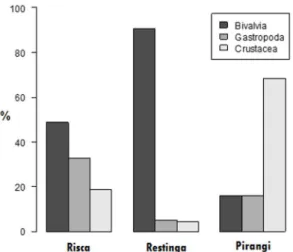
of octopus, we ind that these have diferent proportions amongst the three areas (X² = 213.42, df = 4, p = 2.2e-16). In Pirangi, 68% of the consumed items were crustaceans, being small decapods; followed in equal proportions by 16% bivalves and gastropods. At Restinga, the diet consisted almost entirely of bivalves (91%), and to a lesser extent gastropod (5%) and crustaceans (4%). At Risca, the proportion of taxons was more balanced, however, as half of the items consumed were bivalves (49%), followed by gastropods (33%), and crustaceans at a lesser amount (18%) (Figure 7).
The prey species found in dens remains at Risca e Restinga did not correspond the one already described for
O. insularis at the oceanic islands (Table 3), indicating an increase of its diet preference toward the continent.
Regarding the variation in the size of the prey among the octopus size categories, we found that the width of the shells of the most consumed species A. notabilis varied
signiicantly (ANOVA, F = 3.9; df = 3; p = 0.009) among the Exta Small (n = 32; 23.7 ± 4.6 mm) and Large (n = 24; 28.6 ± 5.1 mm) categories (Tukey, MS = 35.01; df = 104;
p = 0.017). The diet composition among size categories
Extra small individuals did not consume gastropods,
Figure 7. Percentage of Bivalvia, Gastropod and Crustacea prey categories, found in middens/debris of Octopus insularis in the sampled areas of Pirangi, Restinga and Risca (n = 492).
however larger individuals had the highest consumption of gastropods (16%) (Figure 8).
DISCUSSION
Some distinct features were found in this study when comparing the niches occupied by the population of
Octopus insularis in the state of RN with the populations of oceanic islands in the Northeast. These include expansion of habitats and diets, and other similarities, such as the population density, clustered distribution pattern in rocky bottoms and bathymetric segregation in relation to body size categories (see Table 2).
One of the most important results of this study was
the occurrence of O. insularis in the biogenic plateau,
known locally by local octopus ishermen as ‘Restinga’, a completely diferent habitat from previously recorded habitats for the species (LEITE et al., 2009c; BOUTH et al.,
2011). Restinga is a plateau formed by both non-biogenic material (sand, gravel and rocks), as well as biogenic material, primarily sponges and algae. It is interesting to note that this environment has mild heterogeneity, low roughness, and a lower number of dens when compared to reef areas, where one might expect a lower abundance of octopus as these are considered important requirements for the occurrence of octopus (ANDERSON, 1997;
KATSANEVAKIS; VERRIOPOULOS, 2004a). However,
this region had abundances similar to those found in the Fernando de Noronha national reef park, stressing the
Figure 8. Percentage of Bivalvia, Gastropod and Crustacea prey categories across Octopus insularis size categories. Extra-Small (ES, n = 92), Small (S, n = 132), Medium (M, n = 30) and Large (L, n = 148).
importance of the environment for the population of octopuses in this region.
Restinga is not a completely sandy environment, which in fact would reduce the density of these mollusks in the environment, but it presents extensions than can be dug out by octopuses for building their shelters, or by increasing existing cracks/gaps in the plateau. In Rodas Inlet, Portugal, in an environment similar to the Restinga with a depth
between 5 and 21m, GUERRA et al. (2014) found O. vulgaris dens built on sand, reinforced with bivalve shells, and suggested that more than half of the observed dens are permanent, being occupied by several generations of octopus. Furthermore, the density of 0.34 ind. per 100 m-2,
and the clustered aggregation pattern are similar to those found in reef environments with high availability of dens such as in Pirangi.
The population density of 0.40 ind. per 100 m-2 found
in the area of Pirangi, and 3.2 and 2.7 ind. h-1 (duration of
dive) in Rio do Fogo were also similar to those found in Fernando de Noronha of 0.12 to 0.88 ind. per 100 m-2, and
mean of 1.34ind. h-1 (LEITE et al., 2009c) in rocky and
reef habitats, and at Rocas Atoll on reef plateaus (0.12 to 0.36 ind. per 100 m-2) (BOUTH et al., 2011). Such densities
show that O. insularis is also abundant and dominant in
shallow and deep reefs in the coastal waters of northeastern Brazil. Such densities are also similar to those found for
other species and in other environments. For example, O.
vulgaris in sandy shore environments in Greece, with results
between 0 and 0.68 ind. per 100 m-2 (KATSANEVAKIS;
in Alaska, between 0 and 0.25 ind. per 100 m-2 (SCHEEL, 2002). These diferent densities may be associated with diferent resources and conditions that the habitats present,
such as availability of shelter and food (KATSANEVAKIS;
VERRIOPOULOS, 2004a).
The clustered distribution pattern of O. insularis found in our analysis was also found by LEITE et al. (2009c) in
Fernando de Noronha, and for BOUTH et al. (2011) at Rocas
Atoll, and for other species, such as Octopus joubini in sandy
environments (MATHER, 1982), Octopus tetricus in reef
environments (ANDERSON, 1997), and also for Octopus
vulgaris in sandy environments (GUERRA et al., 2014). In
this study, clustered distribution was observed at the edge of a reef at a depth of 0-2m, with lots of rocks, gravel and dens available, representing an attraction for octopuses. The heterogeneity of habitat such as edge reefs, plateaus, and gravel in sandy environments are important factors in the distribution of benthic octopuses because they provide the shelter needed for them (ANDERSON, 1997; FORSYTHE;
HANLON, 1997; KATSANEVAKIS; VERRIOPOULOS,
2004a). Aggregation due to reproductive demands was not a justifying factor for the aggregation in the present study
(HUFFARD et al., 2008; LEITE et al., 2009c). The absence
of this relationship is probably related to the fact of not having taken into account the distances among dens in the
deeper areas of study, where one would expect to ind adult
animals. The aggregation evaluation was only performed in the shallow reefs of Pirangi, which more resembled a nursery area in the shallow waters of Rocas Atoll due to the high amount of juvenile animals.
Similar to LEITE et al. (2009c) study in Fernando de Noronha where octopuses (Extra Small) had an occupancy preference for horizontal dens in rocky and reef beds, octopuses found on the RN coast also showed preference for theirs types of dens. The variety and reduced amount of dens with few solids available in the environment (e.g. rocks blocks) might be an explanatory reason, since the
Reef Flat and Under Rock types of dens were dens more
occupied by all sizes. Small octopuses also preferred the shallower waters, similar to that found on oceanic islands. Compared with species of temperate waters, the bathymetric segregation of O. vulgaris sizes in the Mediterranean was
found only when analyzed in diferent seasons. The smaller
individuals were found in summer when the temperature is higher, while in the opposite season of winter, larger individuals were more abundant (KATSANEVAKIS;
VERRIOPOULOS, 2006).
Some abiotic factors such as temperature and brightness can explain this spatial segregation between small and large individuals. Provided there is food available,
temperature is a major factor afecting the growth rate of cephalopods (FORSYTHE; VAN HEUKELEM, 1987).
Larger animals are stimulated to search for less warmer water at greater depth, thereby reducing the energy cost of a warmer metabolism, and on the other hand, smaller animals seek shallower areas in order to accelerate their growth rates, making them less vulnerable to predation (SCHMIDT-NIELSEN, 1996). In addition, the brightness in the environment can delay sexual maturation in cephalopods due to inhibiting the optical gland responsible for maturation (O’DOR; WELLS, 1978). Thus, the large ones found in the deeper areas may grow more slowly and reach sexual maturity faster. This information indirectly shows us a migration of the larger individuals to deeper areas.
Also in relation to abiotic factors afecting the
distribution of this species, AMADO et al. (2015) recently
found signiicant diferences in the physiology of O. insularis, with the latter being a more euryhaline species
when compared to O. vulgaris. This ability to withstand
salinity changes either up or down may help explain the dominance of O. insularis in shallow tropical waters, where salinity can reach up to 34 ppm in pools of coastal reefs of tides, where O. insularis juveniles were found in this study.
Another important diference in the niche occupied
by O. insularis on the continent compared to oceanic islands was the expansion of food preference. While the populations of Fernando de Noronha and at Rocas Atoll mostly consumed (>70%) 4 and 5 species of small crabs
(LEITE et al., 2009b; BOUTH et al., 2011), the diet of
the octopuses at Rio do Fogo consisted largely (>80%) of bivalve mollusks, and in all size categories as the main food items consumed in this region. This shift in food preference, of crustaceans to bivalves, appears to be strongly associated with the availability of prey in the habitat. A dominance of bivalves in the O. vulgaris diet in a sandy environment was
also found in Portugal (GUERRA et al., 2014).
Despite this shift in food preference of crustaceans for bivalves, as well as the presence of few species in the diet in general, a relatively small size of the prey, and little variation of their size relative to the size of the octopus, there was continued evidence present that the continental
et al., 2016). The occurrence of unusual species in the O. insularis diet such as two species of small octopus found
at Rio do Fogo, and also ish and turtles points to the
opportunism of this predator, a well-known feature in this mollusk group.
The expansion of the diet described for O. insularis
on the coast of Rio Grande do Norte highlights the need to investigate the ecology of this species, and strengthen
the adaptability of these mollusks to diferent types of
environments. This type of study is always necessary, especially when it is a commercially exploited species. Its abundance and distribution characteristics, as well as its bathymetric segregation being similar to the ones found on oceanic islands appear to be general ecological characteristics of the species. This information provides adequate support for the management and exploitation of
O. insularis, and also for the coastal region, such as to protect shallow areas to increase the chances of juveniles surviving to reach adulthood, as proposed by LEITE et al. (2009a) for Fernando de Noronha; and to expand
pot ishing in little explored regions with great ishing
potential.
ACKNOWLEDGEMENTS
We would like to thank the members of the research laboratories (LABECE) for their help with the various
dives and analysis; the Rio do Fogo ishermen for leading
us to dive points with their boats, and their shared
knowledge; the Federal University of Rio Grande do Norte (UFRN), the Brazilian National Research Council
(CNPq) Project: 559863/2008-0 and the Coordination for Higher Education Personnel Improvement (CAPES) for
logistical and inancial support.
REFERENCES
AMADO, E. M.; SOUZA-BASTOS, L. R.; VIDAL, E. A. G.; LEITE, T. S.; FREIRE, C. A. Diferent abilities to regulate
tissue hydration upon osmotic challenge in vitro, in the cephalopods Octopus vulgaris and O. insularis. Mar. Freshw. Behav. Physiol., v. 48, n. 3, p. 205-211, 2015.
ANDERSON, T. J. Habitat selection and shelter use by Octopus
tetricus. Mar. Ecol Prog. Ser., v. 150, p. 137-148, 1997.
BOUTH, H. F.; LEITE, T. S.; LIMA, F. D.; OLIVEIRA, J. E.
L. Atol das Rocas: an oasis for Octopus insularis juveniles (Cephalopoda: Octopodidae). Zoologia, v. 28, n. 1, p. 45-52, 2011.
BRAGA, M. S. C.; MARINHO, R. A.; BATISTA, B. B.; ROCHA, E. P. Histórico e descrição da desca do polvo, Octopus cf
vulgaris, com potes, no estado do Ceará. Arq. Ciênc. Mar, v.
40, n. 2, p. 5-13, 2007.
FORSYTHE, J. W.; VAN HEUKELEM, W. F. Growth. In:
BOYLE, P. R. (Ed.). Chephalopods life cycles. London: Academic Press, 1987. p. 135-156.
FORSYTHE, J. W.; HANLON, R. T. Foraging and associated behavior by Octopus cyanea Gray, 1849 on a coral atoll, French Polynesia. J. Exp. Mar. Biol. Ecol., v. 209, n. 1-2, p. 15-31, 1997.
GRATWICKE, B.; SPEIGHT, M. R. The relationship between
ish species richness, abundance and habitat complexity in a
range of shallow tropical marine habitats. J. Fish Biol., v. 66, n. 3, p. 650-667, 2005.
GUERRA, A.; HERNÁNDEZ-URCERA, J.; GARCI, M. E.; SESTELO, M.; REGUEIRA, M.; GONZÁLEZ, A. F.;
CABANELLAS-REBOREDO, M.; CALVO-MANAZZA, M.; MORALES-NIN, B. Dwellers in dens on sandy bottoms: Ecological and behavioural traits of Octopus vulgaris. Sci. Mar., v. 78, n. 3, p. 405-414, 2014.
HUFFARD, C. L.; CALDWELL, R. L.; BONEKA, F.
Mating behavior of Abdopus aculeatus (d’Orbigny 1834) (Cephalopoda: Octopodidae) in the wild. Mar. Biol., v. 154, n. 2, p. 353-362, 2008.
KATSANEVAKIS, S.; VERRIOPOULOS, G. Den ecology of
Octopus vulgaris Cuvier, 1797, on soft sediment: availability
and types of shelter. Sci. Mar., v. 68, n. 1, p. 147-157, 2004a.
KATSANEVAKIS, S.; VERRIOPOULOS, G. Abundance of
Octopus vulgaris on soft sediment. Sci. Mar., v. 68, n. 4, p.
553-560, 2004b.
KATSANEVAKIS, S.; VERRIOPOULOS, G. Seasonal
population dynamics of Octopus vulgaris in the eastern Mediterranean. J. Mar. Sci., v. 63, n. 1, p. 151-160, 2006. KREBS, C. J. Ecological Methodology. 2nd ed. San Francisco:
Benjamin Cummings. 1999.
LEITE, T. S.; HAIMOVICI, M.; MOLINA, W.; WARNKE, K. Morphological and genetic description of Octopus insularis, a new cryptic species in the Octopus vulgaris complex (Cephalopoda: Octopodidae) from the tropical southwestern Atlantic. J. Mollus. Stud., v. 74, n. 1, p. 63-74, 2008.
LEITE, T. S.; ANDRADE, L. C. A.; HAIMOVICI, M.; AGUIAR,
R. S.; LINS-OLIVEIRA, J. E. Lulas e polvos. In: HAZIN, F. H. V. (Ed.). OArquipélago São Pedro e São Paulo: 10 anos
Estação Cientíica. Brasília: SECIRM, 2009a. p. 186-193.
LEITE, T. S.; HAIMOVICI, M.; MATHER, J. Octopus insularis
(Octopodidae), evidences of a specialized predator and a time-minimizing hunter. Mar. Biol., v. 156, n. 11, p. 2355-2367, 2009b.
LEITE, T. S.; HAIMOVICI, M; MATHER, J; LINS-OLIVEIRA, J. E. Habitat, distribution, and abundance of the commercial octopus (Octopus insularis) in a tropical oceanic island,
Brazil: Information for management of an artisanal ishery
inside a marine protected area. Fish. Res., v. 98, n. 1-3, p. 85-91, 2009c.
LEITE, T. S.; BARBOSA, J. C.; ALMEIDA, L. B.; LIMA, F. D.; HAIMOVICI, M. Occurrence of Octopus insularis
and observations on its feeding and mating in Trindade and Martim Vaz Archipelago of southeastern Brazil. Florianópolis: Cephalopod International Advisory Council Symposium, 2012.
LEITE, T. S.; BATISTA, A. T.; LIMA, F. D.; BARBOSA, J. C.; MATHER, J. Geographic variability of Octopus insularis
LIMA, F. D.; LEITE, T. S.; HAIMOVICI, M.; LINS-OLIVEIRA, J. E. Gonadal development and reproductive strategies of the tropical octopus (Octopus insularis) in northeast Brazil. Hydrobiologia, v. 725, n. 1, p. 7-21, 2014a.
LIMA, F. D.; LEITE, T. S.; HAIMOVICI, M.; NÓBREGA, M. F.; LINS-OLIVEIRA, J. E. Population structure and reproductive dynamics of Octopus insularis (Cephalopoda: Octopodidae) in a coastal reef environment along northeastern Brazil. Fish. Res., v. 152, p. 86-92, 2014b.
MATHER, J. A. Factors afecting the spatial distribution of
natural populations of Octopus joubini robson. Anim. Behav., v. 30, n. 4, p. 1166-1170, 1982.
MATHER, J. A. Foraging, feeding and prey remains in middens of juvenile Octopus vulgaris (Mollusca: Cephalopoda). J. Zool., v. 224, n. 1, p. 27-35, 1991.
MELO, G. A. S. Manual de identiicação dos Brachyura
(Caranguejos e siris) do litoral brasileiro. São Paulo: FAPESP/Pleiade, 1996.
MUNRO, C. Diving. In: ELEFTHERIOU, A. (Ed.) Methods for the
study of marine benthos. 4th ed. Hoboken: John Wiley & Sons, 2013, 496 p.
O’DOR, R. K.; WELLS, M. J. Reproduction versus somatic growth: hormonal control in Octopus vulgaris. J. Exp. Biol., v. 77, p. 15-31, 1978.
RIOS, E. Seashells of Brazil. 2nd ed. Rio Grande: Fundação
Universidade do Rio Grande. Museu Oceanográico, 1994. 368 p. SCHEEL, D. Characteristics of Habitats Used by Enteroctopus
doleini in Prince William Sound and Cook Inlet, Alaska. Mar. Ecol., v. 23, n. 3, p. 185-206, 2002.
SCHMIDT-NIELSEN, K. Fisiologia Animal: Adaptação e Meio Ambiente. 5th ed. São Paulo: Santos, 1996.
SCHMITT, E. F.; SULLIVAN, K. M. Analysis of a volunteer method for collecting ish presence and abundance data in the lorida
keys. Bull. Mar. Sci., v. 59, n. 2, p. 404-416, 1996.