Arq
u
ivo
s
d
e
C
iê
n
ci
a
s
d
o
Ma
r
SPATIAL VARIATION OF THE PLANKTON COMMUNITY
OVER A SHORT-TERM SURVEY AT A TROPICAL
HYPEREUTROPHIC ESTUARY
Variação espacial da comunidade planctônica submetida a
monitoramento de curta duração em um estuário tropical
hipereutróico
1 Instituto de Ciências Biológicas, Universidade de Pernambuco, Recife, PE, 50100-130, Brasil. 2 Departamento de Oceanografia, Universidade Federal de Pernambuco, Recife, PE 50670-901, Brasil 3 Département de Biologie, Université de Sherbrooke, Québec- J1K 2R, Canada
* Corresponding author: [email protected]
Mariana Guenther1,2*, Sarah-Jeanne Royer2,3, Danniely de Oliveira Campos1, Sigrid
Neumann-Leitão2
ABSTRACT
Composition, abundance, diversity and evenness of phytoplankton (micro: > 20 µm) and zooplankton (micro: 20-200 µm and meso: > 20-200 µm) were assessed at three different points of Recife Harbor (NE Brazil), a hypereutrophic estuary, during the wet season. Its spatial structure was clearly heterogeneous, being the phytoplankton more abundant and less diverse at the inner portion, due to a Thalassiosira bloom. Micro and mesozooplankton were more abundant at the intermediate and outer estuary. Ciliates (e.g.,Codonella spp.) dominated the microzooplankton at the inner system while Gastropoda larvae prevailed at the outer section. In the mesozooplankton community, cyclopoid copepods (e.g., Oithona hebes) were more abundant at the inner section while calanoids (e.g., Parvocalanus crassirostris) prevailed at the outer system. Tidal oscillation effects on plankton dynamics were more important near the estuary’s mouth. These results suggest that the variations in abiotic factors may not be enough to explain the effects of eutrophication on such hydrological dynamic systems and raise some hypotheses about the more likely biotic regulation of those communities such as competition and predation, to be evaluated on a long-term basis.
Keywords: trophic interactions;eutrophication; microzooplankton; mesozooplankton; phytoplankton; Pernambuco; NE Brazil.
RESUMO
Composição, abundância, diversidade e equitabilidade do itoplâncton (micro: > 20 µm) e zooplâncton (micro: 20-200 µm e meso: > 20-200 µm) foram estimadas em três pontos distintos do Porto do Recife (NE Brasil), um estuário hipereutróico, durante a estação chuvosa. Sua estrutura espacial mostrou-se claramente heterogênea, sendo o itoplâncton mais abundante e menos diverso na porção interna, devido a uma loração de Thalassiosira. O micro e mesozooplâncton foram mais abundantes nas regiões intermediária e externa do estuário. Ciliados (e.g., Codonella spp.) dominaram o microzooplâncton no interior enquanto que larvas de Gastropoda predominaram na seção externa. Na comunidade mesozooplanctônica, copépodos ciclopóides (e.g., Oithona hebes) foram mais abundantes no interior enquanto que os calanóides (e.g., Parvocalanus crassirostris) predominaram na parte externa do sistema. O efeito da oscilação da maré na dinâmica do plâncton foi mais pronunciado próximo à boca do estuário. O presente estudo sugere que as variações nos fatores abióticos não são suicientes para explicar o efeito da eutroização nesses sistemas hidrodinâmicos e levanta algumas hipóteses sobre a prevalência da regulação biótica dessas comunidades, como competição e predação, a ser avaliada em um estudo em larga escala temporal.
INTRODUCTION
Estuaries are hydrodynamically complex systems where salinity, temperature, nutrient contents, species diversity and abundance of organisms can vary in a daily basis. Spatial variation in these characters is also important, and may depend on the strength of tidal currents and river runoff which are related to the geomorphology of the system (McLusky & Elliott, 2004).
The intense loads of nutrients and organic material from the terrestrial runoff together with the harbored nature of these systems provide an ideal nursery place for a large variety of marine ishes and meroplankton (Kennish, 1990, Mallin & Paerl, 1994). The vast majority of estuaries is surrounded by urbanized areas, and provides an important economic support through isheries. These densely populated areas also receive high loads of inorganic pollution (mainly ammonium and phosphate), most of them derived from untreated domestic sewage (Day et al, 2013). The nutrient input in excess results in a deep impact on the whole ecosystem, limiting its ecological and economic functions.
Nutrient loading in excess, usually not in the ideal stoichiometric balance to be uptaken, results in a selection of particular phytoplankton species, resulting in a sharp algal diversity decrease, which leads to a food shortage to the following trophic levels: micro and mesozooplankton (e.g. Smith et al, 1999, Rothenberger et al, 2013). The primary biomass produced not incorporated by the zooplankton accumulates to be decomposed by the heterotrophic bacterioplankton resulting in high oxygen depletion (Guenther et al, 2008).
Plankton organisms are important indicators of small scale environmental changes due to their short life-span and sensibility to instantaneous abiotic and biotic variations. Therefore, their dynamics respond directly to environmental oscillations (Smayda, 1998, Cloern & Dufford, 2005).
In the present study we evaluated some community parameters (composition, abundance, diversity and evenness) of three linked plankton compartments: microphytoplankton (autotrophs > 20µm), microzooplankton (heterotrophs 20-200µm) and mesozooplankton (heterotrophs > 200µm) at three different points of Recife harbor estuary (NE Brazil). This is a hypereutrophic vertically and horizontally well mixed system with short residence times but restricted water renewal, whose high loads of inorganic phosphate from domestic untreated sewage and agriculture runoff result in extremely
low N:P ratios and hence a nitrogen limitation for the primary producers (Guenther et al, 2015).
The aim of the present study was to estimate at a short-term basis (one semi-diurnal cycle) the spatial structure of these main plankton compartments in order to evaluate the effects of tidal circulation on these communities.
MATERIAL AND METHODS
Study area
The Recife harbor (08°03’S; 34°52’W - Recife – PE, Brazil) is situated in a densely populated area of the city, being supplied by the Pina, Capibaribe and Beberibe rivers, which low into it at three distinct points. It is a long, narrow and shallow system (7km long, 250-1000m wide and 1-12m deep) connected to the ocean by a 300 m wide mouth, being also inluenced by the marine spray crossing the long (4km) and thin (30 m) beach rock reef that separates it from the ocean (Fig. 1).
Tides are semidiurnal with maximum ranges of 2.3. Total phosphorous (TP) and dissolved inorganic nitrogen (DIN) contents varies, on an annual basis, from 10-433 µgL-1 and 34-150µgL-1, respectively, which results in low inorganic N:P ratios (0.8-3.6). Chlorophyll-a contents are also high throughout the estuary, varying from 7.0-72 µgL-1. Water temperatures vary from 25oC in winter (rainy season) to 31oC in summer (dry season). Salinity can vary from 25 to 36, at the outer half of the estuary, according to the distance from the ocean and the period of the year (Guenther et al, 2015).
Sampling and data analysis
The samplings were performed at three ixed stations (Fig. 1) at two tidal periods (ebb and lood tides) during the wet season (Jun/2007). The stations were sampled opposed to the water low, i.e., from the outer to the inner channel during the ebb tide and conversely during the lood tide. Microplankton and mesozooplankton samples were obtained through sub-supericial horizontal hauling with conical 20 µm and 200 µm mesh nets, respectively.
RESULTS
Plankton abundance
The microphytoplankton compartment pre-sented the same pattern of abundance variation at both ebb and lood tides: lower at the outer station (#1) and higher at the inner station (#3). However, the individual densities during the ebb tide (8.4 x 10² – 3.2 x 10⁵ ind L-1) were 10 times greater than at the lood tide: 4.0 x 10³ – 3.5 x 10⁴ ind L-1. (Table I; Fig. 2a,b).
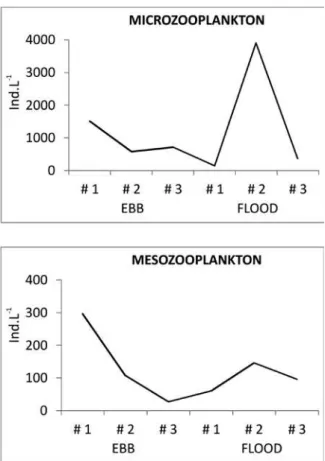
The two sampled zooplankton compartments (micro and meso) presented similar dynamics, unlike that of the microphytoplankton (Table I; Fig. 3a,b). During the ebb tide, an inverted pattern between zooplankton (both micro- and meso) and phytoplankton was observed: higher abundances at the outer station and lower abundances at the inner station. During the lood tide, however, the higher abundances were observed at the intermediate station. In both tidal periods, the
microzooplankton densities (1.4 x 10² to 3.9 x 10³ ind L-1) were 10 times greater than those of the mesozooplankton (26 - 296 ind L-1).
Figure 1 - Map of Recife harbor, northeastern coast of Brazil,
showing its major tributary rivers and the three sampling stations.
Table I - Ecological parameters of the three plankton compartments sampled. #1: outer, #2: intermediate, #3: inner station.
Microphytoplankton Ebb Flood
#1 #2 #3 #1 #2 #3
Abundance (ind L-1) 837 85382 314203 4049 10280 35838
Richness 27 28 21 17 21 18
Diversity (bits ind-1) 3.5 0.8 0.4 1.7 1.7 0.4
Evenness 0.7 0.2 0.1 0.4 0.4 0.1
Microzooplankton Ebb Flood
#1 #2 #3 #1 #2 #3
Abundance (ind L-1) 1509 572 708 140 3903 358
Richness 11 8 11 5 7 8
Diversity (bits ind-1) 1.5 2.6 2.8 2.2 1.8 2.8
Evenness 0.4 0.9 0.8 0.9 0.6 0.9
Mesozooplankton Ebb Flood
#1 #2 #3 #1 #2 #3
Abundance (ind L-1) 296 107 26 60 146 95
Richness 21 14 18 16 20 14
Diversity (bits ind-1) 1.8 2.8 3.1 2.7 2.5 2.0
Evenness 0.4 0.7 0.8 0.7 0.6 0.5
Figure 2 - Total microphytoplankton abundance (ind L-1)
Plankton ecological parameters
Microphytoplankton richness varied between 17 and 28 taxa, being higher during the ebb tide (Table I). Diversity and evenness were very low at the inner station at both tidal periods. The outer station during the ebb tide presented the highest evenness (E = 0.7) and diversity (H’ = 3.5) of the studied period.
Microzooplankton diversity, in contrast, was higher at the inner station at both tidal periods (H’ = 2.8 bits ind-1) as well as at the intermediate station during the ebb tide (H’ = 2.6 bits ind-1). The high diversity was due to the high evenness of the community (E = 0.8-0.9) at these areas and periods. Richness varied between 5 to 8 taxa, being higher during the ebb tide (Table I).
Mesozooplankton richness varied between 14 to 21 taxa with no difference between tidal periods
(Table I). Community diversity and evenness did not present a clear pattern according to the station, nor tidal period. Higher diversities and evenness were observed at the inner station during the ebb tide and at the outer station during the lood tide.
Microphytoplankton composition
The microphytoplankton community was mainly composed by centric diatoms, with Thalassiosira Cleve, 1873 (Thalassiosiraceae) as the dominant genus at the inner and intermediate stations during both ebb and lood tides (Fig. 4). At the outer station during the ebb tide, Cyanophyceae (mainly Oscillatoria simplicissima Gomont, 1892 (Oscillatoriaceae)) and centric diatoms (mainly Coscinodiscus Ehrenberg, 1839 (Coscinodiscaceae)) dominated. During the lood tide, a bloom of
Thalassiosira punctigera (Castracane) Hasle, 1983 (Thalassiosiraceae), not observed during the ebb tide, increased ive-fold the microphytoplankton abun-dance, being the dominant species (see also Table I). At the intermediate and inner stations a shift between the two main Thalassiosira species was observed: T. punctigera was dominant at the intermediate station at both tidal periods, not occurring at the inner station, while T. subtilis (Ostenfeld) Gran, 1900 (Thalassiosiraceae) occurred in all sampled stations, but bloomed on the inner one.
Microzooplankton composition
The microzooplankton community was mainly composed by tintinnid ciliates with Codonella Haeckel, 1873 (Codonellidae) as the dominant genus (Fig. 5). The rotifers Brachionus Pallas, 1766 (Brachionidae), mainly B. plicatilis Müller, 1786 (Brachionidae) were more important at the outer station during the lood tide, although present throughout the estuary. Gastropod larvae were important at the outer station during both ebb and lood tides and at the intermediate station during the lood tide. In fact, the high microzooplankton densities observed at station #1 during ebb and station #2 during lood tides (see Fig. 3a and Table I) were due to the gastropod larvae population increase: 1090 ind L-1 and 2027 ind L-1, respectively. The #2 lood peak was also due to Codonella spp. increase (1076 ind L-1). At the inner portion of the estuary, tintinnids prevailed.
Figure 3 - Total microzooplankton- (a) and mesozooplankton
abundance (ind L-1) (b) along the period and area sampled,
Mesozooplankton composition
The dominant groups in the mesozooplankton community were Copepoda (mainly Cyclopoida) and larvae of Brachyura, Cirripedia and Polychaeta (Fig. 6). Brachyura larvae prevailed (71%) at the outer station and Polychaeta larvae (37%) at the intermediate station during the ebb tide. Cirripedia larvae were the dominant group (52%) at this station during the lood tide. At the inner station, the
cyclopoid copepod Oithona hebes Giesbrecht, 1891 (Oithonidae) was the dominant taxon during both ebb (29%) and lood (59%) tides. The cyclopoids were also dominant at the outer station during the lood tide (67%). At the intermediate station, during both tidal periods and at the outer station during the ebb tide, calanoids, mainly Paracalanus aculeatus Giesbrecht, 1888 (Paracalanidae) and Parvocalanus crassirostris (Dahl F., 1894) (Paracalanidae) were more abundant than cyclopoids.
DISCUSSION
The spatial structure of the three plankton compartments in terms of composition, abundance, diversity and evenness was clearly heterogeneous. Phytoplankton was more abundant and less diverse at the inner portion while microzooplankton was more abundant and less diverse at the outer section. Mesozooplankton abundances followed the same pattern observed for the microzooplankton. Tidal oscillation effects on plankton dynamics were more important at the outer portion of the system.
In the phytoplankton community, the obser-ved bloom of the diatoms Thalassiosirapunctigera and T. subtilis resulted in a sharp decrease in diversity, probably limiting the food availability for the next trophic levels: micro and mesozooplankton. This hypothesis explains the low abundances of these two compartments at the inner estuary. Blooms of Thalassiosira species are common in brackish areas (e.g. Harris et al., 1995, Muylaert & Sabbe, 1996, Gomez & Souissi, 2010). Interestingly, T. subtilis bloomed only at the inner portion of the channel, where T. punctigera did not occur. This spatial separation might indicate a competition between these two species.
The high diversity at the outer station during the ebb tide (i.e., the period following the high tidal phase where there was a higher oceanic contribution), indicates that the mixing potential of the coastal waters is limited to this portion of the estuarine channel. The oceanic currents at this area low northwards (Noriega et al., 2013a). Thus, the narrow width of the channel entrance as well as its northeastern orientation may limit the marine low inside the estuary. In fact, a study performed over a year at this area showed a net transport of nutrients and suspended particulate material to the ocean, at both dry and wet seasons (Noriega et al., 2013b).
The marine inluence limited to the mouth of the estuary was also observed on the micro zoo-plankton compartment. The high densities of Gastro-poda larvae at this portion of the channel evidence the mixing of oceanic waters (Branco et al., 2007), and the increase in the contribution of ciliates to total microzooplankton abundance from the outer to the inner zone indicates a spatial shift in community composition. This spatial variation, greater than the temporal one, indicates the establishment of two different microzooplankton communities along the estuary. A temporal variation could be observed only at the outer portion of the channel, where a higher variability of taxa was observed during the ebb tide.
Among the ciliate taxa occurring at this system, Codonella was the most signiicant. High densities of Codonella species are commonly found in eutrophic waters (e.g. (Hunt & Chein, 1983, Barbieri & Orlandi, 1989). Also, these species usually possess ectobiotic nitrogen-ixing cyanobacterial symbionts (Foster et al., 2006), which may facilitate its growth in those N limiting waters (see Guenther et al., 2015).
In the mesozooplankton community, some taxa occurring only at the outer and intermediate stations during the ebb tide (Brachyura zoeae and Polychaeta larvae, respectively) indicate the same pattern observed for the microplankton: oceanic water mixing restricted to the outer portions of the estuarine channel, and only at the ebb tide, when the marine inluence is higher (e.g. Schwamborn et al., 1999, Branco et al., 2007).
The copepod community also displayed a similar structure: cyclopoids (especially Oithona hebes) prevailed at the inner channel and calanoids (mainly Parvocalanus crassirostris) predominated at the intermediate (at both tidal periods) and outer stations (during the ebb tide). In general, O. hebes is found in brackish waters while P. crassirostris is more common in coastal waters, although it is tolerant to high salinity variations (Björnberg, 1981, Lopes, 1994, Bonecker & Dias, 2009).
Another study performed at the same area (and sampling stations) in a longer temporal scale (throughout a year) showed no signiicant spatial differences on abiotic factors such as temperature, salinity, oxygen, pH, euphotic depth or nutrients, nor on phytoplankton biomass and production (Guenther et al., 2015). The high spatial variability observed in the plankton communities was probably a result of exchange lows with the three rivers that feed the estuary (Pina, Capibaribe and Beberibe). These rivers have different origins, run over distinct terrains and receive a variety (in quantity and quality) of organic and inorganic material, which results in unique abiotic and, hence, biotic characteristics (e.g. Fernandes et al., 1999; Ribeiro & Araujo, 2002).
effects of the high nutrient inputs (and other organic material as well) on the trophic relationships of the system and hence on its whole productivity.
Acknowledgements -The authors thank V.T. Pessoa,
F. Porto-Neto and Z.F. Santos for ield support. Field work and laboratory analyses were supported by grants from the National Research Council (CNPq – 470481/2005-4) and the Pernambuco State Research Foundation (FACEPE – 0199-1.08/06; APQ-0120-1.08/07; APQ-0285-1.08/06). M.G. was supported by postdoctoral fellowship from FACEPE/CNPq (BFP-0023-1.08/06), S.J.R. was supported by a graduate fellowship from Ministère de L’Enseignement Supérieur de la Recherche, de la Science et de la Technologie du Canada (MESRST-PBCSE) and D.O.C was supported by an undergraduate CNPq fellowship from (122819/2009-8).
REFERENCES
Barbieri, S. & Orlandi, M. Ecological-studies on the planktonic protozoa of a eutrophic reservoir (Rio-Grande reservoir - Brazil). Hydrobiologia, v.183, n.1, p.1-10, 1989.
Björnberg, T. Copepoda, p.587-679, in Boltovskoy, D. (ed), Atlas del zooplancton del Atlántico Sudoccidental y métodos de trabajos con el zooplancton marino. INIDEP, Mar del Plata, 1981.
Bonecker, S. & Dias, C. Zooplankton composition in an estuarine area of the state of M0aranhão, northeastern Brazil. Anim. Biol. Journal, v.1, n.2, p.69-79, 2009.
Branco, C.W.C.; Kozlowsky-Suzuki, B. & Esteves, F. A. Environmental changes and zooplankton temporal and spatial variation in a disturbed Brazilian coastal lagoon. Braz. J. Biol., v.67, n.2, p.251-262, 2007.
Cloern, J.E. & Dufford, R. Phytoplankton community ecology: principles applied in San Francisco Bay. Mar. Ecol. Prog. Ser., v.285, p.11-28, 2005.
Day, J.; Crump, B.; Kemp, W. & Yáñez-Arancibia, A. Estuarine ecology, Wiley-Blackwell, 550 p., New York, 2013.
Fernandes, M.B.; Sicre, M.A.; Cardoso, J.N. & Macedo, S.J. Sedimentary 4-desmethyl sterols and n-alkanols in an eutrophic urban estuary, Capibaribe River, Brazil. Sci. Total Environ., v.231, n.1, p.1-16, 1999.
Foster, R.A.; Carpenter, E.J. & Bergman, B. Unicellular cyanobionts in open ocean dinolagellates, radiolarians, and tintinnids: Ultrastructural characterization and immuno-localization of phycoerythrin and nitrogenase. J. Phycol., v.42, n.2, p.453-463, 2006.
Gomez, F. & Souissi, S. The diatoms Odontella sinensis, Coscinodiscus wailesii and Thalassiosira punctigera in the European Atlantic: recent introductions or overlooked in the past? Fresen. Environ. Bull., v.19, n.8, p.1424-1433, 2010.
Grifiths, F.; Fleminger, A.; Kimor, B. & Vanucci, M. Shipboard and curation techniques, p.17-33 in Steedman, H. (ed), Zooplankton ixation and preservation – monographs on oceanographic methodology. UNESCO, Paris, 1976.
Guenther, M.; Araújo, M.; Flores-Montes, M.; Gonzalez-Rodriguez, E. & Neuma00nn-Leitao, S. Eutrophication effects on phytoplankton size-fractioned biomass and production at a tropical estuary. Mar. Poll. Bull., v.91, p.537-547, 2015.
Guenther, M.; Gonzalez-Rodriguez, E.; Carvalho, W.F.; Rezende, C.E.; Mugrabe, G. & Valentin, J.L. Plankton trophic structure and particulate organic carbon production during a coastal downwelling-upwelling cycle. Mar. Ecol. Prog. Ser., v.363, p.109-119, 2008.
Harris, A.S.D.; Medlin, L.K.; Lewis, J. & Jones, K.J. Thalassiosira species (Bacillariophyceae) from a Scottish sea-loch. Eur. J. Phycol., v.30, n.2, p.117-131, 1995.
Hunt, G.W. & Chein, S.M. Seasonal distribution, composition and abundance of the planktonic Ciliata and Testacea of Cayuga lake. Hydrobiologia, v.98, n.3, p.257-266, 1983.
Kennish, M. Ecology of estuaries: biological aspects, CRC Press, 408 p., Boca Raton, 1990.
Lopes, R.M. Zooplankton distribution in the Guarau river estuary (South-Eastern Brazil). Est. Coast. Shelf. Res., v.39, n.3, p.287-302, 1994.
Mallin, M.A. & Paerl, H.W. Planktonic trophic transfer in an estuary - seasonal, diel, and community structure effects. Ecology, v.75, n.8, p.2168-2184, 1994.
McLusky, D. & Elliott, M. The estuarine ecosystem: ecology, threats, and management. Oxford University Press, 224 p., New York, 2004.
Schelde (Belgium and The Netherlands) and the Elbe (Germany). Bot. Mar., v.39, n.2, p.103-115, 1996.
Noriega, C.E.D.; Araujo, M. & Lefevre, N. Spatial and temporal variability of the CO2 luxes in a tropical, highly urbanized estuary. Est. Coast., v.36, n.5, p.1054-1072, 2013a.
Noriega, C.E.D.; Santiago, M.F.; Facanha, P.; Goncalves da Silva Cunha, M.d.G.; da Silva, R.A.; Flores Montes, M.d.J.; Araujo Filho, M.; Pereira da Costa, K.M.; Leca, E.E. & Neumann-Leitao, S. The instantaneous transport of inorganic and organic material in a highly polluted tropical estuary. Mar. Freshw. Res., v.64, n.6, p.562-572, 2013b.
Pielou, E. An introduction to mathematical ecology, Wiley-Intercience, 286 p., New York, 1969.
Ribeiro, C.H.A. & Araujo, M. Mathematical modelling as a management tool for water quality control of the tropical Beberibe estuary, NE Brazil. Hydrobiologia, v.475, n.1, p.229-237, 2002.
Rothenberger, M.; Swafield, T.; Calomeni, A. & Cabrey, C. Multivariate analysis of water quality and plankton assemblages in an urban estuary. Est. Coast., DOI 10.1007/s12237-12013-19714-12230, 2013.
Schwamborn, R.; Ekau, W.; Silva, A.P.; Silva, T.A. & Saint-Paul, U. The contribution of estuarine decapod larvae to marine zooplankton communities in North-East Brazil. Arch. Fish. Mar. Res., v.47, n.2-3, p.167-182, 1999.
Shannon, C.E. A mathematical theory of communication. Bell Syst. Tech. J., v.27, n.3, p.379-423 and 623-656, 1948.
Smayda, T.J. Patterns of variability characterizing marine phytoplankton, with examples from Narra-gansett Bay. ICES J. Mar. Sci., v.55, n.4, p.562-573, 1998.