Mother’s lifestyle: development of a questionnaire to assess
a determinant of children’s health. A cross-sectional study
Estilo de vida materno: desenvolvimento de um questionário para avaliar um
determinante da saúde da criança. Um estudo transversal
Erica Bezerra Nobre
I, Sandra Joseina Ferraz Ellero Grisi
II, Alexandre Archanjo Ferraro
IIIFaculdade de Medicina da Universidade de São Paulo (FMUSP), São Paulo, Brazil
ABSTRACT
CONTEXT AND OBJECTIVE: Lifestyle includes the personal attitudes or behavioral patterns that result in risks or beneits to the individual’s own health or that of others. Children’s health is particularly determined by their mother’s lifestyle. The objective here was to develop and evaluate the reliability of a questionnaire capable of describing the lifestyles of preschoolers’ mothers in terms of their activities, interests, opinions and values.
DESIGN AND SETTING: Cross-sectional study conducted in a public university.
METHODS: This study was conducted between January 2010 and March 2011, among 255 mothers of preschoolers living in the southeastern region of the municipality of São Paulo. A proportional stratiied random probabilistic sample with two strata was selected: schools were drawn and then the children. Three instruments found in the literature were used to create the lifestyle questionnaire. The questionnaire was developed in eight stages: preliminary pretest, cultural adaptation, second pretest, pilot study, seman-tic correction and adaptation, third pretest, inal research and inal retest. Cronbach’s alpha and pairwise correlation coeicients were used.
RESULTS: The Cronbach’s alpha value in the inal version was 0.83 and the pre and post-test pairwise cor-relation coeicients were greater than 0.5. Factor analysis identiied ive factors that explained 73.51% of the correlation variance. As a result, seven variables were eliminated from the questionnaire.
CONCLUSIONS: The questionnaire described ive lifestyle domains, with good reliability, and can be used in combination with preschoolers’ health and nutritional outcomes.
RESUMO
CONTEXTO E OBJETIVO: Estilo de vida compreende as atitudes pessoais ou padrões de comportamento que trazem riscos ou benefícios para a própria saúde ou de outros. A saúde das crianças é principalmente determinada pelo estilo de vida da mãe. O objetivo foi desenvolver e avaliar a coniabilidade de um ques-tionário capaz de descrever o estilo de vida de mães de pré-escolares em termos de atividades, interesses, opiniões e valores.
TIPO DE ESTUDO E LOCAL: Estudo transversal conduzido em uma universidade pública.
MÉTODOS: Estudo realizado entre janeiro de 2010 e março de 2011 com 255 mães de pré-escolares residentes na Região Sudoeste do Município de São Paulo. Selecionou-se uma amostra probabilística aleatória estratiicada proporcional com dois estratos, sendo sorteadas as escolas e depois as crianças. Três instrumentos foram encontrados na literatura e utilizados para compor o questionário de estilo de vida. O desenvolvimento do questionário cumpriu oito etapas: pré-teste preliminar, adaptação cultural, segundo pré-teste, estudo piloto, correção e adaptação semântica, terceiro pré-teste, pesquisa inal e re-teste. Foram utilizados o alfa de Cronbach e coeiciente de correlação pairwise.
RESULTADOS: O valor do alfa de Cronbach na versão inal foi de 0,83 e o coeiciente de correlação pairwise
pré e pós-teste foram maiores que 0,5. A análise fatorial identiicou cinco fatores, os quais explicaram 73,51% da variância de correlação. Como resultado, sete variáveis foram eliminadas do questionário.
CONCLUSÃO: O questionário descreveu cinco domínios de estilo de vida, com boa coniabilidade, e pode ser utilizado em associações com aspectos nutricionais e de saúde de pré-escolares.
IMSc. Nutritionist, University Restaurant, Fundação Universidade de Brasília (FUB), Brasília, Federal District, Brazil.
IIPhD. Full Professor, Department of Pediatrics, Faculdade de Medicina da Universidade de São Paulo (FMUSP), São Paulo, Brazil.
IIIPhD. Associate Professor, Department of Pediatrics, Faculdade de Medicina da Universidade de São Paulo (FMUSP), São Paulo, Brazil.
KEY WORDS: Life style. Child, preschool. Mother-child relations. Questionnaires.
Validation studies [publication type].
INTRODUCTION
For all age groups, including the pediatric age group, diseases asso-ciated with behavior and lifestyle are gaining increased attention. Emerging nations are experiencing epidemiological transitions that create new challenges for the healthcare sector. One epidemi-ological transition is the decrease in pediatric morbidity and mor-tality due to infectious diseases, which is progressively diverting attention to the healthy development of children who now enjoy longer life expectancies. For adults, this transition has generated new understanding of the genesis of illnesses and has identiied the fundamental role of lifestyle. Several studies have assessed the behavioral lifestyles of young adults;1-8 however, little has been
done regarding the impact of such lifestyles on children’s health. Parental lifestyle, especially the mother’s, is a determinant of childhood health because parental lifestyle afects the environ-ment in which the child grows and develops. he efects of this determinant are visible in disease epidemics among children, such as the incidence of overweight or obesity,9,10 and the high
rates of mental disorders present in school-age children.11
Lifestyle includes personal attitudes or behavioral patterns that result in risks or beneits to personal health or to the health of others.8,12 However, most lifestyle studies concentrate more on
behavior and less on the motivation behind these behaviors. his motivation includes attitudes, interests, opinions and values that change an individual’s pattern of life.13-20
In addition to the activities, interests and opinions that are the basis of the mother’s lifestyle, it is necessary to understand the mother’s values. Values are feelings regarding what is important in relation to a person’s goals in life.21,22 Values also explain why people
make decisions. Mothers’ personal values need to be understood, because these values translate into particular ways of thinking and acting. Not only the behaviors but also the dimensions involved in the lifestyle of the child’s mother need to be identiied.
Currently, no instruments are available in Brazil for describ-ing the mother’s lifestyle, i.e. the activities, interests, opinions and values that are the expression of the person’s pattern of life. Such an instrument could be used in studies relating to preschool child health and nutrition. Children’s behavior, personality and health habits are shaped and values are acquired during the pre-school years, and all of these characteristics are obtained pri-marily through the mother’s inluence. he greatest contribution of such an instrument would be to achieve greater capacity to change parental lifestyles through interventions.
OBJECTIVE
he objective of this project was to develop and evaluate the reli-ability of a questionnaire capable of describing the lifestyle of pre-school-age children’s mothers through their attitudes, interests, opinions and values.
METHODS
Population and sample
Between January 2010 and March 2011, a cross-sectional study was conducted among the mothers of preschool-age children (3 to 5 years of age). he target population was the mothers of children who were enrolled in preschools in the Butantã health district in the city of São Paulo (SP, Brazil), which had an esti-mated population of 427,757 residents in 2010.23 he percentages
of mothers belonging to each socioeconomic class followed the same distribution as shown by the whole population of the city of São Paulo in 2010. he sampling unit was the mother-child pair.
To select the mothers, a proportional stratiied random ple was selected with two strata (“school” and “child”). he sam-pling grid included the entire list of public and private preschools indexed in the regional school directory of Butantã (59 schools; 37 private and 22 public). he directors of ive private schools did not allow their children to participate in the study; in the end, the study included 11 public and 7 private schools.
he criteria for inclusion were that the child needed to be properly enrolled and regularly attending classes of the irst and second stage, i.e. the irst and second years of preschool. Because of the need to collect each child’s anthropometric data for analy-sis along with other outcomes, the criterion for exclusion was a neurological deiciency in the child. he type of deiciency for exclusion was not deined. Exclusion was determined ater an analysis on the child followed by the mother’s conirmation that the child possessed some type of neurological disorder.
he selection took place in two stages. First, the schools were randomly selected, and the school director was contacted by phone. hen, the children were randomly selected, and an invi-tation addressed to the mothers was placed in the child’s note-book. Next, the mothers who agreed to participate in the study were contacted by a trained ield researcher, by phone. Before the study began, the mother read and signed an informed consent form, to signal agreement to participate in the project.
he sample size was calculated using an α of 0.05, a β of 0.10, and a correlation coeicient of 0.5, thus requiring 38 individuals for the questionnaire to be evaluated.24 However, data were
col-lected from 255 mothers in order to analyze outcomes relating to another study on child health and nutrition.
Study protocol
he interviews were conducted at the mother’s house or at the child’s school without the inluence of a third party. For 102 mothers, a re-test was conducted within 15 days.
Socioeconomic class was evaluated using the Brazilian Economic Classiication Criterion of 2007, developed by the Brazilian Association of Market Research Companies (Associação Brasileira de Empresas de Pesquisa; ABEP),25 which uses
school-ing level and the presence of consumer goods in the home to clas-sify individuals into ive classes: A, B, C, D and E. Class A has the greatest purchasing power and education level, whereas class E possesses the lowest purchasing power and education level. ABEP’s goal was to obtain a standardized scoring system to economically classify families by estimating their consumption capacity.25
Questionnaire construction
he questionnaire was developed in accordance with Reichenheim and Moraes.26 A bibliographic search was conducted to identify
projects that evaluated lifestyle questionnaires using the same dei-nition utilized in that study. hree instruments21,27,28 were found
that had already been translated into Portuguese, containing 35 statements regarding values and lifestyle (i.e. personal preferences within various topics), 15 statements regarding self-image (i.e. the image that each person has of their own personality) and 47 state-ments regarding activities, interests and opinions based on the concept of lifestyle adopted in the present study. However, these instruments had not been validated for the Brazilian population. No Brazilian-validated instrument was found that used the same concepts as those adopted in the present study.
he instrument for the present study was constructed in eight stages: application of the questionnaire statements in a irst pretest, cultural adaptation, a second pretest, pilot study, correc-tion and adaptacorrec-tion of the semantics, a third pretest, inal study and a re-test. All pre-tests were conducted on a convenience sample of mothers with children in public schools. In this sam-pling, all the mothers contacted agreed to enter the study, and the tests were conducted either at their home or at the child’s school. he pilot study was conducted in two schools (one public and one private), in the same manner as the pretests. he inal study was conducted in the home or in the school environment.
In the irst pretest, the three instruments identiied were administered to 12 mothers of preschool-age children of difer-ent social classes. he following response options were used for the questionnaire on values and lifestyle and for the questionnaire on activities, interests and opinions: “I totally disagree”, “I partially disagree”, “I partially agree” and “I totally agree”. For the self-image questionnaire, the responses followed a Likert scale from 1 to 7.
During instrument development, the usefulness of the items and the ease of understanding by the population were taken into consideration. he need for cultural adaptation and content evaluation was noted, because all the mothers in the irst pre-test requested explanations for the meaning of certain items. Two of the instruments, i.e. values and lifestyle21 and self-image,27
for which the psychometric properties were not assessed, were
eliminated because they would be diicult for mothers with fewer years of education to complete alone and because the ques-tions were irrelevant within the Brazilian cultural context. Out of the three instruments initially proposed, only 29 selected phrases regarding attitudes, interests and opinions (AIO)28 were used.
hese items were similar to those used by Kucukemiroglu in 1997.14 However, the response options on the new form included
“I completely disagree”, “I disagree”, “I neither agree nor disagree”, “I agree”, and “I agree completely”. In addition, 24 statements on personal values drated by an expert in the ield were added with the following response options: “not important”, “slightly impor-tant”, “imporimpor-tant”, “very imporimpor-tant”, and “totally imporimpor-tant”, since these were the answers that best itted the type of statement regarding personal values.
he second version of the questionnaire was subjected to a second pretest, which included 10 mothers. his version con-tained 29 items on activities, interests and opinions and 24 items on personal values. he mothers were asked to indicate whether a question was unclear or whether there was any diiculty in pro-viding a response, as recommended by Ferreira in 2005.29 None
of the mothers reported such diiculties.
All the items tested in the second pretest were put into a pilot study to analyze outcomes relating to another study on child health and nutrition, which that included 50 mothers of preschool-age children from a public school in Vila Sonia and a private school in Butantã. During this phase, four trained ield researchers (fourth-year nutrition students) administered the questionnaire. Within a mean interval of approximately 7 days (a minimum of 2 days and a maxi-mum of 14 days), a re-test was conducted on 50 mothers. To evaluate the clarity of the questions, the mothers were asked to report any feel-ings of uncertainty by choosing one of the following responses at the end of the questionnaire: “I did not understand anything”, “I under-stood little”, “I underunder-stood it more or less”, “I underunder-stood almost every-thing, but I have some uncertainties”, or “I understood everything completely”, as recommended by Ferreira in 2005.29
he need to semantically adapt the items was noted. he items used in the pilot study were semantically modiied by a Portuguese teacher. hus, a inal version of the questionnaire was created, which was then subjected to a third pretest with six mothers. Among these mothers, none identiied any confusing elements or diiculties in responding. A total of 28 mothers par-ticipated in the pretest, which was close to Pasquali’s recommen-dation of 30, in 1998.30 None of the mothers who participated
researcher to ill out the questionnaire with the mother’s answers was 12 minutes (range: 5 to 19 minutes).
Statistical analyses
he categorical variables were described according to their fre-quencies in percentages and 95% conidence intervals, to obtain the precision of the estimate. he mothers’ ages were described using the mean and standard deviation.
he reliability of the instrument was evaluated using two sta-tistical measurements: for internal consistency, Cronbach’s alpha greater than 0.7 was used as the cutof point;31 and for temporal
stability (comparing responses in the irst application with those of the re-test), a pairwise inter-observer correlation coeicient greater than 0.5 was used.18 he pairwise correlation coeicient assessed
the agreement of the responses between the test and re-test. Factor analysis was used to evaluate the data for patterns and reduce the many variables to a manageable number.32
As a prerequisite for conducting factor analysis, two tests were performed. Bartlett’s test of sphericity was used to assess the adequacy of the correlation matrix. Next, the Kaiser-Meyer-Olkin measurement of sampling adequacy was used to determine whether the correlation patterns between the variables were compact or scattered.33 he results from this analysis were used
to determine whether the factor analysis would be capable of producing diferent and reliable factors (positive result ≥ 0.6).
Ater applying these two tests, the factor analysis was per-formed in three steps: identifying eigenvalues > 1; constructing a scree plot;31 and performing a parallel analysis. An eigenvalue
greater than one indicates the amount of variance that each fac-tor represents within the total variance.31,32 he second criterion,
the scree plot, uses the point where the curve begins to level of as the criterion. Finally, a parallel analysis was performed, which consisted of performing 10 repetitions of the mothers’ random responses to compare the eigenvalues of the questionnaire with the eigenvalues of the parallel analysis. Ater the parallel analysis, oblique rotation was used to obtain the values of each item within each factor chosen (correlation of each item within each factor).31,32
he codes of the items with negative load values were reversed during the statistical analysis. Only those items with load values greater than 0.32 or less than -0.32 from the formula 5.152/√N–2
were included, as suggested by Norman and Streiner.32 Each factor
was named using its items with the greatest load and combining the meaning of all the items that it comprised. Factor 1 was named “Personal values”, factor 2 “Family life”, factor 3 “Bohemian”, fac-tor 4 “Socially conscious” and facfac-tor ive “Modern”. Version 10.0 of the STATA statistical package was used to perform these analyses.
Ethics committee
he research protocol was approved by the Research Ethics Committee of the Clinical Hospital of the School of Medicine at
the University of São Paulo. he study was developed with the approval of the Butantã Regional Board of Education.
RESULTS
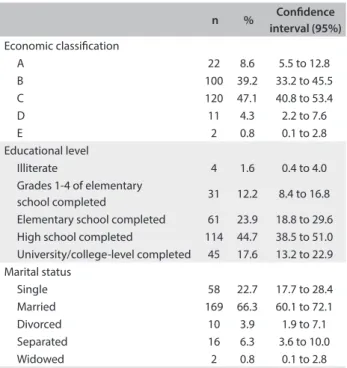
he median age and standard deviation of the participants were 32.9 and 6.21 years, respectively. he percentages of mothers with children in public and private schools were 80% (204) and 20% (51), respectively. Table 1 shows the sample characteristics.
he value of Cronbach’s alpha in the version applied in the pilot study was 0.81, and the value of the inal version of the instrument (ater semantic and cultural revision) was 0.83. he pairwise correlation coeicients for the test-retest also improved from the pilot study to the inal application of the instru-ment (in each stage with 53 items), with all values greater than 0.50. Bartlett’s test of sphericity produced a P-value < 0.001, and the Kaiser-Meyer-Olkin (KMO) measurement of sampling ade-quacy was 0.815. Both results conirmed that the data matrix could be subjected to factor analysis.
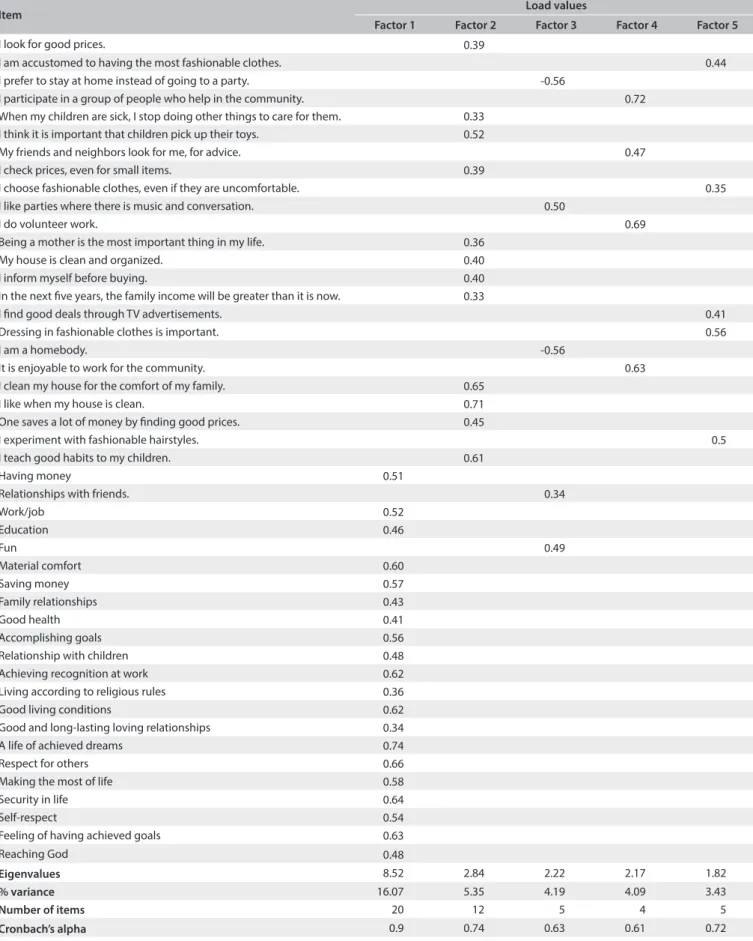
Factor analysis identiied 53 lifestyle factors. Using both cri-teria (eigenvalue > 1 and scree plot), we could maintain six fac-tors. However, the eigenvalue of the sixth factor was similar to the eigenvalue of the parallel analysis. Beyond the sixth factor, there was still a slight slope on the curve. Five factors explained 73.5% of the variance of intercorrelations. hese factors were chosen to undergo oblique rotation. Table 2 shows the load values of each item within each factor, and the eigenvalues, percentage of vari-ance and alpha coeicient of each factor.
Table 1. Sample characteristics according to the number, proportion and conidence interval of the economic classiication, education level and marital status of the mothers of preschool-age children, southeastern region of the city of São Paulo (SP), 2011
n % Conidence interval (95%)
Economic classiication
A 22 8.6 5.5 to 12.8
B 100 39.2 33.2 to 45.5 C 120 47.1 40.8 to 53.4
D 11 4.3 2.2 to 7.6
E 2 0.8 0.1 to 2.8
Educational level
Illiterate 4 1.6 0.4 to 4.0 Grades 1-4 of elementary
school completed 31 12.2 8.4 to 16.8 Elementary school completed 61 23.9 18.8 to 29.6 High school completed 114 44.7 38.5 to 51.0 University/college-level completed 45 17.6 13.2 to 22.9 Marital status
Table 2. Description of the load values of each item, eigenvalue, % variance, number and alpha value of the items for each factor, southeastern region of the city of São Paulo (SP), 2011
Item Load values
Factor 1 Factor 2 Factor 3 Factor 4 Factor 5
I look for good prices. 0.39
I am accustomed to having the most fashionable clothes. 0.44 I prefer to stay at home instead of going to a party. -0.56
I participate in a group of people who help in the community. 0.72 When my children are sick, I stop doing other things to care for them. 0.33
I think it is important that children pick up their toys. 0.52
My friends and neighbors look for me, for advice. 0.47 I check prices, even for small items. 0.39
I choose fashionable clothes, even if they are uncomfortable. 0.35 I like parties where there is music and conversation. 0.50
I do volunteer work. 0.69
Being a mother is the most important thing in my life. 0.36 My house is clean and organized. 0.40 I inform myself before buying. 0.40 In the next ive years, the family income will be greater than it is now. 0.33
I ind good deals through TV advertisements. 0.41
Dressing in fashionable clothes is important. 0.56
I am a homebody. -0.56
It is enjoyable to work for the community. 0.63 I clean my house for the comfort of my family. 0.65
I like when my house is clean. 0.71 One saves a lot of money by inding good prices. 0.45
I experiment with fashionable hairstyles. 0.5
I teach good habits to my children. 0.61
Having money 0.51
Relationships with friends. 0.34
Work/job 0.52
Education 0.46
Fun 0.49
Material comfort 0.60
Saving money 0.57
Family relationships 0.43
Good health 0.41
Accomplishing goals 0.56
Relationship with children 0.48 Achieving recognition at work 0.62 Living according to religious rules 0.36
Good living conditions 0.62
Good and long-lasting loving relationships 0.34 A life of achieved dreams 0.74
Respect for others 0.66
Making the most of life 0.58
Security in life 0.64
Self-respect 0.54
Feeling of having achieved goals 0.63
Reaching God 0.48
Eigenvalues 8.52 2.84 2.22 2.17 1.82
% variance 16.07 5.35 4.19 4.09 3.43
Number of items 20 12 5 4 5
he load values that were greater than 0.32 and less than -0.32 were selected, which resulted in elimination of seven vari-ables from the lifestyle questionnaire. Ater eliminating these items, the value of Cronbach’s alpha was 0.85.
he inal questionnaire with the names of the factors and each of the items with its response options is presented in Appendix A.
Factor 1 related to mothers whose actions and behaviors were based on values built throughout life. Factor 2 referred to moth-ers for whom the link with their homes, such as organizing the household and taking care of their children, was the most impor-tant issue. High scores in factor 3 implied that this was a person for whom leisure and pleasure were very important. Seeking fun was one of its main characteristics. Factor 4 identiied mothers who were interested in helping other people.
Last but not least, factor 5 identiied mothers who focused on fashion-related matters.
A mother with a bohemian lifestyle could also be a mother with a socially conscious lifestyle, i.e. none of these ive factors were exclusive of the others. Rather, the factors would best be used to compare mothers with higher or lower scores for each factor.
DISCUSSION
his study developed an easily administered instrument that characterized mothers into ive lifestyles according to a socio-logical paradigm. It had a randomized design in which informa-tion was collected from mothers on their health and nutriinforma-tional behaviors and risks. hese data included information on nutri-tional state, diet, morbidity, physical activity and use of health services by their preschool-age children. Analyses on the corre-lations of these outcomes with the ive lifestyles described in the present study will be presented in future articles.
he mothers’ attitudes, interests, opinions and values deter-mined which of the ive lifestyle dimensions they possessed, which then potentially inluenced the health and nutrition of their preschool-age children.
Describing lifestyle is a diicult task because of the multi-dimensionality of its makeup and because of the inherent dif-iculty of measuring a subjective phenomenon in an objective manner. Previous studies in this ield have used instruments for measuring healthy lifestyle behaviors;8 however, no studies were
found that evaluated maternal lifestyle in relation to preschool-ers by examining their mothpreschool-ers’ activities, interests, opinions and values. Marketing studies have been published that estab-lish relationships between lifestyle dimensions and eating hab-its among adults.17
he questionnaire consisted of two sections. he irst section con-tained 29 items relating to activities, interests and opinions. he sec-ond section contained 24 items on the mothers’ personal values.
In the pilot study, the value obtained for Cronbach’s alpha was within the acceptable range, thus demonstrating that the
questionnaire presented good reliability. However, the major-ity of the items in the questionnaire had a pairwise correlation coeicient in the re-test that was less than 0.5. his result may have occurred because the items used adverbs and negative words in a way that made responding diicult. In addition, the items were extensive and ambiguous, and conveyed more than one idea. Bias intrinsic to questionnaire responses made it nec-essary to change the items in the pilot study and, following revi-sion, the items moved in a direction that was diferent to what had originally been proposed. Moreover, it had to be taken into consideration that the mothers needed to remember what type of behavior they exhibited with regard to the item in question. In evaluating the item and remembering past actions, it was also necessary for mothers to estimate or infer their own behavior. Even ater addressing all of these potential problems, the mothers still could have had diiculties diferentiating between the types of responses.31
In the inal study, the internal consistency assessed by Cronbach’s alpha was lower than the value of 0.92 obtained by Kucukemiroglu in 1997.14 In that study, the questionnaire
con-tained 56 activity, interest and opinion items that were similar to those used in the questionnaire of the present study, and 532 respondents were tested. However, when the value is less than 0.7, the questionnaire most likely addresses a construct that is diferent to the one that it seeks to measure, whereas when the alpha is greater than 0.9, there is an extremely high correlation due to item redundancy.34,35 For three of the lifestyle factors, the
value of Cronbach’s alpha was less than 0.7 in the present study. he reason for this result was the small number of items in each factor, given that the alpha can be inluenced by the number of items that compose it.
he test-retest reproducibility indicated that there was sta-bility in the respondents’ lives if the irst responses were equal to or similar to those in the subsequent interview. It is impor-tant to take into consideration the time that passed between the two evaluations. In this study, the average time interval until the retest was within the recommended timeframe of 2 to 14 days.31,32 his timeframe was chosen to reduce the
possibil-ity of large changes and the possibilpossibil-ity that the instrument could produce false reliability.
he third aspect was the factorial complexity of the items. In other words, without rotation, the item possessed a load value that was similar in two factors. Finally, the item might possess an average load value, whereas it would be preferable for the value to be at one of the extremes.32
his instrument enables measurements that can be used to compare the degree of exposure to each of the factors consid-ered. Consequently, studies that use this instrument will be able to classify the participants into terciles of low, medium and high scores for each of the factors. his is not a questionnaire that classi-ies according to scores. he scoring achieved in each domain may be compared with children’s nutritional characteristics, for exam-ple. In diferent cultures, the exposure to a speciic lifestyle may imply diferent outcomes. Identiication of the ive lifestyle dimen-sions will, for example, make it possible to understand how the nutritional state, eating habits, morbidity and physical activ-ity of a child correspond to the modern or economic dimension. For example, does the fact that a mother prefers to save money cause her child to have better or worse eating habits?
he limitations of this study were that we could not proceed with criterion validation because of a lack of a reference instru-ment for activities, interests, opinions and values; and that the questionnaire, as it was applied, was intended for use with young adult women.
he present study is part of a larger one. A future paper will demonstrate the validation of the construct. Currently, mater-nal lifestyle is correlated with some behavioral patterns relating to children’s health. In this regard, maternal activities, interests, opinions and values are possible social and cultural determinants of children’s obesity and behavior disorders.
CONCLUSIONS
he questionnaire developed here is the irst instrument to describe ive lifestyle domains according to the attitudes, inter-ests, opinions and values of the mothers of preschool-age chil-dren in Brazil. he instrument content was evaluated and had good reliability as determined through Cronbach’s alpha and pairwise correlation coeicients.
he present questionnaire, “Lifestyle Activities, Interests, Opinions and Values”, is a tool that may be of great value in help-ing healthcare professionals to understand the motivations behind risky maternal behavior in relation to the health of preschoolers, thereby enabling interventions that may be more efective.
REFERENCES
1. Wilson DMC, Ciliska D. Lifestyle assessment: development and use of the FANTASTIC checklist. Can Fam Physician. 1984;30:1527-32. 2. Ciliska D, Wilson DMC. Lifestyle assessment: helping patients change
health behaviors. Can Fam Physician. 1984;30:1665-70.
3. Wilson DMC, Nielsen E, Ciliska D. Lifestyle assessment: testing the FANTASTIC instrument. Can Fam Physician. 1984;30:1863-4, 1866. 4. Sharratt JK, Sharratt MT, Smith DM, Howell MJ, Davenport L.
FANTASTIC lifestyle survey of University of Waterloo employees. Can Fam Physician. 1984;30:1869-70, 1872.
5. Simpson R, Albert W, Wilson DMC, Ciliska D, Evans CE. Lifestyle assessment: part 4. The Halton Health Promotion Survey. Can Fam Physician. 1984;30:2147-8, [2150], 2152-3, 2155.
6. Kason Y, Ylanko VJ. FANTASTIC lifestyle assessment: part 5. Measuring lifestyle in family practice. Can Fam Physician. 1984;30:2379-83. 7. Decina PA, McGregor M, Hagino C. Lifestyle analysis: a comparative
study between freshman, second and fourth year chiropractic students. J Can Chiropr Assoc. 1990;34(2):69-81.
8. Rodriguez Añez CR, Reis RS, Petroski EL. Versão brasileira do questionário “estilo de vida fantástico”: tradução e validação para adultos jovens [Brazilian version of a lifestyle questionnaire: translation and validation for young adults]. Arq Bras Cardiol. 2008;91(2):102-9. 9. Instituto Brasileiro de Geograia e Estatística. Pesquisa de Orçamentos
Familiares 2008-2009: Antropometria e estado nutricional de crianças, adolescentes e adultos no Brasil. Rio de Janeiro: Ministério do Planejamento, Orçamento e Gestão; 2010. Available from: http://www.ibge.gov.br/home/presidencia/noticias/imprensa/ ppts/0000000108.pdf. Accessed in 2014 (Jan 27).
10. Brasil. Ministério da Saúde. Centro Brasileiro de Análise e Planejamento. Pesquisa Nacional de Demograia e Saúde da Criança e da Mulher PNDS 2006: Dimensões do processo reprodutivo e da saúde da criança. Brasília: Ministério da Saúde; 2009. Available from: http://bvsms.saude.gov.br/ bvs/publicacoes/pnds_crianca_mulher.pdf. Accessed in 2014 (Jan 27). 11. Goodman A, Fleitlich-Bilyk B, Patel V, Goodman R. Child, family,
school and community risk factors for poor mental health in Brazilian schoolchildren. J Am Acad Child Adolesc Psychiatry. 2007;46(4):448-56. 12. World Health Organization. Health promotion glossary. Geneva:
World Health Organization; 1998. Available from: http://www. who.int/healthpromotion/about/HPR%20Glossary%201998.pdf. Accessed in 2014 (Jan 27).
13. Kamakura WA, Wedel M. Life-style segmentation with tailored interviewing. Journal of Marketing Research. 1995;32(3):308-17. Available from: http://www.jstor.org/discover/10.2307/3151983?uid=3737664&ui d=2&uid=4&sid=21103345172747. Accessed in 2014 (Jan 27). 14. Kucukemiroglu O. Market segmentation by using consumer lifestyle
dimensions and ethnocentrism: an empirical study. European Journal of Marketing. 1999;33(5-6):470-87. Available from: http:// iba8010kelly.alliant.wikispaces.net/ile/view/5Session3.pdf. Accessed in 2014 (Jan 27).
16. Vyncke P. Lifestyle segmentation: from attitudes, interests and opinions, to values, aesthetic styles, life visions and media preferences. European Journal of Communication. 2002;17(4):445-63. Available from: http://ejc. sagepub.com/content/17/4/445.abstract. Accessed in 2014 (Jan 27). 17. Kesic T, Piri-Rajh S. Market segmentation on the basis of food-related
lifestyles of Croatian families. British Food Journal. 2003;105(3):162-74. Available from: http://www.emeraldinsight.com/journals. htm?articleid=870683. Accessed in 2014 (Jan 27).
18. Finotti MA. Contribuições ao estudo dos estilos de vida: comportamento de compra e uso de crédito [thesis]. São Paulo: Faculdade de Economia, Administração e Contabilidade da Universidade de São Paulo; 2009. Available from: http://www.teses.usp.br/teses/disponiveis/12/12139/ tde-10092009-111233/pt-br.php. Accessed in 2014 (Jan 27).
19. Kassarjian HH. Personality and consumer behavior: a review. Journal of Marketing Research. 1971;8(4):409-18. Available from: http://www. jstor.org/discover/10.2307/3150229?uid=3737664&uid=2&uid=4&s id=21103348265767. Accessed in 2014 (Jan 27).
20. Kotler P. Administração de marketing: análise, planejamento, implementação e controle. São Paulo: Atlas; 1998.
21. Sheth JN. Comportamento do cliente: indo além do comportamento do consumidor. São Paulo: Atlas; 2001.
22. Divine RL, Lepisto L. Analysis of the healthy lifestyle consumer. Journal of Consumer Marketing. 2005;22(5):275-83. Available from: http://www.emeraldinsight.com/journals.htm?articleid=1513547. Accessed in 2014 (Jan 27).
23. São Paulo. Prefeitura de São Paulo. Secretaria Municipal da Saúde. Estimativas Populacionais. População do município de São Paulo. Prefeitura de São Paulo. Available from: http://ww2.prefeitura.sp.gov. br/cgi/tabcgi.exe?secretarias/saude/TABNET/POP/pop.def. Accessed in 2014 (Jan 27).
24. Cardoso MA. Desenvolvimento, validação e aplicações de questionários de frequência alimentar em estudos epidemiológicos. In: Kac G, Sichieri R, Gigante DP. Epidemiologia nutricional. Rio de Janeiro: Fiocruz/Atheneu; 2007. p. 201-12.
25. Associação Brasileira de Estudos Populacionais. Critério de classiicação econômica Brasil. Associação Brasileira de Estudos Populacionais; 2008. Available from: http://www.abep.org/novo/ FileGenerate.ashx?id=250. Accessed in 2014 (Jan 27).
26. Reichenheim ME, Moraes CL. Desenvolvimento de instrumentos de aferição epidemiológicos. In: Kac G, Schieri R, Gigante D. Epidemiologia nutricional. Rio de Janeiro: Fiocruz; 2007. p. 227-43. 27. Engel JF, Blackwell RD, Miniard PW. Comportamento do consumidor.
8th ed. Rio de Janeiro: Livros Técnicos e Cientíicos; 2000.
28. Wells WD, Tigert DJ. Activities, interests and opinions. Journal Advertising Research. 1971;11:27-35.
29. Ferreira AF, Laurindo IM, Rodrigues PT, et al. Brazilian version of the foot health status questionnaire (FHSQ-BR): cross-cultural adaptation and evaluation of measurement properties. Clinics (Sao Paulo). 2008;63(5):595-600.
30. Pasquali L. Princípios de elaboração de escalas psicológicas [Principles of elaboration of psychological scales]. Rev Psiquiatr Clín (São Paulo). 1998;25(5):206-13.
31. Streiner DL, Norman GR. Health measurements scales: a practical guide to their development and use. 4th ed. New York: Oxford
University Press; 2008.
32. Streiner DL, Norman, GR. Exploratory factor analysis in PDQ statistics. 3rd ed. London: BC Decker Inc.; 2003.
33. Fayers PM, Machin D. Factor analysis. In: Staquet MJ, Hays RD, Fayers PM, editors. Quality of life assessment in clinical trials. Method and practice. New York: Oxford University Press; 1998.
34. McDowell I. Measuring health: a guide to rating scales and questionnaires. New York: Oxford University Press; 2006.
35. Bracher ESB. Adaptação e validação da versão em português da escala graduada de dor crônica para o contexto cultural brasileiro [thesis]. São Paulo: Faculdade de Medicina da Universidade de São Paulo; 2008. Available from: http://www.teses.usp.br/teses/ disponiveis/5/5137/tde-12022009-134520/pt-br.php. Accessed in 2014 (Jan 27).
A Portuguese-language summary of this article was introduced in the form of a poster at the 8th Brazilian Congress of Epidemiology, at
Anhembi, São Paulo, on November 15, 2011.
Acknowledgements: We are grateful to Coordenação de
Aperfeiçoamento de Pessoal de Nível Superior (CAPES) for the master’s fellowship; to Prof. Dr. Celso Cláudio de Hildebrand Grisi and Prof. Dr. Angélica Riello for their contributions towards the development of the questionnaire; and to the ield researchers Gisele Cristina Dias, Natália Lemus Duarte Corrêa, Paula de Almeida Silva and Danilo Blanco for collecting the data
Sources of funding: Children’s Health Reference Center, Instituto da Criança, Hospital das Clínicas, Faculdade de Medicina da Universidade de São Paulo (HC-FMUSP)
Conlict of interest: None
Date of irst submission: May 29, 2013
Last received: March 25, 2013
Accepted: March 31, 2014
Address for correspondence: Erica Bezerra Nobre
Av. Enéas Carvalho de Aguiar, 647 Cerqueira César — São Paulo (SP) — Brasil CEP 05403-000
Appendix A. Questionário de estilo de vida atividades, interesses, opiniões e valores (Questionnaire on lifestyle activities, interests, opinions and values)
Para o domínio “valores pessoais”, informe o grau de importância que você atribui a alguns aspectos de sua vida. Para os demais domínios, responda às airmações usando as seguintes categorias de resposta: discordo totalmente, discordo, não concordo e nem discordo, concordo e concordo totalmente.
Estilo de vida Item Opções de resposta
Valores pessoais
Ter saúde. Nada
importante Pouco importante Importante Muito importante Totalmente importante
Ter estudo. Nada
importante Pouco importante Importante Muito importante Totalmente importante Trabalho/emprego. Nada
importante Pouco importante Importante Muito importante Totalmente importante Ser reconhecido no trabalho. Nada
importante Pouco importante Importante Muito importante Totalmente importante Ter dinheiro. Nada
importante Pouco importante Importante Muito importante Totalmente importante Guardar dinheiro. Nada
importante Pouco importante Importante Muito importante Totalmente importante Conforto material. Nada
importante Pouco importante Importante Muito importante Totalmente importante Uma boa condição de vida. Nada
importante Pouco importante Importante Muito importante Totalmente importante Realização dos sonhos. Nada
importante Pouco importante Importante Muito importante Totalmente importante Uma vida de sonhos realizados. Nada
importante Pouco importante Importante Muito importante Totalmente importante Sentimento de ter alcançado o que desejei. Nada
importante Pouco importante Importante Muito importante Totalmente importante Aproveitar a vida. Nada
importante Pouco importante Importante Muito importante Totalmente importante Relacionamento familiar. Nada
importante Pouco importante Importante Muito importante Totalmente importante Relacionamento com os ilhos. Nada
importante Pouco importante Importante Muito importante Totalmente importante Relacionamentos amorosos bons e duradouros. Nada
importante Pouco importante Importante Muito importante Totalmente importante Ter respeito a mim mesmo. Nada
importante Pouco importante Importante Muito importante Totalmente importante Ter o respeito das pessoas. Nada
importante Pouco importante Importante Muito importante Totalmente importante Segurança para viver. Nada
importante Pouco importante Importante Muito importante Totalmente importante Viver de acordo com as regras religiosas. Nada
importante Pouco importante Importante Muito importante Totalmente importante Chegar a Deus. Nada
importante Pouco importante Importante Muito importante Totalmente importante Vida familiar
Ser mãe é a coisa mais importante da minha vida.
Discordo
totalmente Discordo
Não concordo
e nem discordo Concordo
Concordo totalmente Quando meus ilhos icam doentes, deixo
de fazer algumas coisas para cuidar deles.
Discordo
totalmente Discordo
Não concordo
e nem discordo Concordo
Concordo totalmente Ensino bons hábitos aos meus ilhos. Discordo
totalmente Discordo
Não concordo
e nem discordo Concordo
Concordo totalmente
Para o domínio “valores pessoais”, informe o grau de importância que você atribui a alguns aspectos de sua vida. Para os demais domínios, responda às airmações usando as seguintes categorias de resposta: discordo totalmente, discordo, não concordo e nem discordo, concordo e concordo totalmente.
Estilo de vida Item Opções de resposta
Vida familiar
Acho importante as crianças arrumarem os brinquedos.
Discordo
totalmente Discordo
Não concordo
e nem discordo Concordo
Concordo totalmente Arrumo a minha casa para o conforto da família. Discordo
totalmente Discordo
Não concordo
e nem discordo Concordo
Concordo totalmente Gosto quando minha casa está limpa. Discordo
totalmente Discordo
Não concordo
e nem discordo Concordo
Concordo totalmente Minha casa é limpa e arrumada. Discordo
totalmente Discordo
Não concordo
e nem discordo Concordo
Concordo totalmente Procuro por bons preços. Discordo
totalmente Discordo
Não concordo
e nem discordo Concordo
Concordo totalmente Me informo antes de comprar. Discordo
totalmente Discordo
Não concordo
e nem discordo Concordo
Concordo totalmente Eu veriico preços mesmo para itens pequenos.Discordo
totalmente Discordo
Não concordo
e nem discordo Concordo
Concordo totalmente Daqui a cinco anos o salário da família será
maior do que agora.
Discordo
totalmente Discordo
Não concordo
e nem discordo Concordo
Concordo totalmente Uma pessoa economiza um bom dinheiro
procurando bons preços.
Discordo
totalmente Discordo
Não concordo
e nem discordo Concordo
Concordo totalmente
Boêmio
Sou uma pessoa caseira. Discordo
totalmente Discordo
Não concordo
e nem discordo Concordo
Concordo totalmente Preiro icar em casa em vez de ir a festas. Discordo
totalmente Discordo
Não concordo
e nem discordo Concordo
Concordo totalmente Gosto de festas onde há música e conversa. Discordo
totalmente Discordo
Não concordo
e nem discordo Concordo
Concordo totalmente Divertimento. Nada importante Pouco importante Importante Muito importante Totalmente importante Relacionamento com os amigos. Nada
importante Pouco importante Importante Muito importante Totalmente importante Consciente socialmente
Faço trabalho voluntário. Discordo
totalmente Discordo
Não concordo
e nem discordo Concordo
Concordo totalmente É gostoso trabalhar para a comunidade. Discordo
totalmente Discordo
Não concordo
e nem discordo Concordo
Concordo totalmente Participo de um grupo de pessoas que ajuda
a comunidade.
Discordo
totalmente Discordo
Não concordo
e nem discordo Concordo
Concordo totalmente Meus amigos e vizinhos me procuram para
que eu os aconselhe.
Discordo
totalmente Discordo
Não concordo
e nem discordo Concordo
Concordo totalmente
Moderno
Vestir roupas da moda é importante. Discordo
totalmente Discordo
Não concordo
e nem discordo Concordo
Concordo totalmente Costumo ter uma ou mais roupas da moda. Discordo
totalmente Discordo
Não concordo
e nem discordo Concordo
Concordo totalmente Escolho roupas da moda mesmo sendo
desconfortáveis.
Discordo
totalmente Discordo
Não concordo
e nem discordo Concordo
Concordo totalmente Encontro bons preços nas propagandas de TV. Discordo
totalmente Discordo
Não concordo
e nem discordo Concordo
Concordo totalmente Experimento os cortes de cabelo da moda. Discordo
totalmente Discordo
Não concordo
e nem discordo Concordo
Concordo totalmente