A psychotic experience during adolescence: reasoning
about diferential diagnosis. Case report
Vítor Ferreira Leite
I, Carla Andrade Araújo
IPediatric Psychiatry Service, Coimbra Pediatric Hospital, Centro Hospitalar e Universitário de Coimbra, Coimbra, Portugal
ABSTRACT
CONTEXT: The aim of the present clinical review was to illustrate the diagnostic diiculty associated with psychotic experiences during adolescence, in the light of the multiplicity of circumstances interplaying during this period. It was also intended to illustrate the observation that not all hallucinations occur in the context of a declared psychotic disorder.
CASE REPORT: The patient was a 16-year-old adolescent girl who came to the Emergency Department of Coimbra Pediatric Hospital. On admission, she displayed mood and sensory perception disorders, with a bizarre gait abnormality. A diagnosis of conversion disorder was inally suggested, in accordance with the International Classiication of Diseases, 10th edition.
CONCLUSIONS: Conversive hallucinations are rare in the psychiatric literature. This diagnostic hypothesis only gained consistency over a long period of follow-up within a child and adolescent psychiatry outpa-tient service, which was fundamental for appropriate diagnostic clariication. The authors discuss psychotic experiences that can arise from a neurotic setting and share the reasoning that was constructed in relation to the diferential diagnosis. The psychogenesis and phenomenology of this young patient’s conversive hallucinations and the therapeutic strategies adopted over the course of the follow-up are also discussed.
IMedical Doctor, Master and Senior Resident
of Child and Adolescent Psychiatry, Pediatric Psychiatry Service, Coimbra Pediatric Hospital, Centro Hospitalar e Universitário de Coimbra, Coimbra, Portugal.
KEY WORDS:
Psychotic disorders. Conversion disorder. Schizophrenia. Hallucination. Child psychiatry. Adolescent psychiatry.
INTRODUCTION
Since there is no consensus regarding the deinition of psychosis, one can try to deine it, in gen-eral terms, as a disturbance of thought and sensory perception that negatively afects behavior and overall functioning.1 Psychotic symptoms arise from diferent disorders and etiologies, as nonspeciic phenomena.2-4 he most pervasive of these are perhaps delusions, hallucinations, disorganization of thought, speech and behavior, and negative symptoms (blunted afect, alogia and avolition).1-3 Minor psychotic symptoms are reported relatively oten in the general popula-tion without, however, meeting the criteria for a clinical diagnosis of psychosis.5 he most com-monly described prodromal manifestations of a irst psychotic episode are reduced attention and concentration, anergy, decreased will and motivation, depressed mood, sleep disturbances, anxiety, social withdrawal, distrust, irritability and deterioration of the ability to function.6-8
Studies conducted among adolescents have found that the prevalence of “psychotic experi-ences” in this age group is between 17 and 18%.1 hese are frequently associated with states of emotional disturbances (mood or anxiety disorders) and it has been stated that in 90% of these cases, no declared psychotic disorder is developed.5,9 Psychotic experiences reported by young people are rarely interpreted as isolated and declared psychoses: in actual fact, they may throw light on the existence of neurotic psychopathology. Rigor in assessing the mental state and invest-ment in a substantiated history obtained from diferent people and diverse sources of information, along with due respect for the potential of “adolescence” as a process of transition and matura-tion, appear to be of utmost importance.
Characteristically, adolescence is a period of profound change, and is thus a prime age for the onset of mental, emotional and relational disorders. During its development, the symptoms that occur leave room for doubt as to whether they refer to preclinical and prodromal signs of an existing psychotic illness or are simply physiological signs of puberty. Moments of discontinuity and rupture, emotional instability, identity crisis and intergenerational conlict are all part of normative adolescence.
CASE REPORT | Leite VF, Araújo CA
Success in mood regulation becomes easier within a context of ade-quate social development that is guided by proiciency in adaptive management of disruptive situations in everyday life.
Psychopathology results from diiculties in relation to adaptive mediation of stressor circumstances, thereby inhibiting or limiting the normative development process. Symptoms may be associated with psychological conlicts within development, that are norma-tive and transient, and/or reacnorma-tive to certain situations (separa-tion from parents, change of school, birth of a sibling, response to aggression or other traumatic events, diiculties in academic activities, diiculties in interpersonal relationships, diiculties in dealing with frustrations or in regulating emotions, etc.), and which have a dynamic and interactive component that does not appear serious and is oten observed during growth.
Along this line of reasoning, two major diiculties should arise immediately in the mind of a child psychiatrist: distinguish-ing what is pathological from what is normative; and establishdistinguish-ing a diagnosis when justiied.
he aim of the present clinical review was to illustrate the diagnostic diiculty associated with psychotic experiences during adolescence. It was also intended to illustrate the observation that not all hallucinations occur in the context of a declared psychotic disorder. he authors describe their thoughts on psychotic experi-ences that can arise from a neurotic setting, and share the reason-ing that was constructed in relation to the diferential diagnosis.
CASE REPORT
he patient was a 16-year-old adolescent girl in 10th grade when she presented to the Emergency Department of Coimbra Pediatric Hospital (in 2013), accompanied by her father. She did not have any relevant medical history, but the death of her mother in 2010 (as a victim of breast cancer) was cited as the greatest trauma of her childhood, a circumstance that she was having diiculties in coping with.
On admission, she displayed disturbances of mood and sensory perception, concurrently with a bizarre gait abnormality. She was assessed within the neurology and pediatrics sectors, and organic pathological conditions were ruled out through analytical evalu-ations, electroencephalogram (EEG) and computed tomography (CT) scans. Observation within the child and adolescent psychia-try sector was then requested.
From the irst observation, high levels of vegetative anxiety stood out, along with depressive mood, high levels of expressed emotion, thoughts dominated by intrusive images from the day of her mother’s funeral, changes in sensory perception (egosyn-tonic visual hallucinations) and behavior dominated by traits of perfectionism and obsessiveness. Her father mentioned that she was under a great deal of stress in the light of her upcoming school evaluations. No psychiatric family history was identiied. A diag-nosis of afective psychosis was considered, in accordance with the
International Classiication of Diseases, 10th edition10 (ICD-10), and she was medicated with a low dose of an antipsychotic drug.
Ater about 15 asymptomatic days, the patient presented again to the Child Psychiatry Service with allopsychic disorientation, psychomotor agitation, disorganized speech broken by irrational laughter that was inconsistent with the mood, disorganized think-ing, abnormalities of thought control and content, and bizarre egosyntonic visual hallucinations. A drug test on urine that was requested proved benign. Ater emergency administration of an antipsychotic drug, followed by short hospitalization for reassess-ment, a new evaluation of the patient’s mental state was made. She was found to be cognizant, cooperative and focused. Contact was reserved and she showed hypomimia. Her emotions were consistent with mild depression and blunted afect. She did not continue to show abnormalities of thought and sensory percep-tion. Her condition was relatively similar to her previous state and she had no memory of the episode. At this stage, a diagnosis of psychotic disorder with symptoms of schizophrenia was made, in accordance with ICD-10. It was concluded from the assess-ment that she should be monitored long-term. Her antipsychotic medication was then adjusted, accordingly.
he improvement seen in subsequent consultations was believed to be a response to medication. However, her father conided that the irst day of medication coincided with attendance at a spiri-tual center. Her father was understandably wondering about what was having greater impact: the medication or the spiritual center. However, because they were committed to the therapeutic process, they suspended their visits to the spiritual center.
Over the course of the follow-up her father also conided hav-ing met a lady for whom he had nurtured special feelhav-ings, prior to the onset of the clinical picture. his matter was addressed in conversations with the patient, and she reported having distrusted and disliked this relationship, because she considered that it was disrespectful to her mother’s memory.
During the treatment process, she was helped to diversify her range of strategies, and to identify and verbalize her concerns, through more adaptive management and regulation of her emo-tions. Structured cognitive-behavioral psychotherapy was used for an intervention regarding her traits of perfectionism and obses-siveness. Long-term observation (for about two years) of this ado-lescent showed favorable progression, with gradual reduction of antipsychotic medication. he antidepressant therapy was main-tained, accompanied by individual and family psychotherapy. While reducing the antipsychotic medication, use of selective serotonin reuptake inhibitor (SSRI) antidepressants was gradually started and this was maintained for about a year.
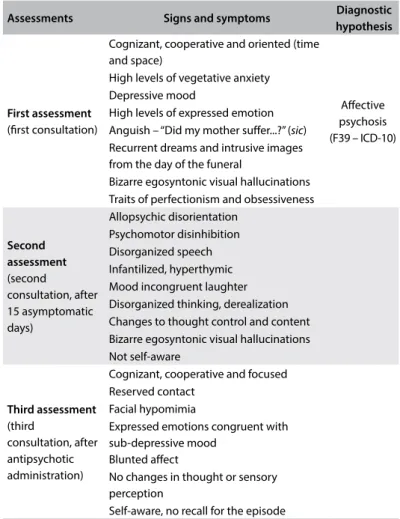
or sensory perception were identiied. She displayed a more devel-oped range of coping strategies, in particular regarding manage-ment of emotions relating to her mother. here remained traces of anxious, perfectionist and hypercritical behavior, but it had clearly improved. A diagnosis of conversion disorder was suggested, in accordance with ICD-10, which gained consistency over a long-term period of monitoring. he diferent mental state assessments conducted can be seen in Table 1.
DISCUSSION
In the present case, diferential diagnoses were made between afective psychosis (F39; ICD-10), psychotic disorder with schizophrenic symptoms (F23.1; ICD-10) and conversion disor-der (F44; ICD-10).
According to the ICD-10, the fundamental disturbance in afec-tive disorders is a change in mood or behavior, usually towards depression (with or without associated anxiety) or towards ela-tion. his change in mood is usually accompanied by a change in overall functioning and most of the accompanying symptoms are secondary or easily framed within the context of such changes. Afective psychosis falls within this context.
Around 15 days ater the patient’s initial presentation, a diag-nosis of psychotic disorder with symptoms of schizophrenia was suggested. According to the ICD-10, this is an acute psychotic dis-order in which hallucinations, delusions and disdis-orders are obvi-ous, but are markedly variable, changing from day to day or even from hour to hour. Emotional turmoil with intense transient feel-ings of joy and ecstasy, or anxiety and irritability, are oten pres-ent. Despite psychotic and emotional symptoms, there are no cri-teria for manic, depressive or schizophrenic episodes. Long-term observation (more than one month) is decisive.
Dissociative disorders (conversion) all involve an apparent loss that is either complete or forms part of the normal integra-tion between memories of the past, awareness of identity and immediate sensations and control of body movements. They are presumed to be psychogenic in origin and are temporally associated with traumatic, unresolved or intolerable events, or disturbed relationships. The term “conversion” implies that there is an unpleasant effect that is engendered by the problems and conflicts that the individual cannot solve and is somehow manifested with these symptoms. These tend to be limited in time, unless they result from unresolvable problems or severe interpersonal difficulties. With regard to pathophysiology, con-version symptoms are due to unconscious repression of emo-tional conflicts, but there is a danger of misdiagnosis without a thorough medical workup.11
On admission, our patient displayed disturbance of mood and sensory perception, concurrently with a bizarre gait abnor-mality. She was assessed within the neurology and pediatrics sectors, and organic pathological conditions were ruled out.
In the literature, conversion disorder is considered to be a relatively rare cause of walking disability. Thus, a few cases presenting alteration of gait in the context of conversion have been described.12-15 Conversion disorder has been found to be the third largest underlying psychological cause of psycho-genic motor disorder after depression and anxiety. However, detailed descriptions of hallucinations as a conversion symp-tom are even rarer in the psychiatric literature. We found only a few case reports in the literature, mostly from the middle to final decades of the twentieth century.16-24 In 1982, Rack cited a case of hysterical hallucination and commented that among Asian women, especially teenagers, the commonest cause of hallucinations is hysteria and not schizophrenia.25 These cases shared the circumstance of involving female patients, either adolescents or young adults.
In our case, different situations of conflict were identified and managed. Therapeutic interventions were successful and the patient has recovered. Long-term observation revealed an improved state with better emotional management and a broader range of coping strategies. Remission was achieved through behavioral and psychotherapy, while antipsychotics were gradually suspended.
Table 1. Mental state assessments
Assessments Signs and symptoms Diagnostic hypothesis
First assessment
(irst consultation)
Cognizant, cooperative and oriented (time and space)
Afective psychosis (F39 – ICD-10) High levels of vegetative anxiety
Depressive mood
High levels of expressed emotion
Anguish – “Did my mother sufer...?” (sic)
Recurrent dreams and intrusive images from the day of the funeral
Bizarre egosyntonic visual hallucinations Traits of perfectionism and obsessiveness
Second assessment
(second
consultation, after 15 asymptomatic days)
Allopsychic disorientation Psychomotor disinhibition Disorganized speech Infantilized, hyperthymic Mood incongruent laughter Disorganized thinking, derealization Changes to thought control and content Bizarre egosyntonic visual hallucinations Not self-aware
Third assessment
(third
consultation, after antipsychotic administration)
Cognizant, cooperative and focused Reserved contact
Facial hypomimia
Expressed emotions congruent with sub-depressive mood
Blunted afect
No changes in thought or sensory perception
CASE REPORT | Leite VF, Araújo CA
The patient’s condition was not considered to be part of an organically-based psychotic process. She will probably require long-term psychotherapy focusing on helping her to gain insight regarding her problems and hopefully making per-manent changes for the better in both her symptoms and her personality structure.
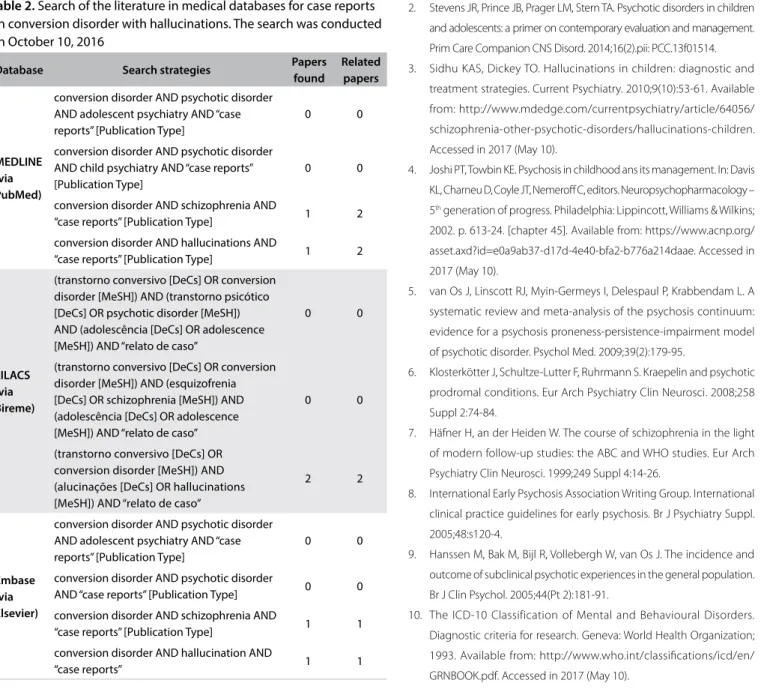
We reviewed the literature in MEDLINE, Embase and LILACS using the English keywords “conversion disorder”, “psychotic dis-order”, “schizophrenia”, “hallucinations”, “adolescent psychiatry” and “child psychiatry”, and the Portuguese keywords “transtorno conversivo”, “transtorno psicótico”, “esquizofrenia”, “alucinações”, “psiquiatria infantil” and “psiquiatria do adolescente”. he results are presented in Table 2. We only found a few reports, mostly from the middle to inal decades of the 20th century.
CONCLUSIONS
Conversion disorder is considered to be a relatively rare cause of walking disability, in the literature available. However, detailed descriptions of hallucinations as a conversion symptom are even rarer, with few case reports in the literature. Our diagnos-tic hypothesis only gained consistency over a long-term follow-up period within the context of our child and adolescent psychiatry outpatient service, which was fundamental for appropriate diag-nostic clariication. It is also important to emphasize that there is a need for rigorous evaluation of the patient’s mental state and investment in substantiated histories provided by diferent people and from various information sources.
REFERENCES
1. Monteiro P. Psicologia e psiquiatria da infância e da adolescência.
Lisboa: Lidel; 2014.
2. Stevens JR, Prince JB, Prager LM, Stern TA. Psychotic disorders in children
and adolescents: a primer on contemporary evaluation and management.
Prim Care Companion CNS Disord. 2014;16(2).pii: PCC.13f01514.
3. Sidhu KAS, Dickey TO. Hallucinations in children: diagnostic and
treatment strategies. Current Psychiatry. 2010;9(10):53-61. Available
from: http://www.mdedge.com/currentpsychiatry/article/64056/
schizophrenia-other-psychotic-disorders/hallucinations-children.
Accessed in 2017 (May 10).
4. Joshi PT, Towbin KE. Psychosis in childhood ans its management. In: Davis
KL, Charneu D, Coyle JT, Nemerof C, editors. Neuropsychopharmacology –
5th generation of progress. Philadelphia: Lippincott, Williams & Wilkins;
2002. p. 613-24. [chapter 45]. Available from: https://www.acnp.org/
asset.axd?id=e0a9ab37-d17d-4e40-bfa2-b776a214daae. Accessed in
2017 (May 10).
5. van Os J, Linscott RJ, Myin-Germeys I, Delespaul P, Krabbendam L. A
systematic review and meta-analysis of the psychosis continuum:
evidence for a psychosis proneness-persistence-impairment model
of psychotic disorder. Psychol Med. 2009;39(2):179-95.
6. Klosterkötter J, Schultze-Lutter F, Ruhrmann S. Kraepelin and psychotic
prodromal conditions. Eur Arch Psychiatry Clin Neurosci. 2008;258
Suppl 2:74-84.
7. Häfner H, an der Heiden W. The course of schizophrenia in the light
of modern follow-up studies: the ABC and WHO studies. Eur Arch
Psychiatry Clin Neurosci. 1999;249 Suppl 4:14-26.
8. International Early Psychosis Association Writing Group. International
clinical practice guidelines for early psychosis. Br J Psychiatry Suppl.
2005;48:s120-4.
9. Hanssen M, Bak M, Bijl R, Vollebergh W, van Os J. The incidence and
outcome of subclinical psychotic experiences in the general population.
Br J Clin Psychol. 2005;44(Pt 2):181-91.
10. The ICD-10 Classification of Mental and Behavioural Disorders.
Diagnostic criteria for research. Geneva: World Health Organization;
1993. Available from: http://www.who.int/classiications/icd/en/
GRNBOOK.pdf. Accessed in 2017 (May 10).
Table 2. Search of the literature in medical databases for case reports on conversion disorder with hallucinations. The search was conducted on October 10, 2016
Database Search strategies Papers
found
Related papers
MEDLINE (via PubMed)
conversion disorder AND psychotic disorder AND adolescent psychiatry AND “case reports” [Publication Type]
0 0
conversion disorder AND psychotic disorder AND child psychiatry AND “case reports” [Publication Type]
0 0
conversion disorder AND schizophrenia AND
“case reports” [Publication Type] 1 2
conversion disorder AND hallucinations AND
“case reports” [Publication Type] 1 2
LILACS (via Bireme)
(transtorno conversivo [DeCs] OR conversion disorder [MeSH]) AND (transtorno psicótico [DeCs] OR psychotic disorder [MeSH]) AND (adolescência [DeCs] OR adolescence [MeSH]) AND “relato de caso”
0 0
(transtorno conversivo [DeCs] OR conversion disorder [MeSH]) AND (esquizofrenia [DeCs] OR schizophrenia [MeSH]) AND (adolescência [DeCs] OR adolescence [MeSH]) AND “relato de caso”
0 0
(transtorno conversivo [DeCs] OR conversion disorder [MeSH]) AND (alucinações [DeCs] OR hallucinations [MeSH]) AND “relato de caso”
2 2
Embase (via Elsevier)
conversion disorder AND psychotic disorder AND adolescent psychiatry AND “case reports” [Publication Type]
0 0
conversion disorder AND psychotic disorder
AND “case reports” [Publication Type] 0 0
conversion disorder AND schizophrenia AND
“case reports” [Publication Type] 1 1
conversion disorder AND hallucination AND
“case reports” 1 1
11. Kozlowska K. The developmental origins of conversion disorders. Clin
Child Psychol Psychiatry. 2007;12(4):487-510.
12. Fahn S, Williams DT. Psychogenic dystonia. Adv Neurol. 1988;50:431-55.
13. Grattan-Smith P, Fairley M, Procopis P. Clinical features of conversion
disorder. Arch Dis Child. 1988;63(4):408-14.
14. Quane T, Chambers CV, Snyderman D. Conversion disorder presenting
as gait disturbance in an adolescent. Arch Fam Med. 1995;4(9):805-7.
15. Balkuv E, Basaran R, Caliskan M. Gait disturbance as conversion
reaction accompanying anorexia nervosa in a young adult: a case
report and literature review. Journal of Scientiic Research & Reports.
2014;3(4):583-91. Article no. JSRR.2014.005. Available from: http://
www.journalrepository.org/media/journals/JSRR_22/2013/Dec/
Balkuv342013JSRR6783_1.pdf. Accessed in 2017 (May 10).
16. Levinson H. Auditory hallucinations in a case of hysteria. Br J Psychiatry.
1966;112(482):19-26.
17. Farley J, Woodruf RA Jr, Guze SB. The prevalence of hysteria and
conversion symptoms. Br J Psychiatry. 1968;114(514):1121-5.
18. Goodwin DW, Alderson P, Rosenthal R. Clinical significance of
hallucinations in psychiatric disorders. A study of 116 hallucinatory
patients. Arch Gen Psychiatry. 1971;24(1):76-80.
19. Modai I, Sirota P, Cygielman G, Wijsenbeek H. Conversive hallucinations.
J Nerv Ment Dis. 1980;168(9):564-5.
20. Andrade C, Srinath S. True auditory hallucinations as a conversion
symptom. Br J Psychiatry. 1986;148:100-2.
21. Sirota P, Spivac B, Meshulam B. Conversive hallucinations. Br J Psychiatry.
1987;151:844-6.
22. Kasckow J, Maltbie A. Conversion hallucinations in a patient with
pseudohypoparathyroidism. Jeferson Journal of Psychiatry. 1989;7(2).
Article 6. Available from: http://jdc.jeferson.edu/jejpsychiatry/vol7/
iss2/6/. Accessed in 2017 (May 10).
23. Zain AM. True hallucination as conversion symptom--a case report.
Med J Malaysia. 1990;45(l):74-7.
24. Spivak B, Livnat E, Weizman A, Rabinowitz S, Mark M. True conversive
hallucinations. Psychopathology. 1991;24(1):19-24.
25. Rack P. Race, Culture and Mental Disorder. London and New York:
Tavistock Publications; 1982.
Sources of funding: None
Conlict of interest: None
Date of irst submission: November 21, 2016
Last received: March 20, 2017
Accepted: March 24, 2017
Address for correspondence:
Vítor Ferreira Leite
Rua da Imaculada Conceição, 119
Fafe, Portugal 4820-190
Tel. +351 911116080