Débora G AmorimI
Taghreed AdamII
João J F AmaralI
Eleanor GouwsIII
Jennifer BryceIV
Cesar G VictoraV
I Núcleo de Ensino, Assistência e Pesquisa da Infância Cesar Victora. Universidade Federal do Ceará. Fortaleza, CE, Brazil
II World Health Organization. Geneva, Switzerland
III Joint United Nations Programme on HIV/ AIDS. Geneva, Switzerland
IV Johns Hopkins University. Baltimore, USA V Universidade Federal de Pelotas. Pelotas,
RS, Brazil
Correspondência | Correspondence: Débora G Amorim
NEAPI/FAMED/UFC
R. Papi Júnior 1225 - Rodolfo Teófi lo 60431970 Fortaleza, CE, Brazil Telefone/fax: +55 85 32246105; E-mail: [email protected] Received: 6/1/2007
Approved: 12/3/2007
Integrated Management of
Childhood Illness: effi ciency
of primary health in Northeast
Brazil
Atenção integrada às doenças
prevalentes da infância: efi ciência
na atenção primária de saúde no
Nordeste
ABSTRACT
OBJECTIVE: The Integrated Management of Childhood Illness is a strategy designed to address major causes of child mortality. The aim of this study was to assess the impact of the strategy on the quality of child health care provided at primary facilities.
METHODS: Child health quality of care and costs were compared in four states in Northeastern Brazil, in 2001. There were studied 48 health facilities considered to have had stable strategy implementation at least two years before the start of study, with 48 matched comparison facilities in the same states. A single measure of correct management of sick children was used to assess care provided to all sick children. Costs included all resources at the national, state, local and facility levels associated with child health care.
RESULTS: Facilities providing strategy-based care had signifi cantly better management of sick children at no additional cost to municipalities relative to the comparison municipalities. At strategy facilities 72% of children were correctly managed compared with 56% in comparison facilities (p=0.001). The cost per child managed correctly was US$13.20 versus US$21.05 in the strategy and comparison municipalities, respectively, after standardization for population size.
CONCLUSIONS: The strategy improves the effi ciency of primary facilities in Northeastern Brazil. It leads to better health outcomes at no extra cost.
In September 2005, fi ve years after signing the United Nations Millennium Declaration, heads of states reunited to review progress towards achieving the Millennium Development Goals (MDGs). Three of the eight MDGs are exclusive to health, one of which is entirely focused on child survival, with the aim of eliminating two thirds of child mortality by 2015.14 Ex-cept for very few notable examples, progress towards the child survival MDG has generally been disappoint-ing, especially in sub-Saharan Africa.14 Many factors have contributed to this, but a common factor to all countries was lack of resources. In most settings there is also a potential for achieving more with the available resources, by reducing waste and by changing the mix of activities being undertaken. Many societies continue to provide or purchase high-cost, relatively ineffective health interventions or services, while low-cost, highly effective interventions are not fully implemented. Fac-tors other than effi ciency infl uence the mix of health activities chosen, including patient preferences and
RESUMO
OBJETIVO: A atenção integrada às doenças prevalentes da infância é uma estratégia desenvolvida para contribuir na redução das principais causas de mortalidade infantil. O objetivo do estudo foi avaliar o impacto da estratégia sobre a saúde infantil.
MÉTODOS: Compararam-se a qualidade do atendimento à saúde infantil e os custos associados em quatro estados da região Nordeste do Brasil, em 2001. Foram estudadas 48 unidades de saúde onde havia implementação estável da estratégia por pelo menos dois anos antes do início do estudo e 48 unidades sem (controle) nos mesmos estados. O percentual de crianças doentes atendidas corretamente foi utilizado para avaliar a qualidade da atenção oferecida a crianças doentes. O custo total da atenção à saúde infantil foi avaliado a partir de dados coletados nos níveis nacional, estadual, municipal e de unidade de saúde.
RESULTADOS: As unidades que adotam a estratégia obtiveram desempenho signifi cantemente melhor no atendimento de crianças doentes, sem custos adicionais em relação aos municípios sem. Nas unidades com a estratégia, 72% das crianças avaliadas foram atendidas corretamente, comparado com 56% nas unidades controle. O custo por criança atendida corretamente foi de US$13.20 versus US$21.05 nos municípios com e sem a estratégia respectivamente, após os ajustes para o tamanho das populações municipais.
CONCLUSÕES: A estratégia melhorou a efi ciência das unidades de atenção primária de saúde da região estudada. Em unidades de atenção primária com a estratégia, a qualidade do tratamento foi melhor, sem aumento de custos.
DESCRITORES: Bem-Estar da Criança. Assistência Integral à Saúde. Custos de Cuidados de Saúde. Serviços de Saúde da Criança, organização e administração. Qualidade da Assistência à Saúde.
INTRODUCTION
equity considerations. However, without information on costs and health impact of alternative strategies to reduce child mortality, policymakers operate in an information vacuum and are unable to determine whether they are advancing as rapidly as possible towards their objectives.
skills, the IMCI strategy also aims at strengthening health care systems support and family practices related to child health.
IMCI has now been implemented in more than 100 low- and middle-income countries, although the scale of its implementation varies widely.5,7 In 1996, the IMCI strategy was identifi ed as a priority in child health care policies of Brazil’s Ministry of Health, with emphasis on primary care.
Consequently, IMCI guidelines have been adapted to the national and sub-national epidemiological condi-tions. IMCI implementation began in 1997 in several Brazilian states, in the Northeast (States of Ceará, Pernambuco, Paraíba and Sergipe) and North (State of Pará) regions. By 2002 all states had begun to imple-ment IMCI as part of the Family Health Program (FHP), supported by the World Bank and the Brazilian Ministry of Health. However, since 2003, IMCI training has been greatly reduced, while the Ministry of Health’s Child Health Care Team has redefi ned its priorities. No evidence on costs and health impact of IMCI rela-tive to routine case management has been available to support the decision of discontinuing IMCI training. It is now opportune and important to make this informa-tion available to assist policymakers in achieving both national and international health targets.
The present study is part of the Multi-Country Evalu-ation of IMCI, with the overall objective to assess the effectiveness, cost and impact of IMCI by comparing routine health care provided to sick under-fi ve children in primary health facilities based on IMCI. The evalu-ation includes four other countries: Bangladesh, Peru, Tanzania and Uganda.8 Observation-based surveys of health care received by children and guidance of their caregivers in primary care facilities in Bangladesh,4 Brazil,3 Tanzania6 and Uganda12 have all reported sig-nifi cant improvements in the quality of care received by children in settings where providers have been trained in IMCI case management.11 Moreover, in Tanzania, IMCI was shown not to incur in higher costs relative to routine care.11 The present study aimed at assessing the impact of the IMCI strategy on the quality of child health care provided at primary facilities.
METHODS
The Brazil Multi-Country Evaluation study has a mixed retrospective-prospective design, since IMCI had al-ready been well implemented in many municipalities at the time of the study. The study compares munici-palities with stable implementation from 1999–2002 in four Brazilian states (Bahia, Ceará, Paraíba and Pernambuco) with matched comparison municipalities without IMCI implementation in the same states. The
study was restricted to municipalities with a population size between 5,000 and 50,000 inhabitants. In addition, IMCI intervention municipalities were required to have continued and appropriate coverage of health provid-ers who managed children and were trained in IMCI over the previous two calendar years (60% or more of health providers trained in IMCI). All municipalities meeting these criteria within each of the four states were included in the evaluation and matched to com-parison municipalities based on geographic region and population size. The fi nal sample included eight IMCI and eight comparison municipalities each in the States of Paraíba and Pernambuco, seven IMCI and seven comparison municipalities in Ceará, and fi ve IMCI and seven comparison municipalities in Bahia. To compen-sate for the different number of municipalities in each state, the number of facilities sampled was fi xed at 12 with IMCI and 12 without IMCI in each state.
Data on the quality of case management were collected in 2002 using a health facility survey protocol designed for the Multi-Country Evaluation, measuring best pe-diatric practice. Teams of trained evaluators spent one full day at each facility, where they observed the case management of ill children; each child was then re-ex-amined by a ”gold standard” evaluator. Tasks assessed covered all measurable elements of the guidelines, including assessment, classifi cation and treatment of the sick child, guidance and communication of the child’s caretaker about how to continue care at home and when to return to the facility. Further details on the survey methods and results are available elsewhere.3
Four standard Multi-Country Evaluation question-naires adapted and translated into Portuguese were used to collect cost data at federal level from the Ministry of Health and Department of Health at each of the four states; municipality level in each Depart-ment of Health in each municipality in the study and primary facility levels. In addition, a time and motion study was performed in a subsample of health facilities included in the health facility survey (32 out 96) for assessing the percent of time health providers spent with under-fi ve children, in order to apportion health provider time to these activities.
Data on the costs of providing and maintaining services for under-fi ve children were collected for the year 2001 in all four states and refl ect the annual costs of child health care in the municipality. They included annual costs of ongoing training related to under-fi ve care (IMCI or other), drugs and vaccines, annualized shares of capital items, the opportunity cost of staff time spent in consultation with under-fi ves, and administra-tive time of staff at local and national levels spent in attending meetings and performing supervision visits related to child health. Capital costs were annualized over their lifetime using a discount rate of 3%. Start-up and post-implementation costs were summed across all levels to obtain the total cost to the municipality of providing child health care, presented in 2001 US dollars.1 Finally, to allow comparison of the total cost between IMCI and comparison municipalities taking into account differences in population, costs were adjusted to a standard municipality size of 2,000 under-fi ve children. Further details about costing methods and analysis are to be published.
A single measure to assess quality of care in terms of management of the sick child was needed that would be equally valid in both IMCI and comparison settings. It was used the measure developed by Bryce et al. (2005),9 a summary measure using only variables considered to be characteristic of good pediatric practice, whether or not IMCI guidelines were strictly followed.
The summary measure, referred to as “correct manage-ment of childhood illness,” was defi ned as the propor-tion of children managed correctly for all presenting conditions as determined by the gold-standard evalu-ator, ranging from 0 to 100. Correct management is defi ned as provision of the correct drug, in the correct formulation (amount, times per day, number of days) and for whom the health provider explained correctly to the caretaker how the drug should be administered at home. Not prescribing an antibiotic for a child who did not need one was also considered as a task per-formed correctly, as was not prescribing inappropriate antidiarrheals.
The denominator for the summary index is defi ned as all sick children presenting for care at the study facili-ties. Alternative options using subgroups of children based on illness severity (immediately life-threatening or “priority” conditions versus non-life-threatening or “non-priority” conditions) or need for referral to a higher-level facility (yes/no) were evaluated using health facility survey data. For the purposes of cost-effectiveness analysis, the proportion of sick children managed correctly in study facilities was assumed to refl ect the overall level in the municipality over the course of one year.
To estimate the cost per child correctly managed in IMCI and comparison municipalities, the total costs of under-fi ve care in a standard municipality with 2,000 under-fi ve children were divided by the number of children visiting the health facilities during the same period who were correctly managed. The number of children correctly managed was estimated by multi-plying the proportion of children managed correctly by the standardized total number of annual under-fi ve consultations at state-run facilities. The resulting ratio represents the average cost-effectiveness ratio for each alternative. The incremental cost-effectiveness ratio is defi ned as the difference between the cost-effectiveness ratio at a standard IMCI and that in a comparison municipality.
RESULTS
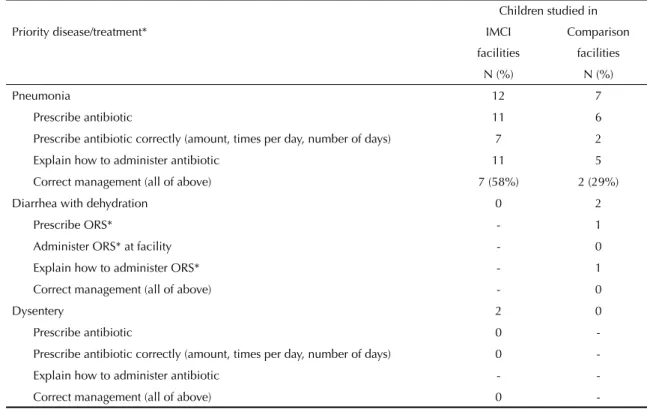
Of 358 children studied (175 in IMCI and 183 in non-IMCI facilities), the majority presented with non-priority illnesses (162 and 175, respectively). Of these children, 72% were correctly managed in IMCI facilities and 56% in non-IMCI facilities (p=0.002). Only 7% of all observed children presented with prior-ity illnesses (14 in IMCI and 9 in non-IMCI facilities), mainly severe pneumonia or diarrhea (Table 1). Of children with priority illnesses, 47% were correctly managed in IMCI facilities, compared with only 22% in comparison facilities (p=0.389). This comparison had low statistical power due to the small number of children with severe conditions. Correct manage-ment of individual illnesses is presented in Table 1 and Table 2.
The Figure presents the proportion of children with all presenting conditions who were managed correctly in IMCI and comparison municipalities. IMCI was asso-ciated with a 30% higher quality of case management than existing training approaches (p=0.001).
0 10 20 30 40 50 60 70 80 %
Comparison 56%
72%
IMCI
p<0.0001
Table 3 summarizes the total cost per child of providing child health care at national, state, local and primary fa-cility levels in IMCI and comparison municipalities, as well as the difference in costs per child in IMCI versus comparison municipalities (referred to as incremental costs). In 2001, there was no signifi cant difference in the total cost per child in a standard IMCI municipal-ity (US$71.85) compared with a standard comparison municipality (US$75.58). The largest components of costs were at the facility and local levels.
Costs of providing services at primary care facilities represented 85% to 90% of the total cost of under-fi ve care per child, mainly due to the high number of consultations per child per year (7.58 and 6.44 in IMCI and comparison municipalities, respectively) in those municipalities. The cost per visit was lower in IMCI versus comparison municipalities hence the lower total costs at primary facility level. Local level costs contributed to total costs in similar proportions in both IMCI and comparison municipalities (13% and 10%) with the main components being personnel costs, recurrent transportation costs and other variable costs like electricity maintenance and supplies.
Table 4 combines the information on quality of care and total municipality costs of child care to report the cost per child correctly managed. As a higher proportion of sick children visiting health facilities was correctly managed in IMCI municipalities than in comparison municipalities with no differences in costs incurred, the cost per child managed correctly was considerably lower in IMCI municipalities (US$13.07) than in com-parison municipalities (US$20.96). This indicates that IMCI leads to signifi cant improvements in effi ciency at primary care facilities, since IMCI led to a marked increase in quality of care for under-fi ves relative to routine care at the same level of resource use.
DISCUSSION
The present study shows new evidence on the relation-ship between IMCI and correct management of sick children, with associated cost implications, at primary health facilities in Northeastern Brazil. Training health providers in IMCI case management in Northeastern Brazil was found to be associated with higher quality of child care received by sick children than routine care provided in comparison municipalities. Improving
Table 1. Number of children and caretakers who received correct treatment and guidance on how to administer medication for episodes of priority illnesses. Northeastern Brazil, 2001.
Priority disease/treatment*
Children studied in
IMCI Comparison
facilities facilities
N (%) N (%)
Pneumonia 12 7
Prescribe antibiotic 11 6
Prescribe antibiotic correctly (amount, times per day, number of days) 7 2
Explain how to administer antibiotic 11 5
Correct management (all of above) 7 (58%) 2 (29%)
Diarrhea with dehydration 0 2
Prescribe ORS* - 1
Administer ORS* at facility - 0
Explain how to administer ORS* - 1
Correct management (all of above) - 0
Dysentery 2 0
Prescribe antibiotic 0
-Prescribe antibiotic correctly (amount, times per day, number of days) 0
-Explain how to administer antibiotic -
-Correct management (all of above) 0
-ORS: oral rehydration solution
IMCI: Integrated Management of Childhood Illness
* Based on gold standard classifi cation, by health providers trained and not trained in Integrated Management of Childhood Illness in four municipalities
quality without increasing costs – as was the case for IMCI in the present analysis – indicates improved ef-fi ciency. IMCI can help municipalities make the most of their scarce public health resources.
The results of the present work are comparable to those from the Multi-Country Evaluation in Tanzania where IMCI led to six fold increase in quality of care (65% compared with 16% in IMCI and comparison munici-palities, respectively), at no extra costs.2,9 Although the impact of IMCI training on the quality of care was higher in Tanzania than in Northeastern Brazil, likely due to their lower baseline rates, the absolute level of quality of care was higher in Northeastern Brazil. This may be partly due to differences in provider’s skill levels between the two countries; where as in Brazil
health providers providing child care at the time of the study included mostly medical doctors and a small pro-portion of university-trained nurses, in Tanzania most health providers were medical assistants, with shorter training than their Brazilian counterparts. Also, absolute costs per child in Brazil (around US$70 per child-year) are considerably higher than those in Tanzania (around US$14 per child-year), particularly due to notable dif-ferences in absolute wage levels and staffi ng profi les between the two countries.2,9
Although this study fi ndings support the scaling-up of IMCI-based child health care at health facilities in Northeastern Brazil and similar settings, the extent to which the observed gains in quality and effi ciency of resource use at primary facilities can be maintained during periods of rapid scaling-up is worth exploring
Table 2. Number of children and caretakers who received correct treatment and guidance on how to administer medication for episodes of non-priority illnesses. Northeastern Brazil, 2001.
Non-priority diseases/treatment
Children studied in
IMCI Comparison
facilities facilities
N (%) N (%)
Cough / cold 166 176
N (excluding diseases for which antibiotics are likely to be prescribed) 108 91
Did not prescribe antibiotic 97 (90%) 77(85%)
Fever (no malaria) 85 96
N (excluding other illnesses for which AB would normally be required) 49 47
Prescribed paracetamol / antipyretic 41 33
Did not prescribe antibiotic 40 39
Correct management 32 (65%) 27(57%)
Diarrhea with no dehydration 44 53
N (excluding diseases for which antibiotics are likely to be prescribed) 28 35
Did not prescribe antibiotic 22 31
Correct guidance given on providing extra fl uid / continued feeding 22 28
Correct management (all of above) 19 (68%) 25 (71%)
Acute ear infection 5 7
Prescribe antibiotic 5 6
Prescribe antibiotic correctly 5 4
Explain how to administer drug 5 5
Correct management (all of above) 5(100%) 4 (57%)
Chronic ear infection 0 1
N (excluding diseases for which antibiotics are likely to be prescribed) - 1
Did not prescribe antibiotic - 1
Correct management - 1 (100%)
Anemia 43 72
Prescribe iron 21 28
and monitoring over time. In Uganda, another country participating in the Multi-Country Evaluation, rapid scaling-up led to lower quality of care.12
In conclusion, the present study shows that effi ciency analysis, such as the estimation of the cost per child managed correctly, can answer fundamental ques-tions posed by policymakers and program planners. In order to support evidence-based decision making, the Brazilian government should reconsider its decision to discontinue its support to IMCI training.
ACKNOWLEDGEMENTS
To the Brazilian Ministry of Health personnel for their support to the study both technically and admin-istratively, and to the survey teams in the four states for collecting costs and quality of care data; to the Multi-Country Evaluation central and country teams who have contributed in developing the methods and refi ning the interpretation of the results throughout the course of this study.
Table 4. Cost per child correctly managed in Integrated Management of Childhood Illness and comparison municipalities based on variable C (all sick children including severe illness). Northeastern Brazil, 2001.
Measure
Brazil
IMCI US$
Brazil
Comparison US$
(Real) (Real)
Total costs per standard municipality* 326,580 107,775 343,650 113,370
Quality measure (proportion of children correctly managed) 0.72 0.56
Annual under-fi ve visits at state-run facilities in a standard municipality** 11,370 9,660
Effectiveness (number of children correctly managed)*** 8,186 5,410
Cost per child correctly managed 39.89 13.17 63.53 20.96
* Municipality costs are standardized for a population size of 2,000 under-fi ve children ** Collected from forms available at health facilities during the study
*** Annual visits multiplied by the proportion of correctly managed children
Table 3. Cost of under-fi ve care per child in a standard municipality in 2001 reais and US dolars. Northeastern Brazil, 2001
Level
Standard
%
Standard
% p-value
IMCI municipality Comparison municipality
R$ (US$) R$ (US$)
National 0.13 0.04 0.00 0.13 0.04 0.00
-State 4.23 1.4 0.02 2.17 0.72 0.01 <0.0001
Local 28.79 9.5 0.13 23.04 7.6 0.10 0.24
Primary-facility 184.57 60.91 0.85 203.76 67.22 0.89 0.76
Total* 217.72 71.85 1 229.1 75.58 1 0.86
1 Adam T, Bishai D, Khan M, Evans D. Methods for the costing component of the multi-country evaluation of IMCI. Geneva: World Health Organization; 2004. Available from: http://www.who.int/imci-mce/ Publications/Costing_Methodology.pdf
2 Adam T, Manzi F, Schellenberg JA, Mgalula L, de Savigny D, Evans DB. Does the Integrated Management of Childhood Illness cost more than routine care? Results from the United Republic of Tanzania. Bull
World Health Organ. 2005;83(5):369-77.
3 Amaral J, Gouws E, Bryce J, Leite AJM, Cunha ALA, Victora CG. Effect of Integrated Management of Childhood Illness (IMCI) on health worker performance in Northeast Brazil. Cad Saude Publica. 2004;20(Supl 2):209-19.
4 Arifeen SE, Bryce J, Gouws E, Baqui AH, Black RE, Hoque DM, et al. Quality of care for under-fi ves in fi rst-level health facilities in one district of Bangladesh.
Bull World Health Organ. 2005;83(4):260-7.
5 Armstrong Schellenberg J, Bryce J, de Savigny D, Lambrechts T, Mbuya C, Mgalula L, et al. The effect of Integrated Management of Childhood Illness on observed quality of care of under-fi ves in rural Tanzania. Health Policy Plan. 2004;19(1):1-10.
6 Black RE, Morris SS, Bryce J. Where and why are 10 million children dying every year? Lancet. 2003;361(9376):2226-34.
7 Bryce J, Arifeen S, Pariyo G, Lanata C, Gwatkin D, Habicht JP, et al. Reducing child mortality: can public health deliver? Lancet. 2003;362(9378):159-64.
8 Bryce J, Victora CG, Habicht J-P, Vaughan JP, Black RE. The multi-country evaluation of the integrated
management of childhood illness strategy: lessons for the evaluation of public health interventions. Am J
Public Health. 2004;94(3):406-15.
9 Bryce J, Gouws E, Adam T, Black R, Schellenberg JA, Manzi F, et al. Improving quality and effi ciency of facility-based child health care through Integrated Management of Childhood Illness in Tanzania. Health
Policy Plan. 2005;20(Supl 1):i69-76.
10 Drummond MF, O’Brien BJ, Stoddart GL, Torrance GW. Methods for the economic evaluation of health care programmes. 2.ed. Oxford: Oxford University Press; 1997.
11 Gouws E, Bryce J, Habicht JP, Amaral J, Pariyo G, Schellenberg JA, et al. Improving antimicrobial use among health workers in fi rst-level facilities: results from the Multi-country Evaluation of the Integrated Management of Childhood Illness strategy. Bull World
Health Organ. 2004;82(7):509-15.
12 Pariyo GW, Gouws E, Bryce J, Uganda IMCI Impact Study Team. Improving facility-based care for sick children in Uganda: training is not enough. Health
Policy Plan. 2005; 20(Supl 1):i58-68.
13 Tulloch J. Integrated approach to child health in developing countries. Lancet. 1999;354(Supl 2): SII16-20.
14 United Nations. The Millennium Development Goals Report 2005. New York; 2005. Disponível em: http:// www.un.org/docs/summit2005/MDGBook.pdf
15 World Bank. World Development Indicators 2001. Washington; 2001.
REFERENCES