* Extracted from the project “Avaliação da preocupação dos idosos da comunidade em cair”, Escola de Enfermagem Wenceslau Braz, 2012. 1 Universidade Federal de São Paulo, Escola Paulista de Enfermagem, São Paulo, SP, Brazil. 2 Universidade de São Paulo, Escola de Enfermagem de Ribeirão, Programa de Pós-Graduação em Enfermagem Psiquiátrica, Ribeirão Preto, SP, Brazil.
3 Escola de Enfermagem Wenceslau Braz, Itajubá, MG, Brazil.
4 Hospital Escola de Itajubá, Itajubá, MG, Brazil. 5 Universidade Federal do Rio Grande do Sul, Escola de Enfermagem, Porto Alegre, RS, Brazil.
6 Universidade Federal de Alagoas, Escola de Enfermagem e Farmácia, Maceió, AL, Brazil.
ABSTRACT
Objective: To identify the factors associated with the fear of falling in the older adult living at home. Method: Cross-sectional study with probabilistic sampling of older adult enrolled in two Family Health Strategies (FHS). he fear of falling was measured by the Brazilian version of the Falls Eicacy Scale-International and by a household questionnaire that contained the explanatory variables. Multiple Linear Regression using the stepwise selection technique and the Generalized Linear Models were used in the statistical analyses. Results: A total of170 older adults participated in the research, 85 from each FHS. he majority (57.1%) aged between 60 and 69; 67.6% were female; 46.1% fell once in the last year. he majority of the older adults (66.5%) had high fear of falling. In the inal multiple linear regression model, it was identiied that a higher number of previous falls, female gender, older age, and worse health self-assessment explained 37% of the fear of falling among the older adult. Conclusion: he indings reinforce the need to assess the fear of falling among the older adult living at home, in conjunction with the development and use of strategies based on modiiable factors by professionals to reduce falls and improve health status, which may contribute to the reduction of the fear of falling among the older adult.
DESCRIPTORS
Aged; Accidental Falls; Fear; Geriatric Nursing; Family Health Strategy; Cross-Sectional Studies.
Fear of falling in older adults living at home: associated factors*
Medo de cair em idosos residentes no domicílio: fatores associados Miedo de caer en ancianos residentes en su domicilio: factores asociados
Luciano Magalhães Vitorino1, Carla Araujo Bastos Teixeira2, Eliandra Laís Vilas Boas3, Rúbia Lopes Pereira4, Naiana Oliveira dos Santos5, Célia Alves Rozendo6
How to cite this article:
Vitorino LM, Teixeira CAB, Vilas Boas EL, Pereira RL, Santos NO, Rozendo CA. Fear of falling in older adults living at home: associated factors. Rev Esc Enferm USP. 2017;51:e03215. DOI: http://dx.doi.org/10.1590/S1980-220X2016011803215
Received: 03/14/2016 Approved: 01/05/2017
Corresponding author:
Luciano Magalhães Vitorino Rua Napoleão de Barros, 754 CEP 04024-002 – São Paulo, SP, Brazil [email protected]
Fear of falling in older adults living at home: associated factors
INTRODUCTION
Falls are deined as events in which the individual inad-vertently comes to rest on the ground or lower level, against his will. his event has a high incidence among people over 65 years old, reaching 30% of the older adult living at home. Falling is considered one of the most common causes of hos-pitalization in the older adult population(1). It is estimated
that one in three older adult people sufers a fall yearly and less than half report it to their physicians. Among these falls, one in ive causes serious injury, such as fractures or head injuries(2), which implies in a high impact on health care
expenses worldwide(1,3) and contributes to the fact that falls
among the older adult are a public health issue(4).
Besides the fall itself, an important aspect to be empha-sized in the older adult population is the fear of falling, which has been described as a permanent fear or worry of tumbling(3). his fear can set up barriers in daily activities and
cause a state of anxiety and even inhibition and/or restriction of these activities(4-5). his can reduce mobility and physical
itness, compromise lower limb muscles and the balance of the older adult, and consequently increase risk of future falls(3-5). his way, the fear of falling may be a predictor of
falls and, consequently, of their negative repercussions for the older adult, including demands for individualized care(4,6).
As a result, there may be a greater need to use health ser-vices, resulting in higher expenses considering the cost of long hospitalizations, medical interventions and medication, among other expenses(2,7).
he “fear of falling” problem has been a major concern not only for the older adult, but also for families and health care providers, considering itcan lead to greater use of health services(2-3). he consequences of the fear of falling go through
the clinical, psychological, social and epidemiological spheres, and should receive special attention, since the ramiications of the consequencesare important for the health, well-being and quality of life (QoL) of the older adult(8).
Based on the identiication of the factors associated with the fear of falling in the older adult, it is possible to get an overview that can help in the development of actions aimed not only at the target audience but also actions involving health professionals who deal with the older adult, their rela-tives and caregivers(8-9). he relevance of the study is based
on the premise that knowledge about the factors associated with fear of falls is crucial, since falls of the older adult are an important public health problem and one of the main causes of mental health and QoL impairment in this population(1).
hus, the present study aimed to identify the factors associ-ated with the fear of falling in older adult living at home.
METHOD
A cross-sectional and probabilistic sampling research was conducted with older adult people aged 60 years or older enrolled in two of the 12 Family Health Strategies (FHS) from a city located in the southern Minas Gerais State, Brazil. he choice for the FHS was made by convenience. he two FHS were chosen because of the familiarity of the institutions with the research team. In 2010, this city had
90,658 inhabitants, with 11,397 (12.57%) people aged 60 and over. FHS1 (n=456) and FHS2 (n=444) had a total of 7,128 registered people, of which 900 (12.62%) were older adult. Data was collected between June and August 2012 by two trained members of the research team.
he sample was calculated based on a inite population(10)
of 900 older adult people and at least a 90.5% fear of falling in one of the 16 FES-I-Brazil activities on the study carried out with older adult people from Diamantina, MG(11); we
adopted a sampling errorof ± 5% and a 95% conidence interval(α=1.96). hus, the minimum sample required for this study was 136 older adults. he numbers of the records of each older adult enrolled in the two FHS were used to draw 50% of the sample (n=68) in each FHS. For inclusion in the sample, the participants met the following criteria: age ≥ 60 years, be registered and live within the area covered by one of the FHS that were scenarios of this study. he exclusion criterion adopted was the bedridden older adult.
For this study, a sociodemographic and health house-hold questionnairewas conducted, consisting of the explana-tory variables: age; gender; level of education; marital sta-tus; chronic disease; daily use of medication; number of falls; time of the last fall; use of glasses; diicultyseeing even with the use of glasses; necessity of walking aid and self-assessment of health status. he Falls Eicacy Scale International scale was used to evaluate the outcome: con-cern about the possibility of falling. his scale was validated for the Brazilian population (FEI-I-BRAZIL) in 2010(12). It
has excellent psychometric properties and has been validated in several countries. For Brazil’s validation, the internal con-sistency measured with Cronbach’s alpha presented excellent psychometric properties (α=0.96). hrough this scale, “it’s possible to investigate the concern about the possibility of falling in 16 distinct daily activities, scored on a Likert scale from 1 to 4, with a score that can vary from 16 (no concern) to 64 (extreme concern). he items evaluated cover tasks related to postural control, associated with a higher level of diiculty, and other basic, instrumental and socialization tasks, which involve less physical demand”(12). Regarding the
interpretation of the FES-I-Brazil scale, those responsible for validation in Brazil conclude that the total score is the best element to evaluate the concern about falling(12). he
cut-of score used indicate a score of 16 to 22 as low concern and from 23 to 64 as high concern about falling(13).
he data was managed by the Statistical Package for the Social Sciences – SPSS® version 21. To describe the sociodemographic characteristics, and the FES-I-Brazil Scale, descriptive statistics were used. he Kolmogorov-Smirnov test with Lilliefors correction demonstrated normal distri-bution of the FES-I-Brazil scale (p=0.105). Simple Linear Regression (SLR) and Multiple Linear Regression (MLR)
(14) were used to identify the factors associated with the fear
Generalized Linear Models (GLM)(15) were used in order
to test the mean diferences of the FES-I-Brazil among the subgroups of statistically signiicant MLR covariates deined by number of falls (never, once, twice); gender (male, female); age (60 to 69, 70 or more) and health self-assessment (good, regular). he F test and the degrees of freedom (d.f.) were used to describe the GLM univariate analysis. he signiicance level adopted was 5%, with a 95% conidence interval(95% CI).
he study was conducted in accordance with the guide-lines and regulatory norms of the Resolution 466/2012 of the National Health Council/Ministry of Health, on Research Involving Human Beings and approved by the Research Ethics Committee under decision number 50521, July 4th, 2012. he objectives of the research were clariied
and all the participants signed an Informed Consent Form.
RESULTS
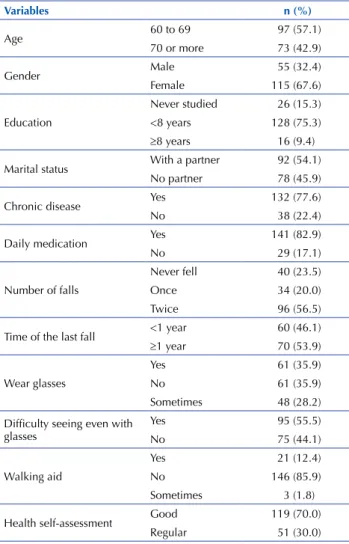
A total of 188 older adult people were approached, eight of whom refused to participate in the study, three were visi-tors and did not live in the perimeters of the selected FHS, two had psychological conditions of anxiety/sadness and ive were bedridden or were wheelchair users. At the end of data collection, 170 older adult people participated in this research, 85 older adult from each FHS (Table 1).
he majority (57.1%) were between 60 and 69 years old, 67.6% were female and 54.1% of the older adult reported having a partner. Approximately 78.0% reported having at least one chronic disease and 83% had daily use of at least one medication. Regarding the history of falls, 76.5% had had at least one fall and 46.1% had a fall in the last year. he proportion among the older adult who wore glasses and the ones who did not was the same (35.9%), and the majority (55.5%) had diiculty seeing, even with glasses.
Approximately, 86% of the older adult did not use walking aids. Regarding the self-assessment of health status, 70.0% of the older adult reported that their health was good.
he fear of the possibility of falling assessed by the FES-I Brazil Scale presented mean of 29.5. (SD=10.2; 95.0% coni-dence interval= 28.0-31.1). When rating this fear, the results showed that 66.5% (n=113) of the older adult presented a score between 23 and 64 in the FES-I Brazil Scale, which represents a high concern about falling, and 33.5% (n=57) of the older adult had low concern about falling, with a score between 16 and 22.
Table 2 presents two models of Linear Regression used to evaluate the factors associated with the fear of falling among the older adult in the community. In the irst SLR model, it is observed that only the variable number of previous falls explained 21.0% of the variance of fear of falling (B=5.6; p<0.001). In the inal MLR model, the number of previ-ous falls (B=3.3; p<0.001), plus gender (B=-7.0; p<0.003), age (B=0.2; p<0.001) and health self-assessment (B=-3.7; p=0.001) explained 37.0% of the variance of fear of falling.
Table 2 – Results of simple and multiple linear regression for the fear of falling in older adult in the FES-I-Brazil Scale – Itajubá, Minas Gerais, Brazil, 2012
Models Variables B (95% CI) P Value Adjusted R2
1st model
FES-I-Brazil Number of falls 5.6 (3.9 ; 7.3) <0.001 0.21
Final modela FES-I-Brazil
Number of falls 3.3 (1.6 ; 4.9) <0.001
0.37
Gender -7.0 (-9.7 ; – 4.2) 0.003
Age 0.2 (0.1 ; 0.4) <0.001
Health
self-assessment -3.7 (-6.0 ; 1.1) 0.001
a: Used in the Generalized Linear Models; B: Beta coeicient is the estimate of the
increase or decrease of the dependent variable for each 1-point increase of the inde-pendent variable; CI: 95% Conidence Interval.
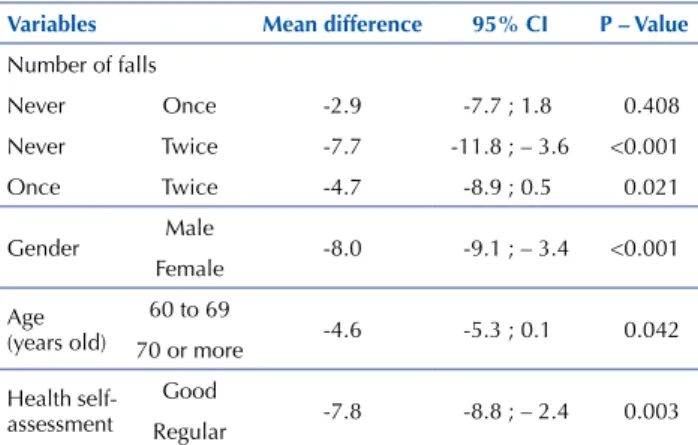
GLMs (Table 3) were used to explore the mean dif-ference between the covariates associated with the fear of falling among the older adult. he fear of falling presented a statistically signiicant diference between the number of previous falls: (F=11.1; d.f.=2,; p<0.001); gender: (F=19.5; d.f.=1; p<0.001), age: (F=4.2; d.f.=1; p<0.001) and health self-assessment: (F=9.2; d.f.=1; p=0.003).
Regarding the number of previous falls, it was identiied that there was no statistically signiicant diference between the older adult who had never fell and the older adult who had fell only once (mean diference= – 2.9; p=0.4). But a dif-ference in the fear of falling was observed among the older adult who had never fell and the older adult who had fell twice (mean diference= – 7.7; p<0.001). When comparing
Table 1 – Characteristics of the older adult – Itajubá, Minas Gerais, Brazil, 2012
Variables n (%)
Age 60 to 69 97 (57.1)
70 or more 73 (42.9)
Gender Male 55 (32.4)
Female 115 (67.6)
Education
Never studied 26 (15.3)
<8 years 128 (75.3)
≥8 years 16 (9.4)
Marital status With a partner 92 (54.1)
No partner 78 (45.9)
Chronic disease Yes 132 (77.6)
No 38 (22.4)
Daily medication Yes 141 (82.9)
No 29 (17.1)
Number of falls
Never fell 40 (23.5)
Once 34 (20.0)
Twice 96 (56.5)
Time of the last fall <1 year 60 (46.1)
≥1 year 70 (53.9)
Wear glasses
Yes 61 (35.9)
No 61 (35.9)
Sometimes 48 (28.2)
Dificulty seeing even with
glasses
Yes 95 (55.5)
No 75 (44.1)
Walking aid
Yes 21 (12.4)
No 146 (85.9)
Sometimes 3 (1.8)
Health self-assessment Good 119 (70.0)
Fear of falling in older adults living at home: associated factors
the older adults who fell once with those who fell twice, the diference in fear of falling was lower and statistically signiicant (mean diference= – 4.7; p=0.021). Older women presented greater fear of falling than older men (mean dif-ference= – 8.0; p<0.001). he age diference was also a factor that presented discrepancy in the fear of falling. Younger, 60-69 year-olds were less fearful of falling than older adults aged 70 or over (mean diference= – 4.6; p=0.042). Older adult patients with worse health self-assessment were more fearful of falling than older adults with better self-assessment (mean diference= – 7.8; p=0.003 (Table 3).
Table 3 – Mean difference FES-I-Brazil Scale – Itajubá, Minas Gerais, Brazil, 2012
Variables Mean difference 95% CI P – Value
Number of falls
Never Once -2.9 -7.7 ; 1.8 0.408
Never Twice -7.7 -11.8 ; – 3.6 <0.001
Once Twice -4.7 -8.9 ; 0.5 0.021
Gender Male -8.0 -9.1 ; – 3.4 <0.001
Female
Age (years old)
60 to 69
-4.6 -5.3 ; 0.1 0.042
70 or more
Health self-assessment
Good
-7.8 -8.8 ; – 2.4 0.003
Regular
Note: Mean diference; SD: standard deviation; CI: conidence interval.
DISCUSSION
he present study investigated the factors associated with fear of falling among older adult people living at home. he majority of these older adults (67.0%) had a high fear of fall-ing. he factors associated with fear of falling were: higher number of falls; women; worse health self-assessment and age, especially for those above 70 years.
A higher number of falls was the main factor that explained the fear of falling among the older adult who lived in their own house. Older adults who fell twice were more afraid of falling than older people who had never fell or had fell once. It is noteworthy that no diference in the fear of falling was found between older adults who fell once and those who had never fell. Any older adult person with a history of falls, with or without injury, is more likely to trigger a fear of falling(11,13). Recurring falls among the
older adult has been highlighted as a relevant factor for the development of fear of falling(16-17). Fear, in most cases, is
related to the possibility of fractures, hospitalization and compromising autonomy of the older adult(13,17). his fear
can trigger changes in the behavior of the older adult, such as restrictions of basic daily and instrumental activities and reduction of physical itness, which lead to cardiovascu-lar risks and musculoskeletal disorders. In addition, it may increase the risk of falls(4,18) and compromise the QoL of
the older adult(6).
Falls and fear of falling are mutually associated, since the older adult presenting an outcome have a high risk of developing the other(6). In the present study, no signiicant
diference was identiied between the fear of falling among the older adult who fell once and those who never fell. In previous studies, a statistically signiicant diference in the fear of falling among older adult people who never fell and who fell once was detected(11). It is believed that this inding
may be associated with the severity of the fall. Older adults who sufered a fall with complications, such as fractures or injuries, are more afraid of falling than older adult people who did not sufer complications(6,8). his study did not
investigate the outcome fracture/lesions, which may make it diicult to make some inferences with the present indings.
An inluence of the female gender on the fear of falling was observed. Older adult women were more likely to fall than older adult men(19). he fear of falling among older adult
women was associated with reduced physical activity(19);
obe-sity(20-21); impairment of activities of daily living (ADLs)(19);
social isolation(4); higherdepressive symptoms(20,22); higher
probability of future falls(23). he fear of falling among older
adult women is inluenced by a number of factors peculiar to gender, such as a higher prevalence of chronic non-commu-nicable diseases (NCDs) and musculoskeletal frailty(23); low
bone density after menopause and greater and more rapid loss of muscle mass, due to the hormonal decrease(24). It is
also believed that the higher frequency of household tasks can inluence this fear(3). Older adult women also have more
diiculty engaging in physical activities of muscle strength-ening(25). Another factor that should be highlighted is that
even though women recognize health risks more easily, men are more resistant to accepting these risks(26).
Older people who assessed their health status as “regular” were more afraid of falling than the older adult with “good” health self-assessment. A worst health status among the older adult has been associated with greater fear of falling in international studies, such as studies in he United States of America(27), England(28), Nigeria(4), and also Brazil(7). To the
World Health Organization(4), in addition to NCDs,
physi-cal and cognitive decline, physiphysi-cal frailty, afective impair-ment, and depression may exacerbate the fear and risk of falling among the older adult. his study corroborates the need to detect older adult people vulnerable to this fear, with the purpose of elaborating preventive measures against the increase of the fear of falling to contribute to the reduction of the fear of falling and the number of falls among these older adults.
Age was another factor associated with fear of falling. 70 years old or older adults were more fearful of falling than younger older adult people (60-69 years). he older adult usually presentwith advancing age a decline in physical and mental functioning, as well as an increase in physical frailty and in the number of NCDs(29). his set of alterations afects
the older and contributes to the greater fear of falling among older individuals(19). A population-based study with 9,033
South Korean, aged over 65, found that older people over 75 years of age are more likely to have fear of falling than younger older adult(30). A higher age was also associated with
a greater fear of falling in other international studies(28). In
that with the advancement of age, the fear of falling in older adult people living at home increases.
he present study has some limitations. During the research conducted in their homes, it was not investigated whether, after the fall, there were fractures/lesions. It is believed that this questioning could help explain why there was no association of the fear of falling among older adult who had never fell and those who had fell once, which opens a gap for future studies. Other limitations were the reduced number of older adult people aged 80 years or older, which made it diicult to use this category in the results and analy-sis, and the use of only two categories to assess the percep-tion of the health status of the older adult.
CONCLUSION
his study showed that the older adult who have already fallen twice, female, with worse health self-assessment, and over 70 years of age were more afraid of falling. In terms of recommendations for practice, the indings reinforce the need to assess the fear of falling among older adult people living at home. his assessment does not imply high costs, it
is uncomplicated and can be carried out by members of the multi-professional team of the FHS or Basic Health Units (BHU), which are closer to the community. Supervised physical exercises for strengthening upper and lower limb muscles and developing balance should be provided. Group and individual educational activities are important because they aim to understand the risks of falls and provide the idea that the fear of falling is controllable. he supervision of modiiable risk factors in the older adult households should be carried out by the multi-professional team of the FHS or the BHU, to reduce the possibility of falling. he associated factors found in this study can contribute to the elaboration of preventive actions to reduce the fear of falling and the possible consequences of this fear in ADL, physical and mental health, socialization and in the QoL of the older adult, besides impacting on the costs and organization of health systems and services.
Longitudinal studies in larger samples with a multifacto-rial approach should be carried out to identify the possible predictive factors of the fear of falling from older adult liv-ing at home.
RESUMO
Objetivo: Identiicar os fatores associados ao medo de cair em idosos residentes no domicílio. Métodos: Estudo transversal com amostragem probabilística de idosos cadastrados em duas Estratégias Saúde da Família (ESF). O medo de cair foi avaliado pela versão brasileira da escala Falls Eicacy Scale International e por um inquérito domiciliar que continha as variáveis explicativas.A Regressão Linear Múltipla por meio da técnica stepwise selection e os Modelos Lineares Generalizados foram utilizados nas análises estatísticas. Resultados: Participaram da pesquisa170 idosos, 85 de cada ESF. A maioria (57,1%) tinha entre 60 e 69 anos de idade; 67,6% eram do sexo feminino; 46,1 % tiveram queda no último ano. A maioria dos idosos (66,5%) tinha elevado medo de cair. No modelo inal de regressão multivariada, identiicou-se que maior número de quedas anteriores, sexo feminino, idade mais avançada, e pior autoavaliação de saúde explicaram 37% do medo de cair entre os idosos. Conclusão: Os achados reforçam a necessidade da avaliação do medo de cair entre os idosos que residem no próprio domicílio, assim como o desenvolvimento e a utilização de estratégias pelos proissionais voltadas para os fatores modiicáveis, de modo a reduzir as quedas e melhorar o estado de saúde, o que pode contribuir para a diminuição do medo de cair entre os idosos.
DESCRITORES
Idoso; Acidentes por Quedas; Medo; Enfermagem Geriátrica; Estratégia Saúde da Família; Estudos Transversais.
RESUMEn
Objetivo: Identiicar los factores asociados con el miedo de caer en ancianos residentes en su domicilio. Métodos: Estudio transversal con muestreo probabilístico de ancianos registrados en dos Estrategias Salud de la Familia (ESF). El miedo de caer fue evaluado por la versión brasileña de la escala Falls Eicacy Scale International y por una encuesta domiciliaria que contenía las variables explicativas.La Regresión Lineal Múltiple mediante la técnica stepwise selection y los Modelos Lineales Generalizados fueron utilizados en los análisis estadísticos. Resultados: Participaron en la investigación 170 ancianos, 85 de cada ESF. La mayoría (57,1%) tenía entre 60 y 69 años de edad; el 67,6% eran del sexo femenino; el 46,1 % sufrieron caída el último año. La mayoría de los ancianos (66,5%) tenía elevado miedo de caer. En el modelo inal de regresión multivariada, se identiicó que mayor número de caídas anteriores, sexo femenino, edad más avanzada y peor autoevaluación de salud explicaron el 37% del miedo de caer entre los ancianos. Conclusión: Los hallazgos refuerzan la necesidad de la evaluación del miedo de caer entre los ancianos que residen en su propio domicilio, así como el desarrollo y la utilización de estrategias por los profesionales dirigidos a los factores cambiables, a in de reducir las caídas y mejorar el estado de salud, lo que puede contribuir para la reducción del miedo de caer entre los ancianos.
DESCRIPTORES
Anciano; Accidentes por Caídas; Miedo; Enfermería Geriátrica; Estrategia de Salud Familiar; Estudios Transversales.
REFERENCES
1. Heslop KR, Wynaden DG. Impact of falls on mental health outcomes for older adult mental health patients: an Australian study. Int J Ment Health Nurs. 2016;25(1):3-11.
Fear of falling in older adults living at home: associated factors
3. Ayoubi F, Launay C, Annweiler C, Beauchet O. Fear of falling and gait variability in older adults: a systematic review and meta-analysis. J Am Med Dir Assoc. 2015;16(1):14-9.
4. World Health Organization. WHO Global report on falls prevention in older age [Internet]. Geneva: WHO; 2007 [cited 2016 Jan 14]. Available from: http://www.who.int/ageing/publications/Falls_prevention7March.pdf
5. Shirooka H, Nishiguchi S, Fukutani N, Tashiro Y, Nozaki Y, Hirata H, et al. Cognitive impairment is associated with the absence of fear of falling in community-dwelling frail older adults. Geriatr Gerontol Int. 2016 Jan 21. [Epub ahead of print]
6. Akosile CO, Anukam GO, Johnson OE, Fabunmi AA, Okoye EC, Iheukwumere N, et al. Fear of falling and quality of life of apparently-healthy elderly individuals from a Nigerian population. J Cross Cult Gerontol. 2014;29(2):201-9.
7. Antes DL, Schneider IJC, Benedetti TRB, D’Orsi E. Medo de queda recorrente e fatores associados em idosos de Florianópolis, Santa Catarina, Brasil. Cad Saúde Pública. [Internet]. 2013 [citado 2016 jan. 04];29(4):758-68. Disponível em: http://www.scielo.br/pdf/csp/ v29n4/13.pdf.
8. Lach HW, Parsons JL. Impact of fear of falling in long term care: an integrative review. J Am Med Dir Assoc. 2013;14(8):573-7.
9. Akin S, Mazicioglu MM, Mucuk S, Gocer S, Safak ED, Arguvanli S, et al. The prevalence of frailty and related factors in communitydwelling Turkish elderly according to modiied Fried Frailty Index and FRAIL scales. Aging Clin Exp Res. 2015;27(5):703-9.
10. Fontelles MJ, Simões MG, Almeida JC, Fontelles RGS. Metodologia da pesquisa: diretrizes para o cálculo do tamanho da amostra. Rev Para Med. 2010;24(2):57-64.
11. Lopes KT, Costa DF, Santos LF, Castro DP, Bastone AC. Prevalence of fear of falling among a population of older adults and its correlation with mobility, dynamic balance, risk and history of falls. Rev Bras Fisioter [Internet]. 2010 [cited 2016 Feb 04];13(3): 223-9. Available from: http://www.scielo.br/pdf/rbis/v13n3/en_aop024_09.pdf
12. Camargos FFO, Dias RC, Dias JMD, Freire MTF. Cross-cultural adaptation and evaluation of the psychometric properties of the Falls Eficacy Scale – International Among Elderly Brazilians (FES-I-BRAZIL). Rev Bras Fisioter [Internet]. 2010 [cited 2016 Feb 15];14(3):237-43. Available from: http://www.scielo.br/pdf/rbis/v14n3/en_10.pdf
13. Delbaere K, Close JC, Heim J, Sachdev PS, Brodaty H, Slavin MJ, et al. A multifactorial approach to understanding fall risk in older people. J Am Geriatr Soc. 2010;58(9):1679-85.
14. Alexopoulos EC. Introduction to multivariate regression analysis. Hippokratia. [Internet]. 2010 [cited 2016 July 11];14 Suppl 1):23-8. Available from: http://www.ncbi.nlm.nih.gov/pmc/articles/PMC3049417/
15. Taylor A. Using the GLM procedure in SPSS. Macquarie: Macquarie University; 2011.
16. Bryant MS, Rintala DH, Hou JG, Protas EJ. Inluence of fear of falling on gait and balance in Parkinson’s disease. Disabil Rehabil. 2014;36(9):744-8.
17. Mane AB, Sanjana T, Patil PR, Sriniwas T. Prevalence and correlates of fear of falling among elderly population in urban area of Karnataka, India. J Midlife Health. [Internet]. 2014 [cited 2016 Feb 15];5(3):150-5. Available from: http://www.ncbi.nlm.nih.gov/pmc/articles/ PMC4195189/
18. Mazumder R, Lambert WE, Nguyen T, Bourdette DN, Cameron MH. Fear of falling is associated with recurrent falls in people with multiple sclerosis. Int J MS Care. [Internet]. 2015 [cited 2016 Feb 15];17(4):164-70. Available from: https://www.ncbi.nlm.nih.gov/pmc/articles/ PMC4542711/
19. Centers for Disease Control and Prevention; National Center for Injury Prevention and Control. Preventing falls: a guide to implementing effective community-based fall prevention programs [Internet]. Atlanta: CDC; 2015 [cited 2016 Jan 10]. Available from: http://www.cdc. gov/homeandrecreationalsafety/pdf/falls/fallpreventionguide-2015-a.pdf
20. Pohl P, Sandlund M, Ahlgren C, Bergvall-Kåreborn C, Lundin-Olsson L, Wikman AM. Fall risk awareness and safety precautions taken by older community-dwelling women and men: a qualitative study using focus group discussions. PLoS One. 2015;10(3):e0119630. 21. Jeon B. The effects of obesity on fall eficacy in elderly people. J Phys Ther Sci [Internet]. 2013 [cited 2016 July 10];25(11):1485-9. Available
from: https://www.ncbi.nlm.nih.gov/pmc/articles/PMC3881484/
22. White UE, Black AA, Wood JM, Delbaere K. Fear of falling in vision impairment. Optom Vis Sci. 2015;92(6):730-5.
23. Ambrose AF, Cruz L, Paul G. Falls and fractures: a systematic approach to screening and prevention. Maturitas. 2015;82(1):85-93. 24. Hita-Contreras F, Martínez-Amat A, Lomas-Vega R, Álvarez P, Aránega A, Martínez-López E, et al. Predictive value of stabilometry and fear
of falling on falls in postmenopausal women. Climacteric. 2013;16(5):584-9.
25. Visschedijk JHM, Caljouw MAA, Bakkers E, van Balen R, Achterberg WP. Longitudinal follow-up study on fear of falling during and after rehabilitation in skilled nursing facilities. BMC Geriatrics [Internet]. 2015 [cited 2016 July 10];15:161. Available from: https://www.ncbi. nlm.nih.gov/pmc/articles/PMC4670507/
26. Knauth DR, Couto MT, Figueiredo WS. The standpoint of professionals on the presence and demands of men on the healthcare services: perspectives for the analysis of the implementation of the Comprehensive Healthcare Policy for Men. Ciênc Saúde Coletiva [Internet]. 2012 [cited 2016 Jan 15];17(10):2617-26. Available from: http://www.scielo.br/pdf/csc/v17n10/en_11.pdf
27. Bryant MS, Rintala DH, Hou JG, Protas EJ. Relationship of falls and fear of falling to activity limitations and physical inactivity in Parkinson’s disease. J Aging Phys Act. 2015;23(2):187-93.
28. Denkinger MD, Lukas A, Nikolaus T, Hauer K. Factors associated with fear of falling and associated activity restriction in community-dwelling older adults: a systematic review. Am J Geriatr Psychiatry. 2015;23(1):72-86.
29. Cho H, Seol SJ, Yoon DH, Kim MJ, Choi BY, Kim T. Disparity in the Fear of Falling Between Urban and Rural Residents in Relation With Socio-economic Variables, Health Issues, and Functional Independency. Ann Rehabil Med. 2013;37(6):848-61.
30. Kim S, So WY. Prevalence and correlates of fear of falling in Korean community-dwelling elderly subjects. Exp Gerontol. 2013;48(11):1323-8.