Rev Odontol UNESP. 2012 Nov-Dec; 41(6): 390-395 © 2012 - ISSN 1807-2577 ARTIGO ORIGINAL
Proile and scientiic production of Brazilian
researchers in oral pathology
Peril e produção cientíica dos pesquisadores brasileiros em patologia oral
Maria Ivanilde Pereira SANTOS
a, Bárbara Gusmão Lopes LEITE
b,
Lívia Máris Ribeiro PARANAÍBA
b,
Eduardo Araujo OLIVEIRA
c, Francisco Marcone VERÍSSIMO
b,
Rafael Amâncio Dias de OLIVEIRA
b,
Hercílio MARTELLI-JÚNIOR
baHealth Science Program, Department of Mental Health and Coletive Health, and Economics Science,
UNIMONTES – State University of Montes Claros, 39401-089 Montes Claros - MG, Brazil bHealth Science Program, UNIMONTES – State University of Montes Claros,
39401-089 Montes Claros - MG, Brazil
cDepartment of Pediatrics, UFMG – University of Minas Gerais, 31270-901 Belo Horizonte - MG, Brazil
Resumo
Objetivo: Este estudo objetivou avaliar o perfil e a produção científica de pesquisadores da Odontologia na área da patologia oral que receberam bolsas do Conselho Nacional de Desenvolvimento Científico e Tecnológico (CNPq) no Brasil. Material e método:O curriculum vitae padronizado (Curriculum Lattes) de 34 pesquisadores da área de patologia oral que receberam bolsas no triênio 2008-2010 foram analisados. As variáveis analisadas foram: sexo, filiação institucional, tempo de conclusão do doutorado, produção científica, e orientação de estudantes de iniciação científica e em programas de mestrado e doutorado. Resultado:Os Estados de São Paulo (18; 52,94%) e Minas Gerais (9; 26,47%) foram responsáveis por 79,41% dos pesquisadores. Quanto à filiação, três instituições foram responsáveis por aproximadamente 44,11% dos pesquisadores: UNICAMP (6 = 17,64%); USP (5 = 14,71%) e UFMG (4 = 11,76%). Os pesquisadores publicaram um total de 906 artigos com texto completo, com mediana de 26,64 artigos por pesquisador no triênio e 8,88 artigos por ano. Verificou-se que de 906 artigos publicados, 366 (40,39%) foram publicados em qualis A (Qualis-CAPES). Os pesquisadores da patologia oral orientaram 437 alunos de graduação e pós graduação. Destes, 138 (31,57%) eram alunos de iniciação científica, 169 (38,67%) eram alunos de mestrado e 130 (29,74%) eram alunos de doutorado. Conclusão: Uma importante produção científica dos pesquisadores da patologia oral no triênio 2008-2010 foi observada. Ao conhecer o perfil dos pesquisadores da Odontologia na área de patologia oral, estratégias mais eficazes para estimular a produção científica e a demanda de recursos para financiar projetos de pesquisa podem ser definidas.
Descritores: Indicadores de produção científica; pesquisadores; pesquisa em odontologia; relação pesquisador-produção científica; Brasil.
Abstract
Objective:This study evaluated the profile and scientific production of research ers in oral pathology who received grants in the area of Dentistry from the Brazilian National Research and Development Council. Material and method: The standardized online curriculum vitae (Curriculum Lattes) of 34 researchers in oral pathology who received grants in the years 2008-2010 were analyzed. The variables were: gender, affiliation, time from completion of the PhD program, scientific production, and supervision of undergraduate students and Master’s and PhD programs. Result: The States of São Paulo (52.94%) and Minas Gerais (26.47%) were responsible for 79.41% of the researchers. Regarding af filiation, three institutions accounted for approximately 44.11% of the researchers: UNICAMP (17.64%); USP (14.70%); and UFMG (11.76%). The researchers published a total of 906 full-text articles, with a median of 26.64 articles per re searcher in the triennium and 8.88 articles per year. It was found that of 906 articles published, 366 (40.39%) were published in strata A (qualis-CAPES). Oral pathology researchers supervised 437 scientific initiation and post-graduate students. Of these, 138 (31.57%) were scientific initiation, 169 (38.67%) were Master and 130 (29.74%) were PhD students. Conclusion: An important scientific production of oral pathology researchers in the 2008-2010 triennium was observed. By knowing the profile of researchers in oral pathology, more effective strategies for encouraging scientific production and demanding resources to finance research projects can be defined.
INTRODUCTION
In the last decade, scientiic production in Brazil has consistently grown based on an increase in total funding for science and technology that soared from 21.4 billion reais (US$ 11.4 billion) to 43.1 billion reais (or from 1.26% to 1.43% of Brazil’s growing gross domestic product; GDP)1. Between 1997 and 2007, the number of Brazilian papers in indexed, peer-reviewed journals more than doubled, reaching 19,000 papers per year. According to homson Reuters, Brazil now ranks 13th in publications, having surpassed the Netherlands, Israel, and Switzerland2.
In Brazil, there are two main scientiic funding agencies: CAPES (Coordination for the Improvement of Higher Education Personnel, a section of the Ministry of Education) and CNPq (National Council for the Development of Science and Technology, a part of the Ministry of Science and Technology), where CNPq is the funding agency that evaluates and funds researchers, and CAPES evaluates and supports postgraduate courses. he National Council for the Development of Science and Technology (CNPq) funds research based on a peer evaluation of the merits of the proponents and of their proposals, and it also provides a particular form of funding for researches, called scientiic productivity fellowships. hese researchers are currently classiied into two main categories for this fellowship: researcher category 1 and researcher category 2, by decreasing order of value and prestige. Category 1 is subdivided into four levels: 1A, 1B, 1C and 1D, where the irst level is only attributed to researchers with notorious scientiic productivity3.
Research in the ield of dentistry has also increased both quantitatively and qualitatively4. Recently, Scariot et al.5 (2011) showed that a change in the proile of scientiic research production may be occurring in Brazilian dentistry. With the exception of restorative dentistry/dental materials, research in ields focusing on technical and traditional professional dentistry disciplines has decreased, while increasing interest has been observed in basic ields and new specialties. Although inter-regional and inter-state discrepancies exist in Brazilian research production, this diference has tended to decrease over time. Moreover, public institutions are still responsible for the majority of dental research projects performed in Brazil.
A number of studies have examined the proile and the scientiic production of researchers supported by CNPq in several areas of knowledge6-9. Recently, we compared CNPq researchers in Medicine according to their areas of specialty10. Due to the important role of oral pathology among the scientiic productivity fellowships of CNPq11, the present cross-sectional study aimed to de scribe the demographic characteristics and academic production of Brazilian researchers in oral pathology.
MATERIAL AND METHOD
1.
Participants
At irst, 201 researchers registered as having received a CNPq grant for scientiic productivity were included in the database, according to the list provided by the CNPq in April 201111.
2.
Research Area
Each researcher’s speciic area detailed in the Lattes platform was considered for this variable. When such information was lacking, the researcher’s scientiic production in the last three years was assessed, and the dominant area in the publications and/or supervised themes was at tributed to the researcher. Following this methodology, 34 researchers in the area of oral pathology were identiied.
3.
Data Collection Protocol
his scientiic in vestigation focused on 34 CNPq researchers who received scientiic productivity grants in the area of oral pathology and who were active in the 2008-2010 triennium. As an inclusion criterion, the researcher had to have received a CNPq scientiic productiv ity grant, which should still have been active. Ater identifying the researchers, their curricula Lattes were consulted and the researchers were classiied according to the following CNPq categories: 1A, 1B, 1C, 1D, and 2. Based on the
curricula Lattes publicly available in the Lattes platform (CNPq), a database was built including the following information: gender; distribution of the researchers according to the CNPq categories (1A, 1B, 1C, 1D, 2, and senior); geographical and institutional distribution; time from completion of the PhD program; PhD institution; scientiic production (publication of scientiic articles); and human resource formation (supervision in scientiic initiation, Master’s and PhD programs). he publications and supervisions during the 2008-2010 triennium were analyzed.
Regarding the variables of interest, the values referring to the last triennium described in the curricula Lattes were assessed. he CAPES website (http://novo.periodicos.capes.gov.br/)12 was used to access the databases from which the scientiic articles published by the researchers includ ed in the CNPq list were retrieved. he researcher’s scientiic name, used in the investigation, was the one provided on the curriculum Lattes. In addition, pos sible variations in the names of the researchers were sought.
RESULT
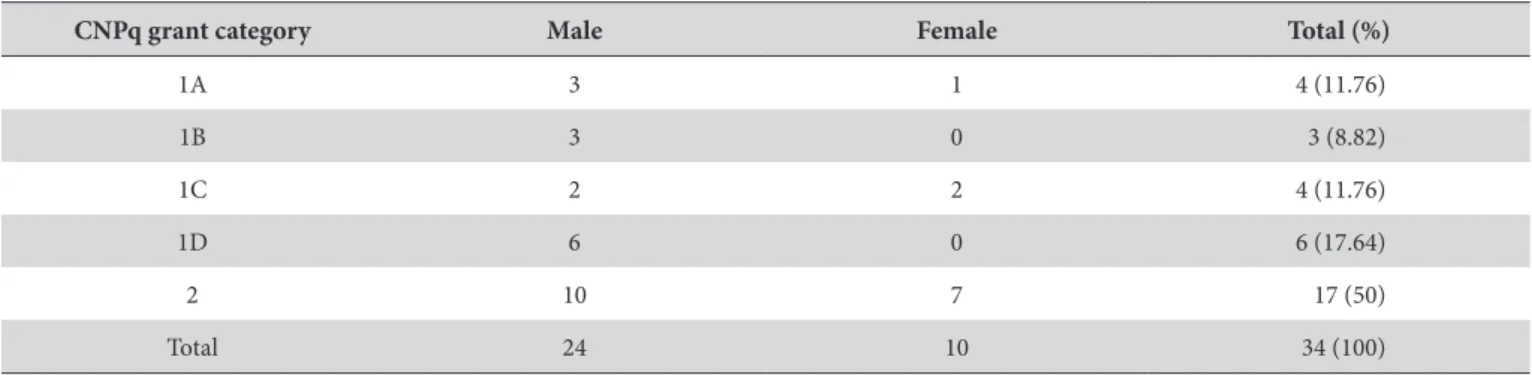
Of a total of 202 researchers in Dentistry, 34 (16.83%) were identiied in the area of oral pathology. he distribution of the 34 researchers according to gender and grant category is shown in Table 1. A predominance of male gender (70.58%) and category 2 grants (50.0%) was observed. All categories showed a prevalence of male gender, except category 1C. he distribution of the oral pathology researchers according to time from completion of the PhD program is shown in Table 2. Most of the researchers concluded their PhDs between 11-20 years ago. In category 1A, three researchers (75%) had obtained their PhDs more than 21 years ago, whereas researchers in category 2 concluded their PhDs less than 10 years ago.
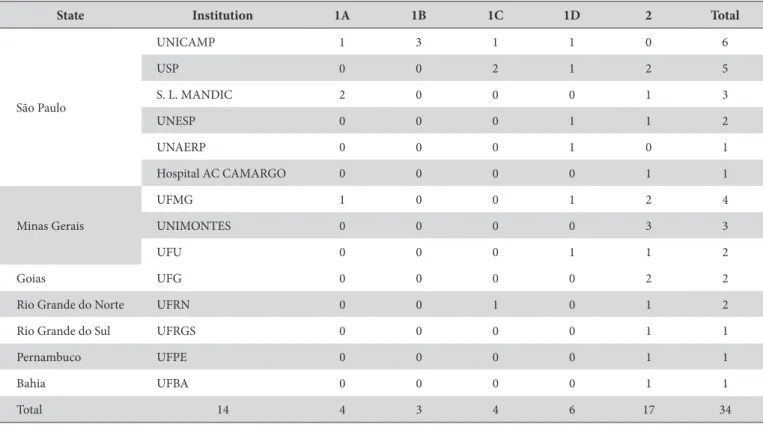
he following two Brazilian States accounted for approximately 79.41% of the researchers: São Paulo (18; 52.94%) and Minas Gerais (9; 26.47%). Regarding af liation, the oral pathology researchers were distributed throughout 14 diferent institutions in the country. However, the following three institutions accounted for approximately 44.11% of the researchers: UNICAMP (6. 17.64%); USP (5. 14.70%); and UFMG (4. 11.76%).
Regarding the institution of the PhD program, 33 researchers obtained their PhD degree in Brazil and 1 in a foreign institution (United Kingdom). he following Brazilian institutions contained the greatest number of PhD researchers: USP, 21 researchers; and UNICAMP, 9. he other institutions at which PhD degrees were obtained were as follows: UFMG (2) and PUC-RS (1). Most researchers (52.94%) had a post-doctorate degree, 15 were obtained at foreign institutions and three in Brazil.
1.
Publications/journals
Considering the 2008-2010 triennium analyzed, oral pathology researchers published 906 ar ticles in journals, with a median of 26.64 articles per researcher during the triennium and 8.88 articles per year. Table 5 illustrates the distribution of articles among the oral pathology scientiic productivity fellowships of CNPq, according to the qualis-CAPES12. It was found that of
906 articles published in three years, 366 (40.39%) were published in strata A (qualis-CAPES). Only 4 articles were published in strata C and 15 were not published in qualis-CAPES12.
2.
Supervisions
Considering the 2008-2010 triennium analyzed, oral pathology researchers supervised 437 scientiic initiation and post-graduate (Master’s and PhD) students. Of these, 138 (31.57%) were scientiic initiation, 169 (38.67%) were Master’s and 130 (29.74%) were PhD students. Regarding the values adjusted for time, the researchers supervised, on average, 1.35 scientiic initiation, 1.65 Master’s, and 1.27 PhD grants per year.
DISCUSSION
According to the Advisory Committee for Dentistry of CNPq, the criteria for the selection and classiication of scholarships include scientiic production, the training of human resources, contributions to innovation, coordination and participation in research projects, participation in editorial activities, and scientiic management3. Moreover, this Committee stated that, considering the limited supply of scholarships, the following criteria, among others, should be used as classiication parameters for all categories/levels: (1) the number of publications and the impact factor of the journals; (2) the number of national and foreign patents; (3) the number of PhD theses, both tutored and approved; (4) the number of Master’s theses, both tutored and approved; and (5) the leadership of research groups3.
he group of oral pathology researchers was formed by 24 men (70.58%) and 10 women (29.41%), revealing the predominance of the male gender. Furthermore, there were more men in all categories, except category 1C. Among the categories analyzed, there was a clear dominance of category 2 grants (50.0%). hese results are consistent with a previous analysis of ours7. In 2006, among 132 researchers in Dentistry, 64.39% were men.
Table 1. Distribution of research grants in oral pathology according to gender and CNPq grant category (n = 34)
CNPq grant category Male Female Total (%)
1A 3 1 4 (11.76)
1B 3 0 3 (8.82)
1C 2 2 4 (11.76)
1D 6 0 6 (17.64)
2 10 7 17 (50)
Total 24 10 34 (100)
Table 2. Distribution of the oral pathology researchers according to time from completion of the PhD program (n = 34)
Time (years) 1A 1B 1C 1D 2 Total (%)
<10 0 0 0 2 10 12 (35.29)
11-20 1 3 3 3 6 16 (47.05)
>21 3 0 1 1 1 6 (17.64)
Table 3. Distribuition of the researchers with grants of the Stomatology area considering Brazilian regions
Regions of Brazil Number of
re-searchers %
Midwest 2 5.88
Northeast 5 14.71
Southeast 25 73.53
South 2 5.88
Furthermore, there were more men in all of the categories, and 42.4% of the researchers were in category 27. hese results are in agreement with those of Scarpelli et al.4 (2008), who analyzed the proile and distribution of researchers in Dentistry who received CNPq scientiic productivity grants in 2008. Research in the ield of Dentistry has seen an increase in the number of references to Brazilian dental studies indexed in international databases (ISI, Web of Science)13. Brazilian dental research is currently one of the most respected areas of dental research in the international scientiic community14.
For decades, disparities have been seen in the development of macro-regions in Brazil, and these discrepancies have also manifested in the distribution of scientiic, technological and
human resources, as well as in scientiic production14. he technical-scientiic base in Brazil is much more pronounced in the southeastern and southern regions, to which most government investments in science and technology are directed, besides the existence of Higher Education Institutions well established in this region and the presence of institutions that promote strong and historically aware of the importance of investment in research. Indicators have revealed that the southeast region houses a large portion of university centers with a level of excellence in many ields of knowledge, as well as the most well-equipped research institutes in the country15. In the present study, 82.35% of the oral pathology researchers were from the southeastern and southern regions. In another study, we showed that most (90%) nephrology researchers were concentrated in only three Brazilian states, two of which were located in the southeastern region16.
Another important characteristic of scientiic activity relates to the formation of qualiied human resources, with an emphasis on the supervision of undergraduate and post-graduate (Master’s and PhD programs) levels. his study illustrated the important participation of researchers in the formation of new researchers. he medians of supervision, adjusted for the researchers’ time from completion of post-graduate (Master’s and PhD), were 1.65 for the Master’s degree and 1.27 for the PhD degree per year. hese values are very similar to those of the 411 researchers in Medicine, considering all specialties (0.50 and 0.30 for the Master’s degree and PhD degree, respectively)10. hey are also comparable to those of the most productive researchers in the area of public health, as compiled by Barata, Goldbaum6 (2003) in an analysis of CNPq researchers. he analysis of the scientiic production of researchers in oral pathology showed a robust
Table 4. Distribution of research grants in Oral Pathology according to the State of Federation and Institutions in the country (n = 34)
State Institution 1A 1B 1C 1D 2 Total
São Paulo
UNICAMP 1 3 1 1 0 6
USP 0 0 2 1 2 5
S. L. MANDIC 2 0 0 0 1 3
UNESP 0 0 0 1 1 2
UNAERP 0 0 0 1 0 1
Hospital AC CAMARGO 0 0 0 0 1 1
Minas Gerais
UFMG 1 0 0 1 2 4
UNIMONTES 0 0 0 0 3 3
UFU 0 0 0 1 1 2
Goias UFG 0 0 0 0 2 2
Rio Grande do Norte UFRN 0 0 1 0 1 2
Rio Grande do Sul UFRGS 0 0 0 0 1 1
Pernambuco UFPE 0 0 0 0 1 1
Bahia UFBA 0 0 0 0 1 1
Total 14 4 3 4 6 17 34
Table 5. Distribution of articles among the oral pathology scientiic productivity fellowships of CNPq according to the qualis-CAPES12 (n = 34)
QUALIS n (%)
A1 104 11.47
A2 262 28.91
B1 127 14.01
B2 101 11.14
B3 152 16.77
B4 79 8.71
B5 62 6.84
C 4 0.44
None 15 1.65
level of production, with a large number of published scientiic articles. From a quality perspective, it is also noteworthy that most of the articles by these researchers were published in journals indexed in prominent databases, such as ISI and Scopus. Considering the 2008-2010 triennium analyzed, the researchers published 906 ar-ticles in journals, with a median of 26.64 articles per researcher during the triennium and 8.88 articles per year. It was found that of the 906 articles published in the three years, 366 (40.39%) were published in strata A12. his increase in scientiic production was also observed in other areas such as public health, chemistry, and physical therapy6-9.
his inding possibly relects several factors that have contributed to the positive incremental cycle of Brazilian scientiic production, as recently pointed out by Petherick1 (2010). We believe that this quantitative increase in the productivity of researchers in Dentistry is also correlated with the general increase in Brazilian scientiic production and possibly relects the various incentive mechanisms that have been implemented by Brazilian research agencies. Among these mechanisms is the improvement in the system for evaluating postgraduate programs. he Brazilian institution responsible for this evaluation is CAPES, which gives priority to the number and quality of articles when published ranking Brazilian postgraduate programs. Another mechanism is the diverse modality of scholarships, including the productivity in research scholarship that promotes competition among peers, encouraging both the training of new researchers and the publication of articles in journals of renown.
A challenging question in science is how to judiciously distribute resources among a large number of competing
researchers16. hus, an important issue for our analysis was to compare the various scholarship categories regarding scientiic productivity. Scholarship in research productivity was conceived by CNPq as a way to motivate researchers with a PhD degree and outstanding scientiic output. Ater several changes in the levels, the scholarships are currently divided into two categories: category 1 (subdivided into levels 1A, 1B, 1C, and 1D) and category 2. Researchers are assigned to these categories/levels according to several criteria available on the CNPq website11, and this assignment has practical implications regarding several aspects of an academic career.
CONCLUSION
he present scientiic investigation addressed the proile and distribution of oral pathology researchers who received CNPq productivity grants and emphasized the important scientiic production during the 2008-2010 triennium, with signiicant participation in the supervision of scientiic initiation and post-graduate (Master’s and PhD) students. It also showed that most researchers are concentrated in a few Brazilian States. By knowing the proile of researchers in oral pathology, more efective strategies for encouraging scientiic production and demanding resources to inance research projects can be deined.
ACKNOWLEDGEMENTS
his work was supported by grants from he National Council for Scientiic and Technological Development-CNPq (to HMJ) and from he Minas Gerais State Research Foundation-FAPEMIG.
REFERENCES
1. Petherick A. High hopes for Brazilian science. Nature. 2010;465(7299):674-5. PMid:20535173. http://dx.doi.org/10.1038/465674a 2. Regalado A. Science in Brazil. Brazilian science: riding a gusher. Science. 2010;330(6009):1306-12. PMid:21127226. http://dx.doi.
org/10.1126/science.330.6009.1306
3. Arruda D, Bezerra F, Neris VA, Toro PR, Wainer J. Brazilian computer science research: gender and regional distributions. Scientometrics. 2009;79:651-65. http://dx.doi.org/10.1007/s11192-007-1944-0
4. Scarpelli AC, Sardenberg F, Goursand D, Paiva SM, Pordeus IA. Academic trajectories of dental researchers receiving CNPQ´s productivity grants. Braz Dent J. 2008;19:252-6. PMid:18949300. http://dx.doi.org/10.1590/S0103-64402008000300014
5. Scariot R, Stadler AF, Assunção CM, Pintarelli TP, Ferreira FM. A map of Brazilian dental research in the last decade. Braz Oral Res. 2011;25:197-204. PMid:21670851. http://dx.doi.org/10.1590/S1806-83242011000300002
6. Barata RB, Goldbaum M. A proile of researchers in public health with productivity grants from the Brazilian National Research Council (CNPq). Cad Saúde Pública. 2003;19:1863-76. PMid:14999353. http://dx.doi.org/10.1590/S0102-311X2003000600031
7. Cavalcante RA, Barbosa DR, Bonan PRF, Pires MBO, Martelli Júnior H. Peril dos pesquisadores da área de odontologia no Conselho Nacional de Desenvolvimento Cientíico e Tecnológico (CNPq). Rev Bras Epidemiol. 2008;11:106-13. http://dx.doi.org/10.1590/S1415-790X2008000100010
8. Mendes PHC, Martelli DRB, Souza WP, Filho SQ, Martelli Júnior H. Peril dos pesquisadores bolsistas de produtividade cientíica na medicina no CNPq, Brasil. Rev Bras Educ Med. 2010;34:535-41. http://dx.doi.org/10.1590/S0100-55022010000400008
9. Santos SMC, Lima LS, Martelli DRB, Martelli Júnior H. Peril dos pesquisadores da Saúde Coletiva no Conselho Nacional de Desenvolvimento Cientíico e Tecnológico. Physis. 2009;19:761-75. http://dx.doi.org/10.1590/S0103-73312009000300012
10. Martelli Júnior H, Martelli DRB, Quirino IG, Oliveira MC, Lima LS, Oliveira EA. CNPq researchers in medicine: a comparative study of research areas. Rev Assoc Med Bras. 2010;56:478-83. PMid:20835648.
12. Capes. Ministério da Educação. Qualis (2011). Disponível em: http://www.capes.gov.br/avaliacao/qualis. 13. Cormack E, Silva Filho CF. A pesquisa cientíica odontológica no Brasil. Rev Assoc Paul Cir Dent. 2000;54:242-7.
14. Dias AA, Narvai PC, Rêgo DM. Scientiic output trends in oral health in Brazil. Rev Panam Salud Publica. 2008;24(1):54-60. PMid:18764995. http://dx.doi.org/10.1590/S1020-49892008000700007
15. Barros FAF. he regional unbalances of the technical-scientiic production. São Paulo Perspec. 2000;14(2):12-9.
16. Oliveira EA, Pécoits-Filho R, Quirino I, Oliveira MC, Martelli DRB, Lima LS, et al. Proile and scientiic production of CNPq researchers in Nephrology and Urology. J Bras Nefrol. 2011;33(1):17-22.
CONFLICTS OF INTERESTS
he authors declare no conlicts of interest.
CORRESPONDING AUTHOR
Maria Ivanilde Pereira Santos
Rua Cristina Vasconcelos, 115, Barcelona Park, 39401-152 Montes Claros, MG, Brasil e-mail: [email protected]