Eliana Gonçalves V. Souza,
1Melissa G. Ramos,
2Cláudia Hara,
3Bárbara Perdigão Stumpf,
4Fábio L. Rocha
5Desempenho neuropsicológico e ciclo menstrual: revisão da literatura
Neuropsychological performance and menstrual cycle:
a literature review
Abstract
Approximately 80% of all women of reproductive age experience psychological and physical changes associated with the premenstrual phase. Cognitive alterations are among the most common complaints. In this context, studies have assessed cognitive performance across the menstrual cycle in healthy women and also in women with premenstrual syndrome (PMS). The main objective of the present study was to review the literature on cognitive function in different phases of the menstrual cycle in women of reproductive age, both healthy and with PMS, in particular premenstrual dysphoric disorder (PMDD). We searched MEDLINE and LILACS databases. A total of 27 studies were selected. The studies used heterogeneous methodologies. Most studies suggested that healthy women show small luctuations in cognitive performance across the menstrual cycle, with low performance scores in the luteal phase for visuospatial and motor skills, attention and concentration, verbal memory, visual memory, working memory, and reaction time. Among women with PMS or PMDD, low performance scores for visuospatial and motor skills, attention and concentration, verbal memory, working memory, reaction time and impulsivity were also detected in the luteal phase. Symptoms observed in PMS/PMDD patients showed low intensity, but greater when compared with healthy women. Evidence indicates luctuations in cognitive performance in the different phases of the menstrual cycle in healthy and PMS women, with worse performance for women with PMS/PMDD in the luteal phase. However, methodological limitations prevent us from drawing solid conclusions. Further studies are needed to investigate the impact of these cognitive luctuations on patients’ daily activities.
Keywords: Premenstrual syndrome, premenstrual dysphoric disorder, cognitive functioning, impulsivity, attention, executive functions.
1 Psicóloga. Mestre em Ciências da Saúde, Instituto de Previdência dos Servidores do Estado de Minas Gerais (IPSEMG), Belo Horizonte, MG, Brazil. Professora,
Faculdade de Ciências Médicas de Minas Gerais (FCMMG), Belo Horizonte, MG, Brazil. 2 Psiquiatra. Mestre em Ciências da Saúde, IPSEMG. Professora,
Depar-tamento de Psiquiatria, Faculdade de Ciências Médicas de Minas Gerais (FCMMG), Belo Horizonte, MG, Brazil. 3 Psiquiatra. Doutora em Saúde Pública –
Epide-miologia, Faculdade de Medicina, Universidade Federal de Minas Gerais (UFMG), Belo Horizonte, MG, Brazil. Professora, Faculdade da Saúde e Ecologia Humana (FASEH), Vespasiano, MG, Brazil. 4 Psiquiatra. Mestre em Ciências da Saúde, IPSEMG. 5 Psiquiatra. Coordenador, Clínica Psiquiátrica e Curso de Pós-Graduação
em Ciências da Saúde, IPSEMG. Doutor em Ciências da Saúde, Universidade de Brasília (UnB), Brasília, DF, Brazil.
This paper is part of the Master’s thesis presented in 2008 at the Graduate Program in Health Sciences, Instituto de Previdência dos Servidores do Estado de Minas Gerais (IPSEMG). The thesis was entitled “Neuropsychological changes in women with premenstrual dysphoric disorder: focus on impulsivity and attention” (in Portuguese, “Alterações neuropsicológicas em mulheres com transtorno disfórico pré-menstrual: enfoque na impulsividade e na atenção”).
Submitted Apr 04 2011, accepted for publication Aug 04 2011. No conlicts of interest declared concerning the publication of this article.
Suggested citation: Souza EG, Ramos MG, Hara C, Stumpf BP, Rocha FL. Neuropsychological performance and menstrual cycle: a literature review. Trends
Psychiatry Psychother. 2012;34(1):5-12.
Resumo
Cerca de 80% das mulheres em idade fértil apresentam alterações psicológicas e físicas associadas à fase pré-menstrual. Dentre as queixas mais comuns estão as alterações cognitivas. Nesse con-texto, tem-se estudado o desempenho cognitivo ao longo do ciclo menstrual de mulheres com e sem síndrome pré-menstrual (SPM). O objetivo principal deste estudo foi revisar a literatura acerca do desempenho das funções cognitivas nas diferentes fases do ciclo menstrual de mulheres em idade reprodutiva, sadias ou portadoras de SPM, em particular o transtorno disfórico pré-menstrual (TDPM). Foram revisadas as bases de dados MEDLINE e LILACS. Um total de 27 estudos foram selecionados. Os estudos eram heterogêneos em suas metodologias. Em sua maioria, os trabalhos evidenciaram que mulheres sadias apresentam variações leves no desempenho cog-nitivo ao longo do ciclo menstrual, obtendo menor pontuação, du-rante a fase lútea, nas habilidades visuoespaciais e motoras, aten-ção e concentraaten-ção, memória verbal, memória visual, memória de trabalho e tempo de reação. Entre as mulheres com SPM ou TDPM, foi identiicada, na fase lútea, redução no desempenho das habili-dades visuoespaciais e motoras, atenção e concentração, memória verbal, memória de trabalho, tempo de reação e impulsividade. Tais sintomas apresentaram intensidade leve, porém superior à obser-vada em mulheres sadias. As evidências indicam a existência de variações no desempenho cognitivo ao longo das diferentes fases do ciclo menstrual de mulheres sadias ou com SPM, com desem-penho cognitivo pior em mulheres com SPM/TDPM na fase lútea. Entretanto, limitações metodológicas impedem conclusões sólidas. Novos estudos são necessários para investigar o impacto dessas oscilações cognitivas nas atividades cotidianas dos pacientes.
Descritores: Síndrome menstrual, transtorno disfórico pré-menstrual, funcionamento cognitivo, impulsividade, atenção, funções executivas.
Introduction
Physical and psychological symptoms associated with
the premenstrual phase are reported by about 80% of
women of reproductive age.
1The spectrum of symptoms
may range from mild discomfort up to multiple symptoms
of moderate to severe intensity, including functional
impairment. In the latter case, women may be diagnosed
with premenstrual syndrome (PMS) or, in more severe
cases, with premenstrual dysphoric disorder (PMDD).
1,2According to the International Classiication of
Diseases (ICD-10),
3PMS is characterized by a collection
of physical, mood, cognitive, and behavioral symptoms
that follow a cyclic pattern, starting between 1 to 2 weeks
before menstruation (luteal phase) and vanishing on
the irst days of menstrual low (follicular phase).
4The
prevalence of PMS in international studies varies from
20 to 40%.
5PMDD is a severe subtype of PMS in which
mood symptoms predominate in the premenstrual phase
(e.g. sadness, reduced ability to experience pleasure,
mood lability, anxiety, irritability, anger, self-depreciation,
reduced pain threshold, reduced impulse control, and
sleep disorders).
6,7PMDD affects 3 to 8% of women.
1Cognitive complaints, including dificulty concentrating,
memory impairment, distractibility, lack of self-conidence
when making decisions, or even indecision, in addition to
motor insuficiency, comprise the spectrum of symptoms
associated with the premenstrual phase. In PMDD,
these complaints are even more frequent and intense.
1,2However, the results reported by studies focusing on the
inluence of the menstrual cycle on cognitive function are
conlictive.
8The main aim of the present study was to review
the literature on neuropsychological performance in the
different phases of the menstrual cycle of women of
reproductive age, both healthy and with PMS/PMDD.
Method
The literature was browsed for studies focusing on
cognitive performance in women of reproductive age across
the different phases of the menstrual cycle. The databases
and periods assessed were as follows: MEDLINE, studies from
1976 to December 2010, and Literatura Latino-Americana
e do Caribe em Ciências da Saúde (LILACS), studies
from 1982 to December 2010. The following keywords
were used: menstrual cycle, premenstrual syndrome,
premenstrual dysphoric disorder, neuropsychology,
cognitive functioning, impulsivity, attention, and executive
functions. Studies published in Portuguese and English
were reviewed. The reference lists of the selected studies
were also searched. A total of 155 articles were read to
select those assessing neuropsychological functioning with
the use of psychometric tests in women of reproductive
age, either healthy or with PMS/PMDD.
Results and discussion
Of the 155 articles retrieved, 27 were found to use
psychometric tests for the assessment of neuropsychological
functioning across the menstrual cycle of women of
reproductive age (18 to 45 years), either healthy or
with PMS/PMDD. Seventeen articles assessed cognitive
changes in the different phases of the menstrual cycle
in healthy women,
8-24six assessed women with PMS,
25-30and four articles assessed women with PMDD.
31-34The
neuropsychological functions assessed were different
across studies and included verbal and non-verbal
memory, working memory, attention and concentration,
reasoning, language, executive functions (planning,
impulse control, and cognitive lexibility), reaction time,
motor and visuospatial skills.
The main neuropsychological tests used in the
reviewed studies were: Stroop Test, Digit Span, Digit
Symbol, Trail Making A and B, California Verbal Learning
Test (CVLT), Wechsler Adult Intelligence Scale – Revised
(WAIS-R), Wechsler Memory Scale – Revised (WMS-R),
Verbal Fluency (FAS), and the Grooved Pegboard test.
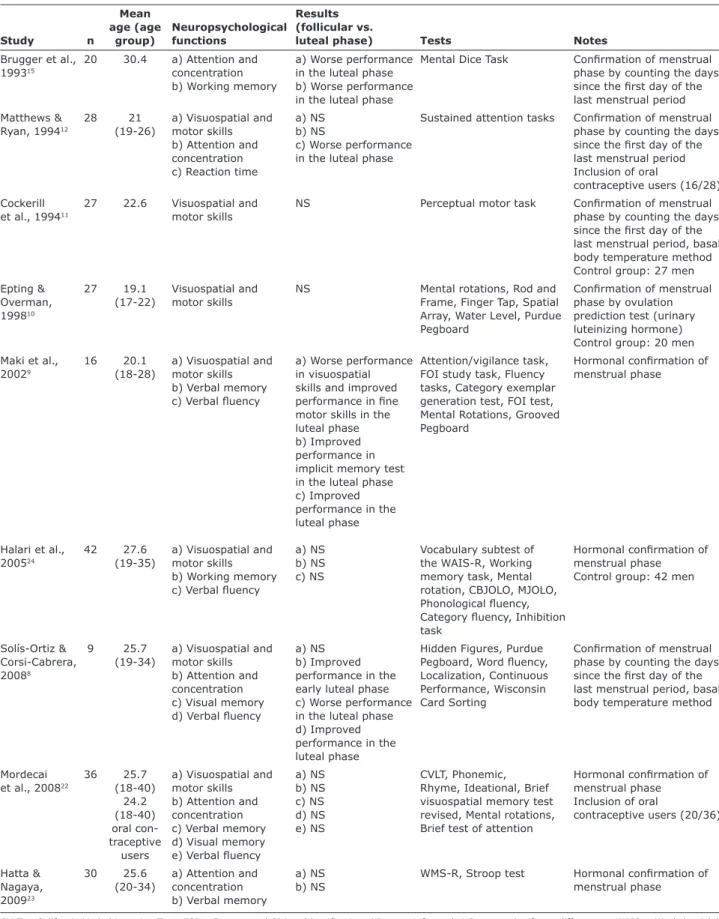
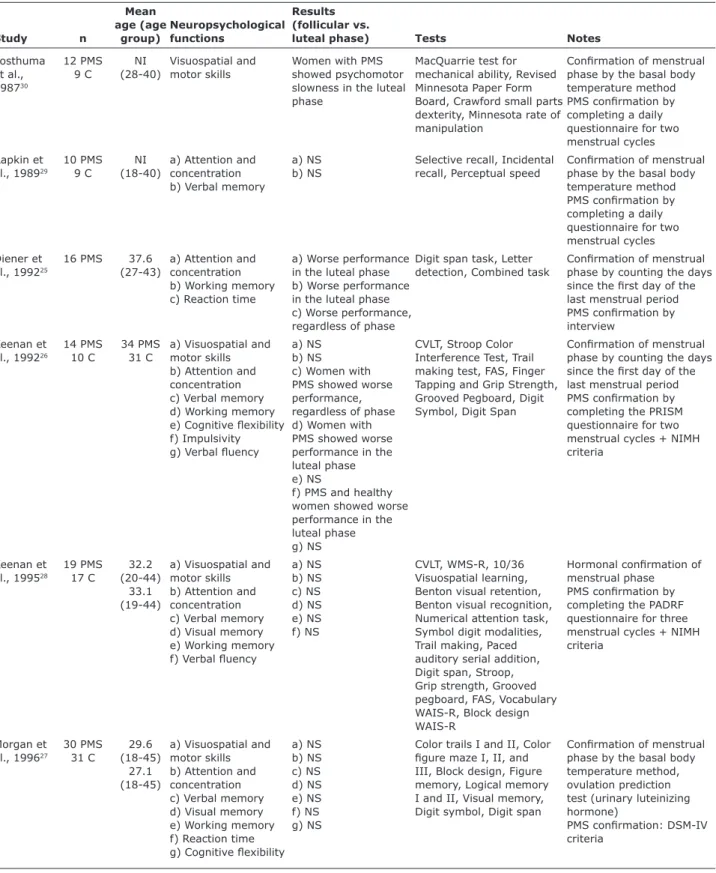
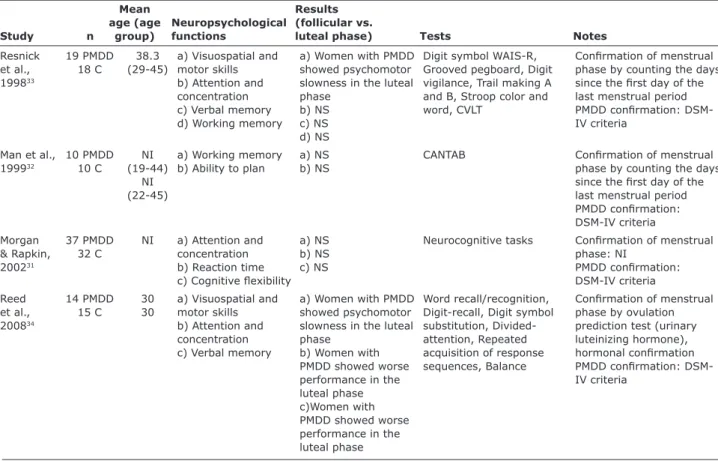
The designs and results of the 27 studies included in the
review are described in Tables 1 and 2.
Studies involving healthy women showed mild
luctuations in visuospatial, ine motor, and articulatory
skills, attention and concentration, verbal memory, visual
memory, working memory, and reaction time across the
menstrual cycle, with a trend towards worse performance
scores in the luteal phase (Table 1). However, indings
were not consensual. No changes were observed in
impulsivity and deductive logical reasoning. The results
reported suggest that hormonal changes have an impact
on the cognitive performance of healthy women.
9,12-18,20,24In women with PMS and PMDD, cognitive complaints
associated with the premenstrual phase point to the
presence of abnormalities in the different phases of the
menstrual cycle and suggest that systematic evaluations
would reveal additional details of such abnormalities.
However, studies employing neuropsychological
functioning tests have reported only mild changes, with
conlictive indings. Evidence points to the presence of
mild impacts on visuospatial and motor skills, attention
and concentration, verbal memory, working memory,
reaction time, and impulsivity, with worse performance
scores in the luteal phase (Table 2). No changes were
observed in visual memory, cognitive lexibility, ability
to plan, and verbal luency. When women with PMS or
Results (follicular vs. luteal phase)
a) NS b) NS c) NS
Worse performance in the luteal phase
a) NS b) NS c) NS
a) Worse performance in memory tests using semantically similar word lists in the follicular phase and worse performance in memory tests using acoustically similar word lists in the luteal phase
b) Improved verbal reasoning speed in complex sentences in the luteal phase a) Worse performance in spatial skills and improved performance in manual and articulatory skills in the late follicular phase compared with the menstrual phase b) NS between the menstrual and late follicular phases c) NS between the menstrual and late follicular phases Worse performance in the luteal phase
a) NS b) NS
c) Worse performance in the follicular phase d) NS
a) NS b) NS c) NS d) NS
Neuropsychological functions
a) Visuospatial and motor skills b) Attention and concentration c) Verbal memory
Reaction time
a) Visuospatial and motor skills b) Attention and concentration c) Impulsivity a) Verbal memory b) Verbal logical reasoning
a) Visuospatial and motor skills b) Deductive logical reasoning
c) Verbal luency
Attention and concentration
a) Attention and concentration b) Verbal memory c) Visual memory d) Working memory
a) Visuospatial and motor skills b) Attention and concentration c) Verbal memory d) Visual memory
n
50
13
87
30
50
50
25
82
Mean age (age
group)
NI (30-45)
NI (19-22)
19.2
34.6
26.4 (20-43)
NI
24 (18-35)
NI (18-36)
Study
Golub, 197621
Slade & Jenner, 198020
Broverman et al., 198119
Hartley et al., 198718
Hampson, 199017
Lord & Taylor, 199114
Phillips & Sherwin, 199216
Gordon & Lee, 199313
Tests
Hidden patterns, Nearer point, Gestalt, Anagrams, Inference, Picture number, Utility (luency), Utility (lexibility), Associational luency, Plot titles (luency), Plot titles (cleverness), Possible jobs, Expressional luency, Hidden igures, Figure classiication Primary task, Secondary task
Speed of reading repeated color names, Speed of naming repeated colors, Embedded igures test, WAIS block design subtest Logical reasoning, Recall of acoustically or semantically similar word lists,
Immediate and delayed retention of prose
Portable Rod-and-Frame Test, Hidden Figures, Space Relations, Number Comparisons, Identical Pictures, Subtraction and Multiplication, Oral Fluency, Expressional Fluency, Speeded Counting, Color Reading and Naming, Syllable Repetition, Manual Sequence Box, Purdue Pegboard, Finger Tapping, Inference Test
Stroop color-word test
WMS
Symbol digit modalities, Cognitive laterality battery, Verbosequential tests, Visuospatial tests
Notes
Conirmation of menstrual phase by counting the days since the irst day of the last menstrual period
Conirmation of menstrual phase by counting the days since the irst day of the last menstrual period Conirmation of menstrual phase by the basal body temperature method: 21/87 (24%) probably did not ovulate
Conirmation of menstrual phase by the basal body temperature method
Hormonal conirmation of menstrual phase
Conirmation of menstrual phase by counting the days since the irst day of the last menstrual period Control group: 50 men
Hormonal conirmation of menstrual phase
Hormonal conirmation of menstrual phase Inclusion of oral
contraceptive users (34/82)
Table 1 – Studies assessing neuropsychological functioning across the menstrual cycle in healthy women
Brugger et al., 199315
Matthews & Ryan, 199412
Cockerill et al., 199411
Epting & Overman, 199810
Maki et al., 20029
Halari et al., 200524
Solís-Ortiz & Corsi-Cabrera, 20088
Mordecai et al., 200822
Hatta & Nagaya, 200923
20
28
27
27
16
42
9
36
30 30.4
21 (19-26)
22.6
19.1 (17-22)
20.1 (18-28)
27.6 (19-35)
25.7 (19-34)
25.7 (18-40)
24.2 (18-40) oral con-traceptive
users 25.6 (20-34)
a) Attention and concentration b) Working memory
a) Visuospatial and motor skills b) Attention and concentration c) Reaction time
Visuospatial and motor skills
Visuospatial and motor skills
a) Visuospatial and motor skills b) Verbal memory c) Verbal luency
a) Visuospatial and motor skills b) Working memory c) Verbal luency
a) Visuospatial and motor skills b) Attention and concentration c) Visual memory d) Verbal luency
a) Visuospatial and motor skills b) Attention and concentration c) Verbal memory d) Visual memory e) Verbal luency a) Attention and concentration b) Verbal memory
a) Worse performance in the luteal phase b) Worse performance in the luteal phase a) NS
b) NS
c) Worse performance in the luteal phase
NS
NS
a) Worse performance in visuospatial skills and improved performance in ine motor skills in the luteal phase b) Improved performance in implicit memory test in the luteal phase c) Improved performance in the luteal phase
a) NS b) NS c) NS
a) NS b) Improved performance in the early luteal phase c) Worse performance in the luteal phase d) Improved performance in the luteal phase a) NS b) NS c) NS d) NS e) NS
a) NS b) NS
Mental Dice Task
Sustained attention tasks
Perceptual motor task
Mental rotations, Rod and Frame, Finger Tap, Spatial Array, Water Level, Purdue Pegboard
Attention/vigilance task, FOI study task, Fluency tasks, Category exemplar generation test, FOI test, Mental Rotations, Grooved Pegboard
Vocabulary subtest of the WAIS-R, Working memory task, Mental rotation, CBJOLO, MJOLO, Phonological luency, Category luency, Inhibition task
Hidden Figures, Purdue Pegboard, Word luency, Localization, Continuous Performance, Wisconsin Card Sorting
CVLT, Phonemic, Rhyme, Ideational, Brief visuospatial memory test revised, Mental rotations, Brief test of attention
WMS-R, Stroop test
Conirmation of menstrual phase by counting the days since the irst day of the last menstrual period Conirmation of menstrual phase by counting the days since the irst day of the last menstrual period Inclusion of oral
contraceptive users (16/28) Conirmation of menstrual phase by counting the days since the irst day of the last menstrual period, basal body temperature method Control group: 27 men Conirmation of menstrual phase by ovulation prediction test (urinary luteinizing hormone) Control group: 20 men Hormonal conirmation of menstrual phase
Hormonal conirmation of menstrual phase Control group: 42 men
Conirmation of menstrual phase by counting the days since the irst day of the last menstrual period, basal body temperature method
Hormonal conirmation of menstrual phase Inclusion of oral
contraceptive users (20/36)
Hormonal conirmation of menstrual phase
CVLT = California Verbal Learning Test; FOI = Fragmented Object Identiication; NI = not informed; NS = non-signiicant differences; WAIS = Wechsler Adult Intelligence Scale; WMS = Wechsler Memory Scale.
Results (follicular vs. luteal phase) Neuropsychological
functions n
Mean age (age
group)
Study Tests Notes
Table 1 – Studies assessing neuropsychological functioning across the menstrual cycle in healthy women (cont.)
Results (follicular vs. luteal phase)
Women with PMS showed psychomotor slowness in the luteal phase
a) NS b) NS
a) Worse performance in the luteal phase b) Worse performance in the luteal phase c) Worse performance, regardless of phase a) NS
b) NS
c) Women with PMS showed worse performance, regardless of phase d) Women with PMS showed worse performance in the luteal phase e) NS
f) PMS and healthy women showed worse performance in the luteal phase g) NS a) NS b) NS c) NS d) NS e) NS f) NS
a) NS b) NS c) NS d) NS e) NS f) NS g) NS
Neuropsychological functions
Visuospatial and motor skills
a) Attention and concentration b) Verbal memory
a) Attention and concentration b) Working memory c) Reaction time
a) Visuospatial and motor skills b) Attention and concentration c) Verbal memory d) Working memory e) Cognitive lexibility f) Impulsivity g) Verbal luency
a) Visuospatial and motor skills b) Attention and concentration c) Verbal memory d) Visual memory e) Working memory f) Verbal luency
a) Visuospatial and motor skills b) Attention and concentration c) Verbal memory d) Visual memory e) Working memory f) Reaction time g) Cognitive lexibility
n
12 PMS 9 C
10 PMS 9 C
16 PMS
14 PMS 10 C
19 PMS 17 C
30 PMS 31 C
Mean age (age
group)
NI (28-40)
NI (18-40)
37.6 (27-43)
34 PMS 31 C
32.2 (20-44)
33.1 (19-44)
29.6 (18-45)
27.1 (18-45)
Study
Posthuma et al., 198730
Rapkin et al., 198929
Diener et al., 199225
Keenan et al., 199226
Keenan et al., 199528
Morgan et al., 199627
Tests
MacQuarrie test for mechanical ability, Revised Minnesota Paper Form Board, Crawford small parts dexterity, Minnesota rate of manipulation
Selective recall, Incidental recall, Perceptual speed
Digit span task, Letter detection, Combined task
CVLT, Stroop Color Interference Test, Trail making test, FAS, Finger Tapping and Grip Strength, Grooved Pegboard, Digit Symbol, Digit Span
CVLT, WMS-R, 10/36 Visuospatial learning, Benton visual retention, Benton visual recognition, Numerical attention task, Symbol digit modalities, Trail making, Paced auditory serial addition, Digit span, Stroop, Grip strength, Grooved pegboard, FAS, Vocabulary WAIS-R, Block design WAIS-R
Color trails I and II, Color igure maze I, II, and III, Block design, Figure memory, Logical memory I and II, Visual memory, Digit symbol, Digit span
Notes
Conirmation of menstrual phase by the basal body temperature method PMS conirmation by completing a daily questionnaire for two menstrual cycles
Conirmation of menstrual phase by the basal body temperature method PMS conirmation by completing a daily questionnaire for two menstrual cycles
Conirmation of menstrual phase by counting the days since the irst day of the last menstrual period PMS conirmation by interview
Conirmation of menstrual phase by counting the days since the irst day of the last menstrual period PMS conirmation by completing the PRISM questionnaire for two menstrual cycles + NIMH criteria
Hormonal conirmation of menstrual phase PMS conirmation by completing the PADRF questionnaire for three menstrual cycles + NIMH criteria
Conirmation of menstrual phase by the basal body temperature method, ovulation prediction test (urinary luteinizing hormone)
PMS conirmation: DSM-IV criteria
Table 2 – Studies assessing neuropsychological functioning across the menstrual cycle in women with PMS/PMDD
PMDD were compared with healthy women, the former
showed a tendency towards worse cognitive performance
in the luteal phase.
The lack of consensus in the results reported
may be explained, at least in part, by heterogeneous
samples, variations in age, educational levels, use of oral
contraceptives, diagnosis (PMS or PMDD), and severity
of symptoms.
Studies with young women should investigate the
occurrence of anovulatory cycles, since only 62% of women
in the 20-24 age group ovulate in all menstrual cycles.
10,16Because anovulatory cycles have been associated with
absence of progesterone increases in the luteal phase,
failing to detect these data (or eliminating them from
the analyses) would decrease the probability of detecting
cognitive abnormalities across the menstrual cycle.
19With regard to education, an improved knowledge
of symptoms associated with the premenstrual phase
seems to overestimate complaints, especially those
related to the last cycle.
2Resnick et al., 199833
Man et al., 199932
Morgan & Rapkin, 200231
Reed et al., 200834
19 PMDD 18 C
10 PMDD 10 C
37 PMDD 32 C
14 PMDD 15 C
38.3 (29-45)
NI (19-44)
NI (22-45)
NI
30 30
a) Visuospatial and motor skills b) Attention and concentration c) Verbal memory d) Working memory
a) Working memory b) Ability to plan
a) Attention and concentration b) Reaction time c) Cognitive lexibility a) Visuospatial and motor skills b) Attention and concentration c) Verbal memory
a) Women with PMDD showed psychomotor slowness in the luteal phase
b) NS c) NS d) NS a) NS b) NS
a) NS b) NS c) NS
a) Women with PMDD showed psychomotor slowness in the luteal phase
b) Women with PMDD showed worse performance in the luteal phase c)Women with PMDD showed worse performance in the luteal phase
Digit symbol WAIS-R, Grooved pegboard, Digit vigilance, Trail making A and B, Stroop color and word, CVLT
CANTAB
Neurocognitive tasks
Word recall/recognition, Digit-recall, Digit symbol substitution, Divided-attention, Repeated acquisition of response sequences, Balance
Conirmation of menstrual phase by counting the days since the irst day of the last menstrual period PMDD conirmation: DSM-IV criteria
Conirmation of menstrual phase by counting the days since the irst day of the last menstrual period PMDD conirmation: DSM-IV criteria
Conirmation of menstrual phase: NI
PMDD conirmation: DSM-IV criteria
Conirmation of menstrual phase by ovulation prediction test (urinary luteinizing hormone), hormonal conirmation PMDD conirmation: DSM-IV criteria
Results (follicular vs. luteal phase) Neuropsychological
functions n
Mean age (age
group)
Study Tests Notes
Table 2 – Studies assessing neuropsychological functioning across the menstrual cycle in women with PMS/PMDD (cont.)
C = controls; CANTAB = Cambridge Neuropsychological Test Automated Batteries; CVLT = California Verbal Learning Test; DSM-IV = Diagnostic and Statiscal Manual of Mental Disorders; NI = not informed; NIMH = National Institute of Mental Health; NS = non-signiicant differences; PADRF = Premenstrual Assessment Form-Daily Rating Form; PMDD = premenstrual dysphoric disorder; PMS = premenstrual syndrome; PRISM = Prospective Record of the Impact and Severity of
Menstrual Symptomatology.
Most studies focusing on neuropsychological
functioning across the menstrual cycle have excluded
women using oral contraceptives.
12Although extremely
popular, little is known about the effect of contraceptive
pills on cognitive functioning.
22In the few studies that
included oral contraceptive users, several potential biases
were observed, e.g. the so-called survivor effect (excluding
women that did not tolerate contraceptives), which causes
a selection bias. The irregular use of oral contraceptives
also provides grounds for concern, once it is known that
nearly 25% of women stop taking oral contraceptives
within 1 year. One further problem is the commercial
availability of several different brands of contraceptives in
the market, each one with different doses of estradiol and
different types of progestinic agents.
In the studies included in the present review,
diagnostic conirmation of PMS or PMDD was performed
prospectively. This is a methodological strength of
these studies, once only a minority of the women who
believe they have PMS or PMDD actually meet diagnostic
Differences in study designs and methodological
limitations are factors that prevent us from drawing
solid conclusions. Further studies are necessary to
investigate the impact of such cognitive luctuations
on clinical practice and patients’ daily activities. It is
also necessary to try to correlate patients’ complaints
with abnormalities found on cognitive tests, in order to
determine the clinical relevance of the results found in
neuropsychological evaluations.
References
1. Pearlstein T, Stone AB. Pemenstrual syndrome. Psychiatr Clin North Am. 1998;21:577-90.
2. Marvan ML, Escobedo C. Premenstrual symptomatology: role of prior knowledge about premenstrual syndrome. Psychosom Med. 1999;61:163-7.
3. Organização Mundial da Saúde. Classiicação Internacional de Doenças e Problemas Relacionados à Saúde - 10ª Revisão (CID-10). São Paulo: EDUSP; 1994.
4. ACOG practice bulletin: premenstrual syndrome. Int J Gynecol Obstet. 2001;73:183-91.
5. Borenstein JE, Dean BB, Endicott J, Wong J, Brown C, Dickerson V, et al. Health and economic impact of the premenstrual syndrome. J Reprod Med. 2003;48:515-24. 6. American Psychiatric Association. Diagnostic and Statistical
Manual of Mental Disorders - 4th edition (DSM-IV). Washington: APA; 1995.
7. Steiner M, Steinberg S, Stewart D, Carter D, Berger C, Reid R, et al. Fluoxetine in the treatment of premenstrual dysphoria. N Engl J Med. 1995;332:1529-34.
8. Solís-Ortiz S, Corsi-Cabrera M. Sustained attention is favored by progesterone during early luteal phase and visuo-spatial memory by estrogens during ovulatory phase in young women. Psychoneuroendocrinology. 2008;33:989-98. 9. Maki PM, Rich JB, Rosenbaum RS. Implicit memory varies
across the menstrual cycle: estrogen effects in young women. Neuropsychologia. 2002;40:518-29.
10. Epting LK, Overman WH. Sex-sensitive tasks in men and women: a search for performance luctuations across the menstrual cycle. Behav Neurosci. 1998;112:1304-17. 11. Cockerill IM, Wormington JA, Nevill AM. Menstrual-cycle
effects on mood and perceptual-motor performance. J Psychosom Res. 1994;38:763-71.
12. Matthews G, Ryan H. The expression of the ‘pre-menstrual syndrome’ in measures of mood and sustained attention. Ergonomics. 1994;37:1407-17.
13. Gordon HW, Lee PA. No difference in cognitive performance between phases of the menstrual cycle. Psychoneuroendocrinology. 1993;18:521-31.
14. Lord T, Taylor K. Monthly luctuation in task concentration in female college students. Percept Mot Skills. 1991;72:435-9. 15. Brugger P, Milicevic A, Regard M, Cook ND. Random-number
generation and the menstrual cycle: preliminary evidence for a premenstrual alteration of frontal lobe functioning. Percept Mot Skills. 1993;77:915-21.
16. Phillips SM, Sherwin BB. Variations in memory function and sex steroid hormones across the menstrual cycle. Psychoneuroendocrinology. 1992;17:497-506.
17. Hampson E. Estrogen-related variations in human spatial and articulatory-motor skills. Psychoneuroendocrinology. 1990;15:97-111.
18. Hartley LR, Lyons D, Dunne M. Memory and menstrual cycle. Ergonomics. 1987;30:111-20.
criteria.
35An additional dificulty in the comparison of
results is the diversity of neuropsychological tests and
batteries used to measure different cognitive functions.
It is possible that at least some of the psychometric
tests employed have been inadequate, i.e., not sensitive
enough to detect menstrual inluences on cognition.
36Another relevant problem is related to the determination
of the menstrual cycle phase in the different studies. Most
studies used one of the following methods to conirm the
menstrual phase: counting the days since the irst day
of the last menstrual period, basal body temperature
method, or hormonal conirmation. The latter method is
the most reliable, but also the most costly.
10,16,23Studies
that base menstrual cycle phase conirmation on counting
days use different criteria to deine the luteal phase (e.g.
days 20-25 or days 15-22).
16Finally, the absence of
control for anxiety and depression symptoms may affect
women’s performance on tests, hindering a consistent
comparative analysis across studies.
36As already mentioned, there is no consensus in
the literature on the relationship between hormones
and cognitive performance. Even when positive results
were reported, they were either not replicated or
inconsistent.
13It is also necessary to consider the
possibility that a larger number of studies with positive
results have been published (publication bias). Finally,
the poor understanding currently available of the effects
of hormones and other neurobiological substances
on cognitive performance, as well as the inluence of
environmental variables (e.g. stress, sleep deprivation,
diet), should be taken into consideration.
13Conclusion
Although complaints are frequent, there is no
unequivocal evidence of the inluence of the menstrual
cycle on neuropsychological abnormalities in healthy
women. Conversely, there appears to be some
inluence on visuospatial and motor skills, attention and
concentration, verbal memory, visual memory, working
memory, and reaction time, with a tendency toward
worse performance scores in the luteal phase.
In women with PMS or PMDD, unequivocal evidence
of such inluence has not been found either. There is only
little evidence of reduced performance on visuospatial
and motor skills, attention and concentration, verbal
memory, working memory, reaction time, and impulsivity
in the luteal phase; symptoms in PMS/PMDD patients
show low intensity, but greater when compared with
healthy women. The luctuations found can be considered
19. Broverman DM, Vogel W, Klaiber EL, Majcher D, Shea D, Paul V. Changes in cognitive task performance across the menstrual cycle. J Comp Physiol Psychol. 1981;95:646-54. 20. Slade P, Jenner FA. Performance tests in different phases of
the menstrual cycle. J Psychosom Res. 1980;24:5-8. 21. Golub S. The effect of premenstrual anxiety and depression
on cognitive function. J Pers Soc Psychol. 1976;34:99-104. 22. Mordecai KL, Rubin LH, Maki PM. Effects of menstrual cycle
phase and oral contraceptive use on verbal memory. Horm Behav. 2008;54:286-93.
23. Hatta T, Nagaya K. Menstrual cycle phase effects on memory and Stroop task performance. Arch Sex Behav. 2009;38:821-7.
24. Halari R, Hines M, Kumari V, Mehrotra R, Wheeler M, Ng V, et al. Sex differences and individual differences in cognitive performance and their relationship to endogenous gonadal hormones and gonadotropins. Behav Neurosci. 2005;119:104-17.
25. Diener D, Greenstein FL, Turnbough PD. Cyclical variation in digit-span and visual-search performance in women differing in the severity of their premenstrual symptoms. Percept Mot Skills. 1992;74:67-76.
26. Keenan PA, Stern RA, Janowsky DS, Pedersen CA. Psychological aspects of premenstrual syndrome I: cognition and memory. Psychoneuroendocrinology. 1992;17:179-87. 27. Morgan M, Rapkin AJ, D’Elia L, Reading A, Goldman L.
Cognitive functioning in premenstrual syndrome. Obstet Gynecol. 1996;88:961-6.
28. Keenan PA, Lindamer LA, Jong SK. Menstrual phase-independent retrieval deicit in women with PMS. Biol Psychiatry. 1995;38:369-77.
29. Rapkin AJ, Chang LC, Reading AE. Mood and cognitive style in premenstrual syndrome. Obstet Gynecol. 1989;74:644-9. 30. Posthuma BW, Bass MJ, Bull SB, Nisker JA. Detecting changes
in functional ability in women with premenstrual syndrome. Am J Obstet Gynecol. 1987;156:275-8.
31. Morgan M, Rapkin A. Cognitive lexibility, reaction time, and attention in women with premenstrual dysphoric disorder. J Gend Specif Med. 2002;5:28-36.
32. Man MS, MacMillan I, Scott J, Young AH. Mood, neuropsychological function and cognitions in premenstrual dysphoric disorder. Psychol Med. 1999;29:727-33.
33. Resnick A, Perry W, Parry B, Mostoi N, Udell C. Neuropsychological performance across the menstrual cycle in women with and without premenstrual dysphoric disorder. Psychiatry Res. 1998;77:147-58.
34. Reed SC, Levin FR, Evans SM. Changes in mood, cognitive performance and appetite in the late luteal and follicular phases of the menstrual cycle in women with and without PMDD (premenstrual dysphoric disorder). Horm Behav. 2008;54:185-93.
35. Ramos MG, Hara C, Rocha FL. Duloxetine treatment for women with premenstrual dysphoric disorder: a single blind trial. Int J Neuropsychopharmacol. 2009;12:1081-8. 36. Sherwin BB. Estrogen and cognitive functioning in women.
Endocr Rev. 2003;24:133-51.
Correspondence:
Bárbara Perdigão Stumpf
Rua Ceará, 195/1203, Santa Eigênia 30150-310 - Belo Horizonte, MG - Brazil E-mail: [email protected]