Nursing workload among adults, elderly
and very elderly patients in the
Intensive Care Unit
CARGA DE TRABALHO DE ENFERMAGEM REQUERIDA POR ADULTOS, IDOSOS E MUITO IDOSOS EM UNIDADE DE TERAPIA INTENSIVA
CARGA DE TRABAJO DE ENFERMERÍA RELACIONADA A ADULTOS, ANCIANOS Y MUY ANCIANOS EN TERAPIA INTENSIVA
1 Associate Professor at School of Nursing of University of São Paulo. São Paulo, SP, Brazil. [email protected] 2 Full Professor at Medical-Surgical Nursing
Department of School of Nursing of University of São Paulo. São Paulo, SP, Brazil. [email protected] 3 RN. M.Sc. and Ph.D. candidate at School of Nursing
of University of São Paulo. São Paulo, SP, Brazil. [email protected] 4 Full Professor at Medical-Surgical Nursing Department of School of Nursing of
University of São Paulo. São Paulo, SP, Brazil. [email protected] 5 RN. M.Sc. candidate at School of Nursing of University of São Paulo. São Paulo, SP,
O
RIGINAL
A
R
TICLE
RESUMO
O objetivo deste estudo foicomparar a car-ga de trabalho de enfermagem requerida pelos pacientes adultos, idosos e muito ido-sos, incluindo nas análises as intervenções realizadas e a evolução da carga de traba-lho entre admissão e alta. Estudo pros-pectivo, longitudinal, realizado em UTIs ge-rais de quatro hospitais do Município de São Paulo. Os resultados apontaram que, inde-pendente da idade, houve similaridade da carga de trabalho de enfermagem na admis-são, bem como na evolução das demandas de cuidados dos pacientes. Diferenças en-tre os grupos foram observadas no NAS na alta da UTI e nos seguintes itens desse ins-trumento: Monitorização e controles e Pro-cedimentos de higiene, na admissão, Supor-te respiratório e Hiperalimentação intraveno-sa na alta e Mobilização e posicionamento
tanto na alta como na admissão. Concluiu-se, portanto, que a idade interferiu somen-te em aspectos específicos da carga de tra-balho de enfermagem requeridas por paci-entes internados em UTIs.
DESCRITORES
Carga de trabalho. Enfermagem.
Unidades de Terapia Intensiva. Grupos etários.
Regina Marcia Cardoso de Sousa1, Katia Grillo Padilha2, Lilia de Souza Nogueira3, Ana Maria Kazue
Miyadahira4, Verônica Cunha Rodrigues de Oliveira5
ABSTRACT
The study’s objectives were to compare nursing workload among adults, elderly and very elderly patients, including in the analy-ses the interventions and evolution of the workload between admission and dis-charge. This prospective longitudinal study involved 600 adult patients in general ICU in four city hospitals in Sao Paulo. The re-sults showed that, independent of the age, it had the similarity of the nursing workload in the admission, as well as in the evolu-tion of the patients’ care. Differences be-tween the groups were observed in the NAS on ICU’s discharge and the following instrument’s items: Monitoring and titra-tion and Hygiene procedures in admission,
Respiratory support and Intravenous hyper-alimentation in discharge and Mobilization and positioning in discharge and admission. In conclusion, the results evidenced that the age interfered only in specific aspects of the nursing workload required by pa-tients in ICUs.
KEY WORDS
Workload. Nursing.
Intensive Care Units. Age groups.
RESUMEN
El objetivo fue comparar la carga de trabajo de enfermería entre los pacientes adultos, ancianos y muy ancianos, incluyendo en las análisis las intervenciones y la evolución de la carga de trabajo entre admisión y alta. Estudio prospectivo longitudinal de 600 pa-cientes adultos internados en la UCI gene-ral de cuatro hospitales de São Paulo. Como resultados, independientemente de la edad, hubo similitud de la carga de trabajo de enfermería en la admisión y evolución de las demandas de cuidados. Diferencias en-tre los grupos fueron observadas en el NAS en la alta de la UCI y en los siguientes apar-tados de esta herramienta: Monitorización y controles y Procedimientos de higiene, en la admisión; Soporte ventilatorio e Iperalimen-tación intravenosa en la alta; y Movilización y posicionamiento en la alta y admisión. Se concluye, por tanto, que la edad interfiere sólo en aspectos especificos de la carga de trabajo en enfermería requeridos por los pacientes internados en la UCI.
DESCRIPTORES
Carga de trabajo. Enfermería.
INTRODUCTION
Intensive Care Units (ICUs) are high-cost units, as they demand high-tech equipment, a distinguished physical space and highly qualified staff. Researches appoint that specialized nursing workforce is one of the main sources of resource consumption in these environments, explain-ing the need for adequate staff dimensionexplain-ing(1-4). In this
context, one of the challenges ICU managers face is to adapt the nursing staff to the care demands of severe pa-tients, which includes an increasingly large contingent of elderly and elder elderly patients, due to global popula-tion aging.
According to the World Health Organization (WHO)(5),
in the period from 2005 to 2040, a 164% increase in the elderly population (over 65 years of age) is estimated, a 301% increase in those older than 85 years and a 746% increase in people over 100 years old.
In Brazil, the number of elderly has grown from 3 lion in 1960 to 7 million in 1975 and 17
mil-lion in 2006, i.e. a 600% rise in less than fifty years. Moreover, conservative projections indicate that, in 2020, Brazil will occupy the sixth place in the global ranking of elderly people, with a group of more than 30 million elderly(6).
In view of this scenario and considering that aging is characterized by the gradual deterioration of functional reserves, in-creased comorbidities, disabilities and de-creased independence and autonomy, an in-creasing number of elderly patients is ex-pected, needing health care in ICUs(7-8).
Despite controversies about admitting
elderly people to critical care units(7-8), once at the unit,
patients demand nursing care that should be delivered by an adequate number of staff. In that sense, it is interesting to find out how elderly people participate in this context and whether adult patients in progressive age ranges con-sume a greater nursing workload for their care.
OBJECTIVES
Considering those issues, this research aims to com-pare the nursing workload required by adult, elderly and elder elderly patients, including the interventions made and the evolution of the workload upon admission to and discharge from ICUs into analyses.
METHOD
This is a prospective, longitudinal study of adult pa-tients hospitalized in general ICUs of two public and two private hospitals. Hospital selection was based on the
following criteria: location in São Paulo City; medium, large or extra large size; presence of general ICU and inter-mediate unit. Besides an exclusively pediatric clientele, exclusion criteria included a number of ICU beds corre-sponding to less than 6% of all hospital beds and less than five beds in the intermediary unit(9).
Participants comprised 600 patients > 18 years of age, admitted at these ICUs between August 2006 and January 2007, who remained at the unit for 24 hours or more.
After approval obtained from the Research Ethics Com-mittees (No SMS52/2006; HU650/06; HSL2006/03 and AE06/ 510) data collection started at the selected units. Each day, new patients were selected, while those already in-cluded in the research were followed up. Follow-up lasted until discharge from the ICU, so as to obtain data from the first and last 24 hours of stay at the unit.
The nursing workload was measured by the Nursing Activities Score – NAS(2), while death risk was established
according to the Simplified Acute Physiology Score II– SAPS II(10) and the Logistic Organ Dysfunction
Score – LODS(11).
Data were processed in Stata for Win-dows 8.0 and SPSS 13.0 for WinWin-dows. To com-pare patient groups according to age, three age ranges were considered, which include people aged: >18 and < 60 years (adults), >60 and < 80 years (elderly) and >80 years (elder elderly).
In the analysis of interventions de-scribed in the NAS, items 2, 3, 5 and 9-23 were considered dichotomous variables and patients were distributed according to the presence or absence of these interventions. In items 1, 4, 6, 7 and 8, with mutually ex-clusive sub-items, patients were distributed according to the following classification: sub-item 1a or 1b and 1c; 4a or 4b and 4c; 6a or 6b and 6c; 7a or 7b and 8a or 8b and 8c.
To compare the groups of adult, elderly and elder eld-erly patients, Pearson’s association Chi-Square test was used. When the result of this test indicated a statistically significant difference between the groups (p< 0.05), pairs of groups were submitted to complementary analysis: adults versus elderly, elderly versus elder elderly and adults versus elder elderly, so as to identify elements of distinction among the three groups.
The evolution of patients’ workload during the hospi-talization period at the ICUs was analyzed, considering the difference in total NAS score between the patient’s first and last day of hospitalization at the ICU ((NAS admission – NAS discharge or death).
In this analysis, besides mean NAS scores (admission to and discharge from ICU), the groups were compared
One of the challenges ICU managers face is to adapt the nursing
staff to the care demands of severe
patients, which includes an increasingly large contingent of elderly
through the One-Way Anova test. In case differences were indicated, Tukey’s test was applied to check between which groups the difference occurred. All analyses were done with α < 0.05.
RESULTS
Among the 600 patients under analysis, men predomi-nated, with 56.70% of all patients hospitalized at the ICUs. Ages ranged from 18 to 97 years, with 46.50% between >18 and <60 years (279 persons), 36.00% between >60 and <80 years (216) and 17.50% >80 years (105). Sample patients mean age was 60.76 years and the median was 62 years.
Among clinical characteristics, most patients came from the Emergency or Urgency Care Unit (36.34%) or Sur-gical Center (35.50%). The analysis of comorbidities showed that the most frequent category of antecedents was related to diseases of the circulatory system (58.00%). The mean hospitalization time at the ICUs was 8.90 (±10.90) days and mortality amounted to 20.00%. Among patients who survived (n=480), 64.60% were discharged to inter-mediate units and 32.90% were directly transferred to hospitalization units.
As for the risk of death upon admission to the ICUs, the mean was 25.50% according to the SAPS II and 21.43% ac-cording to the LODS, close to the levels found upon discharge from these units, with 23.14% and 20.73%, respectively.
Table 1 - Measures of central tendency upon admission and discharge of patients hospitalized at ICUs (n=600) according to age range
- São Paulo - 2006/2007
Age ranges Adults
( 18 and <60)>
Elderly ( 60> and<80)
Elder elderly ( 80)> Variables
Mean SD Mean SD Mean SD
p*
NAS admission 59.98 22.40 64.41 20.66 62.45 20.80 0.07
NAS discharge 50.37 14.56 55.85 16.77 53.39 16.17 0.00
* OneWay-Anova Test
As observed in Table 1, among the groups, the mean NAS score ranged from 64.41 to 59.98 upon admission and from 55.85 to 50.37 upon discharge, with the elderly group obtaining the highest mean score at both times. A statistically significant difference was found among the groups for the NAS score only upon the patient’s discharge from the ICUs (p=0.00). Tukey’s test identified that this dif-ference occurred between the adult and elderly group (p=0.00)
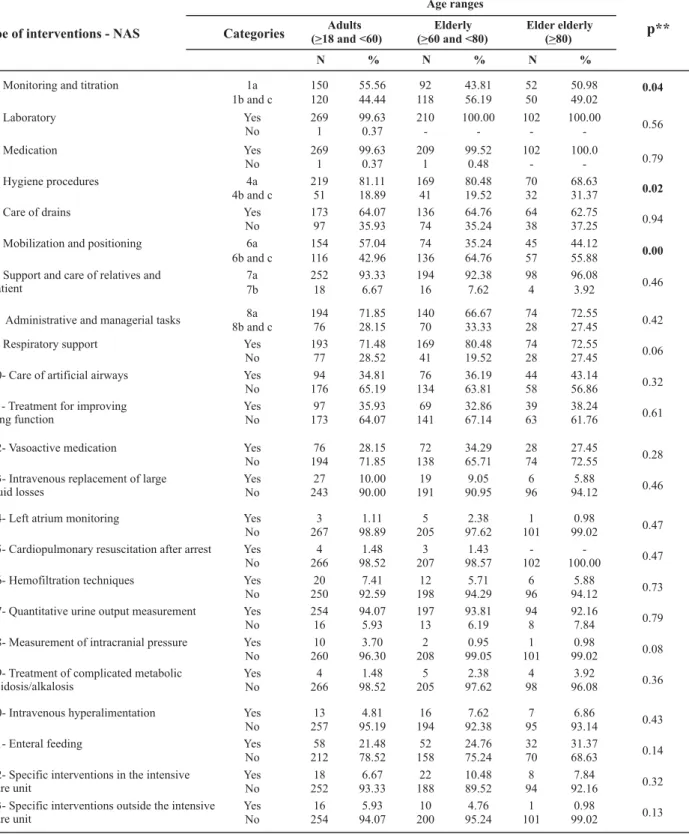
Table 2 shows differences among adult, elderly and elder elderly patients upon admission with regard to the following interventions: Monitoring and titration, Hygiene procedures and Mobilization and positioning.
As for Monitoring and titration, when comparing pairs of groups through the Chi-Square test, it was observed that this difference occurred between adults and elderly, with p=0.01. No differences were found, however, between the elder elderly group and others.
Adults showed a higher frequency (55.56%) than eld-erly (43.81%) with regard to item a (hourly vital signs, regu-lar registration and calculation of fluid balance). The oppo-site occurred on item b and c (need for presence at the
bedside for monitoring and control during 2 hours or more in any shift, or for 4 hours or more in case of item c), in which the elderly were more frequent (56.19%), characterizing that this group demanded more nursing care time on Moni-toring and titration.
As for Hygiene procedures, comparisons between pairs identified that the group of elder elderly differed from the adult (p=0.01) as well as the elderly group (p=0.02).
Elder elderly presented a higher frequency (31.37%) of
hygiene procedures that took more than 2 hours (item b) or more than 4 hours during any shift (item c) in comparison with the other groups (18.89% and 19.52%), evidencing that this group needed more nursing time related to this type of care.
Table 2 - Distribution of patients hospitalized at ICUs (n=582*) according to age range and type of intervention performed upon admission, according to the NAS - São Paulo - 2006/2007
Age ranges
Adults ( 18 and <60)>
Elderly (>60and<80)
Elder elderly
(>80) p** Type of interventions - NAS Categories
N % N % N %
1- Monitoring and titration 1a 150 55.56 92 43.81 52 50.98
1b and c 120 44.44 118 56.19 50 49.02
0.04
2- Laboratory Yes 269 99.63 210 100.00 102 100.00
No 1 0.37 - - - - 0.56
3- Medication Yes 269 99.63 209 99.52 102 100.0
No 1 0.37 1 0.48 - - 0.79
4- Hygiene procedures 4a 219 81.11 169 80.48 70 68.63
4b and c 51 18.89 41 19.52 32 31.37 0.02
5- Care of drains Yes 173 64.07 136 64.76 64 62.75
No 97 35.93 74 35.24 38 37.25 0.94
6- Mobilization and positioning 6a 154 57.04 74 35.24 45 44.12
6b and c 116 42.96 136 64.76 57 55.88 0.00
7- Support and care of relatives and patient
7a 252 93.33 194 92.38 98 96.08
7b 18 6.67 16 7.62 4 3.92 0.46
8a 194 71.85 140 66.67 74 72.55
8- Administrative and managerial tasks 8b and c 76 28.15 70 33.33 28 27.45 0.42
9- Respiratory support Yes 193 71.48 169 80.48 74 72.55
No 77 28.52 41 19.52 28 27.45 0.06
10- Care of artificial airways Yes 94 34.81 76 36.19 44 43.14
No 176 65.19 134 63.81 58 56.86 0.32
11- Treatment for improving lung function
Yes 97 35.93 69 32.86 39 38.24
No 173 64.07 141 67.14 63 61.76 0.61
12- Vasoactive medication Yes 76 28.15 72 34.29 28 27.45
No 194 71.85 138 65.71 74 72.55 0.28
13- Intravenous replacement of large fluid losses
Yes 27 10.00 19 9.05 6 5.88
No 243 90.00 191 90.95 96 94.12 0.46
14- Left atrium monitoring Yes 3 1.11 5 2.38 1 0.98
No 267 98.89 205 97.62 101 99.02 0.47
15- Cardiopulmonary resuscitation after arrest Yes 4 1.48 3 1.43 -
-No 266 98.52 207 98.57 102 100.00 0.47
16- Hemofiltration techniques Yes 20 7.41 12 5.71 6 5.88
No 250 92.59 198 94.29 96 94.12 0.73
17- Quantitative urine output measurement Yes 254 94.07 197 93.81 94 92.16
No 16 5.93 13 6.19 8 7.84 0.79
18- Measurement of intracranial pressure Yes 10 3.70 2 0.95 1 0.98
No 260 96.30 208 99.05 101 99.02 0.08
19- Treatment of complicated metabolic acidosis/alkalosis
Yes 4 1.48 5 2.38 4 3.92
No 266 98.52 205 97.62 98 96.08 0.36
20- Intravenous hyperalimentation Yes 13 4.81 16 7.62 7 6.86
No 257 95.19 194 92.38 95 93.14 0.43
21- Enteral feeding Yes 58 21.48 52 24.76 32 31.37
No 212 78.52 158 75.24 70 68.63 0.14
22- Specific interventions in the intensive care unit
Yes 18 6.67 22 10.48 8 7.84
No 252 93.33 188 89.52 94 92.16 0.32
23- Specific interventions outside the intensive care unit
Yes 16 5.93 10 4.76 1 0.98
No 254 94.07 200 95.24 101 99.02 0.13
* OneWay-Anova Test
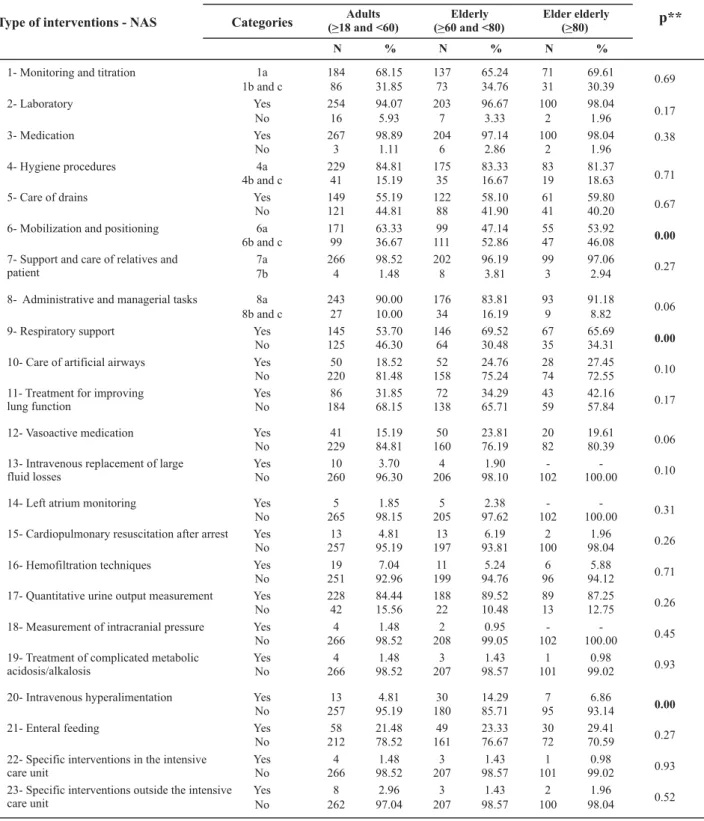
In Table 3, intergroup differences upon discharge appear for the following interventions: Mobilization and
Table 3 - Distribution of patients hospitalized at ICUs (n=582*) according to age range and type of intervention performed upon discharge, according to the NAS - São Paulo - 2006/2007
1a 184 68.15 137 65.24 71 69.61
1b and c 86 31.85 73 34.76 31 30.39 0.69
Yes 254 94.07 203 96.67 100 98.04
No 16 5.93 7 3.33 2 1.96 0.17
Yes 267 98.89 204 97.14 100 98.04
No 3 1.11 6 2.86 2 1.96
0.38
4a 229 84.81 175 83.33 83 81.37
4b and c 41 15.19 35 16.67 19 18.63 0.71
Yes 149 55.19 122 58.10 61 59.80
No 121 44.81 88 41.90 41 40.20 0.67
6a 171 63.33 99 47.14 55 53.92
6b and c 99 36.67 111 52.86 47 46.08 0.00
7a 266 98.52 202 96.19 99 97.06
7b 4 1.48 8 3.81 3 2.94 0.27
8a 243 90.00 176 83.81 93 91.18
8b and c 27 10.00 34 16.19 9 8.82 0.06
Yes 145 53.70 146 69.52 67 65.69
No 125 46.30 64 30.48 35 34.31 0.00
Yes 50 18.52 52 24.76 28 27.45
No 220 81.48 158 75.24 74 72.55 0.10
Yes 86 31.85 72 34.29 43 42.16
No 184 68.15 138 65.71 59 57.84 0.17
Yes 41 15.19 50 23.81 20 19.61
No 229 84.81 160 76.19 82 80.39 0.06
Yes 10 3.70 4 1.90 -
-No 260 96.30 206 98.10 102 100.00 0.10
Yes 5 1.85 5 2.38 -
-No 265 98.15 205 97.62 102 100.00 0.31
Yes 13 4.81 13 6.19 2 1.96
No 257 95.19 197 93.81 100 98.04 0.26
Yes 19 7.04 11 5.24 6 5.88
No 251 92.96 199 94.76 96 94.12 0.71
Yes 228 84.44 188 89.52 89 87.25
No 42 15.56 22 10.48 13 12.75 0.26
Yes 4 1.48 2 0.95 -
-No 266 98.52 208 99.05 102 100.00 0.45
Yes 4 1.48 3 1.43 1 0.98
No 266 98.52 207 98.57 101 99.02 0.93
Yes 13 4.81 30 14.29 7 6.86
No 257 95.19 180 85.71 95 93.14 0.00
Yes 58 21.48 49 23.33 30 29.41
No 212 78.52 161 76.67 72 70.59 0.27
Yes 4 1.48 3 1.43 1 0.98
No 266 98.52 207 98.57 101 99.02 0.93
Yes 8 2.96 3 1.43 2 1.96
No 262 97.04 207 98.57 100 98.04 0.52
Age ranges
Adults ( 18 and <60)>
Elderly (>60and<80)
Elder elderly
(>80) p** Type of interventions - NAS Categories
N % N % N %
1- Monitoring and titration
2- Laboratory
3- Medication
4- Hygiene procedures
5- Care of drains
6- Mobilization and positioning
7- Support and care of relatives and patient
8- Administrative and managerial tasks
9- Respiratory support
10- Care of artificial airways
11- Treatment for improving lung function
12- Vasoactive medication
13- Intravenous replacement of large fluid losses
14- Left atrium monitoring
15- Cardiopulmonary resuscitation after arrest
16- Hemofiltration techniques
17- Quantitative urine output measurement
18- Measurement of intracranial pressure
19- Treatment of complicated metabolic acidosis/alkalosis
20- Intravenous hyperalimentation
21- Enteral feeding
22- Specific interventions in the intensive care unit
23- Specific interventions outside the intensive care unit
*missing: 9 in the age range between >18 and <60, 6 between >60 and <80 and 3 >80 years. ** Chi-Square test
With regard to Mobilization and positioning, compari-son between paired groups through the Chi-Square test showed that this difference occurred between the adult
procedures. Nevertheless, differences between elderly (52.86%) and elder elderly (46.08%) and between adults (36.67%) and elder elderly (46.08%) did not reach the sig-nificance level set forth in this research (p<0.05).
As for Respiratory support, the adult group differed from the elderly (p=0.00) and elder elderly (p=0.04). Elderly and elder elderly need Respiratory support more frequently during the last 24 hours of hospitalization at the ICU, with 69.52% and 65.69% respectively, than adults (53.70%).
Intravenous hyperalimentation was more frequent among elderly patients (14.29%). The comparison between paired groups revealed a statistically significant difference between elderly and adults (p=0.00), while the comparison between the elderly and elder elderly bordered upon significance (p=0.06). It should be highlighted that statistically significant differences among the three groups were found for only three of the 23 NAS items, upon admission and also upon discharge from the ICU, as observed in Tables 2 and 3.
Table 4 - Difference in NAS between admission and discharge of ICU patients (n=600), survivors (n=480) and those who died at the unit
(n=120), according to age range - São Paulo – 2006/2007
All patients 9.61 20.16 8.56 22.74 9.05 21.26 0.86
Survivors 11.27 19.54 12.71 21.48 10.91 21.83 0.74
No survivors 0.77 21.36 3.59 22.13 1.59 17.35 0.49
Age ranges Adults
( 18 e <60)> ( 60 e <80)>Elderly
Elder elderly ( 80)> NAS Difference
admission/discharge
Mean SD Mean SD Mean SD
p*
* OneWay-Anova Test
In the analysis of mean differences in NAS between ad-mission and discharge, no significant difference was found among the three groups when alive and dead patients were analyzed jointly, nor when analyzed separately (Table 4).
DISCUSSION
With regard to the characteristics of the total sample, similarity with other studies was found for the following variables: age(12-14), gender(12-17), origin(15-17), antecedents(15-17),
severity of illness(14,16) and nursing workload upon
admis-sion at the ICU(12,14-15,17). Mortality and length of stay (LOS)
in ICU greatly varied in literature(12-17) and were
intermedi-ate in this research when compared to findings described in other studies.
The population’s age has progressively increased in Brazil(6) and in other countries(5) and nurses’ clinical
expe-rience has evidenced the increased number of elderly pa-tients at ICUs, in line with the growth of this population. A study carried out in Switzerland confirmed this premise in a comparative analysis of 35.327 ICU patients’ character-istics, hospitalized between 1980 and 1995, showing a significant increase in patients’ age during that period(1).
Although it has already been described in literature(7-8,18)
that age does not determine a worse prognosis, but asso-ciated factors, such as the severity of an acute dysfunc-tion and comorbidities, health professionals still perceive that elderly patients respond less to certain therapeutic measures and, therefore, demand more care.
Nevertheless, these study results reveal that the age factor interferes little in the workload of care delivered to ICU patients, in line with other studies that compare eld-erly (>60 years) and non eldeld-erly patients (>18 and <60 years)(15) and only elderly patients from different age ranges
(>60 and <70; >70 and <80; >80)(16). Moreover, studies that
analyzed the influence of different variables (gender, age, LOS, mortality, severity, origin and treatment type) on NAS scores evidenced that age did not interfere in the nursing workload demand, reasserting that therapeutic invest-ments are applied to promote patients’ clinical improve-ment, independently of the age range(12-13,17).
The evolution in the demand for nursing workload be-tween admission to and discharge from the ICU (NAS ad-mission – NAS discharge) and NAS scores upon adad-mission were similar among the three groups. This may be related to the intervention pattern applied to patients hospital-ized at ICUs, independently of age. The nursing workload upon discharge, however, showed differences between adult and elderly patients, indicating that, probably, eld-erly patients continue demanding more care after discharge from an ICU.
well as in daily team distribution. Moreover, patients aged >60 years (elderly and elder elderly) demanded more care and their demands were complied with. Hence, it can be in-ferred that, once admitted to the ICU, no distinction is made with regard to therapeutic and nursing investments.
CONCLUSION
These study results indicated that, independently of age, nursing workload upon admission at the unit were similar. The same was true for the evolution of ICU pa-tients’ care demands. Likewise, no differences were found on 20 of the 23 NAS items between admission and dis-charge from the unit.
Nevertheless, comparisons among the three patient groups revealed the following differences:
•
Adults and elderly with regard to total NAS score upon discharge and for the following interventions: Monitoring and titration upon admission, Respiratory support and Intra-venous hyperalimentation upon discharge, besides Mobili-zation and positioning upon admission and discharge;•
Adults and elder elderly for the interventions: Hy-giene procedures and Mobilization and positioning upon admission, besides Respiratory support upon discharge;•
Elderly and elder elderly for Hygiene procedures upon admission only.REFERENCES
1. Jakob SM, Tothen HU. Intensive care 1980-1995: change in patient characteristics, nursing workload and outcome. Intensive Care Med. 1997;23(11):1165-70.
2. Miranda DR, Raoul N, Rijk A, Schaufeli W, Iapichino G. Nursing Activities Score. Crit Care Med. 2003;31(2):374-82.
3. Telles SCR, Castilho V. Custo de pessoal na assistência direta de enfermagem em unidade de terapia intensi-va. Rev Lat Am Enferm. 2007;15(5):1005-9.
4. Noseworthy TW, Konopad E, Shustack A, Johnston R, Grace M. Cost accouting of adult intensive care: methods and human and capital inputs. Crit Care Med. 1996;24(7):1168-72.
5. World Health Organization (WHO). WHO Study on Global AGEing and Adult Health (SAGE) [text on the Internet]. Geneva; 2009 [citado 2009 set.10]. Available from: www.who.int/healthinfo/systems/sage/en/index.html
6. Veras R. Population aging and health information from the National Household Sample Survey: contemporary demands and challenges. Introdução. Cad Saúde Públi-ca. 2007;23(10):2463-6.
7. Galzerano A, Sabatini E, Durì D, Rossi C, Silvestri L, Mazzon D, et al. Old patients in intensive care unit (ICU): What decisions to make? Arch Gerontol Geriatr. 2009;49(2):294-7.
8. López-Soto A, Sacanella E, Castejón MP, Nicolás JM. El anciano en la Unidade de Cuidados Intensivos. Rev Esp Geriatr Gerontol. 2009;44 Supl 1:27-33.
9. Brasil. Ministério da Saúde. Portaria n. 466/MS/SVS, de 4 de junho de 1998. Dispõe sobre o regulamento técnico para o funcionamento dos Serviços de Tratamento In-tensivo. Diário Oficial da União, Brasília, 5 jun.1998.
10. Le Gall JR, Lemeshow S, Saulnier F. A new Simplified Acute Physiology Score (SAPS II) based on a European/North American multicenter study. JAMA.1993;270(24):2957-63.
11. Le Gall JR, Klar J, Lemeshow S, Saulnier F, Alberti C, Artigas A, et al. The Logistic Organ Dysfunction system: a new way to assess organ dysfunction in the Intensive Care Unit. JAMA. 1996;276(10):802-10.
12. Padilha KG, Sousa RMC, Queijo AF, Mendes AM, Miranda DR. Nursing Activities Score in the Intensive Care Unit: analysis of the related factors. Intensive Crit Care Nurs. 2008;24(3):197-204.
13. Gonçalves LA, Padilha KG. Fatores associados à carga de trabalho de enfermagem em Unidade de Terapia Intensiva. Rev Esc Enferm USP. 2007;41(4):645-52.
14. Queijo AF. Estudo comparativo da carga de trabalho de enfermagem em Unidades de Terapia Intensiva geral e especializadas, segundo o Nursing Activities Score (NAS) [tese]. São Paulo: Escola de Enfermagem, Univer-sidade de São Paulo; 2008.
15. Ciampone JT, Gonçalves LA, Maia FOM, Padilha KG. Necessidades de cuidados de enfermagem e interven-ções terapêuticas em Unidade de Terapia Intensiva: estudo comparativo entre pacientes idosos e não ido-sos. Acta Paul Enferm. 2006;19(1):28-35.
16. Sousa CR, Gonçalves LA, Toffoleto MC, Leão K, Padilha KG. Preditores da demanda de trabalho de enferma-gem para idosos internados em Unidade de Terapia Intensiva. Rev Lat Am Enferm. 2008;16(2):218-23.
17. Gonçalves LA, Garcia PC, Toffoleto MC, Telles SCR, Padilha KG. Necessidades de cuidados de enferma-gem em Terapia Intensiva: evolução diária dos paci-entes segundo o Nursing Activities Score (NAS). Rev Bras Enferm. 2006;59(1):56-60.