Revista Gaúcha
de Enfermagem
http://dx.doi.org/10.1590/1983-1447.2014.02.45178
Skin tear treatment and prevention by nurses:
an integrative literature review
a Enterostomal Therapist Nurse with a Master’s in Nursing from Rio de Janeiro State University (UERJ). Assistant Professor for the Nursing Department of the Fluminense Federal University (UFF), Rio das Ostras Campus, RJ, Brazil.
Érick Igor dos Santosa
ABSTRACT
The objective of the present study was to identify scientifi c evidence in the literature regarding management and prevention of skin tears by nurses over the last ten years. This is an integrative review of articles found in the LILACS, SciELO, BDENF, MEDLINE, Scopus, ScienceDirect and PubMed databases, identifi ed with the Portuguese, English and Spanish descriptors for “skin,” “friction,” or with the keyword “skin tears”. After inclusion and exclusion criteria were applied, fi fteen texts were selected. Scientifi c evidence demon-strated that the best management results are obtained by covering the tear with the skin fl ap itself, using octylcyanoacrylate or silicone-based products. Prevention consists of promoting a safe environment, through multidisciplinary work and health education. We conclude that it is the nursing staff ’s responsibility to avoid infection, trauma of any intensity, pain and bleeding.
Descriptors: Wounds and injuries. Friction. Skin. Nursing care. Nurses.
RESUMO
Este estudo teve por objetivo caracterizar as evidências científi cas dos últimos dez anos sobre a enfermagem no cuidado e prevenção das lesões do tipo skin tears. Trata-se de uma revisão integrativa de literatura de artigos completos presentes nas bases LILACS,
SciELO, BDENF, MEDLINE, Scopus, ScienceDirect e PUBMED acessáveis com os descritores “pele” and “fricção” and “enfermagem” em
português, inglês ou espanhol, ou com a palavra-chave “skin tears”. Foram selecionados quinze artigos após a aplicação dos critérios
de inclusão e de exclusão. A cobertura com o próprio retalho de pele, com produtos à base de octilcianoacrilato ou de silicone são as evidências científi cas com melhores resultados para serem aplicadas por enfermeiros. A prevenção consiste na promoção de ambiente seguro, com trabalho multidisciplinar e educação em saúde. Conclui-se caber à enfermagem evitar infecção, traumas de qualquer intensidade, dor e hemorragia.
Descritores: Ferimentos e lesões. Fricção. Pele. Cuidados de Enfermagem. Enfermeiras.
RESUMEN
El objetivo de ese estudi fue caracterizar las evidencias científi cas de los últimos diez años sobre la enfermería en el cuidado y la pre-vención de skin tears. erase trata de una revisión integradora de los artículos presentes en las bases LILACS, SciELO, BDENF, MEDLINE, Scopus, ScienceDirect y PubMed, accesible con los descriptores “piel” y “fricción” y “enfermería” en portugués, inglés o español, o con la palabra clave “fi suras en la piel”. Se seleccionaron 15 artículos después de la aplicación de los criterios de inclusión y exclusión. La cobertura con el propio retazo de piel, con productos a base de octilcianoacrilato o silicona tenían la evidencia científi ca con los mejores resultados para la práctica de los enfermeros. La prevención consiste en la promoción de un ambiente seguro, con un trabajo multidisciplinario y educación sanitaria. Se concluyó que le corresponde a los enfermeros evitar la infección, trauma de cualquier intensidad, dolor y hemorragia.
Descriptores: Heridas y lesiones. Fricción. Piel. Atención de Enfermería. Enfermeros.
Cuidado e prevenção das skin tears por
enfermeiros: revisão integrativa de literatura
INTRODUCTION
Skin tears are lesions caused by trauma, be it through friction, blunt-force or shearing. The tension caused by re-traction, friction or hitting one’s skin against the surface of a hospital bed or on surrounding objects can cause partial or full thickness wounds. The regions of the body most af-fected by skin tears are the back of the hand, arms, elbows and the legs of elderly or very young individuals, such as neonates. Serous exudate production, especially within the fi rst 24 hours, makes skin tears mostly humid. Although Brazilian data regarding these types of lesions remain limit-ed, its prevalence is greater than that of pressure ulcers and there is a tendency for the number of cases to increase in the years to come. (1-10)
Even though the period between 1993 and 2007 was productive in terms of concept defi nition, formal investi-gation, and the creation of clinical protocols for classifying skin tears, an international survey conducted in 2011 led to the creation of a formal document expressing a consensus among specialists from diff erent countries. This document presents a more current defi nition of skin tears, which is used as a theoretical basis for the present research. (8)
These types of lesions are predominantly the conse-quence of frailties of the elderly person’s body, such as thin-ning of the skin and the reduction of its humidity, elasticity and resistance, all of which intensify after the age of 75. (2,8)
For some authors, skin tears can be considered indica-tors for quality of care, since in most cases they are related to how objects are arranged in the individual’s environment. (5)
Based on these issues, the following research question was formulated: What scientifi c evidence regarding skin tear management and prevention by nurses has been pro-duced over the last ten years? National and international scientifi c evidence on the topic of skin tear management and prevention conducted by nurses was the object of this study. The aim was to characterize national and interna-tional scientifi c evidence in the literature regarding man-agement and prevention of skin tears by nurses over the last ten years.
This theme is relevant because of the potential creased incidence of these types of lesions with the in-crease in the aging population,(4,6) the threat presented by skin tears to the quality of life of the elderly, and the high costs of non-evidence based interventions and the time spent by the nursing staff to care for patients with these types of lesion.(5) It is also relevant due to the defi cit of re-search,(2,8) especially in Brazil, which could provide nursing professionals with clear guidelines for skin tear manage-ment and prevention.(3)
METHOD
This is an integrative literature review,(11) a research method which includes searching for, critically analyzing and synthesizing the evidence available on skin tears and their management. The six steps inherent to this method were followed, namely, research question formulation, lit-erature search, categorizing studies, evaluating the studies included in the review, interpretation of results and review presentation.
The following research question was formulated: What scientific evidence regarding skin tear management and prevention by nurses has been produced over the last ten years?
Inclusion criteria
The inclusion criteria adopted to guide the search and selection of publications were:
a) Articles published in peer-reviewed national and in-ternational scientifi c journals which report research on skin tears and their management and prevention by nursing professionals;
b) Articles published in Portuguese, English or Spanish; c) Articles published between 2003 and 2013, i.e., over the last ten years, taking into consideration the need for current information on the theme;
d) Articles indexed in at least one of the following da-tabases: Latin American and Caribbean Health Science Lit-erature (LILACS), the Nursing Database (BDENF), Medical Literature Analysis and Retrieval System Online (MEDLINE), Elsevier SciVerse Scopus, Elsevier SciVerse ScienceDirect Journals, National Library of Medicine (PUBMED) or in the Scientifi c Electronic Library Online (SciELO), and when an article was not directly available through the respective database, we consulted the Coordination for the Improve-ment of Higher Level Personnel Portal (CAPES) in order to locate and access it;
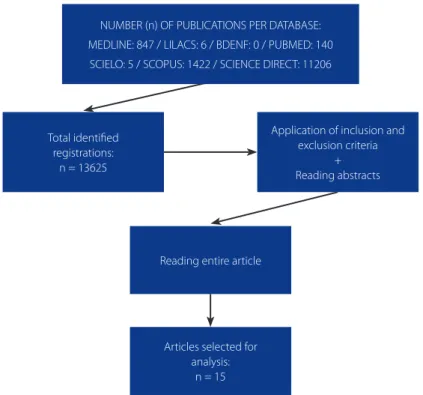
f ) In order to include an article in our study, we read each title and abstract carefully so as to verify its agreement with the investigation’s guiding question. When there was any doubt about whether or not a study should be includ-ed, it was read in its entirety in order to reduce the risk of losing relevant publications. Below, we include a fl owchart displaying the steps involved in article selection (Figure 1).
Exclusion criteria:
a) Publications that were not available as full text; b) Publications that were available as full text, but whose link presented an error message upon attempted access;
Data collection instrument
Data were collected between July and December of 2013, using a data collection instrument created with the Microsoft Offi ce Excel 2010 software. The following vari-ables were used: title of article, authors, periodical, year of publication, country of origin, study type/approach, da-tabase in which it is indexed, descriptors/keywords used, level of evidence(12), and established recommendations for nursing care management and prevention strategies.
RESULTS
We identifi ed 13,625 texts, which upon being read in their entirety and submitted to the pre-established in-clusion and exin-clusion criteria, were reduced to 15. Of the 13,625 identifi ed studies, 3,822 were not available free of charge in the databases and were not found in the CAPES Periodical Portal; 4,788 were not pertinent to the theme; 3,697 were published prior to 2003; and 1,303 were avail-able only in languages other than Portuguese, English or Spanish. All of these characteristics limited the study. We found the greatest number of publications in the Elsevier SciVerse Science Direct Journals and Elsevier SciVerse Sco-pus. On the other hand, regarding the publications that complied with our methodological criteria, the majority was found in MEDLINE and Elsevier SciVerse ScienceDirect Journals. We observed that combining the descriptors was not as eff ective for tracking down publications as using the single term “skin tears” (Chart 1). This could be a conse-quence of the popularization of the term in the 1990s for referring to these types of lesions. (8)
The low number of articles found in the LILACS, SciE-LO and BDENF databases highlight the scarcity of scientifi c publications (or at least of their availability in Latin Amer-ica’s largest databases) in nursing regarding the theme.
NUMBER (n) OF PUBLICATIONS PER DATABASE: MEDLINE: 847 / LILACS: 6 / BDENF: 0 / PUBMED: 140 SCIELO: 5 / SCOPUS: 1422 / SCIENCE DIRECT: 11206
Total identifi ed registrations:
n = 13625
Application of inclusion and exclusion criteria
+ Reading abstracts
Reading entire article
Articles selected for analysis:
n = 15
Figure 1. Flowchart of the methodological steps carried out for article selection. Rio de Janeiro, RJ, 2014.
Only one Brazilian article was found and selected. This scarcity has been detected by other studies in Brazil and abroad. (2,3,8)
Chart 2 displays the article distribution by analyzed vari-able, with the exception of established recommendations for nursing care for skin tear management and prevention, which will be discussed separately. With exception to Bra-zil, which presented one article, the other countries that reported studies on skin tears were the United States (USA) with seven articles, Australia with two, the United King-dom with two, Canada and New Zealand with one each, and another article written by authors from more than one country.
Regarding the year of publication, a continual increase was noticed in the number of publications and a latent increase in 2013 (Chart 2). The greatest number of studies on skin tears were published in 2011, with four articles, fol-lowed by 2009, with three, and 2012 and 2013 tied with two articles each. Among the periodicals which most stood out in the fi eld, we found The British Journal of Community Nursing, with two published articles in the same volume. All other articles were published in separate volumes.
The scientifi c evidence was analyzed by applying the hierarchical system for classifying the quality of evidence (12) to the methodological data of the studies presented in Chart 2. As observed, according to the stratifi cation by level of evidence, there are four level-6 articles, two level-5
articles, four level-4 articles, two level-3, and three level-2. If on the one hand there is a great variety among the pub-lications regarding their level of evidence, on the other we observed that there are few high evidence level studies available. Articles on skin tear with signifi cant levels of ev-idence are important in order to increase the use of scien-tifi c information and improve the scienscien-tifi c basis for health and nursing care practices directed at patients with these kinds of lesions.
Discussion of the results was divided into the two major axes that emerged after categorizing the studies, as sug-gested by the methodological framework of Integrative Literature Reviews.(11)
DISCUSSION
On the recommendations for nursing care for treating patients with skin tears
A defi cit of solid scientifi c framework was found for practices linked to skin tears. (5) The ideal dressing must be simple, quick, painless, comfortable, easily removable, serve as a protective barrier against bacterial invasion, and suffi ciently strong and resistant while not interfering with daily activities. (10)
The product used for confecting a skin tear dressing needs to be chosen according to the classifi cation of the
Database
Descriptors Keywords
Total per base “skin” and “friction” and “nursing”
“pele” and “fricção” and “enfermagem” “piel” and “fricción” and “enfermería”
“skin tears”
F S F S
LILACS 0 0 5 1 6
SciELO 0 0 5 0 5
BDENF 0 0 0 0 0
MEDLINE 77 0 765 5 847
Elsevier SciVerse Scopus 64 1 1353 3 1421
Elsevier SciVerse
ScienceDi-rect Journals 689 0 10512 5 11206
PUBMED 64 0 76 0 140
TOTAL PER TERM 894 1 12711 14
Publications found 13625
Publications selected 15
Chart 1. Number (n) of articles found (F) and selected (S) after integrative review, per database. Rio de Janeiro, RJ, 2014.
lesion. Using the Payne-Martin Classifi cation System, one study recommends that category I lesions – those without tissue loss – should be cleansed with saline solution and the skin fl ap replaced over the wound. The skin fl ap itself,
when viable, has proved to be the best possible way to close skin tears. A primary silicone-based dressing is also recommended (left in place no longer than 7 days), with an arrow indicating the correct direction so that other
Author/ Country
Periodical/ Year
Study type/
approach Database
Descriptor/ Keyword
Level of Evidence
Amaral AFS, Pulido KCS, Santos VLCG / Brazil
Rev Esc Enferm USP / 2012
Epidemiologic and
exploratory LILACS “skin tears” 3
Kazandjiean DG,
Okulicz JF/USA Am J Med / 2006 Case study
Elsevier SciVerse
Sci-enceDirect Journals “skin tears” 5
Milne CT, Corbett
LQ/USA Geriatr Nurs / 2005 Prospective
Elsevier SciVerse
Sci-enceDirect Journals “skin tears” 2
Cuzzell J / USA Dermatol Nurs /
2003 Opinion
Elsevier SciVerse
Sci-enceDirect Journals “skin tears” 6
Benbow M / United Kingdom
Br J Community
Nurs / 2009 Opinion
Elsevier SciVerse
Sci-enceDirect Journals “skin tears” 6
Ousey K / United Kingdom
Br J Community
Nurs / 2009 Opinion
Elsevier SciVerse
Sci-enceDirect Journals “skin tears” 6
Kotowski SE, Davis KG, Wiggermann N, Williamson R / USA
Hum Factors / 2013
Clinical-laboratorial quantitative study
Elsevier SciVerse Scopus
“skin” and “friction” and “nursing”
2
Kennedy P, Kerse N / New Zealand
J Am Geriatr Soc /
2011 Epidemiologic MEDLINE “skin tears” 3
Lopez V, Dunk AM, Parke J, Larkin D, Trudinger M, Stuart M / Australia
Int J Evid Based
Healthc / 2011 Survey MEDLINE “skin tears” 4
Xu XBS, Lau K, Taira BR, Singer AJ / USA
Am J Emerg Med
/ 2009 Review MEDLINE “skin tears” 4
Holmes RF, Davidson MW, Thompson BJ, Kelechi TJ / USA
Home Healthc
Nurse / 2013 Review MEDLINE “skin tears” 4
LeBlanc K, Baranoski S / Several countries
Adv Skin Wound Care / 2011
Specialist
Consen-sus Panel MEDLINE “skin tears” 6
Bajwa AA, Arasi L, Canabal JM, Kramer DJ / USA
J Intensive Care Med / 2010
Retrospective clini-cal study
Elsevier SciVerse
Scopus “skin tears” 2
Foster RS, Chan J / Australia
Aust J Dermatol /
2011 Case study
Elsevier SciVerse
Scopus “skin tears” 5
Maida V, Ennis M,
Corban J / Canada Int Wound J / 2012 Prospective study
Elsevier SciVerse
Scopus “skin tears” 4
Chart 2. Articles found after integrative literature review by analyzed variable. Rio de Janeiro, RJ, 2014.
professionals – who might have to conduct evaluations – can remove the skin fl ap without extracting it partially or completely and thus compromise its ability to cover the le-sion. The study advocates that after the dressing is in place, the care plan must be re-elaborated, the next review date established and data recorded correctly so as to prevent complications. Category II and III lesions present similar care procedures. For category II, it is recommended that the skin fl ap be replaced over the wound (by rolling) with the help of a cotton swab, due to complications caused by tissue loss. Category III lesions require that a secondary dressing be applied, made out of absorbent foam, in order to better control the exudate, and which must be changed within 5 days. (1,9)
One case study demonstrated success in preventing skin tears in an elderly patient who underwent surgery in which an elliptic incision was performed. Since this patient pre-sented skin frailty,(13) a porous and hypoallergenic adhesive tape made of polyester was recommended in order to pre-vent new trauma, reduce the risk of bleeding, and prepre-vent infection, all of which can delay wound healing.(6) In order to avoid trauma while removing the adhesive tape, a spe-cifi c remover was used. The authors make clear that nurs-es can also use vegetable oil for this purpose.(14) Although they were concerned with conducting removal in the least traumatic manner, this proposal diverges from that of other authors who discourage the use of adhesive dressings due to the risk of damage (albeit small) to the skin fl ap, the lesion itself, and the periwound, during removal.(5-7,9-10)
Octylcyanoacrylate-based products demonstrated the greatest potential for treating skin tears.(5,8,10) It is a liquid ad-hesive manufactured by diff erent laboratories, which does not damage skin when removed. Octylcyanoacrylate-based adhesives have proven to promote a homeostatic eff ect, ef-fective protection against bacterial penetration, faster epitel-ization, and pain reduction. They also maintain the humidi-ty at an ideal level(8) for healing. One study(5) demonstrated that 18 out of 20 patients with category II and III skin tears (according to the Payne-Martin system) who were treat-ed with this type of dressing netreat-edtreat-ed only one application (which was left in place for one week). This indicates the possibility for reducing costs, optimizing nurses’ work time, and enabling patients to maintain their daily activities such as taking a bath normally. As a side eff ect, this study verifi ed that only one patient presented moderate pain. It is contra-indicated for lesions which cut through the dermal layers and are penetrating, presenting uncontrolled hemorrhage and active areas of infection, and are located in very hairy regions. The dressing is applied by cleansing the region with saline solution, “milking” the borders of the lesion in order to
remove as much sanguineous exudate as possible with the help of a sterile gauze, approximating the skin fl ap to the borders (if such exists), applying the product approximately 1 to 2 cm beyond the margins of the skin tear, and fi nally, allowing the area to dry for 15 to 30 seconds. No secondary dressing is necessary and it must be reapplied at the end of seven days.
As long as the indications and contraindications of each product are respected, other primary or secondary dress-ings can be applied. Non- or low-adherent dressdress-ings, such as hydrocolloid, foam, hydrogel, petrolatum impregnated gauze, hydrofi ber or calcium alginate (the latter two for very exudative lesions) can be used by nurses after cleans-ing the skin tear by fi rst irrigatcleans-ing the wound preferentially with a warm physiological solution, followed by drying nat-urally or with a sterile gauze. (8-10) If skin tears present signs of infl ammation, the dressing must be left on for less time than those without a sustained infection/infl ammation. The last consensus (8) on the topic also defends that necrot-ic or devitalized tissues be removed and, depending on the institution, tetanus vaccination may be administered as part of the therapeutic treatment plan.
It is reiterated that, whenever possible, the nurse use the skin fl ap itself for covering up the skin tear.(6,10) When this is not possible, the products mentioned above are the alternatives recommended by scientifi c evidence for treat-ing skin tears, due to their non or low adherence.
Pain can compromise quality of life and make healing more diffi cult. It can be managed by using specifi c coverings such as octylcyanoacrylate-based dressings or by taking an-algesics.(9) Nevertheless, it is necessary to keep in mind that some drugs can act as a risk factor for skin tears. (14)
The majority of studies used the Payne-Martin system for classifying skin tears. Created in 2007 (15), revised in 2010(16) and translated into Portuguese in 2010(17), it is the most up-to-date classifi cation system available, although it has not been broadly used. (9) Use of the Skin Tear Classi-fi cation System (STAR) in conjunction with others such as the Karnofsky and Braden scales has demonstrated great potential, considering its utility for evaluating the level of dependence of hospitalized elderly patients and their risk for pressure ulcers.(3,18-19)
On skin tear prevention strategies carried out by nurses
lesions and help nurses to track, eliminate or minimize risk factors.(6,8,20-21) One study showed that in some cases skin tears could have been caused by small trauma even before the patient’s admission into the health institution, which indicates the need for nurses to conduct educational ac-tivities with patients, caretakers and family members about the risks of an unfavorable care environment.(1)
Although skin tears cannot always be prevented, nurs-es must be vigilant and apply the correct techniqunurs-es for manipulating, changing positions and transferring the patient from one bed/gurney to another in order to avoid friction, shearing and contusions. A balanced nutritional program can also favor greater skin resistance. Thus, one of the most important recommendations found in these studies is to aim for a multidisciplinary approach for skin tear prevention and management activities.(6,8) The care plan for the patient with skin tears should be formulated collaboratively, so that nurses, other members of the team, caretakers, family members and patients themselves can participate and contribute to defi ning the best path to-wards therapeutic success.
A safe environment is a critical component of a preven-tion plan for this type of wound.(9) One quantitative study states that there must be constant concern regarding the design of the hospital bed, which can off er risks to skin in-tegrity. The ideal bed design can reduce the risk for skin tears and pressure ulcers, even though its development is quite complex and is still in progress.(4) Even the choice of soap needs to be discussed among nursing professionals and others involved in the care process. Alkaline, antibac-terial and highly perfumed soaps must be avoided, for they reduce skin lubrication and alter the profi le of its fl ora. In-stead, one can use emollient, pH neutral and/or Aloe vera soap.(9-10) Attention must also be given to the weather or environmental conditions, which favor the occurrence of skin tears, such as high temperatures in summer.(21)
According to this review, there is a lack of studies that in-vestigate the prevalence, incidence and economic impact of skin tears in Brazil and in the world.(8) This review present-ed limitations, such as considering only articles available in full text, but it indicates directions so that general-practice nurses and, in particular, specialized enterostomal therapy nurses, can identify the most common risk factors, under-stand the most current protocols and classifi cation sys-tems, and be familiar with the resources available that can produce the best results, in order to implement care prac-tices in consonance with the latest scientifi c evidence.(22)
It is up to health institutions to supply the necessary organizational support for the best practices for skin tear management.
CONCLUSIONS
Scientifi c articles in the fi eld of nursing over the last ten years regarding skin tears indicate that although the best dressings are those which use the skin fl ap itself or are oc-tylcyanoacrylate or silicone-based, skin tear management by nurses can vary according to the patient’s clinical status, institutional resources, and the body of knowledge of pro-fessionals managing the patient’s care, among other issues. Basic nursing care objectives for this type of patient are to avoid infections, trauma of any intensity, pain and bleeding, as well as to promote a therapeutic environment which is favorable to the fastest possible healing.
Despite the limitations of this review, especially with re-gard to the low number of studies found, we indicate scientif-ic evidence that can be useful for the nursing care of patients with skin tears. Further research can be developed to confi rm or refute the results of this study, analyzing skin tears in Brazil through multiple theoretical and methodological prisms.
REFERENCES
1. Lopez V, Dunk AM, Parke J, Larkin D, Trudinger M, Stuart M. Skin tear prevention and management among patients in the acute aged care and rehabilitation units in the Australian Capital Territory: a best practice implementation project. Int J Evid Based Healthc. 2011;9(4):429-34.
2. Maida V, Ennis M, Corban J. Wound outcomes in patients with advanced illness. Int Wound J. 2012;9(6):683-92.
3. Amaral AFS, Pulido KCS, Santos VLCG. Prevalence of skin tears among hospitali-zed patients with cancer. Rev Esc Enferm USP. 2012;46(Esp):44-50.
4. Kotowski SE, Davis KG, Wiggermann N, Williamson R. Quantifi cation of patient migration in bed: catalyst to improve hospital bed design to reduce shear and friction forces and nurse’s injuries. Hum Factors. 2013;55(1):36-47.
5. Milne CT, Corbett LQ. A new option in the treatment of skin tears for the insti-tutionalized resident: formulated 2 octylcyanoacrylate topical bandage. Geratr Nurs. 2005;26(5):321-5.
6. Ousey K. Identifying, managing and treating skin tears. Br J Community Nurs. 2009;23(9):18-22.
7. Benbow M. Skin tears. Br J Community Nurs. 2009;23(1):14-8.
8. LeBlanc K, Baranoski S. Skin tears: state of the science: consensus statements for the prevention, prediction, assessment, and treatment of skin tears. Adv Skin Wound Care. 2011;24(9):2-15.
9. Holmes RF, Davidson MW, Thompson BJ, Kelechi TJ. Skin tears: care and mana-gement of the older adult at home. Home Healthc Nurse. 2013;31(2):90-101. 10. Xu XBS, Lau K, Taira BR, Singer AJ. The current management of skin tears. Am J
Emerg Med. 2009;27(6):729-33.
11. Mendes KDS, Silveira RCCP, Galvão CM. Revisão integrativa: método de pesquisa para a incorporação de evidências na saúde e na enfermagem. Texto Contex-to Enferm. 2008;17(4):758-64.
12. Galvão CM, Sawada NO, Mendes IAC. A busca das melhores evidências. Rev Esc Enferm USP. 2003;37(4):43-50.
14. Cuzzell J. Wound assessment and evaluation: skin tear protocol. Dermatol Nurs. 2003;14(6):405.
15. Caville K, Lewin G, Newall N, Haslehurst P, Michael R, Santamaria N, et al. STAR: a consensus for skin tear classifi cation. Prim Intention. 2007;15(1):8-25. 16. Curtin University of Technology. Silver Chain Nursing Association. School
of Nursing Midwifery. STAR skin tear classification system guidelines [Internet]. Curtin, Australia; 2010 [citado 2013 April 23]. Disponível em: http://www.silverchain.org.au/assets/GROUP/research/STAR-Skin-Tear--tool-04022010.pdf
17. Strazzieri-Pulido KC, Santos VLCG. Cultural adaptation and validation of STAR Skin Tear Cassifi cation System for Brazilians [abstract]. Wound Ostomy Conti-nence Nurs J. 2011;38(3S):S92.
18. Urbanetto JS, Roberta M, Carvalho SM, Creutzberg M, Oliveira KF, Magnago TBS. Degree of dependence of hospitalized elderly according to the patients’ classifi -cation system. Rev Bras Enferm. 2012;65(6):950-4.
19. Bajwa AA, Arasi L, Canabal JM, Kramer DJ. Automated prone positioning and axial rotation in critically ill, nontrauma patients with acute respiratory distress syndrome (ARDS). J Intensive Care Med. 2010;25(2):121-5.
20. Kazandjiean DG, Okulicz JF. Skin tears? Am J Med. 2006;119(8):657-9 21. Kennedy P, Kerse N. Pretibial skin tears in older adults: a 2-year epidemiological
study. J Am Geriatr Soc. 2011;59(8):1547-8.
22. Santos ÉI, Gomes AMT, Barreto EAS, Ramos RS. Evidências científi cas sobre fato-res de risco e sistemas de classifi cação das skin tears. Rev Enferm Atual In Derme. 2013;64:16-21.
Author’s address:
Érick Igor dos Santos
Rua Recife, s/n, Jardim Bela Vista 28895-532, Rio das Ostras, RJ E-mail: eigoruff @gmail.com