Revista Gaúcha
de Enfermagem
Caring for women with HIV/AIDS:
an interactionist analysis from the perspective
of female healthcare professionals
Cuidando de mulheres com HIV/AIDS: uma análise interacionista
na perspectiva de mulheres profi ssionais de saúde
Cuidando a mujeres con VIH/SIDA: análisis interaccionista
desde la perspectiva de mujeres profesionales de salud
a Doctoral degree student in Nursing, Faculty of
Nurs-ing, University of the State of Rio de Janeiro (UERJ), Rio de Janeiro, RJ – Brazil. E-mail: tataserodio@yahoo. com.br
b PhD in Nursing, Adjunct Professor, Faculty of
Nurs-ing, University of the State of Rio de Janeiro (UERJ). Rio de Janeiro, RJ – Brazil. E-mail: carlamarinss@ hotmail.com
c PhD in Nursing, Full Professor, Faculty of Nursing,
University of the State of Rio de Janeiro (UERJ). Rio de Janeiro, RJ – Brazil. E-mail: [email protected]
Tainara Serodio Amim Rangel Portoa
Carla Marins Silvab
Octavio Muniz da Costa Vargensc
DOI: http://dx.doi.org/10.1590/1983-1447.2014.02.41253
ABSTRACT
The aim of this study was to know the meanings attributed by female health professionals to the process of caring for women with HIV, considering their vulnerability in the context of feminization of HIV/AIDS. It is a qualitative study based on the grounded theory method and symbolic interactionism, conducted in two public maternity hospitals in Rio de Janeiro, from November 2009 to April 2010. Data were collected by means of semi-structured interviews with twelve female health professionals. The core category that emerged was “Speaking as a Professional and Thinking about Caring”, which focused on the meaning of care, and the integration of two categories, the fi rst being the concerns of being a woman/professional caring for women with HIV and the second being the meanings of professional care provided to women with the virus. It was concluded that the professionals still maintained the former perception of HIV/AIDS, contributing to increased gender vulnerability to HIV, discrimination and prejudice.
Descriptors: Women’s health. Acquired immunodefi ciency syndrome. Health vulnerability. Gender identity.
RESUMO
Este estudo buscou conhecer os signifi cados atribuídos por mulheres, profi ssionais de saúde, ao processo de cuidar de mulheres com HIV, considerando a vulnerabilidade no contexto da feminização do HIV/AIDS. Estudo qualitativo baseado nos pressupostos da Groun-ded Theory e do Interacionismo Simbólico, realizado em duas maternidades públicas do Rio de Janeiro, de novembro de 2009 a abril de 2010. Para coleta de dados utilizou-se a entrevista semiestruturada. Foram entrevistadas doze mulheres profi ssionais de saúde. Como categoria central emergiu “Falando como Profi ssional e Pensando no Cuidar”, cujo foco foi o signifi cado do cuidado, integrando duas categorias: a primeira traduz as inquietações do ser mulher/profi ssional cuidando de mulheres com HIV, e a segunda traz os sig-nifi cados dados por essas profi ssionais ao cuidado prestado às mulheres com o vírus. Conclui-se que as profi ssionais ainda trazem con-sigo a antiga visão do HIV/AIDS, contribuindo para o aumento da vulnerabilidade de gênero para o HIV, discriminação e preconceito.
Descritores: Saúde da mulher. Síndrome de imunodefi ciência adquirida. Vulnerabilidade em saúde. Identidade de gênero.
RESUMEN
Este estudio buscó conocer los signifi cados atribuidos por mujeres profesionales de salud, al cuidado de mujeres con VIH, teniendo en cuenta la vulnerabilidad en el contexto de la feminización del VIH/SIDA. Estudio cualitativo basado en la Grounded Theory y el inte-raccionismo simbólico, realizado en dos maternidades gubernamentales, en Río de Janeiro, desde noviembre/2009 hasta abril/2010. Los datos fueron obtenidos a través de entrevista semiestructurada. Se entrevistó a doce mujeres profesionales de salud. “Hablando como profesional y Pensando en el Cuidado” surgió como categoría central, cuyo foco fue el signifi cado del cuidado, con la integración de dos categorías: la primera refl eja las preocupaciones de ser una mujer/profesional que cuida a mujeres con VIH, la segunda trae los signifi cados del cuidado profesional prestado a las mujeres con el virus. Se concluye que los profesionales conservan la antigua percepción del VIH/SIDA, contribuyendo a aumentar la vulnerabilidad de género, la discriminación y prejuicios.
INTRODUCTION
HIV/AIDS is a pandemic that, over the years, has pre-sented changes in its social and epidemiological profi le. In spite of these changes, carriers of the virus still suff er prej-udice and are labelled by society as individuals who were condemned for breaking social rules(1). Women already
suff er prejudice related to their gender, so HIV carriers are doubly judged.
This occurs because society still reproduces the sym-bols it attributed to AIDS in the 1980s, which, in turn, carry representations supported in the concept of “plague” that punishes transgressors of morality and respectability (1-2).
In terms of social and epidemiological changes, re-searchers indicate growth of this pandemic in fi nancially under-privileged population groups in cities of the interior, and women, chiefl y due to gender vulnerability, resulting in the feminization of HIV/AIDS (3-4).
The sex ratio, which was 40 men to every woman with AIDS in 1983, reached 1.7 men to every woman in 2010(6). Some authors explain that due to gender vulnera-bility some women cannot convince their partners to use condoms, and, due to their submission, they accept their partner’s imposition when they decide not to adopt this method(2-6).
When it comes to gender, there is unequal treatment in terms of political, social, fi nancial and cultural aspects, which generates unequal relationships of power and rights, and diff erences in obtaining access to material and symbolic assets (7).
This inequality in relationships of power is also present in feminine sexuality, constructed from the perspective of gender as impure and passive, exerted from the feeling of love rather than desire with a maternal focus (4,8-10). Women must also face the antitheses of pure and eternal love, as the idea of women negotiating the use of condoms or sex has always been considered the attitude of prostitutes. This lack of power to negotiate the use of condoms increases their vulnerability to HIV(2,11).
There are diff erent perspectives to analyse and inter-pret this phenomenon. In this study, the chosen perspec-tive was symbolic interactionism.
Symbolic interactionism infl uences the meanings that female healthcare professionals attribute to the process of caring for HIV-positive women, as it conceives “society” as an entity that consists of interacting individuals based on sharing senses or meanings in the form of common under-standing and expectations (12).
The construction of the meaning of AIDS and the elab-oration of its common knowledge were parallel to medical
coding (1). Consequently, society produces meanings sup-ported on the idea of a contagious, incurable and mortal disease. Furthermore, AIDS was associated to groups con-sidered discriminated and marginalized (1-2).
In the interactionist perspective, human beings act in relation to things based on the meanings these things have for them, and this is also the case with HIV/AIDS (12). As this disease is burdened with taboos and prejudice, it leads to the idea of transgression of social standards.
Integration occurs through memories and prior infor-mation we acquire on a given subject. When we retrieve them in our minds, we also retrieve the symbols attributed to them, the opinions we have and the opinions that oth-ers expressed on that subject, as the meaning of things is also derived from social integration (12).
For this reason, the research question of this study was: what is the meaning attributed by female healthcare pro-fessionals when caring for HIV-positive women? It is be-lieved that healthcare professionals have knowledge on the biological and social implications of AIDS and adopt a gender perspective. Thus, this research is justifi ed by these healthcare professionals, who care for these women, and who attribute to themselves a gender identity and recog-nize the same risk in themselves or for themselves.
The aim of this study was to acquire knowledge on the meanings attributed by female healthcare professionals to the process of caring for women with HIV, considering vul-nerability in the context of feminization of HIV/AIDS.
METHODOLOGY
This is a quantitative study based on the grounded the-ory method and symbolic interactionism (13). It originated from a dissertation (14) conducted in two municipal mater-nity hospitals in Rio de Janeiro.
Data were collected from November 2009 to April 2010. These units were chosen because they are benchmark ma-ternity hospitals for expectant mothers with HIV and due to the certainty of fi nding female healthcare professionals providing care for HIV-positive women.
aides. The fi nal number of interviewees was defi ned by information saturation (13).
Participation was voluntary and all subjects signed an informed consent statement. Interviews were coded using Arabic algorithms in ascending order of participation.
The adopted research method was semi-structured interviews, which were recorded in MP3 format and fully transcribed for analysis. These interviews were conducted on a time and date chosen by the participants. The guid-ing question for the interviews, after creatguid-ing a settguid-ing between interviewees and interviewer, was based on the meaning of caring for women with HIV.
Interviews were analysed according to the ground-ed theory steps: a) codes, when the researcher examines data by using substantive coding; b) categorization, when coded data are compared and grouped into categories; c) concept building, when the researcher identifi es the core problems of the social scene by using data as they are obtained; d) concept development, when the emerg-ing theory is expanded and densifi ed by comparemerg-ing the developed categories to interrelate them, and when ad-ditional data is sought and specifi cally collected to de-velop hypotheses or core category properties by means of selective/theoretical samples; e) concept modifi cation and integration, when the researcher compares concepts conveyed during the study to discover their relationship, and when conveyed concepts are again compared with data for assessment (13).
In compliance with Resolution 466/2012 of the Na-tional Health Council (15), research was approved by the Re-search and Ethics Committee of the Municipal Health and Civil Defence Secretariat of Rio de Janeiro (#191/09).
RESULTS AND DISCUSSION
To acquire knowledge on the meanings attributed by female healthcare professionals when caring for HIV-pos-itive women, and considering vulnerability in the context of feminization of HIV/AIDS, it was necessary to identify the meanings of HIV/AIDS for these professionals. These mean-ings emerged according to several concepts that the virus and disease represent for each participant of this research. The need to identify the meanings of HIV/AIDS for participants is important because, according to the in-teractionist perspective, these professionals are con-fronted with the situation defined as caring for women with HIV. At that moment, they are also confronted with symbols, perspectives, group references and their own past experiences. They observe themselves in the situa-tion and take the place of others in that situasitua-tion. They
eventually adopt a set of concepts that will be manipu-lated and used to give meaning to and make sense of objects and define their actions (13).
Concepts attributed to HIV/AIDS have changed from their former characteristics, such as its association with adultery, former risk groups, promiscuity and drug abuse, to the current expectations, such as solidarity and quality of life. These characteristics originate from the history of the virus, past experiences with other patients, the social cycle with its conceptions, the work environment, educa-tional background, and others. These aspects helped to un-derstand how professional women see themselves within this process and attribute meanings to this care.
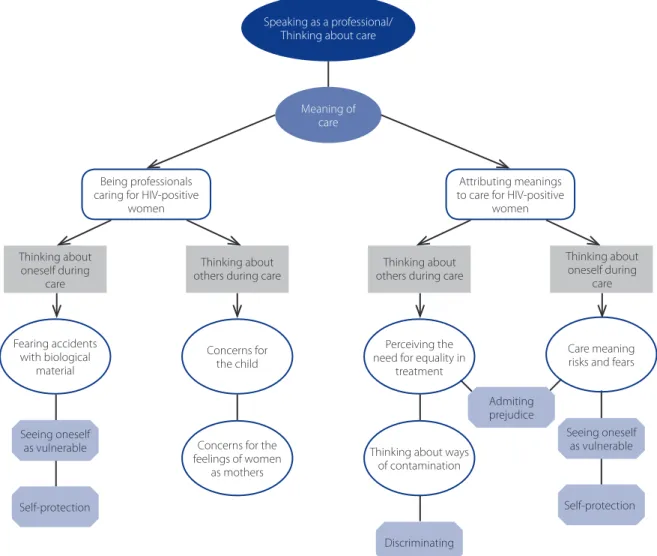
The interviews and the transcription and analysis pro-cesses showed that these women, when they spoke as professionals, incorporated the entire theoretical discourse that involves the physiopathological and/or social aspects of HIV/AIDS, resulting in the core category “Speaking as a Professional and Thinking about Care”. In this category, the focus was “providing meaning to care” (Figure 1).
Data analysis produced two categories: “Being profes-sionals caring for HIV-positive women” and “Attributing meanings to care for HIV-positive women”. In these cate-gories, women/professionals talked about providing care in two dimensions: i) when they perceived themselves as healthcare professionals who cared for women with HIV/ AIDS and worried about themselves, the care provider; and ii) when they thought about the women and worried about issues related to HIV-positive women, the receiver of care.
Being professionals caring for HIV-positive women
Some participants indicated uneasiness during the pro-vision of care by expressing fear of accidents with biolog-ical material. Others mentioned their concerns for others; the “other” being the child that is born of a woman with HIV, or the actual woman. These concerns formed three sub-categories: “Fearing accidents with biological materi-al”, “Concern for the child” and “Concern for the feelings of women as mothers” (see Figure 1).
Fearing accidents with biological material
I think I am because of my profession, because I am afraid, be-cause I have already cut myself, [...] I’ve had two accidents. (E02)
[...] I had to undergo antiretroviral therapy for a while, a year, and then I was tested and everything was fi ne [...] It was a rough period, because I vomited all the time, lost four kilos, it was a month, but I did not manage to keep up with the entire treatment, for all that time [...] (E12)
The interviewees, due to a classical issue of gender, do not consider themselves sexually vulnerable to HIV, only professionally vulnerable. Consequently, their fear of acci-dents with biological material is so expressive that it ap-pears in various categories.
Once women are diagnosed with HIV, they are con-fronted with the social and moral implications of being HIV-seropositive and start to fear abandonment on a
dai-ly basis (16). Fear of accidents with biological material is triggered by the idea that they will be judged if they are HIV-seropositive and subsequently abandoned by friends, family members and partners (2,16).
Concern for the child
Interviewees spoke about their concerns for the health of children that must anxiously await positive or negative results for seroconversion. They expressed concern for the future of children by acknowledging the existence of prej-udice and discrimination from their friends and fellow stu-dents. These same children may also grow up without their mothers, as these professionals believed their mothers would have short life spans. These concerns are the results of the meanings attributed to HIV, such as discrimination, prejudice, death and others.
Speaking as a professional/ Thinking about care
Meaning of care
Seeing oneself as vulnerable
Self-protection
Being professionals caring for HIV-positive
women
Fearing accidents with biological
material
Attributing meanings to care for HIV-positive
women
Admiting prejudice
Discriminating
Seeing oneself as vulnerable
Self-protection Thinking about
oneself during care
Thinking about others during care
Concerns for the child
Perceiving the need for equality in
treatment
Care meaning risks and fears
Concerns for the feelings of women
as mothers
Thinking about ways of contamination
Figure 1. Speaking as a professional/Caring for others.
Thinking about others during care
Thinking about oneself during
The person is prone [...] and then they have a baby that basically depends on luck. [...] We, who work with health-care [...] from the moment an opportunist disease emerges, they feel bad. (E03)
When it comes to children [...] what will it be like at school, with his classmates, there is still so much discrimination, isn’t there? (E10)
These statements show a lack of preparation of pro-fessionals, considering that there are protocols with measures that signifi cantly diminish the risk of vertical contamination. However, this lack of preparation is not always caused by lack of information, but by prejudice constructed on the meanings that each individual attri-butes to HIV(2).
The fear of exclusion and discrimination is described in a study in which parents of children with HIV reported they concealed the serological condition from friends and some family members. As these children need medication, only very close family members took care of them, such as par-ents or grandparpar-ents, and they had little social interaction to prevent suspicion (17).
The fact that the interviewees showed concern for the future of these children and the death of their mothers is due to the strong and stigmatized image of an incurable disease that debilitates and kills in a short time, despite ad-vancements in treatment(16).
Concern for the feelings of women as mothers
This sub-category addressed the fact that women with HIV do not breastfeed, and their concerns. The healthcare professionals showed evident concern for the confl icting feelings of women when they wanted to breastfeed and were unable to. It is a confl ict that also aff ects professionals as they tend to place themselves in this same situation.
It’s also something that really bothers me [...] it’s that this mother cannot breastfeed, and sometimes she wants to breastfeed, do you know what I mean? [...] (E01)
It’s [...] quite sad.To want to breastfeed your baby and not being able to. (E02)
Participants showed concern for the feelings of these women because they cannot breastfeed their babies, al-though they were aware that this is a protective measure for the newborn child. However, this concern is maintained because of the meanings that women attribute to
breast-feeding, considering that, in addition to the health bene-fi ts, breastfeeding also carries a symbolic meaning that is understood by women as being an act of love (16). The con-traindication of breastfeeding can be interpreted as being deprived of fully experiencing maternity (16,18).
Studies with women that were diagnosed as HIV-pos-itive during pregnancy showed that the impossibility of breastfeeding aff ects women in several ways (16,18). Moover, the fact that they cannot breastfeed is a constant re-minder of HIV in their organism. By not breastfeeding in order to protect their babies, they expose themselves to the risk of discrimination, as people close to them even-tually suspect they are infected and distance themselves from these mothers(18).
Attributing meanings to care for HIV-positive women
In this category, the professionals also spoke about care for women with HIV in two dimensions. These dimensions formed the three sub-categories that defi ned caring for women with HIV (see Figure 1).
Perceiving the need for equality in treatment
The interviewees emphasized the need for equality in treatment, without labelling and without discrimi-nating, and the importance of providing support for these women by checking medical records to know if their families and partners are aware of their condition, the number of prenatal consultations, HIV treatment, its prevention for the newborn baby and their behaviour in relation to infection.
You start the inquiries [...]in fact, the fi rst approach is ours, of the nursing unit [...] we talk to her, and ask things like, whether it’s her fi rst child, do you know what I mean? (E11)
We don’t have to discriminate really, do we? (E08)
aff ects transgressors of social standards(1,19). The HIV-posi-tive women are labelled as promiscuous or as drug users, both of which are considered inacceptable behaviour by society, thus generating discrimination and exclusion (1).
Thinking about ways patients are contaminated
During the interviews, the participants stated that they have diff erent experiences depending on the medical his-tory of each female patient.
It’s actually quite tough, because every woman has a his-tory, right [...] They are very diff erent experiences [...] (E03)
I think….how they were contaminated, that they know the risks, right? Oh, the younger ones, as I said, are often street girls, they’ve been with several men. (02)
They also stated diff erent care experiences, depending on the manner in which women were infected with the virus. That is, providing care for a woman with HIV can have diff erent meanings depending on how she acquired the virus. Women are either considered “guilty” or “unfortunate”. This shows how HIV/AIDS carriers, especially women, are still labelled, judged and condemned by society, including by healthcare professionals of the same gender (2).
According to the interactionist perspective, when healthcare professionals observe these women, they resort to the symbols attributed to HIV/AIDS in the 1980s, and they apply past experiences and defi ne their action, their feelings and meanings. These symbols are still burdened with prejudice and label women that carry the virus as prostitutes, as if HIV infection was a punishment for their so-called promiscuous behaviour (2,3,8-9,19).
Care meaning risks and fear
According to the participants, caring for women with HIV means running risks and they consequently reinforce protection measures. Others emphasized the importance of maintaining the same care for all women, for preven-tive measures and to avoid discrimination. They stated that risks are also present in the healthy appearance of an HIV carrier and the fact that these women do not have the evi-dent signs that would otherwise call the attention of these professionals does not exempt them of these risks.
Because care, the way I treat them, is the same for all of them. One of them is declared, with positive results. What about those that aren’t? (E03)
Look, it’s like this, [...] extra attention, right? [...] But I advise them [...] I try not to get that way [...] and label, right? (E09)
More care, more risks [...] for us [...] Sometimes she is so young and poses a risk and she doesn’t look like she would [...] understand? (E02)
The healthcare professionals present the discourse of non-discrimination, but they also have social customs and values that infl uence the provided care (2). When they per-ceive the need for equality in treatment, they admit that there may be prejudice when caring for women with HIV, as a consequence of their actions and reactions.
By attributing a sense of “extra attention”, “risks and fear” to this care, these professionals are once again expressing their fears of having accidents with biological material and acting in a discriminatory and prejudiced manner (2). When this occurs, they reproduce in women with HIV the same judgements they fear confronting if they were HIV-sero-positive (2,16).
In spite of the technical and scientifi c knowledge and the discourse of equal treatment, statements showed a distanced and mechanistic care that is infl uenced by prej-udice and discrimination. For these professionals, this care represents a health risk instead of the possibility to exercise humanized care based on comprehensiveness.
FINAL CONSIDERATIONS
Analysis of the meanings attributed by female health-care professionals when providing health-care for HIV-positive women, considering gender vulnerability in the context of feminization of HIV/AIDS, showed that HIV/AIDS is associat-ed to deep-rootassociat-ed stigmas that, to this day, determine the profi le of HIV carriers and infl uence the meaning of care for healthcare professionals.
It was consequently concluded that although these professionals are aware of the changes to the social and epidemiological profi le and have technical and scientif-ic knowledge of the HIV/AIDS prevention and treatment process, the meaning of care for women with HIV is de-fi ned within a process of social interaction. These women suff er the infl uence of concepts, meanings and symbols that healthcare professionals bring from their social con-text. These professionals act and react with their daily lives, with all the reproductions or alterations, depending on the manner in which these professionals defi ne the situation to themselves.
HIV carrier as a woman that deserves the same dignity and respect as any other, which does not justify differ-ent feelings and approaches during care. The transfor-mation of these symbols must also occur in relation to the image and consequence of the disease, considering that treatment is effective and is significantly reducing the morbidity and mortality rate of AIDS in Brazil and around the world.
It should be observed that this study did not consider the meanings of care for the mother-child. Although the interviewees mentioned their concerns for the newborn child, the focus of their statements was the provision of care for women. This could be a limitation of the study and the development of studies on the mother-child in this same perspective is therefore recommended.
This research provided the grounds to stimulate refl ec-tion of all healthcare professionals, especially women, in relation to the professional discourse, which is academically constructed, and care practices, which suff er the infl uence of the social interactions experienced during an entire lifetime.
REFERENCES
1. Almeida MRC, Labronice LB de. A trajetória silenciosa de pessoas portadoras do HIV contada pela história oral. Cienc. Saúde Colet. 2007;12(1):263-74. 2. Rangel TSA. Vivendo a contradição entre ser mulher e ser profi ssional no
proces-so de cuidar de mulheres proces-soropositivas para o HIV [dissertação]. Rio de Janeiro: Faculdade de Enfermagem, Universidade do Estado do Rio de Janeiro; 2010. 3. Silva CM, Vargens OMC. A percepção de mulheres quanto à vulnerabilidade
fe-minina para contrair DST/HIV. Rev Esc Enferm USP. 2009;43(2):401-6. 4. Anjos RHD dos, Silva JAS, Val LF do, Rincon LA, Nichiata LYI. Diferenças entre
ad-olescentes do sexo feminino e masculino na vulnerabilidade individual ao HIV. Rev Esc Enferm USP. 2012;46(4):829-37.
5. Boletim Epidemiológico Aids/DST [Internet]. 2011 [citado 2012 out];8(1):1-159. http://www.aids.gov.br/sites/default/fi les/anexos/publicacao/2011/50652/ boletim_aids_2011_fi nal_m_pdf_26659.pdf
6. Silva CM, Lopes FMVM, Vargens OMC. A vulnerabilidade da mulher idosa em relação à AIDS. Rev Gaúcha Enferm. 2010;31(3):450-7.
7. Facchini R, Ferreira CBC. Medicalização, sexualidade e gênero: sujeitos e
agenci-amentos.Sex Salud Soc. 2013;(14):164-71.
8. Meyer DEE, Klein C, Andrade SS. Sexualidade, prazeres e vulnerabilidade: im-plicações educativas. Educ Rev. 2007 dez [citado 2012 nov 27];(46):219-39. Available in: http://dx.doi.org/10.1590/S0102-46982007000200009. 9. Wiese IRB, Braga LNG, Saldanha AAW. Representações de gênero e situações
de vulnerabilidade às DST/aids na adolescência. In: [Anais do] 2º Seminário Nacional Gênero e Práticas Culturais: Culturas, Leituras e Representações; 2009 out. 28-30; João Pessoa, BR [Internet]. [citado 2011 mar 1]. Available in: http:// itaporanga.net/genero/gt6/7.pdf.
10. Martins CBG, Alencastro LCS, Mato KF de, Almeida FM de, Souza SPS de, Nasci-mento SCF. As questões de gênero quanto à sexualidade dos adolescentes. Rev Enferm UERJ. 2012;20(1):98-104.
11. Carvalho FT de, Piccinini CA. Aspectos históricos do feminino e do maternal e a infecção pelo HIV em mulheres. Cienc Saúde Colet. 2008 dez [citado 2009 set 24];13(6):1889-98. Available in: http://www.scielo.br/pdf/csc/v13n6/ a24v13n6.pdf.
12. Cassiani SHB, Caliri MHL, Pela NTR. A Teoria fundamentada em dados como abordagem da pesquisa interpretativa. Rev Latino-Am Enferm. 1996;4(3):75-8. 13. Glaser BG. Doing grounded theory: issues and discussions. Mill Valley: Sociology
Press; 1998. 254 p.
14. Rangel TSA. Vivendo a contradição entre ser mulher e ser profi ssional no proces-so de cuidar de mulheres proces-soropositivas para o HIV [dissertação]. Rio de Janeiro: Faculdade de Enfermagem, Universidade do Estado do Rio de Janeiro; 2010. 15. Ministério da Saúde (BR). Conselho Nacional de Saúde. Resolução nº 466, de
12 dedezembro de 2012. Diretrizes e normas regulamentadoras de pesquisas envolvendo seres humanos. Diário Ofi cial da União [da] República Federativa do Brasil. 2013 jun 13;150(112 Seção 1):59-62.
16. Padoin SMM, Souza IEO. A compreensão do temor como modo de disposição da mulher com HIV/AIDS diante da (im)possibilidade de amamentar. Texto & Contexto Enferm. 2008;17(3):510-8.
17. Gomes GC, Pintanel AC, Strasburg A, Xavier DM. Face singular do cuidado fami-liar à criança portadora do vírus HIV/AIDS. Acta Paul Enferm. 2012;25(5):749-54.
18. Cartaxo CMB, Nascimento CAD, Diniz CMM, Brasil DRPA, Silva IF. Gestantes por-tadoras de HIV/AIDS: aspectos psicológicos sobre a prevenção da transmissão vertical.Estud. Psicol. 2013;18(3):419-27.
19. Rodrigues LSA, Paiva MS, Oliveira JF, Nóbrega SM. Vulnerabilidade de mulheres em união heterossexual estável à infecção pelo HIV/AIDS: estudo de representa-ções sociais. Rev Esc Enferm USP. 2012;46(2):349-55.
Author’s address: Octavio Vargens
Rua Barata Ribeiro, 727/505, Copacabana 22051-001, Rio de Janeiro, RJ
E-mail: [email protected]