ABSTRACT
BACKGROUND AND OBJECTIVES: Painful crises are part in the evolution of sickle cell anemia, is the more dramatic pic-ture of variable intensity and location, caused by chronic hemo-lysis and vaso-occlusion, which alter the daily life of the patients. he objective of this study was to understand, by means of draw-ing, the repercussions and the coping strategies in situations caused by the painful crises of the sickle cell anemia, from the children’s perspective.
METHODS: Exploratory, qualitative study, carried out in a pe-diatric referral hospital of Ceará, with ive children diagnosed with sickle cell anemia. Data collection was performed from May to July 2016, by means of observations and drawings-story by Trinca. In the analysis, it was used the analysis of drawings con-tent by Coutinho.
RESULTS: Two categories emerged: the pain that hurts and cop-ing with pain. Every child identiied its bigger meancop-ing, evokcop-ing the repercussions of pain as the most striking element and more present in its life.
CONCLUSION: In face of the suferings confronted by chil-dren with sickle cell anemia, it is necessary to create strategies that promote the implementation of public policies to prevent crises and treat the disease, modifying the course of the disease and improving the quality of life.
Keywords: Child, Pain, Sickle cell anemia.
Drawing pain for children with sickle cell anemia: the pain that hurts,
really hurts
O desenhar da dor para as crianças com anemia falciforme: a dor que dói, dói muito
Lívia Lopes Custódio1, Ilse Maria Tigre de Arruda Leitão1, Ilvana Lima Verde Gomes1, Layza Castelo Branco Mendes2
1. Universidade Estadual do Ceará, Departamento de Saúde, Fortaleza, CE, Brasil. 2. Universidade Estadual do Ceara, Departamento de Psicologia, Fortaleza, CE, Brasil. Submitted in February 20, 2017.
Accepted for publication in October 26, 2017. Conlict of interests: none – Sponsoring sources: none.
Correspondence to:
Av. Dr. Silas Munguba, 1700, Campus do Itaperi 60714-903 Fortaleza, CE, Brasil.
E-mail: [email protected]
© Sociedade Brasileira para o Estudo da Dor
RESUMO
JUSTIFICATIVA E OBJETIVOS: As crises dolorosas fazem parte constante na evolução da anemia falciforme, é o quadro mais dramático, de intensidade e localização variáveis, ocasiona-dos pela hemólise crônica e vaso-oclusão, que alteram o cotidia-no dos pacientes. O objetivo deste estudo foi compreender, por meio do desenho, as repercussões e as estratégias de enfrenta-mento em situações ocasionadas pelas crises dolorosas da anemia falciforme, a partir da perspectiva das crianças.
MÉTODOS: Estudo exploratório, qualitativo, realizado em um hospital de referência pediátrica do Ceará, com cinco crianças diagnosticadas com anemia falciforme. A coleta de dados ocor-reu de maio a julho de 2016, por meio de observações e desenho--estória de Trinca. Na análise, foi utilizada a análise de conteúdo para desenhos de Coutinho.
RESULTADOS: Emergiram duas categorias: a dor que dói e en-frentando a dor. Cada criança identiicou o seu signiicado maior, evocando as repercussões da dor como elemento mais marcante e mais presente em suas existências.
CONCLUSÃO: Diante dos sofrimentos enfrentados pelas crian-ças com anemia falciforme, se faz necessária a criação de estra-tégias que favoreçam a implantação e implementação de políti-cas públipolíti-cas com esforços de prevenir as crises e tratar a doença, modiicando positivamente o curso da doença e melhorando sua qualidade de vida.
Descritores: Anemia falciforme, Criança, Dor.
INTRODUCTION
he sickle cell disease (SCD) is part of the group of chronic dis-eases, and one of the main and most frequent inherited hema-tological diseases that afect the human population1. A genetic mutation afects the DNA and causes erythrocyte distortion by a type of mutant hemoglobin that replaces the glutamic acid by a valine at position six of the beta chain, resulting in an abnormal hemoglobin, forming the hemoglobinopathies2.
Of the hemoglobinopathies, sickle cell anemia (SCA) is the most serious, with the highest clinical signiicance3, of more impact-ing epidemiological character4 and more frequent morbidity and mortality in the human population, especially in developing countries5. In Brazil, it is estimated an incidence of 1-3:1,000 live births with this type of disease6, with a tendency to achieve increasingly signiicant portions of the population due to the high degree of racial miscegenation, reaching blacks, browns, and whites7.
Characterized as a public health problem, the SCA has a great diversity of clinical manifestation that appears during the life of the people afected, caused by chronic hemolysis and vaso-occlusion8. Such processes are related to the painful crises that occur unexpectedly, involving any organs or tissues, produc-ing pictures of great severity and pain intensity that impact directly on the quality of life of the patient.
In the face of the SCA complexity of symptoms and compli-cations, it is necessary that the family seek immediate care at health centers in order to evaluate the picture and prevent complications. However, when the pain intensiies, patients need to look for treatment at urgency or emergency units which may involve successive and frequent hospitalizations9. his period of illness impairs and changes the daily life of children and adolescents, being, according to the World Health Organization10, a chronic condition that requires con-tinuous management, treatment, and care for many years or even decades.
he repercussions of a chronic disease and the treatment of children alicted with SCA require constant care in relation to the therapy and to the determinants that may aggravate their health11. hus, it is necessary that both the families and health professionals be knowledgeable about the disease, its manifestations and implications, as well as being inserted into the process of care to provide a better service.
In order to contribute to the understanding of the meaning that this chronic disease has for a child, this article aims at sharing revelations that can lead to relections both for health professionals, who need to catch up on, and the families, with the purpose of rethinking care to better meet the unique needs of this population.
Given that, the objective of this study was to understand, by means of drawing, the repercussions and the coping strategies in situations caused by the painful crises of the SCA, from the children’s perspective.
METHODS
It is a qualitative, exploratory, descriptive research, carried out in a tertiary unit of the State of Ceará, located in the city of Fortaleza, a referral center for the treatment of children and adolescents with serious and high complexity diseases. Five children participated in the study, with ages varying from 5 to 11 years, with a diagnosis of SCA, undergoing outpatient follow-up, who agreed to participate in the study. In order to ensure children’s anonymity, letters with a number were used to identify them as C1, C2, C3, C4, and C5.
Data collection was performed from May to July 2016. We used the observations and drawing-story constructions by Trinca12 since it is considered the best material by which one can understand the children’s subjectivity involving their lives, history, their way of looking at and thinking about the reality. The Free and Informed Acknowledge Form (FIAF) was signed by the children and adolescents, and the Free and Informed Consent Form (FICT), by their legally respon-sible person.
he drawing-story technique was applied after establishing a contact with the researcher who explained this technique to the child. Next, the child was asked to produce one single drawing, focusing on what it meant to the child to have SCA. his happened in only one moment, in a free and individual manner, on a sheet of paper, and the duration varied from child to child. When inished, the child was invited to speak, clarify and/or explain what was produced, so assigning its meaning.
Data analysis was based on the assumptions of drawings content analysis by Coutinho13. This method meets the following analysis procedures: systematic observation of the drawings and themes; floating reading of the stories content; selection of drawings by graphic similarities and/ or proximity to the themes; exploration of the material, identification of core sense, categorization, and processing of the results. After the data decoding and categorization, two broad categories emerged: The pain that hurts and
coping with pain.
he study complied with the ethical principles of research with humans, being approved by the Research Ethics Com-mittee of the State University of Ceará (UECE) and the Chil-dren’s Hospital Albert Sabin (HIAS), under the opinion num-ber 1.547.314.
RESULTS
When the children were asked to draw their perceptions of coping strategies in relation to SCA, it was found that each has identiied its bigger meaning, evoking pain as the most striking and more present element.
The pain that hurts
In the irst category, children represented in their drawings their personal experiences, with special emphasis to their rep-resentations in relation to pain, as noted in igure 1.
Figure 1 was produced by a 5-year old child who represented pain in the form of drops, with lines coming from above on the upper part of the sheet of paper. he drops reach his body directly, as shown by the line on the bottom of the paper. When invited to talk about the production, he irst pointed to the drops and said: -”that’s the pain [...]”. hen, pointing to the bottom part of the paper, he continued: - “[…] and this is me. It is my leg and my foot”.
When asked about the reason of the drawing, C1 he point-ed again to the bottom part and answerpoint-ed: - “[…] it hurts here.” Then he took the pencil in his hand, and started mov-ing it upwards and downwards touchmov-ing his foot, and said: - “[…] it’s like this, see […] like this […] like this […] and it hurts.”
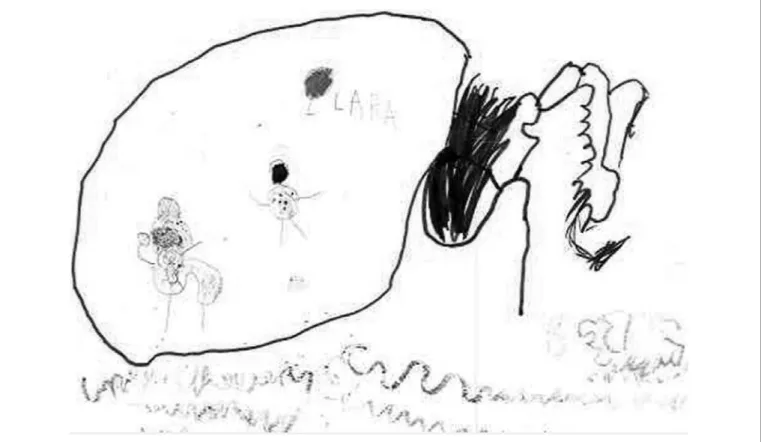
Another 5-year old child represented her pain showing the feeling she has when attacked by a painful crisis.
of her mother, sitting on a rocking chair inside the balloon on the left. It is interesting of notice in this drawing that in the same way the child marked the monster, she also marked her your own face as if she was emphasizing that she has been hit. When asked to talk about her work, the child, very casually started to tell what she feels when in pain: it hurts, and the baby is sad and cries […] it hurts, a lot […] the baby is crying […]” (Figure 2).
hen, she pointed to the girl with the marked face and con-tinued:
“It hurts and the baby is sad and cries […] it hurts, a lot […] the baby is crying […] then, her mom gives the soother medicine in the arm, in the other arm and feet […] then, mom goes to the chair and takes the baby in her arms, sits and starts rocking to make the baby sleep […] and […] gives the baby the paciier […] and the baby sleeps and the pain goes away”.
When asked what would be the line that was involving her, on the right of the paper, C2 looked at it and said: - “[…] it hurts, is bad, makes the baby cry.”
In the third drawing, we see, once again, another child repre-senting its pain (Figure 3).
he explanation was straightforward with few words, as shown in the author’s own speech: - his is a girl crying, she is in pain […] much pain […], she was in school, but she had to leave. She couldn’t stand the pain”.
Later, the child ended up saying: “[…] his is me, crying in pain.”
Figure 1. Drops of pain Source: 5-year-old child (C1).
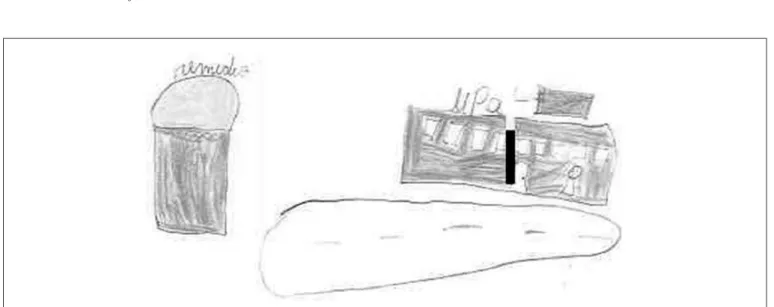
In the second category, it was possible to grasp how each child faces its process of pain crisis due to SCA, as we can see in igure 4.
The way C4 copes with pain is expressed searching for help, apparently alone and crying next to the door of an urgent care unit, called UPA, on the right side of the paper. She drew a road below and a gigantic medication on the left side.
When explaining its production, C4 irst pointed to the per-son crying inside of UPA and said: Here, it’s me crying and feeling much pain, then I go to UPA] … I always go there […] it is where I take my medication”. hen, pointing to the medica-tion: - “[…] this is the medication, it helps me to feel better.” Another way of coping with SCA pain was shown by an 11-year old child (Figure 5).
he drawing shows an apparently happy girl holding a rosary in her right hand, she explains: “[…] his is me. I do that when I’m sick, in pain”.
And she was asked: -”Do that what? And she added: “I take my rosary and pray [...], and I get better”.
Figure 3. Crying in pain Source: 9-year old child (C3).
Figure 4. The urgent care unit and the medication Source: A 7-year old child (C4).
DISCUSSION
he analysis was established from the elements that emerged from the data about the children’s perception by means of their drawings and the researchers’ observations. herefore, the child drawing and its symbolic language were consid-ered instruments through which children establish contact with their inner world, being able to express their feelings by means of graphic representation, articulating their problem or their emotional conlict, or the stress that arises in that moment of life13,14.
Several meanings attributed in the children’s drawings were no-ticed, mainly related to the painful crises due to SCA. Accord-ing to the irst category, the pain appears as a common symp-tom among participants, in line with a study15 that compares the perception of SCA painful episodes among 27 children and their caregivers. he results revealed diferences in relation to the type and intensity of pain. In terms of the pain location, the majority referred to the trunk region followed by the limbs. In the irst two drawings, the experience of a painful episode was expressed in its physical aspects, probably by a manifesta-tion related to dactylitis. C1 makes its approach in a solitary way, indicating the pain site; whereas C2 draws itself involved by pain, but the mother appears, embracing the child, giving the medication, taking her in her arms until “the baby sleeps and the pain goes away.”
he way C2 copes with pain is in line with a survey16 carried out in two referral centers for pediatric cancer treatment in the Midwest of the state of São Paulo, where 66.7% of the cases showed that the mothers were the primary caregivers. he attempt to have a regression to improve and neutralize the experience of physical discomfort caused by the painful crisis is delegated to the mother, as shown in another survey17, whose results show that when the children are sick and/or hospitalized, they become the focus of the attention, requir-ing exclusive dedication and, it is in the family, especially the mother, that the child has its references assured.
Indeed, in the third drawing, the girl did not identify nor her caregivers either the speciic location of the pain but drew herself crying because of a painful crisis she had when in school, and because of that she had to leave.
he impact of pain afects the daily life of the children, in such a way that C3 had to leave school, as in the study17 aim-ing at identifyaim-ing the impact of SCA in the daily life of ado-lescents that demonstrated frequent reports of pain, fatigue, and limitations to social interaction. Corroborating this idea, in the study18 on the experience of people with SCA, it con-irmed the limitation in these people’s lives causing physical and emotional destabilization.
In the second category, the children expressedthe way how they face the episodes of SCA painful crisis. In drawing four, C4 brings to the scene a healthcare unit where she seeks for care, she called it UPA; showing, as well as, a big bottle of medication.
It drew attention the representation that this kid did to the size of the medication in contrast to its own size and even to the size of the healthcare unit where she is treated. he draw
of such a big medicine reminds the pain felt that was moti-vated by the disease. It seems to be a form of greater relief for the anguish felt.
he manifestations of pain in the individuals with hemoglo-binopathies include episodes that require the administration of drugs aiming at the regression and improvement of the pic-ture the soonest the possible19. herefore, analgesia should be in line with what the patient presents, with the particularity of each case. he initial orientation is to do it at home, and if there is no improvement or other symptoms arise, caregivers need to go to the hospital20.
In the study21 carried out in an emergency care unit in the interior of the state of Bahia, it was noticed, in the speech of the multi-professional team, that the patients look for the service when they have clinical complications or when they do not know what to do facing these complications. Another inding showed that there was a priority and focus solely on pain control, underestimating the physical examination as a chance for other episodes.
he way C5 coped with her pain was with spiritual support, possibly learned at home with her parents or someone close, recognizing in her faith in God a way to overcome the dii-culties of the complications imposed by the disease.
Spiritual practice is one of the alternatives for confronting and overcoming, being a positive aspect to alleviate the dis-ease, as shown in the study22 conducted in a tertiary hospital with 61 patients in dialysis treatment that identiied the reli-gious practice in the majority of the individuals.
he meaning presented shows that both to patients and fam-ily members and/or their accompanying person, “spirituality and religiosity help the experiences related to the disease and treatment, acting as a source of balance and strengthening the struggle for life”23.
CONCLUSION
Children have a trajectory marked by multiple adversities that directly impact their lives. herefore, we can conclude that in face of the suferings confronted by children with SCA, it is nec-essary to create strategies that promote the implementation of public policies establishing a line of care, with eforts to prevent the crises and treat the disease, modifying the course of the dis-ease and improving the quality of life.
REFERENCES
1. Cançado RD, Jesus JA. A doença falciforme no Brasil. Rev Bras Hematol Hemoter. 2007;29(3):204-6.
2. Secretaria de Atenção à Saúde (Brasil). Departamento de Atenção Especializada. Do-ença falciforme: condutas básicas para o tratamento. Brasília, DF: Ministério da Saú-de; 2013.
3. Jesus JA. Doença falciforme no Brasil. Gaz Méd Bahia. 2010;80(3):8-9.
4. Viscogliosi C, Belleville S, Desrosiers J, Caron CD, Ska B. Participation after a stroke: changes over time as a function of cognitive deicits. Arch Gerontol Geriatr. 2011;52(3):336-43.
5. McGann PT. Sickle cell anemia: an underappreciated and unaddressed contributor to global childhood mortality. J Pediatr. 2014;165(1):18-22.
7. Gesteira EC, Bousso RS, Rodarte AC. Uma relexão sobre o manejo familiar da crian-ça com doencrian-ça falciforme. R Enferm Cent O Min. 2016;6(3):2454-62.
8. Booth C, Inusa B, Obaro SK. Infection in sickle cell disease: a review. Int J Infect Dis. 2010;14(1): e2-e12.
9. Secretaria de Atenção à Saúde (Brasil). Departamento de Atenção Hospitalar e de Urgência. Doença falciforme: diretrizes básicas da linha de cuidado. Brasília, DF: Mi-nistério da Saúde; 2015.
10. Organização Mundial da Saúde. O cuidado das condições crônicas na atenção primá-ria a saúde: o imperativo na consolidação da estratégia da saúde da família. Brasília, DF: OMS, 2012.
11. Da Silva AH, Bellato R, Araújo L. Cotidiano de família que experiencia a condição crônica por anemia falciforme em dois adolescentes, Rev Eletr Enf. 2013;15(2):437-46. 12. Trinca TW. Formas de investigação clínica em psicologia: procedimento de
desenhos--estórias. São Paulo: Vetor; 2003.
13. Coutinho MPL. Saraiva ERA, organizadoras. Métodos de pesquisa em psicologia so-cial: perspectivas qualitativas e quantitativas. João Pessoa: UFPB/Editora Universitá-ria; 2011.
14. Winnicott DW. Consultas terapêuticas em psiquiatria infantil. Rio de Janeiro: Imago; 1984.
15. Dias TL, Oliveira CG, Enumo SR, Paula KM. A dor no cotidiano de cuidadores e crianças com anemia falciforme. Psicol USP. 2013;24(3):391-411.
16. Lopes GC. A compreensão da doença, do tratamento quimioterápico e as formas de
enfrentamento de crianças com câncer. Botucatu. Dissertação [Mestrado em Saúde Coletiva] - Universidade Estadual Paulista, 2016.
17. Schneider CM, Medeiros LG. Criança hospitalizada e o impacto emocional gerado nos pais. Unesc Ciênc. [periódico na Internet]. 2011 [acessado 2016 dez 12]; 2 (2): [cerca de 14 p.]. Disponível em: http://editora.unoesc.edu.br/index.php/achs/article/ view/741/pdf_216
18. De Souza FM, Pereira RA, Ramos EJ, Matos VF, Migoto MT. O impacto da anemia falciforme na vida de adolescente. Cogit Enferm. 2015;20(3):547-53.
19. Roberti BM, Moreira CL, Tavares RS, Borges FH, Silva AG, Maia CH, et al. Avaliação da qualidade de vida em portadores de doença falciforme do Hospital das Clínicas de Goiás, Brasil. Rev Bras Hematol Hemoter. 2010;32(6):449-54.
20. Cordeiro RC, Ferreira SL, Santos AC. [he illness of women and men with sickle cell disease: a Grounded heory study]. Rev Lat Am Enfermagem. 2015;23(6):1113-20. English, Portuguese, Spanish. he illness of women and men with sickle cell disease: a Grounded heory study.
21. Tostes MA, Braga JA, Len CA, Hilário MO. Avaliação de dor em crianças e adolescen-tes portadores de doença falciforme. Rev Ciênc Méd. 2008;17(3-6):141-7. 22. Soares EP, Silva DS, Xavier AS, Carvalho ES, Cordeiro RC, Araújo EM. Cuidar de
pessoas com doença falciforme na unidade de emergência: discurso de uma equipe multiproissional. Cienc Cuid Saude. 2014;13(2):278-85.