370
Rev Dor. São Paulo, 2017 oct-dec;18(4):370-3
ABSTRACT
BACKGROUND AND OBJECTIVES: Chikungunya fever is
caused by the chikungunya virus, but with characteristics similar to the dengue fever. he main clinical manifestation that dif-fers from dengue is the strong joint pains, which can remain for long periods, and that is found at lower intensity and duration with dengue. he objective of this study was to contribute to the physical therapy in patients with persistent polyarthralgia after chikungunya fever.
CASE REPORT: Female patient, 35 years old, diagnosed with persistent polyarthralgia after chikungunya fever. When admit-ted to the physiotherapy service, she complained of severe pain in the knee, wrist and right ankle, mainly in the morning. For the physiotherapeutic evaluation, the following parameters were used: visual analog scale, use of painkillers, goniometry, modiied sphygmomanometer test, and perimetry. he functional assess-ment was done through a 10m walking test, Quick Dash and Le-quesne scales, Portuguese version, for the upper and lower limbs, respectively. he proposed physiotherapeutic program was based on therapeutic exercises and manual therapy for 4 weeks. he results showed that the proposed physical therapy was efective in decreasing the pain, increasing muscle strength, the range of motion, decreasing edema and improving functional capacity.
CONCLUSION: he physiotherapeutic treatment proved to be efective in treating a patient with persistent polyarthralgia after chikungunya fever, improving the subjective pain and functional capacity.
Keywords: Arthralgia, Chikungunya fever, Physical therapy.
Effect of a physiotherapy program in patient with persistent polyarthralgia
after chikungunya fever. Case report
Efeito de um programa de tratamento fisioterapêutico em paciente com poliartralgia persistente
pós-febre de chikungunya. Relato de caso
Alexsandro da Silva Oliveira1, Júlio Guilherme Silva1
1. Centro Universitário Augusto Motta, Rio de Janeiro, RJ, Brasil.
Submitted in July 19, 2017.
Accepted for publication in October 25, 2017. Conlict of interests: none – Sponsoring sources: none.
Correspondence to:
Avenida Paris, 84 - Bonsucesso 21041-020 Rio de Janeiro, RJ, Brasil. E-mail: [email protected]
© Sociedade Brasileira para o Estudo da Dor
RESUMO
JUSTIFICATIVA E OBJETIVOS: A febre de chikungunya é causada pelo vírus chikungunya, porém apresenta características parecidas com a dengue. A principal manifestação clínica que a difere da dengue são as fortes dores articulares, que podem per-manecer por longos períodos, e que são encontradas em menor intensidade e tempo de duração na dengue. O objetivo deste estudo foi contribuir para o tratamento isioterapêutico em pa-cientes com poliartralgia persistente pós-febre de chikungunya.
RELATO DO CASO: Paciente do sexo feminino, 35 anos de idade, diagnosticada com poliartralgia persistente pós-febre de chikungunya. Ao ser admitida no serviço de isioterapia, queixava-se de dor intensa no joelho, punho e tornozelo direi-to, principalmente pela manhã. Para avaliação isioterapêutica foram usados os seguintes parâmetros: escala analógica visual, ingestão de analgésicos, goniometria, teste do esigmomanô-metro modiicado e perimetria. A avaliação funcional foi feita por meio do teste de caminhada de 10m, escalas Quick Dash
e Lequesne versão em português, para o membro superior e inferior, respectivamente. O programa de tratamento isiopêutico proposto foi baseado em condutas de exercícios tera-pêuticos e de terapia manual durante 4 semanas. Os resultados apontaram que a proposta de tratamento isioterapêutico foi eicaz na diminuição do quadro álgico, aumento da força mus-cular, aumento da amplitude de movimento, diminuição do edema e melhora da capacidade funcional.
CONCLUSÃO: O tratamento isioterapêutico mostrou-se efeti-vo no tratamento de uma paciente com poliartralgia persistente pós-febre de chikungunya melhorando a dor subjetiva e a capa-cidade funcional.
Descritores: Artralgia, Febre chikungunya, Fisioterapia.
INTRODUCTION
he chikungunya fever (CF) is an arbovirosis caused by the chi-kungunya virus (CHIKV), transmitted through the bite of the
Aedes aegypti female mosquitos infected by Aedes albopictus. he viremia can persist for up to 10 days, after the onset of the clini-cal manifestations that are similar to dengue, namely: acute fever, joint and muscle pain, headache, nausea, fatigue, and rash1,2.
he CF has two phases: acute and chronic. At irst, patients usu-ally have a high fever, chills, headache, nausea, vomiting, fatigue, back pain, myalgia, and polyarthralgia. his last one can be in-tense and disabling, mainly afecting the ankles, ists, and hands.
CASE REPORT
371
Efect of a physiotherapy program in patient with persistentpolyarthralgia after chikungunya fever. Case report
Rev Dor. São Paulo, 2017 oct-dec;18(4):370-3
Concerning the characteristics of arthralgia, it does not have a pattern, although it tends to be more intense in the morning3.
he duration of arthralgia is still uncertain, lasting for months and years. he chronic symptoms may decrease with time, af-ter an initial infection, being of 88 to 100% during irst the six weeks1. he full recovery time is still uncertain, and some
in-fected patients can still remain symptomatic six to eight years after the initial infection, in which the polyarthralgia consider-ably compromises the quality of life and functional capacity of the individual4.
Given to the similarity of the clinical signs between dengue and CF, it is important that healthcare professionals are attentive to the diferential diagnosis. he main clinical manifestation that distinguishes the infection by CHIKV from dengue is the strong joint pain, usually present in lower intensity in dengue with a faster resolution4.
he epidemiological aspects point to an increasing number of people afected with the CF in last the 10 year2. Of these, it is
es-timated that the cumulative number of infected individuals suf-fering from disabling and long-lasting pain is of approximately 1 to 2 million, generating high costs to the health systems4.5.
Diferent predictor factors have been involved in the develop-ment of this more delayed picture of the CF, mainly character-ized by the presence of persistent musculoskeletal pain. Among them are age above 45 years, high-intensity initial pain, previous osteoarthritis and strong IgG-speciic response to the CHIKV in the recovery period and in the chronic phase3.
he pathophysiological mechanisms of musculoskeletal pain and arthritis, after the infection by the CHIKV, are not very are well deined yet. It is believed that these symptoms are caused by the virus early escape located inside the monocytes, with a conse-quent replacement within the synovial macrophages. his fact is reinforced by the observation of the persistence of the virus in muscle, joints, hepatic and lymphoid tissues3.
It is worth mentioning that in spite of the increasing number of people diagnosed with CF, so far there is no kind of recom-mendation based on guidelines for its treatment. In general, the treatment is with drugs (antipyretics and analgesics), in order to control the fever, reduce the impact of the immune process, decrease pain and prevent the development of chronic joint lesions2-4,6.
When the pharmacological treatment of the CF does not present a satisfactory result, mainly in relation to the persistent arthralgia (chronic), many individuals end up needing a physiotherapeutic treatment2. he focus of the physiotherapeutic intervention is
to decrease pain, regain functional capacity and, consequently, improve the quality of life1,2,4.6. However, no study was not found
in the literature addressing the physiotherapeutic intervention in individuals with persistent polyarthralgia after the infection by the CHIKV. his fact led to the elaboration and presentation of the present report.
CASE REPORT
Female patient, 35 years, 1.68m tall, 86kg, brown, administra-tive assistant, naadministra-tive from Rio de Janeiro. Admitted to the
phys-iotherapy service in August 2016, reporting as main complaint “a lot of pain in the wrists and knees, especially when waking up.” he patient reported that on December 6, 2015, she had a sud-den onset of high fever (40°), edema on the distal joints (feet and hands) and disabling polyarthralgia with symmetric character-istics, with more intense pain in ankle and wrist bilaterally. She immediately sought medical care at the public health network. She underwent laboratory tests, being medicated with painkillers (dipyrone) and anti-inlammatory drugs (paracetamol). About three days later, she was clinically diagnosed with CF, conirmed by positive serology. She was oriented to keep on taking dipyrone and paracetamol, to remain at rest with no labor activity and to ingest liquids to improve her clinical picture. he patient fol-lowed the instructions for six months. However, the polyarthral-gia remained. Due to the diiculty to schedule a new medical appointment on the public health network, she only managed to return to the doctor after seven months of the onset of the symp-toms, in July of 2016. She was told to stay with the drugs and to look for physiotherapeutic care to reduce her pain. She had a previous pathological history of systemic arterial hypertension (SAH) and a non-diagnosed gonalgia in the right lower limb. Regarding the social history, she reported not being alcoholic or smoker, living in an easily accessible place, as well as holding back her social, labor and physical activities due to the intense pain, being quite dissatisied with this situation. At the time of the assessment, she was making continued use of painkillers and anti-inlammatory drugs (paracetamol and dipyrone), reporting constant abdominal pain, associating the pain to the continuous use of drugs.
When admitted to the physiotherapy service, the patient com-plained of severe pain in knee, wrist and right ankle, mainly in the morning. During the examination, it was noticed limping gait - with no auxiliary gait device - antalgic posture when sitting, painful facial expression at rest, edema in the wrist (++/4+), knee (++/4+) and ankle (+/4+). All the previously mentioned joints - knee, ankle, and wrist - presented pain on palpation, with great-er intensity in the right wrist. he sensitivity was pgreat-erfect in all body segments, with discreet hyperesthesia in the wrist and right knee. As evaluation parameters to identify the pre-and post-in-tervention efects the following instruments were used: the visual analog scale (VAS)7 and the intake of analgesics reported by the
patient to measure the subjective pain, goniometry to quantify the range of motion (ROM)8, the modiied sphygmomanometer
test (MST) to evaluate muscle strength9 and perimetry for edema
volume10. he functional assessment was done through the 10m
walking test, (TC10)11, Quick Dash12 and Lequesne13 scales,
Portuguese version, for the upper and lower limbs, respectively. Previously to the irst intervention protocol, it was briely ex-plained to the patient the harmful efects to the body from the prolonged use of analgesic and anti-inlammatory drugs, and she was advised to try to gradually reduce the use, daily writ-ing down the amount of writ-ingested drugs. No speciic explana-tion was provided on the neurophysiological mechanisms of the pain. However, it was explained that the exercises should be done even when in pain, provided it was tolerable14. he
kine-372
Oliveira AS and Silva JG
Rev Dor. São Paulo, 2017 oct-dec;18(4):370-3
siotherapy approach and manual therapy for 4 weeks. Table 1 shows the description of the approach.
he comparison of the variables values before and after the treatment protocol, allowed to conirm the presence of
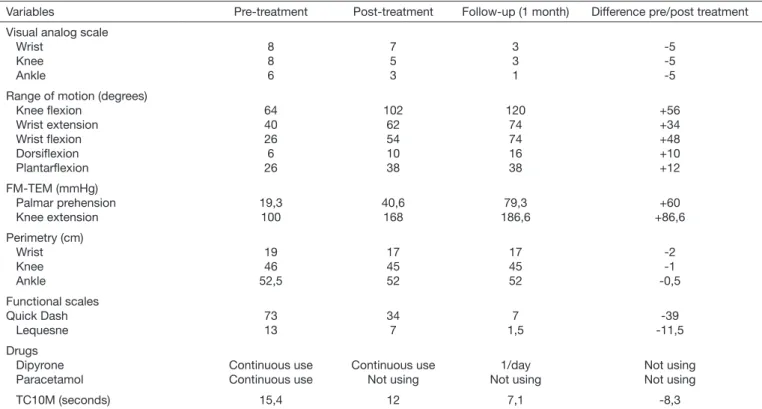
consid-erable alterations with the applied intervention. To follow-up the results after the treatment period, the patient was reevalu-ated one month after concluding the protocol. he values of each variable are shown table 2.
Table 1. Description of physiotherapeutic approach adopted during 4 weeks of intervention
Week of treatment Intervention
Weeks 1-2*
UL: 1 - Radio-carpica articular decoaptation/traction (40-60 repetitions/minute); 2- Myofascial release of the wrist extensors/lexors retinaculum (3 minutes each region); 3- Grade I-II articular mobilization for wrist lexion/extension (40-60 oscillations/minute); 4- Stretching technique for wrist extension/lexion + passive stretching of wrist exten-sors/lexors (60 oscillations/minute + 1 minute of stretching); 5- Passive mobilization for wrist lexion/extension (12 repetitions for each movement); Home Cryotherapy in the painful areas (20 min 3x/day).
Patient’s positioning: 1, 2 and 3-supine position (SP) with UL along the body; 4 and 5-SP with 90° elbow lexion. LL: 1-Decoaptation/femorotibial articular traction (60 repetitions per minute); 2- Grade I-II articular mobilization for knee lexion (40-60 oscillations/minute); 3- Ankle pump associated to draining position; 4- Passive stretching of the triceps sural muscle (1 minute);
Patient’s position: 1-Sitting on the stretcher; 2-SP with the lower limbs with the maximum range of motion of knee lexion; 3-SP with the lower limbs in elevation on the triangle; 4-SP.
Week 3-4 ** UL: 1-Active exercise with a stick for bilateral lexion/extension movements of the wrist (2 x/12 repeats); 2-Streng-thening with 1kg halter for wrist extensors/lexors (2 x/12 repeats); 3-Palmar prehension isometric exercise with visual feedback from the sphygmomanometer with 70% of maximum voluntary isometric contractions (2x/10 re-petitions with 3-5 seconds);
Patient’s position: 1- SP with 90° of UL lexion; 2- Sit on the stretcher with 90° lexion of elbow and forearm prone/ supine;
LL: 1-Active movement of triple lexion of LL with the aid of the Swiss ball; 2- Strengthening of the quadriceps with 1kg shin pads (2x/12 repetitions) + evolution to strengthening of the quadriceps sitting on the stretcher (2x/12 repetitions); 3- SLR with no additional weight + evolution with 1kg shin pad;
Patient’s position: 1-SP with a 35cm Swiss ball under the distal extremities of the LL; 2- SP with a triangle under the knee; 3- SP.
* = at the beginning of the treatment the patient was instructed to remain physically active and to perform active movements for knee, ankle, and wrist in the morning, when waking up; ** = after week 4, the patient was instructed to gradually start physical activity (walking), in accordance with the pain tolerance) until reaching the goal of 150 minutes/week; UL = upper limbs; LL = lower limbs; SLR = straight-leg raising; SP = supine position.
Table 2. Results of the variables before and after 4 weeks of the physiotherapy protocol and one-month follow-up
Variables Pre-treatment Post-treatment Follow-up (1 month) Difference pre/post treatment
Visual analog scale Wrist
Knee Ankle
8 8 6
7 5 3
3 3 1
-5 -5 -5
Range of motion (degrees) Knee lexion
Wrist extension Wrist lexion Dorsilexion Plantarlexion
64 40 26 6 26
102 62 54 10 38
120 74 74 16 38
+56 +34 +48 +10 +12
FM-TEM (mmHg) Palmar prehension Knee extension
19,3 100
40,6 168
79,3 186,6
+60 +86,6
Perimetry (cm) Wrist Knee Ankle
19 46 52,5
17 45 52
17 45 52
-2 -1 -0,5
Functional scales Quick Dash Lequesne
73 13
34 7
7 1,5
-39 -11,5
Drugs Dipyrone Paracetamol
Continuous use Continuous use
Continuous use Not using
1/day Not using
Not using Not using
TC10M (seconds) 15,4 12 7,1 -8,3
373
Efect of a physiotherapy program in patient with persistentpolyarthralgia after chikungunya fever. Case report
Rev Dor. São Paulo, 2017 oct-dec;18(4):370-3
DISCUSSION
he persistent polyarthralgia associated to the functional limi-tation is often considered one of the main complications of the CF1,2,4-6. Due to this, many patients end up needing physiotherapy
follow-up to improve the algesic picture and the quality of life2,4.
he results of the present study show that the proposal of a phys-iotherapy treatment with kinesphys-iotherapy and manual therapy had a positive inluence on several aspects for a patient with persistent polyarthralgia (Table 1), namely the reduction of the algesic picture; increase in muscle strength; increase the range of motion; reduction of edema and improvement of the functional capacity.
he physiotherapy approach, by means of a well-structured treatment program, is widely indicated for patients with chron-ic-degenerative joint diseases. here are strong evidences that a rehab program based on motivation and orientation to self-care, muscle strengthening, low-impact aerobic exercises and neuro-muscular education help to decrease the symptoms of patients with osteoarthritis15.
In this context, the present results corroborate the literature since with a treatment program with these characteristics, mainly based on kinesiotherapy together with manual techniques and orientation about self-care, it was possible to decrease the algesic picture considerably and to improve the functional capacity of a patient with persistent polyarthralgia after CF.
It is believed that such efects may be related to the hypoalgesia induced by comprehensive therapeutic exercises and by the acti-vation of the endogenous pain descending inhibitory pathways activated by the manual therapy techniques, as already observed in other studies16-18. In the present study, the reduction in pain
was noticeable, especially on the VAS pre-and post-intervention, as well as by the decreased intake of analgesics (Table 2). In this context, having the pain variable as predominant, it is possible that the secondary outcomes such as ROM, muscle strength and functional capacity have been positively inluenced due to the reduction of the algesic picture (Table 2). It is worth mentioning that all exercises were performed gradually, taking into consideration the patient’s tolerance to pain during its per-formance.
It is also important to highlight the recommendation to the pa-tient to do a regular physical activity (walking) after the out-patient follow-up period to maintain the obtained results and the encouragement to self-care. he regular physical activity has been considered an excellent treatment option for some types of chronic pain such as the ibromyalgia, non-speciic chronic back pain, osteoarthritis and rheumatoid arthritis16, in addition
to strongly contribute to the general health16,19. In the present
study, the patient was very engaged and motivated during all the rehab process, and she was the one who chose walking as the preferred exercise. Recent studies have demonstrated that when encouraging the practice of physical exercises to patients
with chronic pain, it is of crucial importance to take into con-sideration the preferences of the patient16. his makes it easier to
have the patient’s compliance and the continuity of the exercise program with short, medium and long-term results, and also to strengthen the therapeutical alliance19.
CONCLUSION
he treatment program proposed in the present study can ben-eit patients with persistent polyarthralgia after the chikungunya fever, decreasing the pain perception and improving the func-tional capacity.
REFERENCES
1. Javelle E, Ribera A, Degasne I, Gaüzère BA, Marimoutou C, Simon F. Speciic mana-gement of post-chikungunya rheumatic disorders: a retrospective study of 159 cases in Reunion Island from 2006-2012. PLoS Negl Trop Dis. 2015;9(3):e0003603. 2. Ministério da Saúde. Febre de Chikungunya: Manejo Clínico; 2014.
3. Castro AP, Lima RA, Nascimento JS. Chikungunya: vision of the pain clinician. Rev Dor. 2016;17(4):299-302.
4. Foissac M, Javelle E, Ray S, Guérin B, Simon F. Post-chikungunya rheumatoid arthri-tis, Saint Martin. Emerg Infect Dis. 2015;21(3):530-2.
5. Sepúlveda-Delgado J, Vera-Lastra OL, Trujillo-Murillo K, Canseco-Ávila LM, Sán-chez-González RA, Gómez-Cruz O, et al. Inlammatory biomarkers, disease activity index, and self-reported disability may be predictors of chronic arthritis after chikun-gunya infection: brief report. Clin. Rheumatol. 2016;36(3):695-9.
6. Couturier E, Guillemin F, Mura M, Léon L, Virion JM, Letort MJ, et al. Impaired quality of life after chikungunya virus infection: a 2-year follow-up study. Rheumato-logy. 2012;51(7):1315-22.
7. Boonstra AM, Schiphorst Preuper HR, Reneman MF, Posthumus JB, Stewart RE. Re-liability and validity of the visual analogue scale for disability in patients with chronic musculoskeletal pain. Int J Rehabil Res. 2008;31(2):165-9.
8. Carvalho RM, Mazzer N, Barbieri CH. Análise da coniabilidade e reprodutibilidade da goniometria em relação à fotogrametria na mão. Acta Ortop Bras. 2012;20(3):139-49. 9. Souza LA, Martins JC, Moura JB, Teixeira-Salmela LF, De Paula FV, Faria CD.
Asses-sment of muscular strength with the modiied sphygmomanometer test: what is the best method and source of outcome values? Braz J Phys her. 2014;18(2):191-200. English, Portuguese.
10. Tacani PM, Machado AF, Tacani RE. Abordagem isioterapêutica do linfedema bilate-ral de membros inferiores. Fisioter Mov. 2012;25(3):561-70.
11. Novaes RD, Miranda AS, Dourado VZ. Usual gait speed assessment in middle--aged and elderly Brazilian subjects. Rev Bras Fisioter. 2011;15(2):117-22. En-glish, Portuguese.
12. Orfale AG, Araújo PM, Ferraz MB, Natour J. Translation into Brazilian Portuguese, cultural adaptation and evaluation of the reliability of the Disabilities of the Arm, Shoulder and Hand Questionnaire. Braz J Med Biol Res. 2005;38(2):293-302. 13. Marx FC, Oliveira LM, Bellini CG, Ribeiro MC. Tradução e validação cultural do
questionário algofuncional de Lequesne para osteoartrite de joelhos e quadris para a língua Portuguesa. Rev Bras Reumatol. 2006;46(4):253-60.
14. Louw A, Diener I, Butler DS, Puentedura EJ. he efect of neuroscience education on pain, disability, anxiety, and stress in chronic musculoskeletal pain. Arch Phys Med Rehabil. 2011;92(12):2041-56.
15. AAOS. Treatment of osteoarthritis of the knee evidence-based guideline 2nd ed. Am
Acad Orthop Surg Board Dir. 2013.
16. Nijs J, Lluch Girbés E, Lundberg M, Malliet A, Sterling M. Exercise therapy for chronic musculoskeletal pain: innovation by altering pain memories. Man her. 2016;20(1):216-20.
17. hornton JS, Frémont P, Khan K, Poiries P, Fowles J, Wells GD, et al. Physical ac-tivity prescription: a critical opportunity to address a modiiable risk factor for the prevention and management of chronic disease: a position statement by the Canadian Academy of Sport and Exercise Medicine. Br J Sports Med. 2016;50(18):1109-14. 18. Louw A, Zimney K, O’Hotto C, Hilton S. he clinical application of teaching people
about pain. Physiother heory Pract. 2016;32(5):385-95.