Diazepam or midazolam for orotracheal intubation in the ICU?
LÍSIA GEHRKE1, ROSELAINE P. OLIVEIRA2, MAICON BECKER3, GILBERTO FRIEDMAN4*1Medical intensivist, Dr. Bartholomeu Tocchini Hospital, Intensive Care Unit, Bento Gonçalves, RS, Brazil
2Adjunct professor, Department of Clinical Medicine, Federal University of Health Sciences of Porto Alegre (UFCSPA), Porto Alegre, RS, Brazil 3Medical intensivist, Pompéia Hospital, Intensive Care Unit, Caxias do Sul, RS, Brazil
4Associate professor, Department of Internal Medicine, Faculty of Medicine, Federal University of Rio Grande do Sul (UFRGS), Porto Alegre, RS, Brazil
S
UMMARYStudy conducted at the Intensive Care Unit of the Santa Casa Hospital Complex in Porto Alegre, Brazil
Article received: 4/6/2014
Accepted for publication: 6/3/2014
*Correspondence:
Address: Rua Fernandes Vieira, 181/601 Postal Code: 90035-091 Porto Alegre – RS – Brazil [email protected]
http://dx.doi.org/10.1590/1806-9282.61.01.030
Conflict of interest: none
Objective: to compare clinical and cost effectiveness of midazolam and diaze-pam for urgent intubation.
Methods: patients admitted to the Central ICU of the Santa Casa Hospital Com-plex in Porto Alegre, over the age of 18 years, undergoing urgent intubation dur-ing 6 months were eligible. Patients were randomized in a sdur-ingle-blinded manner to either intravenous diazepam or midazolam. Diazepam was given as a 5 mg in-travenous bolus followed by aliquots of 5 mg each minute. Midazolam was given as an intravenous bolus of 5 mg with further aliquots of 2.5 mg each minute. Ram-say sedation scale 5-6 was considered adequate sedation. We recorded time and re-quired doses to reach adequate sedation and duration of sedation.
Results: thirty four patients were randomized, but one patient in the diazepam group was excluded because data were lost. Both groups were similar in terms of illness severity and demographics. Time for adequate sedation was shorter (132 ± 87 sec vs. 224 ± 117 sec, p = 0.016) but duration of sedation was similar (86 ± 67 min vs.
88 ± 50 min, p = 0.936) for diazepam in comparison to midazolam. Total drug dose to reach adequate sedation after either drugs was similar (10.0 [10.0-12.5] mg
vs. 15.0 [10.0-17.5] mg, p = 0.248). Arterial pressure and sedation intensity reduced
similarly overtime with both drugs. Cost of sedation was lower for diazepam than for midazolam (1.4[1.4-1.8] vs. 13.9[9.4-16.2] reais, p <0.001).
Conclusions: intubation using intravenous diazepam and midazolam is
effec-tive and well tolerated. Sedation with diazepam is associated to a quicker seda-tion time and to lower costs.
Keywords: deep sedation, drug costs, intubation, randomized controlled trial, diazepam, midazolam.
I
NTRODUCTIONWhen physicians around the world started using diaze-pam in the 1960s, numerous studies were published sho-wing that intravenous diazepam as sole sedative agent was safe, easy to use and well tolerated by patients.1-4 In the late 1970s and 1980s, midazolam replaced diazepam as first choice sedative for several procedures basically due to its better amnesia properties.5-14 It has repeatedly been shown that physician-led sedation using the benzo-diazepine diazepam is also safe and has a positive impact on patient acceptability of the procedure.15,16
In several countries, benzodiazepines are still the main drug of choice for procedures instead of using newer, ra-pidly acting, anesthetics, largely driven by cost concerns.16
In the Santa Casa Hospital Complex (seven hospitals and eight ICUs), midazolam is the drug most used – and fre-quently solely used – for sedation in procedures like up-per endoscopy, cardioversion or intubation.
The sedation time is reduced with midazolam compa-red with diazepam in several studies on medical procedu-res but the differences are not clinically relevant.6,16,17 The awakening time is considerably longer for midazolam so that any time gained with induction of sedation is lost in the longer recovery.15,16,18-20 However, most patients that need urgent intubation in the ICU will need continuous sedation, mainly due to respiratory insufficiency.
he-modynamic alterations.16,17,21,22 Hypotension is observed with both diazepam and midazolam. This side effect can be of relevance when inducing sedation in a patient al-ready hemodinamically unstable as several patients in need of urgent intubation.
There are no randomized trials comparing midazolam and diazepam for sedation in urgent oral-tracheal intuba-tion. The finding of clinical equivalence between the two drugs in quality of sedation and adverse effects would allow institutions to choose between the agents on a drug cost ba-sis. Eight years ago we performed a randomized study to compare both drugs during hospital financial crisis and a partial analysis of results was presented in an international congress.23 We are motivated to publish the results because the issue is up to date for several institutions in our country and others. Firstly, we hypothesized that diazepam and mi-dazolam produce equal quality of sedation and, secondly, hemodynamic instability is equally significantly with both drugs. The main aim of this study was to compare the cli-nical effectiveness and after-effects of midazolam and dia-zepam in a single-blinded randomized design, during emer-gency intubation in the ICU. Also, we aimed to compare drug costs for adequate sedation during the procedure.
M
ETHODSThe local research ethical committee approved the study. The need for an informed consent was waived by the ethics committee as both drugs are commercially available and used by intensivists for the study procedure in the last thirty years. All patients admitted to the Central Intensi-ve Care Unit of the Santa Casa Hospital Complex in Por-to Alegre, over the age of 18 years, undergoing the first urgent intubation during ICU stay between May 2005 and October 2005 were eligible for the study. Patients were excluded if they had allergy to either drug, or if they were already under sedation. Immediately after decision to intubate, once all inclusion and exclusion criteria were met, patients were randomized in a single-blinded man-ner (opaque sealed envelopes) to either diazepam or mi-dazolam for intravenous sedation during the procedure. Patients or families were not told which type of sedation they received but operators were unblinded.
All intubations were coordinated by a senior intensi-vist of the staff. Pre-intubation protocol followed our stan-dard procedures for preparation (i.e. positioning, oxyme-ter, monitor) and preoxygenation before medication. The attending doctor administered the sedative according to a titration protocol. Diazepam was given as a 5 mg intra-venous bolus followed by aliquots of 5 mg each minute. Midazolam was given as an intravenous bolus of 5 mg with
further aliquots of 2.5 mg each minute. The use of an opioid (morphine or fentanyl) or neuromuscular blockers was al-lowed at discretion of the attending doctor. ECG, oxygen saturation, respiratory rate, and blood pressure monito-ring were performed continuously throughout the proce-dure. Adequate sedation was considered whenever a Ram-say sedation scale 5-6 was reached.
Sedation time was recorded as the time from first in-jection to the time of adequate sedation. Oral-tracheal intubation was performed according to the standard ICU procedure. Each patient was observed during 60 min sin-ce first injection, every 15 minutes and thereafter conti-nuously received sedation and analgesia to facilitate me-chanical ventilation. During the observation period, we evaluated required doses of each drug, time to adequate sedation and duration of sedation. The following demo-graphic variables were collected for all patients: age, gen-der, admission diagnosis, Acute Physiology and Chronic Health Evaluation II severity score (Apache II).24
Statistics
Data are presented as mean±standard deviation or median (25-75 percentiles) according to the statistical test used. Comparisons of non-parametric data were by Mann-Whit-ney U tests. Parametric data were compared with unpaired Student’s t tests. Cardiovascular and oxygenation parame-ters at each time were analyzed with a two-way repeated measures analysis of variance with post hoc Dunnett’s test (within groups) and single degree of freedom tests (between groups) when significance was detected. Nominal data were analyzed by Chi-square or Fisher’s exact test, as appropria-te. P <0.05 was considered significant. Calculation of sam-ple size indicated 17 patients in each group with a power of 0.8 and alpha 0.05, based on a pilot study after inclu-sion of 5 patients in each group and using a 30% differen-ce on time for adequate sedation as outcome.
R
ESULTSTABLE 1 Characteristics of patients
Parameters Midazolam
(n=17)
Diazepam (n=16)
P value
Age (years) 62 ± 13 60 ± 18 0.698
Apache II 23 ± 7 25 ± 10 0.633
Sex (male/female) 9/8 8/8 1.000
Glasgow coma scale 13 ± 4 12 ± 3 0.462
Weight (kg) 67 ± 18 65 ± 13 0.611
Height (cm) 164 ± 8 166 ± 8 0.454
BMI 25 ± 6 23 ± 3 0.431
Causes of intubation
Hypoxemia 8 8 1.000
Hypercapnia 4 3 1.000
Mixed respiratory failure 2 4 0.398
Coma 3 1 0.601
Diagnosis on study admission
Renal failure 2 3 0.656
Diabetes 1 4 0.175
Ischemic heart disease 0 1 0.485
Arterial hypertension 6 7 0.728
Ischemic stroke 5 3 0.688
Acute Physiology and Chronic Health Evaluation (Apache) II score; Body mass index.
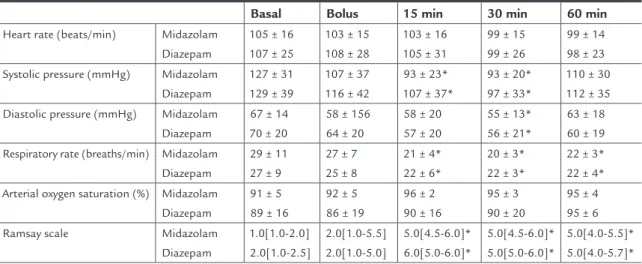
Time for adequate sedation (Figure 1) was shorter but duration of sedation was similar for diazepam in compa-rison to midazolam (Figure 2). Total drug dose to reach adequate sedation after intravenous diazepam or mida-zolam was not different (10.0 [10.0-12.5] mg vs. 15.0
[10.0-17.5] mg, p = 0.248). There were no differences between study drugs during time for cardiorespiratory parame-ters or sedation intensity (Table 2). Arterial pressure and
Ramsay scale reduced significantly after 15 minutes for both drugs. The proportion of patients that experienced hypotension (Systolic pressure < 90 mmHg) was similar for midazolam and diazepam (10 patients vs. 10 patients).
Four patients received a bolus of fentanyl in the midazo-lam and diazepam groups (130 ± 26 µg vs. 125 ± 19 µg, p =
0.76). One patient received a 5 mg bolus of morphine in the midazolam group. None of the patients was intuba-ted under paralysis.
Single use ampoules were used and excess drug was discarded between cases. The current (January-2014) cost of sedation (syringes and ampoules) with diazepam, 1.40 [1.40-1.85] reais, was significantly lower than with
mida-zolam, 13.90 [9.40-16.25] reais, p <0.001.
Senior intensivists were not required in any of the in-tubations.
D
ISCUSSIONThis study showed that both midazolam and diazepam were safe and well tolerated for physician-led sedation during urgent oral-tracheal intubation. At the doses used, they were equally effective and without major adverse events following the procedure.
Important differences between the clinical effects of the studied drugs when used in this manner were identified. Surprisingly, the sedation time was significantly reduced with diazepam compared with midazolam. In comparative studies with diazepam in several procedures, midazolam proved more effective at inducing rapid sedation.16,18-20 Mi-dazolam is known to be rapidly absorbed and the onset of action is, therefore, faster than that of diazepam and its ef-fects are expected to occur sooner than those of diazepam.
TABLE 2 Time changes in and cardiorespiratory parameters and Ramsey scale after intravenous midazolam (n=17) or diazepam (n=16)
Basal Bolus 15 min 30 min 60 min
Heart rate (beats/min) Midazolam Diazepam
105 ± 16 107 ± 25
103 ± 15 108 ± 28
103 ± 16 105 ± 31
99 ± 15 99 ± 26
99 ± 14 98 ± 23 Systolic pressure (mmHg) Midazolam
Diazepam
127 ± 31 129 ± 39
107 ± 37 116 ± 42
93 ± 23* 107 ± 37*
93 ± 20* 97 ± 33*
110 ± 30 112 ± 35
Diastolic pressure (mmHg) Midazolam Diazepam
67 ± 14 70 ± 20
58 ± 156 64 ± 20
58 ± 20 57 ± 20
55 ± 13* 56 ± 21*
63 ± 18 60 ± 19
Respiratory rate (breaths/min) Midazolam Diazepam
29 ± 11 27 ± 9
27 ± 7 25 ± 8
21 ± 4* 22 ± 6*
20 ± 3* 22 ± 3*
22 ± 3* 22 ± 4* Arterial oxygen saturation (%) Midazolam
Diazepam
91 ± 5 89 ± 16
92 ± 5 86 ± 19
96 ± 2 90 ± 16
95 ± 3 90 ± 20
95 ± 4 95 ± 6
Ramsay scale Midazolam
Diazepam
1.0[1.0-2.0] 2.0[1.0-2.5]
2.0[1.0-5.5] 2.0[1.0-5.0]
5.0[4.5-6.0]* 6.0[5.0-6.0]*
5.0[4.5-6.0]* 5.0[5.0-6.0]*
In addition, the dose of both drugs to reach adequate se-dation was similar. This finding is in contrast to several studies that have shown than midazolam is 2-3 times more potent than diazepam.16,17 We speculated that al-though this finding looks contradictory, a wide indivi-dual variation in dose-effect response was seen, as shown by the range of total dosages required in this study. The-se wide variations in responThe-se are typical of benzodiaze-pines and may be partly explained by high plasma pro-tein binding.25,26 Obese patients have an increased volume of distribution due to enhanced distribution in periphe-ral adipose tissues and interactions with other drugs that
are metabolized through the cytochrome p450 system can influence the clinical response.27 Benzodiazepines have synergistic interactions with other drugs like opioids that were simultaneously used in most patients. Pharma-cokinetics of almost all drugs, including sedatives, are not well known in critically ill patients.28,29
The reduction in blood pressure and the incidence of hypotension observed with midazolam and diazepam (60% of patients) may have been related to the high do-ses used to achieve rapid sedation in already sick patients prone to hemodynamic instability. Fifteen episodes of hypotension in this study occurred within the first 15 mi-nutes. It has been shown that the use of both diazepam and midazolam is associated with decreased systolic blood pressure.30 Midazolam is particularly associated with re-duction in both systemic vascular resistance and diasto-lic pressure.30
The lower cost with diazepam is an important finding. Although both drugs have generic presentations with lo-wering costs in the last decade, diazepam costs were much lower both because one milligram of diazepam is cheaper than one milligram of midazolam and the concentration used for the same sedative effect was smaller. Although cost evaluation was not precise because we did not inclu-de expenses with diluents, for instance, drug cost itself ac-counts for the greater part of it. The cost of one syringe was 0.4 real and for most cases a single one was needed.
The study has several limitations. The study was sgle-blinded and operator observations may have been in-fluenced by individual experience and preference with each form of sedation. Due to the different titration pro-perties and appearance of the two drugs, blinding the drug to the operator was not ideal. No adjustments were made in this study for body weight or concomitant drug use. We used the end-point of Ramsay scale 5-6 to indi-cate an adequate level of sedation. Despite the scale of Ramsay being mostly used these days, there is good cor-relation with other scales, particularly the Richmond Agi-tation-Sedation scale, and our end point was deep seda-tion which has excellent equivalence in most scales.31 In addition, both groups included patients with somewhat low Glasgow coma scale or previous strokes that could interfered the sedation evaluation. The study is 8 years old and medical practices may have changed. For instan-ce, the use of rapid sequence intubation as a standard protocol is not yet well incorporated by most physicians, both in our ICU and emergency room. However, the use of midazolam is still the most current practice for hun-dreds of procedures performed in more than 110 ICU adult beds in our Hospital Complex.
FIGURE 1 Time for adequate sedation (Ramsay sedation scale
5-6) was shorter after intravenous diazepam (n=16) in comparison to midazolam (n=17).
FIGURE 2 Duration of sedation (min) until Ramsay scale <5 after
intravenous midazolam (n=17) or diazepam (n=16) was similar.
Midazolam Diazepam
p = 0.016 400
Time (sec)
300
200
100
0
Midazolam Diazepam
p = 0.936 Time (min)
180
160
140
120
100
80
20 40
Physician-led intubation using intravenous diazepam and midazolam is highly effective and well tolerated, with only minor effects. Sedation with diazepam is associated to a quicker sedation time than midazolam and to lower costs.
R
ESUMODiazepam ou midazolam para entubação orotraqueal na UTI?
Objetivo: comparar eficácia clínica e custo de midazolam e diazepam para intubação urgente.
Métodos: pacientes internados na UTI Central do
Com-plexo Hospitalar Santa Casa de Porto Alegre, >18 anos de idade e submetidos a entubação urgente durante seis me-ses eram elegíveis. Pacientes foram randomizados para re-ceber diazepam ou midazolam intravenoso. Diazepam foi dado como bolus IV de 5 mg seguido por alíquotas de 5
mg a cada minuto. Midazolam foi dado como um bolus IV
de 5 mg, com alíquotas adicionais de 2,5 mg a cada minu-to. Escala de sedação de Ramsay 5-6 foi considerada seda-ção adequada. Registramos tempo e doses necessárias para atingir sedação adequada e sua duração.
Resultados: trinta e quatro pacientes foram randomizados; um paciente no grupo diazepam foi excluído por perda dos dados. Grupos foram semelhantes para gravidade da doen-ça e demografia. Tempo de sedação adequada foi mais cur-to (132 ± 87 vs. 224 ± 117 segundos, p = 0,016), mas a
dura-ção da sedadura-ção foi similar (86 ± 67 vs. 88 ± 50 min., p = 0,936)
para o diazepam em comparação com o midazolam. Dose total da droga para atingir a sedação adequada foi semelhan-te para ambas as drogas (10,0 [10,0-12,5] vs. 15,0 [10,0-17,5]
mg, p = 0,248). Pressão arterial e intensidade da sedação re-duziram da mesma forma para ambas as drogas ao longo do tempo. O custo da sedação foi menor para diazepam do que para midazolam (1,4[1,4-1,8] vs. 13,9[9,4-16,2] reais, p < 0,001).
Conclusões: entubação usando diazepam e midazolam
in-travenosos é eficaz e bem tolerada. Sedação com diazepam está associada a sedação mais rápida e menores custos.
Palavras-chave: sedação profunda, entubação, diazepam, midazolam, ensaio clínico controlado aleatório, custos de medicamentos.
R
EFERENCES1. Kahler RL, Burrow GN, Felig P. Diazepam-induced amnesia for cardioversion. JAMA 1967; 200:997-998.
2. Nutter DO, Massumi RA. Diazepam in cardioversion. N Engl J Med 1965; 273(12):650-651.
3. Lebowitz WB. Electrical conversion of arrhythmias under diazepam sedation. Conn Med 1969; 33:173-174.
4. Naney AP, Chaffee WG. Diazepam for cardioversion. JAMA 1971; 215:487. 5. Al Khudhairi D, Whitwam JG, McCloy RF. Midazolam and diazepam for
gastroscopy. Anaesthesia 1982; 37:1002-1006.
6. Whitwam JG, Al Khudhairi D, McCloy RF. Comparison of midazolam and diazepam in doses of comparable potency during gastroscopy. Br J Anaesth 1983; 55:773-777.
7. Brouillette DE, Leventhal R, Kumar S, Berman D, Kajani M, Yoo YK et al.
Midazolam versus diazepam for combined esophogastroduodenoscopy and
colonoscopy. Dig Dis Sci 1989; 34:1265-1271.
8. Krichbaum DW, Hamid I. Midazolam sedation and amnesia in elective cardioversion. Clin Pharm 1988; 7:423.
9. Gupta A, Lennmarken C, Vegfors M, Tyden H. Anaesthesia for cardioversion. A comparison between propofol, thiopentone and midazolam. Anaesthesia 1990; 45:872-875.
10. Gupta A, Vegfors M, Lennmarken C. Midazolam and cardioversion. Br J Anaesth 1992; 69:422.
11. Dickinson ET, Cohen JE, Mechem CC. The effectiveness of midazolam as a single pharmacologic agent to facilitate endotracheal intubation by paramedics. Prehosp Emerg Care 1999; 3:191-193.
12. Schwander D, Sansano C. Cardiovascular changes during intubation with midazolam as anaesthesia inducing agent. Arzneimittelforschung 1981; 31:2255-2260.
13. Boralessa H, Senior DF, Whitwam JG. Cardiovascular response to intubation. A comparative study of thiopentone and midazolam. Anaesthesia 1983; 38:623-627.
14. Sabbatani P, Mantovan R. Electrical cardioversion of atrial fibrillation: Evaluation of sedation safety with midazolam by means of EtCO and IPI algorithm analysis. Int J Cardiol 2013.
15. Pugh PJ, Spurrell P, Kamalvand K, Sulke AN. Sedation by physician with diazepam for DC cardioversion of atrial arrhythmias. Heart 2001; 86:572-573. 16. Mitchell AR, Chalil S, Boodhoo L, Bordoli G, Patel N, Sulke N. Diazepam or midazolam for external DC cardioversion (the DORM Study). Europace 2003; 5:391-395.
17. Staretz LR, Otomo-Corgel J, Lin JI. Effects of intravenous midazolam and diazepam on patient response, percentage of oxygen saturation, and hemodynamic factors during periodontal surgery. J Periodontol 2004; 75:1319-1326. 18. Zakko SF, Seifert HA, Gross JB. A comparison of midazolam and diazepam
for conscious sedation during colonoscopy in a prospective double-blind study. Gastrointest Endosc 1999; 49:684-689.
19. Macken E, Gevers AM, Hendrickx A, Rutgeerts P. Midazolam versus diazepam in lipid emulsion as conscious sedation for colonoscopy with or without reversal of sedation with flumazenil. Gastrointest Endosc 1998; 47:57-61. 20. Van Houten JS, Crane SA, Janardan SK, Wells K. A randomized, prospective,
double-blind comparison of midazolam (Versed) and emulsified diazepam (Dizac) for opioid-based, conscious sedation in endoscopic procedures. Am J Gastroenterol 1998; 93:170-174.
21. Agelink MW, Majewski TB, Andrich J, Mueck-Weymann M. Short-term effects of intravenous benzodiazepines on autonomic neurocardiac regulation in humans: a comparison between midazolam, diazepam, and lorazepam. Crit Care Med 2002; 30:997-1006.
22. Sanders LD, Davies-Evans J, Rosen M, Robinson JO. Comparison of diazepam with midazolam as i.v. sedation for outpatient gastroscopy. Br J Anaesth 1989; 63:726-731.
23. Friedman G, Gehrke L, Oliveira RP, Becker M. Diazepam or Midazolam for Tracheal Intubation in the ICU? Intensive Care Med 2006; 32[suplemment], S250. 24. Knaus WA, Draper EA, Wagner DP, Zimmerman JE. Apache II: a severity of
disease classification system. Crit Care Med 1985; 13:818-829.
25. Henthorn TK, Krejcie TC, Avram MJ. Early drug distribution: a generally neglected aspect of pharmacokinetics of particular relevance to intravenously administered anesthetic agents. Clin Pharmacol Ther 2008; 84:18-22. 26. Olkkola KT, Ahonen J. Midazolam and other benzodiazepines. Handb Exp
Pharmacol 2008; 182:335-360.
27. Oldenhof H, de Jong M, Steenhoek A, Janknegt R. Clinical pharmacokinetics of midazolam in intensive care patients, a wide interpatient variability? Clin Pharmacol Ther 1988; 43:263-269.
28. Roberts DJ, Haroon B, Hall RI. Sedation for critically ill or injured adults in the intensive care unit: a shifting paradigm. Drugs 2012; 72:1881-1916. 29. Escobar L, Gai MN, Regueira T, Andresen M. Pharmacokinetic considerations
in critically ill patients. Rev Med Chil 2012; 140:780-788.
30. Raza SM, Masters RW, Zsigmond EK. Comparison of the hemodynamic effects of midazolam and diazepam in patients with coronary occlusion. Int J Clin Pharmacol Ther Toxicol 1989; 27:1-6.