Rev Bras M ed Esporte _ Vol. 12, Nº 6 – Nov/Dez, 2006
281e
1. Programa de Pós-Graduação Stricto-Sensu em Educação Física, Univer-sidade Católica de Brasília – DF.
2. Laboratório de Fisiologia do Exercício – Universidade de M ogi das Cru-zes, SP.
Received in 23 / 8 / 05. Final version received in 2 / 3 / 06. Approved in 19 / 7 / 06. Correspondence to: Dr. Herbert Gustavo Simões, Universidade Católica de Brasília, Programa de M estrado e Doutorado em Educação Física, sala G 116, QS07, LT 01 S/N EPCT, Águas Claras – 72030-170 – Taguatinga, DF. Voiced: (55 61) 3356-9330, fax: (55 61) 3356-9350. E-mail: hsimoes@pos. ucb.br
Post-exercise hypotension in hypertensive individuals
submitted to aerobic exercises of alternated intensities
and constant intensity-exercise
Gisela Arsa da Cunha1,2,Aline Cristina Santos Rios2, Juliano Rodrigues M oreno1,2, Pedro Luiz Braga2, Carmen Silvia Grubert Campbell1,2,Herbert Gustavo Simões1,2 and M ara Lucy Dompietro Ruiz Denadai2
O
RIGINALA
RTICLEKeyw ords: Post-exercise hypotension. Hypertension. Treadmill. Intensity variation.
ENGLISH VERSION
ABSTRACT
Acute exercise may result in post-exercise hypotension (PEH), w hich has been observed both for normotensive and hypertensive individuals, especially after continuous exercise (low to moderate intensity). The purposes w ere to compare the hypotensive effects of continuous exercise performed w ith alternated (AI) and constant intensities (CI) and verify if AI is more effective on inducing PEH. Eleven hypertensive subjects (56.8 ± 2.6 years; BM I of 26.5 ± 0.3 kg /m²) performed, on different days, an incremental test (IT) and tw o submaximal exercise sessions (45 min) on treadmill (AI and CI). The AI consisted of 2 min at 55.9 ± 2.6% and 1 min at 74.5 ± 4.0% of heart rate reserve (HRR) w hile the CI consisted of 45 min at 60 ± 2.5% of HRR. On both sessions participants rested for 10 min before exercise for blood pressure (BP) and heart rate (HR) measurements and then performed a 5 min w arm-up follow ed by 45 min of either AI or CI. BP and HR w ere monitored at each 5 min of exercise and at the 5th, 10th, 15th, 30th, 60th, 90th and 120th min of post-exercise recovery (rec). ANOVA and Student t-test evidenced PEH of systolic blood pressure (SBP) after both sessions w hen compared to resting (p < 0.001) at all moments of rec w ith no differences betw een AI and CI. PEH of diastolic blood pressure (DBP) w as observed at the 5th, 10th, 15th and 30th min of rec after CI (p < 0.05), but not after AI. PEH of mean blood pressure (M BP) w as observed after CI and AI at all moments of rec. In spite of the similar PEH for SBP, the CI resulted in PEH of DBP, w ith longer reduction of M BP. No differences w ere observed betw een treat-ments for the absolute values of BP during the rec period. The authors conclude that the exercise intensities applied during AI did not induce additional hypotensive effects in relation to CI during the rec.
INTRODUCTION
Arterial hypertension (AH) is considered one of the most impor-tant risks for the development of cardiovascular diseases(1), repre-senting in Brazil one of the public health problems of most preva-lence in the population. M oreover, it is able to lead to death approximately 40% of the compromised individuals(2). The AH treat-ment is conducted through medication and should be associated
w ith a change in life-style, such as alterations in eating patterns as w ell as regular physical exercises practice(3).
The product of the cardiac debt by the total peripheral resis-tance defines blood pressure (BP), once BP is influenced by the strength played by the blood against the arteries w alls as w ell as by the resistance imposed by them to the blood flow(4). The BP reference indices considered normal are ≤ 120 mmHg for systolic blood pressure (SBP) and ≤ 80 mmHg for diastolic blood pressure (DBP), being indices ≥ 140 mmHg (SBP) and/or ≥ 90 mmHg (DBP) considered AH(5).
It has been demonstrated that the performance of a single phys-ical exercise session may promote pressor decrease below the indices observed in the pre-exercise period; such phenomenon is called post-exercise hypotension (PEH). PEH may be benefic for the BP control, especially in hypertensive individuals(6-9).M oreover, its magnitude and duration seem to be related to factors such as the exercise type, duration and intensity(10).
Several studies have demonstrated that physical activities of aerobic characteristics present significant reduction of the post-exercise pressor indices(6,8-9), w hile after endurance exercises con-troversial results have been observed, such as increase(11), mainte-nance(12), or even decrease(13) of the post-endurance exercise blood pressure.
The effect of the duration of the exercise session over the PEH has been investigated in hypertensive and normotensive individu-als. M oreover, there is evidence that the longer the exercise ses-sion duration (45 min vs 25 min), the more remarkable and longer the PEH is(7).Such phenomenon has been observed both in nor-motensive and hypertensive individuals(14). Yet, there is no consen-sus about w hich exercise intensity should be applied. There is ev-idence that exercise performed at 30% , 50% and 80% of the VO2peak results in similar reductions in the post-exercise blood pressure in normotensive subjects(15). On the other hand, it has been suggested that the exercise performed in alternated intensities, alternating betw een 50% and 80% of the RHR, results in low -er pressor indices during 24 h post-ex-ercise in relation to the indi-ces obtained in the constant intensity exercise performed at 60% of the RHR, in hypertensive subjects(16). Only few studies evaluat-ed the pressor response to the exercise w ith intervals or of alter-nated intensities, w ith a higher number of research contemplating the rectangular exercise, reflecting thus, the recommendations by the ACSM(3) of aerobic exercises at constant intensities for BP con-trol or non-medicated treatment of the AH.
282e
Rev Bras M ed Esporte _ Vol. 12, Nº 6 – Nov/Dez, 2006 M ETHODSParticipants
The procedures used in the present study w ere previously ap-proved by the Human Research Ethics Committee of the Universi-ty of M ogi das Cruzes, SP, Brazil.
Eleven hypertensive individuals w ith BP controlled by tion w ere selected. The participants’ characteristics and medica-tion used by them are represented in tables 1 and 2 respectively. The participants w ere recruited after having signed an informed consent form about the procedures and benefits of the study. They also answ ered a questionnaire (anamnesis) about their health his-tory. Sedentarism, smoking history, obesity and diabetes, as w ell as presenting orthopedic problems, having coronary arterial condi-tion or using beta-blockers medicacondi-tion, w ere the exclusion criteria.
mined subtracting the resting HR from the maximal HR obtained in the ET, and the target intensities w ere calculated through the multiplication of the HRR by the % of the desired intensity, added to the resting HR index as follow ing:
target HR = [HRR] * target intensity (% ) [+ resting HR]·.
The ET could also be interrupted in case the participant present-ed abnormalities in the electrocardiographic register and/or in the pressor response during the exercise, according to criterion of the cardiologist in charge.
Exercises sessions (CIE and AIE)
After 10 min rest in a seating position, the participants began 5 min of w arming-up on treadmill and the intensity w as adjusted in order to reach the target HR (HRR percentage) previously deter-mined for the exercise sessions of constant intensity (CIE) and alternated intensity exercise (AIE).
Both sessions consisted of 45 min of exercise on treadmill, be-ing one exercise session w ith the aim to keep 60% of the HRR (CIE), and an exercise session w ith variation of intensities (AIE) w ith the aim to alternate intensities betw een 50% and 80% of the HRR, at each fraction of 2 and 1 minutes respectively, so that that exercise periods in higher intensities could be w ell tolerated by the participants, and w ith total w ork and mean intensity not differ-ent from the CIE session (table 3). After the ending of each exer-cise session the participants w ould stay in post-exerexer-cise recovery, in the seating position, during 120 min.
TABLE 1
Biometrical characteristics of the participants of the study and mean standard error (M SE) for SBP, DBP and resting HR indices
(n = 11) Age Weight Height BM I SBP DBP HR
(years) (kg) (m) (kg/ m²) (mmHg) (mmHg) (bpm)
M ean 56,8 71,7 1,64 26,5 120,0 72,0 70,0
M SE ± 2,6 ± 2,6 ± 0,00 ± 0,3 ± 3,4 2,3 ± 1,8
BM I = Body M ass Index; SBP = systolic blood pressure; DBP = diastolic blood pressure; HR = heart rate Seven (n = 7) participants out of eleven performed both exercises sessions.
TABLE 2
M edication types that w ere being used by the participants of the study
M edication CIE AIE
Diuretics 5* 3*
Calcium channel blockers (Dihydropiridines) – 1*
Antagonists of the angiotensine II receptor 2* 2*
Inhibitors of the conversor enzyme of angiotensine 4* 3*
* Participant w ho makes use of tw o types of medication.
Procedures
The participants w ere submitted, on distinct days, to three exer-cise sessions on treadmill (M oviment®). On the first session an
ergometric test w as conducted until exhaustion and on the tw o follow ing sessions the volunteers w ere submitted to 45 min of continuous exercise of constant (CIE) and alternated intensity (AIE), w hich w ere randomly performed, w ith interval of at least 48 hours betw een the sessions.
Ergometric test (ET)
It consisted of a test of grow ing loads according to protocol pro-posed by Ellestad(17), w ith initial velocity of 2,4 km/h, inclination of 10% and increases of 1,6 km/h and 2% of inclination at each stage of 3 min, w ithout pause betw een stages, until voluntary exhaus-tion. The BP w as monitored at each 3 min during the test through a sphygmomanometer of mercury column (M issouri®) and
stetho-scope (Premium®). All participants w ere monitored w ith
electro-cardiogram, supervised by a cardiologist. On the day before the ET, the participants w ere told not to perform physical exercise and not to stop the medication of blood pressure control on the ET day. M oreover, a light meal w as served tw o hours prior to the ET and the intake of stimulating substances such as coffee, tea, and soda w as not allow ed. Before the ET beginning, the participants w ere instructed to interrupt the exertion w hen the voluntary exhaustion w as reached, being used the maximal HR (M HR) obtained during the ET (exhaustion momentum) for later establishment of the in-tensities of the exercises sessions. The exercises inin-tensities w ere established considering the HR reserve (HRR) as reference, ac-cording to description by Karvonen et al.(18). The HRR w as
deter-TABLE 3
M ean volume (pondered average) and mean standard error (± M SE) of the exercise sessions
CIE AIE
Expected mean intensity 60% 60% * (% HRR) (50% and 80% – 2:1) Real mean intensity 60,0 ± 2,5% 62,1 ± 3,1% * *
(% HRR) (55,9 ± 2,6% and 74,5 ± 4,0% – 2:1) Exercise characteristics Constant Varied intensities
intensity (55,9 ± 2,6% and 74,5 ± 4,0% – 2:1) per 45 min alternated at each 2 and 1 min (2:1) ** Expected mean intensity for AIE: (2 * 50 + 80)/3 (50 and 80 are the relative intensities in the
AIE).
* * Real pondered mean for AIE: (2 * 55,9 + 74,5)/3 (55,9 and 74,5 are the real intensities obtained in the AIE).
M easured variables
The SBP, DBP, M BP and the HR (Polar®, Finland) w ere checked
at each 5 min during the 10 min rest prior to the exercise, at each 5 min during the exercise (CIE and AIE), as w ell as at the 5, 10, 15, 30, 60, 90 and 120 min of post-exercise recovery.
Overload of the exercises sessions
The exercises sessions resulted in an equal total overload, once both had the same performance time (45 min), and mean intensity (pondered average) w hich w as not different betw een AIE and CIE.
Statistical treatment
Rev Bras M ed Esporte _ Vol. 12, Nº 6 – Nov/Dez, 2006
283e
RESULTSTables 1 and 2 present the biomedical characteristics and the type of anti-hypertensive medication used by the participants. It is observed that the resting SBP and DBP indices of the participants are presented w ithin the normality(1) (SBP of 120 ± 3,4 mmHg and DBP of 72 ± 2,3 mmHg) due to the participants’ AH being con-trolled through the use of anti-hypertensive medication.
The mean intensities calculated through the pondered averages of the HR indices obtained during the exercise, in the minutes that should correspond to 50% and 80% of the HRR for AIE and 60% of the HRR for CIE, w ere 62,1 ± 3,1% of the HRR for AIE and 60 ± 2,5% of the HRR for CIE w ithout statistical differences betw een sessions. Although the initial objective w as to reach 50% and 80% of the HRR in the AIE session, the intensities varied betw een 55,9 ± 2,6% of the HRR during intervals of 2 min and 74,5 ± 4,0% of the HRR during intervals of 1 min, during the 45 min of exercise (table 3).
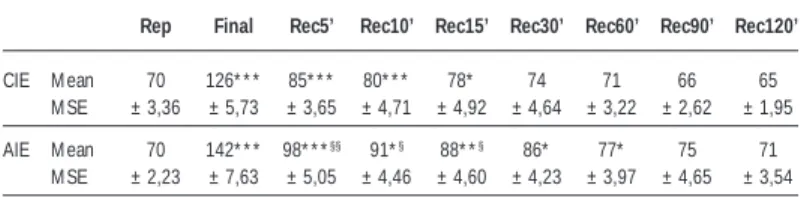
The SBP and DBP behaviors in the post-exercise resting and recovery conditions in the AIE and CIE sessions are presented in figure 1, w hile the SEA and the HR are presented in figure 2 and table 4 respectively.
It w as observed PEH of SBP in both exercises sessions (CIE and AIE p < 0,001) in all recovery moments w hen the pre-exercise resting indices w ere compared. The low est indices of SBP w ere observed betw een the 5th min and the 60th min of post-exercise recovery. Concerning resting, theses indices represent decrease of up to 18 mmHg for VIE and 19 mmHg for CIE. The comparison betw een sessions show ed SBP indices similar after CIE and AIE (figure 1). The DBP presented PEH after CIE at 5, 10, 15 and 30 min of recovery (p < 0,05), w ith decrease of up to 9 mmHg at 30 min of rec, not being observed PEH of DBP after AIE session (fig-ure 1). It w as observed PEH of CIE during the 120 min of recovery after CIE, and during 90 min of recovery (p < 0,05) after AIE. The highest decrease of CIE (13 mmHg) w as observed at 30 min of rec after CIE, w hile the highest decreases after AIE (10 mmHg) w ere observed at 5, 15 and 60 min of rec (figure 2). The HR indices remained high during rec in relation to pre-exercise resting during the first 15 min of recovery (p < 0,05) after CIE and in the first 30 min of rec (p < 0,001) after AIE. The differences betw een the ses-sions w ere verified only at 5,10 and 30 min of rec (p < 0,05), w ith higher HR indices after AIE (table 4).
DISCUSSION
The present study compared the hypertensive effects of CIE and AIE performed by hypertensive individuals under the use of anti-hypertensive medication. The main results show ed that the AIE (2 min at 55,9 ± 2,6% of the HRR and 1 min at 74,5 ± 4,0% of the HRR alternated during 45 min) presented a hypotensive effect of SBP similar to the CIE performed at 60 ± 2,5% of the HRR. It w as observed as w ell the hypotensive effect in the DBP only after CIE, besides of higher number of momentums (post-exercise re-covery minutes) of PEH of CIE after CIE.
These results contribute for a better comprehension of the PEH phenomenon, once it w as demonstrated that continuous exercis-es performed in steady intensitiexercis-es and varied intensitiexercis-es as w ell, result in PEH in hypertensive individuals under the use of anti-hy-pertensive medication. Within the used medication, the calcium channel blocker (dihydropiridine) may decrease, increase or not have effect over the HR in the rec and in exercise, decreasing the BP. The diuretics do not directly influence the HR, decreasing or not having effect over the BP (in exercise). The angiotensin conver-sion inhibitors do not directly influence the HR, being able to result in BP decrease(3). Nonetheless, considering that the participants made use of the same medication in both sessions, any difference observed betw een sessions cannot be attributed to the medica-tion, but as an additional effect derived from the exercise sessions performance (CIE and AIE).
The results observed in this study are according to research that verified the acute exercise benefit to the BP control, both in nor-motensive(6-8) and hypertensive individuals(9,14,16,19-20). The hypoten-sive response and the SBP observed after CIE and AIE is accord-ing t o ot her st udies, w hich verif ied sim ilar PEH bot h in normotensive(7) ans hypertensive individuals(14) and that aerobic exercises performed at different intensities (30% ,50% and 80% ) Figure 1 – Systolic blood pressure (SBP) and diastolic blood pressure
be-havior (DBP), as w ell as M SE during the pre-exercise resting (res), at the end of the exercise (Final) and during the post-exercise recovery period after session of AIE and CIE.
* * * p < 0,001, * * p < 0,01 and * p < 0,05 in relation to the res of AIE and + + + p < 0,001, + + p < 0,01 and + p < 0,05 in relation to the res of CIE
Figure 2 –Behavior of the mean blood pressure (M BP) and M SE during pre-exercise resting (res) exercise ending (Final) and during the post-exer-cise recovery period after session of AIE and CIE
* * * p < 0,001, * * p < 0,01 and * p < 0,05 for AIE and + + + p < 0,001, + + p < 0,01 and + p < 0,05 for CIE in relation to res
TABLE 4
M ean results (± mean standard error) of the response of the Heart Rate (bpm) during the pre-exercise resting (res), end of the exercise (Final) and during post-exercise recovery period after session of AIE and CIE
Rep Final Rec5’ Rec10’ Rec15’ Rec30’ Rec60’ Rec90’ Rec120’
CIE M ean 70 126* * * 85* * * 80* * * 78* 74 71 66 65 M SE ± 3,36 ± 5,73 ± 3,65 ± 4,71 ± 4,92 ± 4,64 ± 3,22 ± 2,62 ± 1,95 AIE M ean 70 142* * * 98* * *§§ 91*§ 88* *§ 86* 77* 75 71
M SE ± 2,23 ± 7,63 ± 5,05 ± 4,46 ± 4,60 ± 4,23 ± 3,97 ± 4,65 ± 3,54
* p < 0,05; * * * p < 0,001 in relation to res
284e
Rev Bras M ed Esporte _ Vol. 12, Nº 6 – Nov/Dez, 2006 result in PEH of same duration and magnitude(6,8). Nevertheless,Ciolac et al.(16) observed higher hypotensive effect during 24 h af-ter exercise w ith inaf-tervals w hen compared w ith continuous exer-cise, confronting our results, despite the present study having in-vestigated the PEH only during 2 hours of post-exercise recovery. The lack of PEH of DBP after AIE w as contrary to the results obtained in the research protocols w ith exercise w ith intervals, as show ed by Ciolac et al.(16). How ever, they agree w ith the research results w hich did not show significant differences betw een exer-cise intensities and decrease in the DBP. M oreover, significant decrease w as verified only at 30 min post-exercise of 45 min at 50% of the VO2peak in cycle ergometer, as show n respectively in the studies by M acDonald et al.(8) and Rondon(9).
As can be observed in figure 2, the CIE presented more signifi-cant decrease after CIE; how ever, no signifisignifi-cant differences w ere observed betw een CIE and AIE, having similar results to the ones by Forjaz et al.(6) and M acDonald et al.(8) w ho did not observe effect of the exercise intensity in the PEH.
Despite of that, other studies have demonstrated that the PEH is dependent on the intensity in w hich the exercise is performed. Willianson et al.(21) show ed the intensity effect comparing exercise intensities performed in cycle ergometer (session at 60-70% vs. session at 20% of the HRR) and observed PEH only after session performed at 60-70% of the HRR, suggesting that this PEH w as associated w ith alterations of brain flow in insular cortex areas, w hich is related w ith the autonomic control of the cardiovascular function. These authors verified as w ell that the exercise performed at 20% of the HRR did not result in any significant alteration of the BP (w ithout PEH) or flow alteration in brain areas related w ith the cardiovascular control. In the present study, although having re-sulted in similar PEH of SBP and DIE, the exercise of higher inten-sity (AIE) did not present PEH of DBP, confronting the results by Willianson et al.(21) concerning the effect of the intensity on the PEH. Nonetheless, the study by Willianson et al.(21) compared very different intensities, and since both exercise sessions of the present study w ere performed w ithin the same intensity domain (probably below the anaerobic threshold – Lan), it is not possible to reach the conclusion w hether AIE performed in different intensity do-mains (for instance, alternating intensities above and below the Lan or betw een 65 and 85% of the HRR) may improve the PEH in relation to the steady intensity exercise. M oreover, it is even pos-sible that our results have not show ed evidence of intensity in the response betw een sessions due to the limited exercise time in intensities that could result in higher hypotensive effect (1 min at ~ 75% of the HRR), combined w ith longer time (2 min) in low er intensities (2 min at ~ 56% of the HRR).
The HR presented similar behavior in both exercises sessions, being higher after AIE. Such behavior w as also demonstrated by M cDonald et al.(8) w ho investigated the BP and HR response in normotensive subjects after exercise performed in different inten-sities (50% or 75% of the VO2peak). The HR w as higher after exer-cise of higher intensity, being the increase more significant at 15 min post-exercise. Besides that, although the pre-exercise cate-cholamines indices have not been measured, it is possible that the increased HR after AIE is due to higher release of catecholamines during the alternations of intensities in this session (74,5 ± 4,0% and 55,9 ± 2,6% of the HRR). In the session of CIE though, the intensity w as only kept at 60 ± 2,5% of the HRR. This behavior (increased HR in the rec) is also attributed to a reflex increase of the HR due to the post-exercise BP decrease, in the trial of keep-ing the cardiac debt durkeep-ing the PEH, as previously proposed by M cDonald et al.(22).
CONCLUSION
Although the PEH of SBP and CIE have been observed in both sessions, only the CIE resulted in PEH of DBP. Nonetheless, no
difference w as observed betw een the treatments for the absolute BP indices during the rec period. Therefore, w e come to the con-clusion that the sessions of AIE and CIE result in similar PEH, and that the AIE, w ithin the intensities used in the present study, does not improve the post-exercise hypotensive effect w hen compared w ith the CIE. Finally, further studies should be conducted applying different variations of intensities and different duration times in the intensities studied in order to analyze and compare their hy-potensive effects and their clinical applications in the prevention and non-pharmacological treatment of the arterial hypertension.
ACKNOWLEDGM ENTS
To the cardiologist Dr. M anoel Leitão Neto for having carried out the ergometric tests in his clinic, in the city of M ogi das Cruzes.
All the authors declared there is not any potential conflict of inter-ests regarding this article.
REFERENCES
1. Chobanian AV, Bakris GL, Black HR, Cusham WC, Green LA, Izzo JL Jr, Jones DW, M aterson BJ, Oparil S, Wright JT Jr., Roccela EJ. National High Blood Pres-sure Education Program Coordinating Committee. The seventh report of the Joint National Committee on Prevention, Detection, Evaluation, and Treatment of High Blood Pressure: the JNC 7 report. JAM A. 2003;289:2560-72. 2. Fagard RH. Exercise characteristics and the blood pressure response to
dynam-ic physdynam-ical training. M ed Sci Sports Exerc. 2001;33(6):484-92.
3. American College of Sports M edicine. Diretrizes do ACSM para os testes de esforço e sua prescrição. 6ª ed. Rio de Janeiro: Guanabara Koogan, 2000. 4. Brooks GA, Fahey TD, White TP. Exercise Physiology – human bioenergetics
and its applications. 3nd edition. M ountain View, California: M ayfield Publishing Company, 1999.
5. IV Diretrizes Brasileiras de Hipertensão Arterial, S. Paul, 2002.
6. Forjaz CLM , M atsudaira Y, Rodrigues FB, Nunes N, Negrão CE. Post-exercise changes in blood pressure, heart rate and rate pressure product at different exercise int ensit ies in norm ot ensives hum ans. Braz J M ed Biol Res. 1998;(31)1247: 255.
7. Forjaz CLM , Santaella DF, Rezende LO, Barreto ACP, Negrão CE. A duração do exercício determina a magnitude e a duração da hipotensão pós-exercício. Arq Bras Cardiol. 1998;70(2):1-6.
8. M acDonald J, M acDougall J, Hogben C. The effects of exercise intensity on post exercise hypotension. J Hum Hypertens. 1999;13(8):527-31.
9. Rondon M UPB. Comportamento imediato e prolongado da pressão arterial pós-exercício em idosos normotensos e hipertensos [Dissertação de Doutorado]. São Paulo: EEFE USP, 1999.
10. Bermudes AM LM , Vassalo DV, Vasquez EC, Lima EG. Ambulatory blood pres-sure monitoring in normotensive individuals undergoing tw o single exercise ses-sions. Resistive exercise training and aerobic exercise training. Arq Bras Cardiol. 2003;82(1):65-71.
11. Kelley G, M cClellan P. Antihypertensive effects of aerobic exercise: a brief meta-analytic review of randomized controlled trials. Am J Hypertens. 1994;7:115-9. 12. Welton SP, Chin A, Xin X, He J. Effect of aerobic exercise on blood pressure: a meta-analysis of randomized, controlled trials. Ann Intern M ed. 2002;136:493-503.
13. Arrol B, Beaglehole R. Does physical activity low er blood pressure: a critical review of the clinical trials. J Clin Epidemiol. 1992;45:439-47.
14. Rebelo FPV, Benetti M , Lemos LS, Carvalho T. Efeito agudo do exercício físico aeróbio sobre a pressão arterial de hipertensos controlados submetidos a dife-rentes volumes de treinamento. Revista Brasileira de Atividade Física e Saúde. 2001;(6):28-37.
15. Negrão CE, Rondon M UPB. Exercício físico, hipertensão e controle barorreflexo da pressão arterial. Rev Bras Hipertens. 2001;8(1):89-95.
16. Ciolac EG, Davilla VM , M orgado C, Doria E, Berlink M , Lotufo P, et al. Efeito do treinamento físico intervalado e contínuo na pressão arterial 24 horas, compla-cência arterial e qualidade de vida em pacientes com hipertensão arterial: resul-tados preliminares. Revista da Sociedade de Cardiologia do Estado de São Pau-lo. Suplemento Especial; 14(2) M arço/Abril, 143.
17. Ellestad M H, Allen W, Wan M CK, Kemp GL. M aximal treadmill stress testing for cardiovascular evaluation. Circulation. 1969;39:517.
18. Karvonen M J, Kentala E, M ustala O. The effects of training on heart rate; a longitudinal study. Ann M ed Exp Biol Fenn. 1957;35:307-15.
19. Halliw il JR. M echanisms and clinical implications of postexercise hypotension in humans. Exerc Sport Sci Rev. 2001;65-9.
20. Rondon M UPB, Alves M JNN, Braga AM FW, Teixeira OTUN, Barreto ACP, Kreiger EM , et al. Postexercise blood pressure reduction in elderly hypertensive pa-tients. J Am Coll Cardiol. 2002;39(4):676-82.
21. Willianson JW, M cColl R, M athew s D. Changes in regional cerebral blood flow distribution during postexercise hypotension in humans. J Appl Physiol. 2004; 96:719-24.