www.spsp.org.br
REVISTA PAULISTA
DE PEDIATRIA
1984-0462/$ - see front matter © 2014 Sociedade de Pediatria de São Paulo. Published by Elsevier Editora Ltda. All rights reserved.
KEYWORDS
Body image; Body dissatisfaction; Self concept; Adolescents
Abstract
Objective: To evaluate the influence of self-esteem on levels of body dissatisfaction among adolescent females.
Methods: A group of 397 adolescents aged 12 to 17 years were enrolled in the study. The Body Shape Questionnaire (BSQ) was applied to assess body dissatisfaction. The Rosenberg Self-Esteem Scale was used to assess self-esteem. Weight, height, and skinfold thickness were also measured. These anthropometric data were controlled in the statistical analyses. Results: The multiple regression model indicated influence of “positive self-esteem” (R²=0.16; p=0.001) and “negative self-esteem” (R²=0.23; p=0.001) subscales on the BSQ scores. Univariate analysis of covariance demonstrated differences in BSQ scores (p=0.001) according to groups of self-esteem.
Conclusion: It was concluded that self-esteem influenced body dissatisfaction in adoles-cent girls from Juiz de Fora, MG.
© 2014 Sociedade de Pediatria de São Paulo. Published by Elsevier Editora Ltda. All rights reserved.
ORIGINAL ARTICLE
Does self-esteem affect body dissatisfaction levels in female
adolescents?
☆Leonardo de Sousa Fortes
a,*, Flávia Marcele Cipriani
b, Fernanda Dias Coelho
b,
Santiago Tavares Paes
b, Maria Elisa Caputo Ferreira
baUniversidade Federal de Pernambuco (UFPE), Vitória de Santo Antão, PE, Brazil b Universidade Federal de Juiz de Fora (UFJF), Juiz de Fora, MG, Brazil
Received 6 January 2014; accepted 27 February 2014
DOI refers to: 10.1590/1984-0462201432314
☆Study conducted at Faculdade de Educação Física e Desportos da Universidade Federal de Juiz de Fora, Juiz de Fora, Minas Gerais, Brazil. *Corresponding author.
E-mail: [email protected] (L.S. Fortes).
PALAVRAS-CHAVE
Imagem corporal; Insatisfação corporal; Autoestima;
Adolescentes
A autoestima afeta a insatisfação corporal em adolescentes do sexo feminino?
Resumo
Objetivo: O objetivo do estudo foi avaliar a influência da autoestima na insatisfação corporal de adolescentes do sexo feminino.
estatura e dobras cutâneas. Esses dados antropométricos foram controlados nas análises estatísticas.
Resultados: O modelo de regressão múltipla indicou influência das subescalas “autoesti-ma positiva” (R²=0,16; p=0,001) e “autoesti“autoesti-ma negativa” (R²=0,23; p=0,001) nos escores do BSQ. A análise univariada de covariância demonstrou diferenças nos escores do BSQ (p=0,001) em razão dos grupos de autoestima.
Conclusão: Concluiu-se que a autoestima influenciou a insatisfação corporal em meninas adolescentes de Juiz de Fora/MG.
© 2014 Sociedade de Pediatria de São Paulo. Publicado por Elsevier Editora Ltda. Todos os direitos reservados.
Introduction
Adolescence is a period comprising the age range of 10 to 19 years old,1 during which several psychological, social, and morphological changes2 occur. Evidence indicates increased responsibility, demands, and changes in friend-ship among adolescents.3 Scientific investigations also indi-cate the increased percentage of body fat in females during adolescence.4-5 These and other modifications may influ-ence body image.
Body image refers to a multifaceted construct, encom-passing perception, emotion, feelings, and thoughts direct-ed to one’s own body.6 Body dissatisfaction, classified as a component of body image, concerns the dissatisfac-tionx with one’s weight, appearance, and physical shape.7 Studies have shown a prevalence of body dissatisfaction ranging from 10% to 40% among adolescents.2,8 More specifi-cally, it appears that this prevalence may be even higher among female adolescents.9-12 Body dissatisfaction may be associated with self-esteem. 13-14
Self-esteem is related to the set of feelings and thoughts of the individual regarding his/her own worth, compe-tence, and suitability, which results in a positive or nega-tive attitude towards oneself.13 Self-esteem is subdivided into negative and positive. The first refers to feelings of worthlessness and failure and the second is related to the feelings of satisfaction and appreciation of oneself.13 Flament et al8 indicate that the main point of self-esteem is the evaluative aspect, which influences how the indi-vidual sets his goals, accepts himself, values others, and projects his expectations for the future.13
Self-esteem is considered one of the main predictors of favorable outcomes in adolescence, with implications in areas such as interpersonal relationships and academic performance.13 In contrast, the influence of this character-istic has also been observed in adverse problems such as aggression, antisocial behavior, delinquency in youth, and negative changes in body image.8,14,15
Evidence has shown a positive association between nega-tive self-esteem and body dissatisfaction.8,16 Similarly, pre-vious studies showed an inversely proportional association between positive self-esteem and body dissatisfaction.14,17 However, these investigations were developed with popula-tions from Chile, the United States, and Canada. A search was performed with some descriptors (body image, self-esteem and adolescents) in the main scientific databases (SciELO, PubMed, and Scopus), and no research was found that attempted to analyze the influence of self-esteem on
body dissatisfaction in Brazilian adolescents. The findings of such a study could assist professionals who work directly with adolescents in the organization of meetings, lectures, and discussions that have body in adolescence as the cen-tral focus. Given the above, the aim of the study was to evaluate the association between self-esteem and body dis-satisfaction in female Brazilian adolescents.
Methods
This was a cross-sectional, school-based study conducted during 2012 and 2013 in the city of Juiz de Fora, state of Minas Gerais, Brazil, with female adolescents aged between 12 and 17 years. According to information from the Education Secretariat of Juiz de Fora, the popula-tion of female adolescents aged 12 to 17 years enrolled in municipal schools in 2012 was approximately 41,000. Thus, sample size calculation was performed using the following criteria, following the recommendations of Alves et al:9 30% prevalence of body dissatisfaction, according to the find-ings of Fortes et al,11 95% confidence, 5% sampling error, and the total value was increased by 20% due to possible losses, totaling 387 students necessary for a representa-tive sample. Sample size calculation was performed using EpiInfo software (release 3.5) (Centers for Disease Control and Prevention, Georgia – USA).
The proportional sample was stratified according to the location of schools in the sociogeographic regions of Juiz de Fora (North, Central, and South) and the type of school (pub-lic or private), and then distributed into primary and second-ary education. The selection was performed randomly through simple drawing, in two stages. First the drawing of the schools was performed in each region, and then the drawing of ado-lescents in these units. The schools were selected from the list provided by the statistics section of the Education Secretariat of the State of Minas Gerais. The final study sample was divid-ed into six different sampling sites (schools) and consistdivid-ed of randomly selected female adolescents that were present in the schools on the collection days.
Body dissatisfaction was assessed by the Body Shape Questionnaire (BSQ). The BSQ is a self-reporting tool con-sisting of 34 questions on the Likert point scale, ranging from 1 = never to 6 = always, which aims to assess the frequency of concern or dissatisfaction that the young indi-vidual has with weight and physical appearance i.e., body dissatisfaction. The higher the score, the higher the dis-satisfaction with body appearance. This questionnaire has been validated for the Brazilian adolescent population10 and has good psychometric properties. Internal consistency was calculated by Cronbach’s alpha for the present sample, yielding a satisfactory value of 0.96. It is also possible to differentiate the assessed adolescents by the cutoffs that classify four levels of body dissatisfaction: less than 80 points, free of body dissatisfaction; between 80 and 110, slight dissatisfaction; between 110 and 140, moderate dis-satisfaction; and scores above 140, severe dissatisfaction. Self-esteem was assessed by the Rosenberg Self-Esteem Scale (RSES).13 This scale consists of 10 items, with three choices of answers on the Likert point scale (1 = completely agree; 2 = neither agree nor disagree; 3 = completely dis-agree). The tool has two factors. The first factor comprises six items related to positive self-esteem; the second factor, four items that refer to negative self-esteem. The higher the score on the scale, the higher the individual’s level of self-esteem. Due to the statistical analysis, the RSES median was used to classify adolescents with high and low self-esteem, a methodology that has been used previous-ly.16 Thus, females with a score greater than or equal to 26 were included in the “high self-esteem” group (RSES+). The version of the scale used in the study has been validated for Brazilian adolescents13 and its internal consistency analysis showed an alpha of 0.70. For the present sample, internal consistency was assessed by Cronbach’s alpha, yielding a value equivalent to 0.81.
Body mass was measured on a portable digital Tanita scale (Tanita Corporation of America, Illinois – USA) with 100 g precision and maximum capacity of 200 kg. A por-table Welmy stadiometer (Welmy, São Paulo – Brazil) with 0.1 cm precision and maximum height of 2.20 m was used to measure height. Body mass index (BMI) was obtained using the formula: body mass (kg) / height squared (m²). Since some studies have shown the influence of BMI on body dissatisfaction,2,4 the authors chose to control BMI in the statistical analyses.
The protocol for adolescents developed by Slaughter et al18 was used to calculate the percentage of body fat. The triceps and subscapular skinfolds were measured accord-ing to the standardization determined by the International Society for Advancement for Kinanthropometry19 using a Lange scientific caliper (Cambridge Scientific Industries Inc, Cambridge – USA), with a 1 mm precision. Measurements were taken rotationally and collected three times, con-sidering the mean values. In view of the findings of some studies that indicate the influence of body fat on body dis-satisfaction,4,11 the percentage of body fat was controlled in the statistical analyses.
The principals of ten schools (five public and five pri-vate) were invited to participate in the study, after being informed about the study objectives and procedures. The distribution of private and public schools in the city of Juiz
de Fora, MG, is proportional.11 However, only six principals (four private and two public) agreed to allow their students to participate in the study. After the approval, meetings with each of the classes were conducted to explain objec-tives and procedures for inclusion of students in the study. The informed consent was given to the adolescents and they were asked to return them duly signed by a parent/ guardian by the following week, in case of agreement with their voluntary participation.
The study was performed in two different stages. In the first stage, the students answered the tools (BSQ and RSES). This step was performed in a group with a single research-er, using standardized verbal explanations. Therefore, after completing the questionnaires, the students were sent indi-vidually to the next room to undergo anthropometric mea-surements (weight, height, and skinfolds).
This study was approved by the Research Ethics Committee for Studies in Human Subjects of Faculdade de Filosofia, Ciências, e Letras of Universidade de São Paulo (Edict No. 109 971), according to Decree 466/12 of the National Health Council.
The Kolmogorov-Smirnov test was performed to assess the BSQ distribution. Given the absence of parametric violation, parametric tests were used. Central tendency measures (mean), dispersion (standard deviation, standard error, minimum and maximum values), and relative fre-quency were used to describe the study variables. Stepwise multiple linear regression was performed to analyze the association of RSES subscales (positive and negative) with body dissatisfaction. Only variables with p<0.10 were kept in the model. Univariate analysis of covariance (ANCOVA) was used to compare the scores in the BSQ in relation to
the dichotomous classifications established for RSES (≥26),
as performed in a previous study.16
Bonferroni’s post-hoc test was applied to identify pos-sible statistical differences. Finally, the effect size was calculated, represented by the letter “d” to highlight the importance of differences from a practical standpoint. BMI and body fat percentage were controlled in all analyses. All data were processed using SPSS 20.0 software (BM Corp. IBM SPSS Statistics for Windows, New York – USA), with a significance level of 5%.
Results
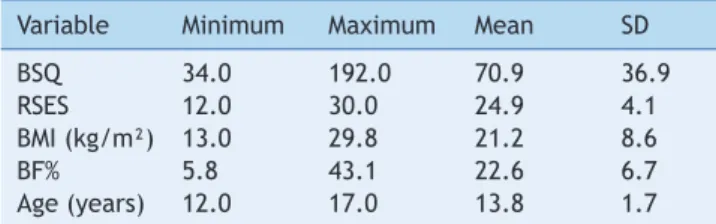
The results indicated that 30.6% of the adolescents dem-onstrated body dissatisfaction, divided as follows: 16.1% with mild body dissatisfaction, 8.9% with moderate body dissatisfaction, and the remaining 5.6% with severe body dissatisfaction. Regarding self-esteem, the findings showed that 56% of the adolescents had low self-esteem (RSES < 26). The descriptive data for all variables in this study is described in Table 1.
The multiple regression model indicated a statistical-ly significant association of the subscales “positive self-esteem” (F [1, 396] = 32.85, R²=0.16, p=0.001) and “nega-tive self-esteem” (F [2, 395] = 25.63, R²=0.23, p=0.001) with BSQ scores (Table 2).
rela-tion to the self-esteem groups (RSES<26.00 = 81.6±3.5;
RSES≥26.0 = 56.4±4.4). Regarding the covariates, only BMI
showed a statistically significant influence on BSQ scores (p=0.049).
Discussion
The findings of this study indicated a prevalence of approximately 30% of body dissatisfaction among Brazilian female adolescents. Other studies have corroborated this result.2,9,12 Body dissatisfaction affects approximately one-third of the Brazilian female adolescent population.2,10,11 However, this prevalence has increased in recent years,12,20 making it a public health problem. According to Flament et al, 8 the media is mainly responsible for this fact, as it broadcasts images of skinny bodies associated with success, which tends to keep adolescents distant from reality and, in turn, generates feelings of dissatisfaction with weight, physical appearance, and body shape.
Regarding self-esteem, the results indicated a signifi-cant association between the “positive self-esteem” sub-scale and body dissatisfaction. Multiple regression analysis showed that 16% of body dissatisfaction was explained by feelings of satisfaction and self-appreciation. According to Caqueo-Urizar et al,14 girls with high positive self-esteem do not usually internalize the sociocultural ideal of thinness, causing reductions in body dissatisfaction. For instance, Flament et al8 assessed the mediating effects of self-esteem between the internalization of the thinness ideal, body dissatisfaction, and risk behaviors for eating disorders. The authors demonstrated that positive self-esteem decreases female adolescents’ susceptibility to body dissatisfaction, which, in turn, reduces the likelihood of triggering risk behaviors for eating disorders. Similarly, Johnson et al17 found that positive self-esteem accounted for the decrease in dissatisfaction with weight and physical appearance among American female university students. Thus, girls who value their personal qualities and feel able
to perform tasks as well as other people appear to be less vulnerable to body dissatisfaction.
Regarding the negative self-esteem, this was also associated with body dissatisfaction. The results indicat-ed that 8% of body dissatisfaction was explainindicat-ed by the negative self-esteem. Other scientific evidence supports these findings. The study of Flament et al8 suggested that negative self-esteem is a major predictor of body dissat-isfaction, second only to the internalization of the thin-ness ideal. Similarly, De Bruin et al16 demonstrated that low self-esteem was closely related to body dissatisfaction in females. Considering what the scientific literature has found and the findings of this research, it can be assumed that feelings of worthlessness and failure can make adoles-cents more susceptible to dissatisfaction with their weight, physical appearance, and body shape.
Regarding the comparison of scores on the BSQ in rela-tion to the self-esteem groups, the results suggested great-er body dissatisfaction in adolescents with low self-esteem compared to those with high self-esteem. Corroborating these findings, Johnson et al17 and Pisitsungkagarn et al21 found greater body dissatisfaction in female university stu-dents17 and adolescents21 with low self-esteem than those with high self-esteem. Likewise, De Bruin et al16 and Murray et al22 observed greater body dissatisfaction in female ado-lescents with low esteem. It appears that low self-esteem plays an important role in increased concern with the body among female individuals.
As mentioned by Flament et al,8 perhaps the adolescents with low self-esteem more often internalize the sociocul-tural ideal of thinness, which has a negative effect on body dissatisfaction. The studies by Johnson et al17 and De Bruin et al16 were conducted with athletes. Therefore, compari-sons with the results presented herein should be analyzed with caution.
Although the present study demonstrated interesting and unpublished results for Brazilian literature, it has limitations that should be mentioned. Researchers point out that young individuals might not reliably answer the questionnaire.14,23 However, Fortes.3 emphasized that in studies with large samples, self-reporting tools can be considered the gold-standard method, as they are easy-to-apply and low-cost tools. Also noteworthy is the use of a doubly indirect method to estimate body fat in adoles-cents. However, the authors emphasize the difficulty of access to sophisticated equipment and the large financial costs to use this type of equipment. Finally, it is believed this is the first study to be conducted in Brazil assessing the influence of self-esteem on body dissatisfaction in female adolescents.
The results demonstrated that low self-esteem was associated with body dissatisfaction among female adoles-cents in Juiz de Fora, MG. Thus, professionals that work in schools should concentrate on organizing events that aim to discuss body-related aspects during adolescence – for instance, the deleterious consequences to psychological health arising from negative comments made by friends in relation to body morphology. In summary, it is recommend-ed that studies with longitudinal design are conductrecommend-ed to verify the cause and effect association of self-esteem and body dissatisfaction in Brazilian female adolescents. Table 1 Descriptive values of the study variables. Juiz de
Fora, 2013
Variable Minimum Maximum Mean SD
BSQ 34.0 192.0 70.9 36.9
RSES 12.0 30.0 24.9 4.1
BMI (kg/m²) 13.0 29.8 21.2 8.6
BF% 5.8 43.1 22.6 6.7
Age (years) 12.0 17.0 13.8 1.7
SD, standard deviation; BSQ, Body Shape Questionnaire; RSES, Rosenberg self-esteem scale; BMI, body mass index; BF%, body fat percentage
Table 2 Multiple linear regression using RSES subscales as the explanatory variables on BSQ variance in female adolescents. Juiz de Fora, 2013
Variable Block B R R² R²* p-value
Conlicts of interest
The authors declare no conflicts of interest.
References
1. World Health Organization. Development of a WHO growth reference for school-aged children and adolescents. Geneva: WHO; 2007.
2. Miranda VP, Conti MA, Bastos R, Ferreira ME. Body dissatisfaction in Brazilian adolescents from small municipalities of Minas Gerais. J Bras Psiquiatr 2011;60:190-7.
3. Fortes LS, Morgado FF, Ferreira ME. Factors associated with inappropriate eating behavior in adolescent students. Rev Psiq Clin 2013;40:59-64.
4. Fortes LS, Almeida SS, Ferreira ME. Maturation process, body dissatisfaction and inappropriate eating behavior in young athletes. Rev Nutr 2012;5:575-86.
5. Fortes LS, Conti MA, Ferreira ME. Relationship between risk behaviors for eating disorders and maturational process in young athletes. Rev Bras Ativ Fis Saude 2012;17:383-95.
6. Slade PD. What is body image? Behav Res Ther 1994;32:497-502. 7. Garner DM, Garinkel PE. Body Image in anorexia nervosa:
Measurement theory and clinical implications. Inter J Psychiatr Med 1981;11:263-84.
8. Flament MF, Hill EM, Buckholz A, Henderson K, Tasca GA, Goldield G. Internalization of the thin and muscular body ideal and disordered eating in adolescence: the mediation effects of body esteem. Body Image 2012;9:68-75.
9. Alves E, Vasconcelos FA, Calvo MC, Neves J. Prevalence of symptoms of anorexia nervosa and dissatisfaction with body image in female adolescents in Florianópolis, Santa Catarina, Brazil. Cad Saude Publica 2008;24:503-12.
10. Conti MA, Cordás TA, Latorre MRDO. Body image among adolescents: association with sexual maturation and symptoms of eating disorders. Rev Bras Saude Mater Infant 2009;9:331-8. 11. Fortes LS, Conti MA, Almeida SS, Ferreira ME. Body dissatisfaction
in adolescents: a longitudinal study. Rev Psiquiatr Clin 2013;40:167-71.
12. De Castro IR, Levy RB, Cardoso LO, dos Passos MD, Sardinha LM, Tavares LF et al. Body image, nutritional status and practices for
weight control among Brazilian adolescents. Cienc Saude Colet 2010;15 (Suppl 2):3099-108.
13. Sbicigo JB, Bandeira DR, Dell’Aglio DD. Escala de Autoestima de Rosenberg (EAR): validade fatorial e consistência interna. Psico-USF 2010;15:395-403.
14. Caqueo-Urízar A, Ferrer-García M, Toro J, Gutiérrez-Maldonado J, Peñaloza C, Cuadros-Sosa Y et al. Associations between sociocultural pressures to be thin, body distress, and eating disorder symptomatology among Chilean adolescent girls. Body Image 2011;8:78-81.
15. Mirza NM, Davis D., Yanovski JA. Body dissatisfaction, self-esteem and overweight among inner-city hispanic children and adolescentes. J Adolescent Health 2005;36:267-71.
16. De Bruin AP, Woertman L, Bakker FC, Oudejans RR. Weight-related sport motives and girl´s body image, weight control behaviors, and self-esteem. Sex Roles 2009;60:628-41.
17. Johnson C, Crosby R, Engel S, Mitchell J, Powers P, Wittrock D et al. Gender, ethnicity, self-esteem and disordered eating among college athletes. Eating Behaviors 2004;5:147-56.
18. Slaughter MH, Lohman TG, Boileau RA, Hoswill CA, Stillman RJ, Yanloan MD et al. Skinfold equations for estimation of body fatness in children and youth. Hum Biol 1988;60:709-23.
19. ISAK – The Internacional Society for Advancement for Kineanthropometry. Australia: National Library of Australia; 2001.
20. Martins CR, Pelegrini A, Matheus SC, Petroski EL. Body image dissatisfaction and its relationship with nutritional status, body fat, and anorexia and bulimia symptoms in adolescents. Rev Psiquiatr RS 2010;32:19-23.
21. Pisitsungkagarn K, Taephant N, Attasaranya P. Body image satisfaction and self-esteem in Thai female adolescents: the moderating role of self-compassion. Int J Adolesc Med Health 2013;11:1-6.
22. Murray K, Rieger E, Byrne D. A longitudinal investigation of the mediating role of self-esteem and body importance in the relationship between stress and body dissatisfaction in adolescent females and males. Body Image 2013;10:544-51. 23. Fortes LS, Amaral AC, Almeida SS, Ferreira ME. Effects of