SPEECH LANGUAGE PATHOLOGY DISORDERS
IN CHILDREN WITH CONGENITAL HYPOTHYROIDISM:
CRITIC REVIEW OF LITERATURE
Alterações fonoaudiológicas em crianças com hipotireoidismo
congênito: revisão crítica da literatura
Monica Barby Muñoz(1), Ana Paula Dassie-Leite(2), Mara Behlau(3), Luiz de Lacerda Filho(4), Rogério Hamerschmidt(4), Suzana Nesi-França(4)
(1) Prefeitura Municipal de Prudentópolis, PR, Brasil.
(2) Universidade Estadual do Centro Oeste - UNICENTRO,
Irati, PR, Brasil.
(3) Diretora do Centro de Estudos da Voz - CEV, São Paulo,
SP, Brasil.
(4) Hospital de Clínicas da Universidade Federal do Paraná,
Curitiba, PR, Brasil.
Research carried out at Unidade de endocrinologia pediátrica, programa de pós-graduação em saúde da criança e do ado-lescente – Universidade Federal do Paraná, Curitiba, PR,
Bra-zil. The irst two authors developed the same part during all the
research steps.
4000 births. Characterized by the lack of thyroid hormones (TH), CH may be prematurely detected
through newborn screening test (the neonatal heel
prick). Thyroid gland is responsible to produce, to
store, and to release the TH (thyroxine and triiodo -thyronine) in bloodstream. The HT acts in almost all the organism cells in enzymatic concentration and activity, in substrate metabolism, as vitamins and minerals, basal metabolism, and also stimulates the
oxygen absorption1.
In fetus and newborn (NB) the TH are deter -minant to central nervous system (CNS) devel-opment. In case of improper or premature hormone
restoration the growth and development sequels
may be irreversible2.
Literature reports the presence of
speech- INTRODUCTION
Congenital Hypothyroidism (CH) is the most common endocrine congenital disease in childhood and its incidence is one for each 3000 up to
ABSTRACT
Congenital Hypothyroidism (CH) is the most common congenital endocrine disorder in childhood
which corresponds to a deiciency of thyroid hormones. This article aimed to do a literature review about the Speech Language Pathology disorders that might be associated to HC. The keywords used for searching the electronic databases PUBMED and MEDLINE were: congenital hypothyroidism OR hypothyroidism AND hearing OR voice OR language. It was included studies published up to July 2011. Two researchers did the analyses, independently, with further discussion and consensus about the inclusion. Out of the 324 studies found in the preliminary analysis, only 20 of them were included in the inal sample after establishing the criteria for inclusion. We observed that a great number of articles on the children language development on CH, but controversial ones, when it comes to the results of
the evaluations. In Audiology, there has been a reduction in the number of articles that describe hearing
loss in children who had CH. Only two papers were found about the voice, which referred exclusively to crying abnormalities in babies affected by CH. Although some indings were proven relevant to the subject, the great variability of the research methodology does not allow us to have a clear conclusion on the probable speech language pathology disorders in children with congenital hypothyroidism.
in previous study7; published up to 2011 July. The exclusion criteria were: papers which theme were not direct related to the speech-language aspects; written in other languages than English or Portuguese; which themes were acquired or transitional hypothyroidism; in which the congenital hypothyroidism were associated to others diseases/ comorbidity; which abstracts were not able to be
accessed in included database (PUBMED and MEDLINE) or CAPES periodic homepage; about
adults exclusively; and using animal model.
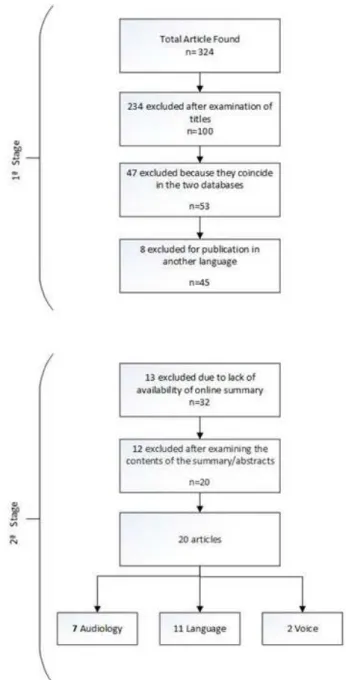
At irst, 324 papers about speech-language
pathology and the diverse types of thyroid
distur-bances were located. Through title analysis, 100 were selected having direct relation to this review theme. 47 papers were excluded since they were
coincident at both databases. Finally, eight papers
were excluded since they were published in
other languages than English or Portuguese, and
therefore, the abstract and the complete text were not available in either the two languages. Thus, 45 papers remained to the next review step.
At second step, it was veriied the abstracts existence. 13 papers were excluded since they did not have the abstract available at the website of the included databases (PUBMED and MEDLINE) and/
or at CAPES periodic homepage and, therefore, the content of the paper could not be evaluated.
Thereby 32 papers remained, 20 of them were
accessed through CAPES periodic homepage, 11
were requested to national libraries, and one to an
international library. Through reading the abstracts
and full papers there was the exclusion of 12 papers
due to not being compatible to the study theme.
Therefore, the inal number of papers included in the sample was 20 (Figure 1).
It was made a descriptive analysis about the content f the included papers in this review. It was
sought to observe agreement and disagreement
points among them, besides to identify whether there were enough scientiic evidence to draw the speech-language pathology proile of CH children.
It was collected data regarding research purpose,
age range, presence of control group, and main obtained results. From that, compiling data and critic
analysis were made.
development disturbances, and hearing losses due to maturation dysfunction of inner ear structures and VIII cranial nerve myelination4. Regarding voice,
the rough crying is the one of clinical symptoms common at birth5, which may occur up to 20% of cases6. However the scientiic evidences are not
clear yet, especially about the endurance of this
symptom during irst childhood in premature treated
children.
It is believed that the speech-language distur-bances related to language, hearing and voice must be investigated mainly due to the advance in
newborn screening tests systems and follow-up. It
is possible that diagnose and premature treatment may be related to decreasing negative
conse-quences to children.
The purpose of the present study was to review
the literature regarding possible speech-language disturbances related to congenital hypothyroidism
and, therefore, to answer the following question:
“Is there scientiic evidence about the presence of speech-language disturbances in children with congenital hypothyroidism?”
METHODS
The papers search was done in PUBMED and MEDLINE electronic database during 2011 July. The used keywords to search were: hypothyroidism OR
congenital hypothyroidism AND voice OR hearing
OR language. The crossing among all keywords combination was made.
The papers search process was done by two of
the researchers of the present research, individual and independently, to posterior comparing and
deining the inal sample inclusion. To all data collection steps, the results of each researcher were
compared and, at the end of each step, a meeting to
consensus and clearing possible conlicts/inconsis
-tencies regarding the found papers was made. The inclusion criteria were: papers related to
voice (phonation and resonance), language and
hearing in children with congenital hypothyroidism (primary); with evidence level 1 (systematic review),
2 (controlled random studies), or 3 (nonrandomized
nineties. From the total papers which reported the
possibility of hearing loss in CH children9,12,13, only
one of them had more methodological strength, having control group and a considerable number
of children (n=75) 13. The other papers, as the ones with newborns10,14 as with children11, did not prove the relation between congenital hypothyroidism and
hearing loss.
The papers located were about peripheral auditory evaluation. It was not located speciic
papers about the hearing processing investigation,
deined as mechanisms and process of auditory nervous system, which promotes speech decoding
and comprehension, especially in unfavorable situations, as the background noise presence or competitive speech15. It is considered of major
importance to carry out new researches that inves -tigate this aspect. It is believed that the results of these researches may contribute to clearing other complaint types commonly reported by the CH children, in language and learning (school, attention,
memory and others dificulties).
Besides, the hearing loss incidence in CH
children is questionable, since none reviewed
paper had epidemiologic character. The only paper9 suggesting hearing deviations percentage (10%
or a tenth) to this population have a big variability regarding the beginning of treatment of the partici-pants (14 days to seven years and three months),
which could possible question and generate bias of
the obtained results.
The results showed from the three Speech-language Pathology ields investigated, Speech-language was the one with higher number of published
papers16-26. This allows the arguing about this topic
in CH children to be more clear and consistent, but
do not exclude the importance of other communi
-cation aspects. It is worthy to note that the totality of
found papers corresponds to oral language
devia-tions, with only two paper having information about writing language, literacy process, and scholar
development in CH children.
Besides, about language yet, it was observed the predominance of cognitive process focus, with
complementary information about the deviations in this area. Therefore, QI information, memory, attention skill and general neuropsychological
development overlapped speciic language data, with the contribution of these aspects regarding the
language disturbance not clear.
About the content of the language iles papers,
there are still controversies about the relation
between its development and CH presence. Some papers report proper development when CH children
16,21,25
Figure 1 – Flowchart about data collection
LITERATURE REVIEW
The following results were distributed according to Speech-language pathology researched ields. It was located seven papers in Audiology, 11 in Language, and two in Voice (Figure 2)
Regarding Audiology, excepting one literature review paper8, which was made the option to include
Authors/Year Purpose Sample Main Results
Meyerhoff WL;
19767
To review in literature possible rela
-tions between hearing losses and thyroid disturbances from the follow -ing types: not genetic but congenital,
not genetic but acquired, congenital, and genetic with late symptoms.
47 researches published in pe-riodic (n=43) and books (n=3)
from 1896 to 1974 were com -piled.
The relation between hearing losses and
thyroid disturbances are coincident and
there is not a connection between them.
Debruyne F; 19838
To investigate the incidence, type and severity of hearing loss in CH children.
SG: 45 children with CH ag -ing from 1 up to 13 years. CG: none.
20% (n=9) of children had some kind of hearing loss (four with mild degree and ive needing hearing loss device adapta -tion).
François M et al.; 19939
To evaluate the newborn with CH
hearing before and after the hor-mone treatment.
SG: 11 newborns with CH; CG: 9 newborns without the disease.
Up to 25 days of life the children with CH without treatment had normal hearing ca
-pability. It was concluded that the cochlea
development and auditory-brain function is unresponsive to fetal hypothyroidism, and the thyroid hormone level during fetal
life was enough to normal development of
children.
François M et al.;199410
To verify whether CH is related to
hearing losses, and to relate the hearing data to the variables:
begin-ning of treatment age, thyroxin level
at the beginning of treatment, and CH cause.
SG: 42 subjects with CH, aging
from 12 months up to 21 years;
CG: 42 subject without hearing
loss risk.
CH is not necessarily associated to
hear-ing losses in high frequencies when chil
-dren having the disease were compared
to health ones. Besides, the hearing loss occurrence is independent of CH causes or the age of treatment beginning.
Bell-manSC;199611
To verify the prevalence of auditory-vestibular disturbances in 32
chil-dren with CH prematurely treated
(longitudinal study).
SG: 38 children with CH, from 10 up to 12 years, followed
since their birth; CG: none.
It may occur slight disturbance of hear-ing and vestibular function in CH children,
even when prematurely treated.
Rovet J et al.;
199612
To determine incidence and type of CH children hearing loss; to re-late the hearing loss and premature treatment to thyroid disease; and to
report the functional signiicance of
the hearing loss to posterior oral and
writing language capabilities.
SG: 75 CH children, aging from 10 up to 12 years, followed after newborn screening, with specif -ic neurolog-ic assessment; CG: CH children classmates.
Fifteen (20%) of children had some hear -ing problem. Nine of them had unilateral
hearing loss in high frequencies, ive had
conductive loss, and one had combined loss. The authors suggested CH children must have hearing screening.
Parazzini M et al.;200213
To analyze the hormone deiciency
effects on peripheral hearing
sys-tem, at the irst month of life in CH
children.
SG: 29 CH newborns; CG: 42
healthy newborns. There is not inluence of CH in hearing capability up to the 30th day of life
Fuggle PW et
al.;199114
To evaluate CH children prematurely treated intelligence, motor skills, and behavior.
SG: 57 CH children aging up to ive years old; CG: 51 children without the disease, paired in sex, age, and socio-economic
level to CG.
There are not differences in intelligence, vocabulary, comprehension and verbal
IQ assessment between the SG and CG. However, CH children had the worst mo -tor skills levels.
Rovet JF
et al.;199215
To evaluate the neurologic develop-ment of CH children and relate it to etiology and treatment interference variables.
SG: 108 CH children aging
among 1 and 5 years; CG: 71 brothers without the disease.
Although the CH children development
improves according to the newborn diag -nose and treatment, it still may be risks
for deicits due to thyroid hormone dei -ciency in uterus and the beginning of life.
Children with thyroid agenesis had more
risks to neurologic development.
Kooistra L et al.;199416
To evaluate the cognitive and motor development of prematurely treated CH children, and to relate to the
vari-ables regarding etiology, thyroxin blood concentration at newborn
screening and the beginning of treat-ment age.
SG: 72 CH children, aging among 7 and 9 years, prema-turely treated; CG: healthy chil-dren.
Children with lower thyroxin level at new
-born screening particularly the ones with thyroid agenesis had lower intelligence scores up to 9 years. To children with se
-vere CH there was relation between the
beginning of treatment age and cognitive and motor evaluation. Regarding
Authors/Year Purpose Sample Main Results
Simons WF
et al.;199717
To describe the reading, mathemat-ics, motor skills and behavior prog-ress in a CH children group.
SG: 59 CH children, with 10 years old, in which 31 had se -vere CH and 28 less se-vere
in newborn screening; CG: 59 classmates without the disease.
Severe CH children at the newborn
screening had more deviations in math-ematics, motor skills and behavior than moderate CH and normal control.
Re-garding reading there was no difference between groups.
Bargagna S et al.;199718
To longitudinally compare the
neuro-psychological development of twins, one with CH prematurely treated and the other without the disease, and
also to compare them to a healthy children group.
SG: twins, one with CH and the other without the disease.
CG: 34 healthy children, from 3 months up to 8 years old.
The twins language development were
slight retarded comparing to control; At
four years the CH twin had phonologic disturbance and pour expressive lan -guage comparing to her sister, but at 8
years this matter was normalized; CH twin was not different to control regarding
school skills.
Rovet JF.;
199919
To longitudinally investigate the neu-ropsychological function in CH chil-dren
SG: 100 prematurely treated
CH children that were assessed
by intelligence tests (phase 1), psycho-educational assess-ment (phase 2), and
neuropsy-chological complete examina -tion (phase 3 – teenage); CG: brothers and classmates.
The CH children premature attendance is related to normal intellectual function levels.
Bargagna S et al.;199920
To evaluate the scholar development of CH children prematurely treated, and to compare them to normal con-trol.
SG: 19 CH children aging from
5 to 10 years, attending nursery
or elementary school; CG: 298 healthy children, paired in age and scholar level.
In nursery the CH children had the worst development in coping symbols and ig -ures, sentences repetition, and
sponta-neous writing. Regarding spontasponta-neous writing, the CH children had lower scores
only in recognizing orthographic mis-takes. QI, language and social condition
levels were worst in CH children.
Bargagna S et al.;200021
To indentify which neuropsychologi
-cal functions would be more affected
in prematurely treated CH children, comparing them to healthy control.
SG: 24 prematurely treated Ch
children, evaluated at 3.5 and 7 years old; CG: 25 healthy chil
-dren, paired in age and sex.
At 7 years, the cognitive development of
CH children was similar to CG. At 3 years, 29% of CH children had phonologic dis
-turbance and 21% expressive language disturbance. At 5 years, 37.5% of them had phonologic disturbance and 12.5% in expressive language. At 7 years, 12.5%
of CH children still had phonologic dis-turbance. Severe CH children had more language disturbance.
Alvarez M et al.;200422
To indentify the fetus, newborn, and treatment inluence at the beginning
of language development in CH chil-dren.
SG: 26 CH children, from 3 up to 18 months; CG: none.
The better language development was related to lower biochemical perturbation
(T4 values) before the treatment begin-ning. The language development seems to be independent from the fetus hypothy-roidism duration.
Gejão MG et al.;200823
To draw the development proile of
prematurely treated children focus-ing on communicative skills.
SG: 32 Ch children, from 2 up to 36 months; CG: none.
Majority of children had proper motor, cognitive, language, social and self-care skills development. Among deviated
children, more deicits were observed in language skills (expressive and cognitive
skills).
Gejão MG et al.;200924
To describe the communicative and psycholinguistics skills of phenylke-tonuria (PKU) and CH children.
SG: 68 children, as 43 with CH
(from 1 up to 60 months) and
25 with PKU (from 1 up to 120
months). CG: none.
CH and PKU children had risk to devel-opment skills (motor, cognitive, linguistic, adaptive, and social). Socio-linguistics
disturbances were observed mainly af -ter preschool age. CH patients had more
cognitive and language deicits.
Michelsson et al.;197625
To investigate possible deviation in
CH newborn cry through acoustic
spectrographic analysis.
SG: 4 CH children aging from
10 days up to 4 months; CG: 75 children without the disease, at
the same age range.
CH newborns had lower mean, minimum and maximum fundamental frequency
Authors/Year Purpose Sample Main Results
Boero D et al.;200026
To evaluate the acoustic parameters
of CH newborn cry at the diagnose
moment and after 30 days of the medical hormone treatment.
SG: 12 CH newborns; CG: 16 newborns without the disease
and healthy.
At irst evaluation, the CH children had cries in lower volume and lower number
of vibratos during emissions. Mean
ini-tial F0, mean, minimum, maximum and inal were also lower in SG. At second evaluation, even with some change in parameters, there was no change in time parameter, fundamental frequency and frequency peak. The authors concluded to be abnormalities in CH newborn cry
and part of them do not modify after a
month treatment with thyroid hormone.
Subtitles: SG= study group; CG = control group
Figure 2 – Contents of localized papers about speech-language disturbances related to congenital hypothyroidism
signiicant delay in language development17-20,22-24,26. Lower inconsistencies were observed when the language deviations were related to CH etiology and “severity of the disease at diagnose (newborn
screening)” variables. All the papers that purposed to evaluate such relation concluded that thyroid agenesis and more deviated hormone levels at diagnose (more severe) contributes to a higher risk to deviation in language development17-19;23,24.
There was a big methodological variability in
Language papers, probably due to the differences and particularities regarding main evaluation focus (some papers includes the language evaluation as complementary to neuropsychological development evaluation), or the academic graduation and research line of the author(s). Besides, does not
seem to have a relation between the paper publi
-cation period and obtained results, once the most
recent ones had variability about the indings of CH
children language development22-26.
About the relation between congenital hypothy -roidism and possible vocal deviation in children,
there still is a big gap of knowledge to be fulilled.
That is because, even the literature pointing out rough cry as one of the main clinic symptoms of CH children at birth (usually evaluated under the
physician perspective), only two papers made
objective analysis about the subject27,28. The two
papers have similar conclusions and make clear
there is a considerable level of CH newborns
having voice deviations. One of them28 points out
that even after a month treatment and the hormone
levels within normal patterns, part of the children still had vocal disturbances. However, there was not
obtained papers that pointed out any evidence about
the maintenance of these deviations throughout irst childhood. It is worthy to mention that one of the
above mentioned researches28 is from the medical
ield and it was carried out trying to relate vocal
characteristics to neurologic and breathing devel-opment of the children28. But it was made the option to select the paper to this review due to acoustic analysis inclusion and the shortage of papers with
strong data about the topic.
It was not located other studies of voice
assessment in CH children, in any other age range
than newborns. So, it is important to carry out
other researches that clear this aspect, once there
is still not clear whether there is the maintenance
of a possible dysphonia throughout childhood information.
Currently, with the advance of newborn screening programs, the CH newborns receive treatment and medical attendance since the irst weeks of life. The hormone reposition and following will be permanent which may promote the normal or very close to normality growth and development. However, the
real implications of prematurely treated CH, mainly
in teenage and adulthood, are still unknown29. Therefore, longitudinal studies, which will follow
the hearing, language and voice development, are fundamental in order to better understand the cases progress and their hypothyroidism possible
consequences with aging. It is worthy to highlight that newborn screening became a law in Brazil in 1990 and 2001, through GM/MS ordinance nº 822, and it was held in all national territory and, therefore,
there are already a big number of teenagers and
adults followed since their birth, systematically, in
specialized centre30.
CONCLUSION
The big method variability of the reviewed papers does not allow a clear conclusion about possible
in voice of CH newborns they do not allow to make
inference about possible dysphonia maintenance in childhood and teenage.
Speech-language pathologist action in congenital hypothyroidism children is still poorly discussed and deserves attention. Therefore, the insertion of this
professional in inter-disciplinary teams that follows
CH children should be considered, and also in the development of researches that produce stronger evidence regarding the importance of its action to this population.
ACKNOWLEDGMENT
We would like to thanks the Coordenação de Aperfeiçoamento de Pessoal de Nível Superior (CAPES) the inancial support in order to perform
this research through scholarship master and
doctoral grants to the irst and second authors,
respectively. congenial hypothyroidism, mainly in Audiology and
Voice ields. Some papers, really old, report the subject in a previous moment to newborn screening tests implantation which certainly contributed to
the bigger number of descriptions in the children of these researches. Although it seems to have a tendency to “normalization” or decreasing the number of speech-language disturbances as the screening tests implantation happens, there is a lack of evidence regarding the subject.
It is important that new researches in language
to be performed by speech-language pathologists in order to be possible to prior and analyze the most
important aspects of the ield, adding the speech-language pathology perspective so the indings
may be easily applied in human communication disorders clinic. The audiology researches have been prioritized only audiometric thresholds and, therefore, researches about sound perception should be carried out. In voice, the production is pretty scarce and, even coinciding about deviations
RESUMO
O Hipotireoidismo Congênito (HC) é a doença endócrina congênita mais comum na infância e
cor-responde à deiciência de hormônios tireoidianos. Este artigo teve o objetivo de realizar uma revisão
crítica da literatura, a respeito das possíveis alterações fonoaudiológicas relacionadas ao HC. Os
descritores utilizados para a busca nas bases de dados eletrônicas PUBMED e MEDLINE foram:
hypothyroidism OR congenital hypothyroidism AND voice OR hearing OR language. Foram incluídos estudos publicados até julho de 2011. As análises foram realizadas independentemente por dois dos
pesquisadores, com posterior discussão e consenso sobre a inclusão. Dos 324 estudos localizados na análise inicial, apenas 20 compuseram a amostra inal após o estabelecimento dos critérios de inclusão. Observou-se que há um número considerável de artigos sobre a linguagem de crianças com HC, embora com controvérsias no que se refere aos resultados das avaliações. Quanto à Audiologia, nos últimos anos houve uma redução no número de artigos que descrevem alterações auditivas em crianças com HC. Na área de Voz, foram localizados apenas dois artigos, que se referiram exclusiva -mente às anormalidades observadas no choro de bebês com HC. Embora com algumas constatações
relevantes a respeito do assunto, a grande variabilidade metodológica das pesquisas não permite que
se tenha uma conclusão clara sobre as possíveis alterações fonoaudiológicas em crianças portadoras de hipotireoidismo congênito na atualidade.
15. ASHA: American Speech and Hearing
Association [Internet].(Central) auditory processing
disorders, 1997-2008.Available at http://www.asha. org/members/deskref-journals/deskref/default. 2005.
16. Fuggle PW, Grant DB, Smith I, Murphy G. Intelligence, motor skills and behavior at 5 years in early-treated congenital hypothyroidism. Eur J Pediatr. 1991;150(8):570-4.
17.Rovet JF, Ehrlich RM, Sorbara DL.
Neurodevelopment in infants and preschool
children with congenital hypothyroidism: etiological
and treatment factors affecting outcome.
JPediatrPsychology. 1992;17(2):187-213.
18.Kooistra L, Laane C, Vulsma T, Schellekens
JM, Van Der Meere JJ, Kalverboer AF Motor and cognitive development in children with congenital
hypothyroidism: a long-term evaluation of the effects
of neonatal treatment. .J Pediatr. 1994;124(6):903-9. 19. Simons WF, Fuggle PW, Grant DB, Smith I.
Educational progress, behavior, and motor skills at 10 years in early treated congenital hypothyroidism. Arch Disease in Childhood. 1997;77:219-22.
20.Bargagna S, Chiovato L, Dinetti D, Montanelli L, Giachetti C, Romalini E, Marcheschi M, Pinchera A. Neuropsychological development in a child
with early-treated congenital hypothyroidism as compared with her unaffected identical twin. Eur J
Endocrinol. 1997;136(1):100-4.
21. Rovet JF. Long-term neuropsychological sequelae of early-treated congenital hypothyroidism:
effects in adolescence. ActaPediatr Suppl. 1999
88(432):88-95.
22.Bargagna S, Dinetti D, Pinchera A, Marcheschi M, Montanelli L, Presciuttini S et al. School attainments
in children with congenital hypothyroidism detected by neonatal screening and treated early in life. Eur J Endocrinol. 1999;140(5):407-13.
23. Bargagna S, Canepa G, Costagli C , Dinetti D, Marcheschi M, Millepiedi S et al.
Neuropsychological Follow-up in Early-Treated
Congenital Hypothyroidism: a problem-oriented approach.Thyroid. 2000;10(3):243-9.
24. Alvarez M, Carvajal F, Renón A Pérez C, Olivares A, Rodríguez G et al. Deferential effect of fetal, neonatal and treatment variable on
neurodevelopment in infants with congenital
hypothyroidism. Horm Res. 2004;61:17-20.
25. Gejão MG, Lamônica DAC. Habilidades do
desenvolvimento em crianças com hipotireoidismo
congênito: enfoque na comunicação. Pró-Fono R Atual Cient. 2008;20(1):25-30.
26.Gejão MG, Ferreira, AT, Silva GC,
Anastácio-Pessan, Lamônica D. Comunicative and psycholinguistic abilities in children with REFERENCES
1. Fisher D A. Disorders of the thyroid in the
newborn and infant. In: Sperling M A. Pediatric Endocrinology. 3ª.ed. Philadelphia: W.B. Saunders;
2008. p. 198-226.
2. American Academy of Pediatrics/American Thyroid Association. Lawson Wilkins Pediatric Endocrine Society. Update of newborn screening
and therapy for congenital hypothyroidism. Pediatrics. 2006;117(6):2290-303.
3. Lazarus JH. Congenital hypothyroidism. Arch Dis Child. 2005;90:112-3.
4. Working Group on Neonatal Screening of the
European Society for Pediatric Endocrinology. Revised guidelines for neonatal screening programs for congenital hypothyroidism. Horam
Res.Basel.1999;52:49-52.
5. Maciel LMZ, Kimura ET, Nogueira CR, Mazeto
GM, Magalhães PKR, Nascimento ML et al. Hipotireoidismo congênito: recomendações do Departamento de Tireoide da Sociedade Brasileira
de Endocrinologia e Metabologia. Arq Bras Endocrinol Metab. 2013;57(3):188-92.
6. Pezzuti IL, Lima PP, Dias VMA. Hipotireoidismo
congênito: peril clínico dos recém-nascidos identiicados pelo Programa de Triagem Neonatal de Minas Gerais. J Pediatr. 2009;85(1):72-9. 7. Cox RM. Waiting for evidence-based practice for you hearing aid ittings? It’s here. The Hearing Journal. 2004;57(8):10-7.
8. Meyerhoff WL. The thyroid and audition.
Laryngoscope.1976;86(4):483-9.
9. Debruyne F, Vanderschueren-Lodeweyckx M,
Bastijns P. Hearing in congenital hypothyroidism. Audiology. 1983;22(4):404-9.
10. François M, Bonils P, Leger J, Avan P, Czernichow P, Narcy P. Audiological assessment
of eleven congenital hypothyroid infants before and after treatment. ActaOtolaryngol. 1993;113(1):39-42.
11. François M Bonils P, Leger J, Czernichow P,
Narcy P. Role of congenital hypothyroidism in hearing
loss in children. J Pediatr. 1994;124(3):444-6. 12. Bellman SC, Davies A, Fuggle, PW, Grant, DB,
Smith I. Mild impairment of neuro-otological function in early treated congenital hypothyroidism. Arch Dis
Child. 1996;74(3):215-8.
13. Rovet J, Walker W, Bliss B, Buchanan L, Ehrlich R. Long-term sequelae of hearing impairment in congenital hypothyroidism. J Pediatr.
1996;128(6):776-83.
14. Parazzini M, Ravazzani P, Medaglini S,
Weber G, Fornara C, Tognla G et al. Click-evoked
otoacoustic emissions recorded from untreated
congenital hypothyroid newborns. Hear Res.
29. Klein RZ, Mitchell ML. Hypothyroidism in infants
and children In: Braverman, LE, Utiger RD. The
Thyroid: a fundamental and chinical text. 8 ed. Philadelphia: Ed. Lippincott Williams e Wilkins,
2000. P. 973-88.
30. Brasil. Ministério da Saúde. Portaria GM/MS n. 822/GM, de 6 de junho de 2001. Disponível em: HTTP://dtr2001.saude.gov.br/sas/sas02/sasjun02. htm. Acesso em 05 out. 2012.
phenylketonuria and congenital hypothyroidism. J Appl Oral Sci. 2009;17(sp. Issue):69-75.
27. Michelsson K, Sirvio P. Cry analysis in congenital hypothyroidism. Folia Phoniatrica. 1976;28(1):40-7.
28.Boero D, Weber G, Vigone MC, Lenti C. Crying
abnormalities in Congenital Hypothyroidism:
Preliminary Spectrographic Study. J Child Neurology. 2000;15(9):603-8.
Received on: July 11, 2013 Accepted on: January 28, 2014
Mailing address: Monica BarbyMuñoz
Unidade de Endócrino-Pediatria –
R. Padre Camargo, 250