EVALUATION OF THE AUDITORY SYSTEM
OF FARM WORKERS EXPOSED TO PESTICIDES
Avaliação do sistema auditivo em agricultores expostos à agrotóxicos
Maria Isabel Kós(1), Maria de Fátima Miranda(2), Raphael Mendonça Guimarães(3), Armando Meyer(4)
(1) Universidade Federal do Rio de Janeiro, Rio de Janeiro,
RJ, Brazil.
(2) Universidade Federal do Rio de Janeiro, Rio de Janeiro,
RJ, Brazil.
(3) Universidade Federal do Rio de Janeiro, Rio de Janeiro,
RJ, Brazil.
(4) Universidade Federal do Rio de Janeiro, Rio de Janeiro,
RJ, Brazil.
Conlict of interest: non existent
certain cognitive and emotional aspects2-4. This kind
of handicap hinders access to and use of healthcare in general, yielding potential adverse effects on health and survival5.
The prevalence of hearing loss is on the rise in the population at large, probably because of the ageing of the population and increased exposure to noise. There are concerns that hearing impairment may take on epidemic proportions6.
Hearing loss is generally associated with ageing, exposure to noise, and head injuries. Hearing loss induced by high sound pressure levels is one of the most widespread irreversible work-related ailments in the world7, described in many scientiic studies.
Occupational hearing loss is a term that is widely used as a synonym for noise-induced hearing loss, but apart from noise, many other work-related activities can put hearing at risk, such as chemicals which in isolation or in combination with noise may trigger or exacerbate the risk to workers’ health 8,9.
Many studies have shown that chemicals can cause damage to human beings and the environment. While the main focus of studies into auditory health is still noise exposure, there are an
INTRODUCTION
Hearing impairment is generally regarded as a difference between a subject’s capacity and normal capacity to detect sounds, based on the standards set by the American National Standards Institute (ANSI, 1989)1.
Hearing impairment may become a personal handicap. In adults, it can result in a number of psychosocial alterations, potentially hampering verbal language processing and thereby restricting communication and social contact. These communi
-cation dificulties have a negative impact on produc
-tivity at work, quality of health, quality of life, and ABSTRACT
Purposes: to evaluate the peripheral auditory system, by means of pure tone audiometry for farmers living in areas of heavy use of pesticides in the State of Rio de Janeiro. Methods: 70 individuals of genders, 35 farmers and 35 non-farmers, with ages between 25 and 59 years, residents Campos dos Goytacazes, were enrolled into the study. All subjects had their peripheral hearing evaluated by means of pure tone audiometry at frequencies of 250, 500, 1,000, 2,000, 3,000, 4,000, 6,000 and 8,000 Hz. Individuals with alterations in external and middle ear and/or with a otologic complaint were excluded from the study. In addition, interview was conducted regarding health issues, socioeconomic status, education and exposure to pesticides. Hearing loss was considered if hearing thresholds were equal or more than 25 dB at any frequency tested. Results: the Odds Ratio of hearing loss was 3.67 times (95% CI: 2.08 - 6.48) higher among agricultural workers (94.3%) when compared to non-agricultural workers (25.7%). Furthermore, most of the hearing alterations were observed in the higher frequencies. Conclusion: this study suggests that the agricultural activity and possible exposure to pesticides increases the risk of hearing loss.
METHODS
In observance of the standards applicable to research involving humans, this study was analyzed and approved by the Research Ethics Committee at the Institute of Public Health Studies (Instituto de Estudos em Saúde Coletiva), Federal University of Rio de Janeiro, according to Research Ethics Committee resolution no. 113/2009, process 51/2009. All those who took part in the study were informed about the research procedures, had their queries answered, and signed an informed consent form.
This study is a cross-sectional epidemiological study.
70 subjects were evaluated, of whom 35 were farm workers and 35 were not. They were of both sexes (54 male and 16 female) and were aged between 25 and 59. All lived in Campos dos Goytacazes and none complained of having hearing problems.
The farm workers were recruited randomly from the Campos dos Goytacazes Farm Workers Union, and 35 were found to meet the inclusion criteria, which included the requirement that they had had chronic exposure to insecticides, fungicides and/ or herbicides. Their average age was 46.57. The hearing test was conducted using a soundproof audiometric booth in a quiet room at the union premises.
The control group were recruited from amongst orthopedics outpatients and cleaning staff at Guarus Municipal Hospital. They were chosen because their socioeconomic status was similar to that of the farm workers. Those who reported having exposure to noise or chemicals or any hearing impairment were excluded from the group. The average age of this group was 44.45. The study was conducted using a soundproof audiometric booth inside the hospital’s audiology department.
All the subjects had their external auditory canal inspected and acoustic immittance measured with the aim of verifying the functional integrity of the middle ear and the existence of any conductive or mixed impairment (obstruction of the external auditory canal, perforated tympanic membrane or other alterations in the middle ear). Those subjects found to have some kind of alteration of the external auditory canal or acoustic immittance were excluded from the study. Other exclusion criteria were the frequent use of ototoxic medication and existence of degenerative diseases. Acoustic immittance was measured using Mini-Tymp®, a
increasing number of studies into the impacts of chemical exposure on auditory capacity, especially in workers 10-13. Sensory processing disorders in
the auditory system have been associated with prescription drugs, such as aminoglycosides, quinine and others14.
It is believed that many chemical compounds could be ototoxic or neurotoxic, but little research has been done to conirm this. One of the groups of chemicals cited as potentially ototoxic is pesticides. Many of these are neurotoxic and could potentially affect hearing. Some studies have identiied organo
-phosphorates as potential causers of permanent bilateral hearing loss14-17.
In a cross-sectional study conducted with 830 individuals, the indings suggested that the risk of developing mild cognitive impairment was around ive times higher in the group of individuals exposed to pesticides than it was in the group not exposed to these chemicals18.
In another study conducted with the aim of estimating the prevalence of peripheral hearing impairment in a group of workers exposed to organophosphorate and pyrethroid insecticides, auditory impairment was found. In those exposed only to the insecticides, 63.8% had hearing loss, with an average of 7.3 years elapsing between the start of exposure and the onset of hearing loss. For the group exposed to noise and pesticides, the prevalence of hearing loss was 66.7%, with the onset of hearing loss happening after 3.4 years on average14. The difference encountered between the
group exposed only to pesticides and those exposed simultaneously to pesticides and noise was statisti
-cally signiicant.
In another study, 1622 farm workers from New York state were interviewed using a questionnaire. To assess the reliability of the questionnaire, 376 audiometric tests were conducted. The indings of the research showed that 36% of the patients had hearing loss, characterized as some degree of hearing impairment in one or both ears. In the audiometric tests, 9% of the subjects had bilateral hearing loss at 0.5, 1 and 2KHz, 29% had bilateral hearing loss at 1, 2, 3 and 4KHz, and 47% had bilateral hearing loss at 3, 4, 6 and 8KHz19.
workers (no exposure to pesticides). The average ages of the groups were 46.57 for the farm workers and 44.45 for the non-farm workers. 42.9% of the farm workers reported exposure to noise, 22.9% were smokers, and the majority (71.4%) did not regularly drink alcohol. As for their state of health, 34.3% said they used some kind of medication regularly, and 65.7% said they did not have high blood pressure. Meanwhile, in the control group (non-farm workers), just 20% reported being exposed to noise in the workplace and/or leisure. As far as their habits were concerns, 22.9% of the non-farm workers reported that they smoked, and 37.1% consumed alcoholic beverages regularly. 45.7% of them also reported the regular use of medications and the same percentage had high blood pressure. Most of the workers (65.7%) and non-farm workers (51.4%) had had fewer than nine years of formal education (Table 1).
In the audiometric test, it was found that unilateral and bilateral hearing loss was more prevalent amongst the farm workers for all the frequencies analyzed, and that this difference was statisti
-cally signiicant. When the adjusted results for the speech frequency average were analyzed, 45.71% (16 individuals) were found to have bilateral hearing loss and 17.14% (6 individuals) unilateral hearing loss. Meanwhile, the prevalence of bilateral hearing loss amongst the non-farm workers was 5.71% (2 individuals), while unilateral hearing loss was found in three individuals (8.57%). Meanwhile, for the high frequency average there was a 45.71% prevalence (16 individuals) of bilateral hearing loss and 25.71% prevalence (9 individuals) of unilateral hearing loss amongst the farm workers, while these values were 28.57% (10 individuals) and 5.7% (2 individuals) for the non-farm workers, respectively (Table 2). The interviews were conducted using a
semi-structured questionnaire designed to gather information on personal data, occupational risks, non-occupational risks, the use of personal protective equipment, history of hearing problems and general health, socioeconomic status, education, and exposure to pesticides. The occupa
-tional health questions included a description of their work and their exposure to noise, pesticides and other chemicals. The results of the hearing tests were attached to the subjects’ questionnaires after each interview. All the tests were conducted by the same audiologist using standard methods.
All the subjects had their peripheral hearing tested using pure tone audiometry at the following frequencies: 0.25, 0.5, 1, 2, 3, 4, 6 and 8KHz. Thresholds were determined by descending presen
-tations of tones, then conirmed by an ascending series. An Interacoustics audiometer, model AC33, was used, which was calibrated according to ISO R389 (1991) prior to data collection. Those subjects with a threshold of 25dB or more for any of the frequencies tested were considered to have hearing
loss.
The data were analyzed statistically using the SPSS Statistics package, version 17.0. Fisher’s exact test and Pearson’s chi-squared test were used to evaluate the statistical signiicance of the difference in the prevalence of hearing loss amongst the farm workers and non-farm workers. Finally, unconditional logistic regression was used to adjust the odds ratio.
RESULTS
Table 1 – Characteristics of the study participants
Farm workers Not farm workers
Age (average)
25 – 44 45 – 59
n %
35.3 53.9
n %
35.6 50.3
Sex
Male
Female
27 77.2 08 22.8
27 77.2 08 22.8
Exposure to noise
Yes
No
15 42.9 20 57.1
7 20 28 80
Smoking
Yes
No
8 22.9 27 77.1
8 22.9 27 77.1
Alcohol consumption
Yes
No
10 28.6 25 71.4
13 37.1 22 62.9
Regular medication
Yes
No
12 34.3 23 65.7
16 45.7 19 54.3
High blood pressure
Yes
No
12 34.3 23 65.7
16 45.7 19 54.3
Years of schooling Illiterate
Less than 9 years 9 years
10-12 years 12 years
6 17.1 23 65.7 2 5.7 2 5.7
12.9
0 0 18 51.4 13 37.1 2 5.7
25.7
Table 2 – Prevalence of unilateral and bilateral hearing loss
Hearing Loss Farmers
Unilateral
Non-Farmers
Unilateral p value
a Farmers
Bilateral
Non-Farmers
Bilateral p value
a
Speech
Range YesNob 13 (37.14%) 30 (85.71%)6 (17.14%) 3 (8.58%) 0.028 16 (45.72%)13 (37.14%) 30 (85.71%)2 (5.71%) < 0.001
High Frequency Average
Yes 9 (25.71%) 2 (5.71%)
0.002
16 (45.72%) 10 (28.57%)
0.008
Nob 10 (28.57%) 23 (65.72%) 10 (28.57%) 23 (65.72%)
a. Obtained from Fisher’s exact test (when n<5) and the Pearson-Fisher chi-squared test (when n>5) b. Control group with no unilateral or bilateral hearing loss
In order to facilitate the analysis of the audio
-metric tests, the averages of the speech frequencies (0.5 – 2KHz) and high frequencies (4 – 8KHz) were
loss in the left and right ear was analyzed for the speech frequency and high frequency averages.
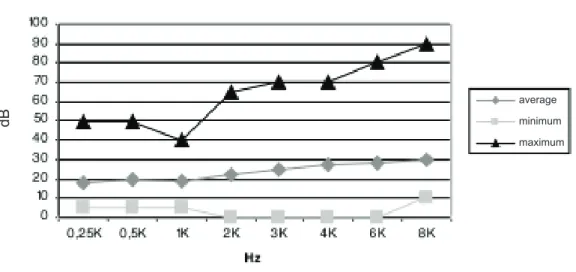
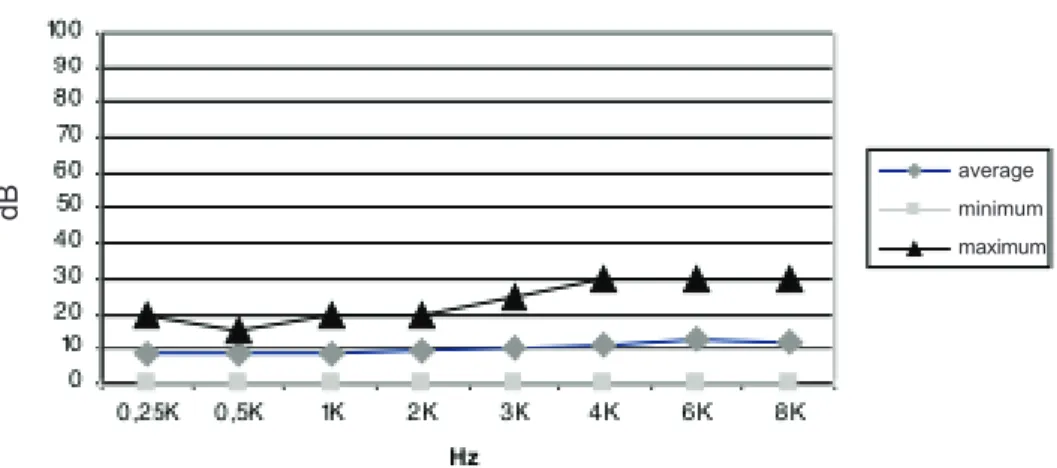
between 25 and 30dB, while for the control group this variation was between 10 and 13dB. Another major difference was the maximum threshold levels: at 8KHz, a 90dB threshold was found for the farm workers, while for the control group it was 30dB. In both groups, the values rose as the frequency rose from 2 to 8KHz.
Figures 1 and 2 (below) show the average, minimum and maximum results found for the farm workers and non-farm workers per frequency (0.25,
0.5, 1, 2, 3, 4, 6 and 8KHz).
By analyzing the results of the minimum, maximum and average values per frequency, the difference between the averages of the two groups can be seen. Mainly at the high frequencies (3 to 8KHz), the average for the farm workers varied
yielded an increased risk: 17.0 (CI 95%: 3.6 – 79.3) for the speech frequency range in the right ear, 14.8 (CI 95%: 3.4 – 64.4) for the speech frequency range in the left ear, 7.1 (CI 95%: 1.9 – 26.3) for high frequencies in the right ear, and 7.0 (CI 95%: 2.0 – 23.8) for high frequencies in the left ear (Table 3). frequencies, the risk was found to be 4.1 (CI 95%:
1.5 – 11.3) and 4.7 (CI 95%: 1.7 – 13.0) respectively for the right and left ears.
To control the confounding variables, the results were adjusted for noise exposure, age, education, smoking, regular drinking, regular use of medica-tions, and high blood pressure. All the averages
Table 3 – Estimated risk (odds ratio) of the association between agricultural work and hearing loss
Farm Workers Not Farm
Workers cOR* (CI 95%) aOR* (CI 95%)
RE speech range 19 (54.28%) 3 (8.57%) 12.67 (3.26 – 49.23) 17.05 (3.66 – 79.39)
LE speech range 19 (54.28%) 4 (11.42%) 9.20 (2.67 – 21.66) 14.90 (3.44 – 64.48)
RE high average 23 (65.71%) 11 (31.42%) 4.182 (1.54 – 11.35) 7.14 (1.93 – 26.37)
LE high average 24 (68.57%) 11 (31.42%) 4.76 (1.73 – 13.06) 7.03 (2.08 – 23.84)
Key: cOR – crude odds ratio; aOR – adjusted odds ratio; RE – right ear; LE – left ear
* adjusted by exposure to noise, age, education, smoking, drinking, medication use and high blood pressure
Figure 1 – Average, minimum and maximum values of the farm workers FARMERS
d
B
at 4KHz: 53% for the workers and 67% for the farm workers23.
In other studies 9,24-26, a higher prevalence of
hearing loss in farm workers was also found, with worse thresholds for high frequencies exacerbated by exposure to noise.
In this study, the prevalence of hearing loss at high frequencies was 71.42% for the farm workers and 34.28% for the control group. This could be explained by the age of the subjects, since most were between 45 and 59 years of age (54.9%). Another factor relating to the farm workers is that they had higher exposure to noise (42.9%) than the group without exposure to pesticides (20%). In a study conducted to estimate the extent of occupa-tional hearing loss amongst Polish farm workers who drove tractors, 45 workers aged 21 to 50 were evaluated. The study found that the group exposed to tractors, especially those aged over 30, yielded statistically worse results in high frequencies (3, 4 and 6KHz) than the control group of the same age26,
corroborating the i ndings of this study. Meanwhile, in another study to assess the prevalence of hearing impairment in high school students in a rural part of Wisconsin, USA, 872 adolescents did a hearing test. The i ndings indicated a greater prevalence of hearing loss amongst the youth involved in rural activities than those that were not27, showing that
although the prevalence of hearing impairment is higher in older age groups, there is still a higher
DISCUSSION
The i ndings of this study show a greater preva-lence of hearing impairment in individuals exposed to pesticides. These data are compatible with the i ndings of other studies involving farm workers reported in the literature14,15,17,19,21-26.
In this study, a high rate of unilateral and bilateral hearing loss was encountered amongst the farm workers: 62.85% in the speech frequency range and 71.42% in the high frequency range. Meanwhile, for the non-farm workers, the prevalence of impairment was only 14.28% for the speech frequency range and 34.28% for the high frequency average. We did not i nd any signii cant difference between the ears of the two groups studied. The values encoun-tered for the individuals with and without exposure to pesticides are similar to those reported in other studies 21- 23. In a cross-sectional study conducted
with 150 immigrant farm workers in the USA, the authors encountered alterations in the audiometric tests in over 50% of the group studied, especially for high frequencies, while 35% reported difi culty understanding speech 21. In another study of 49
randomly selected full-time farm workers, they were found to have 65% hearing loss for high frequencies and 37% for middle frequencies, while the non-farm workers had 37% hearing loss for high frequencies and 12% hearing loss for middle frequencies. The hearing in the farm workers’ left ears was found to be signii cantly worse22. In another study involving
Figure 2 - Average, minimum and maximum values of the non-farm workers NON-FARMERS WORKERS
d
B averageminimum
CONCLUSION
The results of this study suggest that chronic exposure to pesticides may affect the peripheral auditory system even without exposure to noise. Data from this and other studies suggest that chemical exposure deserves greater attention in programs for the prevention of hearing loss, independent of noise exposure. Further studies should be conducted to assess the neurotoxic effects of pesticides.
In this study, we found an approximately fourfold risk of hearing loss at high frequencies which, when adjusted for age, noise exposure, high pressure, smoking, drinking, use of medications and education, rose to seven. In a study of 150 farm workers in Iowa, USA, an estimated risk of 1.62 was found for the better ear, 1.67 for asymmetrical hearing loss and 1.96 for the worse ear. Subjects exposed to noise were found to have a higher risk of hearing
loss15. This study shows that the use of pesticides
could contribute towards peripheral hearing loss, with or without exposure to noise.
REFERENCES
1. Bagal A, Thavendiranathan P, Detsky AS. Does
this patient have hearing impairment? JAMA.
2006;295 (4):416-28.
2. Jacob LCB, Aguiar FP, Tomiasi AA, Tschoeke
SN, Bitencourt RF. Monitoramento auditivo na ototoxidade. Rev. Bras. Otorrinolaringol. 2006;72(6):
836-44.
3. Yueh B, Shapiro N, MacLean CH, Shekelle
PG. Screening and management of adult hearing loss in primary care: scientiic review. JAMA.
2003;289(15):1976-85.
4. Campbell VA, Crews JE, Morlaty DG, Zack MM,
Blackman DK. Surveillance for sensory impairment activity limitation, and health-related quality of lfe among olders adults: United States, 1993-1997. MMWR CDC Surveil Summ. 1999;48(8):131-56.
5. Gates GA, Cobb JL, D’Agostino RB, Wolf PA.
The relation of hearing in the elderly to the presence
of cardiovascular disease and cardiovascular risk factors. Arch Otolaryngol Head Neck Surg.
1993;119(2):156-61.
6. Agrawal Y, Platz EA, Niparko JK. Prevalence
of hearing loss and differences by demographic characteristics among US adults. Arch. Intern Med.
2008;168(14):1522-30.
7. Who PDH. Report of the First Informal Consultation
on Future Programme Developments for the Prevention of Deafness and Hearing Impairment. World Health Organization, Geneva. 1997;23-4.
8. Crawford JM, Hoppin JA, Alavanja MCR, Blair A,
Sandler DP, Kamel F. Hearing loss among licensed pesticide applicators. J. Occup. Envirom. Med.
2008;50(7):817-26.
9. Morata TC, Lemasters G. Considerações
epidemiológicas para o estudo de perdas auditivas ocupacionais. In: Nudelmann A.A, Costa EA, Seligman J, Ibañez RN. PAIR – Perda auditiva RESUMO
Objetivos: avaliar o sistema auditivo periférico, por meio de audiometria tonal, em agricultores resi
-dentes em área de intenso uso de agrotóxicos no Estado do Rio de Janeiro. Métodos: foram avalia
-dos 70 indivíduos, de ambos os gêneros, moradores de Campos -dos Goytacazes, com idade variando entre 25 e 59 anos, sendo 35 agricultores e 35 não agricultores. Todos os indivíduos tiveram sua audição periférica avaliada, por meio de audiometria tonal nas frequências de 250, 500, 1.000, 2.000, 3.000, 4.000, 6.000 e 8.000Hz. Foram excluídos indivíduos com alteração de orelha externa e média e/ou com alguma queixa otológica. Além disso, foi realizada anamnese com questões relacionadas à saúde, situação sócio-econômica, educação e exposição ao agrotóxico. Foi considerada perda auditiva, os limiares maiores ou iguais a 25dB em qualquer das frequências testadas. Resultados:
oOdds Ratio de perda auditiva foi 3,67 vezes (IC95%: 2,08-6,48) maior entre agricultores (94,3%), quando comparados aos não agricultores (25,7%). Além disso, a maior parte das alterações auditivas foi observada nas frequências mais agudas. Conclusão: o presente estudo sugere que a atividade agrícola e possivelmente a exposição a agrotóxicos aumenta o risco de perda auditiva.
cognitive dysfunction. The Lancet. 2000;356(9233):
912-3.
19. Gomez MI Hwang SA, Sobotova L, Stark AD,
May JJ. A Comparison of self-reported hearing loss and audiometry in a cohort of New York farmers. J. Sp. Lang. Hear. Res. 2001;44:1201-8.
20. Frota S. Avaliação básica da audição. In:
Fundamentos em Fonoaudiologia – Audiologia, 2ª edição, ed. Guanabara Koogan, 2003.
21. Rabinowitz PM, Sircar KD, Tarabar S, Galusha
D, Slade MD. Hearing loss in migrant agricultural workers. Journal of Agromed. 2005;10(4):9-17.
22. Marvel ME, Pratt DS, Marvel LH, Regan M,
May JJ. Occupational hearing loss in New York dairy farmers. Amer. J. of Industr. Med. 1991;20(4):
517-31.
23. Kerr MJ, McCullagh M, Savik K, Dvorak
LA. Perceived and measured hearing ability in construction laborers and farmers. Am. J. Ind. Med.
2003;44(4): 431-7.
24. Plakke BL, Dare E. Occupational hearing loss
in farmers. Public Health Rep. 1992;107(2):188-92.
25. Guida HL, Morini RG, Cardoso ACV. Avaliação
audiológica em trabalhadores expostos a ruído e praguicidas. J. Bras. Otorrinol. 2010;76(4):423-7.
26. Oliveira CCC, Vargas MM, Sena TRR. Saúde
auditiva e qualidade de vida em trabalhadores expostos a agrotóxicos. Rev. Ciências e Saúde Coletiva. 2012;12(4):167-9.
27. Solecki L. Occupational hearing loss among
selected farm tractor operators employed on large multiproduction farms in Poland. Int. J. Occup. Med. Environ. Health. 1998;11(1):69-80.
induzida pelo ruído. Vol. II. Rio de Janeiro: Revinter; 2001.p.1-16.
10. Morata TC. Assessing occupational hearing
loss: beyond noise exposures. Scand. Audiol. Suppl. 1998;48:111-6.
11. Morata TC. Chemical exposure as a risk
factor for hearing loss. J. Occup. Env. Med.
2003;45(7):676-82.
12. Beckett WS, Chamberlain DBA, Hallman E,
May J, Hwang SA, Gomez M, Eberly S, Cox C, Stark A. Hearing Conservation for Farmers: Source Apportionment of Occupational and Environmental Factors Contributing to Hearing Loss. J. Occup.
Env. Med. 2000;42(8):806-13.
13. Sass-Kortsak AM, Corey PN, James R. An
investigation of the association between exposure to styrene and hearing loss. Annals of Epidemio.
1995;5(1): 15-24.
14. Teixeira CF, Augusto LGS, Morata T. Saúde
auditiva de trabalhadores expostos a ruído e inseticidas. Rev. Saúde Pub. 2003;37(4):417-23.
15. Choi SW, Peek-Asa C, Sprince NL, Rautiainen
RH, Donham KJ, Flamme GA et al. Hearing loss as a risk factor agricultural injuries. Amer. J. Indus.
Med. 2005;48:293-301.
16. Lizardi PS, O´Rourke MK,Morris RJ.The effects
of organophosphate pesticide exposure on hispanc children´s cognitive and behavioral functioning. J. Pedia. Psych. 2007;1-11.
17. Renick KM, Crawford JM, Wilkins III JR.
Hearing loss among Ohio farm youth: a comparison to a National sample. Amer. J. Indust. Med.
2009;52:233-9.
18. Bosma H, Van Boxtel MPJ, Ponds RW, Houx,
PJ, Jolles J. Pesticide exposure and risk of mild
Received on: September 03, 2012 Accepted on: December 06, 2013
Mailing address: Maria Isabel Kós