OCCURENCE OF UNILATERAL HEARING LOSS
IN PATIENTS WITH CLEFT LIP AND PALATE
Ocorrência de perda auditiva unilateral em pacientes
com issura labiopalatina
Maria Fernanda Capoani Garcia Mondelli(1),
Luzia Maria Pozzobom Ventura(2), Mariza Ribeiro Feniman(3)
(1) Dental School of Bauru, University of Sao Paulo, Bauru, São Paulo, Brasil
(2) Hospital for Rehabilitation of Cranial Anomalies – University Sao Paulo – Bauru, São Paulo, Brasil
(3) Dental School of Bauru, University of Sao Paulo, Bauru, São Paulo, Brasil
Work developed at the Hospital for Rehabilitation of Cranial Ano-malies – University Sao Paulo - Bauru.
Source of help: FAPESP process no: 03/02643-4
Conlict of interest: non-existent
the location of the lesion in relation to the incisive foramen. The pre-foramen cleft affects lip and alveolar arch and can be unilateral or bilateral. The post-foramen cleft affects hard palate and soft palate and can be unilateral or bilateral. Clefts that affect both pre-foramen and post-foramen areas are called transforaminal.
The subject with cleft lip and palate may present speech, dental, orthodontic and emotional problems. Thus, the characterization of the phonoaudiological signs and symptoms, the search for etiological
diagnosis and inding clinical entities affecting the
subject with cleft lip and palate have been concerns of healthcare professionals.
In children with CLP, the most frequent hearing-related change is otitis media, due to anatomicals and/or functional malformations of the eustachian tube and the pharyngeal sphincter (PS) region1.
Hearing loss due to otitis involves the most frequent loss found in this group and can be respon-sible of delayed acquisition of language, cognitive and psychosocial development4.
Hearing loss is the reduction of hearing in any degree that reduces the intelligibility of the spoken message for accurate interpretation or learning5.
INTRODUCTION
Hearing problems can be composed in an isolated clinical case or be presented in association with other changes. Between the hearing-related changes found, are emphasized cleft lip and palate (CLP)1.
Congenital cleft lip and palate are developed conspicuous in the face, during embryonic and early fetal stage, being presented, clinically, by the absence of closure of lip, palate or both2.
There are several systems used to classify and describe the anatomical type of cleft. The Spina system3 is the most used one, and it is based on
ABSTRACT
Purpose: to investigate the occurrence of unilateral hearing loss in individuals with cleft palate.
Methods: a retrospective study of 500 medical records of patients with cleft palate. Results: 55 subjects have been raised with unilateral hearing loss, 27 (49.1%) were male and 28 (50.9%) were female, mean age of 14.6 years. Eighteen (32.73%) had hearing loss in right ear and 37 (67.27%) in the left ear. Being 72.73% (40 subjects) with conductive hearing loss, 18.18% (10 subjects) sensorineural and
9.09% (5 subjects) of mixed type. Regarding the degree of hearing loss was found higher incidence
of mild hearing loss. Conclusion: a unilateral hearing loss was more frequent in subjects aged 0-11 years, with equal gender ratio. A unilateral hearing loss may affect social and emotional aspects of the subject, leading him to need an intervention.
the nasal and oral cavities. It can be unilateral or bilateral.
– Incisive post-foramen cleft: it is always median and located posterior to the anterior palatine foramen. Its degree can vary in width and length, which can be incomplete, when there is only soft palate and/or uvula impairment, or complete, when the cleft reaches the anterior palatine foramen, compromising the hard palate. This kind of cleft promotes communication between the posterior nasal cavity and oral cavity in greater or lesser degree.
– Post-foramen cleft: it can be unilateral or bilateral, complete or incomplete. When complete, the cleft begins in the anterior palatine foramen and reaches the anterior section of the palate, the alveolar arch at the level of the lateral incisor and
canine teeth, nasal loor and upper lip. When
incomplete, may be characterized by a notch in the lip vermilion, or by a lip impairment, or by lip
and nasal loor impairment, with or without cleft
alveolar arch, in a variety of forms.
– Submucous cleft palate: it is a variant of the post--foramen cleft, in which there is no continuity of the musculature in both sizes of the midline, with the oral and nasal mucous sections integrate.
Hearing loss type was classiied according to
Santos and Russo (1993)11:
– Conductive hearing loss: lowered tone thresholds
for air conduction and normal thresholds for bone conduction, with a gap between air and bone conductions of at least 15 dBNA, and altered tympanometric measures.
– Sensorineural hearing loss: lowered tone
thresholds for air and bone conduction, with no
gap, and tympanometric measures, within the normal range.
– Mixed hearing loss: lowered tone thresholds for
air and bone conduction, with or without variable gap, at different frequencies in the same ear. Tympanometric results can show the magnitude of the conductive component.
Hearing loss degree (HL) was classiied using
the audiometric frequencies of 500, 1000, 2000, 3000 and 4000 Hz: mild HL (average 26-40 dBNA), moderate HL (average 41-60 dBNA), severe HL (average 61-80 dBNA) and deep HL (average above 81 dBNA), according to WHO12.
The normality criterion for children, aged 0 to 11 years old, was adopted according Northern and Downs13, regarding normal hearing thresholds from
0 and 15 dB.
Tympanogram coniguration was classiied
according to Jerger14:
• Type A: maximum compliance peak around the
air pressure of 0 daPa, whose variation does Any type of hearing loss can compromise language,
learning, cognitive development and social inclusion of children.
Unilateral hearing loss can be responsible
for academic dificulties, speech and language changes and social and emotional dificulties6, is
characterized by decreased hearing in only one ear and occurs, mostly, in males7.
The unilateral hearing loss effects are smaller than those caused by bilateral loss, however can also cause problems. In the presence of ambient noise, individuals with unilateral loss face greater
dificulties than normal hearing to understand
speech, even when the better ear is positioned towards speech. Furthermore, the spatial location of sound sources is compromised8.
Therefore, knowing that cleft palate is an important craniofacial anomaly in the clinical reality and that according to the Joint Committee on Infant Hearing9 craniofacial anomalies are listed as one
of the risk factors for hearing, Speech Language Pathologists, as well as having knowledge of present otologic complications determinants, have to be able to evaluate the whole auditory system thus contributing to the preventing process, therapy and the establishment of suitable conducts10.
For its signiicant consequences for the individ -ual’s overall development, unilateral or bilateral hearing losses, among communication disorders, have been emphatically studied under various aspects and in different populations. Unilateral hearing loss is not commonly found in patients with CLP.
The purpose of this research was to inves-tigate the occurrence of unilateral hearing loss in individuals with cleft lip and palate.
METHODS
A retrospective study of 500 medical records of patients with CLP enrolled in Hospital for Rehabilitation of Cranial Anomalies – HRAC/USP. The records were randomly selected from a list provided by the Central Data Processing of HRAC.
All subjects included in this study showed no genetic syndrome associated and had undergone to otologic microsurgery.
The medical records were checked data pertaining to gender, cleft type, audiologic
evalu-ation and age at the time of the exams.
For describing the type of cleft, it was used the Spina system et al (1972):
The procedures for patient selection started after approval by the Research Ethics Committee (Protocol 055/2003).
After completing data collection, it was performed a descriptive analysis of the results, which are presented in charts for ease of analysis and interpretation.
RESULTS
Were analyzed medical records of 27 (49.1%) male patients and, 28 (50.9%) female, average age of 14.6 years old (Chart 1).
The type of cleft was classiied according to the
Spina criteria, results shown in Chart 2.
not exceed -100 daPa, frequently found in indivi -duals with normal middle ear function.
• Type B: maximum compliance peak in no air
pressure, showing lattened and unalterable curve. Frequently indicates presence of luid in
the middle ear, usually associated with serious otitis media, or may represent a perforation of the tympanic membrane.
• Type C: displaced maximum compliance with
negative pressure, below -100 daPa, found in individuals with malfunction of the eustachian tube.
• Type Ar: shows low compliance and stiffness, may be found in individuals with otosclerosis tympanosclerosis.
• Type Ad: usually represents a very mobile or highly compliant middle ear system, although, it
might mean a very laccid tympanic membrane
and not necessarily a disjunction of the ossicular chain.
All patients in this sample treat and follow their
speciic craniofacial malformation and systematic
monitoring of Otorhinolaryngology and Speech, Language and Hearing Sciences in a hospital specialized in craniofacial abnormalities and hearing impairment.
Table 1 – Sample distribution according to age group
Age group N (%)
0 to 11 years 12 to 20 years 21 to 40 years
26 (47.27%) 14 (25.46%) 15 (27.27%)
Total 55 (100%)
Table 2 – Sample distribution according to cleft type
Cleft type N (%)
Complete incisive post-foramen Incomplete incisive post-foramen Complete unilateral incisive pre-foramen Incomplete unilateral incisive pre-foramen Complete bilateral incisive pre-foramen Incomplete bilateral incisive pre-foramen Unilateral incisive trans-foramen
Bilateral incisive trans-foramen Submucosa
05 (09.09%) 06 (10.91%) 01 (01.82%) 03 (05.45%) 01 (01.82%) 01 (01.82%) 26 (47.27%) 10 (18.18%) 02 (03.64%)
Total 55 (100%)
Among 55 subjects, 18 (32.73%) showed hearing loss in the right ear and 37(67.27%) in the left ear, 72.73% (40 subjects) with conductive hearing loss, 18.18% (10 subjects) sensorineural and 9.09% (5
subjects) with mixed type.
Regarding the degree of hearing loss it was found higher occurrence of mild hearing loss (Chart 3).
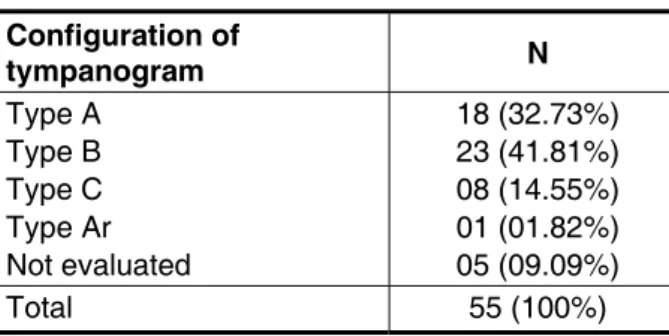
Subjects showed higher incidence of curve type
B in tympanometric coniguration (Chart 4).
Table 3 – Sample distribution according to hearing loss degree
Hearing loss degree N (%)
Mild Moderate Severe
33 (60.00%) 20 (36.36%) 2 (3.64%)
Total 55 (100%)
Table 4 – Sample distribution according to coniguration of tympanogram
Configuration of
tympanogram N
Type A Type B Type C Type Ar Not evaluated
18 (32.73%) 23 (41.81%) 08 (14.55%) 01 (01.82%) 05 (09.09%)
Total 55 (100%)
In ive (9.09%) records were not found results
of tympanometria, as an individual had perfo-rated tympanic membrane, two had undergone a tympanomastoidetomy and two evaluations were not performed due to technical problems with the equipment.
DISCUSSION
After collecting 500 medical records, it was found that 281 (56.20%) subjects showed bilateral normal hearing and 219 (43.8%) hearing loss, in which 164 (32.80%) bilateral, compatible with the literature 15,16.
Unilateral hearing loss had been shown in 55 (11%) subjects, this being a new data concerning patients with CLP.
Regarding demographic distribution as to the gender of the subjetcs, focusing on records that show a unilateral hearing loss, there was an assimi-lation of both for this variable.
Regarding age, prevalence concentrated age 0 to 11 years, what may be due to the fact that nowadays the treatment for cleft lip and palate had been followed by an overall diagnosis, including audiological, what makes hearing loss diagnosable during childhood.
Unilateral trans-foramen cleft was most evident with 47.27% of the population, compatible with several research results, which showed a preva-lence of 70% 17, 47.9% 18 and 66.2% 19 on the
studied samples.
It was shown that unilateral hearing loss incidence was concentrated in the left ear (67.27%)
at odds with a study regarding unilateral hearing loss that was prevalent in the right ear20.
Conductive hearing loss was found in 72.73% of the sample, results aligned to researches with cleft patients 1,21.
Tympanogram type B indicates the presence
of luid in the middle ear, due to inlammation and
presence of secretory otitis media, common among patients with CLP 1. In this research, it was found
that 41.81% of the participants showed this conigu -ration, although, type A tympanograms, indicating normal middle ear function was also found in 32.73% of the population sampled in this work.
Only eight subjects showed type C tympano-metric curve, not typically found in patients with cleft lip and palate22, which shows a highly negative
pressure in the middle ear and may indicate a
transition between a normal ear and an ear illed with luid23.
Regarding the degree of hearing loss, there was prevalence of mild hearing, result similar to a characterization study of the hearing of 119 children from the city of Itajaí / SC, which found higher incidence of mild hearing loss and 63.4% unilateral hearing loss24.
Hearing loss in childhood, even mild, brings
learning dificulties. Children with mild hearing loss
may present problems in language development, reading disabilities and behavioral disorders.
Speech, Language and Hearing Sciences needs studies that contribute to diagnosis of unilateral hearing loss, so there is a proper, early intervention for this type of hearing loss.
It is known that children with CLP show changes in essential abilities to the learning process 21,25,26
such as socialization dificulties, speech changes
and, in some cases, hearing changes due to its own cleft. The consequence usually is the learning failure frequently found in these children.
CONCLUSION
REFERENCES
1. Amaral MIR, Martins JE, Santos MFC. Estudo
da audição em crianças com issura labiopalatina
não-sindrômica. Braz J Otorhinolaryngol. 2010;76(2):164-71.
2. Lemos ICC, Monteiro CZ, Camargo RA, Rissato ACS, Feniman MR. Teste Dicótico de Dígitos (etapa de escuta direcionada) em crianças com
issura labiopalatina. Rev Bras Otorrinolaringol.
2008;74(5):662-7.
3. Spina V, Psillakis JM, Lapa FS, Ferreira
MC. Classiicação das issuras lábio-palatinas: sugestões de modiicação. Rev Hosp Clín Fac Med.
1972;27:5-6.
4. Testa JR, Dimatos SC, Greggio B, Duarte JA. Avaliação de resultados e complicações da cirurgia de colocação de tubos de ventilação em pacientes com otite media serosa. Arq. Int. Otorrinolaringol. 2010;14(1):671-6.
5. Mondain M, Blanchet C, Venail F, Vieu A.
Classiication et traitement des surdités de l’enfant. Oto-rhinolaryngologie (traité). 2005;20:190C-200C. 6. McKay S, Gravel JS, Tharpe AM. Ampliication
considerations for children with minimal or mild bilateral hearing loss and unilateral hearing loss. Trends Amplif. 2008;12:43-54.
7. Vartiainen EA, Karjalainen S. Prevalence and etiology of unilateral ensoryneural hearing
imparirment in innish childhood population. Int J
Pediatr Othorhinolaryngol. 1998;3(2):253-9.
8. Almeida K, Santos TMM. Seleção e adaptação de próteses auditivas em crianças. In: Almeida K, Iorio MCM. Próteses auditivas: fundamentos teóricos e aplicações clínicas. São Paulo: Lovise; 2003.p.357-80.
9. Joint Committee on Infant Hearing. Principles and guidelines for early hearing detection an intervention programs. Pediatrics. 2000;106(4):798-817.
10. Pegoraro-Krook MI, Dutka-Souza JCR, Magalhães LCT, Feniman MR. Intervenção
fonoaudiológica na issura palatina. In: Ferreria LP, Bei-Lopes DM, Limongi SCO, organizadores.
Tratado de Fonoaudiologia. São Paulo: Roca; 2004. p.439-55.
11. Santos TMM, Russo ICP. Interpretação dos
Resultados da avaliação audiológica. In: A Prática
da Audiologia Clínica. 4ª ed. São Paulo, Cortez, 1993. cap.9, p.191-212.
12. World Health Organization. Grades of Hearing Impairment, 2007.
13. Northern JL, Downs MP. O que é perda auditiva.
In: Northern JL, Downs MP. Audição em Crianças. São Paulo, Manole, 1989. cap. 1, p.2-23.
14. Jerger J. Clinical experience with impedance
audiometry. Arch. Otolaringol. 1970;92(4):311-24. 15. Spauwen PH, Ritsma RJ, Huffstadt BJ, Schutte HK, Brown IF. The inferiorly based pharyngoplasty: effects on chronic otitis media with effusion. Cleft Palate J. 1988;25(1):26-32.
16. Piazentin-Penna SHA. Identiicação Auditiva
em Crianças de 3 a 12 meses de idade com Fissura Labiopalatina. [Tese]. Bauru: Hospital de Reabilitação de Anomalias Craniofaciais, Universidade de São Paulo; 2002, 157p.
17. Zambonato TCF, Feniman MR, Blasca WQ,
Lauris JRP, Maximino LP. Peril de usuários de AASI com issura labiopalatina. Braz. j. otorhinolaryngol.
2009; 75(6):888-92.
18. Cymrot M, Dantas SFC, Teixeira FAA, Teixeira JFAA, Teixeira GSB, Cunha FJF et al. Prevalência dos tipos de issura em pacientes com issuras labiopalatinas atendidos em um Hospital Pediátrico RESUMO
Objetivo: investigar a ocorrência da perda auditiva unilateral em indivíduos com issura labiopal -tina. Métodos: estudo retrospectivo com 500 prontuários de pacientes com issura labiopalatina.
Resultados: foram levantados 55 sujeitos com perda auditiva unilateral, 27(49,1%) do gênero mas
-culino e, 28 (50,9%) do gênero feminino, com média de idade de 14,6 anos. Dezoito (32,73%) apre -sentaram perda auditiva na orelha direita e 37(67,27%) na orelha esquerda, 72,73% (40 sujeitos) com perda auditiva do tipo condutiva, 18,18% (10 sujeitos) do tipo neurossensorial e 9,09% (5 sujeitos)
do tipo mista. Quanto ao grau da perda auditiva foi constatada maior ocorrência de perda auditiva de
grau leve. Conclusão: a perda auditiva unilateral foi mais frequente nos indivíduos com faixa etária
de 0 a 11 anos, com igual proporção em gênero. A perda auditiva unilateral pode comprometer aspec -tos sociais e emocionais do sujeito, levando-o a necessitar de uma intervenção apropriada.
23. Combs JT. The diagnosis of otitis media: new techniques. Pediatr Infect Dis J 1994;13:1039-46.
24. Balen AS, Debiasi TF, Pagnossim DF, Broca VS, Roggia SM, Gondim LM. Caracterização da audição de crianças em um estudo de base populacional no município de Itajaí / SC. Intl. Arch. Otorhinolaryngol.2009;13(4):372-80.
25. Henningsson G, Kuehn DP, Sell D, Sweeney T, Trost-Cardamone JE, Whitehill TL, et al. Universal parameters for reporting speech outcomes in individuals with cleft palate. Cleft Palate Craniofac J. 2008;45(1):1-17.
26. Konst EM, Rietveld T, Peters HF, Prahl-Andersen B. Phonological development of toddlers with unilateral cleft lip and palate who were treated with and without infant orthopedics: a randomized clinical trial. Cleft Palate Craniofac J. 2003;40(1):32-9.
do Nordeste brasileiro. Rev. Bras. Cir. Plást.
2010;25(4):648-51.
19. Coutinho ALF, Lima MC, Kitamura MAP,
Ferreira NJ, Pereira RM. Peril epidemiológico dos portadores de issuras orofaciais atendidos em um Centro de Referência do Nordeste do Brasil. Rev.
Bras. Saude Mater. Infant. 2009;9(2):149-56.
20. Toma MMT, Matas CG. Audiometria de
tronco encefálico (abr): o uso do mascaramento
na avaliação de indivíduos portadores de perda auditiva unilateral. Rev. Bras. Otorrinolaringol. 2003;69(3):356-62.
21. Goudy S, Lott D, Canadyj, Smith RJ. Conductive hearing loss and otopathology in cleft palate patients. Otolaryngol Head Neck Surg. 2006;134(6):946-8. 22. Handzic-Cuk J, Cuk V, Gluhinin M, Risavi R,
Stajner-Katusic S. Tym¬panometric indings in cleft palate patients: inluence of age and cleft type. J
Laryngol Otol 2001;115(2):91-6.
Received on: January 17, 2012 Accepted on: March 18, 2012
Mailing address:
Maria Fernanda Capoani Garcia Mondelli
Al. Octávio Pinheiro Brizola 9-75 Vila Universitária
Bauru – SP CEP: 17012-901