Approximation of Small Solutions
M.F. Teodoro1,2
, P.M. Lima2
, N.J. Ford3
and P.M. Lumb3
1 Departamento de Matem´atica, Escola Superior de Tecnologia de Set´ubal, Instituto
Polit´ecnico de Set´ubal, Estefanilha, 2910-761 Set´ubal, Portugal
2 CEMAT, Instituto Superior T´ecnico, Technical University of Lisbon, Av. Rovisco Pais
1, 1049-001 Lisboa, Portugal
3 Department of Mathematics, University of Chester, CH1 4BJ, Chester, UK
emails: [email protected],[email protected], [email protected],[email protected]
Abstract
In the context of physics, economic dynamics, finance, optimal control, biology and other applied sciences, many mathematical models contain mixed type functional dif-ferential equations (MTFDEs), equations with both delayed and advanced arguments. Knowing from the analysis of delay differential equations (DDEs) that the evaluation of small solutions (that decay faster than any exponential) often leads to computa-tional problems (degeneracy), we investigate this subject in the case of MTFDEs. Some computations have been carried out and are presented here, concerning the linear nonau-tonomous case. We continue this work and extend the investigation to other problems.
Key words: Mixed-type functional differential equation, method of steps, small solu-tions, collocation, least squares, finite element method.
MSC 2000: 34K06; 34K10; 34K28; 65Q05
1
Introduction
In the context of physics, economic dynamics, finance, optimal control, biology and other applied sciences, many mathematical models contain forward-backward differential equa-tions, usually denominated mixed type functional differential equations (MTFDEs):
x′
(t) =F(t, x(t), x(t−τ1), . . . , x(t−τn)), (1)
For the problems studied in this work, we focus our attention on computation of solu-tions. We are particularly interested in obtaining the numerical solution of the equations:
x′
(t) =F(t, x(t), x(t−τ), x(t+τ)), τ >0 (2)
Interest in this type of equation is motivated by applications in optimal control [20] [21], economic dynamics [22], nerve conduction [6] and travelling waves in a spatial lattice [1], [19].
Important contributions in such fields have appeared in the literature in the two last decades of past century and it remains an actual subject of research until now.
Concerning the application of MTFDEs to optimal control and economic dynamics, a fundamental contribuition was introduced by Rustichini in 1989 [21]. However, the basis for the application of MTFDEs to optimal control was given earlier by Mischenko and his co-authors [20].
Nowadays, MTFDEs continue to play an important role in analysis and modeling of economic growth. The have been used, for example, by Boucekkine et al. in [5] to study the relation between demographic and economic variables in the vintage capital problem.
In 2009 [2] a system of functional differential equations having leads and lags has been applied by Albis et al. to model the dynamic behaviour of the capital growth in an overlapping-generations model with continous trading and finitely lived agents.
Differential equations with advanced and delayed time arguments may also arise in simple growth models with delays, such as models with investment generations lags proposed by Collard et al [7] in 2004. In this article, the authors proposed and implemented a numerical scheme which combine a Runge-Kutta and a shooting method to solve the short run dynamics of a neoclassical growth model with a simple time to build lag.
Another application of MTFDEs is investigated in [3, 4, 6, 16] where a nonlinear func-tional differential equation with delay and advanced arguments is used to model conduction in a myelinated nerve axon.
Special attention has been paid by many authors to mixed-type functional differential equations of the form
x′
(t) =α(t)x(t) +β(t)x(t−1) +γ(t)x(t+ 1), (3)
where xis the unknown function, α,β and γ are known functions.
solution on a certain real interval [−1, k],k∈N,given its values on the intervals [−1,0] and
(k−1, k]. They concluded that in general the specification of such boundary functions is not sufficient to ensure that a solution can be found. With arbitrary boundary conditions, the problem turns out to be ill-posed. They provided sufficient analytical background on which the numerical scheme could be built. For the case where such a solution exists they introduced a numerical algorithm based on theθ-method to compute it. The same authors of [8] and their colaborators extended this work in [11]. In 2011, Da Silva and Escalante [23] presented a numerical algorithm based on the method of steps and tau method, for the approximation of solutions of BVP equation (3) in the autonomous case.
2
Numerical Experiments
We say that x(t) is a small solution of equation (3) ifft→+∞limx(t)eλt= 0,∀λ∈R+. It is known that the detection and computation of small solutions are important pro-blems when studying DDEs. Such propro-blems have been discussed in [9, 10, 12, 17]. Therefore, we decided to investigate how our method for MTFDEs work in the case of a small solution. We are concerned with the numerical solution of the linear homogeneous nonautonomous equation (3) in the case of a small solution.
The numerical algorithms applied to the solution of this problem, based on the collo-cation method and on the method of steps, were introduced in [24, 14, 25]. In [26, 15] new algorithms were introduced, based on the finite elements and on the least squares methods.
In the present work, the BVP under consideration is defined in Example 2. The choosen boundary value problem (BVP) is defined by equations (4)-(6).
x′
(t) =−2t x(t)−e−2tx(t−1) +e2tx(t+ 1), (4)
with boundary conditions
x(t) =e−t2
, t∈[−1,0]; (5)
x(t) =e−t2
, t∈[k−1, k]. (6)
The exact solution isx(t) =e−t2 .
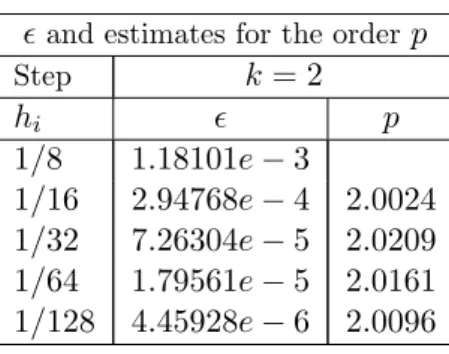
The numerical results of BVP (4)-(6) are presented in Table 1. There is a good agree-ment with the convergence order of the collocation method (k = 2). Similar results are obtained when the least squares and finite element methods are applied. We are still working with larger intervals of estimation (k= 3,4).
Acknowledgements
ǫand estimates for the orderp
Step k= 2
hi ǫ p
1/8 1.18101e−3
1/16 2.94768e−4 2.0024 1/32 7.26304e−5 2.0209 1/64 1.79561e−5 2.0161 1/128 4.45928e−6 2.0096
Table 1: Collocation method. Estimates of errorǫand convergence orderp for the approxi-mate solution ˜x in the case k= 2. ǫ=kx−x˜k∞ (error on [0,1]).
References
[1] K. A. Abell, C. E. Elmer, A. R. Humphries, E. S. Van Vleck, Computation
of mixed type functional differential boundary value problems, SIADS 4, 3 (2005) , 755-781.
[2] H. D’Albis and E. Augeraud-Veron, Competitive Growth in a Life-Cycle Model:
existence and Dynamics, International Review of Economics50 (2009), 459–484.
[3] J. Bell,Behaviour of some models of myelinated axons, IMA Journal of Mathematics Applied in Medicine and Biology1 (1984), 149-167.
[4] J. Bell and C. Cosner,Threshold conditions for a diffusive model of a myelinated axon, Journal of Mathematical Biology 18(1983), 39-52.
[5] R. Boucekkine, D. de La Croix and O. Licandro,Modeling Vintage Structures
with DDEs: Principles and Applications, Mathematical Population Studies11(2004), 151179.
[6] H. Chi, J. Bell and B. Hassard,Numerical solution of a nonlinear advance-delay-differential equation from nerve conduction theory, Journal of Mathematical Biology 24(1986), 583-601.
[7] F. Collard, O. Licandro, L.A. Puch,The short-run dynamics of optimal growth
models with delays, Computing in economics and finance, 117, Society for Computa-tional Economics (2004).
[9] N. J. Ford, P. M. Lumb, Numerical approaches to delay equations with small solu-tions, E. A. Lipitakis(Ed), Proceedings of HERCMA 2001, 1, 101-108.
[10] N. J. Ford, S. M. Verduyn-Lunel, Numerical approximation of delay differential equations with small solutions, Proceedings of 16th IMACS World Congress on Scien-tific Computation, Applied Mathematics and Simulation, Lausanne 2000, paper 173-3, New Brunswick, 2000 (ISBN 3-9522075-1-9).
[11] N. J. Ford, P. M. Lumb, P. M. Lima, M. F. Teodoro, The numerical solution
of forward-backward equations: decomposition and related issues, Journal of Computa-tional and Applied Mathematics, 234 (2010), 9, 2826-2837.
[12] D. Henry, Small solutions of linear autonomous functional differential equations, Journal of Differential Equations 8 (1970), 494-501.
[13] V. Iakovleva and C. Vanegas , On the solution of differential equations with de-layed and advanced arguments, Electronic Journal of Differential Equations, Conference 13 (2005),57-63.
[14] P. M. Lima, M. F. Teodoro, N.J. Ford and P.M. Lumb,Analytical and
Numer-ical Investigation of Mixed Type Functional Differential Equations, Journal of Compu-tational and Applied Mathematics, 234 (2010), 9, 2732-2744.
[15] P. M. Lima, M. F. Teodoro, N. J. Ford and P. M. Lumb, Finite Element
Solu-tion of a Linear Mixed-Type FuncSolu-tional Differential EquaSolu-tion, Numerical Algorithms, 55 (2010), 301-320.
[16] P. M. Lima, M. F. Teodoro, N. J. Ford and P. M. Lumb, Analysis and
Compu-tational Approximation of a Forward-Backward Equation Arising in Nerve Conduction, accepted for publication in Proceedings of the International Conference on Differential & Difference Equations, Azores, 2011.
[17] P. M. Lumb, Delay differential equations: Detection of small solutions, PhD Thesis, University of Liverpool, UK, 2004.
[18] J. Mallet-Paret, The Fredholm alternative for functional differential equations of mixed type, Journal of Dynamics and Differential Equations,11 (1999), 1, 1-47.
[19] J. Mallet-Paret, The Global Structure of Traveling Waves in Spattially Discrete Dynamical Systems, Journal of Dynamics and Differential Equations, 11 (1999), 1, 49-128.
[20] L. S. Pontryagin, R. V.gamkreledze, E. F. Mischenko,The mathematical
[21] A. Rustichini, Functional differential equations of mixed type: The linear au-tonomous case, Journal of Dynamics and Differential Equations1 (1989), 2, 121-143.
[22] A. Rustichini, Hopf bifurcation for functional differential equations of mixed type, Journal of Dynamics and Differential Equations1 (1989), 2, 145-177.
[23] C. da Silva and R. Escalante, Segmented Tau approximation for a
forward-backward functional differential equation, Computers and Mathematics with Appli-cations62 (2011), 4582-4591.
[24] M. F. Teodoro, N. J. Ford, P. M. Lima, and P. M. Lumb, New approach to
the numerical solution of forward-backward equations, Front. Math. China, 4 (2009), 1, 155-168.
[25] M. F. Teodoro, P. M. Lima, N. J. Ford and P. M. Lumb, Numerical modelling of
a functional differential equation with deviating arguments using a collocation method, Proceedings of ICNAAM 2008, International Conference on Numerical Analysis and Applied Mathematics, Kos 2008, AIP Proceedings,1048(2008), 553-557.
[26] M. F. Teodoro, P. M. Lima, N. J. Ford and P.M. Lumb, Numerical
Approxima-tion of Forward-Backward Differential EquaApproxima-tions by a Finite Element Method, Proceed-ings of CMMSE 2009, 9th International Computational and Mathematical Methods in Science and Engineering, Gijon, Spain, 3(2009), 1010-1019, ISBN:978-84-612-9727-6.
[27] J.L. Pons,Wearable Robots: Biomechatronic Exoskeletons, Wiley Blackwell, 2008.
[28] J. E. Sanders, B. S. Goldstein & D. F. Leotta, Skin response to mechanical stress: adaptation rather than breakdown - a literature review, Journal of Rehabilitation Research and Development32214–226 (1995).
[29] G. A. F. Seber, C. J. Wild,Nonlinear Regression, Wiley Blackwell, 1989.
[30] P. Silva, Computational Modelling Of A Wearable Ankle-Foot Orthosis For
Loco-motion Analysis And Comfort Evaluation, PHD Thesis, Department of Mechanical Engineering, Instituto Superior T´ecnico, Universidade T´ecnica de Lisboa, 2012.
[31] P. Silva, A. Monteiro, I. Bernardo, R. Claudio & C. Figueiredo-Pina,