Procedia Computer Science 64 ( 2015 ) 1149 – 1156
1877-0509 © 2015 Published by Elsevier B.V. This is an open access article under the CC BY-NC-ND license (http://creativecommons.org/licenses/by-nc-nd/4.0/).
Peer-review under responsibility of SciKA - Association for Promotion and Dissemination of Scientific Knowledge doi: 10.1016/j.procs.2015.08.593
ScienceDirect
Conference on ENTERprise Information Systems / International Conference on Project
MANagement / Conference on Health and Social Care Information Systems and Technologies,
CENTERIS / ProjMAN / HCist 2015 October 7-9, 2015
The Rare Disease Person’s Card Implementation Strategy In
Portugal
Anabela Santos
a*, Paulo Sá
a, Rui Romão
a, Cristina D’Arrábida
b, Anabela Coelho
b, J.
Alexandre Diniz
b, Henrique Martins
aaPortuguese Ministry of Health, Shared Services (SPMS), Av. João Crisóstomo n.º 9 3º, 1049-062 Lisboa, Portugal bGeneral Directorate of Health (DGS), Alameda D. Afonso Henriques, nº. 45, 1049-005 Lisboa, Portugal
Abstract
The Rare Disease Person’s Card (RDPC) aims to identify and display information regarding rare diseases. It was created through a collaborative work between two major Portuguese heath care stakeholders, namely the Portuguese Ministry of Health Shared Services (SPMS) and Directorate General of Health (DGS), following EU resolutions. The card aims to identify the patient and the rare disease, as well as to display a text explaining the special needs in emergency situations. The disease is coded through the ORPHA code system. RDPC was implemented through the Health Data SharingPlatform. There are three distinct circuit phases in RDPC: requisition, activation and release. Patients use the Patient Portal in order to activate the card. Until March 16 2015, there were 828 cards requested regarding 738 different rare diseases. About 51% of requests were still waiting activation by patients. 16% of activated cards were awaiting approval and printing by the coordinator physician. 33% were sent to patient’s
address, thereby completing the RDPC circle. The card is increasing awareness and empowerment of rare disease’s patients,
pushing forward the project and improving Health care.
© 2015 The Authors. Published by Elsevier B.V.
Peer-review under responsibility of SciKA - Association for Promotion and Dissemination of Scientific Knowledge.
Keywords:Rare disease; Rare Disease Person’s Card; ORPHA code; Health Data Sharing Platform; Patient Portal; Information Technologies.
* Corresponding author.
E-mail address: [email protected]
© 2015 Published by Elsevier B.V. This is an open access article under the CC BY-NC-ND license (http://creativecommons.org/licenses/by-nc-nd/4.0/).
1. Introduction
Rare diseases in the European Union (EU) are defined as diseases that have a prevalence of no more than 5:100001. There is an estimated total number of 27 to 36 million people affected across Europe, scattered between 5000 to 8000 different diseases. Most of these patients are suffering from the “rarest between the rarest”, turning them isolated and vulnerable.
For the EU, rare diseases are a fundamental priority of health policy. In 2008, the EU Commission adopted a "Communication on rare diseases: Europe's challenges"2 defining a global strategy to support member states in the diagnosis, treatment and care of EU citizens with rare diseases.
The Integrated Strategy for Rare Diseases 2015-20203 aims to ensure that priorities are refocused in a global approach to rare diseases, bringing together the contributions and skills of all relevant health care stakeholders in order to cause a real change in the patient’s quality of life.
In Portugal, Rare Diseases affect about 6% to 8% of the population, with an estimated number of five thousand carriers of these pathologies. Most rare diseases can have a severe and disabling clinical expression with early appearance before 2 years of age, involving multiple disabilities (physical disabilities, sensory or intellectual). The prognosis is poor in most cases, leading to 35% of deaths in children less than 1 year of age3.
In accordance with these data, the Portuguese Ministry of Health approved “The National Program for Rare Diseases” in 2008. The major goal was to promote the quality and equity of health care to patients and families. In 2009, the Portuguese Parliament Resolution No. 34/2009 was approved, which allowed the Rare Disease Person’s Card (RDPC) development.
In 2013, following these policies, the General Directorate of Health (DGS) and the Portuguese Ministry of Health Shared Services (SPMS) developed the project.4
This article aims to describe the RDPC project, focusing in the major challenges involving the implementation in the Portuguese (PT) health information technology systems, but highlighting the advantages for rare disease’s patients and their families.
Semantics
Rare disorders are scarcely represented in international classifications and therefore invisible in information systems. One of the major needs in health information systems and for research, is to share and integrate data coming from heterogeneous sources with diverse reference terminologies.
The process of coding a rare disease can facilitate the process of identifying and diagnosing rare diseases, so health professionals and care givers can access it in an easier and faster way. On the other hand, this allows keeping a track of every patient and disease, so no one gets lost in the system.
ORPHANET5 is a multilingual information portal on rare diseases and orphan drugs. Orphanet information system is supported by a relational database built around the concept of rare disorders. Representation of rare diseases in Orphanet encompasses levels of increasing complexity: lexical (multilingual terminology), nosological (hierarchical classifications), relational (annotations epidemiological data, manifestations, and orphan drugs-integrated in a relational database), and interoperational (semantic interoperability).
Rare disorders are mapped to International Classification of Diseases (10th version), SNOMED CT, MeSH, MedDRA, and UMLS. Genes are cross-referenced with HGNC, UniProt, OMIM, and Genatlas. The Orphanet nomenclature is at the crossroads of scientific data repositories and of clinical terminology standards, and is suitable to be used as a standard terminology.
SNOMED CT (Systematized Nomenclature of Medicine Clinical Terms), owned by the IHTSDO (International Health Terminology Standards Organization), contains about 3000 codes and the International Classification of Diseases (ICD), in its 10th Revision (ICD-10), contains about 500 rare disease codes.
The data retrieved can be used for statistical, epidemiological purposes and for planning and reimbursement. The movement of patients across borders to get a specialized treatment, is also facilitated by the emission of an International and widely adopted code system.
2. Portuguese Rare Disease Person’s Card (RDPC)
The Portuguese Parliament Resolution No. 34/2009 was approved and published to promote the creation of Rare Disease Person’s Card (RDPC)- in Portuguese, “Cartão da Pessoa com Doença Rara (CPDR)”. In 2013, following these policies, the Quality Department of General Directorate of Health (DGS) and the Portuguese Ministry of Health Shared Services (SPMS) developed the project4. Figure 1 show how the card looks like.
Fig. 1. Rare Disease Person’s Card (RDPC).
The RDPC “exists” in both a printed, as well as, and more importantly, a digital form. The printable physical form allows patients to carry it with them, The digital form allows reprint via Patient Portal as well as it makes it available online, through the different Portals of the Portuguese Health Data Sharing Platform, so called Plataforma de Dados da Saúde (PDS). This makes it available in all computers in the entire NHS (Continental Portugal and islands) as well as private physicians regardless of public or private Healthcare Provision Facilities.
The RDPC is divided in two main parts:
1. Identification: patient’s name, health unit, attending physician and the disease’s name with the correspondent ORPHA code.
2. Clinical guidelines in emergent or urgent situations.
Governance model
The circuit of the Rare Disease Person’s Card (RDPC) has different key players and is managed and regulated by DGS.
The patient is the RDPC owner and is responsible for the activation and consent to the physician´s access to RDPC. After the reception of the card, the patient can present in any health institution for a most appropriate
treatment. In case of a card’s lost, the patient may request a duplicate, in the patient portal.
The health units are responsible for RDPC local monitoring, as well as for printing RDPC and send it to patient´s address. A coordinator physician must be nominated and a technical team appointedfor rare disease’s registration.
The coordinator physician is responsible for the management of the clinical staff, and releases the requested
cards that were previously activated by patients. After the patient’s consent, the digital version of RDPC can be consulted by physicians and nurses through the professional portal.
Three phases of RDPC (requirement, activation and emission)
The diagram in Figure 2, describes the inherent circuit of the RDPC emission’s process:
1. RDPC request can be made in the following cases: a. The patient asks RDPC to the physician
b. The physician suggests the patient to emit a RDPC
2. After the physician’s register, he must print the document and deliver it to the patient
3. The document contains a key that should be used in the Patient Portal by the user, to activate and consent the RDPC emission
4. The physician coordinator, through the Institutional Portal, can access the list of activated cards so to print them and send them to patient’s address.
5. DGS monitorizes and analyzes the RDPC circuit, using statistics available in the Institutional Portal 6. DGS can provide information on rare diseases to other stakeholders: patient support associations, rare
disease’s people organizations, the EU commission and the Portuguese Government.
Rare disease detection
physician coordinator of rare diseases 1
2
3 4
5 6
Fig. 2. RDPC circuit.
Health Data Sharing Platform
In 2011, when a national health data sharing platform, named PDS (eHealth Data Sharing Platform/ Plataforma de Dados da Saúde), was designed, there was no central repository for clinical information and the systems used by the institutions were very different among themselves.
Therefore, neither physicians nor nurses could access information regarding patients beyond their institutions. In emergency situations, a full check of the past medical problems had to be performed; no information was shared between institutions. PDS aimed to solve the data sharing problem between institutions, patients and physicians, and with only one year to be developed, tested and implemented.
Table 1. PDS Portals.
Patient Portal
Official launch: May 2012
Scope: Personal Health Record area that offers online informative and electronic services to the citizens. It aims to strengthen the relationship between patients and the PT NHS, as well as, to promote self-care management.
Professional Portal
Official launch: July 2012
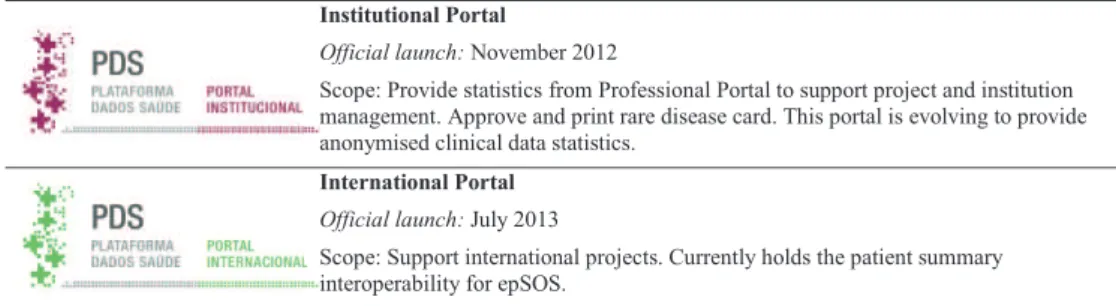
Institutional Portal
Official launch: November 2012
Scope: Provide statistics from Professional Portal to support project and institution management. Approve and print rare disease card. This portal is evolving to provide anonymised clinical data statistics.
International Portal
Official launch: July 2013
Scope: Support international projects. Currently holds the patient summary interoperability for epSOS.
Following the international trend, the Portuguese healthcare system is evolving into a patient-centred approach. PDS is based on this approach: data sharing can be managed and controlled by the patient on the Patient Portal and the patient can also audit the professionals that accessed his or her information.
It is important to note that patients and professionals use different portals. The Patient Portal allows patients to manage, audit and control healthcare professionals that accessed their information through the Professional Portal.
Currently, the Patient Portal has almost 1 million citizens registered and an average of 9.000 visits per day. Regarding the Professional Portal, it has been visualized by more than 45.000 professionals, integrates around 600 sources of information and accounts for an average of 30.000 daily views.
More than two million patients’ processes have already been accessed through the Professional Portal, with the
distribution of accesses presented in Figure 3.
PDS continues to address big changes in healthcare, primarily on first time patient’s visits where prior information is of utmost importance.
Fig. 3. Professional Portal visits per type of episode.
3. Related Work
Rare diseases are a group of entities characterized by a low prevalence, affecting less than 1 in 2,000 people; 5000 to 7000 rare diseases have been currently identified in Europe. Also, most diseases do not have any curative treatment7.They represent thus an important public health concern.
There are some specific features of rare diseases that turn the registration of patients additionally challenging, and constitute the prime reason for cross-border collaboration in registration.
Most Rare Diseases (RD) are genetic in origin and a large proportion of them are familial, which implies that family related cases have to be traceable.8
The scarcity of cases imposes a large geographical coverage of data collection, which implies multiple collaborations and exchanges of data, usually transnationally. Also, the cost of establishing and maintaining a
patient’s registry is nearly equal for a prevalent disease as it is for a rare disease, although budgets are more difficult
to obtain for the latter.
The European Community proposed solutions to address these challenges, namely the establishment of an European Platform on Rare Disease Registration, providing common services and tools for existing and future rare disease registries in the European Union. The establishment of a system of European Reference Networks, and
3.703 4.925 23.921
288.008 458.636 466.291
1.509.908
3.594.304
registries for rare diseases (RDs) is based on shared criteria, and the 'Building Consensus and Synergies for the EU Registration of RD Patients in Europe constitutes the EPIRARE project8.
Across Europe, France and Germany developed already tools that suit their own needs. In particular, the French database of rare diseases has built the application LORD9 (Linking Open data for Rare Diseases), an online database, and has a Rare Disease Card similar to the Portuguese RDPC10. The German Institute for Medical documentation is building an integrated solution to align the ORPHA codes with ICD10 German version.
4. Portuguese achievements
The implementation of the RDPC project is underway and currently covers 8 of the 52 hospitals of the PT National Health System (NHS).
Pilot and Roll Out
In early 2014, six hospitals joined the pilot phase together with 69 physicians. There was a focus on Pediatrics, however doctors of other specialties could request the card for other age groups. In July, DGS published a Clinical Guideline regarding implementation of the RDPC4.
The rollout phase began at the end of 2014, with two more hospitals involved and an increased number of doctors involved, with a total of 182 involved. The institutions updated and improved the emergency care procedures and updated the text introduced in the card, aiming to provide better health care to these patients.
There is a number of initiatives to promote awareness and adoption of the card, namely through the patient portal. Nowadays, an informative leaflet is being developed by DGS to be available at a national level
There is an increasing effort going on for the extension to more patients, doctor, and institutions, as well as other age groups, focusing in the most severe rare diseases.
Monitoring and Evaluation
The monitoring of the project was made through initial training action, email and regular meetings with the doctors involved and partners of Shared Services of the Ministry of Health (SPMS).
Fig. 4. RDPC status in Portugal.
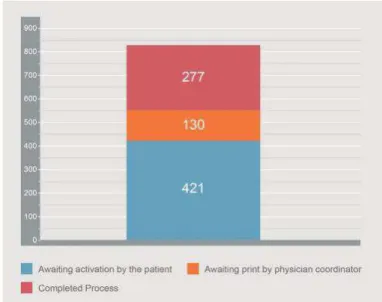
The RDPC circuit consists of three mains steps (Figure 4), with the following results:
x 51% of requests are still awaiting activation by the patient. On average, this step takes about 31 days. x 16% of activated cards are still awaiting approval and printing by the physician coordinator.
x More than 1/3 of the required cards (33%) have been sent to the patient in this way the completed circuit. There are three diseases that have a higher prevalence of RDPC requests, in Portugal.
Table 2. Top 3 rare diseases.
Rare Disease Total requests
ORPHA716 – Phenylketonuria 8,6 % ORPHA586 – Cystic fibrosis 7,9 % ORPHA85447 – Familial amyloid polyneuropathy 5,1 %
Phenylketonuria12 (PKU) is commonly included in the new born screening panel of most countries, with varied detection techniques. Most babies in developed countries are screened for PKU soon after birth. This renders PKU one of the most recognizable rare diseases in the all world.
Cystic Fibrosis13 is a genetic disorder that affects mostly the lungs but also the pancreas, liver, kidneys and intestine. Lung infections are responsible for 80% of deaths. It affects most commonly people of Northern European ancestry and affects about one out of every three thousand new-borns.
Familial Amyloid Polyneuropathy14 (FAP) is a sensory, motor, and autonomic late onset neuropathy inherited in an autosomal dominant mode, first described by Andrade in Portugal. The observation in 1939 of a patient with "a peculiar form of neuropathy" from the coastal area of Póvoa de Varzim (some 30 km north of Porto) was followed in subsequent years by the ascertainment of similar cases which provided the basis for Andrade's recognition of this disease as a new clinical entity.
5. Conclusions
The Portuguese Rare Disease Person Card is aligned with the strategies regarding rare diseases in the EU. The project has started in early 2014, and so the results are still in a small scale.
the number of professionals and institutions involved is another major goal.
In the future, an Alerting System will be available in the clinical IT solutions, so any health care professional can immediately realize that the patient has a rare disease.
Despite such encouraging progress, there is still a long way to go to ensure that people suffering from a rare disease can obtain the right diagnosis at the right time, and the best possible treatment throughout the EU.
We strongly believe that RDPC is increasing awareness and empowerment of rare disease’s patients, pushing forward the project, and increasing Health care.
References
[1] Council Recommendation of 8 June 2009 on an action in the field of rare diseases, (2009/C 151/02), Official Journal of the European Union. [2] Implementation report on the Commission Communication on Rare Diseases: Europe's challenges [COM (2008) 679 final] and Council Recommendation of 8 June 2009 on an action in the field of rare diseases (2009/C 151/02).
[3] The Integrated Strategy for Rare Diseases 2015-2020, Order no. 2129-B/2015 – Official Journal of Portugal, 2nd series – no.41 - February 27, 2015.
[4] Rare Disease Person Card, General Directorate of Health - Norm no. 008/2014 - July 21, 2012.
[5] Hum Mutat. 2012 May;33(5):803-8. doi: 10.1002/humu.22078. Epub 2012 Apr 6.Representation of rare diseases in health information systems: the Orphanet approach to serve a wide range of end users.Rath A1, Olry A, Dhombres F, Brandt MM, Urbero B, Ayme S.
[6] EUCERD Core Recommendations on Rare Disease Patient Registration and Data Collection – June 5, 2013.
[7] Landais P1, Messiaen C, Rath A. et al. CEMARA an information system for rare diseases. Stud Health Technol Inform. 2010;160 (Pt 1):481-5.
[8] Proposed Aims, Scope, Governance and Sustainability options for a European Platform for Rare Disease Registries EPIRARE WP5: Anna Kole, Monica Ensini, Yann le Cam. EURORDIS - European Organisation for Rare Diseases (Paris, FR). [Online] Available from: http://www.epirare.eu/_down/del/D5_DevelopingaEuropeanPlatformforRareDiseaseRegistries%20FINAL.pdf. [Accessed: 3thJuly2015]. [9] “Does Your Rare Disease Have aCode?” – Eva Bearryman, EURORDIS Rare Diseases Europe - February 03, 2015.
[10] Emergency Guidelines and Emergency Cards – Véronique Faucounneau, Ana Rath, ECRD 2014 – Berlin, 10 May 2014. [11] Rare Disease Person Card 2014 Report – Health Quality Department of General Directorate of Health - January 2015.
[12] Williams RA, Mamotte CD, Burnett JR. Phenylketonuria: an inborn error of phenylalanine metabolism. Clin Biochem Rev. Feb 2008; 29(1). [13] Brooks M. FDA OKs Expanded Use of Ivacaftor (Kalydeco) in Cystic Fibrosis. Medscape Medical News. Available at http://www.medscape.com/viewarticle/821097. Accessed March 26, 2015.